Archive | Architecture RSS feed for this section

Things to do in Roma

11 Feb
I am frequently asked for ideas on what to do in Roma. After all, we have people house-and-cat-sitting all the time, often for 2 or 3 weeks. And living here, we certainly have to get beyond the usual suspects.
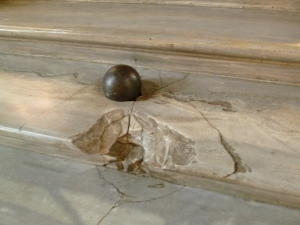
Embedded in the steps of the Great Hall of Galleria Colonna, this cannon ball dates back to the Risorgimento.

Embedded in the steps of the Great Hall of Galleria Colonna, this cannon ball dates back to the Risorgimento.

Everyone knows the Colosseum and Vatican, and probably the Galleria Borghese. While these should not be missed, there are many other lesser-known sights to consider. You might also enjoy reading my blog on the subject of off-the-beaten-track ideas.

Palazzi, museums, events, and exhibits

From April-November 12, 2017, there are once again special events in the Forums, a guided walk through Caesar’s Forum at night, and a multi-media show in the Forum of Augustus. You can find info at Viaggio nei fori. There’s nothing like a lovely outing after dark on a warm summer night. Take a break during the heat and head out after an early dinner for these events. I would do both, if not necessarily on the same night. If you have trouble reserving online, do not hesitate to call. They speak English.
Domus Romane at Palazzo Valentini is not the usual Roman ruin. Everyone we send here says it is one of the best things they did in Roma. Beneath a government building in the center of Roma, just off Piazza Venezia, are the excavated ruins of a Roman palazzo. You walk across a Plexiglas floor to view them, enhanced with a multimedia presentation to illustrate what things looked like 2000 years ago. Only three English tours daily so be sure to reserve online in advance.
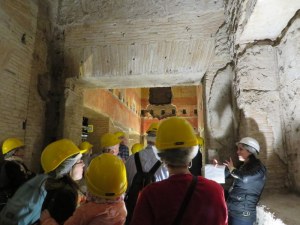
Hard-hat tour of Nero's

Hard-hat tour of Nero’s “Golden House,” the Domus Aurea.

Domus Aurea, Nero’s Golden Palace. Who can resist? It is legendary, although the goldenness is long gone. The restoration project is ambitious given the size. Visit the website and click on “Opening Hours.” Be aware, it is cold underground and even in summer you’ll need a jacket!
We went to Villa Torlonia a couple of years ago on a sunny February Sunday and enjoyed it very much. Recent guests told us that more has been done and one can even visit Mussolini’s bunker from WWII. The entrance fee to see all of the buildings is a little expensive, IMHO, but worth seeing for architecture buffs. La Casina della Civette is quite unique.  The Mussolini Bunker is priced separately from the main buildings.
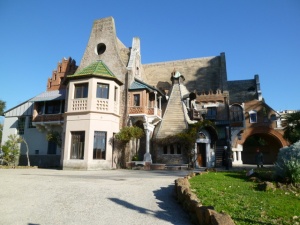
Villa Torlonia

La Casina delle Civette at Villa Torlonia, a curious mix of styles.

Galleria Colonna  is only open on Saturday mornings with an English tour at noon. We went early and had a wander around, then took the tour. Lovely private collection in an amazing building. The Colonnas are an ancient Roman family and members still live in the palazzo in private apartments. We have not been to the Princess’ Apartments, but British friends said they were great, so we need to go back.
Palazzo Farnese, the French Embassy to Italy. This is an historic building with Michelangelo’s art and frescoes worth straining your neck to see. English tours only on Wednesday at 17:00 and you must reserve a few weeks in advance for security reasons.
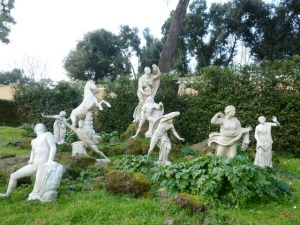
Villa Medici

Niobe suffers from hubris and loses al of her children. Gardens of Villa Medici.

Villa Medici, the French Art Academy in Roma. Open Tue-Sun with English tours three times each day. You will see what the gardens of a Renaissance Roman villa night have looked like.
The Palazzo delle Esposizioni has special art exhibits that are usually worthwhile. Recently we saw French Impressionists from the Phillips Collection in Washington, D.C. Very busy Sundays when Roman families seem to flock to museums. 
Palazzo Braschi Museo di Roma near Piazza Navona is an under-visited, very tranquil museum. Cool on a warm day and certainly a respite from the rain should that occur. Featuring art depicting Roma in days gone by.
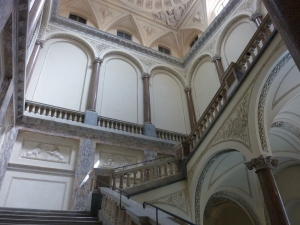
The massive staircase at Palazzo Braschi was like an Escher painting.

The massive staircase at Palazzo Braschi is like an Escher painting.

Galleria Doria Pamphilj in the historic center is also under-appreciated. It is yet another private collection in the old family digs. The collection includes Bernini, Caravaggio, Tiziano, Raffaello, and several Flemish Old Masters. The audio guide is excellent.
The Quirinale, the President’s Palace. Only recently opened for regular tours, thanks to President Sergio Matterella. Previously it was the Papal Palace (pre-Vatican days) and also housed four kings of Italy. Like visiting the White House, but security is less stringent and it’s fancier.
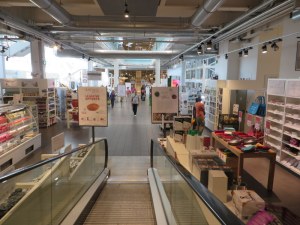
Riding the moving ramp down at Eataly. This is a huge place, built in what was an abandoned air terminal.

Riding the moving ramp down at Eataly. This is a huge place, built in what was an abandoned air terminal.

Eataly has two locations, a small one in Piazza della Repubblica, and the Mother Ship near Stazione Ostiense. I believe the larger store is worth the trip. Easy to stop on your way home from Ostia Antica (see below) with many choices for lunch. Eataly features Italian-made food products and a few non-food items. It is a showcase for all good things in the Italian food culture. Getting there once you reach Stazione Ostiense is a bit interesting, as I mentioned in my blog. You must persevere!
Looking to leave the crowds behind? Villa Farnesina is hidden away in Trastevere. Commissioned during the Renaissance by Agostino Chigi, a Sienese banker, it contains frescoes by Raphael and is lightly attended. 
Churches worth seeing: Santa Maria Sopra Minerva, St. Ignazio, San Clemente (the famous layered church), San Giovanni in Laterano, St. Paul’s Outside the Walls, Santa Maria Maggiore, Santa Prassede, San Luigi dei Francesi (the seat of the French Catholic Church in Rome) and others too numerous to mention. 
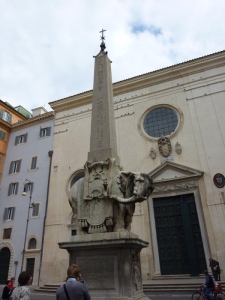
Bernini's elephant obelisk, Santa Maria Sopra Minerva.

Bernini’s elephant obelisk, Santa Maria Sopra Minerva.

Guided Tours

There are two places we highly recommend guided tours: The Vatican and The Colosseo/Foro Romano/Palatino.
Walks of Italy  does a special tour of the Vatican Museums and St. Peter’s, “The Pristine Sistine.” I highly recommend it. It is not inexpensive, but the groups are small (only 12 people), the guides are educational and entertaining, and you get to the Sistine Chapel before it is a hot mess of people.
For the sites of Ancient Rome, the Colosseo/Foro Romano/Palatino, a private guide is a great idea. For about €50-55 per hour, you get a personalized experience. Sonia Tavoletta (soniatavoletta63@gmail.com) and Francesca Caruso (francescainroma@gmail.com) are excellent. They will customize anything you want. If you have four-or-more people in your party, this is less expensive on a per person basis than many organized tours. 

Day Trips
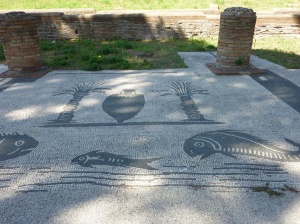
Ostia Antica. In the

Ostia Antica. In the “Piazzale delle Corporazioni” or Square of the Guilds. Mosaics depict services and products.

Ostia Antica is less than an hour away from Roma by local train out of Stazione Ostiense. What the volcano did at Pompeii, time and the river did to Ostia Antica. These are actually well-preserved for Roman ruins, and I find the Rick Steves’ audio guide (MP3 available at his website) and the guide in his book are excellent for self-touring.
Orvieto is a one-hour train ride from Roma Stazione Termini and a fascinating Umbrian hill town. There is a nifty funicular that glides up from the train station to the plateau. Great place to wander, see the Duomo, have lunch, shop a little. Again, I have to turn to Rick Steves and encourage you to consult his guide to make good use of your time. The underground tour is worthwhile!
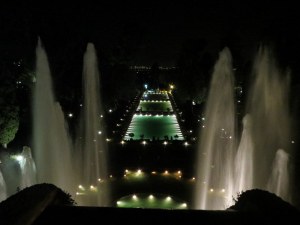
Fountains and pools of Villa d’Este, beautiful during the day, take on added drama at night.

Fountains and pools of Villa d’Este, beautiful during the day, take on added drama at night.

Tivoli is about an hour by train from Stazione Tiburtina and an excellent trip any time of the year. We’ve gone in August for the evening light displays at Villa d’Este, which makes a wonderful one-night trip (see my prior post here). We’ve gone to Villa d’Este in September and April as well, and to Hadrian’s Villa (Villa Adriano) in May one year. Villa d’Este is easily done by train, but I would suggest having a car to try to go to Villa Adriano. Alternatively, take a bus tour from Roma. (Haven’t done this myself but there are options through many tour companies if you care to research it.) I think Villa Adriano would be best with a guide. It’s vast and a bit confusing.
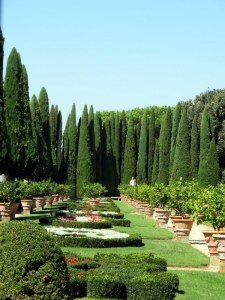
Formal gardens, Lazio Albano, the Papal Gardens

Formal gardens, Albano Laziale, papal estate.

Castel Gandolfo and the Papal Palace. The Apostolic Palace is where the popes up until Papa Francesco went to relax and escape the heat of Roma. Papa F doesn’t relax and eschews the trappings of papal wealth. Bravo! Thus, one can visit the palace almost any old time. Castel Gandolfo is a lovely little town with good restaurants in addition to the fantastic Papal Palace. It would be hard to combine with my next suggestion because the gardens one visits in the Vatican by Train tour are actually in neighboring Albano Laziale, but if you enlist a taxi and make lunch a quick panino you just might manage to do both in a day. 
The Vatican by Train  is an all-day event. You start with about 90 minutes to tour the Vatican Museums. (It is not enough time for the entire museum so you must pick a facet, a corner, and see what you can. We chose the Pinacoteca, which we had to ourselves for most of an hour.) Then you have a walking tour of the Vatican Gardens, which leads you to the San Pietro train station where you catch your private train to Albano Laziale and a tour of the papal estate there. You ride a train through these gardens as well. An audio guide is provided.
There are many other possibilities: Sperlonga for the beach, Frascati just because (porchetta and local Frascati wine), Tarquinia for the Etruscan museum and tombs (stunning!)…. 

Miscellany

10 Things you can do for Free in Rome from Italy magazine.
Coop Culture is the official ticket site for many Italian sites. Check them before using a consolidator, who will add on fees.  If you are going to the Colosseo without a guided tour, get your skip-the-line tickets from Coop Culture.
The Roma Pass can be worthwhile if you do the Colosseo, et.al., one day and the Galleria Borghese the next, making those your first two entries with the pass. Otherwise, forget it.
Transportation tickets/passes. You can buy tickets for single trips for €1.50 at any edicola (newsstand) or tabaccheria (tobacconist). There are also passes for 24, 48 and 72 hours at €7.00, €12.50, and €18.00 respectively, which are usually available at the edicola or tabaccheria. A 7-day pass is €24.00. Details at ATAC.com. Note that few buses sell tickets on board. Buy before you board and validate or risk a huge fine. 
Transit Trip Planning is available here. If you are traveling with a smartphone, download ProBus, AutoBusRoma, or Moovit. You can research bus routes and get an estimate on when the next bus will arrive.
The books 24 Great Walks of Rome, Rome the Second Time, and 111 Things to Do in Rome are great for inspiration! I found all of them either at Amazon.com or Powells.com.
Movies in English are shown every week. Usually, they are posted on Friday for movies from Saturday through the following Wednesday. Check here for what’s on. Some of the theatres do not sell popcorn or anything else to eat or drink, so eat before you go.
Now you see why they say Roma una vita non basta! (Rome – a lifetime is not enough!)
If you have a favorite place I haven’t mentioned, please leave a comment.

Of castles and kings

29 Jan
Palazzo Reale, the royal residence in the heart of Torino at Piazza Castello.

Palazzo Reale, the royal residence in the heart of Torino at Piazza Castello.

Americans do not usually visit Torino (Turin in English), yet it is a remarkable city that deserves a closer look. We first visited in 2014. That year as a birthday gift for Ric, my train-a-holic spouse, I found the longest trip one could make in a high-speed Frecciarossa train from Roma: a little over 4 hours to Torino. As the ride was the objective, we only stayed one night (see “Motown Italy”). What a mistake. We decided to correct that.
Torinese architecture, the Museum of the Risorgimento in Palazzo Carignano, one of the Savoy Palaces.

Torinese architecture, the Museum of the Risorgimento in Palazzo Carignano, one of the Savoy Palaces.

Setting our sights on getting to know the area and seeing some of the museums as well as palaces of the Savoia, we slipped away this week for 3 nights. The charming B&B A Casa di Giò was our home. Here we found a quiet refuge, incredible hosts and, reinforcing my impression that Americans do not stop in Torino, we were the first American guests to stay in their home. Located near Piazza Castello, the heart of Torino, A Casa di Giò was perfectly located to explore the city on foot.
A typical porticoed street makes for nice shopping, protection from heat or rain.

A typical porticoed street makes for nice shopping, protection from heat or rain.

Torino is pedestrian friendly to a fault. Not once did a motorino creep up my backside as they do in Roma, and drivers actually yielded to pedestrians in the crosswalks. Lovely wide sidewalks under substantial porticos reminded us of Bologna, last winter’s city trip. The wide piazzas and generous parks combined with tree-lined boulevards reminded us a bit of Paris. No wonder! Napoleon’s occupation of the Piemonte resulted in a legacy that left the city of Torino with some of these grand public places.
Apericena is a thing in Torino as well as Milano. Buy a glass of good wine for €7.00 and you get a plate of savories at Mulassano. Stop a few places and you've had cena, Italian for dinner.

Apericena is a thing in Torino as well as Milano. Buy a glass of very good wine for €7.00 and you get a plate of savories at Mulassano. Stop a few places and you’ve had cena, Italian for dinner.

Who goes to Torino? It is very much on the radar of Italians and other Europeans. There’s a vibrant opera and the Piemonte region is also the home turf of the Savoys, Italian royalty that spawned several kings of the newly unified Italy in the 19th century. The patrimony of modern Italy is here. Castles and kings indeed!
La Mole Antonelliana. We tried to ascend, but were foiled by a Japanese film crew that had taken it over for a shoot.

La Mole Antonelliana. We tried to ascend, but were foiled by a Japanese film crew that had taken it over for a shoot.

La Venaria Reale is the Versailles of Torino. It is much easier to get to than Versailles, and far less crowded. We thought we would pass a couple of hours here. We could have spent much of the day! As the vast gardens were in hibernation, we chose to skip them and return sometime on a sunny spring day.
A sprawling estate dating to the 17th century, La Venaria was built as a hunting lodge. In its heyday, the stables housed hundreds of horses and dozens of hunting dogs. The estate has had a history of construction, destruction, additions and renovations so extensive that it is difficult to believe anyone had time to live here. Unfortunately, during the Napoleonic domination, the structures were turned into barracks and the gardens used for military training. The Italian military continued this tradition until 1978, after which it was ransacked to the degree that neither doors nor windows remained. We saw pictures of what a train wreck the property was just a couple of decades ago. Fortunately, those interested in preserving Italian history embarked on a restoration project and since 2007 it has been open to visitors.
This is how crowded La Venaria was.... Most of the people here are the same Japanese film crew we encountered at La Mole.

This is how crowded La Venaria was…. Most of the people here are the same Japanese film crew we encountered at La Mole.

I had some familiarity with the House of Savoy due to my work as a docent at the U.S. Embassy. The main palazzo at the embassy is called Palazzo Margherita as Queen Margherita of Savoy live in it for 20 years. This family has deep roots. Dukes and Counts, Marquis and Marquesses, not to mention Kings of Sardegna, Sicily, and Italy, this family dates back to 1003.
Ceiling detail, La Venaria Reale.

Ceiling detail, La Venaria Reale.

La Venaria is only one of many luxurious palaces ringing the city of Torino built, as the website states to create a refined “Crown of Delights” around the capital, as a demonstration of the magnificence of the House of Savoy. It is good to be the king.
A little something from the Egyptian Museum. Many of the artifacts were transported across the mountains from Genova in military wagons pulled by horses, 19th century style.

A little something from the Egyptian Museum. Many of the artifacts were transported across the mountains from Genova in military wagons pulled by horses, 19th-century style.

While we did not get to see any other palaces or castles from the interior (I can only handle so much majesty in a day), many are in use for other purposes, such as the Museum of the Risorgimento at Palazzo Carignano, and the Municipal Museum of Ancient Art in Palazzo Madama. This website has links to information about all of the Royal Residences.
We did manage to fit in a visit to the impressive Egyptian Museum, the second most important in the world for Egyptology enthusiasts (only the museum in Cairo is considered more important). A five-year renovation was completed less than a year ago, and the result is a well-curated, open, light, and engaging museum. Why is the second-largest collection of Egyptian artifacts in Torino? It all started with a purchase by a Savoy King, Carlo Emanuele I in 1630…. Castles and kings indeed.


Out and about

5 Dec
So what do we do every day here in Roma? Surely every day cannot be like a vacation. We have to run errands, do laundry, go to the doctor, clean the cat box, drink wine and exercise, just like people everywhere.  But one of the things we do is intersperse the mundane with field trips. We might go to a museum with a special exhibit, to a movie (in English with reserved seats), or revisit a site we saw a few years ago. Such was the case yesterday.
San Giovanni in Laterano's magnificent facade only dates to the 18th century.

San Giovanni in Laterano’s magnificent facade only dates to the 18th century.

We headed out into weak December sun to return to San Giovanni in Laterano, one of the four Papal Basilicas. We last visited in October 2010, so it was about time. 
San Giovanni was the first Christian church established in Roma, by Emperor Constantine in 318 A.D., and it is the home church of the Bishop of Rome, Papa Francesco. In fact, it was the home of all popes until the renovation of St. Peter’s and the expansion of the Vatican during the Renaissance. It is not Italy, it is part of the Vatican State.
Internal view with the Naval service in progress.

Internal view with the Naval service in progress.

On arrival at this magnificent basilica, we found it thronged with military personnel, primarily from the Italian Navy. They were commemorating their patron saint, Santa Barbara. In the U.S., if this were a military event at say the National Cathedral in Washington, D.C., it is unlikely we would have been allowed to wander in and play tourist. But this is Italy, with no separation of church and state by the way, and the only price to entry was having a Carabinieri officer look in my purse to ensure I was not carrying anything explosive.
Renaissance ceiling of the basilica. Stunning!

Renaissance ceiling of the basilica. Stunning!

Instead of an empty church with tourists wandering through, we were fortunate to observe the basilica being used for its intended purpose, a service. Here is a link in Italian about the observance. On land and sea, the Italian Navy celebrated Santa Barbara yesterday, inviting their colleagues from the army, Carabinieri, Vigili del Fuoco (firefighters), and others who share the patron saint. There was an orchestra and chorus that opened the service with a captivating rendition of Handel’s “Thine is the Glory,” sung in Italian. I can only assume that is a piece with some tradition and meaning for the Italian Navy.
Close up of the doors, originally from the Curia. The acorn "studs" date to the 3rd century.

Close up of the doors, originally from the Curia. The acorn “studs” date to the 3rd century.

Though little remains of Constantine’s original church (mostly rebuilt after 1600), the art and architecture are definitely worth a visit. There are massive bronze doors from the ancient Roman Curia (Senate House), moved here in the 17th century, and the golden columns from the Temple of Jupiter which used to stand on the Capitoline Hill. The enormous statues of the 12 apostles stand guard over the nave with a fabulous Renaissance ceiling overhead.
Columns from the Temple of Jupiter.

Columns from the Temple of Jupiter.

The baldacchino over the alter. See the little statues in the upper cage? Those are silver, and are of St. Peter and St. Paul, which contain pieces of their heads.

The Baldacchino over the altar. See the little statues in the upper cage? Those are silver reliquaries of St. Peter and St. Paul which contain pieces of their heads.

Bigger than life St.Matthew.

Bigger than life St.Matthew.

Big big doors, appropriated from the Senate House. The purple smudge is me.

Big big doors, appropriated from the Senate House. The purple smudge is me.

We took our leave as the solemn Mass began. There was another church on our itinerary: Santo Stefano Rotondo.
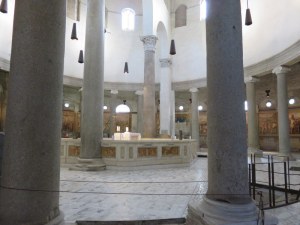
The sanctuary at Santo Stefano Rotondo. The ancient walls wtih frescoes surround the sanctuary.

The sanctuary at Santo Stefano Rotondo. The ancient walls with frescoes surround the sanctuary.

Santo Stefano is an eerie little church built, as the name implies, in the round. Why eerie? This 5th-century church built on top of a Roman Mithraeum and named for the first Christian martyr, Santo Stephano is decorated with frescoes depicting the martyrdom of some 34 saints. No one could describe this scene better than Charles Dickens did:
“To single out details from the great dream of Roman Churches, would be the wildest occupation in the world. But St. Stefano Rotondo, a damp, mildewed vault of an old church in the outskirts of Rome, will always struggle uppermost in my mind, by reason of the hideous paintings with which its walls are covered. These represent the martyrdoms of saints and early Christians; and such a panorama of horror and butchery no man could imagine in his sleep, though he were to eat a whole pig raw, for supper. Grey-bearded men being boiled, fried, grilled, crimped, singed, eaten by wild beasts, worried by dogs, buried alive, torn asunder by horses, chopped up small with hatchets: women having their breasts torn with iron pinchers, their tongues cut out, their ears screwed off, their jaws broken…. So insisted on, and laboured at, besides, that every sufferer gives you the same occasion for wonder as poor old Duncan awoke, in Lady Macbeth, when she marvelled at his having so much blood in him.” Pictures from Italy (1846)
Please click on any photo for a larger view and caption. Warning: some rather gruesome images!
Still Santo Stefano Rotondo is a peaceful site and from what we saw this day visited by few. Off the beaten path? You won’t find many people wandering here, but it is not all that far from the Colosseo, and perhaps a 15-minute walk from San Giovanni in Laterano. Also in the neighborhood, which we visited a couple of years ago, the Case Romane del Celioan extraordinary archeological site of 2nd and 3rd-century Roman houses with vivid frescoes. (Don’t worry about the language on the web page. Just go if you have the chance.)
So this is some of what we do with our spare time. As they say “Roma una vita non basta.” (A lifetime is not enough.)

Paris v. Roma – Part II: Street Scene and Getting Around

22 Mar
In Part One I spoke about the differences in gustatory delights between Paris and Roma. We also have a number of observations to make about architecture, mobility, and behavior.
Street Scene
Saint Dennis holding his head, facade of Notre Dame.
When we travel we like to settle in for a long stay. No “Paris-in-three-days” whirlwind for us! We saw one museum a day, at most, and spent plenty of time wandering neighborhoods both wealthy and moderate. We rented an apartment in the 17th arrondissment, managing to stay under our goal of €100.00 per night. It was nothing fancy yet everything we needed. This approach let us observe local life: children going to school, city workers, mothers and fathers, the elderly doing their shopping, transportation systems, and maybe just figure out a little how a place works, what it might be like to live there. Thus a few words on the streets of Paris versus Rome.
Streets in Paris are cleaner than in Roma, due partly to an absence of graffiti and less litter overall. This
This little girl was endlessly fascinated by the pigeons.
is made possible by an amazing system of street cleaning involving surging water and workers with brooms. We first feared all the crap ended up in the River Seine, but lo-and-behold found this explanation.  Cigarette butts and other small debris is washed away, and larger items are bagged by the workers.
In Roma it is a never-ending battle for city workers against messy denizens. If a trash bin is overflowing, they leave their bags on the street, never mind there’s an empty bin 50 yards further on. Of course in Roma graffiti is art (sometimes) and after all, it was invented by the Romans. Old-fashioned street cleaning trucks make their way down the street very few days and hose down the debris, sweeping up some of it.
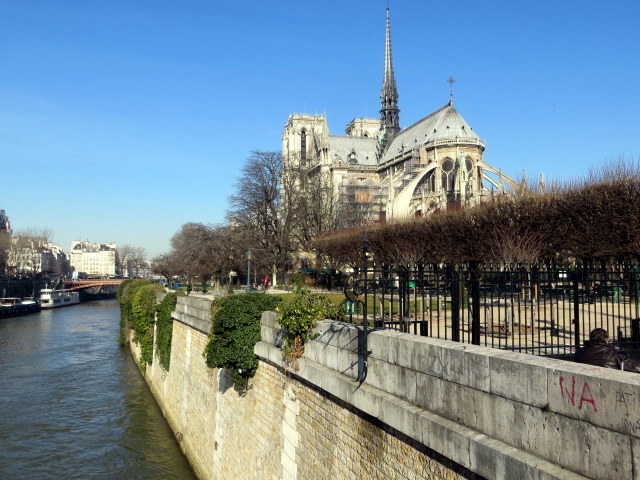
Notre Dame, of course!
Paris’ grand old Haussmann buildings are elegant and the straight streets make navigation on foot easy. The wide tree-lined avenues and boulevards allow one to see far in each direction. Cars are parked in an organized fashion and pedestrian crossings are left open for, well, pedestrians to cross. There are pleasant manicured parks that illustrate design principles.
In Roma every building is an individual, many are very pretty, and most are the same height regulated to not exceed the height of St. Peter’s. We have ancient sites preserved and visible almost everywhere and ancient walls and columns are oft incorporated into new buildings (if by “new” you can accept 400 years as “new”). But we have the ugly serrande pulled down over shops and restaurants and covered with graffiti. Not a pretty street presence, those.
In Roma, streets wind about not only in the Centro Storico and Trastevere, but also in other
The Louvre featured an installation of neon art.
neighborhoods. They may start by radiating off a piazza, but soon change direction and probably name. Finding your way is a nightmare until you’ve spent considerable time in the city. Trees are scattered, but on the other hand, Rome has some great green spaces (Villa Borghese, Villa Torlonia, Villa Ada, Villa Doria Pamphilj) and fountains running year ‘round. In Paris we did not see a fountain “on” in March.
Parking in Roma shows little respect for property or other people’s rights-of-way. White stripes in the pedestrian crossings are free parking, right? Double-parking is a constant battle for buses trying to weave through the already narrow streets. In Paris we have not seen such abuse of parking. It is very orderly and it seems there are plenty of parcheggi (parking lots).
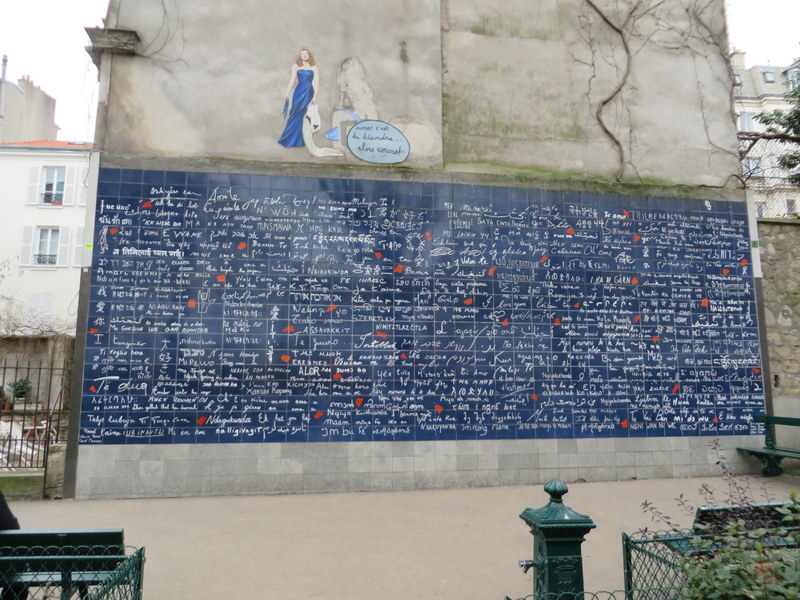
"I love you" wall in Montmarte.

“I love you” wall in Montmarte.

Cats are absent in Paris. We did not see one cat in a week in Paris. I conjectured that perhaps they are all coddled little Fluffies tucked up in their Haussmann apartments. According to one Parisian I am probably right: they are house cats. Still, no ferals? We walked through residential areas and did see not one cat in a churchyard or courtyard or sitting on a wall. In Roma, a cat outdoors is not only a common sight, there are the gattare, women who feed the cats in the streets. There seemed to be fewer dogs in Paris than in Roma, and thus less dog poop on the sidewalks.
Military and police presence is omnipresent and focused in Paris. The patrols we saw were really
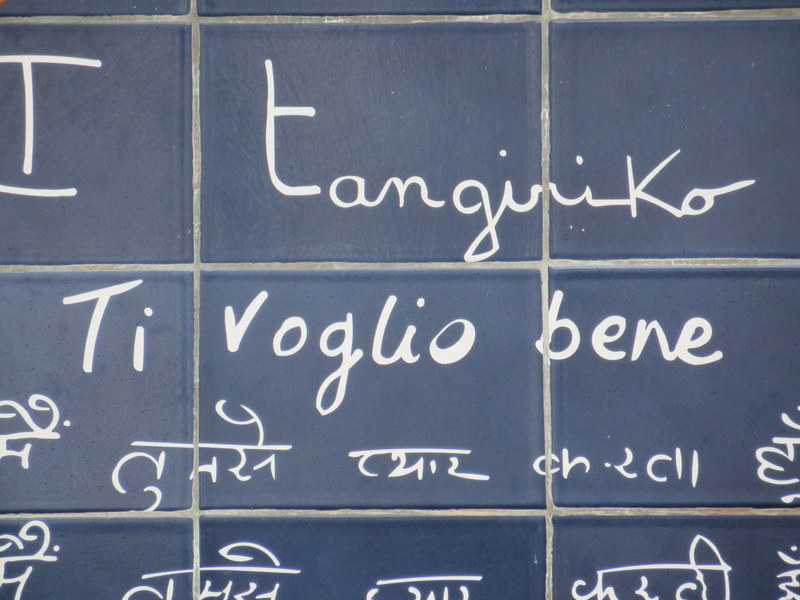
Ti voglio bene - I love you in Italian
Ti voglio bene – I love you in Italian
observing people. Good for them! In Roma, police/military presence is here-and-there and likely to involve five officers in a tight circle talking about soccer.
We did not encounter as much trouble with pedestrians hogging the sidewalks in Paris as we face in Roma. In Roma, groups of people will walk 3, 4, and 5 abreast acting indignant if they have to move for oncoming pedestrians. An old lady with a shopping bag can somehow occupy the entire sidewalk as she shuffles along weaving from side to side as if to thwart anyone from passing her. In Paris people made way as one might expect in crowded situations. If you have not encountered the difference yourself it is hard to describe, but many Romans seem to be so self-absorbed they are unaware of other people needing to pass and use the sidewalks.  I call them sidewalk hogs.
 
Transportation
Paris delivery vehicel.

Paris delivery vehicle.

Ah the Paris Metro! It goes everywhere! People enter the buses from the front, validate their tickets and passes, and exit only from the middle. Che bello! There are seats in both Metro and buses! People stand back and allow others to exit the Metro before forcing their way on, and it is QUIET! One day as we were riding, a guy answered a cell phone call while on the bus and got the stink-eye from an older couple. Any talking is done in hushed tones.
Roma? Chaos! On the bus, enter or exit any door, validate if you feel like it. Noisy? You bet! Several loud cell phone conversations are punctuated with loud talk and laughter. Why not catch up calling your mamma in Bangladesh (pennies a minute according to the ads!) while commuting half-an-hour?  Talk loud too be sure she can hear you over the noise of the bus. In Roma it is hard to get OFF the Metro or bus as the incoming traffic is pushing their way on. Young men fight old ladies for the few seats.
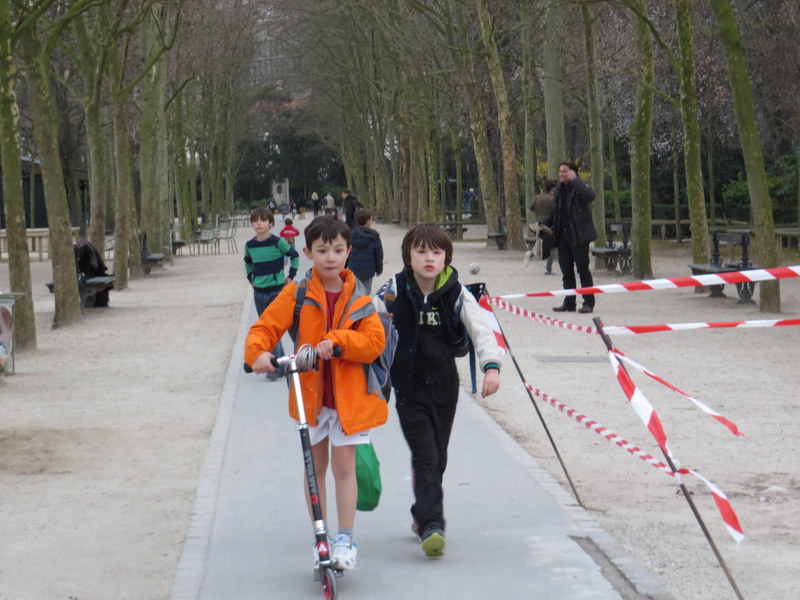
Scooters were everywhere, ridden by both children and adults. Here in Luxembourg Gardens.
The Parisian buses are on a schedule! A real schedule! You can go to the RATP trip planner and be told – several hours in advance – when your bus will arrive at your stop. Che meraviglioso!  At each bus stop there is an electronic feed telling you when the next bus will actually arrive. Roma has a few of the electronic signs at downtown stops, but there is nothing resembling a schedule. There are departure times posted for each capolinea, but very rarely are these schedules followed.
Velib bikes all tucked away at night. During the day the racks were empty, all bikes in use.
Where in Roma one might be run down by a motorino, in Paris a bicycle might sneak up and knock you flat. The Velib system of bike rentals is very popular. We’d see racks full with 20-or-so bikes in the early mornings and late at night, but during the day they would all be checked out through an efficient subscription system accessible to tourists as well as residents. There are bike lanes in Paris (very few in Roma) that run counter to the direction of cars in one-way streets, so while looking right to see if traffic is clear, a jay-walker might be surprised by a bicycle silently approaching from the left.
We were  unimpressed by the famous TGV high-speed train run by SNCF, except for the price.
Look at the little yellow safety vests the children are wearing! So cute and easy to identify!
We paid less to go from Milan to Paris than from Rome to Milan in order to catch the TGV. However, there were no courtesy beverages like on Trenitalia, and overall we felt the trains were dingy inside and out. The food was overpriced and marginal, and when you are on a train for 7.5 hours, you want need food. Still, we did not have to deal with an airport, and that is always a plus.
 
In summary
Food: Italy for the win! While ethnic selections are few, wine, coffee, quality, healthfulness, and price are all in the positive column for Italy. Paris gets points for baguette. The French pastries and chocolates are amazing, and I prefer pain au chocolat to an Italian cornetto. Much flakier and delicate. The Boeuf Bourguignon at one tiny little bistro we found would be reason enough to go back to Paris.
Wine: Scales tip to Roma again. Quality at every price point. In Paris we got very good wine only at a price we find unacceptable for daily consumption.
Great cappuccino at a neighborhood cafe, where locals go. This was not by a tourist attraction. We drank it at the bar and still it was €4.20 FOR ONE. I shudder to think of what they would have charged if we sat down.
Coffee: Roma for price and availability; Parisian baristas pour a good shot, but the cost is at least double most bars in Roma.
Architecture: Tie. Paris for elegance, Roma for quaint, ancient, charm.
Parks: Tie. Each city has nice green spaces. Paris’ are more formal, Roma’s more casual, even a bit wild.
Cleanliness: Paris by far! The street cleaning system of Eugène Belgrand is pure genius. City workers are very prominent in tidying up as well.
Transportation/Getting Around: Paris by a mile. The Metro is omnipresent, the buses on time and predictable. In Roma even the bus app we have on our smartphones cannot always predict when the bus will come. People park where they should in Paris, you do not get run over by motorini, and the availability and use of bicycles is laudable. The narcissism of Roman drivers with cars blocking pedestrian crossings and double-parking makes it difficult for buses and walkers to maneuver. The narcissistic self-absorption of pedestrians in Roma makes it difficult to walk down the street without getting knocked into. In Roma, people will walk out of a shop door without looking right or left and run into you. They are quick to apologize, but the behavior never changes as far as I can tell. Rant over.
Park near our apartment in the 17th.

Park near our apartment in the 17th.

Toto, we’re not in Kansas anymore

23 Jan
Iconic symbols of the city, dating back to the 12th or 13th century, there were once as many as 180 towers.

Iconic symbols of the city, dating back to the 12th or 13th century, there were once as many as 180 towers.

We’re not in Kansas Roma anymore. We stepped off the train in Bologna (pronounced “bow-LONE-ya”) and I thought perhaps we had left Italy entirely. In fact it looked like we had arrived in a newly constructed airport facility, but we were in the new “High Speed Bologna Centrale.”  There was a noticeable freshness to the facility, good signage, wide walkways, no cigarette butts, and plenty of escalators: until we reached the end of the new facility and had to lug our cases up a steep flight of depression-era station steps.
Bologna's high-speed train terminal. Clean, bright, chairs available! We're not in r\Roma any more.

Bologna’s high-speed train terminal. Clean, bright, chairs available! We’re not in Roma any more.

The differences between Bologna and Roma continued to astound us. Beautiful porticoes dating back centuries separate pedestrian traffic from automotive. Clean streets, no overflowing waste bins. People walk in more-or-less straight lines and keep to the right except to pass. Oncoming pedestrians do not block the sidewalks: they make way for you! This is truly not like Roma, where walking down the sidewalk is like a game of chicken and when you swerve to avoid an oncoming body, you may very well step in dog poop. 
Bologna is a lovely city if not one full of E-ticket sites. Sitting in the bread-basket of Italy, it is known for its cuisine and we worked hard at sampling as much of that as possible.
Another notable difference in Bologna: little or no double-parking and no one parks in the pedestrian crosswalks. In Roma there is hardly a pedestrian crosswalk that has not been turned into parking.
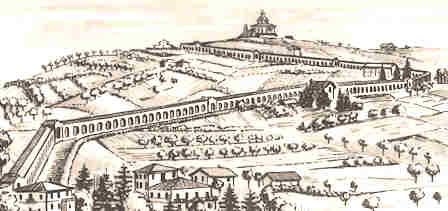
We had lovely weather, so rather than spend time indoors, we took a phenomenal urban trek, the Percorso della Madonna di San Luca. This is a walk of about 4 km (2.4 miles), 2.3 km of which is steadily uphill. The walk is entirely covered by the famous porticos of Bologna, and is the longest continuous section of portico-covered walkway in the world. There are 666 arches. In that final 2.3 km, the altitude gain is a respectable 722 feet (220m), a workout indeed! We were impressed by the number of people doing the percorso on a cold but sunny Sunday. Afterwards we of course rewarded ourselves with a fine tagliere and wine, accompanied by a salad for the health of it.
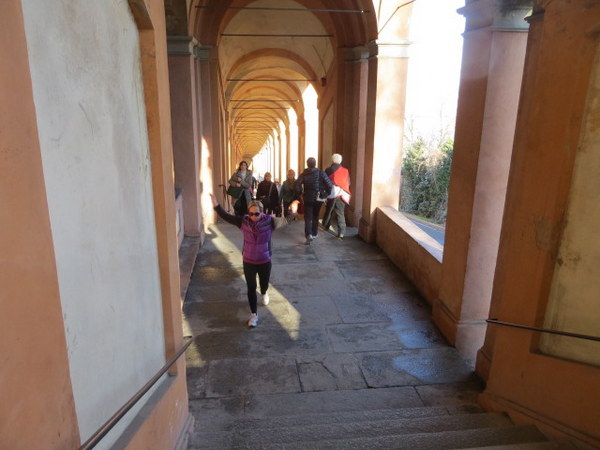
Many run up the 2 km. to the sanctuary. Show-offs.

Many run up the 2 km. to the sanctuary. Show-offs.

Interesting view showing inside and outside of the extraordinary covered walkway.

Interesting view showing inside and outside of the world’s longest covered walkway.

Not only does the path go up over 700 feet in altitude over 2.3 km, there are in excess of 300 stairs. Ugh!

Not only does the path go up over 700 feet in altitude over 2.3 km, there are in excess of 300 stairs. Ugh!

A view from the sanctuary looking toward the mountains of Emilia-Romagna.

A view from the sanctuary looking toward the mountains of Emilia-Romagna.

If I had seen this view before making the trek, I might not have done it. :-)

If I had seen this view before making the trek, I might not have done it. 🙂

The food was great, although we like Ligurian and Sicilian food better overall. But the Bolognese are justifiably proud of the quality of food. We had four meals there and each was a winner. We did not research restaurants ahead of time, but merely wandered into what looked good. One cannot do that everywhere. Of course we – actually Ric – ate mortadella, which is the Bologna delicacy that has been transformed into the unfortunate American “bologna.” And so the Oscar Meyer song is now stuck in my head. (Personally I am not a fan of either the Bolognese delicacy nor the American lunch meat.)
A typical Bolognese "tagliere" or cutting board of assorted salumi.  Mortadella on the left.

A typical Bolognese “tagliere” or cutting board of assorted salumi. Mortadella on the left.

Street performers are everywhere in Italy. Bologna is the first place we have seen bubble blowers. Kids had a great time running after them.

Street performers are everywhere in Italy. Bologna is the first place we have seen bubble blowers. Kids had a great time running after them.

Aperitivi are a huge thing in Bologna, like in Milano. The cafes are crowded even in winter.

Aperitivi are a huge thing in Bologna, like in Milano. The cafes are crowded even in winter.

The only fault we found with Bologna is that it’s a little lacking in charm. The porticoes that are elegant also make for a sameness. (Actually there was a second flaw: people still do not scoop the poop.) We will be back in June on a trek through the area, heading to the hills outside of Bologna for some hiking. We’ll see what she’s like in summer when the trees and flowers are blooming!
N.B. – I have decided to use Italian city names from now on, therefore Roma and Firenze not Rome and Florence. I think it is rather bizarre of any language to change a perfectly pronounceable city name from the original language, an idiosyncrasy driven home to me when my hometown of St. Paul Minnesota was referred to as “Sao Paolo” by an Italian bureaucrat.