Archive | Architecture RSS feed for this section

Summer nights

23 Aug
When it is hot, Italy comes alive at night. The number of people dining at 10:00PM or later even on a week night is amazing. People take their lives out-of-doors once the sun goes down.
Fountains and pools of Villa d’Este, beautiful during the day, take on added drama at night.

Fountains and pools of Villa d’Este, beautiful during the day, take on added drama at night.

Although this summer has not been as miserably hot as the past two (2012 was one for the record books), it’s still humid and hard to move around in full sun. The nights are soft and pleasant, and there is a tradition of special events and the opening of venues that normally close at 6:00PM.   Notte d’Estate a Castel Sant’Angelo, Lungo Il Tevere Roma  (a festival along the Tiber), and various other events dot the calendar in Rome.
Last summer we tried to go to Tivoli to see the magnificent Villa d’Este lighted at night. It was a bust because we were driving, directional signs were poor, and we didn’t know what we were looking for. We did find on that first visit that Tivoli is very lively on summer evenings. So during the past year we made two daytrips to Villa d’Este via train to get our bearings. Finding it remarkable,  we decided to spend a night at a B&B and see the gardens by night.  Every Friday and Saturday through September 13 (weather permitting), Villa D’Este opens its gates after dark allowing one to enjoy its magnificent fountains illuminated. The transformation at night is stunning.
We boarded a regionale train from Station Tiburtina on the holiday of Ferragosto (August 15), and checked into the charming B&B al Palazzetto, a recently restored 15th century building.  The proprietor is an architect and his professionalism showed in the fine design. We were warmly welcomed and shown to a comfortable room with one of the most modern bathrooms we have had in Italy.
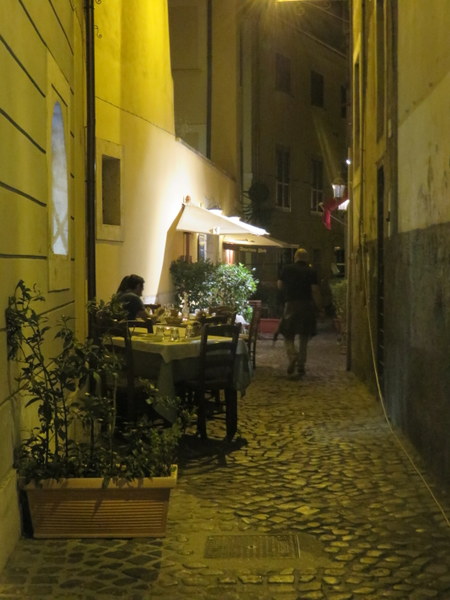
Delightful, serene dining on a soft summer night

Delightful, serene dining on a soft summer night

The town of Tivoli offers many fine restaurants, and it seems they are open very late to serve those who choose to tour Villa d’Este before dining. We chose one with a fine location on a piazza, Taverna Quintilia, only a few minutes’ walk from the entrance to Villa d’Este.  Taverna Quintilia is a rarity: a true Neapolitan seafood restaurant in Lazio, featuring succulent octopus, fresh marinated alici (anchovies), grilled spigola (sea bass), and more. This was some of the best seafood we have eaten outside of the Cinque Terre and Sicilia.
After dinner we headed over to Villa d’Este, arriving about 9:30PM to find a fast-moving line. The estate is huge so it swallowed the crowd easily and we enjoyed an uncrowded tour. The estate is transformed by the play of light on fountains. It occurred to us that in the U.S. this place would not be allowed to be open at night: it would be too dangerous with the low lighting, uneven walkways, and dark Renaissance staircases. We firmly held hands and thoroughly enjoyed wandering the grounds, watching the families and couples alike enjoying a soft evening – almost cool for August.


The Renaissance-era villa, Cardinal Ippolito II d'Este, son of Alfonso I d'Este and Lucrezia Borgia and grandson of Pope Alexander VI.

The Renaissance-era villa, commissioned by Cardinal Ippolito II d’Este, son of Alfonso I d’Este and Lucrezia Borgia and grandson of Pope Alexander VI.

Beautifully lighted fountains – Renaissance era faces carved into a long wall light a romantic walkway.

Beautifully lighted fountains – Renaissance era faces carved into a long wall light a romantic walkway.

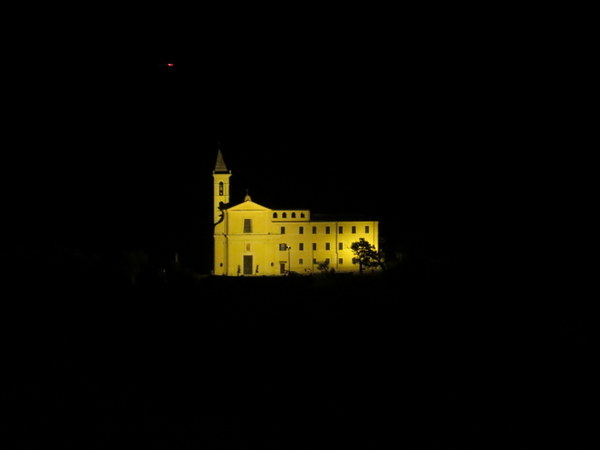
An unidentified church seem s to float in the darkness, just beyond Villa d'Este.

An unidentified church seem s to float in the darkness, just beyond Villa d’Este.

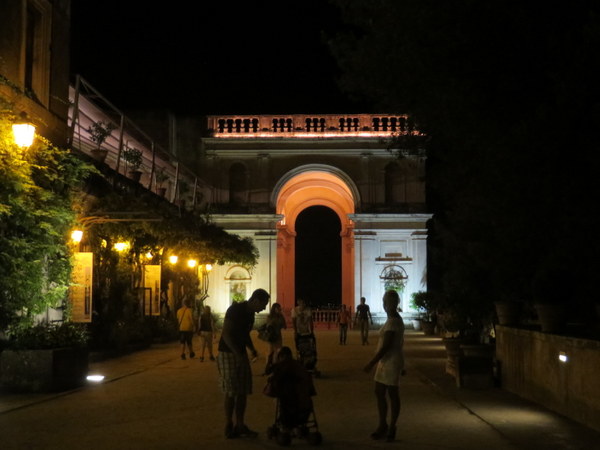
Dramatic lighting of architectural features at Villa d'Este.

Dramatic lighting of architectural features at Villa d’Este.

Milano Musings

2 Mar

2 March 2014

When you arrive in Milan after living in Rome for awhile, the first thing you notice is how tall the buildings are. (If you are coming from, say, Seattle or Denver, you won’t even notice.)

The Duomo in Milano, during a brief rain-free moment in the evening. It truly is spectacular!

The Duomo in Milano, during a brief rain-free moment in the evening. It truly is spectacular!

In Rome nothing can be taller than St. Peter’s Dome, so the buildings all top out at about 6 floors. This lends an interesting sameness to the architecture of Rome, a unity in height if in no other manner. Also, in Milan, there is a “newness.” As the city was heavily damaged in WWII, one doesn’t find as many old buildings.

The second thing you might notice is the streets: they are wider overall than in Rome, and fewer are winding alleyways. Some areas have broad flat sidewalks without loose stones so you can walk without watching your feet. And it is flat. Rome’s famous seven hills won’t exactly test the legs of someone from Portland, but Milan makes Omaha look hilly.

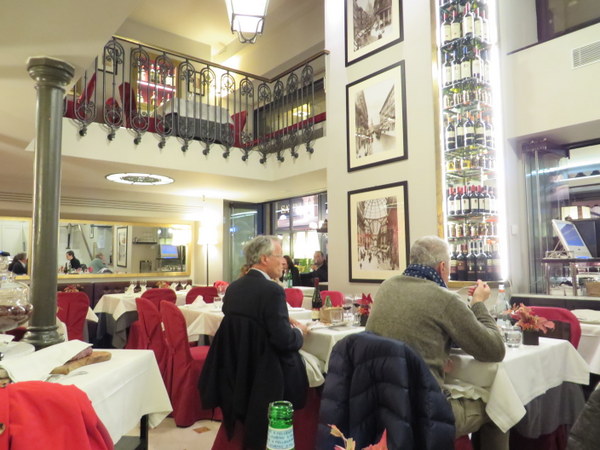
Not your average mall restaurant....

Not your average mall restaurant….

I had need to go to Milan for work, and Ric came to join me for the weekend. Two days in the office passed easily enough and I didn’t have time for any culturally significant outings. Upon Ric’s arrival we headed to Centro Storico to wander around, taking a quaint little tram that dated to 1928.  Now some real behavioral differences began. In Milan, those waiting to board a tram or a Metro train actually let those exiting get off before shoving their way on. Ric and I turned to each other in wonderment! What a delightful change in comportment!

We shopped a bit – after all Milan is the shopping Mecca of Italy – then proceeded to supper in the Galleria Vittorio Emanuele II. To call this a “mall” is like calling Villa Borghese a “playground.” No food court or discount stores here. Rather the likes of Prada, Valentino and Versace. For the record, we didn’t buy anything in the galleria.

Saturday dawned like a Portland March day, but even colder and wetter.

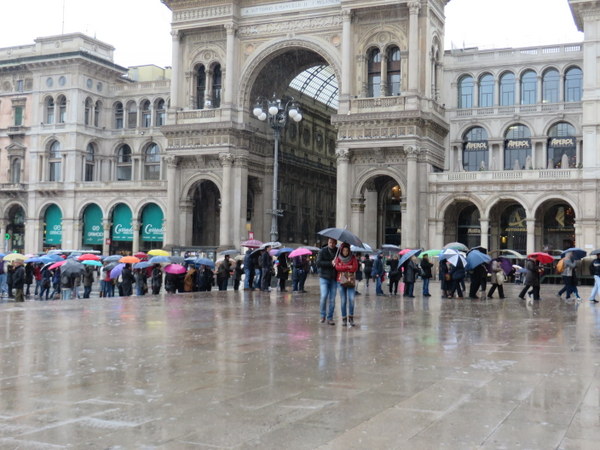
The rain did not deter the crowds waiting in line to enter the Duomo. Glad we arrived before the line was so long.

The rain did not deter the crowds waiting in line to enter the Duomo. Glad we arrived before the line was so long.

It never stopped raining, making for a good museum day. We were impressed at the number of people out despite the rain. Long queues of umbrellas waited patiently to enter the magnificent Duomo, and we narrowly beat the crowd both at the Duomo and for an Andy Warhol exhibit nearby, handily avoiding the long queues because we are early-birds. The Warhol exhibit was eye-opening as we discovered some of Andy’s less-known work, all from the private collection of Peter Brant. Truly amazing that one person could have amassed such a collection from a single artist.

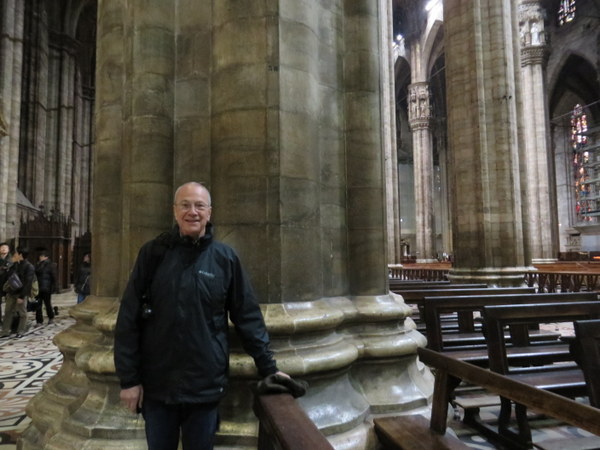
The pillars in the Duomo of Milan are about the size of sequoias.

The pillars in the Duomo of Milan are about the size of sequoias.

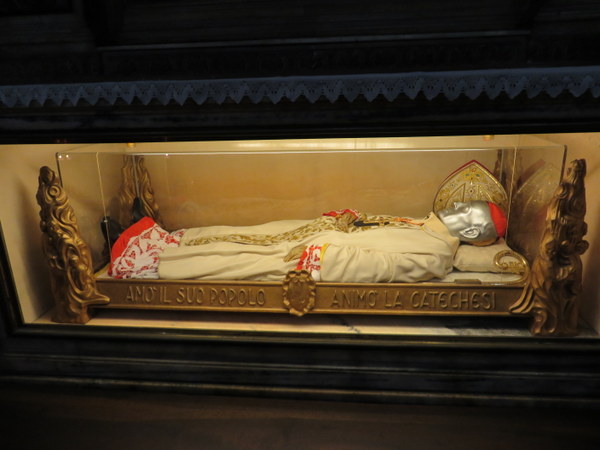
As to the Duomo, this is the fourth largest church in Europe and quite a contrast to most of those we’ve seen in Italy. Ric said “This church seems almost Lutheran,” which is quite insightful as it is predominantly Gothic, reminiscent of the Protestant Churches of Northern Europe. Of course the Lutheran churches in our hometowns lack marble, entombed remains of cardinals on display, or pillars the size of sequoias.

Yes, that's the body of a Cardinal, with a silver death mask. Nothing like this in St. Paul, either.

Yes, that’s the body of a Cardinal, with a silver death mask. There’s nothing like this in St. Paul, MN.

4th longest nave in Christendom, so says my guidebook.

4th longest nave in Christendom, so says my guidebook.

There's nothing quite like this in St. Paul, MN.

There’s nothing quite like this in St. Paul, either.

The afternoon took us to a more obscure museum, Pinacoteca Ambrosiana  where the building was as much art as the contents. This is a fabulous palace with amazing mosaics and inlaid floors. Regrettably, no photos allowed so I cannot show you. Again, a private collection, this time of none other than a Cardinal from the 17th century, Borromeo.  In this vast collection of 1600 items there’s a Caravaggio, Raphael’s original charcoal drawing for his Vatican fresco “The School of Athens,” a Tiziano, a Botticelli or two, a DaVinci, several Brueghels, and a lock of Lucretia Borgia’s blond hair. Oh, and Leonardo’s Codex Atlanticus in its 1119 page glory is in the library at Ambrosiana. We saw 22 pages carefully displayed. (It’s only 500 years-or-so old.) Church work was very profitable back in the old days…. I don’t think Papa Francesco would approve today.

For those looking at this post as a travel guide, we stayed at Hotel Teco, a sweet and relatively (for Milan!) inexpensive hotel at about €137.00 per night including breakfast. We were able to get a VAT exemption as diplomats. To my Embassy friends: don’t overlook the paperwork needed before you travel.  A 17 minute walk or €10.00 cab ride from Milano Centrale, Hotel Teco is convenient to the Metro (5 minute walk to the Rosso), and Tram #1 to the Duomo is about a 7 minute walk. Numerous restaurants including Ristorante Sabatini (the woman at the front desk said ottimo pizza” and she was right!) are a short walk away.  I also like Osteria Mamma Rosa nearby, although we didn’t make it there this trip.

I’ve been to Milan four times for work, and once prior in personal travel. I’ve either lacked time or weather sufficiently pleasant for a trip to the roof of the Duomo. I think we’ll have to take advantage some sunny summer day and hop a train to Milan just for the day and make our way to the top. 

Day One of Five

13 Feb

Facing another long holiday weekend (the last until Easter) we decided to extend it even more and take five days to explore Rome. We have done so much traveling that the list of things to see and do in Rome continues to grow and we don’t have enough daylight hours to be tourists in our own town. So begins what I like to call i cinque giorni del compleanno di Laurel (the five days of Laurel’s birthday).

Iconic EUR "Square Coliseum", unoccupied but rumored to be destined as Fendi headquarters.

Iconic EUR “Square Coliseum”, unoccupied but rumored to be destined as Fendi headquarters.

There are a lot of mega-sites in Rome: the Coliseum, the Roman Forum, Vatican Museums, Borghese Gallery, the Pantheon. The list goes on and on. And there are so many places the average tourist does not see unless she returns to Rome multiple times. We haven’t even managed to get to all of the neighborhoods yet.

The obelisk and colonnades on buildings, along with wide boulevards, reminded me of Washington, D.C.

The obelisk and colonnades on buildings, along with wide boulevards, reminded me of Washington, D.C.

So today we ventured south to the E.U. R., Mussolini’s site for a planned 1942 world’s fair, the Esposizione Universale Roma, which obviously didn’t happen. Today it is described as a residential and business area. We felt like we had left Rome and traveled to another realm.

The architecture is interesting if cold, distant, and rather lacking in charm. The streets are straight, which is unsettling after so long in Rome. If you took in a certain view, it felt in places a little like Washington, D.C., but not nearly as pretty. Washington, D.C., for all its issues, has beauty. Still we were happy to have seen it as the weather was glorious for the first time in weeks.

San Paolo Fuori le Mura (Ric in foreground).

San Paolo Fuori le Mura (Ric in foreground).

After the E.U.R., we stopped by the Basilica Papale di San Paolo Fuori le Mura, or St. Paul’s Outside the Walls. This is the fourth of four papal basilicas for us, and it has taken more than 3 years to get to all of them. Way off the track for most tourists, no exceptional art such as Raphael, Caravaggio, Michelangelo, or Bernini, but with lovely mosaics and peaceful. Of course since my hometown is named for this saint, it seemed fitting to visit.

This uber-serious saint is the namesake of my home town.

This uber-serious saint is the namesake of my home town.

Alter canopy over the tomb of St, Paul.

Alter canopy over the tomb of St, Paul.

Lunch at Eataly, an afternoon on the couch watching a movie, and shortly dinner at my favorite fancy restaurant in Rome, QuarantaQuattro, where I know Sergio will make a fuss.

When I hovered my mouse over this doodle, my name showed up. Strano!

When I hovered my mouse over this doodle, my name showed up. Strano!

On another note, I was shocked to pull up Google this morning and find my birthday was a Google-Doodle. A Big-Brother moment; I assume they pulled the date from Facebook or Google+. Weird. 

Beyond il Colosseo

20 Feb

Beyond il Colosseo

Every guest wants to see il Colosseo, followed closely by the Vatican Museums, St. Peter’s, Villa Borghese, and many of Rome’s grand and well-known sites. But where do you go once you’ve seen all the most-popular sites? What treasures await those who have more time in Rome? Ric and I have made a point of visiting some lesser-known venues over the past few months and have found some true gems, virtually free of tourists, lacking long lines and crowds.

Palazzo Braschi Museo di Roma
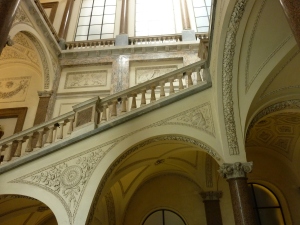
Grand staircase Palazzo Braschi

The art is interesting, but Palazzo Braschi is the star.

New by Roman standards, Palazzo Braschi dates only to the 18th century. Situated adjacent to Piazza Navona, it is a wonder that so few people venture in. The building itself is amazing, with one of the grandest staircases imaginable. Built with Papal wealth, after financial problems plagued the owner the building was sold to the State. After the Second World War, 300 homeless families lived here causing extensive damage, but restoration work resulted in the fine museum we see today.  One hot June day, at the height of tourist season, we found ourselves among a mere handful of people enjoying the cool interior of Palazzo Braschi.  The collection features scenes of Rome as painted during the Renaissance. It’s fun to see how things looked to the artists of the time, but the real star is the Palazzo itself. Revel in the architecture and imagine a time when this was a private residence. 

 Palazzo Colonna 
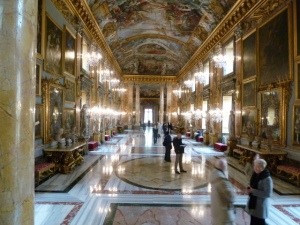
Great Hall Palazzo Colonna

Palazzo Colonna grandeur: only available on a Saturday.

Not every museum is open every day. A truly notable exception is the Palazzo/Galleria Colonna. Open only on Saturdays from 09:00-13:15, one has to plan to see this treasure. As a bonus, there is an English tour at 11:45 (Italian at 11:00).  Just off Via IV Novembre, Palazzo Colonna presents a less-than-stunning edifice. In fact, we have been past this structure dozens of times without realizing the importance of the site and the art within. (The wax museum at street level provides an odd contrast and is no doubt visited by more people daily than Palazzo Colonna sees in a month… or two.)  Once you are inside, it is jaw-droppingly beautiful. If you recall the movie “Roman Holiday” with Audrey Hepburn and Gregory Peck, the final scene of a palace press conference was filmed in Palazzo Colonna. Parts of the palazzo date from the 13th century and there is a claim that “Dante slept here.” Popes and Hapsburgs, feuds and wars, provide background to this enormous and elegant residence and gallery. The family still lives in apartments at the site, explaining perhaps why it is open so few hours each week.
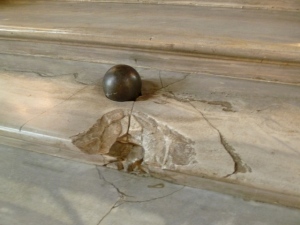
Palazzo Colonna

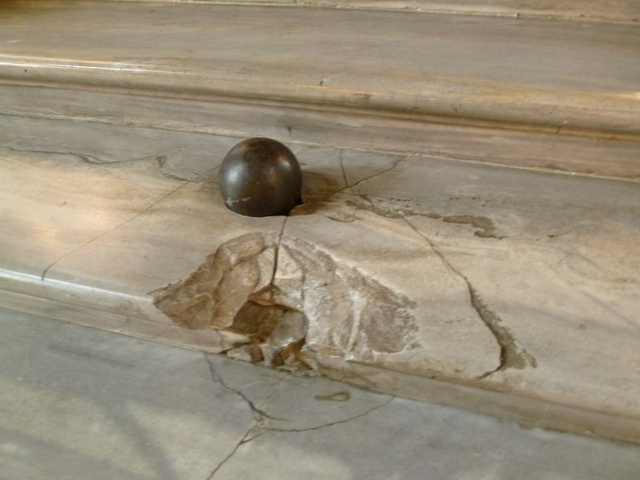
Palazzo Colonna: You’ll have to take the tour to hear the story of the cannon ball….

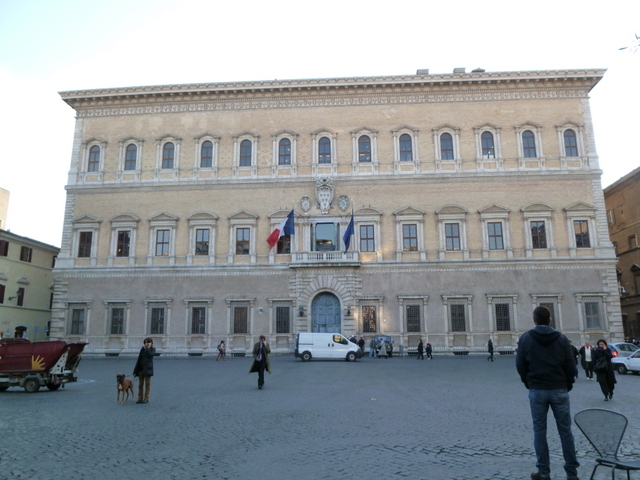
Palazzo Farnese
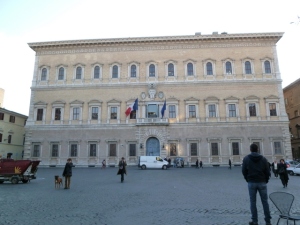
Palazzo Farnese

A formidable façade reveals a grand beauty, seat of the French Embassy.

Another one-day-a-week venue – at least for English speakers –  is the French Embassy to Italy, located in Palazzo Farnese, which is only open for tours in English on Wednesday, and only at 17:00. (French and Italian language tours are also available on Monday and Friday.)  As a working embassy, only portions of the building and grounds are accessible, and one must reserve at least a week in advance; However, for the modest price of €5.00, it is perhaps one of the highest value tours available.  A pope, Michelangelo, Puccini, Annibale Carracci, Queen Christina of Sweden (the proverbial tenant from Hell), and Giacomo della Porta all played a role in the rich history of this palace.  No pictures are allowed inside, but trust me; the severe exterior on Piazza Farnese does no favors to the beauty within. 


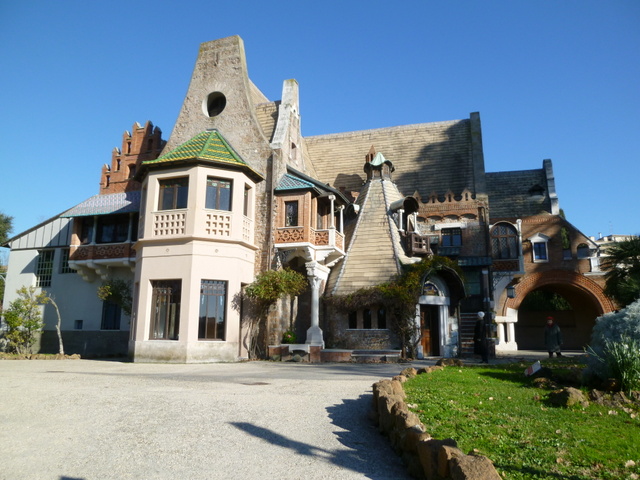
Villa Torlonia
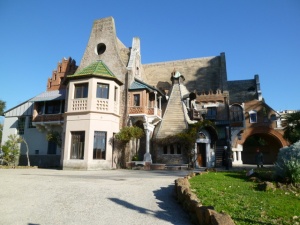
Villa Torlonia

La Casina delle Civette, a curious mix of styles.

This is a truly off-the-beaten-path location even for many Romans, Villa Torlonia is a vast and beautiful park with three diverse villas now serving as museums. Once owned by the Pamphilj family (Villa Pamphilj and Galleria Doria Pamphilj are also properties of this enormously wealthy dynasty), it passed to the Colonna family and finally the Torlonia. The estate was extensively remodeled in the early 19th century. There are winding paths, small lakes and fountains, obelisks, the three museums, and more restoration work in progress.  Mussolini lived in the Casino Nobile for 18 years, renting it for one Lira per year.  You will see families enjoying the grounds, playing, walking, and soaking up the sun from a bench. My favorite building is the Casina delle Civette, House of the Owls. Formerly known as “The Swiss Cabin” and originally a refuge from the grand villa Casino Nobile, it has been transformed through the years with a mixture of architectural styles that almost defy description. Go for the stained glass and enjoy the inlaid wood, medieval influences, mosaics and majolica.  


Villa Medici
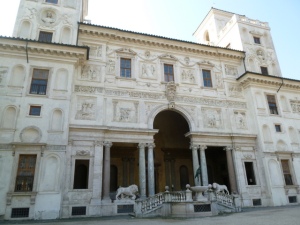
Villa Medici

Villa Medici from the garden.

On a recent Sunday, we were among only four Americans touring Villa Medici. Bordering Villa Borghese, above Viale del Muro Torto, just north of Piazza di Spagna, you will find this magnificent palazzo and grounds. Entering from the fortress like side facing Viale Trinità dei Monti, the villa is impressive only in size and age. Sign up for the guided tour and the beauty of this 16th century enclave is revealed. Villa Medici is like most palazzi, steeped in the history of cardinals, artists, architects and even ancient Romans. Today it is the seat of the French Academy in Rome, hosting artists from all over the world in residency fellowships.  The focus of the tour is on the grounds, which are truly magnificent.  Unfortunately with the Tuscan heritage of Cardinal Ricci and Cardinal Ferdinando de’ Medici, much of the original sculpture collection is now in Firenze in the Uffizi. Through restoration and replicas, we can enjoy the site much as it once was.  In the private pavilion of Cardinal Medici admire recently restored frescoes from the 17th century, once covered
Villa MEdici

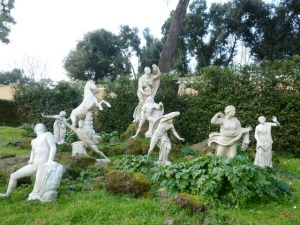
Niobe suffers from hubris and loses al of her children.

thoughtlessly with many coats of lime, now again visible thanks to one of the artist-in-residence fellows.  And in one of the 16 squares of the garden, we discover the dramatic installation of Niobe and her dying children.  The entire estate was restored in the 20th century, ensuring many generations can continue to enjoy this oasis in the midst of busy Rome. By all means one should see the Colosseum, Forum, Palatine Hill, Borghese Gallery, the Vatican and St. Peter’s. When you’ve seen these historic “must do” sites, when you’ve seen the Caravaggios and the Michelangelos in the magnificent churches, there’s still more to discover in Rome: places where you might just find yourself alone with the art.