Archive | Culture RSS feed for this section

Buy Italian

15 Sep

Three months ago I wrote about our experiment in weaning ourselves from the habit of buying online from the U.S. You can read about it here, but in summary, we decided to try to confine our consumerism to Italy and not use the U.S. Diplomatic Post Office to ship in goods from Nordstrom, Amazon, Zappos, etc. So how did it go? It was a mixed success.

On the plus side
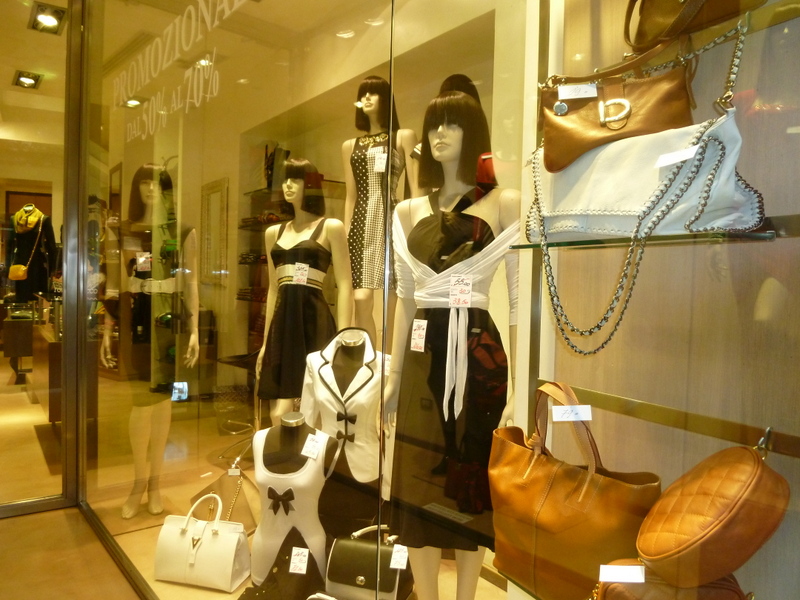
Always beautifully displayed merchandise. I think there's an Italian gene related to beautiful displays and wrapping packages.

Always beautifully displayed merchandise. I think there’s an Italian gene related to beautiful displays and wrapping packages.

We learned we can live in Italy, as Italians do, without buying a special brand from the U.S. We Americans can be addicted to our own brands of toothpaste, deodorant, shampoo, lotion, etc., but Italians need that stuff too and the stores carry many fine international and European brands. We gave up 8 ½” x 11” paper for the common A4 size sold in Europe. It’s a setting on the printer so no big deal.

Some products are better than the U.S. equivalent. I found an amazing olive-oil based lotion, for example, and Janie, our senior cat who is picky about her treats has come to crave a treat we found as a sample inside a carton of her packaged food.

We found new stores and sources. We went on
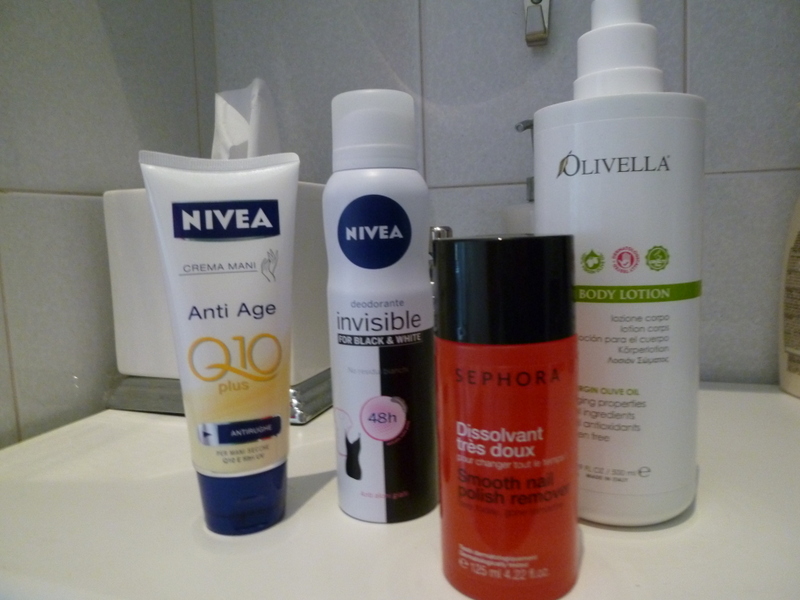
A few of the brands I switched to as a result of our experiment.

A few of the brands I switched to as a result of our experiment.

forays into stores we’d not entered prior, neighborhoods we’d passed through but not really shopped in. We discovered you can go looking and not find, but you have to be ready to buy when you pass a shop with promising merchandise. One Saturday we spent 4 hours looking for a dress for me. I tried on 8 or 10 at various stores. Niente! But the next day, walking to a museum, I spied a dress in the window of a tiny little boutique, walked in and 5 minutes later walked out with the dress.  You have to be opportunistic.

We bought less because it took more time to go looking the old-fashioned way, in stores. Oh Zappos, how easy it is to find black heels, size 7.5 with a 1” heel and ship three pair overnight! But try to find a pair going shop to shop. It takes hours! Days, even!

In July and August "i saldi" are everywhere. And prices get lower as the weeks go by....

In July and August “i saldi” are everywhere. And prices get lower as the weeks go by….

The July/August saldi (sales) offer some good buys and even the opportunity to bargain, something I’d not done before. One day on the way home from work we popped into a boutique because I saw a lovely dress in the window. I slipped it on and it fit like a dream, but I nearly fainted when they told me the price! “But signora, it is on sale,” and she quoted me a price about 30% less. Still high, so I started to walk out shaking my head. “Signora,” she called, “Wait. It’s specially tailored… but I can sell it for €XXX,” and she knocked another 15% off. Score!

I practiced my Italian. Always a vocabulary builder and an opportunity to tune my ear. I can talk about the features of our new food processor and of our new Italian iron, purchased to replace the one clogged up with calcium after a year of ironing with this hard water.

On the other hand…
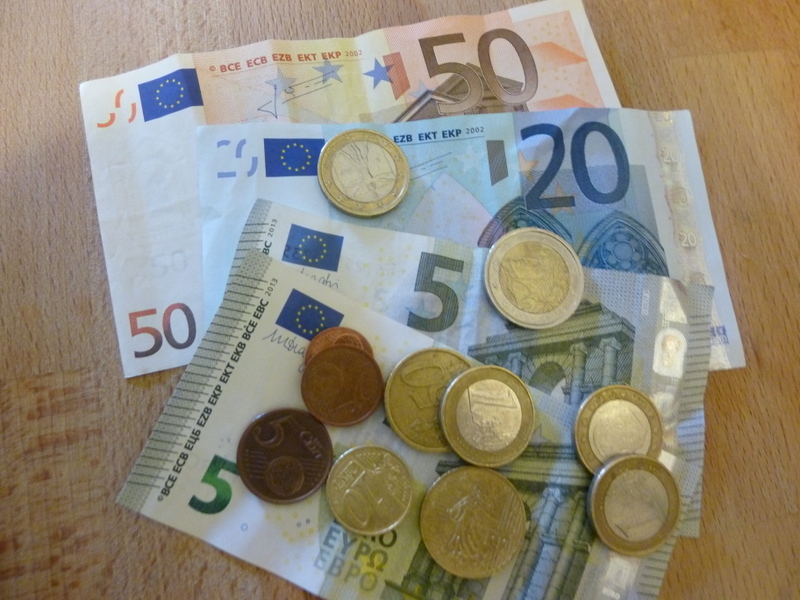
EurosThings cost un’occhio della testa (an “eye of the head,” or as we’d say “an arm and a leg”). VAT (a tax) is 21%, driving already high prices up significantly. And the exchange rate makes everything 30-35% higher in dollars. So a €100 item is $132.00 plus-or-minus U.S. The amount we spent on shorts and hiking shoes we bought up in the mountains in July could have clothed a small child for the school year if you shopped at Walmart.  

It takes a lot of time to shop in stores, especially when you don’t know brands, you don’t know sizes, and boutiques are small with limited selection. I am a size 10 U.S., but a 42 or 44 Italian and a 3 French.  Everything has to be tried on.

Customer service is…different. Sometimes we are warmly greeted and professionally served. This is especially true upon return visits (regulars!) or once they realize we are not tourists. Sometimes we are totally ignored until we ask for help and then it is given begrudgingly. Also, this is not a culture in which returns are gladly accepted, so do not have buyer’s remorse unless you shopped at IKEA.Color coordinated
You have to run around to buy some items. For example, you cannot buy cardio (baby) aspirin at the grocery store. You have to go to a farmacia and ask the druggist for it.  Thread? Not in a fabric store, but only in a special sewing notions store.  Tell me, who would think it is not a good idea to sell thread where you buy fabric?

Some American things are better than Italian equivalents. American plastic bags, whether for lining your trashcan or wrapping up leftovers, are far better in size, durability and functionality. Give me my Ziplocs! There’s huge problem with calcium in Rome and everything gets clogged and spotted. But good old CLR declogs a shower head better than anything I’ve found in Rome.

 Will we continue to buy Italian? Absolutely, but not exclusively. Food is no-brainer. Other than peanut butter and white vinegar (Which is hard to find here. We are awash in fine balsamico, but plain white distilled? Not available at the supermercato.), we buy all of our food in Italian markets. But then most of our food is fresh. Ric has been buying Italian clothes since we arrived and has some go-to places, but even he turned to Lands’ End online for his fall shirts and to

Ric and I at Piazza Navona. Photo by Derek

Ric and I at Piazza Navona. Photo by Derek

Zappos for some walking shoes. It’s just easier to buy online at 3:00PM on a hot afternoon than to walk all over Rome looking for shoes. But if we didn’t have the Diplomatic Post Office, we’d not be able to buy this way.

I am still searching for go-to shops for myself. But I’ll return to shopping a piede (on foot) as the cooler weather hits for some Italian fall fashions. And when we are in Venice this week, I’ll stop in at my favorite glass-maker and pick up some new jewelry. 

Rome – Closed for the Holidays

15 Aug
A simple hand-lettered sign on a boutique. When will they return? Who knows!

A simple hand-lettered sign on a boutique. When will they return? Who knows!

Rome is deserted. For the past three weeks, the city has become progressively quieter: less traffic, fewer stores open. Some of the city buses are on a special schedule in August with reduced runs. Even the seagulls that frequent our neighborhood and scream at 3:00AM seem to have taken off for parts unknown. There are fewer dogs in the park, and fewer runners, too. Some mornings I can walk through Villa Borghese and see almost no one except the omnipresent vendors setting up for the day’s business.

I cannot possibly imagine this happening in the United States, but store after store is closed per ferie, the period surrounding the mid-August holiday of ferragosto.  I won’t go into the ancient roots of this holiday, or the fact that it was co-opted by “The Church.” I will tell you what it is like this month.

  • People are at the beach, whether for the day, the week or the month. Those that are not at the beach are in the mountains, but most Italians are true sun-worshipers and so they flock to the beach where they lay on a chaise lounge under an umbrella, side-by-side-by-side.
  • Businesses are shuttered with little signs that say how long they will be chiuso. Could be a week, or even the entire month.
  • You can find a place to park on almost any street, in almost any piazza. This does not happen any other time of the year. Buses run almost empty.

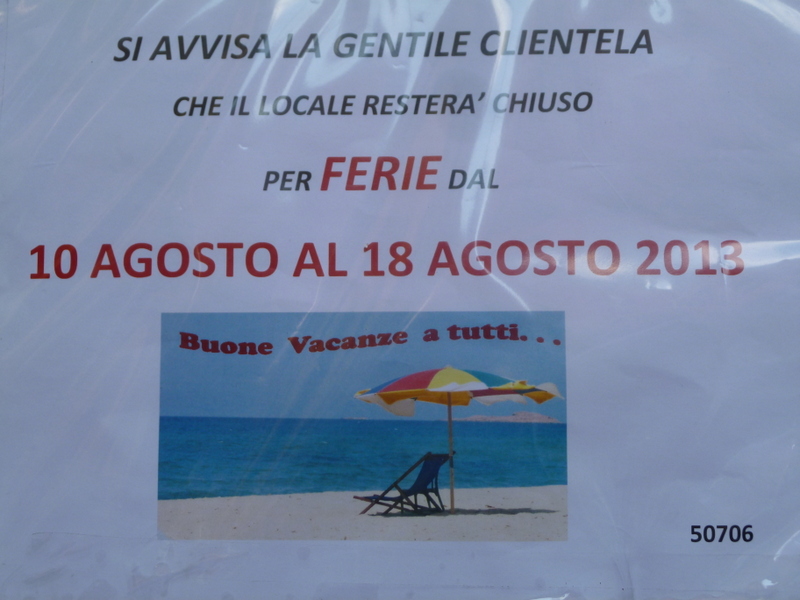
    A more formal sign assures  customers of this cafe that they will only be closed a week.  Everyone to the beach!

    A more formal sign assures customers of this cafe that they will only be closed a week. Everyone to the beach!

Restaurants are closed or quasi-empty. Two weeks ago, on a Saturday night, we went to a highly recommended restaurant near the Embassy and at the peak dining hour of 21:00 we were the only customers! I’d even made a reservation. A very uncomfortable situation for us and for the restaurant owner.  Luckily the quality of the food did not suffer.

An Italian friend told me that when she was a child (35-40 years ago) it was even quieter in August. It was even difficult to get groceries as supermarkets and shopping centers did not exist.

Another tradition of ferragosto is to give your portiere (building superintendent-manager-doorman-handyman all rolled into one) a gift of €25-€50 (about $33-67) in recognition of what they do for us. This is also traditional at Christmas and Easter.  The portiere is also key to security, so he remains on duty in August when many apartments are vacant and is – hopefully – a deterrent to the break-ins that increase in frequency during the mass-exodus to the beach.

This children's shop in a posh neighborhood is closed from 8 Aug to 2 Sept.

This children’s shop in a posh neighborhood is closed from 8 Aug to 2 Sept.

Today, August 15, is the actual ferragosto. The Embassy is closed, as are most businesses not in the tourist-trade. Our neighborhood is Christmas-morning quiet. No dogs, no birds, no motorini, no traffic, just one suspicious helicopter circling occasionally (never a good thing). We were able to find a nice bar (cafe) open for a holiday cornetto e cappucino fix.

While it may not be the best economic decision to close your business during the current crisis, I have to respect the tradition. People spending time with their families, having lunch with grandma, and escaping the heat if possible. For an amusing look at the holiday, seek out the movie “Mid-August Lunch” (Italian with English subtitles, available to stream on Netflix).

Waterless Weekend

14 Jul
This eroded lion head fountain is the only source of water for our while building of 14 condos. He's over 100 years old.

This eroded lion/hippo/whatever-head fountain is the only source of water for our whole building of 14 condos. He’s over 100 years old.

Living in Rome is a dream; we pinch ourselves almost daily. But for two days, it’s been a bit scomodo (inconvenient). We have had no water in the apartment. We had showers Saturday, but since about 12:30 yesterday, nothing. It seems the pump is out. Apparently the city feeds the property (a condominium building, about 110 years old), and the distribution is via an electric pump underground, accessed through a scary stairway.  The portiere (superintendent) is away for the weekend as he gets half of Saturday and all of Sunday off. And there is no one else to call. No management firm we are made aware of. Ric and I tried to reset the circuit breaker on the pump yesterday, to no avail. But thought we were just being stupid Americans not knowing what to do or who to call in an emergency.  Then today our 80-something-year-old neighbor, Signora Vyta (who may actually have lived in this building her entire life from what I understand), asked us to go with her to the pump and see if we could fix it. She was fed up. She’d called the portiere with no result, no answer, and she wanted to try and fix it. So Signora Vyta oversaw a second attempt telling Ric (in Italian) what to do to reset it and told us this happens a lot. Apparently never when we are at home. Just our luck this time!

Ric makes the umpteenth trip to fill a bucket. We have tons of bottled water on hand, too, because that's what we do in Rome.  And there's always wine.

Ric makes the umpteenth trip to fill a bucket. We have tons of bottled water on hand, too, because that’s what we do in Rome. And there’s always wine.

So how do we function with no water? We haul buckets in from the only functioning source on the property, a tiny little old-fashioned, 100-plus-year-old fountain, now controlled with a spigot. We use gravity to flush, and we went to the Embassy today to shower, a 2-hour round trip. I heated water on the stove to wash dishes, just like camping in the 1960s with my parents.

What’s worse, we had to cancel a dinner party planned for tonight! We’ve decided being without water actually sucks more than an Internet outage.  I only hope Emilio, our portiere, knows where to hit the pump with his magic hammer to get it back online tonight. 

Gravity flush. Just keep a bucket close by.

Gravity flush. Just keep a bucket close by.

Empire State – Dinosaurs, Venus and more

2 Jun

Short post with a simple message: if you are in Rome between now and 21 July, go to Palazzo delle Esposizioni and see this exhibit.  It’s an engaging installation by a couple of dozen artists from the greater NYC area. I cannot describe it better than the project’s website so I won’t.   http://english.palazzoesposizioni.it/categorie/empire-state-arte-a-new-york-oggi.

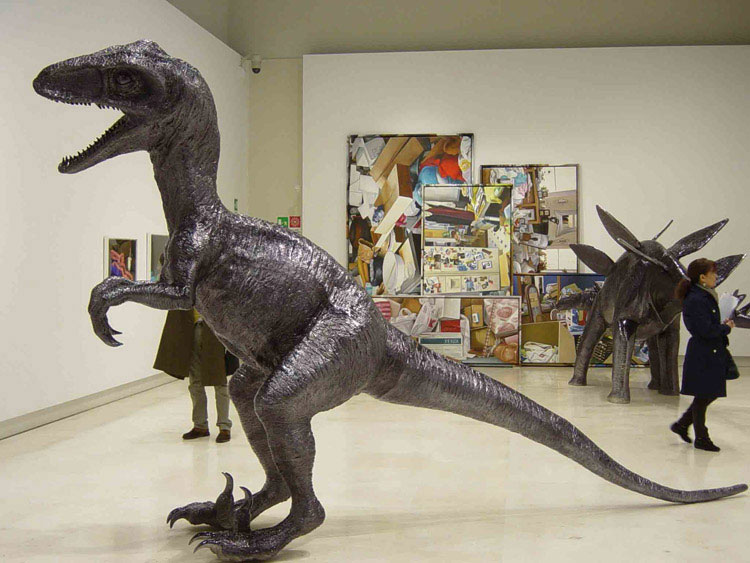
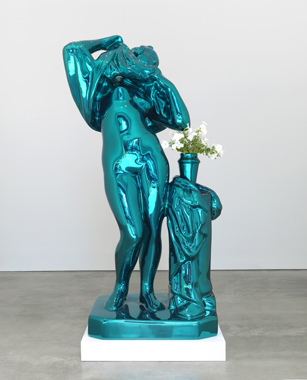
We loved the dinosaur installation for its whimsy, but also for a message about “stuff” and the propensity to collect, or more specifically to hoard.  Michele Abeles’ “Flag Flag Flag” is strikingly displayed, and Jeff Koons’ turquoise polychrome Venus Antiquity took my breath away, but the empty chicken coop and flashlight left me shaking my head.

I wonder if I can be paid as an artist for putting an espresso machine on the floor with an iPad on my coffee table. Just go.

Flag Flag Flag

Flag Flag Flag by Michele Abeles, one of the younger artists featured.

Dinosaurs

History of the World by Jeff Pruitt: Shiny dinosaurs tower over the visitor while gazing at stuff collected by hoarders.

Venus

Curvaceous, shiny, sensual: this is Jeff Koons’ Venus Antiquity. It invites a 360 degree viewing.

Things are different here

30 Mar

Banking, shopping, mammograms: there are many differences here in bella Italia.

Banking was invented in Italy. In fact, the oldest bank in the world is Monte dei Paschi di Siena, which is in deep doo doo over some questionable transactions…but I digress.  We needed to open an Italian bank account so we could pay some local doctors’ bills. The process of opening the account was akin to closing on a house, only more difficult. It took several days and 3 visits to the bank, but no money was deposited until the account was open and we had a fistful of documents in hand to prove it. Only then were we allowed to deposit money.

And about depositing money: We get reimbursement checks from various sources that we deposit here rather than send back to the U.S. for deposit. One day I popped into the bank with four checks, totaling about $150. No deposit slip is necessary; you just tell the teller your account number. For a deposit of four checks, 10 pieces of A4 paper are generated. Each check requires two (one for me, one for the bank), and the deposit itself requires two (same drill). I signed five times to deposit four checks. They are very nice people, very accommodating, and the experience is very personal, as opposed to the no-human-touch-required ATM deposit.  As long as our balance is correct…but many trees sacrificed their lives.

On the other hand, no trees are harmed in creation of bank statements: everything is electronic and self-service. When we opened our account, we received a random-code-generator token for secure access. It’s quite efficient and more advanced than the 3 online banking systems we access in the U.S.

Paying bills is a matter of making a wire transfer. If you want to pay a doctor’s bill, unless you are paying in cash which is quite common, you need the doctor’s International Banking Number as well as bank name. Simple and not too costly. I marched into the bank armed with this information only to be asked by the teller “what is this payment for?”  Hmmm, seems a bit intrusive and personal to ask what I am paying a doctor for. How detailed to get? I mean what if you had something rather, um, sensitive and personal done? Do you blurt out “pap smear” or “wart removal?” (Neither of which were involved I might add.)  I opted for a rather vanilla “medical consultation,” then hours later realized that without an invoice number, perhaps the recipient of the payment might find information beyond the patient name useful in matching payment to service.  Still, a potentially awkward moment; No HIPAA rules here. I’m sticking with “medical consultation.”

Campo dei Fiori

Campo dei Fiori market. Let the vendor select your produce or risk a scolding.

Shopping has oh-so-many differences from the U.S.  First, it can be rather disjointed. Megastores are few, and out in the suburbs. One may need to go to many stores to accomplish what a stop at Target would do. I like small businesses and wandering around Rome, so it’s an opportunity to poke my head into various establishments. But sometimes it is hard to know where to go to get what. Light bulbs, for example, are most likely in an electrical shop, although there are some in the larger grocery stores. Need a curling iron? Don’t try a beauty supply store; go to an appliance and electronics shop.  Cosmetics? A profumeria of course.  If all else fails, try a ferramenta, which is a household goods store with everything from toilet paper to wine glasses, but in the tiniest stores!

Store hours also need to be considered. The larger grocery stores are usually open continually, but a ferramenta or an electrical shop might close from 13:30-16:00. A large wine shop near us does this, even on a busy Saturday, as does Ric’s favorite men’s clothier. They re-open from 16:00-20:00. Since one does not eat before 21:00, these are prime shopping hours.  Even the electronics giant Euronics takes la pausa on Saturday and they close on Sunday, limiting recreational shopping. Quality of life versus consumerism: interesting concept.

At the outdoor markets, like Campo dei Fiori (think large Farmers’ Market in the U.S.) one never touches the produce. Let the nice vendor help you. Be prepared for questions like “What are you going to use them for” when you ask for tomatoes: “For sauce or to eat?” You’ll get different tomatoes based on the answer.  Or the fish monger might ask “How many people is this for,” then argue with you about whether you are buying enough. (He’ll also want to know your method of preparation.)

Rabbit babyfood

Pat the Bunny? No eat the bunny, Babyfood in flavors attuned to Italian tastes. I have not seen equine….

In the grocery store produce department, one dons a plastic glove, then bags, weighs, and prices one’s own produce. You won’t forget to do that more than once,because if in a moment of American-ness you get distracted and head for the checkout, the cassa will send you trotting back through the store to price the goods, holding up the entire line while you do so. Che imbarazzante! (I’ve only done it once.)

Milk is sold in shelf-stable cartons that do not have to be refrigerated until after opening, and eggs are always on the shelf at room temp.  There is a staggering variety of pasta of course, and the best tuna ever, packed in olive oil. Who needs mayonnaise? Ethnic foods (Mexican, Thai, Chinese) are impossible to find in a regular store. There are specialty shops, but I have not sought them out yet. However, if your infant likes parmesan cheese, salmon, or rabbit, there’s a baby food for that. 

mammografiaThis picture says almost all you need to know about getting a mammogram here: there is no virtually useless “gown.” Just strip to the waist and belly up to the bar. I was warned by the Embassy Health Unit what to expect, and provided a paper gown to take along, but geez, really, did I want to be la Americana there with the Italian women, the only one shielding her girls with a flimsy gown that was mostly coming off anyway?  So I went along with local custom.  But there’s one more surprise for those of us from a sheltered, HIPAA-indoctrinated, North American, law-suit inspired environment: many of the mammographers are men. 

As I entered the office of the senologist (breasts are their only business), I saw a man in scrubs with long gray hair, a little wild, who resembled an aging 60s rock musician. “Please God, don’t let that be my mammographer,” I pleaded silently.  I waited with the other women and was relieved to be summoned to an exam room by a lovely young woman; Take off everything from the waist up and so we begin. But could this be a straightforward get-it-done process? Of course not! She’d get me arranged in the machine then open the door to the adjoining suite and ask a question. She set me up again, and with my breast pressed inextricably between two plates of glass, open the door to the reception area and talk to another person. At one point she left me hanging (literally and figuratively) for about 2 minutes while she went through yet a third door and talked to someone else! At the end of the session she motioned to the chair where I had left my clothes and said I should make myself comfortable (Si accomodi usually means make yourself comfortable, have a seat;  but I now know it can also be used as for “lay back and relax”) and wait for the doctor. To me comfortable  (and relaxed!) is fully dressed, so I began to suit up. I had just put my bra on and had my arms in the sleeves of my blouse when a man in a white coat opened Door Number 3 and my tech beamed with a cheery Ciao bello! Buongiorno! As they consulted over some technical issue (I don’t know if he was a doctor or a computer technician), I buttoned my blouse and donned my sweater. Standing there awkwardly I asked if I should wait. “Sì” and another wave to the chair.

About 40 seconds later in sweeps another young woman who escorts me into the room where I thought the aging rocker was. Yup; He’s the doctor. I figured he was going to give me the “all clear” and I’d be on my way.  Huge office with a desk on one side, mammograms up on the large computer screens, which the doctor is studying. On the other side of the office is an exam table, which the nurse escorts me to and tells me to undress. I ask: “What are we doing?” “An exam” she says, perplexed. I had heard they do ultrasounds on most everyone…. So I strip to the waist again and lay down (Si accomodi!), only to be left there, half-naked and certainly not comfortable, while the doctor makes a phone call and the nurse comes-and-goes a couple of times. They ask me for my last films (not handy – they are in Oregon), and finally the doctor does the ultrasound.  I give great credit for thoroughness.  My favorite part (tongue firmly in cheek) was when he motioned bare-breasted me 20 feet across the huge office to see my mammogram close up, and then back again to the complete the exam.  My only question is why they even allowed me to dress between the two exams. I suspect an Italian woman would not do so, would know she was moving on through Door Number 1 for the sonogram.

In our own environment we know pretty-much what to expect, and I think in North America medical personnel tend to explain — maybe even over-explain — what you are to do, what is going to happen, what to expect. Here there seems to be a great assumption that one already knows what to expect. And of course in North America we have huge body-consciousness/privacy issues. Not worth having here….

I can hardly wait for a trip to the gynecologist.