Archive | Food RSS feed for this section

Good Day Rome Guide to Roman Restaurants

23 Jun

I am frequently asked – by both friends and people I have never met – where to eat in Rome, so Ric and I collaborated on this list providing a convenient link to send to those who inquire. Seems like a good idea for the blog so here you go!

What this list is not: A guidebook-type of recommendation; “the best” whatever that may mean; infallible.

What this list is: Places Ric and I have enjoyed over the past year or so. Some are true favorites we return to again and again, some are “okay if you are in the area.” Some are in “touristy” areas; some are quirky. Some are expensive, and some are, shall we say, more affordable.  Some are elegant; most are casual. And they are scattered about Rome as we love to roam. (Couldn’t resist the pun.)

Whether you like or dislike a place please let me know with a comment.

Oh, and make a reservation if at all possible. We have learned our lessons the hard way and had to go in search of an alternate spot, or sit at a terrible table reserved only for oafs that do not call ahead.

Click here for the list http://wp.me/P2puzn-ff 

Si mangia troppo ma costo meno

21 May

When he learned we were going to Puglia, un ragazzo in our neighborhood regaled us with stories of how beautiful it was, and especially how well we would eat for very little money. “You’ll tell them ‘Enough! No more food,’” he said. Two days into our trip to Puglia his words rang in our ears. Si mangia troppo, ma costo meno. (You’ll eat too much but it costs less.)

Beach castle

Squat towers and castles dot the area in the heel of the boot. Originally built to protect from Saracens and other invaders.

This is a vast region, in the heel of the boot, with squat medieval castles and windswept shoreline, where whitewashed villages tumble to the sea. Puglia is also the largest producer of grapes in all of Italy, and ancient olive trees stand watch along the roadside. If grapes and olives are abundant, tourists are not, at least in May. We heard little American-accented English, making for a good opportunity to sharpen Italian skills.

Ristorante Antiche Mura within the old walls of Polignano a Mare.

Ristorante Antiche Mura within the old walls of Polignano a Mare.

We are traveling with my brother and his wife, who spent a few days with us in Rome. Wanting to enjoy a region none of us had visited, we chose Puglia. A long drive from Rome ended with a two-night stay in Lecce, a Baroque town deep in the heel of the boot, characterized by elegant buildings and graceful balconies. A good base for driving the heel, Lecce has also offered some great dining, new-to-us dishes, excellent wines, and is easy on the budget. There’s a lot of meat on the menus, at prices unheard of in Rome. I gravitate toward seafood, also a relative bargain.  Octopus, calamari (stuffed and sautéed), clams, mussels, orecchiette (little ears, a regional pasta), lots of vegetables, all in huge quantities made for sharing. One night the antipasto of three fish carpaccio could have fed a family of six! Still, we ate it all (it’s only fish!) followed by a serving of orecchiette con ceci e vongole (ear-shaped pasta with chickpeas and clams) served in a small vat for me. Chickpeas in pasta seems like a double-hit on carbs, but it is de-li-cious! My Ric ordered lamb and had four large chops, grilled to lamby-perfection. Brother Rick and Jane ate similarly, yet with two

Gallipoli

Gallipoli in Puglia is still a working port with a charming old town and, of course, a castle for protection.

bottles of very fine local vino, our bill was about 20% less than the same meal would cost in Rome.

Night number two was even more remarkable! At tiny little Cucina Casareccia in Lecce we were treated like family.  Here we discovered the Puglian delight of purè di fave con chicoria (pureed fava beans with chicory), accompanied by antipasti della casa, verza con pecorino, (Savoy cabbage sautéed with pecorino cheese) and also a very fine octopus stewed in a special Puglian style.  €25 per person with great house wine. Si mangia troppo, ma costo meno. This is a place you will not stumble upon in your meanderings. It’s on a dark and otherwise non-commercial street. You have to ring the bell to gain entry; An altogether different experience.

Still, we are eating too much for a car-based trip. Ugh! At least we aren’t eating dessert.

Moving up through the region we passed through gorgeous country side, stringing together the towns of Ostuni, Locorotondo, Martina

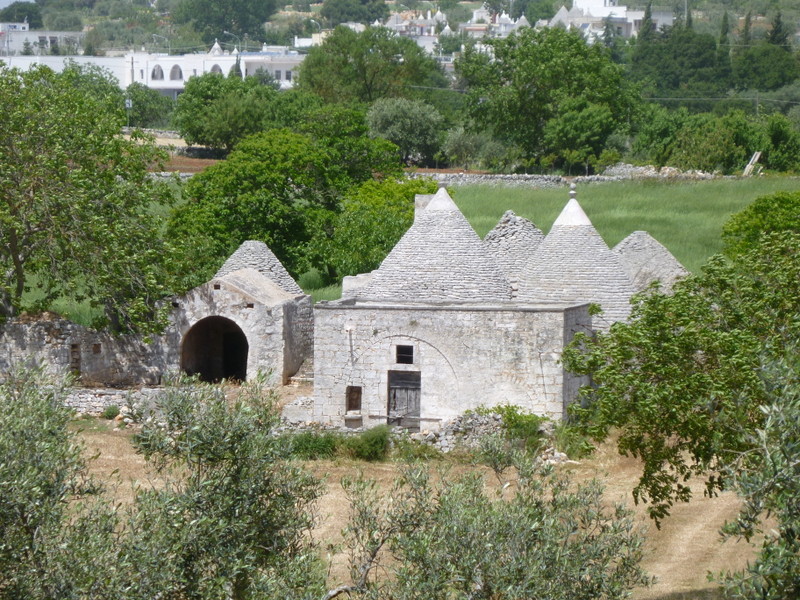
Trullo

Traditional dwelling in Puglia, particularly in the area of Alberobello. The trulli give the landscape a fairy-tale-Tolkien-kind of feel.

Franca, and Alberobello on our way to Polignano a Mare. The landscape is dotted with trulli lending a Shire-like aspect to the terrain. These traditional structures, particularly present in Alberobello, are adapted in new construction as well.  Martina Franca is an incredibly lovely town with piazzas strung together, dotted with charming restaurants and friendly, welcoming residents. It is, in the words of writer Fred Plotkin “the best of what Italy has to offer.”

Martina Franca

You’ll not find a prettier town in Puglia. Kind people, great food, welcoming green spaces.

We intended to stop for a light lunch, having sworn off midday pasta after Thursday’s gluttony. But when we invaded Ristorante ai Portici, the waiter/owner kept the food coming (Si mangia troppo) from a free starter through a giant salume and cheese platter he insisted we must have because Ric’s entrée was going to take 15 minutes to cook. Once again I indulged in the local specialty fava bean puree with chicory, and once again we rolled out more-than-satiated. €75 for four people with wine (costo meno). The best part: an owner who was so attentive, so proud of his food, and a location evocative of the best of Italy in a charming Puglian town.

Polignano a Mare

Whitewashed Polignano a Mare, a pleasant stroll through quiet streets at dawn.

Polignano a Mare is a decidedly different side of Puglia, right on the Adriatic sporting a fun-by-the-sea feel. There is a charming old town, Roman ruins, and it’s not far from Castel del Monte, a Castle built by Emperor Frederico II in the 13th century. Well worth a visit as there is no castle like it anywhere on earth.

Castel del Monte

Castel del Monte

And there is food: Polignano features magnificent seafood and the Puglian specialties continued to amaze us and inspire us to find activities requiring us to expend some calories.  After two nights of stuffing ourselves on grilled orate (sea bream), alici (anchovies), octopus salad, marvelous local vegetables, shellfish pasta, and some of the very special wines of Puglia, we headed for home by way of Abruzzo. More to come….

One year

19 May

Italiano

To our friends and family, miscellaneous musings after our first year in Italy. We arrived May 18, 2012.

1. Cats do not need to go outdoors. A windowsill will do.

Dare-devil Janie on the (very wide) window sill. Libby watches from the cat tower. Window screens are a rarity.

Dare-devil Janie on the (very wide) window sill. Libby watches from the cat tower. They traded a Portland garden for a 3rd floor windowsill.

2. When Italians ask “Come stai?” they really mean it. It’s not just in passing, like in the U.S. Here it is a conversation starter.

3. Arugula is fantastic on a sandwich piadina or panino. Lettuce is for salads.

4. A scarf around your neck is really comforting. It keeps the chill off your neck and it looks good, too.

5. Walking is a terrific form of transportation but shoe leather wears out faster than car tires.

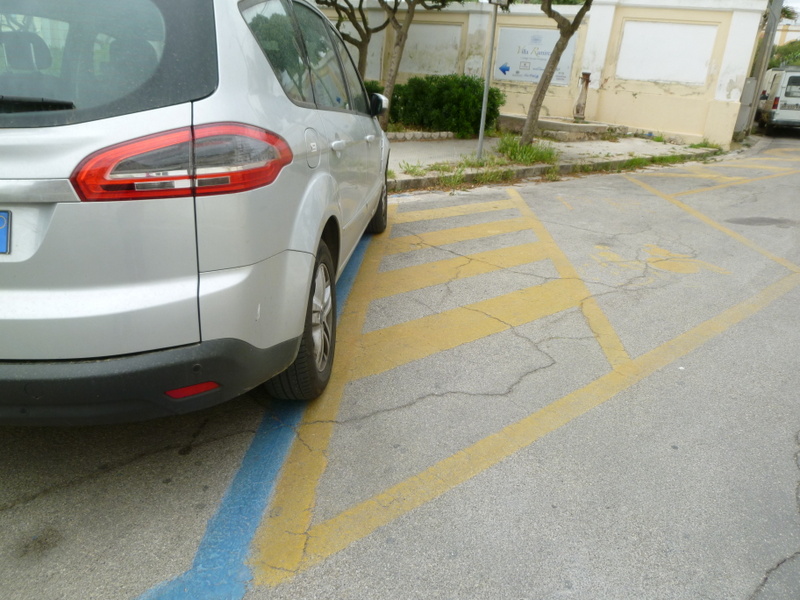
6. Parking is colorful: white (free), blue (pay), yellow (restricted) zones are interpreted liberally by drivers.

Here we see a car parked in blue stripes (pay) but overlapping onto yellow (reserved in this case for handicapped).

Here we see a car parked in blue stripes (pay) but overlapping onto yellow (reserved in this case for handicapped).

This car is parking in a free zone, as indicated by the white lines...except this is a pedestrian crossing. "Liberal interpretation."

This car is parking in a free zone, as indicated by the white lines…except this is a pedestrian crossing. “Liberal interpretation.”

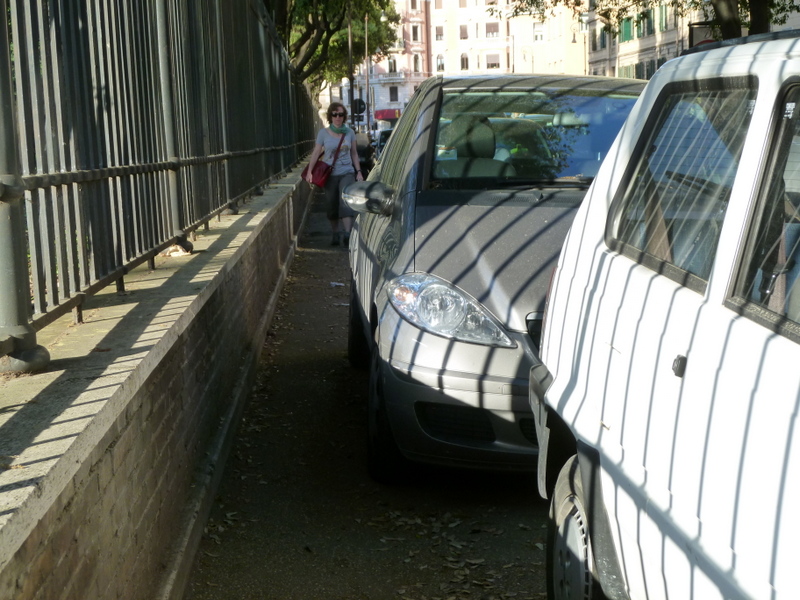
If there's no room in the street, just block a sidewalk. Pedestrians be damned!

If there’s no room in the street, just block a sidewalk. Pedestrians be damned!

7. I’d hate to be in a wheel chair in Rome. (See above)

8. Privacy is an American concept.

9. Dinner does not have to be a protein, a starch, and a vegetable. The American “square meal” is no longer a part of our lives.

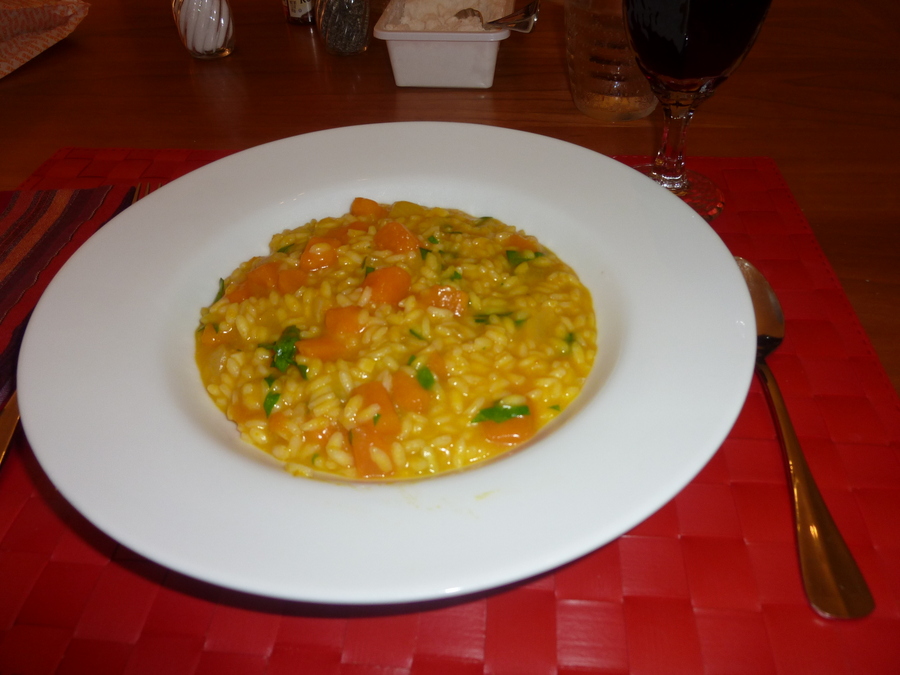
Risotto all zucca

Pumpkin risotto – one dish meal, no meat, delicious local flavors.

10. Fresh flavors need little help. We have tossed out many of our spices.

11. Starbucks is NOT an Italian experience.

No  "Grande Americano" here: a single shot espresso gets us going in the morning. We have a few throughout the day.

No “Grande Americano” here: a single shot espresso gets us going in the morning. We have a few throughout the day. Pastries only on the weekends…or holidays…or vacation.

12. Being a repeat customer is heartily acknowledged. When was the last time your “regular” waiter greeted you with a kiss on the cheek?

Celebrating one year in Italy, here we are in Martina Franca.

Celebrating one year in Italy, here we are in Martina Franca, Puglia.

Things are different here

30 Mar

Banking, shopping, mammograms: there are many differences here in bella Italia.

Banking was invented in Italy. In fact, the oldest bank in the world is Monte dei Paschi di Siena, which is in deep doo doo over some questionable transactions…but I digress.  We needed to open an Italian bank account so we could pay some local doctors’ bills. The process of opening the account was akin to closing on a house, only more difficult. It took several days and 3 visits to the bank, but no money was deposited until the account was open and we had a fistful of documents in hand to prove it. Only then were we allowed to deposit money.

And about depositing money: We get reimbursement checks from various sources that we deposit here rather than send back to the U.S. for deposit. One day I popped into the bank with four checks, totaling about $150. No deposit slip is necessary; you just tell the teller your account number. For a deposit of four checks, 10 pieces of A4 paper are generated. Each check requires two (one for me, one for the bank), and the deposit itself requires two (same drill). I signed five times to deposit four checks. They are very nice people, very accommodating, and the experience is very personal, as opposed to the no-human-touch-required ATM deposit.  As long as our balance is correct…but many trees sacrificed their lives.

On the other hand, no trees are harmed in creation of bank statements: everything is electronic and self-service. When we opened our account, we received a random-code-generator token for secure access. It’s quite efficient and more advanced than the 3 online banking systems we access in the U.S.

Paying bills is a matter of making a wire transfer. If you want to pay a doctor’s bill, unless you are paying in cash which is quite common, you need the doctor’s International Banking Number as well as bank name. Simple and not too costly. I marched into the bank armed with this information only to be asked by the teller “what is this payment for?”  Hmmm, seems a bit intrusive and personal to ask what I am paying a doctor for. How detailed to get? I mean what if you had something rather, um, sensitive and personal done? Do you blurt out “pap smear” or “wart removal?” (Neither of which were involved I might add.)  I opted for a rather vanilla “medical consultation,” then hours later realized that without an invoice number, perhaps the recipient of the payment might find information beyond the patient name useful in matching payment to service.  Still, a potentially awkward moment; No HIPAA rules here. I’m sticking with “medical consultation.”

Campo dei Fiori

Campo dei Fiori market. Let the vendor select your produce or risk a scolding.

Shopping has oh-so-many differences from the U.S.  First, it can be rather disjointed. Megastores are few, and out in the suburbs. One may need to go to many stores to accomplish what a stop at Target would do. I like small businesses and wandering around Rome, so it’s an opportunity to poke my head into various establishments. But sometimes it is hard to know where to go to get what. Light bulbs, for example, are most likely in an electrical shop, although there are some in the larger grocery stores. Need a curling iron? Don’t try a beauty supply store; go to an appliance and electronics shop.  Cosmetics? A profumeria of course.  If all else fails, try a ferramenta, which is a household goods store with everything from toilet paper to wine glasses, but in the tiniest stores!

Store hours also need to be considered. The larger grocery stores are usually open continually, but a ferramenta or an electrical shop might close from 13:30-16:00. A large wine shop near us does this, even on a busy Saturday, as does Ric’s favorite men’s clothier. They re-open from 16:00-20:00. Since one does not eat before 21:00, these are prime shopping hours.  Even the electronics giant Euronics takes la pausa on Saturday and they close on Sunday, limiting recreational shopping. Quality of life versus consumerism: interesting concept.

At the outdoor markets, like Campo dei Fiori (think large Farmers’ Market in the U.S.) one never touches the produce. Let the nice vendor help you. Be prepared for questions like “What are you going to use them for” when you ask for tomatoes: “For sauce or to eat?” You’ll get different tomatoes based on the answer.  Or the fish monger might ask “How many people is this for,” then argue with you about whether you are buying enough. (He’ll also want to know your method of preparation.)
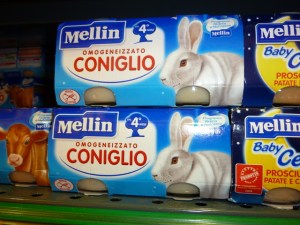
Rabbit babyfood

Pat the Bunny? No eat the bunny, Babyfood in flavors attuned to Italian tastes. I have not seen equine….

In the grocery store produce department, one dons a plastic glove, then bags, weighs, and prices one’s own produce. You won’t forget to do that more than once,because if in a moment of American-ness you get distracted and head for the checkout, the cassa will send you trotting back through the store to price the goods, holding up the entire line while you do so. Che imbarazzante! (I’ve only done it once.)

Milk is sold in shelf-stable cartons that do not have to be refrigerated until after opening, and eggs are always on the shelf at room temp.  There is a staggering variety of pasta of course, and the best tuna ever, packed in olive oil. Who needs mayonnaise? Ethnic foods (Mexican, Thai, Chinese) are impossible to find in a regular store. There are specialty shops, but I have not sought them out yet. However, if your infant likes parmesan cheese, salmon, or rabbit, there’s a baby food for that. 

mammografiaThis picture says almost all you need to know about getting a mammogram here: there is no virtually useless “gown.” Just strip to the waist and belly up to the bar. I was warned by the Embassy Health Unit what to expect, and provided a paper gown to take along, but geez, really, did I want to be la Americana there with the Italian women, the only one shielding her girls with a flimsy gown that was mostly coming off anyway?  So I went along with local custom.  But there’s one more surprise for those of us from a sheltered, HIPAA-indoctrinated, North American, law-suit inspired environment: many of the mammographers are men. 

As I entered the office of the senologist (breasts are their only business), I saw a man in scrubs with long gray hair, a little wild, who resembled an aging 60s rock musician. “Please God, don’t let that be my mammographer,” I pleaded silently.  I waited with the other women and was relieved to be summoned to an exam room by a lovely young woman; Take off everything from the waist up and so we begin. But could this be a straightforward get-it-done process? Of course not! She’d get me arranged in the machine then open the door to the adjoining suite and ask a question. She set me up again, and with my breast pressed inextricably between two plates of glass, open the door to the reception area and talk to another person. At one point she left me hanging (literally and figuratively) for about 2 minutes while she went through yet a third door and talked to someone else! At the end of the session she motioned to the chair where I had left my clothes and said I should make myself comfortable (Si accomodi usually means make yourself comfortable, have a seat;  but I now know it can also be used as for “lay back and relax”) and wait for the doctor. To me comfortable  (and relaxed!) is fully dressed, so I began to suit up. I had just put my bra on and had my arms in the sleeves of my blouse when a man in a white coat opened Door Number 3 and my tech beamed with a cheery Ciao bello! Buongiorno! As they consulted over some technical issue (I don’t know if he was a doctor or a computer technician), I buttoned my blouse and donned my sweater. Standing there awkwardly I asked if I should wait. “Sì” and another wave to the chair.

About 40 seconds later in sweeps another young woman who escorts me into the room where I thought the aging rocker was. Yup; He’s the doctor. I figured he was going to give me the “all clear” and I’d be on my way.  Huge office with a desk on one side, mammograms up on the large computer screens, which the doctor is studying. On the other side of the office is an exam table, which the nurse escorts me to and tells me to undress. I ask: “What are we doing?” “An exam” she says, perplexed. I had heard they do ultrasounds on most everyone…. So I strip to the waist again and lay down (Si accomodi!), only to be left there, half-naked and certainly not comfortable, while the doctor makes a phone call and the nurse comes-and-goes a couple of times. They ask me for my last films (not handy – they are in Oregon), and finally the doctor does the ultrasound.  I give great credit for thoroughness.  My favorite part (tongue firmly in cheek) was when he motioned bare-breasted me 20 feet across the huge office to see my mammogram close up, and then back again to the complete the exam.  My only question is why they even allowed me to dress between the two exams. I suspect an Italian woman would not do so, would know she was moving on through Door Number 1 for the sonogram.

In our own environment we know pretty-much what to expect, and I think in North America medical personnel tend to explain — maybe even over-explain — what you are to do, what is going to happen, what to expect. Here there seems to be a great assumption that one already knows what to expect. And of course in North America we have huge body-consciousness/privacy issues. Not worth having here….

I can hardly wait for a trip to the gynecologist.

Fish balls and snow

15 Mar

The food in Sicilia, and most especially our experience in Tràpani, is amazing. It is perhaps the best part of the trip: that and the people.

I am known by many of you to make a fine Köttbullar or Swedish Meatball. Beef, pork and veal meatballs flavored with nutmeg in an artery-clogging cream gravy.  These are the taste of my childhood.

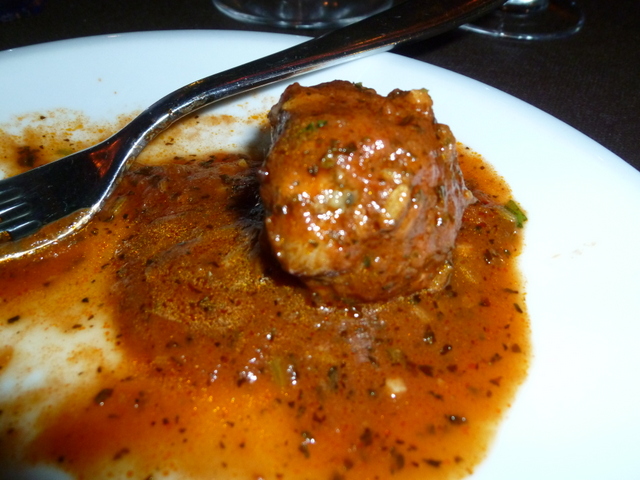
Polpette

“Fish balls’ does not do justice to this masterpiece. Better in Italian “Polpette di Sarde in Sugo.”

Normally I would not be one to order the unfortunately named item “fish balls in sauce.” Luckily it sounds better in Italian. We’ve had “fish balls” twice: once made of swordfish (polpette di pesce spade) in Palermo, but of particular note were the ones we ate last night in Tràpani – polpette di sarde in sugo – made with fresh sardines and pine nuts with mint in a rich tomato-based sauce. I wanted to lick the plate clean. I am going to learn how to make these Sicilian wonders. Anyone who is open to my trial-and-error experimentation please raise your hand, you are invited for dinner.

The polpette antipasto and accompanying fish dinner were the highlight of our day Thursday. The weather, in a word, sucks. Cold, rainy, violently windy, impossible to partake in the outdoor activities we came for. We have barely glimpsed the Egadi Islands we came here to hike. We finally drove to Erice despite the clouds and during a rare respite from the rain, but found it too cold to walk around. Bitingly cold. (We didn’t think to bring puffy jackets and gloves on our spring trip to the south.) So we passed the day reading, writing, napping. Not all that bad for vacation but not what we had in mind. Friday presented us with more of the same only worse. The winds are about 40 mph so we hopped in the car hoping to escape the brutal coastal conditions and headed inland a bit, planning on seeing Monreale and a bit of the countryside off the autostrada. Ha! We were greeted with terrible traffic and closed roads due to flooding, and a downpour that turned into sleet and snow. We turned around. More reading time today and maybe more “fish balls” for dinner.