

Fellow blogger John Henderson has done a wonderful job describing this year’s Christmas scene in Roma. Ric and I did not get to tour lights a lot before leaving for Paris and London, so I wanted to share his impressions and lovely photos. I was pleased to see that Via del Corso did indeed get decked out.
The wonder of Christmas lights
18 DecWhen we were kids, our parents used to take us out at least once every Christmas season to look at the lights in various neighborhoods of St. Paul, Minnesota. We so looked forward to those drives, wondering if the house on Snelling Avenue had the Santa, sleigh and reindeer up again this year (very special in the late 1950s/early 1960s) and marveling at the “rich people’s” houses where there were so many lights you knew they did not have any concerns about electrical bills. Our house always had a few strings of lights, but somehow the other neighborhoods seemed more exotic.
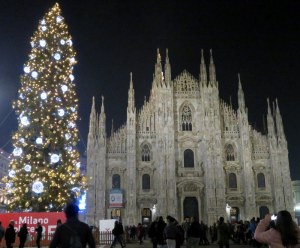
Ahhh, the Milano Duomo and its magnificent tree!
When my son was small I’d do the same thing with him although eventually these viewings became what he called forced marches through neighborhoods in Omaha and Portland as we took to our feet instead of the car. Ric and I have continued the tradition everywhere we’ve lived and traveled, with fond memories of wandering down Peacock Lane & strolling through the Grotto in Portland. In Italy the private dwellings are not the focus, it is the public lighting.
Wednesday night we traveled through Milano, stopping for one night on our way to Paris, and made a point of taking a Christmas Lights Walk. Subtle, like Roma, nothing really garish, but people were out in droves enjoying a crisp-but-not-cold night, taking the kids to see Santa, shopping, and gawking at the tree in Piazza del Duomo.
Adding to the festiveness, a live orchestra was performing in a building overlooking the Piazza del Duomo. Christmas songs done in a swing style with a proper chanteuse singing in slightly accented English (‘Ave you-self a merrrrry little Chris-mas.…) blared out through open windows and over a magnificent sound system. People were paying rapt attention even though one could not see the musicians. It truly was festive!
Click on any photo for a slide show.

Babbo Natale takes his break at a cafe, Galleria Vittorio Emanuele.

The lighting in the dome in the Galleria Vittorio Emanuele is almost painfully blue.

Swarovski’s tree dominates the center of the Galleria Vittorio Emanuele.

The mob in the street outside La Rinascente, Milano. There is a nice Christmas market in the streets around the Duomo area.

Figure skater with apple, Piazza del Duomo.

Tree in a bar in Milano. Molto elegante!

Presepe in the window at Dolce and Gabbana, Milano. This is 1/2 of the giant Neapoletan-style creche.

Porta Venezia lights. Origins go back to Roman times, but this sructure is from the 19th century.

Milano has a theme called “Yellow Christmas” near Porta Venezia. Un po’ strano.

Holiday lights in public garden, Milano Porta Venezia.

Children’s Christmas village in Milano near Porta Venezia.

Babbo Natale receives kids in a very low-key style in Milano Christmas Village. Note the parents taking their own photos!
I am looking forward to the French experience in Paris where I understand the lighting is far less subtle.
Holiday lights in Roma
15 DecTomorrow we head to Paris then on to London for Christmas. I am told by Italian friends that the Christmas lights in Paris are fantastic. I am excited to see them as Roma just is not as sparkly this year as it has been.
The tree in Piazza Venezia is grand, and the one in Piazza San Pietro certainly is grand, although we have not been able to get over there at night yet. (We have until January 6 to do so.) Many of the lights in Roma are sweet, subdued, befitting Roma’s usual level of lighting, soft and amber.
I am disappointed that Via del Corso is lacking lights this year. For the past four holiday seasons, lights have been strung from Piazza del Popolo to Piazza Venezia. This year — at least as of last Thursday — nothing! I guess that goes along with the scaled-down mercatino in Piazza Navona. We haven’t made it down there since it opened late last week, but it is supposed to be more about games for kids and Christmas decorations and artisanal items, instead of the junky atmosphere of years gone by. That sounds nice because it has been pretty cheesy in the past, though the children loved it. I hope to get down there at New Years.
So before we skip town, here are a few holiday scenes from Roma. At the bottom of this post, you’ll see four years of lights in Via Del Corso, from 2011-2014. Sad the tradition has not continued.
Auguri everyone! I’ll write from Paris in a few days.

Love the tree juxtaposed against the Colosseo.

More lights in the historical center. Nothing too garish.

Looks like they used the 2012 lights from Via del Corso on this street a couple of blocks away.

Sparkling ball, one of a series hung above one small street.

Giant Menorah in Piazza Barberini.

Umbrellas floating over a street near the French Embassy.

A side street in the historical center.

Tree in Piazza Venezia, nearing completion.

Piazza San Pietro. The tree is large, but dwarfed by the basilica, as is everything in Roma.

Tree in Piazza San Pietro.

Close up of the creche in Piazza San Pietro.

The entire creche at San Pietro is huge.

Pilgrims arriving to go through the Jubilee Door at San Pietro. The Jubilee started along with the Christmas season on Dec, 8.

Tree and nativity in the lobby of our building. Traditionally the portiere puts up a tree.

Nativity scene in the lobby of our apartment building.

Via del Corso 2011, 150th anniversary of the Italian State.

Via del Corso 2012

Via del Corso 2013
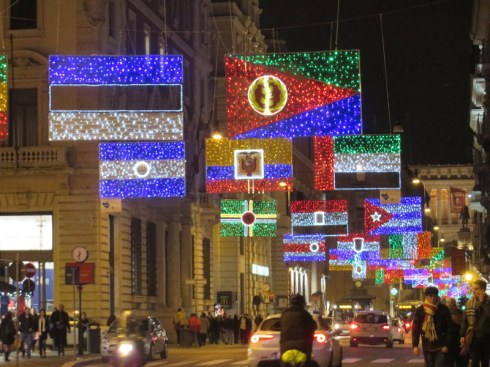
Via del Corso 2014
Signs
12 DecSo many interesting and amusing signs. Thought I’d share a few.
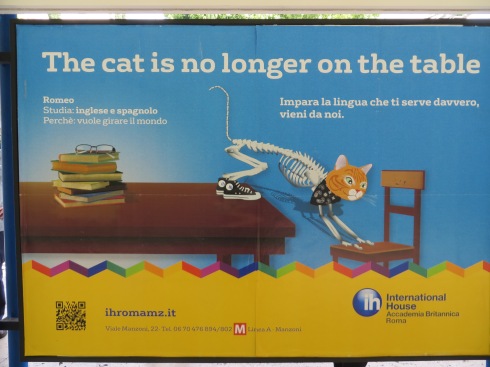
Add for an English-language school. What does this have to do with learning English?
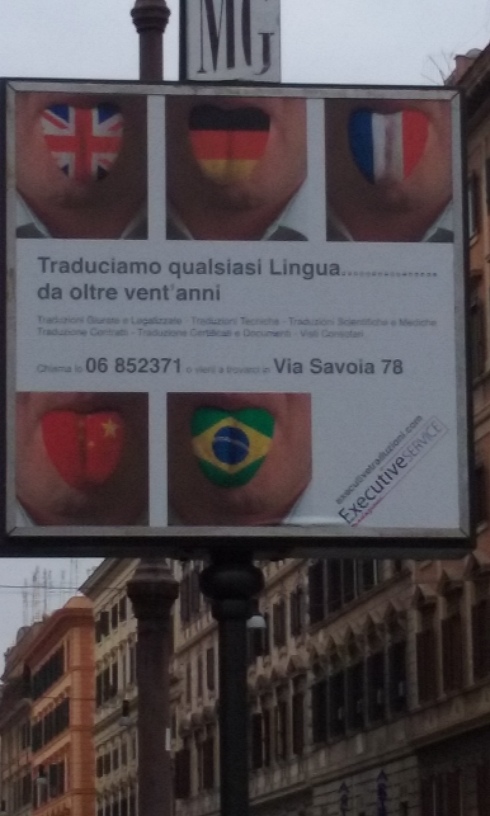
Signboard advert: Gives new meaning to multilingual. The Italian word “lingua” means tongue.
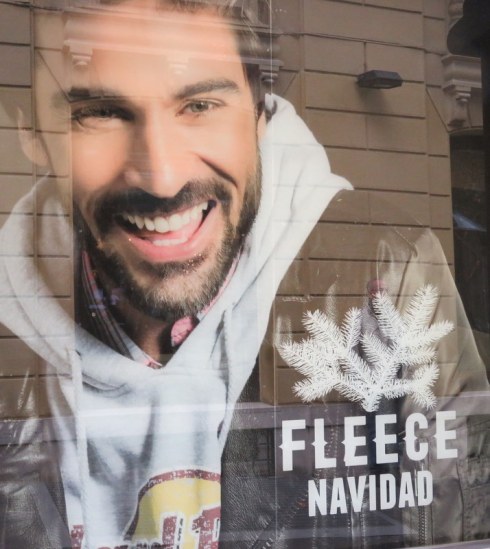
Fleece Navidad…Get it? American Christmas music is huge here, considering there is not a lot of Italian seasonal music, but I don’t know if non-English speakers would really understand this pun. In Italian fleece, as in a jacket, is “pile.”
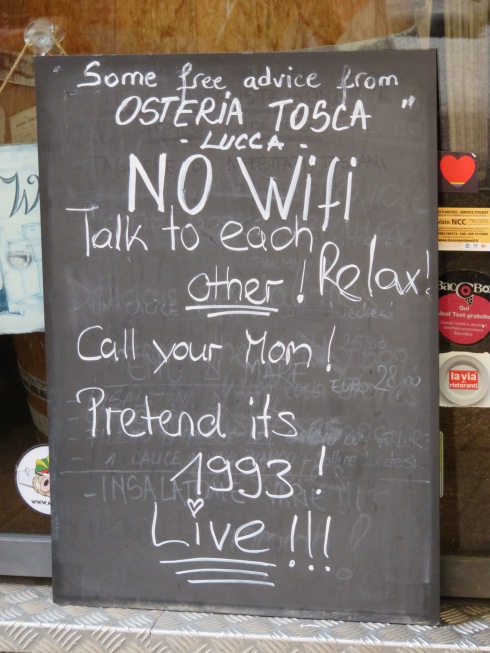
I know this was a favorite from a blog I posted recently. Worth another share.
Out and about
5 DecSo what do we do every day here in Roma? Surely every day cannot be like a vacation. We have to run errands, do laundry, go to the doctor, clean the cat box, drink wine and exercise, just like people everywhere. But one of the things we do is intersperse the mundane with field trips. We might go to a museum with a special exhibit, to a movie (in English with reserved seats), or revisit a site we saw a few years ago. Such was the case yesterday.

San Giovanni in Laterano’s magnificent facade only dates to the 18th century.
We headed out into weak December sun to return to San Giovanni in Laterano, one of the four Papal Basilicas. We last visited in October 2010, so it was about time.
San Giovanni was the first Christian church established in Roma, by Emperor Constantine in 318 A.D., and it is the home church of the Bishop of Rome, Papa Francesco. In fact, it was the home of all popes until the renovation of St. Peter’s and the expansion of the Vatican during the Renaissance. It is not Italy, it is part of the Vatican State.

Internal view with the Naval service in progress.
On arrival at this magnificent basilica, we found it thronged with military personnel, primarily from the Italian Navy. They were commemorating their patron saint, Santa Barbara. In the U.S., if this were a military event at say the National Cathedral in Washington, D.C., it is unlikely we would have been allowed to wander in and play tourist. But this is Italy, with no separation of church and state by the way, and the only price to entry was having a Carabinieri officer look in my purse to ensure I was not carrying anything explosive.

Renaissance ceiling of the basilica. Stunning!
Instead of an empty church with tourists wandering through, we were fortunate to observe the basilica being used for its intended purpose, a service. Here is a link in Italian about the observance. On land and sea, the Italian Navy celebrated Santa Barbara yesterday, inviting their colleagues from the army, Carabinieri, Vigili del Fuoco (firefighters), and others who share the patron saint. There was an orchestra and chorus that opened the service with a captivating rendition of Handel’s “Thine is the Glory,” sung in Italian. I can only assume that is a piece with some tradition and meaning for the Italian Navy.

Close up of the doors, originally from the Curia. The acorn “studs” date to the 3rd century.
Though little remains of Constantine’s original church (mostly rebuilt after 1600), the art and architecture are definitely worth a visit. There are massive bronze doors from the ancient Roman Curia (Senate House), moved here in the 17th century, and the golden columns from the Temple of Jupiter which used to stand on the Capitoline Hill. The enormous statues of the 12 apostles stand guard over the nave with a fabulous Renaissance ceiling overhead.

Columns from the Temple of Jupiter.

The Baldacchino over the altar. See the little statues in the upper cage? Those are silver reliquaries of St. Peter and St. Paul which contain pieces of their heads.

Bigger than life St.Matthew.

Big big doors, appropriated from the Senate House. The purple smudge is me.
We took our leave as the solemn Mass began. There was another church on our itinerary: Santo Stefano Rotondo.
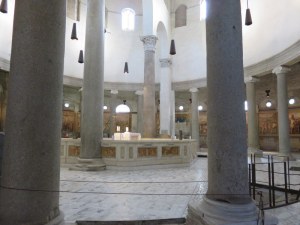
The sanctuary at Santo Stefano Rotondo. The ancient walls with frescoes surround the sanctuary.
Santo Stefano is an eerie little church built, as the name implies, in the round. Why eerie? This 5th-century church built on top of a Roman Mithraeum and named for the first Christian martyr, Santo Stephano is decorated with frescoes depicting the martyrdom of some 34 saints. No one could describe this scene better than Charles Dickens did:
“To single out details from the great dream of Roman Churches, would be the wildest occupation in the world. But St. Stefano Rotondo, a damp, mildewed vault of an old church in the outskirts of Rome, will always struggle uppermost in my mind, by reason of the hideous paintings with which its walls are covered. These represent the martyrdoms of saints and early Christians; and such a panorama of horror and butchery no man could imagine in his sleep, though he were to eat a whole pig raw, for supper. Grey-bearded men being boiled, fried, grilled, crimped, singed, eaten by wild beasts, worried by dogs, buried alive, torn asunder by horses, chopped up small with hatchets: women having their breasts torn with iron pinchers, their tongues cut out, their ears screwed off, their jaws broken…. So insisted on, and laboured at, besides, that every sufferer gives you the same occasion for wonder as poor old Duncan awoke, in Lady Macbeth, when she marvelled at his having so much blood in him.” Pictures from Italy (1846)
Please click on any photo for a larger view and caption. Warning: some rather gruesome images!

Beheading seem tame by comparison to some other methods….

Beneath Santo Stefano is a 2nd century Mithraic temple.

Detail of a capital, Santo Stefano Rotondo.

The peaceful garden at Santo Stefano. Off limits to the likes of us.

I do not know my saints and their martyrdoms, but this fresco is all too vivid.

How peaceful this saint looks while having her head threaded on a skewer.

I believe this is St. John the Evangelist the being boiled in oil.

Some of Santo Stefano’s many frescoes are in the process of being restored.
 Girovaga