Archive | Travel RSS feed for this section

One night stand

26 May
Ric on the trail. Bellissimo!

Ric on the trail. Bellissimo!

Like a beautiful dream, one night in the mountains of Abruzzo left us wishing for more: One night was simply not enough to satisfy. On our way back to Rome from Puglia, we decided to spend a night in Ornano Grande, in the shadow of the tallest peak, the Corno Grande. We sped our way north from Polignano a Mare arriving in time for lunch and an afternoon hike. Not a soul was in sight in the high meadows, only a little horse to greet us looking for apples or carrots.  Once again the food was amazing, the wine abundant, and we spent a peaceful, restful night. There are myriad little towns and hamlets, and many mountain trails to explore. We’ll go back for the 4th-of-July weekend as it is only 2 hours from Rome.

I’ll leave you with additional photos of this magnificent place. In fact, it is much like Oregon, but the food is better.

Forca di Valle

Cute trattoria in Forca di Valle where we feasted before the hike.

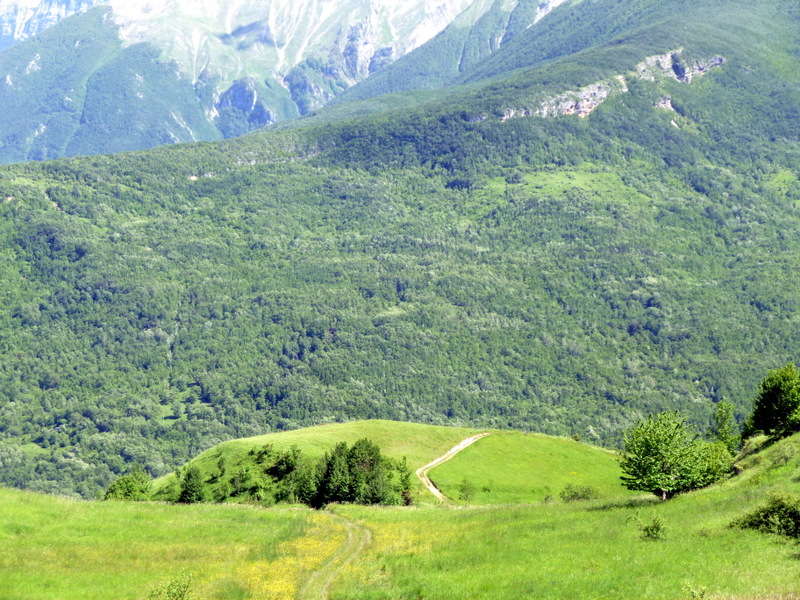
Trail

The trail we hiked across a mountain meadow near the Corno Grande.

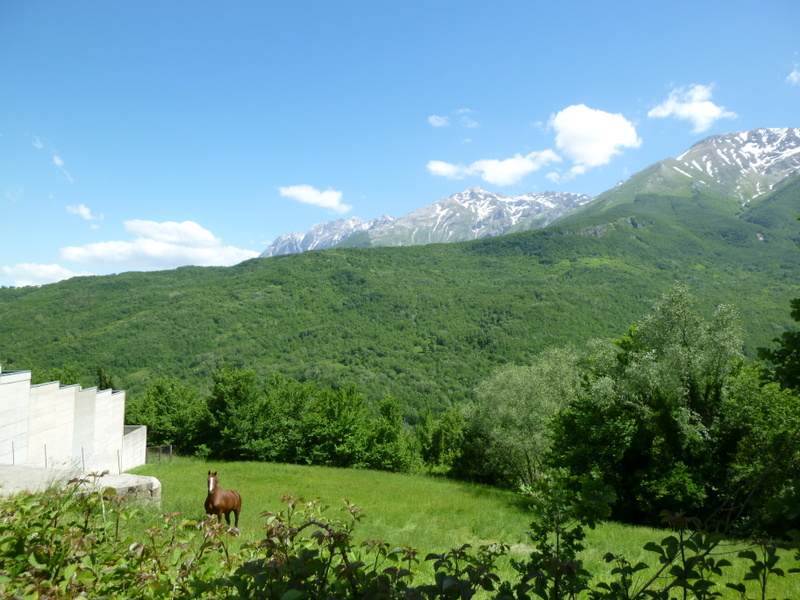
Horse in meadow

The only soul we encountered while hiking was this little horse, who was certain we had an apple for him. Next time!

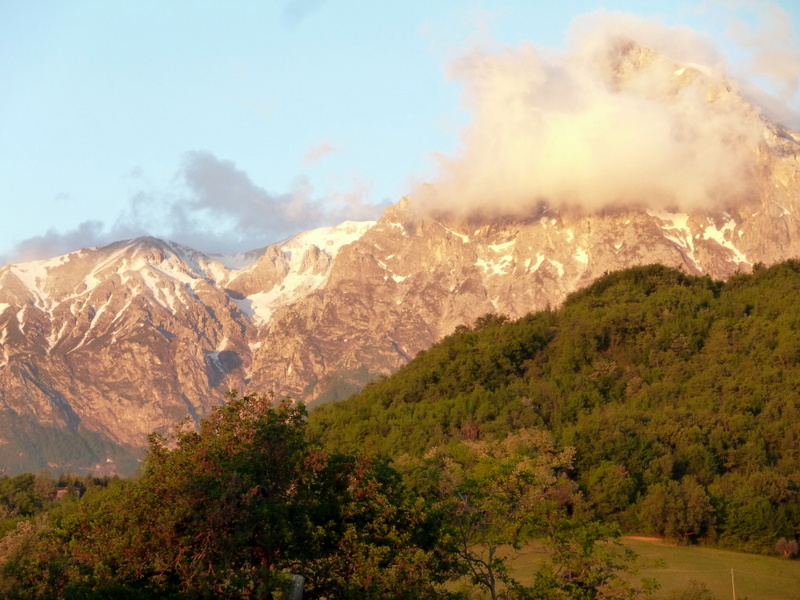
This is the view from our room that greeted me upon rising: Sunrise on the Corno Grande.

This is the view from our room that greeted me upon rising: Sunrise on the Corno Grande.

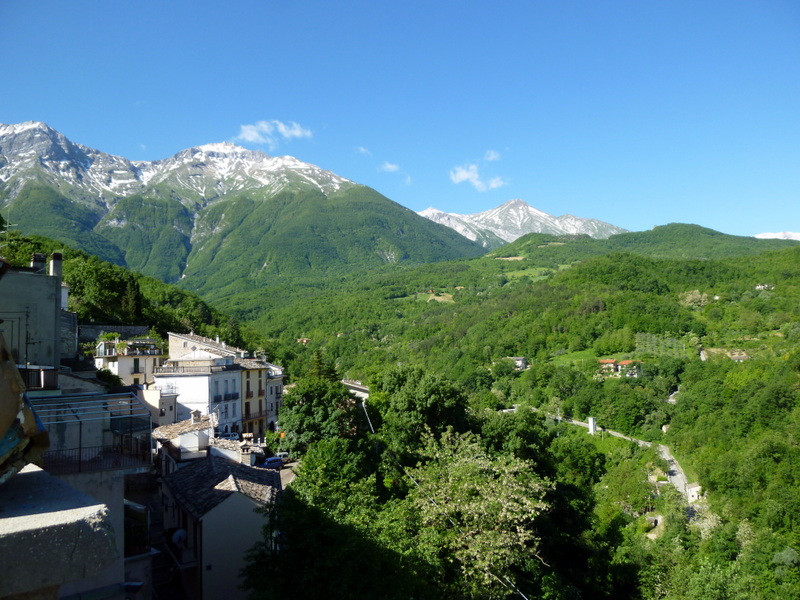
Castelli, Abruzzo

The little town of Castelli, ranks as one of the Most Beautiful Villages in Italy. (Yes, there’s an official list.)

Si mangia troppo ma costo meno

21 May

When he learned we were going to Puglia, un ragazzo in our neighborhood regaled us with stories of how beautiful it was, and especially how well we would eat for very little money. “You’ll tell them ‘Enough! No more food,’” he said. Two days into our trip to Puglia his words rang in our ears. Si mangia troppo, ma costo meno. (You’ll eat too much but it costs less.)

Beach castle

Squat towers and castles dot the area in the heel of the boot. Originally built to protect from Saracens and other invaders.

This is a vast region, in the heel of the boot, with squat medieval castles and windswept shoreline, where whitewashed villages tumble to the sea. Puglia is also the largest producer of grapes in all of Italy, and ancient olive trees stand watch along the roadside. If grapes and olives are abundant, tourists are not, at least in May. We heard little American-accented English, making for a good opportunity to sharpen Italian skills.

Ristorante Antiche Mura within the old walls of Polignano a Mare.

Ristorante Antiche Mura within the old walls of Polignano a Mare.

We are traveling with my brother and his wife, who spent a few days with us in Rome. Wanting to enjoy a region none of us had visited, we chose Puglia. A long drive from Rome ended with a two-night stay in Lecce, a Baroque town deep in the heel of the boot, characterized by elegant buildings and graceful balconies. A good base for driving the heel, Lecce has also offered some great dining, new-to-us dishes, excellent wines, and is easy on the budget. There’s a lot of meat on the menus, at prices unheard of in Rome. I gravitate toward seafood, also a relative bargain.  Octopus, calamari (stuffed and sautéed), clams, mussels, orecchiette (little ears, a regional pasta), lots of vegetables, all in huge quantities made for sharing. One night the antipasto of three fish carpaccio could have fed a family of six! Still, we ate it all (it’s only fish!) followed by a serving of orecchiette con ceci e vongole (ear-shaped pasta with chickpeas and clams) served in a small vat for me. Chickpeas in pasta seems like a double-hit on carbs, but it is de-li-cious! My Ric ordered lamb and had four large chops, grilled to lamby-perfection. Brother Rick and Jane ate similarly, yet with two

Gallipoli

Gallipoli in Puglia is still a working port with a charming old town and, of course, a castle for protection.

bottles of very fine local vino, our bill was about 20% less than the same meal would cost in Rome.

Night number two was even more remarkable! At tiny little Cucina Casareccia in Lecce we were treated like family.  Here we discovered the Puglian delight of purè di fave con chicoria (pureed fava beans with chicory), accompanied by antipasti della casa, verza con pecorino, (Savoy cabbage sautéed with pecorino cheese) and also a very fine octopus stewed in a special Puglian style.  €25 per person with great house wine. Si mangia troppo, ma costo meno. This is a place you will not stumble upon in your meanderings. It’s on a dark and otherwise non-commercial street. You have to ring the bell to gain entry; An altogether different experience.

Still, we are eating too much for a car-based trip. Ugh! At least we aren’t eating dessert.

Moving up through the region we passed through gorgeous country side, stringing together the towns of Ostuni, Locorotondo, Martina

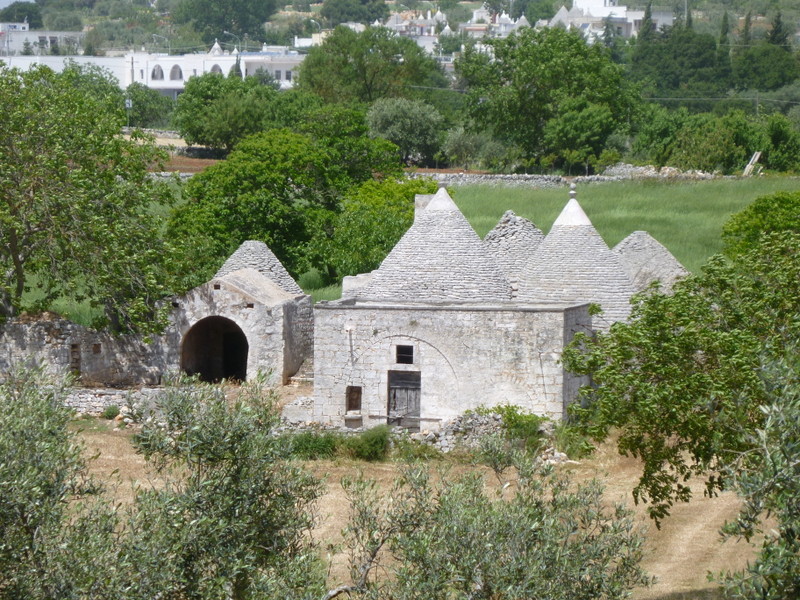
Trullo

Traditional dwelling in Puglia, particularly in the area of Alberobello. The trulli give the landscape a fairy-tale-Tolkien-kind of feel.

Franca, and Alberobello on our way to Polignano a Mare. The landscape is dotted with trulli lending a Shire-like aspect to the terrain. These traditional structures, particularly present in Alberobello, are adapted in new construction as well.  Martina Franca is an incredibly lovely town with piazzas strung together, dotted with charming restaurants and friendly, welcoming residents. It is, in the words of writer Fred Plotkin “the best of what Italy has to offer.”

Martina Franca

You’ll not find a prettier town in Puglia. Kind people, great food, welcoming green spaces.

We intended to stop for a light lunch, having sworn off midday pasta after Thursday’s gluttony. But when we invaded Ristorante ai Portici, the waiter/owner kept the food coming (Si mangia troppo) from a free starter through a giant salume and cheese platter he insisted we must have because Ric’s entrée was going to take 15 minutes to cook. Once again I indulged in the local specialty fava bean puree with chicory, and once again we rolled out more-than-satiated. €75 for four people with wine (costo meno). The best part: an owner who was so attentive, so proud of his food, and a location evocative of the best of Italy in a charming Puglian town.

Polignano a Mare

Whitewashed Polignano a Mare, a pleasant stroll through quiet streets at dawn.

Polignano a Mare is a decidedly different side of Puglia, right on the Adriatic sporting a fun-by-the-sea feel. There is a charming old town, Roman ruins, and it’s not far from Castel del Monte, a Castle built by Emperor Frederico II in the 13th century. Well worth a visit as there is no castle like it anywhere on earth.

Castel del Monte

Castel del Monte

And there is food: Polignano features magnificent seafood and the Puglian specialties continued to amaze us and inspire us to find activities requiring us to expend some calories.  After two nights of stuffing ourselves on grilled orate (sea bream), alici (anchovies), octopus salad, marvelous local vegetables, shellfish pasta, and some of the very special wines of Puglia, we headed for home by way of Abruzzo. More to come….

One year

19 May

Italiano

To our friends and family, miscellaneous musings after our first year in Italy. We arrived May 18, 2012.

1. Cats do not need to go outdoors. A windowsill will do.

Dare-devil Janie on the (very wide) window sill. Libby watches from the cat tower. Window screens are a rarity.

Dare-devil Janie on the (very wide) window sill. Libby watches from the cat tower. They traded a Portland garden for a 3rd floor windowsill.

2. When Italians ask “Come stai?” they really mean it. It’s not just in passing, like in the U.S. Here it is a conversation starter.

3. Arugula is fantastic on a sandwich piadina or panino. Lettuce is for salads.

4. A scarf around your neck is really comforting. It keeps the chill off your neck and it looks good, too.

5. Walking is a terrific form of transportation but shoe leather wears out faster than car tires.

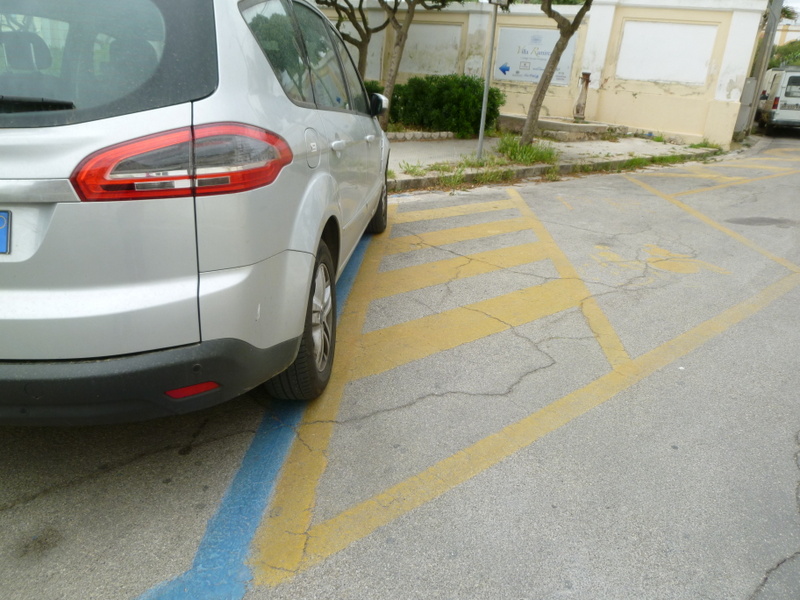
6. Parking is colorful: white (free), blue (pay), yellow (restricted) zones are interpreted liberally by drivers.

Here we see a car parked in blue stripes (pay) but overlapping onto yellow (reserved in this case for handicapped).

Here we see a car parked in blue stripes (pay) but overlapping onto yellow (reserved in this case for handicapped).

This car is parking in a free zone, as indicated by the white lines...except this is a pedestrian crossing. "Liberal interpretation."

This car is parking in a free zone, as indicated by the white lines…except this is a pedestrian crossing. “Liberal interpretation.”

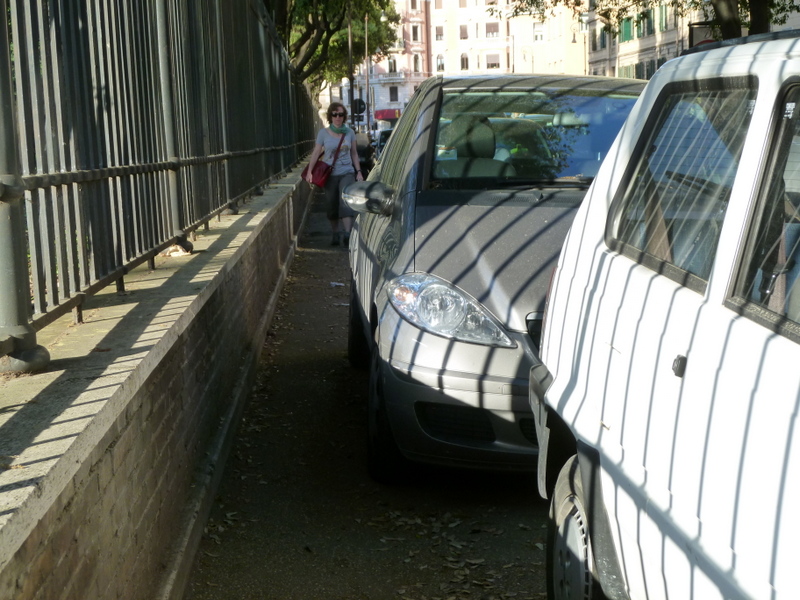
If there's no room in the street, just block a sidewalk. Pedestrians be damned!

If there’s no room in the street, just block a sidewalk. Pedestrians be damned!

7. I’d hate to be in a wheel chair in Rome. (See above)

8. Privacy is an American concept.

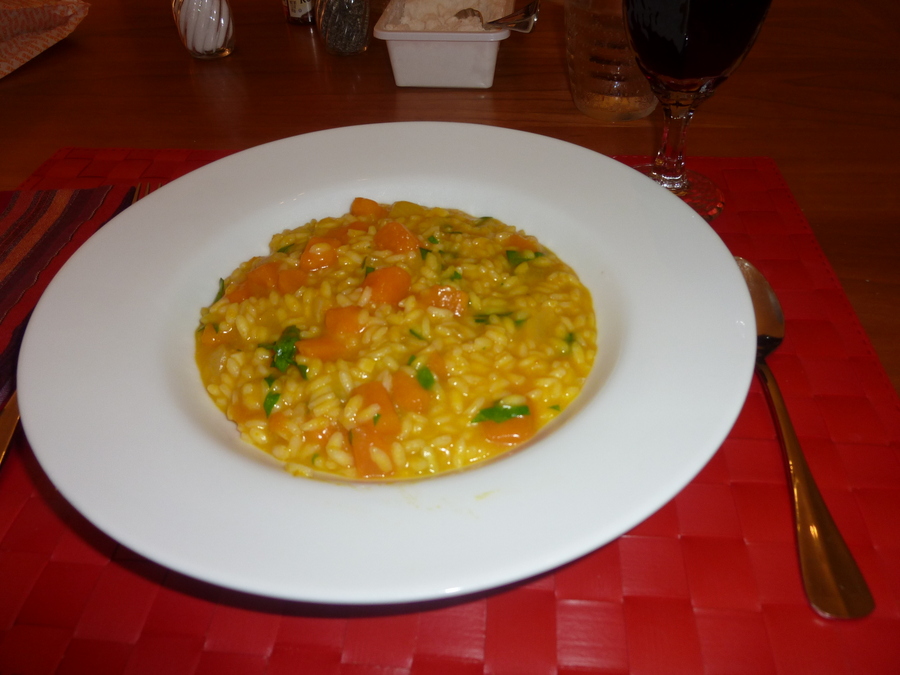
9. Dinner does not have to be a protein, a starch, and a vegetable. The American “square meal” is no longer a part of our lives.

Risotto all zucca

Pumpkin risotto – one dish meal, no meat, delicious local flavors.

10. Fresh flavors need little help. We have tossed out many of our spices.

11. Starbucks is NOT an Italian experience.

No  "Grande Americano" here: a single shot espresso gets us going in the morning. We have a few throughout the day.

No “Grande Americano” here: a single shot espresso gets us going in the morning. We have a few throughout the day. Pastries only on the weekends…or holidays…or vacation.

12. Being a repeat customer is heartily acknowledged. When was the last time your “regular” waiter greeted you with a kiss on the cheek?

Celebrating one year in Italy, here we are in Martina Franca.

Celebrating one year in Italy, here we are in Martina Franca, Puglia.

Fish balls and snow

15 Mar

The food in Sicilia, and most especially our experience in Tràpani, is amazing. It is perhaps the best part of the trip: that and the people.

I am known by many of you to make a fine Köttbullar or Swedish Meatball. Beef, pork and veal meatballs flavored with nutmeg in an artery-clogging cream gravy.  These are the taste of my childhood.

Polpette

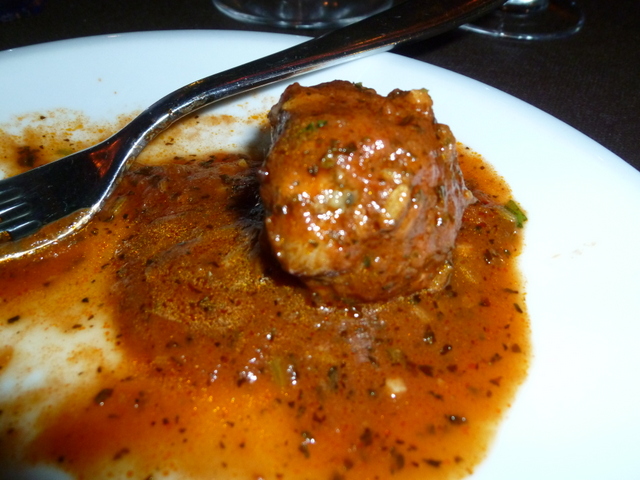
“Fish balls’ does not do justice to this masterpiece. Better in Italian “Polpette di Sarde in Sugo.”

Normally I would not be one to order the unfortunately named item “fish balls in sauce.” Luckily it sounds better in Italian. We’ve had “fish balls” twice: once made of swordfish (polpette di pesce spade) in Palermo, but of particular note were the ones we ate last night in Tràpani – polpette di sarde in sugo – made with fresh sardines and pine nuts with mint in a rich tomato-based sauce. I wanted to lick the plate clean. I am going to learn how to make these Sicilian wonders. Anyone who is open to my trial-and-error experimentation please raise your hand, you are invited for dinner.

The polpette antipasto and accompanying fish dinner were the highlight of our day Thursday. The weather, in a word, sucks. Cold, rainy, violently windy, impossible to partake in the outdoor activities we came for. We have barely glimpsed the Egadi Islands we came here to hike. We finally drove to Erice despite the clouds and during a rare respite from the rain, but found it too cold to walk around. Bitingly cold. (We didn’t think to bring puffy jackets and gloves on our spring trip to the south.) So we passed the day reading, writing, napping. Not all that bad for vacation but not what we had in mind. Friday presented us with more of the same only worse. The winds are about 40 mph so we hopped in the car hoping to escape the brutal coastal conditions and headed inland a bit, planning on seeing Monreale and a bit of the countryside off the autostrada. Ha! We were greeted with terrible traffic and closed roads due to flooding, and a downpour that turned into sleet and snow. We turned around. More reading time today and maybe more “fish balls” for dinner.

Sicilia – II

13 Mar

The weather reports indicate each day will be rainy. Luckily for us, the rain has held off until the afternoon each day, so as early risers we are able to seize the best part of each day.  Since Sicilia is such an outdoor-oriented place, we are blessed, because an entire week of museums was not the plan.

Mozia windmills

Windmills near Mozia, in the salt pans of Western Italy.

We ventured to tiny Mozia, once an important site for Phoenician traders and a very affluent city in its time, today it is an uninhabited island in the midst of the salt pans of western Sicilia.  Once again we are awestruck by the history – the truly ancient history – of this part of the world. You know the old saying: “A hundred miles is a long distance to a European and 100 years is ancient to an American.” When we encounter a place where construction was begun in the 8th century B.C., it gets our attention. Reached by a small launch in a 10-minute ride from the mainland, there’s a fine little museum and the opportunity to explore the island’s many excavations.
Tufa elephant

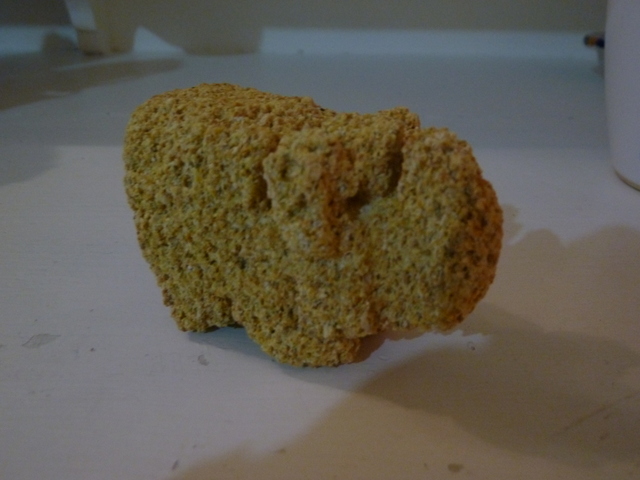
Little tufa elephant carved by Peppe Genna.

Perhaps the highlight, though, was meeting Peppe Genna, the “craftsman poet of the saltworks.”  Peppe keeps alive ancient traditions of hand-making palm brooms and carving tufa animals, holding court alongside the lagoon, selling his crafts from the trunk of his car. What a character! You can Google him and hear him recite his poetry in Sicilian dialect.

Across the lagoon from Mozia is Marsala, where the Phoenicians retreated when Mozia was destroyed by Siracusa. Of course Marsala is famous for its wines, and it is heavily influenced by North Africa, resulting in a city the looks quite different from any other we have yet encountered in Italy.  It has a lovely old center, very clean, with beautiful iron-work balconies. Perhaps not s huge vacation destination, but interesting if you are a) in the area, and b) a fan of Marsala wine.

Runis at Mozia

Ruins at Mozia; Yes that’s me in the photo.

Erice continues to hide her head from us. As we returned to Tràpani in the afternoon, she briefly cleared, only to be socked-in again before we could mount an approach as it is quite a long drive to the top.

The food here makes amends for the marginal weather. Luckily we are walking enough to indulge, although we are not filling ourselves with pastries; rather with fish, beautiful vegetables, and fresh pasta. (There’s wine, of course, and some pizza. I am, after all, traveling with Ric.) On Mondays and Tuesdays many restaurants close in low season. Tuesday night we tried three places, in the rain, before we found one open near our apartment. Although light on
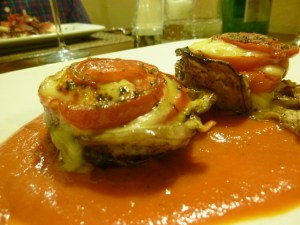
Melanzane torta

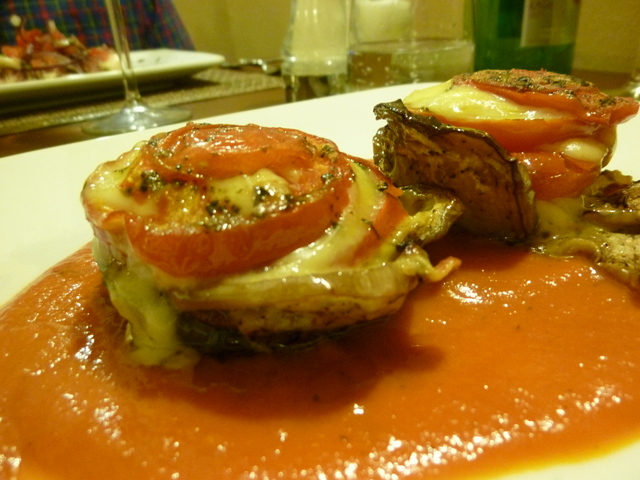
Torta di melanzane, carciofi, pomodori e formaggio. Yum!

customers this dreary night, the staff was gracious and the food divine. We feasted on octopus salad, a layered eggplant/tomato/cheese torte, pasta with sea urchins, and pasta alla Norma, prepared with eggplant and artichokes. All washed down with a fine local white wine and the meal rounded out with an almond semifreddo. We slept well after that meal.

Wednesday held a greater threat of rain – and still no view of Erice – so we braced for traffic and headed to Palermo. I was a bit worried about the reputation Palermo has for bad traffic, gritty neighborhoods, and tough characters. Nothing could be further from the truth. We encountered thoughtful, sweet people who helped us at every turn. (N.B: The drivers in Palermo are even less courteous about pedestrians than Roman drivers. That’s the only negative thing I have to say about the city.)

We navigated to a parking lot near a metro station so we did not have to drive through too

Parking chits

Parking chits look much like lottery tickets in Palermo.

much of the city. I knew parking had a “scratch off” system but really didn’t know what to expect. There are no automated ticket vending machines, so I entered a bar and inquired as to where I could buy a ticket. “Da me, signora,” said a soft-spoken, kind man who proceeded to quiz me about our plans for the day and how long we’d park, then explained the system: one ticket per hour paid, free from 14:00-16:00, so I would buy 4 tickets, one for each hour from 11:00-14:00, and 16:00-17:00, then scratch off year, month day and time, and place them on the dash. Interesting system. The parking lot was filled with cars that looked like they had lottery tickets strewn across their dashboards. As far as I can tell, the sweet man in the bar makes €.25 per ticket he sells. Plus the €1.60 we spent on caffé.
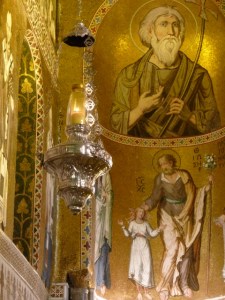
Cappella Palatina

Gold mosaics, Middle Eastern influences, the 12th century Cappella Palatina.

Proceeding by metro to the historic center, we browsed Palermo, had lunch, and visited the brilliant and beautiful Cappella Palatina. This is a 12th century masterpiece that combines Byzantine mosaics and Islamic carvings with Latin Christian tradition. Amazing.

Retracing our steps to the metro, we planned on buying tickets at an automated ticket machine, but the two in the station were broken. Figurati! With trains only every half hour, we were desirous of taking the train that was just pulling in, and not having to go to the street again and search for tickets.  So we jumped on the train and I went immediately to the Capotreno and reported our problem. (My Italian serves me well for these little transactions. I felt almost fluent in my fervor to get my problem across. To fail meant a big fine!)  I asked if we could buy tickets from him. He asked me our stop, and told me to be seated, then left. Ric thought he was going to go get his book and write us a ticket for a fine, not for transit. But at our stop, he came out to ensure we were indeed leaving his train, wished us well, and with a smile encouraged us to buy tickets “la prossima volta.”

BTW, no rain until we were returning to Tràpani. Still no Erice in sight.