Of man and machine

29 Jun
29 June 2016. Finding statues from the Roman Imperial Era is easier than finding a seat on the bus in Rome. Every museum is loaded with the statues of this era (and earlier), all by unknown artists, mostly slaves who were primarily Greek. Many of these statues are beautiful marble copies of Greek bronzes and they are EVERYWHERE. They are so common that unless you are an art historian, sooner or later you just pass them by. Statues with broken noses, exposed breasts, and missing arms and penises become quite ordinary when you see them everywhere. Until you go to Centrale MontemartiniHere the artwork is juxtaposed (I love using that word) with the machinery that once was used to produce power.
Machine works surrounded by ancient works of art.

Machine works surrounded by ancient works of art.

 
Dionysus, 4th century B.C. I love the juxtapositioning with the industrial site.

Dionysus, 4th century B.C. I love the juxtapositioning with the industrial site.

 
Huge resconstructed mosaic floor at Centrale Montemartini.

Huge reconstructed mosaic floor at Centrale Montemartini.

Centrale Montemartini was the first power plant to produce electricity for Rome, starting in the early 20th century, on the banks of the Tiber. A 15-minute walk from Stazione Ostiense brings you to this lightly-visited corner of Rome. The machinery has not been removed: rather it provides a startling backdrop for the Roman Imperial Era statues that are a part of the vast collection of the Capitoline Museum. In fact, this museum started as a temporary home for works the Capitoline could not accommodate. 


Head of a colossus, female. from 101 B.C....

Head of a colossus, female. from 101 B.C….

...and her foot. Ric demonstrates proportion.

…and her foot. Ric demonstrates proportion.

Whether you favor twentieth-century machinery, classical marble statuary, or a peaceful location, Central Montemartini has something for you. After a visit, saunter on over to Eataly for a nice lunch and some shopping before hopping the Metro, tram, or bus back to the throngs of tourists in the Centro Storico.
Fabulous mosaic from Anzio, 1st century B.C.

Fabulous mosaic from Anzio, 1st century B.C.

 
Missing body parts...perhaps the heads and arms are in a different museum. Franco Tosi was the machinery manufacturer. Still in business.

Missing body parts…perhaps the heads and arms are in a different museum. Franco Tosi was the machinery manufacturer. Still in business.

Missing the U.S.A.

19 Jun
19 June 2016. There must be something in the air causing ex-pat Americans in Italy to miss America.  I am pretty certain it isn’t Trump, Clinton or Sanders conjuring up the emotional response to missing the homeland, but a rash of articles, blogs, and posts to Facebook broke out in the past couple of weeks.
We’ve now been in Rome four years (as of May 18, 2016) and retired for one (as of May 19). We have found the experience as true ex-pats, outside the protective bubble of the embassy, to put us more in touch with what it is really like to live here. And yet we do not have to face many of the challenges working Italians that are raising families face. We have no pesky jobs.
Still, I have to say from time-to-time I get a little maudlin about not being in the United States. Rome is so beautiful and a delight to walk through when people aren’t knocking you off the sidewalk, but there are a few things from the U.S. that I miss so very much.
Clothes dryers
Drying rack on our terrace. It faces south, so when the weather is good the drying is fast. That's Libby in the foreground.

Drying rack on our terrace. It faces south, so when the weather is good the drying is fast. That’s Libby in the foreground.

You can try to romanticize the fresh-air drying, clothes warmed by the sun, blah, blah, blah. The truth is, all we have is a terrace with a rack from IKEA. The clothes come out stiff. I have never ironed so much in my life. There is nothing fresh about the motorino-scented air of Roma and if I leave them out too long, they gather pollen and dust. 
In winter, we have to hang clothes on a smaller rack in our second bedroom because they won’t dry in the cold and not enough sun hits the terrace. Drying bed sheets can take 24 hours. Give me a good old tumble dryer! We had one in our embassy apartment but running one is cost-prohibitive for the average person. Plus, there’s not room for one in our apartment.  
Ethnic food
Yes, we love Italian food. We can (and do) eat it day and night, but we miss the diversity of Peruvian, Mexican, Lebanese, Thai, Japanese, Vietnamese, and Indian available in most great cities. Certainly some are available in Roma. We’ve tried Thai in Roma and just was not comparable to anything we get in the U.S., although there is an excellent Lebanese place. On our recent trip through Switzerland, we managed to find excellent Mexican, Vietnamese, and Indian food. Oh, yeah, we had Italian, too. 
It is also challenging to find certain ingredients. I have been seeking fresh cilantro for 4 years. No dice. 
Understanding what is going on around me most of the time
How wondrous it would be to not only understand the words but also most of the pop culture references. Italian journalistic style takes some getting used to. Reading the paper is a chore for me, and I can understand the TV news only if I sit and watch it, completely focused, so I don’t. 
Family and friends and easy visits
Seeing family means an awfully big trip for one of us. We have American friends in Roma, but it is a transient community. In fact, our closest friends of the last two years are leaving this summer. 
Pedestrian-friendly sidewalks
Walking down the sidewalk is a full-body-contact sport in Roma. In the U.S. sidewalks are wide and level.  In the U.S. foot traffic moves more smoothly because there are norms. People in most cities, whether Paris or Portland, stay right or move over well in advance of any possible impact. In Roma, five people walking together expect to walk abreast of one another regardless of oncoming traffic. They gather in large groups in the middle of the sidewalk blocking passage while carrying on a conversation. People barge out of shop doors without glancing left or right. Add the bancarelli (sidewalk vendors) and cars parked on the sidewalks, and you get the picture: There’s little space left for pedestrians. 


A classic example of Roman parking: across the sidewalk, on a pedestrian crossing, in a school zone. I'm sure s/he was only going to be a couple of minutes...

A classic example of Roman parking: across the sidewalk, on a pedestrian crossing, in a school zone. I’m sure s/he was only going to be a couple of minutes…

This is our street. We live in the orangey-pink building on the left. Note the tow-away zone yet cars parked half-on-half-off the sidewalk. There is a sticker on the sign right below the arrow that says "Capito?" Ha! Never, ever do they enforce the parking law here.

This is our street. We live in the orangey-pink building on the left. Note the tow-away zone yet cars parked half-on-half-off the sidewalk. There is a sticker on the sign right below the arrow that says “Capito?” Ha! Never, ever do they enforce the parking law here.


Things working and making sense
  • Buses have no schedule because the traffic is heavy and double-parking is so rampant that the bus cannot keep to a schedule. AND the bus drivers are willy-nilly about departures from the top-of-the-route, so often 2 or 3 buses on the same line are within 5 or 10 minutes of one another and then there will be no bus for 45 minutes. WTF? Funny how in Paris you can set your watch to the bus. In Paris, the parking laws are enforced. How novel.  
  • Websites with an “events” page last updated in 2013
  • Stores that close for the afternoon just about when you have time to actually go shopping, and Post Office hours that are 8:35 to 13:05.
  • Parking in the pedestrian crossings, or on sidewalks, or anywhere the driver damn well feels like it. Arrrggghhhhh!
  • Needing to pay the cable company when we disconnect service. Yup, it costs €200 to disconnect and 60 days notice to do so. We might just test this program by not following the rules….
We recently took a cab home from Stazione Termini and the driver was incredulous that we choose to live in Roma. “Why?” he asked. “America is great. Everything works! Italy is a third-world country!” Even Italians know things don’t work here as well as in the U.S.
Talbots, Zappos, & Nordstrom
I miss my favorite stores and online shopping. We have Amazon.it (not good for clothes), and Lands End U.K. (which is good for clothes). I hate going from one tiny store to another looking for something. 
Going out to breakfast now-and-then
Real American smoked bacon is missing from my life. Along with fluffy omelets and breakfast potatoes. I don’t need them often, but more often than twice in four years would be great. 
Reading the Sunday paper (You still have them, right?)
Still we are privileged to live here. In May, we celebrated four years in Rome. Il tempo vola! My grievances are so-called First World Problems. The food in Italy is terrific, the coffee unbeatable, and the wine both excellent and inexpensive. After a recent 7-night stay in Switzerland where we practically had to sell our blood to afford wine, Italy looks mighty affordable. Our rent is less than we’d pay in Portland and we have trains
We do miss you, though, America! Baci to our friends and family. 


A tale of two bridges

7 Jun
7 June 2016. There is no question the ancient Romans were talented engineers. The Colosseum in Roma is still standing after almost 2000 years while the courthouse in Salem, Oregon, was condemned after 10 years due to construction problems.
Me at the amazing Pont du Gard. Still standing after 2000 years.

Me at the amazing Pont du Gard. Still standing after 2000 years.

At Avignon there are two famous bridges: The Pont du Gard and the Pont Saint-Bénézet. The Pont du Gard is as old as the Colosseum (1st century A.D.) and still standing, but the Pont Saint-Bénézet (aka Pont d’Avignon), built between 1177 and 1185, was abandoned in the mid 17th century as they could not keep the arches from collapsing when the Rhône River flooded. Today the four surviving arches on the bank of the Rhône are believed to have been built in around 1345 and are all that remain. It is a bridge to nowhere.
The bridge to nowhere, that is the "Pont du Avignon."

The bridge to nowhere, that is the “Pont du Avignon.”

Roman engineering triumphs, but not necessarily the Romans of today. Overall it seems to us that maintenance is not a priority. Italians wait until something is broken to fix it.
We’ve stopped in Antibes and Avignon visiting Nice and Arles while in the vicinity, followed by a few chilly days in Chamonix during which Mont Blanc refused to reveal itself. We navigated through the French train strike with minor inconveniences and we ate our share of baguettes and too much cheese. We had a fabulous pizza in Antibes, of all places, and a terrible one — one of the worst ever — in Chamonix. (I’ll blog about this one shortly at Our Weekly Pizza.)
Following are a few travel photos with captions for those inclined to click through the slideshow.
A presto!


In transito: Genova

27 May
27 May 2016. In transito means passing through, and that is what we did in Genova (Genoa to Americans, the birthplace of Christopher Columbus). We made a one-night stop on our way to the French Riviera. As we are traveling by train (as usual), breaking the trip from Roma to Antibes, France, had some appeal.
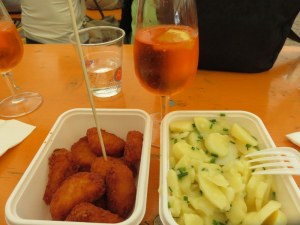
Fritto misto chock full of fried anchovies.

Fritto misto chock full of fried anchovies.

We are very fond of the food in this part of Italy, the region of Liguria, having visited the famous and famously overcrowded Cinque Terre four times, but we had never stopped much outside the five lands. Genova seems to be a city few Americans visit. While old Chris Columbo was born here, there are no “must see” sights to draw the tourist.
What we found, surprised us and we passed an incredibly pleasant half day.
The hotel was near the port, only a few minutes walk from the Aquarium of Genoa. The 20-minute walk from the train station was fine, although the last 50 meters was through an area of “working girls” even at 13:00 on a weekday. But that was the only seediness we encountered. It is an old city, with tiny alleys and ancient palazzi, and while it resembled its much rougher cousin to the south, Napoli, it was far less chaotic.
Cavour 21 - Pesto World Champ!

Cavour 21 – Pesto World Champ!

Le Nuvole Residenza d’Epoca is a gem. Created from a centuries-old palazzo that had been abandoned for decades, today it is a charming blend of old and modern, employing green building practices and old-fashioned customer service at an amazing price. 
Hotel staff led us to two fabulous restaurant experiences and the aquarium, the largest in Italy, is one of the best we’ve seen anywhere.
Trofie Pesto at Cavour 21.Yum!

Trofie Pesto at Cavour 21.Yum!

The advice to go to Cavour 21 for lunch was spot-on. We would NEVER have chosen this place on our own. In fact,  we would never have seen it. But a short walk from the hotel, we happened upon a happy crowd on an elevated sidewalk waiting for a chance to eat here. Mamma Mia! Che stupendo! We waited 25 minutes to get in, ate in about 40 minutes, and walked out for €21.00 which included a half-liter of wine. The owner is a gent who enjoys his work and the beautiful food he brings to the table. Cavour 21 won the Pesto World Championship in 2014. As you can imagine, the pesto is mighty tasty. Pesto, thin green beans, and chunks of potato are mixed into perfectly al dente trofie pasta. A shared dish of pesto, tasty seafood fritto misto with lots of acciughe, and a healthy serving of bietola (boiled beet greens and yes, they are delicious) made for a substantial lunch even though we shared everything.
A customer contribution at Cavour 21. The walls are lined with customers' sketches.

A customer contribution at Cavour 21. The walls are lined with customers’ sketches.

Osteria di Vico Palla

Osteria di Vico Palla

Down a dark alley for dinner to Osteria di Vico Palla was another winner. Low-key, popular with locals, moderately price, great food; what’s not to love? I think our dinner, with a small Italian-style tip, came to €50.00, including a wine. We ate lunch and dinner for less than we pay for most dinners out in Roma.
Cozze (mussels) marinara at Vico Palla.

Cozze (mussels) marinara at Vico Palla.

Between the meals, we managed to walk about 7 km and to see the fine aquarium, which is complete with dolphins. Well-curated in Italian and English, it was busy but not crowded on this fine, late-May day. The tanks are immaculate, the animals seem healthy and stimulated, and the displays stunning. If you get to Genova, it’s a fine way to pass a couple of hours.
We are happy we passed through Genoa. Since we’ll be in Liguria again in October, we just might have to stop in at Cavour 21 for lunch one more time.
Schoolkids on a filed trip enjoy the dolphins at play.

School kids on a field trip enjoy the dolphins at play.

Tartaruga, Aquario di Genova.

Tartaruga, Aquario di Genova.

Jellyfish at Aquario di Genova. There were at least half a dozen different species.

Jellyfish at Aquario di Genova. There were at least half a dozen different species.

More false friends

21 May
21 May 2016. As I continue to struggle with study Italian, I like to amuse myself with false cognates, or false friends: words that sound like an English equivalent but have a completely different meaning. We call them falsi amici in Italian. These are the bane of every foreign language student. If you haven’t read it already, you might enjoy my post from 2014. Here are a few more for your enlightenment or enjoyment.
Eventualmente is not something you’ll get around to, rather it means something you might do…possibly…maybe…if need be, as in “Maybe I’ll look for a new job” but you are not really motivated. If in the fullness of time something did or will happen, we say alle fine.
Attualmente is something going on at this very instant, not something that is “for real.” In Italian we might say per davvero, in realtà, or incredibilmente, depending on the context. 
A fattoria is a farm, not a factory. The place stuff is manufactured is a fabbrica. This is really confusing because fatto is the past participle of the verb for “make” so you’d think fatto=fattoria therefore “made.” Nope.
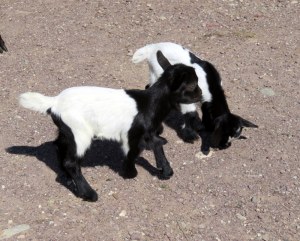
Italian sheep farm or fattoria. Not a factory.

Italian sheep farm or fattoria. Not a factory.

Confrontare does not mean to confront, but rather to compare. If you want to confront someone, the verb is affrontare.
Parente is a relative while genitore is a parent, not sexual body parts.
Cane parkingYour cane (pronounced KHAN-ay) may greet you at the door, but not allow you to lean on him for stability. One day on the bus we overheard an American couple remark “Look, cane parking!” when they saw a sign saying such and a little metal hook planted in the wall. It was, of course, a place to park your dog  with a leash tie-up.
Pretendere is demand or insist. If you are dressing up as Wonder Woman you fare finta.
Crudo means uncooked, as in prosciutto crudo, not crude. A person who is crude is rozzo.
Attendere is to await something, such as to hold the line when on the phone or to wait for the ATM screen to load, while participare is what you do when you go to the opera.
Tastare is to touch, not to check the quality of your cooking. That’s assaggiare. When one goes to a winery one does un assaggio.
In Paris we did a wine and cheese tasting, un assaggio.

In Paris, we did a wine and cheese tasting, un assaggio.

A capitolo is a chapter in a book, but Roma is the capitale of Italy.
What may be conveniente to you may be expensive to me as conveniente means affordable or suitable. Comodo means convenient as well as comfortable.
At the bottom of a letter, there is a firma (signature). This is not a company. A company is an azienda or una ditta.
A most famous firma.

A most famous firma.

Occorrere is to need, succedere is to occur.
Baldo does not describe a hairless head, but rather someone who is bold. Calvo means bald.
Accidenti is not a fender-bender: that’s an incidente. Accidenti is an exclamation like “darn it!” Safe enough to say in front of grandma.
When your computer crashes you might shout "accidenti!" (or somehting stronger.)

When your computer crashes you might shout “accidenti!” (or something stronger.)

If you want to call someone an ass, a scumbag, or a bastard, try stronzo which clearly does not mean strong. When someone parks in the pedestrian crossing, they are a stronzo. (This is not a nice word, BTW.)
Eh basta! That’s enough for now! (Basta is a perfectly nice word although it sounds rather naughty.)


Girovaga

Formerly GoodDayRome

Skip to content ↓