A walk in the park

19 Jan
Sometimes a park is just a park. Sometimes it is Italian. Sunday we took a long walk in Villa Ada, Rome’s second-largest park (Villa Doria Pamphilj is the largest) and happened upon some photo-worthy sites.
To look at a map, Villa Ada is close to our home, but it’s a bit of a PITA to get into on foot. We’ve walked along the periphery many times and waded into the shallows, but finally, we had time and good weather on our side so we ventured a bit farther.
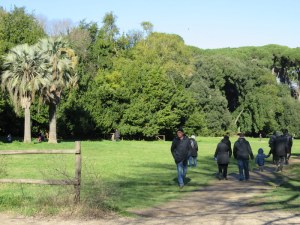
One of the busier paths, Villa Ada. We stuck to the woodsy ones, while most of the Italians embraced the sun.

One of the busier paths, Villa Ada. We stuck to the woodsy ones while most of the Italians embraced the sun.

The grounds and house were once owned by the House of Savoy, Italian royalty. From this family sprang four kings of Italy and also beloved Queen Margherita. Eventually, the estate was purchased by a Swiss gentleman, Count Tellfner, who named it for his wife, Ada. The Savoys bought it back again in the early 20th century turning it into the royal residence until they were ousted in 1946. In the 1950s, it became a public park.
Today Villa Ada is a sprawling landscape of paths, frequented by dog walkers and runners, but it also contains some surprises.
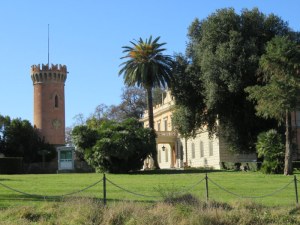
Egyptian Embassy, Villa Ada.

Egyptian Embassy, Villa Ada.

The Egyptian Embassy occupies the old royal residence. It was given to Egypt by the Savoys as a token of their gratitude for the assistance provided during their exile in 1946. Imagine walking through Forest Park in Portland and coming across armed soldiers guarding a foreign embassy. Yeah, it’s that weird.
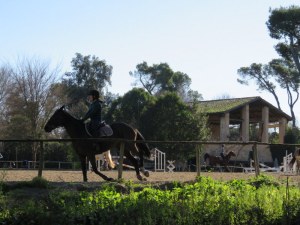
Rounding a corner in a distant end of the park, we came across an equestrian center, 3C – Country Club Cascianese. There were riding lessons in session in the lovely January sun, and it has an air of exclusivity about it, although I always think that when horses are involved. Quite a contrast to the Egyptian Embassy.
Equestrian center, Villa Ada.

Equestrian center, Villa Ada.

We’ll have to go back to explore a few more paths, and there’s an entire quarter of the park we didn’t get to. Much like our beloved Hoyt Arboretum in Portland, after a few visits we should know our way around. 
In the category of NOT a walk in the park, we had an interesting visit to our bank this week. In fact, we had three visits in two days. Ric’s debit card was cracked and required replacement, so we ventured into the main branch of BNL on Via Bissolati. We had to wait about 25 minutes to be served (there’s a take-a-number machine), but the teller was able to give him a new card and PIN on the spot. We were impressed! No waiting for the mail to deliver it to our flat! Who says Italian systems are inefficient?
All’s well until we stopped at the market on the way home. With a huge line at the cashier, my BNL card wouldn’t work.  We trotted down the street to the Parioli BNL and tried my card in the ATM. The ATM took my card! Said it was deactivated! A very nice teller in this branch retrieved it only to tell me my card was no good, that I had to go back to the branch in the center to get a new one and that she needed to destroy my card. She cut it up. 
So off we went the next day to BNL on Via Bissolati. Here the teller told me that my card was perfectly good, according to the system. “It didn’t work yesterday,” I said. He asked to see it. “No, I told you, the woman on Viale Parioli took it and cut it up.” He told me she was wrong, and since I did not bring the card to him, we should file a denuncia (a formal complaint about the “lost” property) with the Carabinieri!
I was doing this in Italian, and I hate it when they tell me “no” because then I have to enter into the realm of the Italian argument, and my skills really suffer. I am just not that eloquent and my pre-rehearsed sentences collapse in a useless heap around me. But one has to push back. If you take the first no and walk away, you absolutely will make things harder for yourself. So I pushed back. “Just because his colleague at the other branch made an error, it should not be my problem,” I told him in grammatically incorrect Italian. Much to my surprise, he agreed and said “Well next time, bring the card here if it doesn’t work,” and he went on to issue me my new card and PIN. Thank God he backed down because I am no match for an Italian who is up for an extended negotiating session!
I am pleased to report that both of us now have access to our funds, but it certainly was not a walk in the park.
Click on the photos below for a better view.

A day in the Cotswolds

17 Jan
The sun rises late in London just after the Solstice, in fact, a few minutes after 08:00. That didn’t stop us from seizing the day and taking a day in the country, thanks to the generosity of friends Carol and Nigel of the East Midlands.
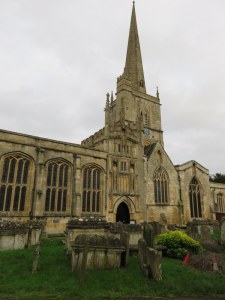
St. John the Baptist in Burford, a so-called "wool church" as it was funded by wealth from wool.

St. John the Baptist in Burford, a so-called “wool church” as it was funded by wealth from wool.

Carol and Nigel got up before the birds and motored to London on Boxing Day to fetch us for a day in Nigel’s old stomping ground, the darling villages of the Cotswolds. You know you are in the Cotswolds when you start seeing names like Bourton-on-the-Water, Chipping Norton, and Barton-on-the-Heath. Thatch roofs appear and great spires above country churches with picturesque cemeteries and nameless gravestones. It’s like a movie set. No wonder Downton Abbey, Harry Potter, Poldark, The Remains of the Day, Bridget Jones Diary and many British shows have filmed scenes here. Even on a gray winter day (no rain!), it was charming, each village cuter than the last.
On the very edge of The Cotswolds we visited Bladon, where beside the village church, Winston Churchill is buried. Not in a great cathedral, like St. Paul’s or Westminster Abbey, rather this great man is buried in the countryside near his ancestral home, Blenheim Palace.
We toured Burford, Bladon, Bourton-on-the-Water, The Slaughters and more than I can remember. Nigel took us along twisty-turny roads I might not successfully navigate even with left-hand drive. A day is not enough. One only gets a sense of the peace and beauty of the English countryside. Best to come back when one can walk the paths through the green hills.
We wrapped up in Oxford, and while it was quiet on a holiday, it was nice to see the fabulous architecture without tourist hordes. We took so many pictures it has taken considerable time to sort through them. Here I offer you a taste of this gorgeous landscape, although remarkably we did not think to get a group picture of the 4 of us. Click on any picture for a larger view and full caption.


This and that

12 Jan
Our trips supply us with anecdotes far beyond the pictures we take, and often provide memories we talk about for years: Our two collie puppies running on moonlit Cannon Beach in Oregon on New Years Day at 6:00-God-help-us-AM; A priest roller-blading, cassock flying, on Via Arenula; A beautifully dressed, kind Italian businessman personally guiding us when we were lost in Spoleto;  Running into a pack of Portlanders on a mountain ridge in Italy on Christmas Eve. Here are a few more tidbits from our trip to London, Paris and Switzerland.

Italian moments

I was amazed at how often we encountered the Italian language and Italians outside of Italy. I heard Italian every single day, whether in the street, on a train, or in a restaurant or a shop. It made me miss Italy.
Parisians can find panettone, pandoro and other Italian treats, too.

Parisians can find panettone, pandoro and other Italian treats, too.

On Christmas Eve at Dean Street Townhouse our waitress was from Italy. It felt like home to order and chat in Italian.
Even in the north of Switzerland, we heard Italian daily. Our waiter at Punctum, where we found an amazingly good pizza, was Italian. You can read about it on my other blog, Our Weekly Pizza.

That small town feel

Many years ago, we traveled to my adopted hometown of Lindstrom, MN for my mother’s 80th birthday. The day we arrived there was a huge snowstorm and we were going to be very late getting from MSP to little Lindstrom. We called the motel and we were told they’d leave the key under the mat for us.  How cute is that?
No picture of Hotel Chur, so here is a serene little alley in the Alt Stadt, on our way to Punctum for pizza.

No picture of Hotel Chur, so here is a serene little alley in the Alt Stadt, on our way to Punctum for pizza.

We had a similar experience in Chur, Switzerland. Coming all the way from London, we knew we would not arrive until at least 10:00 PM, so I contacted the hotel. As the front desk staff goes home at 8:00 PM – odd in a hotel with 58 rooms – we received instructions via email including a code to a box that would release a door entry key. Our room key would be laying on the front desk (along with many others, we saw upon arrival). We had a moment of panic when the entry key did not release easily and I had to use a nail file to finagle it, but it all worked out quite well.

Fabled names

Drury Lane, Carnaby Street, Oxford Street, Piccadilly Square, Baker Street, Covent Garden, Whitehall. How often we have come across these names in literature and history and there we were in the midst of them! London Bridge, Tower of London, Westminster Abbey, Big Ben, Buckingham Palace: fabled landmarks in a literary town. I have to say as much as I like speaking Italian, it was fun to understand every damn word whether spoken or written. No menu translation challenges. 
'Do you know the muffin man who lives in Dury Lane?' There really is a Drury Lane. Now try to get that tune out of your head for the rest of the day.

‘Do you know the muffin man who lives in Drury Lane?’ There really is a Drury Lane. Now try to get that tune out of your head for the rest of the day.

Melting pot

After dinner on Christmas Day, we ventured to the Odeon at Marble Arch to See “Star Wars: The Force Awakens.” With reserved seats, there was no need to arrive super early to stand in line, although we milled around in the lobby for a while before the theatre was clear. We heard very little English being spoken among the various family groups waiting. Predominant language? Arabic.
Carnaby was well decorated for the holiday.

Carnaby was well decorated for the holiday.

Thanks to the former British Empire, London is truly home to many cultures. As a result, ethnic food is widely available. We love Italian food, but it was a real treat to eat good Indian food in a London restaurant.

Hailo

Hailo is the Uber for legal cabs. I am not a fan of Uber. I think the drivers who are licensed and who have spent years studying their cities should get my transportation Euro, Pound, or Dollar. London’s answer is Hailo.  In about 5 minutes, I installed the app, signed up, and had a cab scheduled for 06:30 the next morning. The driver was a gem, arrived early, helped with bags, and spoke with the most amazing Cockney accent. Luckily he could understand me better than I understood him. Hailo is also available outside the U.K. It worked great and I wish it would come to Rome. Thanks to Nigel for the recommendation!

Pedestrians & parking

As a pedestrian in Roma, one watches traffic ever-so-carefully. People wear headsets listening to music when they drive, they talk on cell phones even though it is illegal, and generally pedestrian crossings are used for parking so they get little respect as pedestrian zones.  
Orderly, I tell you! Look how the women areallowed to cross the street without a motorino shooting past. And no one is parked in teh crosswalk. Heaven!

Orderly, I tell you! Look how the women are allowed to cross the street without a motorino shooting past. And no one is parked in the crosswalk. Heaven!

In Switzerland, cars screech to a halt before you even know you want to cross the street. I almost felt obligated to cross the drivers were so polite and accommodating. Reminded me of Portland.
I love that in London and Paris drivers park where they are supposed to, inside the parking zones, not on sidewalks or within the zebra stripes. It makes for such an orderly city! Most of you take this for granted, but if you’ve ever been to Roma, you know that creative acts of parking make rough going for those on foot.

Crypt café

Cafe in the Crypt. Notice the tombstones on the lower left.

Cafe in the Crypt. Notice the tombstones on the lower left.

Eating in a mausoleum? Why not? At the famous St. Martin-in-the-Field there is a cafeteria in the crypt. It’s far from the Lutheran Church basements of our youth in the Upper Midwest. This is a true crypt with ancient tombs underfoot. The food was simple, of good quality and, for London, inexpensive. (One sandwich, 2 bottles of water, coffee and tea for GBP 9.85.) It was warm, with low-lighting, a polite crowd, decorated for Christmas.
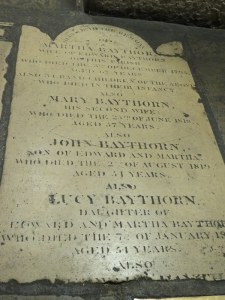
We ate our light lunch with the Baythorns.

We ate our light lunch with the Baythorns.

St. Paul’s Cathedral also has a café in their crypt. Not as big, but great for coffee and cake.
I don’t see this trend coming to St. Peter’s anytime soon. Can you imagine the crowds if you could have lunch at the tomb of a deceased pope?

The Art of the Brick

9 Jan
We have exposed ourselves to a great deal of art during our time in Europe. Rome attracts some amazing collections. Recently we saw a Toulouse Lautrec exhibit, and a couple of months ago were treated to an exhibit of the masterpieces from the Phillips Collection in Washington, D.C. at Palazzo delle Esposizioni. PdE has fabulous exhibits several times each year and we generally see them all. Then there are the regular galleries: The Borghese, Doria Pamphilj, Palazzo Colonna, etc. There is always something to see. 
Yesterday we saw one of the more off-beat and fun installations: art created from Lego bricks, The Art of the Brick. I suspected it would be entertaining, but it was absolutely enthralling to think that someone could build such items and pictures from Legos. We were fortunate to be among very few people there on a Friday morning at opening. It’s only in Roma until February 16, so if you have time, do try to pop over.
The artist, Nathan Sawaya, has connections to the Pacific Northwest: born in Washington state and raised in Oregon.
I’ll leave you to the pictures, but if you have a chance, go see this if/when it comes to a location near you. Any little Lego-builders (or big Lego-builders) in your family will love it.  Please click on any picture for a better view.

Trains, buses, and the Tube

4 Jan
It’s the little stories, observations, and encounters along-the-way that we remember far longer than we recall the stats we learn during a museum tour or even recall in our mind’s eye the finest art in a cathedral. That is certainly the case with our trip to Paris, London, and Switzerland during the Christmas season.
Love the double deckers. Sitting up front on top gives one an impressive view.

Love the double deckers. Sitting up front on top gives one an impressive view.

I have been trying to think of a way to blog about this trip. You’ve seen plenty of pictures of Christmas lights in Roma, Milano, and Paris (plus blogger John Henderson did a far better job than I ever could about Roma). A litany of the sites we saw is just another travelogue.
For the next few posts, I will share some vignettes, stories, and observations from our 4-countries-in-2-weeks trip. First up, a bit about transportation differences.
London Transportation Museum: Old-style bus.

London Transportation Museum: Old-style bus.

Italian trains and buses are anything but quiet. Bangladeshi housekeepers call their mamas in the old country on the super-affordable plan from TIM. Single travelers call everyone in their contact list (Sono in treno! Sono sul autobus!) to inform them of their transit woes. Families en route to their holiday travel with bags of food to sustain them and everyone is chatting ALL THE TIME. Ric’s mom came from the school of never let a moment pass in silence, but they would put her to shame. Italians are social creatures and constantly in touch. What they did before cell phones I cannot imagine, although personal conversation is still a strong suit. Texting happens, sure, but talking is far more prevalent. Who has so much to say? Ric and I can sit for an hour without speaking a word. We call it “companionable silence,” well-developed in 31 years.
Bernina Express . Just threw this one in as a beauty shot.

Bernina Express. Just threw this one in as a beauty shot.

In Paris, if you talk too loud on the bus or Metro you get the stink eye from the French. Conversations are sotto voce and cell phones are not used except to text, peruse Facebook, or other non-intrusive activity. How pleasant it is! The Swiss are similarly low-key, reserved, and, well, Swiss.
In London, we found people chatting a bit more, but in both Paris and London we saw a lot of people reading on the Tube, Metro or bus. Reading actual books, not on devices. One seldom sees a book pulled out on an Italian bus and it would be impossible to do on the Rome Metro since you are always cheek-by-jowl with scarcely room to change your mind. You cannot read on a Roman bus because most of them lack shock-absorbers and the kidney-pounding you take going over cobblestones makes it impossible to focus on a book.
The Metro in Rome is a dog pile. People are in constant motion. There is no queue. People can barely descend from the train before would-be riders crush forward. I have been pushed aside by young people and middle-aged men with no consideration for my gender, age, or the fact I might be dragging luggage. It is a free-for-all. The stations are filthy, the trash bins overflowing, and of course, the great tradition of graffiti covers trains as well as walls.
London Tube station. Excellent signage, lighting, acoustics. Far from Rome.

London Tube station. Excellent signage, lighting, acoustics. Far from Rome.

Ah, London and Paris, with your orderly queues, updated stations, and avoidance of unnecessary conversation! You can actually hear the announcements in a British or French tube station. The Tube stations in London are spotless, with no graffiti at least where we traveled. Even the older stations are well-maintained. I love the Parisian Metro stations that have the glass dividers that keep people from falling into the tracks and define the exit and entry points. Several Parisian men actually offered me their seats and no one pushed past me as though I were invisible. In London, we were able to sit down on the Tube most trips, thanks to a preponderance of trains and well-designed cars. Double-decker buses are, by the way, a delightful way to tour the city. I love how everyone is disciplined enough to get on at the front and off in the middle. Not quite that way in Roma…
Bernina Express interior. Lovely, quiet, comfy. Coffee cost us €4.50 each however. On Trenitalia you get one free.

Bernina Express interior. Lovely, quiet, comfy. Coffee cost us €4.50 each, however. On Trenitalia you get one free.

The Swiss train stations are oases of calm in a calm country. Well-signed, immaculate, orderly, no pushing or shoving (except by foreigners who carry their own habits along). The trains may not be as posh as the Frecciarossa or Italo Treno, but they are comfortable. With no discounting and no complimentary wine (sniff!), the Swiss railroad must be making some serious francs.
Italy, we love you! We love your trains and your warm-hearted people. We love not needing a car to travel all over the city, country, and continent. You do coffee better than anywhere we’ve lived or traveled, and we miss your food when we are out-of-the-country, but you could be just a smidge quieter and stand in line now-and-then.

Girovaga

Formerly GoodDayRome

Skip to content ↓