Archive | September, 2015

Guns and The Top of Europe

30 Sep
30 September 2015.
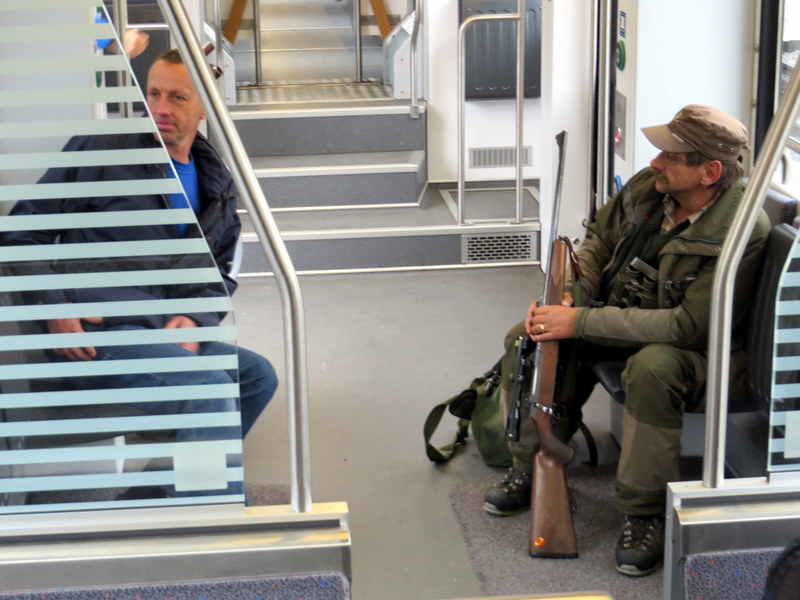
A man gets on the train carrying a gun. What would you do? If I was in France, Spain, Great Britain or the USA, I would dive for cover. But we are in Switzerland, in the Bernese Oberland to be precise, and apparently, no one bats an eye. Neither did we since he walked in accompanied by another local, and even women pushing babies in strollers were undisturbed by the sight. I am not going to pretend I understand the Swiss mindset or even the laws around firearms. This article from Time magazine on the subject is pretty interesting. I am not sure I am more concerned about the fact he was hunting in an area where people hike or carrying a weapon in public. 
When we saw this guy get on we got the giggles. Can you imagine if this happened on MAX in Portland? This was on the Wengeralp narrow-gauge cog railway.
Switzerland seems to have its act together. The Swiss have managed to remain neutral in world politics, insulated from European Union issues as they are non-EU, but they take advantage of the Schengen Agreement and the abolishment of internal borders. Still, immigration is highly controlled. They have an admirable environmental record, plenty of water resources, clean air, excellent recycling, a thriving economy with low unemployment. Their public debt is less than 35% of GDP (compared to Italy at 134% and the USA at about 71%). And of course there’s the cheese. High prices do not seem to deter tourists, especially the Japanese who are here in droves and show no reluctance to shell out hundreds of Swiss Francs to see the sights and buy winter fashions. You would not believe the price of a Patagonia jacket here.
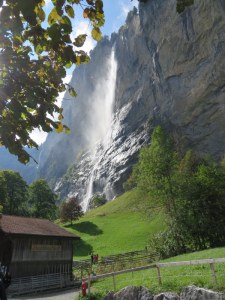
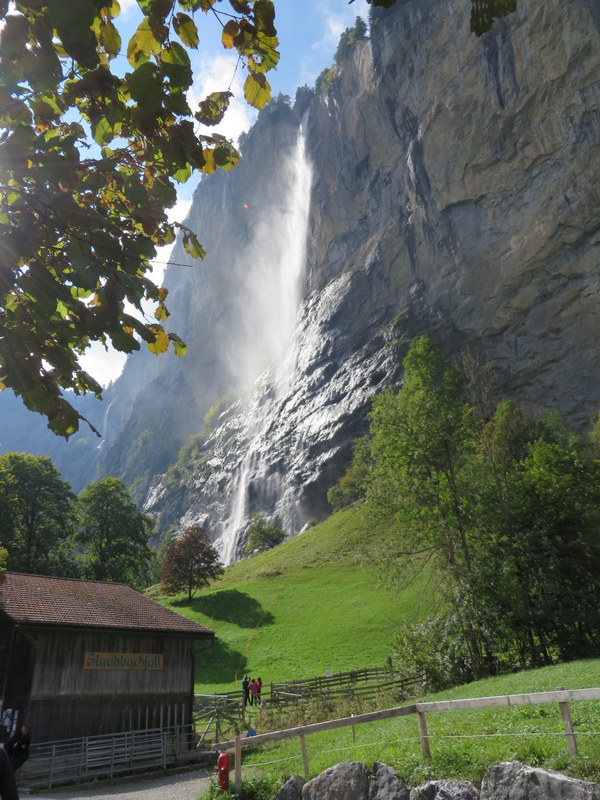
Staubbach Falls, visible from our vacation rental.
This is our third trip to Switzerland in less than 2 years. Yes, we like it. The food is not as good as Italy, and the coffee almost all comes from a ubiquitous push-button machine found in virtually every café and restaurant. It’s CHF 4.00 for a basic cup of coffee or a single shot of espresso. In fact, everything is quite expensive. While the exchange rate is almost on par with the U.S. dollar, the actual prices are high. A pizza that would cost us about $11.00-12.00 in Italy is about $23.00 here. A small green salad runs $8.50. Wine by the bottle is insanely expensive in restaurants, but one can get a small glass of good local wine for a price less than we experienced in Seattle, Portland, and San Francisco. Why do we come back if it costs so much? The transportation system, the hiking, the natural beauty: Switzerland offers a lot of what we like to do when traveling. And it works, well, like a clock.
A Jungfraujoch train moves up the mountain. Most of the journey is in a tunnel inside the Eiger and the Mönch.
I have wanted to go to the Jungfraujoch since Matt Lauer went there in 2011 during his annual “Where in the World is Matt Lauer” tour. During our first two Swiss trips in January 2014 and August 2014, we dismissed the trip to the Jungfraujoch as too expensive. It costs CHF 204.40 per person from Lauterbrunnen in the valley to the Jungfraujoch and back. We learned that with certain types of passes one could pay less, so we vowed “the next time” we would make the trip. This is the next time, so we bought both half-fare Swiss passes and a Bernese Oberland Regional Pass. We had to pay a relatively small supplement to go all the way to the Top of Europe (called so because it is the highest train station in Europe). It was worth it!
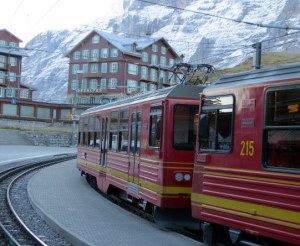
Jungfraujoch Railroad - our train ready to depart.
Jungfraujoch Railroad – our train ready to depart.
Rising at 5:00 AM, we caught the first train up the mountain, in total about 1 hour 45 minutes from the bottom of the valley to the Jungfraujoch, arriving just before 9:00 AM. Some of the “tour” is goofy. The giant snowglobe in the Alpine Sensation was unrefined, and the Ice Palace sculptures were not nearly as nice as those at the Saint Paul Winter Carnival of my youth, but the pure beauty of the pristine mountain was the star, and contemplating the building of such a railroad in the 1890s sobering. Thanks to 100 Italian laborers, the tunnel was built.
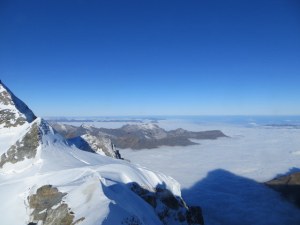
View from the Top of Europe over the cloud-covered valley. It was very cold outside!
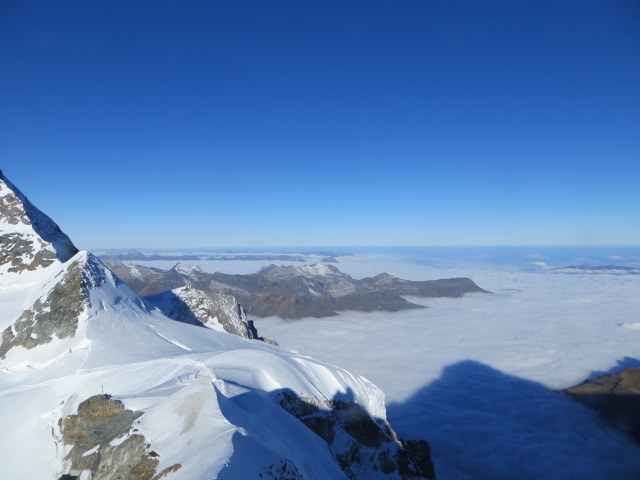

We went outside on the observation platform, but the 33 kph winds combined with the -1.5 Celsius temp reminded us a bit too much of our Minnesota and North Dakota heritage. We lasted long enough to take a few photos. Going on the sledding course was out of the question, as was the glacier walk of 1 1/2 hours roundtrip. 
We were at 11,333 feet above sea level. That is lower than the elevation we hiked to in Colorado last month, but a completely different climate. In Colorado, we peeled off layers. Here, I wished I’d had my puffy coat.
Railway Station at the Top of Europe, inside the mountain.
This was an unforgettable trip and we are glad we did it. Going early was a great strategy, at least with the weather forecast we had. We would be unlikely to go twice, so it truly was a once-in-a-lifetime experience. 


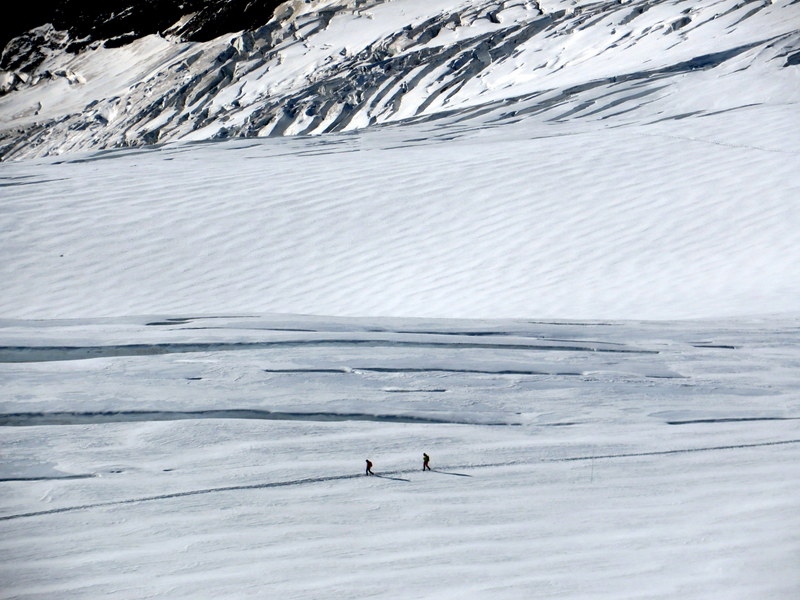
People walking on the glacier beneath the Jungfraujoch.
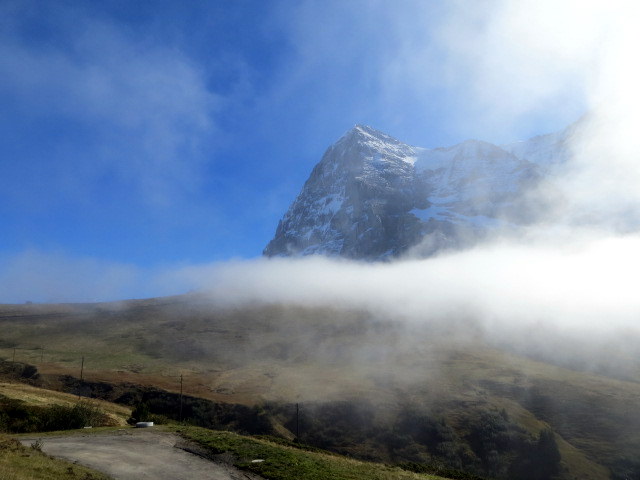
The Eiger pokes above low level clouds as we depart Kleine Scheidegg.
The Eiger pokes above low level clouds as we depart Kleine Scheidegg after our visit on high.
CHF 30,300 watch available at the highest watch shop in Europe.
View of the Lauterbrunnen Valley. Our apartment is just a bit to the left of the church.
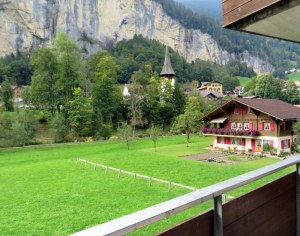
View from our apartment. We can also see Staubbach Falls from our terrace.

Zermatt

26 Sep
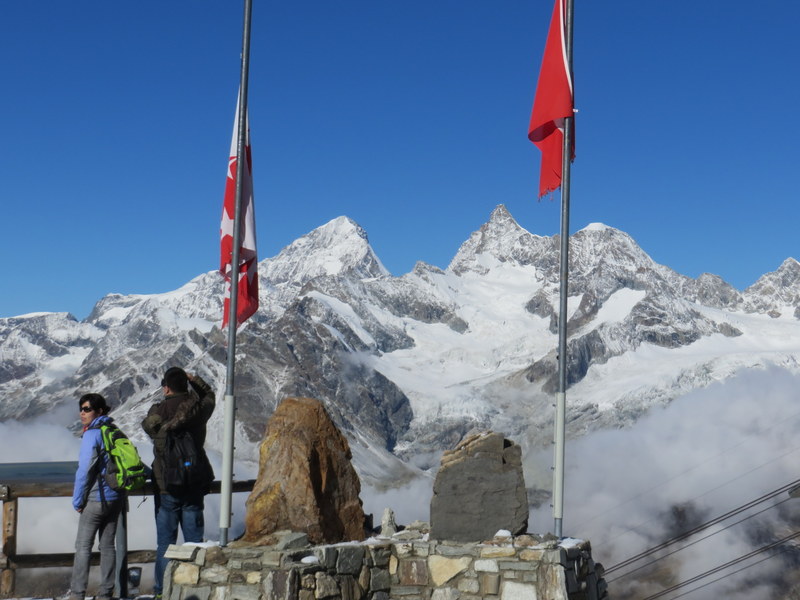
We have had a fabulous time in Zermatt. Great food, unbelievable beauty, fun transportation (who can resist a train that goes to 10,000 feet?), good exercise. Here is a small fraction of the pictures we took in the past two days. Tomorrow, on to the Lauterbrunnen Valley!
This section is about our trip to the Gornergrat, reached by narrow-gauge train. Hover above any picture to see the caption, or click on any picture to start a slideshow.  
The next day we rode gondolas to Furi and Trockener Steg, then hiked around Furi. Hover above any picture to see the caption, or click on any picture to start a slideshow.
Here a few miscellaneous pictures around Zermatt. 
Local color: alpine horn players in Zermatt.

Local color: alpine horn players in Zermatt.


Sunset paraglider in front of the Matterhorn.

Sunset paraglider in front of the Matterhorn.

Garden gazebo.

Garden gazebo.

At the florist.

At the florist.

Fall flowers.

Fall flowers.

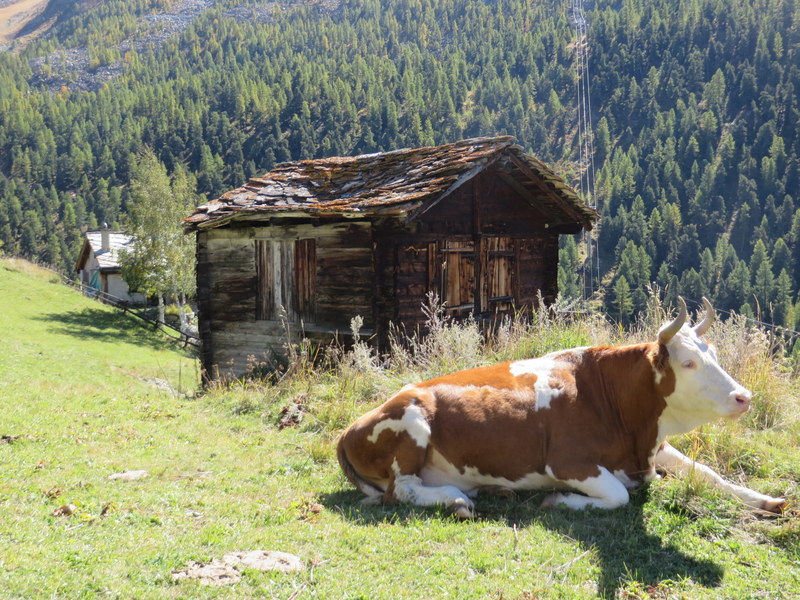
Zermatt has left many of the old-style huts and houses.

Zermatt has left many of the old-style huts and houses.

Water trough detail, Furi.

Water trough detail, Furi.

Looking up river.

Looking up river. Love this view!


Chamber of Commerce picture-postcard-perfect day in Zermatt

25 Sep
The last time I was in Zermatt was 43 years ago. A college girlfriend and I made the Grand Tour of Europe in the summer of 1972 following Frommer’s Europe on $5.00 a Day. Zermatt was a splurge because we had to pay $5.35 EACH just for our room and breakfast, way over budget. I think we lived on bread and cheap wine for the duration of our stay. I never forgot how beautiful it was. It still is. It’s still expensive, too.
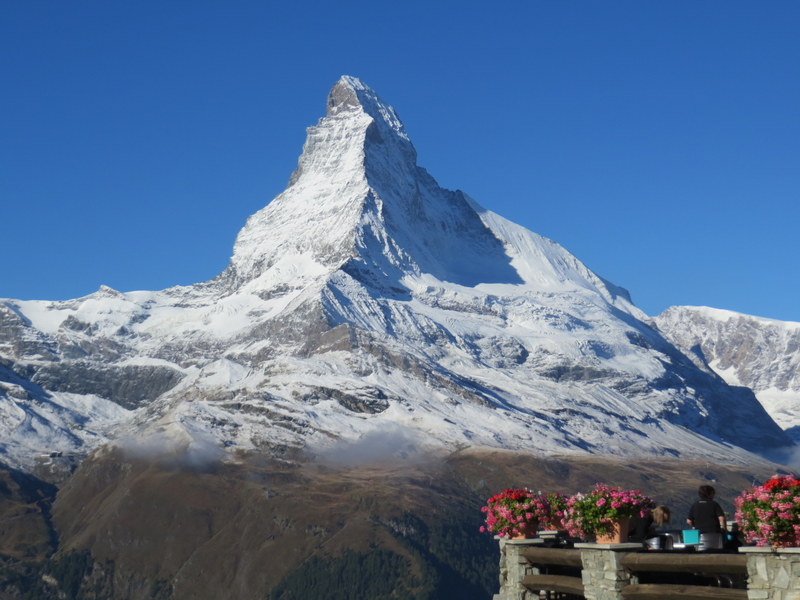
Postcard view. The Matterhorn remained cloud free all day.
We arrived the other day to cold — almost winter-cold — weather. Having worn my jeans for 3 days, they could practically stand up by themselves. I needed to wash them and had only unlined hiking pants to wear for Thursday’s planned expedition to a high elevation. If it was cold in Zermatt, 10,000+ feet was not going to be any better. I set off to see if I could find any tights to wear as insulation. At one of the many shops selling high-priced outdoor fashion, I stated my need. “We didn’t expect it to be so cold,” I told the clerk. “Neither did we,” he said. If the Swiss think it’s cold, it IS cold. Luckily they had a lovely pair of purple and black merino wool long johns for me. I guess today we do not say “long johns” nor even “long underwear;” it is a “base layer.” How elegant. And they were just the ticket.
From the Rothorn. There are other mountains, but it is hard to not focus on the Matterhorn.
Thursday morning we layered up with everything we could and headed out to ride the underground funicular and two gondola lifts to the Rothorn, where one get the classic postcard view of the Matterhorn. The day could not have been more perfect!  A light dusting of snow from the night before added to the beauty.
Not wishing to hike from quite that high, we headed down to the Blauherd station and set off to hike The Marmot Trail. We wanted an easy-ish hike the first day so as not to repeat our July 6 experience. I picked The Marmot Trail as it was rated for those as young as 4-years-old. I figured a couple of anziani could manage. The 4-year-olds the writer had in mind must have been mountain goats! The first third of the downhill-bound trail was marked by rocky portions waiting to twist your ankle and slippery, gooey, clay-based, green-tinged mud that made footing even on flat portions dicey.
Black & white goats, unique to the Valais, resting in a high mountain pasture.
The only sign of marmots we saw was scat.
At Sunnegga, a lift station and restaurant, we decided to take a restorative espresso while lounging on the delightful deck in full view of the Matterhorn. Switzerland is expensive, but I was shocked when our two double-espressos came to 12.40 CHF! And I had to prepare them myself from a self-service machine. I said to Ric, “And people complain about Starbucks prices.” He quipped back, “But Starbucks doesn’t have a view of the Matterhorn.” Amen.
This little guy and his friends were hanging out trailside on our path-to-lunch.
There’s a trail from Sunnegga to Zermatt called the Gourmetweg. Along this trail one encounters not only several restaurants, but several  exceptional restaurants. We are used to having good meals when we hike: freshly prepared food, ceramic plates and real glasses, good wines, and so on. (No hotdogs, burgers, nor nachos with gummy cheese for the European hiker!)
More trailside companions. But no marmots.
Chez Vrony takes outdoor dining while hiking or skiing to a new level. It is Michelin Guide rated and outstanding in every way. The salad ingredients (forgot to take a picture!) came from Vrony’s garden. Hard to believe it is located between two ski runs. The Matterhorn looks down on the deck, and under stunningly blue and cloudless skies, we had a hard time resisting a second glass of wine knowing we had an hour-plus hike still ahead of us. For the record, we took the short Gourmetweg. There is a cut-off that practically dropped us at our front door, near the Furi lift at the south end of Zermatt. Here are a few choice shots from our lunch. Click on any photo for a larger view and slide show.
My pedometer claims the day’s walking burned over 800 calories. Yippee! But today my quads are telling me that cannot happen every day.

But no cotton candy

23 Sep
On our way to EXPO Milano 2015 on Monday, Ric quipped that he thought it might be kind of like a state fair, “but without the cotton candy.” He was right on one count; however, it was not anything like a state fair. It was more like a trade show, but for countries instead of industry, although I guess countries are an industry of a sort.
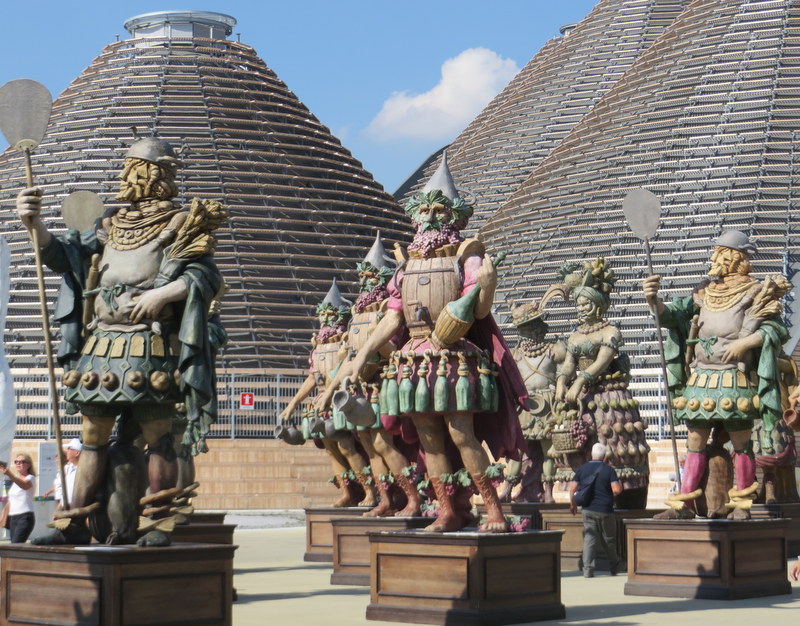
At the entrance to EXPO, Ric thought these looked like invading hoards....
At the entrance to EXPO, Ric thought these looked like invading hoards….
The theme at EXPO is “Feeding the Planet, Energy for Life.” In other words, Food Glorious Food! Some to eat, some to look at, apparently educational and thought-provoking displays and programs about the problems of nutrition and the resources of our planet. Except we couldn’t get into very many of the pavilions and see for ourselves. The lines were beyond the patience of any sane person. They would have had to be giving away gold nuggets for me to stand in line for 2 or more hours to see what any country had to say about the topic. United Arab Emirates — 2 hours. Japan — 3 hours. France, Russia, China, Oman, Slovenia, Slovakia all overwhelmed with ridiculous lines and no Disneyworld attempts to entertain the queue. The Italian pavilion’s line must have been at least 100 meters long. Good thing it was shaded in the afternoon.
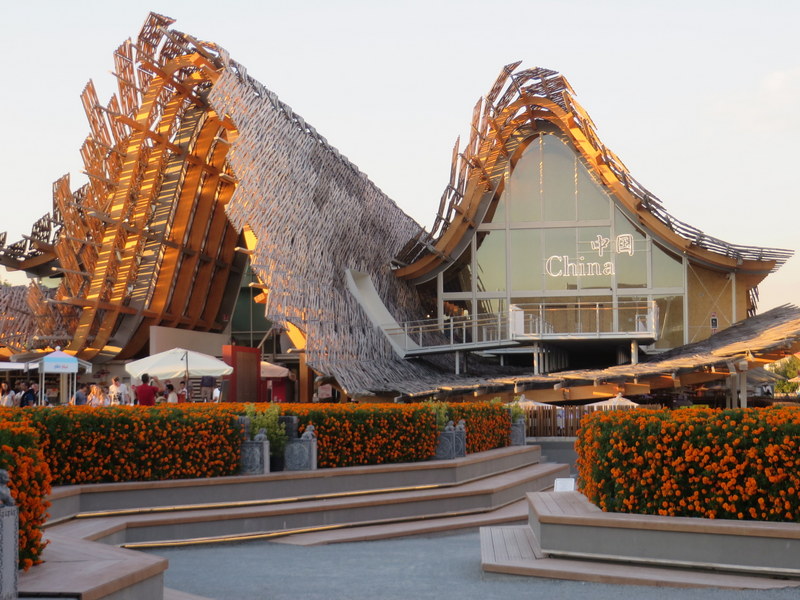
China the elegant...
China the elegant…
China the crowded.
China the crowded.
At the Hungarian pavilion we were able to go in as there were two lines: one slow one for those who wished to do a water tasting and the other a non-line for those who chose to skip the privilege. We skipped the water tasting, but as we walked past it seemed the “tasters” were getting a little cup of water out of a dispenser set in a pretty wall. Yummy. The building is supposed to reflect Noah’s Ark, but looked rather like a large water barrel. The main floor displayed Hungarian crafts and had a stage and seating. We decided not to shuffle through all three floors with the slow-moving throng. Yawn.
Kuwait looked like desert tents. Long entry line here, too.
The small countries are in clusters such as Rice, Arid Zones, Coffee, Chocolate & Cocoa, Islands, Sea and Food, and so on. This allowed smaller nations (like Palestine, San Marino, Senegal, Afghanistan, Haiti, Congo, and dozens more) to have a presence without spending the capital the larger nations did. These were uncrowded when we visited late in the afternoon on a weekday. They amounted to little displays about food technology and traditions in the country with some regional cuisine served in a few of them. Palestine showed lots of religious items (Christian) for sale that were carved from olive wood, and sold hummus and other Middle Eastern specialties.  In the African pavilions one would see people in colorful costumes, some playing instruments. No one seemed to want to engage visitors. I suspect by now, near the end of the fifth month of EXPO, the employees/hosts/volunteers are weary of the crowds.
The Arid Zones cluster. Inside were small rooms for each country.
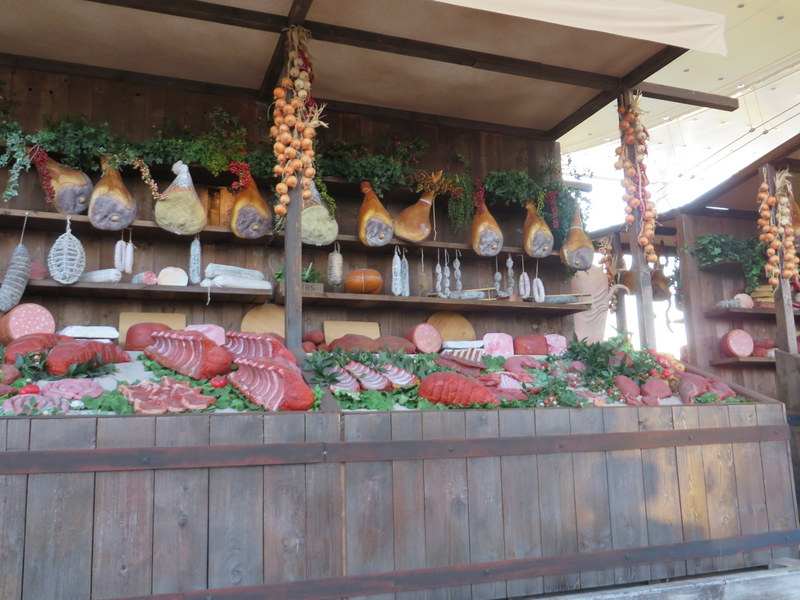
We have seldom been to something so crowded. Disneyland was a piece of cake. The worst line at Disneyworld never took more than 45 minutes when we were there, and that was rare long wait. The Minnesota State Fair I used to attend was highly accessible by comparison, and they had a cow made out of butter. No butter cows at EXPO, but there were displays in the main street of plastic produce, cheeses, fish and meat. Why? Just to fill the space I think. They did nothing to create atmosphere nor inform. I found the giant pigs (plastic or resin?) rather grotesque.
Plastice meat displays. WTF?
Plastic meat displays. WTF?
Most of the restaurants sponsored by the countries were tough to get into. In many cases you had to enter the pavilion in the long line if you wanted to try to eat in that country. There were some cafès outside as well, but much of the food offered by concessionaires was Italian. Sure, we’re in Italy, but the USA pavilion cafe served insalata caprese inside?
American cafe menu. I kid you not!
Outside, the USA pavilion had a water wall that changed pattern efvery few seconds.
Outside, the USA pavilion had a water wall that changed pattern every few seconds.
The USA pavilion had a number of interactive displays about food production.
The USA pavilion had a number of interactive displays about food production. They looked a little like pinball machines with screens.
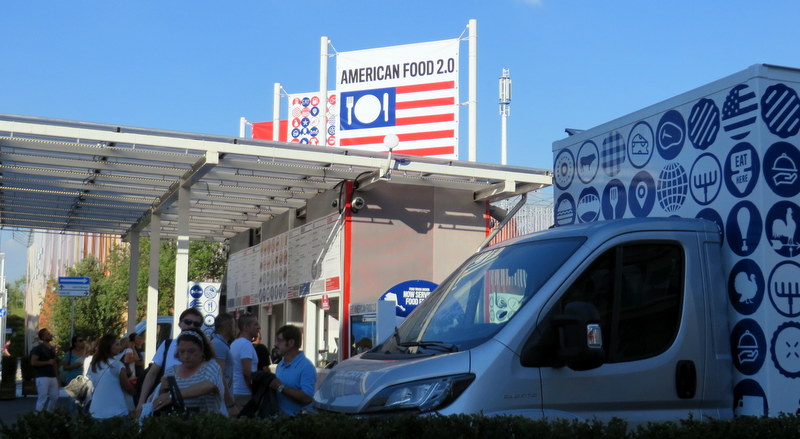
Food Truck Nation. Yup, American food sold from trucks. Pretty good idea, we thought!
There were exceptions. The Czech Republic was in permanent happy hour and they had easy access to beer every time we passed by between 3:00pm and 5:00pm. The USA pavilion had no line and some hands-on stations that were engaging for young people. It was kind of like a science museum in that respect. The Tree of Life “show” is cute — music, dancing fountains, a tree that blooms before your eyes — and on a nice open space where the crowd can gather and not overwhelm.
Tree of Life in full bloom, after the show.
EXPO worked from a logistical standpoint even if the lines were long. There are plenty of bathrooms, great rest areas for the weary, and well-planned shade for the main thoroughfare. There are plenty of workers/hosts/volunteers to provide info. Everyone seemed to speak English at a minimum, and lots of French as well.  Signage and way-finding are excellent. It is clean and there was almost no smoking. Security is top-notch and entry was easy, at least at 3:00pm.
The Slow Food pavilion featured a snack of organic cheeses, corn crackers, and an Abruzzese wine called Passerina, of which we are now fans.


Rest areas were plentiful. If you wanted to sit down, you could.
Why the pavilion entrance times take so long, I cannot guess. What people found inside the Japanese pavilion I was unable to discover for myself, being unwilling to pay the price of a 3-hour wait. Maybe they were giving away gold nuggets. If you planned to spend 8 hours at EXPO, you could visit perhaps 3 or 4 of the big countries. That’s not a great return-on-investment of time.  It is an enormous property and we logged about 10km during our visit.
The Moroccan pavilion has a favorable spot alongside a canal and rest area. But the queue is long and slow-moving.
The Moroccan pavilion has a favorable spot alongside a canal and rest area. But the queue was long and slow-moving.
So I am not a fan. I an no doubt coming off as negative although I an trying to portray realism. I feel about EXPO the same way I felt about Croatia: I am glad we went, it was interesting, but I would not go back. The food was better in Croatia.
At least there was no cotton candy at EXPO. I hate the stuff.
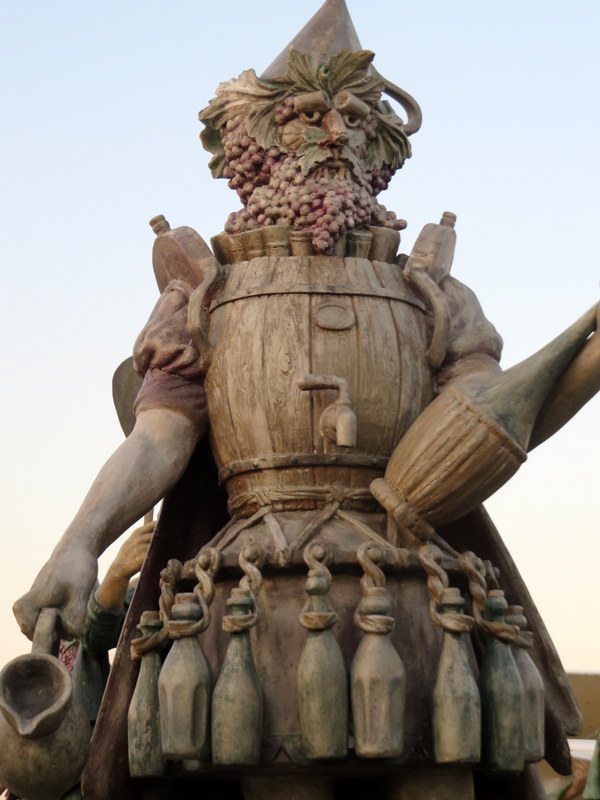
The "invading hoard" turned out to be a clever set of sculptures called "Food People." Here is Mister Salami.

The “invading hoard” turned out to be a clever set of sculptures called “Food People.” Here is Mister Salami.

Carmen Miranda (Mrs. Fruit)
Signor Vino
Signor Vino

Field trip: Eataly

19 Sep
Eataly is not on the itinerary of many who visit Roma. If you only have a few days in the city, trekking out to this distant-from-the-center-grocery-store-on-steroids is probably not how you want to spend a precious vacation day. We, however, are always on the prowl for a good field trip. (No permission slips required.) So one day this week, remembering a nice lunch we had there sometime ago, we made our fourth trip there in 3 years. No, we don’t go there often.
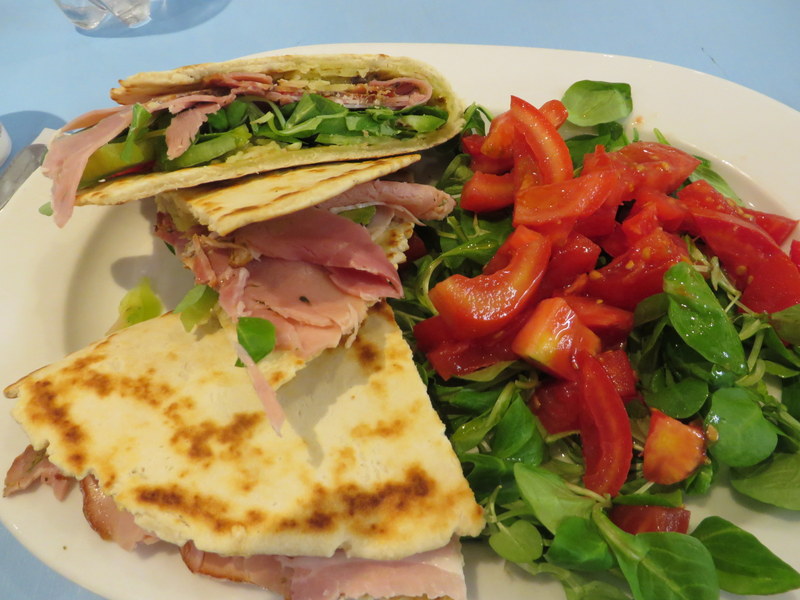
My lunch, Piadina "La Saporita" from La Piadina. True to its name, it was flavorful.
My lunch, Piadina “La Saporita” from La Piadina. True to its name, it was flavorful.
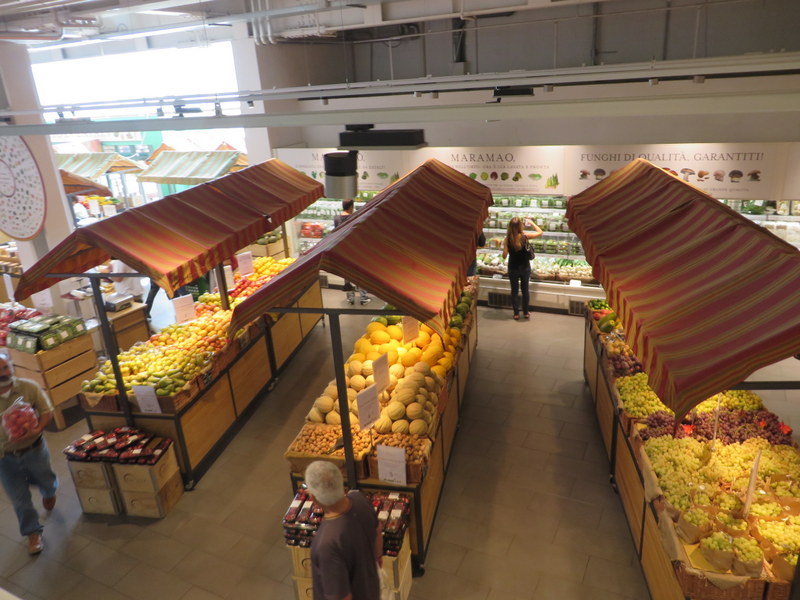
Eataly, to me, is not a place to do the regular shopping (for one thing it is a long way from home), although around lunch time, it gets busy with Italians who are snapping up the fresh produce and other delectables. To me, it is entertainment. Meters and meters of pastas, in shapes I have never seen accompanied by colorful produce, prime meats, abundant fish, hanging prosciutto and salumi of every kind, endless cookbooks, kitchen implements for which the use is obscure, row-upon-row of wine, a rainbow of preserved vegetables, a chocolate selection to make the Swiss jealous, and several interesting eateries. It is four floors of decadence. It is expensive. Everything sold there is Made in Italy. Bravo!
The produce area is almost unreal in its beauty and bounty. All Italian in season, of course.
Tucked behind Stazione Ostiense, it can be difficult to find when arriving by Metro. The first few times we thought we should leave a breadcrumb trail as we traipsed through tunnel-after-tunnel. This time we noticed prominent signage that guided us. It was excellent, we thought. Perfect help for tourists: giant signs and arrows everywhere…until the last couple of turns where clearly the direction givers assumed “You can’t miss it.”  (This happens a lot in Italy: assumptions on way-finding.) The final leg has you traverse the entire under-track corridor at Stazione Ostiense on the hope that at the end one might emerge near the entrance to Eataly. If you decide to go, persevere.
Conservanti included these gorgeous peppers.
There’s a new Eataly in Piazza della Repubblica.  (They took over an old MacDonald’s. Quite the change.) We have not visited yet, but certainly it is more central for most visitors. We’ll make that a future field trip.
This trip, we had a nice look around, and a fine lunch, but we did not buy much: an olive-pitter and some pretty orangey-yellow Moleskin notebooks, which I love for note-taking on trips.
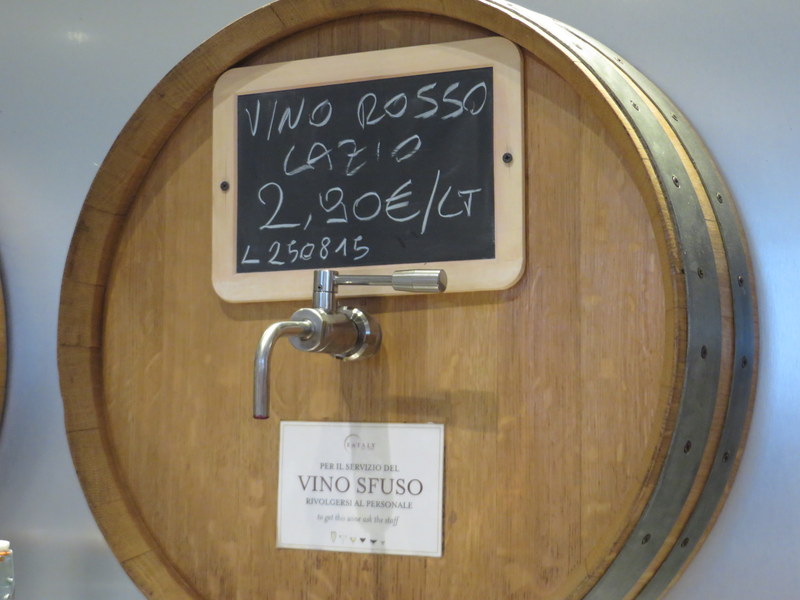
Vino sfuso at a very good price. They even sell bottles in case you forgot yours.
Vino sfuso at a very good price. They even sell empty bottles in case you forgot yours.
The food outlets are called "Ristorantini" or little restaurants. They are semi-self-serve but food is made-to-order. This one empty at noon, because lunch here really does not start until 13:00.
The food outlets are called “Ristorantini” or little restaurants. They are semi-self-serve but food is made-to-order. This one, empty at noon, because lunch here really does not start until 13:00.
Long long shelves of almost everytning. Here, preserved vegetables. Not your Green Giant corn....
Long, long shelves of almost everything. Here, preserved vegetables. Not your Green Giant corn….
Riding the moving ramp down. This is a huge place, built in what was an abandoned air terminal.
Prosciutti hang from the ceiling at the top of a moving ramp leading to the salumi department.