
Embrace winter weather and fewer crowds in Venice.
Going north in the winter or late fall may seem counter-intuitive, unless you are heading for i dolomiti and some skiing. However, for our third trip to Venice – we never tire of her – we chose early December, knowing it would be un-crowded if cool. If you are from a cold climate (I grew up in Minnesota), 7-10⁰ C isn’t all that bad, especially if the sun is out. So we packed some layers and explored Venice in winter once again. Usually we take Trenitalia, but shopping around I found better fares with the new ItaloTreno. These sleek red trains now serve Rome to Venice via Florence, Bologna and Padua, in about 3 1/2 hours. So new and shiny with clean bathrooms and functioning WIFI, they are also incredibly quiet. The Italian State train system, Trenitalia, needs to take note and up its game.

The Grand Canal Apartment, our home in Venice.
We like to rent an apartment so there’s a little space to spread out, a refrig-erator, a place to make our morning caffè. Our choice is a one-bedroom apartment in Sestiere San Polo, only a 5 minute walk from the Rialto Bridge and mercato. Fabbio and Monica offer a cute apartment in a quiet neighborhood where one quickly feels more like a local than a tourist.One of the fun things about returning to a place you’ve been before is re-visiting favorite spots while still discovering new ones. Everyone goes to Piazza San Marco, the Basilica, and the bell tower, the Doge’s Palace, and perhaps the Accademia. People have asked me time and again, how we can spend so much time there. What more can we do in Venice? There’s always something we haven’t seen.
Things to do in Venice when it’s raining
- Visit the Peggy Guggenheim Collection. In our two prior visits, we had near-perfect weather and eschewed some of the standard art museums in favor of outdoor-oriented activities. On this arrival day it was raining, the perfect excuse for a visit to the renowned Peggy Guggenheim Collection. We were amazed at the accessibility of the art (Picasso, Calder, Mondrian, Modigliani, Pollock) and the lovely palazzo that houses it quite intimately.
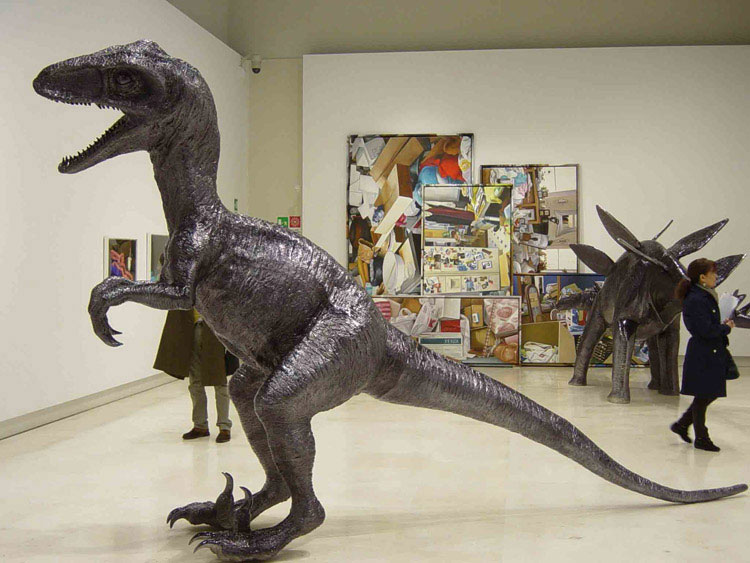
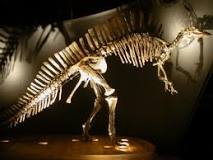
- Walk with the Dinosaurs. We treated ourselves to the Museo di Storia Naturale, (Museum of Natural History),
housing Venice’s only dinosaur. This is a wonderfully well-done and captivating museum! I would put it on par with the Smithsonian’s National Museum of Natural History in Washington, D.C., in terms of quality. There was a 10 year restoration project that just ended in 2010, so the exhibits are well-lighted, well-signed, and interesting. One warning, though, little is in English. But since so much scientific language is Latin-based, with a smattering of Italian you can work through much of the information. We practically had the place to ourselves, marveling at an incredible fossil collection, the dinosaur, a fin whale skeleton, and more. There is a rather alarming room of preserved (through taxidermy) animals from the era of Big Game Hunters, which made me sad. But today’s emphasis is clearly on housing the collection and education, not condoning this practice. Children will love this museum, so when you ask yourself what to do with children in Venice, this should be at the top of the list. A great place to escape heat in summer or inclement winter temps.
- See the Basilica illuminated. We visit the Basilica of San Marco every trip, but usually in the mid-to-late afternoon when the crowds thin. This trip we timed our arrival for the midday illumination. From 11:30-12:30 each day, the church is lighted, bringing the magnificent Byzantine mosaics out of the shadows to all of their glittering glory, which is particularly impressive on a dark day with little available natural light. This is now on my do-not-miss list. (Note to self: Time visit for illumination.) On a December Tuesday the crowds were non-existent and we were enthralled at seeing this museum-piece being used for a simple daily mass in one of the chapels. Nice to know that a church can still be a church. Another great reason to visit in winter.
- See art in situ at Chiesa Dei Frari or the adjacent Scuola di Grande San Rocco. Dei Frari is one of our favorite churches anywhere for the in situ art, but this trip we opted to visit the adjacent scuola with its amazing Tintoretto paintings. We were totally alone in the scuola for most of an hour. Incredibile!
- Other ideas: Explore Venice’s seafaring past at the Museo Storico Navale, offering a peek into Venice as a Mediterranean superpower, trader, ship builder; See the world famous Galleria dell’Accademia (next trip for us). There are also the Correr Museum, Ca’Rezzonico, La Salute Church, the Doge’s Palace. The list goes on.
When the sun shines
- Take a Lagoon Tour. A bright clear day dictates a lagoon tour for us. We walked from our apartment to Piazza San

Handcrafted on Murano.
Marco so we could justify a delicious breakfast pastry at Pasticceria Rosa Salva, a Venetian institution (Two caffè doppi, two incredible cornetti with almonds, €6.20). Then we took to the waves and headed to the islands of Murano, Burano and Torcello. The snow-covered mountains loomed in the distance as we made our way across the lagoon. Murano was just coming alive when we arrived at 10:00. We have a favorite glass shop on Murano where I like to buy a few pieces of jewelry, Vetreria Venier Giorgio Bruno. To find it, head over the Ponte Longo and turn left, away from the main drag, where you will find Giorgio and Michela Bruno and their little dog Cindy, who likes to hug.
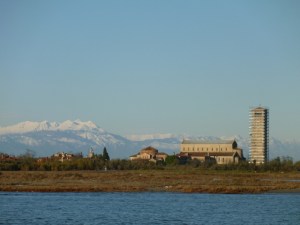
View of Torcello Island and the distant snow-covered mountains. Bellissima!
From Murano, we headed to Torcello, birthplace of Venice nearly 1500 years ago. The Basilica of Santa Maria Assunta, was first built in 639, and is the object of the visit. Torcello is virtually deserted these days, and on a sunny December day, one can meander along the paved brick path, past tiny houses built for the island’s feral cats (some for humans, too, but not many), to the central piazza and basilica complex, and enjoy a crowd-free experience that seems a million miles from Piazza San Marco. Contemplating the mosaics in the basilica, which date from the 11th & 12th centuries, I can’t help but be amazed, especially out here in what was eventually abandoned as a malaria-infested swamp.
While there are a couple of dining options on Torcello, we headed to Burano, famous for lace and for the beautifully colored houses. We find Burano enchanting, except for the “barkers” in front of the restaurants on the main piazza. Avoiding these, we chose Ristorante al Vecio Pipa, where the owner oversees everything personally and does not resort to waving people in. He doesn’t have to. We had a decidedly unhealthy but delicious lunch of fried seafood (fritto misto di pesce) and grilled polenta. Unlike in the U.S., there is a light hand with the batter, if you can even call it that, and there are no French fries, thank God. Luckily we walked for hours that day.

The colorful houses of Burano, reflected in a canal. Everyone has a boat.
- Take a walk. Venice herself is the object of our enchantment. We don’t really need much of an itinerary when the sun shines. We like to discover new-to-us areas of the city and get away from the day trippers, so this trip we took this jaunt. The “Zattere to Piazzale Roma” walk is probably not for a first visit to Venice; it’s more of a second-time-around itinerary, but it is interesting to see some of the neighborhoods where there is more living than touring, and far more Italian spoken than English. Luckily along this route are several favorites of ours: A gondola repair/construction site, Campo S. Margherita, Pasticceria Tonolo, Chiesa dei Frari, and Scuola di Grande San Rocco. At Tonolo, where the espresso is bold and smooth, divine tiny pastries are only €1.00.

Me consulting the map. Crisp, clear day on the Venetian Lagoon. This view is from Santa Elena, back toward Venice.
We like to walk and escape the crowds at Santa Elena and take the vaporetto back with the locals and their dogs. We also take a pre-dinner passeggiata (stroll) along the Strada Nova, one of the straightest streets in Venice. Here there are many places to grab a quick aperitivo, or pick up coffee for morning while enjoying a less-touristy neighborhood. We like to grab a glass of wine and a polpetto (meatball) at Osteria Ca’D’Oro (see below).
We have also used the book “24 Great Walks of Venice” as a guide. I highly recommended it as a way to work off the meals while guiding one’s sightseeing. (Can you tell our trips are meals strung together by miles of walking?) One afternoon, still not worn out completely by the morning’s activities, we hiked over to the Ghetto Nuovo. Venice is where the word “ghetto” first came to mean a Jewish segregated neighborhood. (Originally geto, the word for foundry, the area where Venice’s Jews were isolated in the 1500s.) Again, maybe not the place you go if you are on a two-day time-boxed tour, but when you have time, when you return, when you crave seeing where Venetians live, work and go to school…. You can continue from here through Sestiere Cannareggio and the northern reaches of Venice.
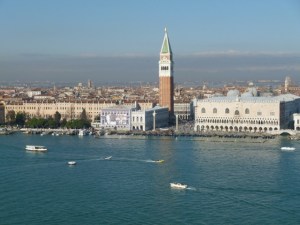
5 minutes from San Marco on a vaporetto, ascend the bell tower at San Giorgio Maggiore and take in this view.
- Ascend a bell tower. Many people choose the campanile in Piazza San Marco. We prefer the tower at San Giorgio Maggiore, just across the basin from San Marco. Here is yet another magnificent church: designed by Palladio, with paintings by Tintoretto, capped by a tower that offers a spectacular view of the lagoon. It’s like a 3-D Venice geography lesson to go up in the tower on a clear day, and a 5 minute vaporetto ride from San Marco.
Eating in Venice
When one thinks of dining in Venice, euro signs flash before your eyes. It can be expensive, but there are places the Venetians dine – real people do live here – and these local places are easier on the budget. In “our” neighborhood, we always dine one night at the convivial and unpretentious Pizzeria NoNo Risorto. Venice is more traditionally fish than pizza, but NoNo does some creative pies, and with i ragazzi (the guys) hanging out, the atmosphere was lively. Ric chose an extraordinary pizza frutti di mare, which was a crust with sauce, no cheese, piled high with baked seafood, some still in their shells: clams, mussels, shrimp and calamari. The seafood was delicious, baked right on the pizza, but it left him with what amounted to tomato sauce on bread as a base. My choice was the “Maurwulf,” with salami piccante and gorgonzola. I gave Ric a share, but my goodness, it was difficult to part with those pieces. Yum! House wine is a bargain, a good way to save some euros.
We have enjoyed La Zucca in the past, and returned there again for dinner. For me, the return was driven by a taste-memory of their fantastic flan di zucca (pumpkin flan). It is creamy and rich served with ricotta stagionata and toasted pumpkin seeds. Good to share as an antipasto. The strength here is in the vegetarian dishes, especially the vast selection of creative contorni. I had broccolo romano con uvetta e pinoli. It was a little “zippy” with some pepperoncini, balanced by the sweet raisins and tender romanesco. The entrees are not classic Italian, IMHO, but more influenced by French and Indian cuisine: roast pork with a dijon sauce, chicken tandoori with lentils, both served with rice, unusual in Italy. But the food is absolutely delicious and reservations are recommended at least two days in advance because it is a very tiny venue (35 seats).

This is “our” neighborhood in Venice. A greengrocer and a few pubs & cafes make it convenient with a residential feel.
We get tired of having to make restaurant choices every now and then on a trip. (And God knows I am not cooking more than espresso!) In Venice one can take advantage of the pub crawl and join the locals for their cicchetti, sampling several places along the way. We like to start with a spritz (con aperol, for me) at Caffè al Ponte del Lovo. It’s a bright and lively coffee house in the center, close to the Goldoni Theatre. We’ve seen superb-looking hot chocolate here, too, but always opt for a spritz during the passaggiata. Of course a cocktail is served with some light snacks, just enough to carry us to the next stop, Osteria Ca’ D’Oro. Here a plate of cicchetti might involve their famous polpette (meatballs), insalata al polpo (tender octopus salad), tiny swordfish steaks, or the most succulent grilled calamari you have ever tasted. There are vegetarian options, too. Washed down with tiny glasses of house wine at the bar, it will cost less than a couple of panini. Other classic places for cicchetti are right in “our” neighborhood, too: Cantina do’ Mori, Osteria Bancogiro, and Cantina do’ Spade. For a bit of a splurge, we went to Trattoria di Remigio on the recommendation of i signori Bruno (the Muranesi glass artist). We walked in without a reservation at 19:45, and by 20:15 the place was full and they were turning away walk-ins. This in stark contrast to a vast array of more tourist-path places we passed with few-to-no customers. Fresh seafood is the specialty, featuring Venetian dishes such as sarde in saor, as well as steamed mussels, branzino, and much much more. This is not a softly lighted romantic spot, but rather a bistro-type establishment with good food, well-prepared, where service is efficient as the owners bustle about ensuring everyone is cared for. We will return to this new-to-us spot, only a few minutes’ walk from San Marco.
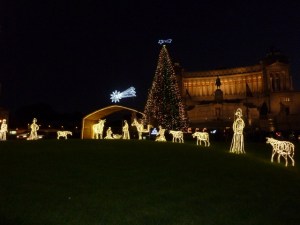
Lights in Piazza Venezia, Roma, 2011.
So now we are back in Rome for the holiday season. The Immaculate Conception (Immacolata Concezione) is celebrated on December 8, serving much as Thanksgiving does in the U.S. to define the start of the holiday season, which runs through Epiphany on January 6. Returning to Rome we see Christmas light displays and nativity scenes (presepi) popping up everywhere. Last year we were tourists in Rome for Christmas. This year we are residents. What an amazing year! Still having “pinch me” moments!
Tags: Burano, Frari, Guggenheim, Italo, Murano, restaurants, Rialto, San Marco, San Rocco, Trenitalia, Venice










 Girovaga