Archive | Culture RSS feed for this section

When the cows come down, the people party

28 Sep

28 September 2024.

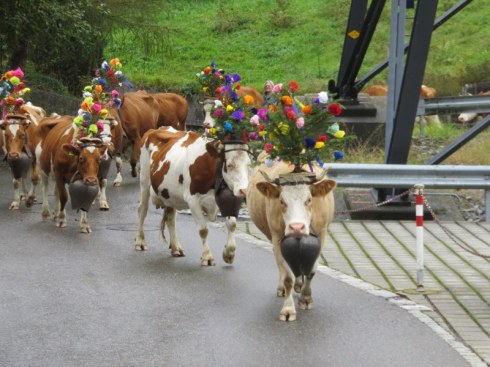
On the streets of every village are traces of the alpabzüg, the annual descent of the cows from mountain grazing pastures (alps) to the valley villages and towns. The cows and their people take the same routes every year, some of which are the very paths hikers use. It is a big deal and a steady rain after is welcome, at least by me, to remove those telltale streaks. A cow must do what a cow must do, and hundreds have made the descent in the past few days.

We have seen many “cow parades” over the 10 years we have been coming to the Jungfrau Region as well as some in other parts of the country. Sometimes there are formal festivals with costumes for both cows and humans. Sometimes it is a farmer simply walking down the street with his 5 or 6 cows when he has the notion to descend. When we hear the giant bells clanging, we run to the street or window (along with many others) to watch the ancient tradition.

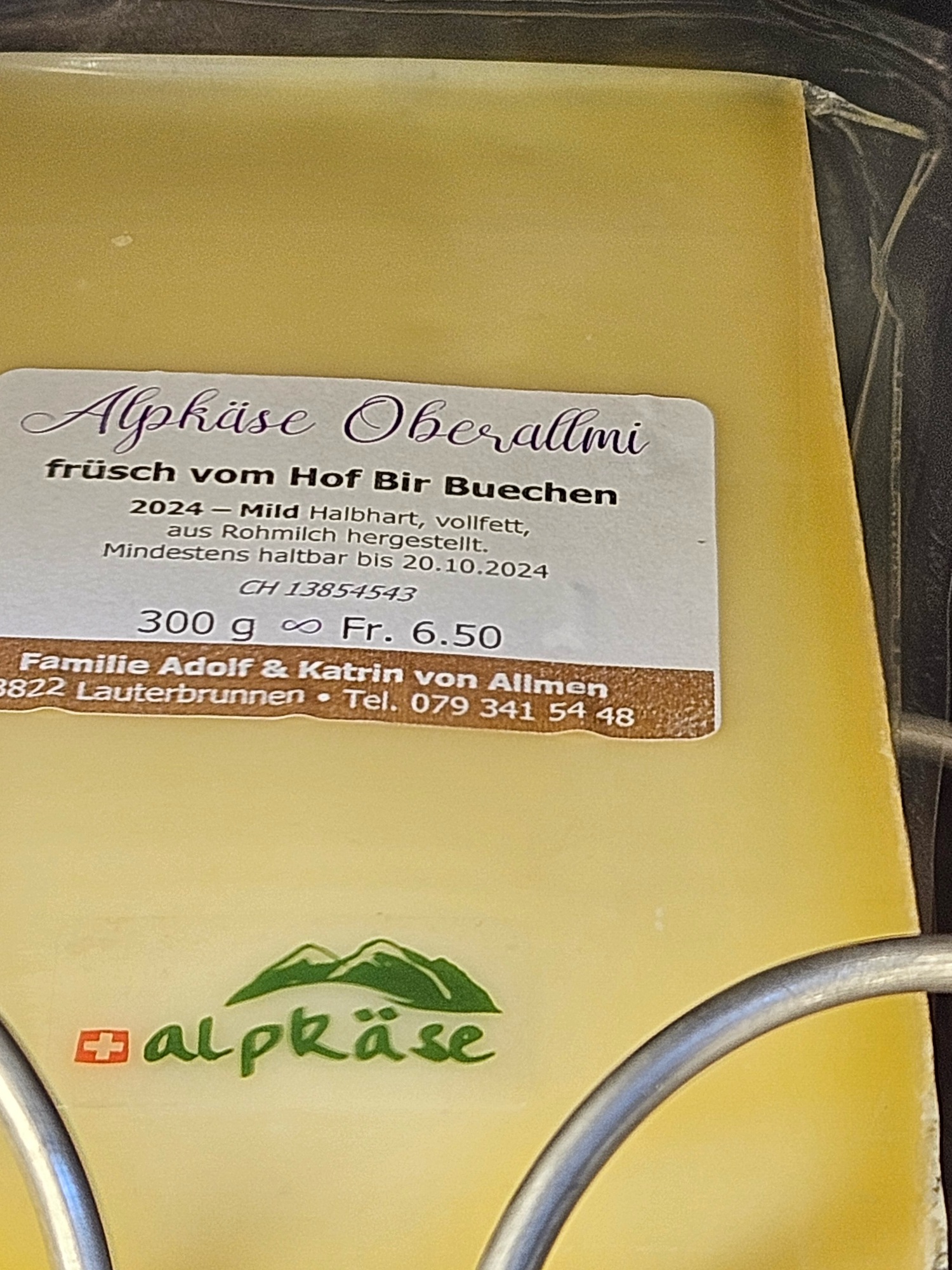
After the descent, the villages celebrate with the chästeilet, or cheese festival, a gathering for music, food, dancing and, of course, the selling of the alpkäse, or cheese made while the cows are feeding on lush mountain grass. Each farmer marks their cheese with their farm name. When we go to the local grocery stores, we can see the products of the various farms displayed. Occasionally we see entrepreneurial farmers selling their cheeses in vending machines along the road along with beverages, dried apple slices, and other snacks.

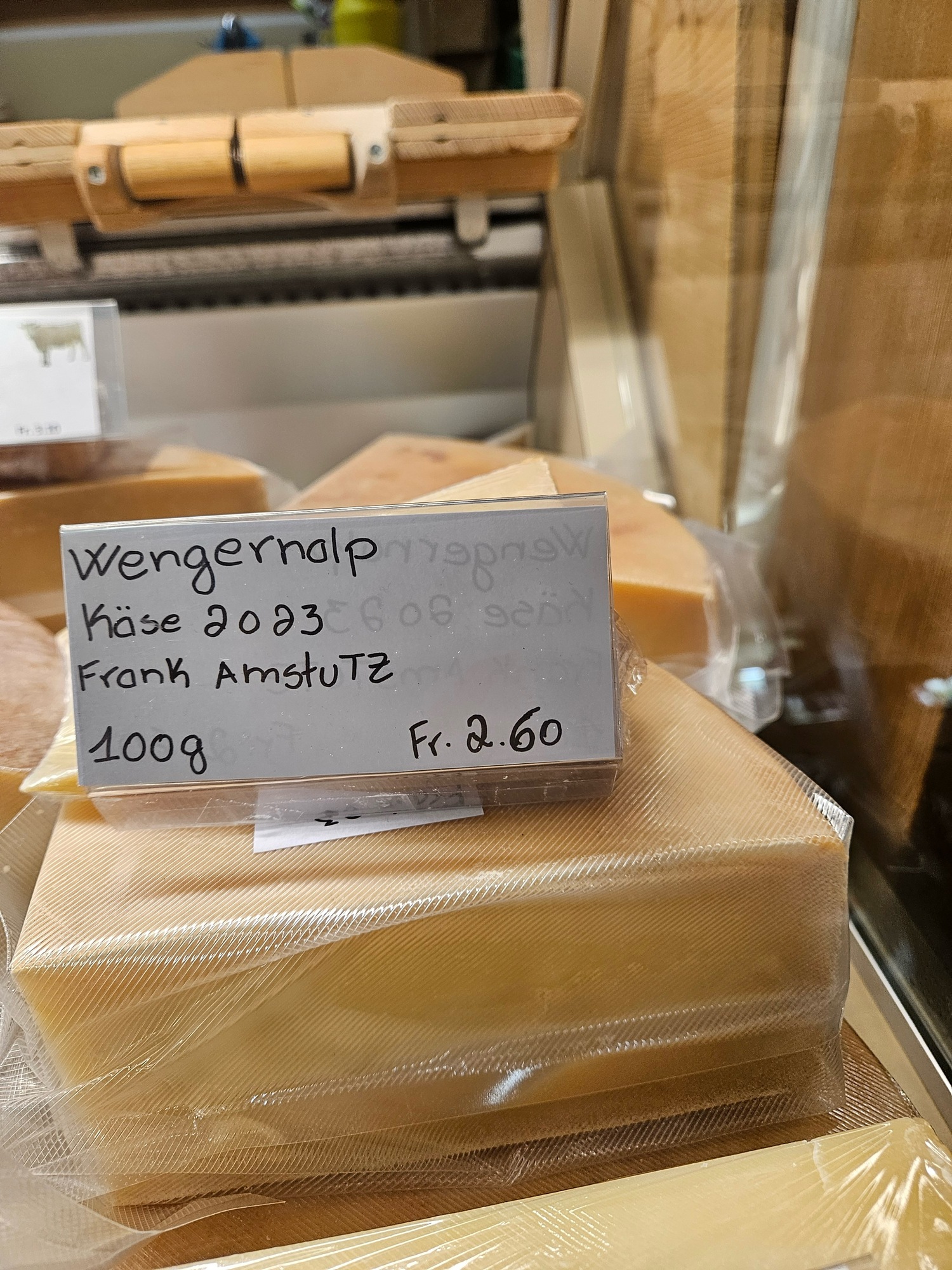
Two cheeses labeled in the grocery store case, one from Stechelberg and another form Wengernalp. The third entry is in a vending machine outside the farm along a road many walk through the valley.

Festivals can be tiny or grand in scale. At little Winteregg, which is where the little cliff top train from Grütschalp to Mürren crosses paths with hiking and cycling trails, we found a small gathering of farm folk with cakes and drinks (beer, schnapps, coffee) available. No entertainment. Just the cheesemakers whose hut is nearby and the farmers who supply the milk.

Winteregg’s 2023 festival, a community gathering right next to the hut where the cheese is made.

Three and a half kilometers away, as the crow flies (12 km by car, but you cannot drive there) is Wengen, which put on a grand chästeilet Saturday and Sunday a week ago. An evening and a day of celebration with music and massive quantities of food, table space for hundreds of people, gigantic cheeses, and handmade goods for sale. You could arrange to purchase a cow share. (Not sure if that means alive or butchered.) For a community of 1,300 permanent residents, it was an amazing event.

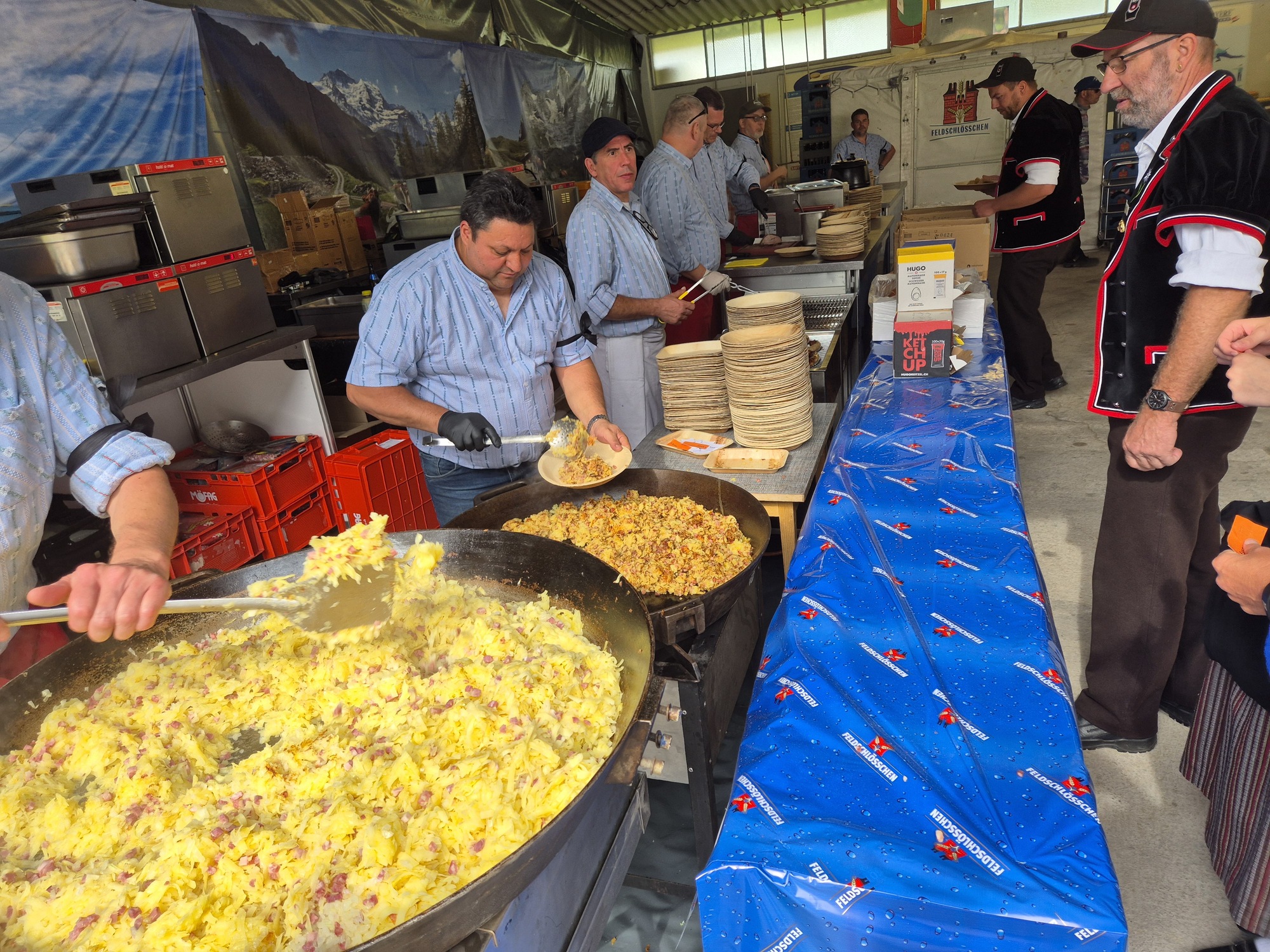
Wengen’s chästeilet is a huge affair for the surrounding farms, locals, and tourists. Massive wheels of cheese, samples, crafts for sale, and a community feed with vats of rösti and other local fare. Of course there was beer, homemade cakes, and coffee.

Last year someone tried to drive to Wengen. We know the path: it leads up from Lauterbrunnen and is clearly marked not for driving. Cringe-worthy video here.

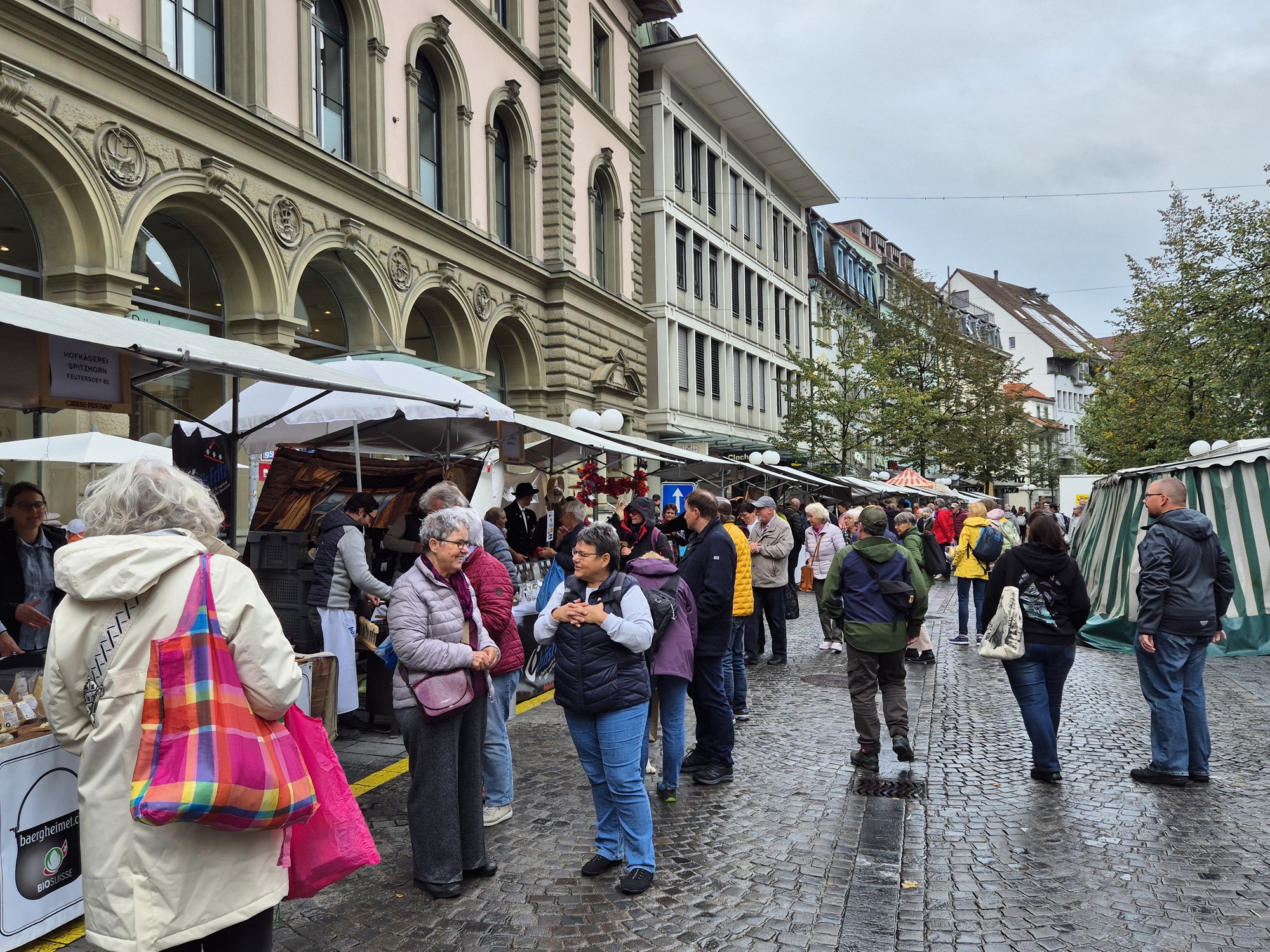
Today we attended the cheese festival in Thun (pronounced ‘tune,’) 42 km away on the shores of Lake Thun. Thun is much larger at 42,000+ people, and draws farmers’ production from all over the Canton of Bern, so the festival is huge. Here they call it käsefest. There must have been 40 vendors as the Thun festival is all about sampling and selling. Cows milk cheese, goats milk cheese (it’s not all feta or chèvre), sheeps milk cheese, organic or not, they had it. Need your fondue or raclette cheese stash fortified for the coming cold months? Buy direct from the farmer at the Thun käsefest. Perhaps chilli pepper laced alp cheese or an herb-flecked mild cheese is more to your liking.

The French may have over 400 types of cheese, but the farmers of the Canton must have at least that many varieties of alp cheese.

The cheese festival was conducted next to the farmers market in charming Thun on the Aare River and included not only sampling, but cheese made on site. Each farm had its own kiosk. Click on any photo for a better view.

Frankly, we are a bit cheesed-out at this point, so we bought some great dark chocolate. Swiss, of course.

Kindness of strangers

3 Sep

3 September 2022.

The other day we went for late morning coffee in the cute village center. We had decided to not go up high on a hike but to chill a bit ad do some shopping since the day prior was quite active. After a couple of grocery store stops, Ric realized he did not have his wallet. A frenzied search of the apartment led us to return to the last place we knew he used his credit card: a grocery store here in town late the afternoon of the day prior.  No, they had not recovered it. Worried about compromise, Ric checked the two credit card accounts and two bank accounts for which cards had been lost. His driver’s license was also in the wallet which was actually a small folio for a few cards and cash.  Good news: no unrecognized activity. Bad news: Ric had to cancel all of the cards which meant I was the only one with access to funds of any sort. 

For a leisurely day, it was intense. We went three times to Ortisei center. We are staying up a hill a 10 minute walk from town center which doesn’t sound bad until the third uphill return. 

After all of the efforts to cancel cards were complete, our landlady, Justine, rang our bell at 4:30 PM to tell us il portofoglio had been found at the café where we’d had coffee about 10:30! 

Two young waiters had spent the day trying to track down Ric. They tried Facebook, Instagram, and God-knows-what other networks with no luck because Ric isn’t connected online. Finally, they called the Tourist Information Office who sent out a blast email to all lodging facilities in Ortisei. Did anyone have a guest “Ric di Oregon?” Luckily, Justine was at her computer and saw it. 

The view from our table at Cafe Demetz, Ortisei. The wallet was found on the floor under our table.

We headed into the village center for the FOURTH TIME to retrieve the wallet and reward the guys. Everything was intact: all 4 cards, driver’s license, health insurance card, and about €50. Remarkable! This is such a small town that all the locals know each other despite hosting more lodging beds than there are residents. Such good news, the kindness and honesty of strangers. 

The timing was just right for un’aperitivo served by the very guys who found the wallet. That eased us into the evening and we ended the day on a true high with great pizza and our favorite local wine, LaGrein, at the pizzeria next door.

Another view, in the evening with Aperol Spritz and a small bite.

Charles Schwab Bank is expressing a replacement debit card to Ric, but the credit card companies wouldn’t do that so I will be paying for most everything since cash is used less and less here as at home.

On another note, hiking has been excellent as the weather has been near perfect. We eased into mountain hiking with a few nights in the Alpe di Siusi where there are many paths and roads for walking that are fairly gentle and undulating. No need to take strenuous ascents and descents unless you want to. We didn’t even unpack our trekking sticks there.

We embarked a couple of days ago on an old favorite in the Val Gardena. We had not taken it since 2019 and 3 years made it seem a wee bit harder on the creaky old knees and hips. 

I am contemplating a book update for 2023 after all. More hikes to add and tweaks to make aimed at other creaky-kneed hikers. We’ll see. Editing is such a job.

Alpine Transhumance

26 Sep

26 September 2019.

It seems I’ve been waiting until the cows come home to see the transhumance here in Lauterbrunnen, or at least the ceremonial descent from summer pasture to the valley.  Now and then we’d see a farmer going down the street with two or three cows — you can hear them coming for a kilometer or so thanks to the bells — but we’ve either been out on the mountain trails or arrived too late in the year to see what we saw today.

We were advised to be near the Hotel Silberhorn at noon to witness the parade. The cows were arriving from pasture at 1500 meters/4900 feet at Winteregg, a path of about 4 miles.


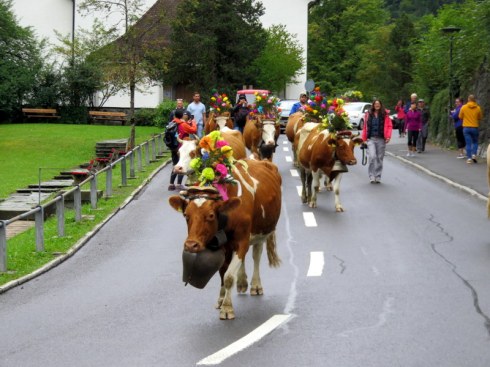
The ceremonial transhumance involves gigantic cowbells and decorative headwear…for the cows. I hope they weren’t forced to wear this gear the entire 4 miles, although that might explain why a couple of them looked so grumpy.

Cow parade

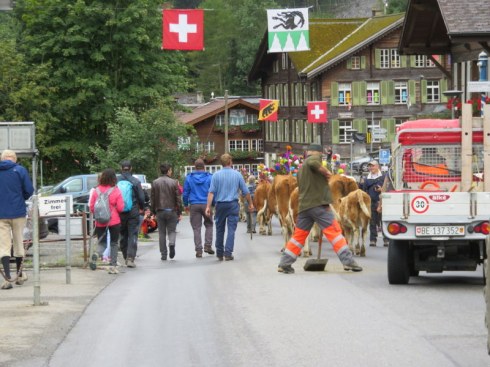
The cows round the curve coming into town by the Hotel Silberhorn, under the Grutschalp gondola. Look at the size of that bell!

End of cow parade

Trailing to cows through town, clean up vehicle and crew following.

Cow Parade

Coming around by the church, traffic is stopped on the main thoroughfare.

Cow Parade

Passing the church, the cows are coming into our neighborhood. We took a shortcut so we could meet them down by the river. This is just 150 meters from our temporary home.

Cow with head dress

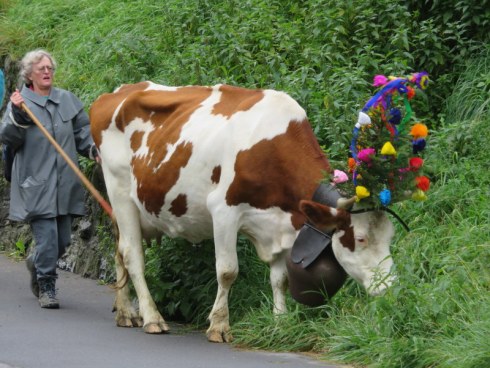
One cow gets out of the parade when she spots something tasty after walking through the town.

Cow mooing

As the ceremonial cows pass on the street below, a small herd overlooks the scene and one cow seems to say “What about us?”

Hotel Silberhorn staff greeted the herders and onlookers bearing trays with small cups of wine. A nice touch!

Retreat on the Alpe di Siusi

15 Sep

15 September 2019.

Sometimes you just need to escape even while you are away. Rick Steves calls this a “vacation from your vacation.” While we aren’t really in need of further relaxation, we do like the atmosphere of the Alpe di Siusi and it has become a tradition for us to pass a couple of nights there and be able to hike in the mornings without worrying about an early bus from Ortisei or racing to beat the last gondola down at 17:30. It’s a looonnggg walk if you miss the last ride.

Cabinovia

The gondola up to — and down from — the Alpe di Siusi. It only runs until 17:30 so don’t miss the last ride!

We are based for 2 1/2 weeks at the incredible Residence Astoria, our home in the Val Gardena the past four years. (See Training cats from 2016.) Taking only our backpacks with a change of clothing, we headed to Hotel Saltria for two nights, partaking of their half-pension plan and enjoying the convenience of being right there in the Alpe di Siusi for an early morning hike as recommended in our book, Walking in Italy’s Val Gardena. It’s good to travel light as this journey takes 3 buses and a gondola over the course of 90 minutes. Not fun with heavy luggage.

Hotel Saltria

The Hotel Saltria is a larger property, yet retains an intimacy

Arriving at the hotel, we had time for an hour’s walk in the afternoon sun through mountain meadows, then a shower before dinner. No extended Italian eating hours here! Dinner is from 19:00-20:30 and almost all of the guests arrived in the first 15 minutes. (We did see one couple, clearly new to the concept and not Italian nor German, waltz in at 20:28 and they were seated and served. I think they got the dregs of what was left, though.)

Rifugio

A rifugio on the Panorama hike. The pond is used for fire-fighting (rare) and snow-making in ski season.

The next morning we were on the trail before 10:00 and took what may be our new favorite hike in the Alpe di Siusi, Panorama to Zallinger. (I’ll be writing that in detail for another post.) This was a long-ish one. Leaving the hotel a few minutes before 9:00, we did not return until 15:30 what with transportation, a coffee stop, a lunch break, and a 10 km walk. If we had tried to do this from Ortisei, we would have been gone from 8:00-18:00.

It was so nice to be catered to for breakfast and dinner. No shopping (which we do daily when we are in a self-catered situation), no cooking or food prep of any type. We just showed up and let the hotel staff take care of everything.

Dining room Saltria

The dining room at Saltria. There were people of all ages: young couples with new babies, young couples alone, multi-generational groups, and people like us.

Breakfast was spread across a room bigger than our home living, dining, and kitchen areas combined! Set in a huge “E” shape, were baskets of various rolls and pastries, 8 types of preserves, 4 kinds of honey including one that was still in the comb, fruits, fruit salad, yoghurt, soft boiled eggs, a vegetable juicer, salad ingredients, 4 kinds of sliced meats, and at least 4 types of cheese. Beverages were on a separate buffet and the waitress made cappuccino, espresso, or “German” coffee to order.

This part of Italy is so Austrian that the first words out of anyone’s mouth are generally in German. In fact, this past week one of the German-language newspapers of the Südtirol expressed sadness on the 100th anniversary of the annexation by the Kingdom of Italy in 1919. Memories are long. So we were offered “German” coffee whereas in most of Italy we would have been asked if we wanted “American” coffee.

German is more prevalent in the Alpe di Siusi than it is even in the valley. A couple of our servers had trouble with Italian. One stumbled over the number 6 (sei in Italian) until I used the German word sechs. Some transactions became amusing mixtures: I told them I wanted my coffee senza milch. That high-school German comes back on occasion.

Vegetables

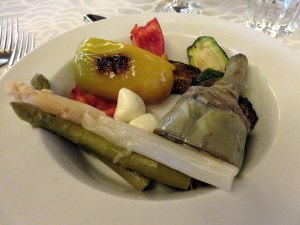
A sampling of the many vegetables available every night.

At the hotel, none of the food on the menus was described in English. Our evening meals — five courses if you wanted to eat that much — were described in Italian and German and the cuisine was decidedly fusion. Pasta or prosciutto and melon for a first course followed by roasted veal and a beetroot/potato puree. Or a cheese strudel as a starter with mountain lake fish on a bed of leeks with lardo. (Lardo is what it sounds like, though quite refined, a Tuscan specialty.) Like I said, fusion, or as our Italian friend would say, contaminated (contaminazione in Italian is a little pejorative, but serves as a false cognate in this case).

After our long day hike, we could have refreshed in the indoor-outdoor pool or worked on our skin cancer, but we retreated to a pre-dinner shower and coffee on the terrace overlooking the magnificent peaks. Just as the sun was setting, we headed to dinner, now greeted by a huge salad and vegetable buffet spread over the enormous “E” that once held breakfast. Perfectly sauteed artichokes, two types of asparagus, grilled peppers and eggplant, marinated mushrooms, more salad ingredients than the farmers’ market, and a cheeseboard.

Pasta

My primo one night, pasta with smoked salmon. Sensibly small portion as there was more to come.

That was the first course. After that, there were soup, a primo, a secondo, and dessert, plus (more) cheese and fruit. We confined ourselves to three courses (no soup nor dessert) but indulged in a fine and reasonably-priced wine list.

My middle-of-the-night trip to the bagno was blessed with the lovely sight of the great mountain peaks bathed in moonlight. That alone was worth getting up for at midnight.

Travelers often complain about “touristy” areas and that so many places are over-crowded, or that they encounter too many Americans carrying Rick Steves’ guidebooks. If one wants to have an experience unlike any you are likely to have in North America, this is a fine place to add to an itinerary.

Laurel and the Sciliar

Just starting out on the Panorama hike. Perfect day!

Dash across Germany

16 Sep
16 September 2017.
Relatively speaking, that is, we dashed across Germany. Eight-and-a-half hours by train from Amsterdam to München. Seems long, but it is not much slower than flying when you consider time to-and-from airports, security, waiting time, etc. And it is far more relaxing. I’ll take a train over a plane any day. We read, napped, chatted, and snacked. The only challenge was the six-minute change of trains. Six minutes! We had to go from the end of one very long train, down from the platform through the very busy Hannover station, up to another platform, and run several car lengths. We made it about 60 seconds before they closed the doors. Note to self: never let Trainline.eu schedule our connections. Should’ve bought directly from Deutsche Bahn. The price was great, though.

This passed for a snack in first class on our second DB train. Expected beer and pretzels.

Germany wasn’t really in our plan, but we needed to get from Amsterdam to Ortisei and it was not feasible to do in a day by train. I last visited München in 1972, a few weeks before the ill-fated Olympics. Ric had never been. In order to make the most of our time there, we hooked up with Taff Simon (not yet born in 1972, he observed) of Dark History Tours. Taff is an archeologist and life-long student of history. He shared with us not only the highlights of München (Marianplatz, Frauenkirche, Hofbrauhaus, and so on) but afforded us an insider’s view taking us into places big groups would never go. For example, the big meeting room on the top of the Hofbrauhaus where in February 1920 Adolf Hitler and the National Socialists held their first meeting. Taff led us through historic sites related to the rise of the Nazi party and Hitler’s activities in München prior to WWII, and we were also privy to his insights on the culture, the Bavarian royal family (think of the “Kings Ludwig”), and of course beer.
Click on any photo for a larger view and caption.

We visited a bierkeller our first night, but the stand-out meal we enjoyed in München was Lebanese at Baalbek. What a delightful change from pork, red cabbage, and dumplings! Served with fine Lebanese red wine, we could not have been happier. We are also happy to be back in the habit of walking everywhere. A 20-minute walk before and after a dinner like that is so preferable to dropping into a car and carrying your new fat right to bed.
We are now in Ortisei and delighted to be back in Italia. It feels like coming home. Had great weather Friday morning, if cold (32 F/0 C), so we got in a great hike. We had to go buy fleeces: Didn’t pack them as we had not expected such cold to hit already.