Archive | Food RSS feed for this section

By the sea

6 May
We are drawn to the sea. I guess growing up in the land-locked Midwest made the sea particularly mesmerizing to us. When we moved to Portland in 1987 we became frequent visitors to the Oregon Coast, and were especially fond of going to Cannon Beach with the dogs. Yet we are not beach people, per se. We are ramblers and hikers who enjoy the fresh sea air and great seafood. So we gravitate to the coastal areas not in the height of summer with normal people, but in the shoulder season, and occasionally in winter. We made a trek to “CB” each fall and very early spring for many years. Never got close to getting sunburned at CB.
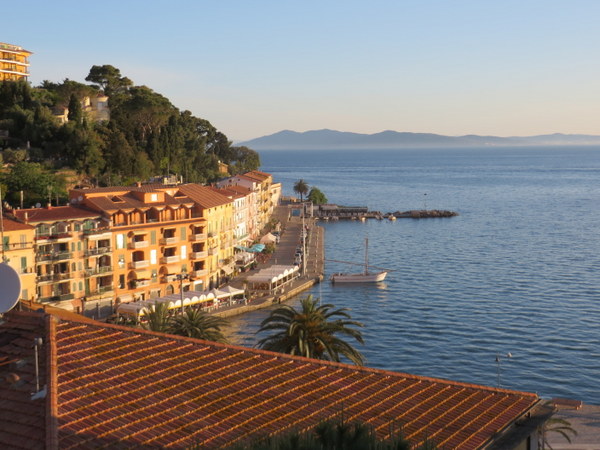
Early morning view from our room in Porto Santo Stefano.

Early morning view from our room in Porto Santo Stefano.

And so we a passed a long weekend in Tuscany. “Tuscany?” you ask. “Isn’t that hill towns, Renaissance art, sangiovese and wild boar?” Yes, it is all that, but it also sports a fabulous coastline in the Maremma area. It’s a little bit like the Cinque Terre, but closer to Rome, easier to get to, and less well-known among North Americans.
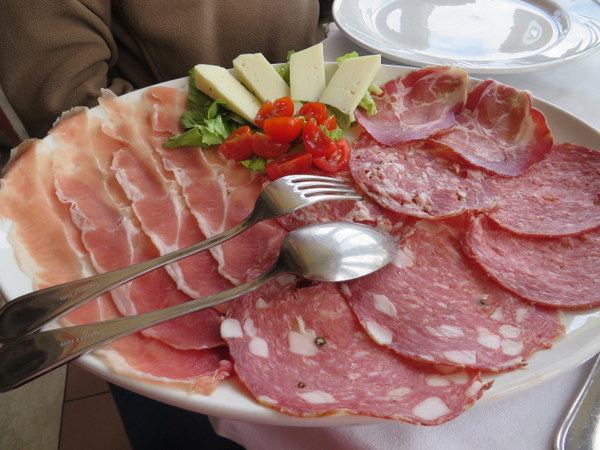
Ric’s contractor friend Dario recommended this area, particularly Porto Santo Stefano, as he knows our interest in hiking and our affection for the Cinque Terre. Isola del Giglio,  which has intrigued us since the Costa Concordia capsized off its coast more than two years ago, is only a short ferry ride from Porto Santo Stefano. Lacking enough time to make a Cinque Terre trek, and always interested in places our countrymen seldom visit, off we went. After talking to some Italian friends it seemed we might have been better off actually staying on Isola del Giglio instead of in PSS, but by the time we came to this knowledge, it was too late to secure a room that was both acceptable and affordable on Giglio. This was a holiday weekend – the third in a row! – for Italians. So we stayed in a quaint B&B in Porto Santo Stefano, with a fine terrace overlooking the sea. The price we had to pay for the view is a four-floor walk-up. Ugh.
Cute little Giglio Porto. The ugly shipwreck is behind me, just outside the harbor.

Cute little Giglio Porto. The ugly shipwreck is behind me, just outside the harbor.

It’s been a chilly spring in Italy, but the lack of oppressive sun makes for good hiking and small crowds. An hour-long ferry ride took us across the channel. Giglio is part of the Tuscan Archipelago, a national park. We secured a map and a brochure and a little information from the guy at the Tourist Information Center who knew slightly less English than I know Italian (always a rewarding moment for me). We wanted a hike of 60-90 minutes, leaving time for lunch and to return to the harbor to catch our ride back. “Up to Castello,” he said, confirming what we’d read online and heard from a local diver the day before. “It’s steep, but go slowly. And there’s a restaurant. You can take a bus back down.”
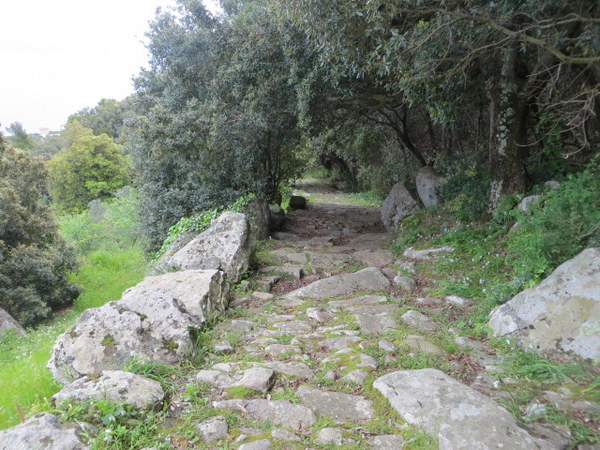
It is difficult to imagine the industrious people, probably Romans, who built this path over the island so very long ago ago.

It is difficult to imagine the industrious people, probably Romans, who built this path over the island so very long ago ago.

Steep it was, and deserted. We only saw four people during 90 minutes, quite a different scenario than the Cinque Terre. We trudged up the mountain, glimpsing the castle high above us, and rewarded with beautiful views below us.  Wild flowers as one can only find in spring are abundant. We traversed oak woods, through scrubby pine, and finally some classic Italian Cyprus, emerging 1300 feet higher at Giglio Castello. Not bad for old people. We weren’t even panting (too much). And there was a restaurant. Not just a “restaurant” but one serving fabulous food. We got ourselves into a very fine lunch indeed! In the U.S. in all of our hiking for years and years in Oregon, we could never have dreamed of such a lunch at the end of a trail! Maybe a stale granola bar, or perhaps a hot dog at the Dairy Queen in some small town on our way back home, but fresh seafood pasta? A Tuscan salumi platter? Fine, crisp vino bianco? Yup, here at the highest point of a tiny Mediterranean island, alongside a castle from the 13th century, after hiking a path used for millennia to cross the island, we find superb cuisine.
Ric on our steep steep hike at Isola del Giglio.

Ric on our steep steep hike at Isola del Giglio.

The castle high above us. The hike was from sea level to about 1300 feet.

The castle high above us. The hike was from sea level to about 1300 feet.

After 90 minutes of uphill hiking, we are at the last bit before achieving Castello. Lunch is in range!
After 90 minutes of uphill hiking, we are at the last bit before achieving Castello. Lunch is in range!

Don't tell Dr. Rosa what we had for lunch! Lovely Tuscan salumi platter. I like to think the hike caused us to wear off the fat before we even ate it.
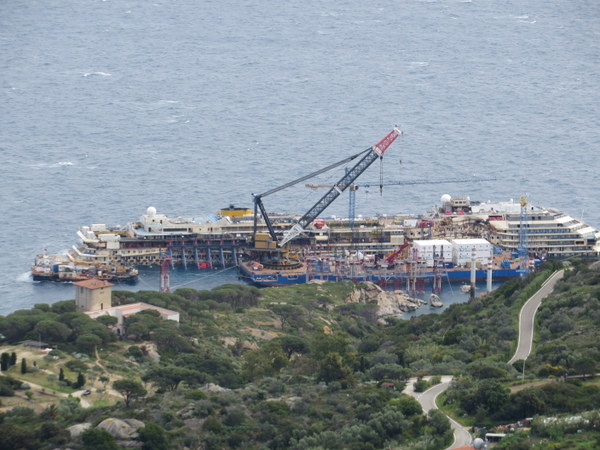
Don’t tell Dr. Rosa what we had for lunch! Lovely Tuscan salumi platter. I like to think the hike caused us to wear off the fat before we even ate it.

As we hiked to Castello, we were seldom out of sight of the Costa Concordia. We are probably at 800 feet taking this photo.

As we hiked to Castello, we were seldom out of sight of the Costa Concordia. We are probably at 800 feet taking this photo.

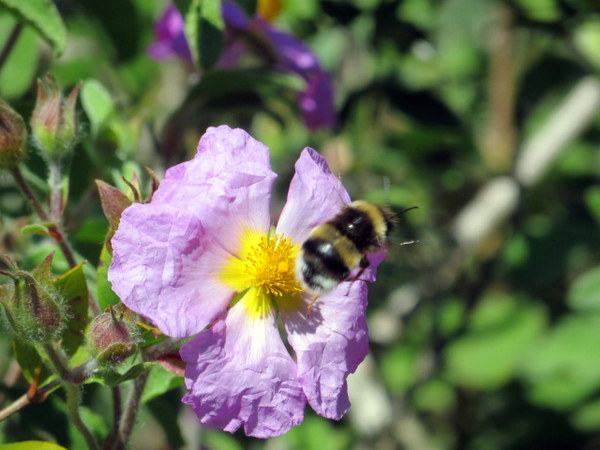
We found Isola del Giglio interesting enough to return a second day, allowing us to check out the windward side of the island at Giglio Campese. An efficient bus ferried us from the port, up-and-over at Castello, down the opposite side to the beach.  Here we found an almost Hawaii-like locale, but not so posh. Also, Hawaii lacks 19th century turrets as far as I know. Our planned ocean-front hike turned into an inland trek when the rock climbing became a bit challenging. Not wanting to risk a broken body part, we opted for forest, wild flowers, and bees. Once again our efforts were rewarded, this time with fresh salads and crisp Ansonaco, (the local wine) on the beach.
The beach at Giglio Campese, a little like Hawaii.

The beach at Giglio Campese, a little like Hawaii.

A little like Hawaii, but with a 19th century tower.
A little like Hawaii, but with a 19th century tower.

Wildflowers are abundant in May, and the bees made industrious.

Wildflowers are abundant in May, and the bees industrious.

Porto Santo Stefano is a very peaceful location with a number of good restaurants at all price levels, a fantastic lungomare and piazza with a 5-star hang-out factor. We could see the stars from our terrace and nights were so quiet that our sleep was uninterrupted. Bliss.
Porto Santo Stefano sports many restaurants along a fabulous lungomare, prime for the passagiata.

Porto Santo Stefano sports many restaurants along a fabulous lungomare, prime for the passagiata.
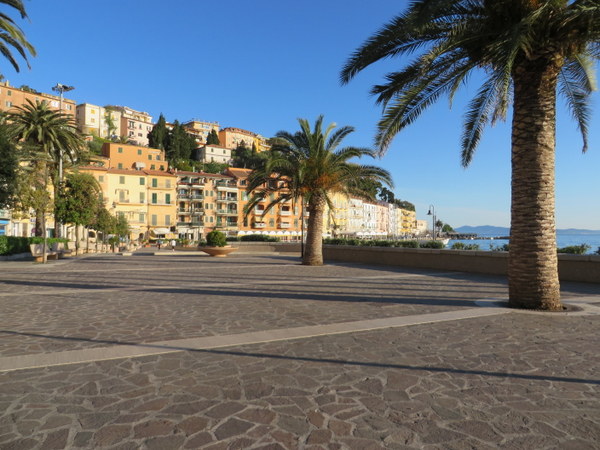
Lovely piazza in Porto Santo Stefano. Great hangout factor.
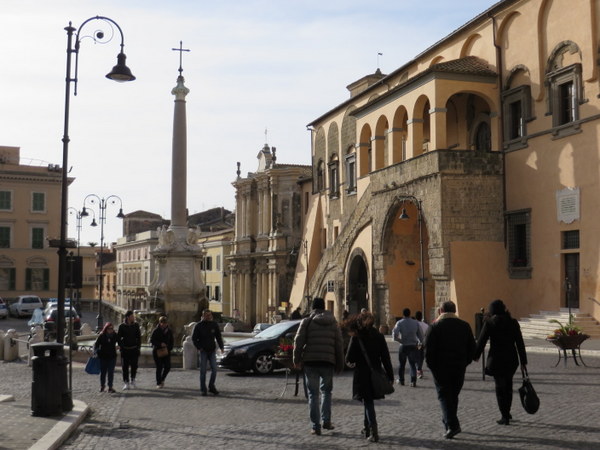
Lovely piazza in Porto Santo Stefano. Great hangout factor.

Day 4: Trains & Etruscans

17 Feb

I am a day late posting this update. Just too tired last night, and today I had to do my Italian grammar homework or suffer the consequences when my tutor shows up tomorrow. Every day here is a test, but I am bound-and-determined that I will speak more-or-less grammatically correct one day. 

Classic Italian piazza": City Hall, a fountain, people enjoying a stroll.

Classic Italian piazza: City Hall, a fountain, people enjoying a stroll.

After an exhausting but interesting tour by car on Saturday, on Sunday we took a train north along the coast to Tarquinia, another ancient Etruscan city. The Etruscans are very mysterious as there is no literature, no historical record nor religious texts. We have only the knowledge derived from their tombs, which contained “grave goods” and art.

The old wall surrounding Tarquinia.

The old wall surrounding Tarquinia.

The train was a Regionale Veloce meaning it runs a bit faster than the serviceable Regionale found along many rural lines. On the train, one passes the port of Civitavecchia with enormous cruise ships docked to disperse passengers for a day in Rome, as well as other more charming seaside towns that perhaps serve as retreats for city-weary Romans. Tarquinia is more than 2500 years old, but today it may serve as a bedroom community to Rome as one can commute by train in a little over an hour. (We know people at the Embassy that make an hour-and-a-half trip to work, living various places on the coast or in the hills and commuting by train.)

Etruscan sarcophagus.  Note the detail in the carving. About 2500 years old.

Etruscan sarcophagus. Note the detail in the carving. About 2500 years old.

With its remoteness from Rome, few tourists venture to Tarquinia, especially in February. It was serene and uncrowded this sunny Sunday. We enjoyed the National Museum and its treasures without interference, then meandered up the street, through a classic piazza in search of Sunday lunch. We stumbled – luckily – into Ristorante Ambaradam and were soon followed by group after group seeking lunch. What a find! We feasted on insalata di polpo & cicoria ripassata (salad of warm octopus and greens) served on a bed of creamed chickpeas, followed by cacio e pepe (think Italian mac & cheese, but classy and “zippy”) for me, and pasta with a ragu of octopus, tomato, and guanciale with flakes of pecorino for Ric. Alongside was THE BEST puntarelle ever.    Puntarelle is a seasonal favorite, and while I like it the “normal” way (see link), the one at Ambaradam was extra nice featuring olives and little bits of sweet orange, with the anchovy taste played down. Yum! Washed down with a Chardonnay from Lazio, this lunch demanded exercise. As the walk to visit the necropolis was ahead, we were able to shake off the postprandial doziness in the cool fresh air.

The necropolis of Tarquinia features more than 6,000 tombs. Once at ground level, after 2,500 years they are subterranean. One climbs down

Another beautiful fresco from 2500 years ago.

Another beautiful fresco from 2500 years ago.

steep stairs to view the chambers, decorated with sometimes lively frescoes. The dioramas and renderings reminded me of the Indian burial mounds found in Minnesota. Although I am unaware of any place you can actually enter one in America, the concept seems similar: bury the person with “grave goods” to take them into the next life. We almost missed the entrance to the park (signage is not terrific), but a tour group of French students attracted our attention and we made for the gate ahead of them.

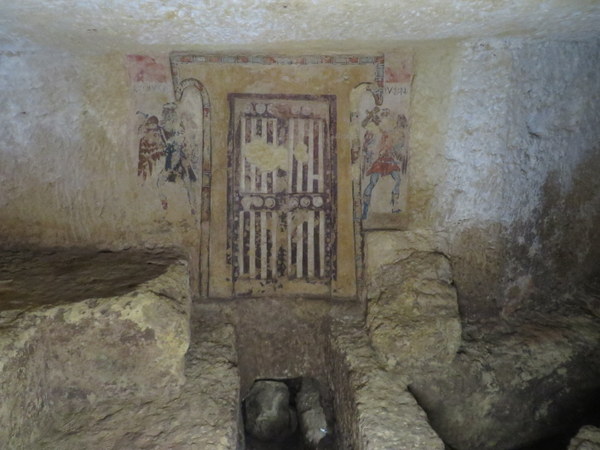
This Etruscan fresco depicts a false door designed to keep the Devil away from the tomb of the departed.

This Etruscan fresco depicts a false door designed to keep the Devil away from the tomb of the departed.

The treasures found in the National Museum came from these tombs: elaborate tombstones and sarcophagi, as well as jewelry, weapons, urns, and other household goods one might need in the afterlife.

We walked a lot in part because the bus service on a Sunday is limited. Here’s a conundrum for you to consider:

  • The museum and necropolis are closed on Monday (very common in Italy) and open Tuesday-Sunday. The two sites are 1.5 km apart.
  • The Tourist Information office is closed on Sunday but open Monday-Saturday
  • The shuttle bus to the tombs does not run on Sunday but does Monday-Saturday

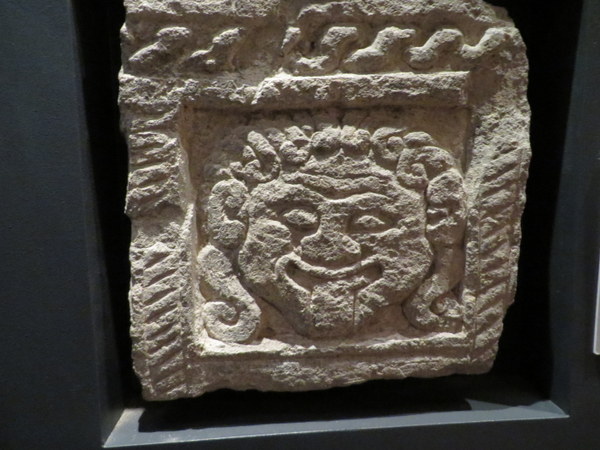
    Fabulous detail of a tombstone.

    Fabulous detail of a tombstone.

Why does the shuttle bus run on Monday when the tombs are closed? Why is the TI closed on Sunday when the museum and tombs are open, but open Monday when the necropolis and museum are closed? Like so many things here, it makes no sense from a service and commerce point-of-view.

Chiesa di San Francesco Bell Tower, Tarquinia.

Chiesa di San Francesco Bell Tower, Tarquinia.

If you go to Tarquinia on Sunday, be prepared to walk…or take a car. But if you eat cacio e pepe or other Italian specialties, you may want to walk anyway. The train back to Rome offered a chance to nap a bit, far better than driving in my book. 

Surprising Spiez

6 Jan

I wasn’t going to blog today (January 5) but we had such an interesting experience in Spiez, Switzerland, I had to write.

Castle on a lake

Castle on a lake

We had a 3 hour layover in Spiez, waiting for our train to Milano. Good time for a walk and lunch. Spying the restaurant in the train station, I checked the menu just-in-case that was our only option. Spiez is small, it’s Sunday in religiously conservative Switzerland, and choices might be limited.

In the U.S. certainly, and for the most part in Italy, one would not expect much in the way of “cuisine” in a railroad station these days. In Italy you can get a good panino to-go, decent wine, pastries, and of course, fine espresso on-the-run. In my limited experience in train stations in the U.S., all I have seen is over-cooked hotdogs, bags of chips, and similar culinary delights. Gone are the days of white tablecloths, crystal glasses and sparkling flatware with “home-cooked” Sunday dinner. My expectations were not high for Spiez.

After a walk thru the town (there’s a castle and a lake), we returned to the station, not having seen

Castle kitty, expectant mamma

Castle kitty, expectant mamma

another option. To our surprise the Restaurant Bahnhoff Buffet was thronged with diners (most of them older than we are) and the clock was only touching noon! Despite the fact we did not have a reservation (who knew?!), they seated us next to a cute old couple (yes, even to us they were old) and their ancient hund. Although my German is almost non-existent, it was better than the server’s English, so we managed to order one of the four daily specials. It was the best meal at the best value of any we had in Switzerland the past few days! Starting with potato soup, we then had access to a salad bar.

Fish filets, potatoes and carrots. The big yellow things are NOT lemons. They are buttered potatoes.

Fish filets, potatoes and carrots. The big yellow things are NOT lemons. They are buttered potatoes.

In typical efficient Swiss manner, much like dining in small town USA, the entrées were delivered before we could finish our salads: perfectly pan-fried perch, buttered potatoes, al dente carrots, side of tartar sauce. I felt like I was back in Lindstrom, MN, having the Sunday dinner special at the Dinner Bell Café, except there the fish would have been walleyed pike. The tables were lined with locals whom we suspect eat there every Sunday. For CHF 19.50 (about Euro 15.85) per person we had a 3-course fresh, reasonably healthy meal.  Of course, in typical local fashion, a glass of mineral water and a cup of coffee were about CHF 4.00 each, clearly a profit generator. We were thus successful in emptying Ric’s pockets of Swiss francs before returning to Italy. Another reminder of small town USA “dining:” Elapsed time from entering the restaurant to exiting: 45 minutes. In Italy we’d have barely finished in time to make our train 2 hours later.

The dining room at Restaurant Bahnhoff Buffet, full of locals, no English.

The dining room at Restaurant Bahnhoff Buffet, full of locals, no English.

Another amazing thing I have not seen in all of our travels the past 3 years: lockers. Switzerland apparently is not in fear of people who would do harm leaving objectionable items in stations. For CHF 5.00, we were able to secure both suitcases and walk freely about the city. What a treat! We saw lockers in the small towns of the Berner-Oberland, and now in Spiez.  There is luggage storage in many Italian stations, with an attendant who will charge a few euros for a few hours of storage. However, some of these close (of course!) for la pausa at midday. So if your train is at 13:00, you may not be able to retrieve your bag because la signora who took your euros and gave you a claim check is enjoying her 90 minute lunch, obviously away from the train station since there is not a nice Bahnhoff Buffet.

If you are ever in Spiez, don’t hesitate to eat at the train station. If it’s Sunday, you might want to call ahead for a reservation!

The castle in Spiez

The castle in Spiez

On the last day of Christmas….

Piazza Navona Jan 6If you were a tourist in Rome today, Epiphany, you’d have awakened to beautiful sunshine. Perhaps desiring to go to Piazza Navona and see Bernini’s masterful Fountain of the Four Rivers, sipping a glass of wine in a cafe, gazing at the fountain. Ah, bliss! Except when it is La Befana or L’Epifania, a national holiday. It seems every family in Rome was there today to visit the Christmas market one more time.  Balloons and strollers, parents and grandparents, vendors and street performers: Absolute madness.  Today was the LAST day of the 12 days of Christmas. Tomorrow is back to school!

Winterwandern

5 Jan

This trip was to be a mutual Christmas present of Paris or London for a weekend, but we decided we wanted to go by train. Then a friend suggested Vienna—also too far by train—which led Ric to think maybe Switzerland. But in the winter? We haven’t willingly spent time in snow for years. Then I discovered that the Swiss groom trails for something called Winterwandern (Winter hiking) and as hiking always interests us, the planning began.

The little Swiss town of Spiez; Snow in the mountains, nothing in the town.

The little Swiss town of Spiez; Snow in the mountains, nothing in the town.

When we stepped off the train in Spiez, the first thing that came to mind was the line from the movie “White Christmas” where upon stepping off the train Rosemary Clooney says “There has to be snow!  This place is advertised as America’s Winter Playground!” We thought Switzerland in winter would be snow-covered from end to end. We needn’t have worried: Once up out of the valleys there was plenty of snow…and great hiking!

January 3 saw us above Lauterbrunnen hiking to Mürren. Of course one can hike up the 700-or-so meters (1800 feet), but why waste energy (and knees) when there’s a fun gondola? Once on top, we hiked almost alone the 1.5 hours to Mürren, paralleling the electric railroad that ferries skiers and non-hikers. Quiet, except for the distant sounds of helicopters doing God-knows-what on the other side of the valley, and the electric glide of the train every 15 minutes. Crunching through snow in and out of forest on groomed trails was absolutely delightful.

Trail to Murren, through lovely piney woods.

Trail to Murren, through lovely piney woods.

On the trail, a mother pushes her children in a "sledge"

On the trail, a mother pushes her children in a “sledge”

Captivating town of Murren. Only a few service vehicles allowed. Otherewise all pedestrian...which includes people on skies and sleds.

Captivating town of Murren. Only a few service vehicles allowed. Otherewise all pedestrian…which includes people on skies and sleds.

Tine skier in Murren

Tiny skier in Murren

Mürren is cute and definitely on our radar for a future summer trip. With minimal motorized traffic and typical Swiss architecture, filled with adorable children learning to ski, it is also the jump off point for a ride on a gondola to the Schilthorn and Piz GLoria, a mountain setting featured in “On Her Majesty’s Secret Service” the 007 movie starring one-time Bond, George Lazenby.  More intriguing to us, as non-skiers, were the people heading to 9748 feet to ski and snow board down. Yikes! The slopes looked impossible to us (remember, we are from MN and ND originally), but even children were whizzing down them from this amazing height in a snow storm!

Japanese tourist in snowstorm to have her picture taken with "James Bond". I stayed inside.

Japanese tourist in snowstorm to have her picture taken with “James Bond”. I stayed inside.

Sun!

Sun!

Descending via the cable way, we re-entered Mürren and the sun came out, brightening the winterscape and warming our backs as we hiked down to Gimmelwald, a tiny village on the cliff from where one can catch yet another gondola back to the valley floor.  On the way down to Gimmelwald from Mürren we were passed by those commuting on sleds through what would be village paths in summer. No one even came close to hitting us as everyone is very aware of the need to share the “road” safely. The occasional and friendly “Achtung!” warned us to step aside.

Little sledder spins out on the trail to Gimmelwald. She laughingly recovered.

Little sledder spins out on the trail to Gimmelwald. She laughingly recovered.

January 4

The weather report says 1-3 inches of snow expected in Mürren and Wengen. Better than rain in the valley, so we headed up the cliff again. This time treating ourselves to the train along the cliff top to Mürren, we were joined by a Japanese tour group. The Japanese apparently flock here in winter, not for skiing but for simple sightseeing. There are families as well as young singles, each with a smartphone, iPad, or camera snapping away at the scenery and each other. I was struck by the politeness of the group, standing aside to allow people to descend from the train row by row. After the every-person-for-themselves attitude in public transportation in Rome, it was surprising to have the Brits “minding the queue,” Germans telling their children to “akt freundlich” (Literally “act friendly” but used in the context of correcting a child about to barge through a crowd to get to the front), and now the Japanese bowing to let us out of our row in turn! For those who do not know, there is no queue for bus or Metro in Rome. People do not wait for those exiting to descend before trying to crowd onto buses or trains. It is a free-for-all at every stop. Italians are warm and engaging, helpful and friendly. They will give you free food, the shirt off their backs, and go ten minutes out of the way to give directions, but they’ll knock old ladies out of the way to get on the bus first.  In Switzerland there is no free food – they even charge for tap water – but they do line up and allow people to pass on the sidewalk or trail. The Swiss are efficient above all. But I digress….

The train to Murren parallels the trail for much of the way. Note the open air baggage car for luggage, supplies, skies.

The train to Murren parallels the trail for much of the way. Note the open air baggage car for luggage, supplies, skies.

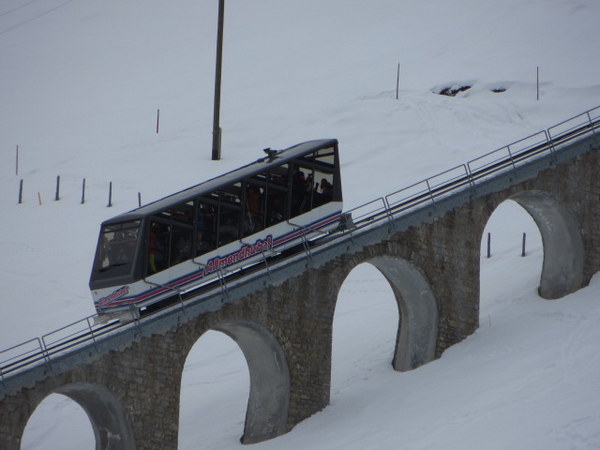
Funicular to Allmendhuble

Funicular to Allmendhuble

Yet another mode of transportation awaited us, the funicular at Allmendhubel. A quick three minute trip took us to the starting point of a downhill hike back to Mürren. The big difference this time is we shared a mixed-use trail with skiers and “sledgers” as translated into English, the people using the “bob run.” It was a little disquieting to have tiny children as well as adults flying by us on skies and on sleds for what must easily have been a 6 km downhill run. Once again, everyone behaved beautifully and watched where they were going. I doubt we’d have as much luck in the U.S. on such a run as evidenced by my friend Heather who was run down by a sled a few days ago in Oregon. Grazie a Dio she wasn’t injured. Here, if someone ran you down, you might go flying off a cliff!

Murren

Murren

Skiers gather in the shadow of the Jungfrau

Skiers gather in the shadow of the Jungfrau

Sharing the "trail" with sleds and skiers.

Sharing the “trail” with sleds and skiers.

A final word on food here: There’s little variation. I know, some of you are thinking “Italian food is all the same” but I beg to differ! There are 10,000 <sic> pasta dishes, there’s risotto, there are fagioli, vegetables beautifully prepared, seafood galore. Sure we have salumi and cheeses in Italy, but meat is often only a small portion of the meal. Here it seems every restaurant’s menu is the same as the next. Raclette, fondue, rösti:  everything is bathed in cheese, there’s a huge emphasis on meat and potatoes, and the major form of vegetable is salad. The “Italian food” served here in the Berner-Oberland is more like the American-ized version, not the preparations we have come to love. The bread is phenomenal, though, and breakfast is more than a croissant. The coffee comes in large cups and is robust. While I love my Italian espresso shots, sitting here in the cold a larger cup of coffee seems right, although it costs about as much for a cup of coffee (no refill!) here as it costs for a great panino for lunch in Rome.

Tomorrow we return to Rome. We’d love to hike this place in the summer for comparison, but it has given us resolve to go to the Dolomites next winter. Maybe we’ll have a White Christmas in Italy’s Winter Playground. At least we know they serve Italian food there.

It's still Christmas here! Ends with Epiphany, January 6!

It’s still Christmas here! Ends with Epiphany, January 6!

New Year, New Country

3 Jan

January 1

It is 20:48 and I am already tucked into my fedderbett.  I probably should take a statin drug after what I ate for dinner. At first nothing looked good on the Swiss menu. There were no good antipasti. Surely I would not order pasta here, and certainly not the pizza. Where are the grilled fresh vegetables? So we both went with Rösti and salad.  The former are a little like hashbrowns but worse for you, dripping with cheese. At least mine had sliced tomatoes on them.  Oh my God, get me back to Italy before I kill myself on this food! The wine is marginal, but the country is jaw-droppingly beautiful and the trains are lovely. We’ve been on four different types today coming from Rome to Lauterbrunnen. (Examples below.) Now to sleep as we only had 4 hours on New Year’s Eve.

EuroCity from Milan to Switzerland

EuroCity from Milan to Switzerland

Frecciarosso, top of the line Trenitalia

Frecciarosso, top of the line Trenitalia

Interlaken to Lauterbrunner

Interlaken to Lauterbrunnen

January 2

Cogwheel train to the mountains, filled with skiers

Cogwheel train to the mountains, filled with skiers

With precipitation in the forecast – rain in the valley and snow in the mountains – we decided to head up the Jungfrau side of the valley on the cute cog railway, joining throngs of skiers as well as hikers and those intent on sledding. First stop, Wengen, a resort town in sight of the Jungfrau. The day quickly became about transportation, always popular with Ric. The cog railway goes up very high, ferrying skiers to an array of lifts. They ski down a variety of runs, and in a complex network of lifts and railways, can return for additional runs via traditional ski lifts or rejoin the train for a warm ride to another starting point. We continued on to

Apfelkuchen for 2nd breakfast at Kleine Scheidigg. The apples are barely mortared together with cake. Yes, it was huge. Luckily it was for two.

Apfelkuchen for 2nd breakfast at Kleine Scheidigg. The apples are barely mortared together with cake. Yes, it was huge. Luckily it was for two.

Kleine Scheidigg and in a heavy snow storm there determined hiking down was not in the cards, so we took another train to Grindlewald, a larger ski resort. Luckily the pass we purchased covers all forms of lifts, gondolas and trains for three days as the tickets purchased one-at-a-time are quite pricey. Reversing, we came back to Wengen, the snow stopped, the clouds parted, the sun came out, and we caught a gondola to a magnificent viewpoint at Mannlichen. We rode so many transports we actually amortized the cost of the 3 day pass in one day. Ric was in heaven, and we managed to log over 8 kilometers on foot too.

At Mannlichen, 3 peaks, the Eiger, the Monch and the Jungfrau

At Mannlichen, 3 peaks, the Eiger, the Monch and the Jungfrau

For our flatland readers, sledding is nothing like when we grew up. When we were kids we hoped to find a little hill and take our sleds for a 30, 60, or 90 second ride, then slog back up and do it again until we were soaked through and had blue lips. (Of course as kids in the Upper Midwest, Ric and I also dealt with temperatures as low as -10 Fahrenheit or worse, which led to blue lips pretty damn fast.)  Here, they groom the runs for walking and sledding.  You take a train or a lift to the start of the trail and can sled for several kilometers on

Ric in the snowfield at Mannlichen. Yes, it was cold!

Ric in the snowfield at Mannlichen. Yes, it was cold!

snow packed for your pleasure. And the temp hovered around 28-30 Fahrenheit, practically spring in Minnesota. Then take a lift or train back up and do it again!

People warned us it was expensive here. They were right on some things. For example, a bottle of water that is CHF 2.20 in the valley where we are staying is Euro 1.80, or $2.44. Up on the mountain, that same bottle of water is CHF 5.50!  But everything has to be carted in on the train, increasing costs considerably. I shudder to think the cost of bringing fresh vegetables in. Dinner was on par with prices in Rome, although the wine cost more and was of lower quality. We are spoiled at wine quality and price in Italy: It’s a basic human right to have good wine at a reasonable price in Italy.

I miss hearing and speaking Italian. I never know what will come out of my mouth now. Buongiorno gets a funny look, as does grazie, but guten morgan sounds strange from my lips. Funny, though, I remember my numbers in German although I haven’t spoken it in 40 years. We sat next to four Italian young people on the train this afternoon and I really enjoyed eavesdropping on their conversation. The most priceless statement from one young man, probably 20-22 years old: “I hate the telephone. I never call anyone on my cell phone, except my mamma.” Bravo!

Tomorrow we will attempt a hike on the other side of the valley, magari