Archive | Restaurants RSS feed for this section

Bits and pieces

30 Nov
It has been a long time since I posted to Good Day Rome. How to catch you up on our busy month?
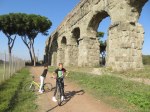
We started with an outing on Ognisanti (All Saints’ Day) November 1. It was a spring-like start to November and we were not alone, but it was divine to walk among the ancient aqueducts yet be so close to home.  Click on any picture for a larger view. 
Ric had a couple of eye doctor appointments, including one with a doctor who specializes in the vitreous gel of the eye and the retina.  (Narrow focus.) This doctor said no further treatment was needed (yea!) but that he should have frequent check-ups. Va bene.
In sharp contrast to last year’s memorable and wonderful event, we choose to spend a quiet Thanksgiving this year: no cooking. I made a turkey breast on Sunday prior and we ate some excellent meals during the week, but on The Day we ate a decidedly Italian lunch at our favorite trattoria, following  a visit to the Norman Rockwell exhibition that is currently in Rome.  
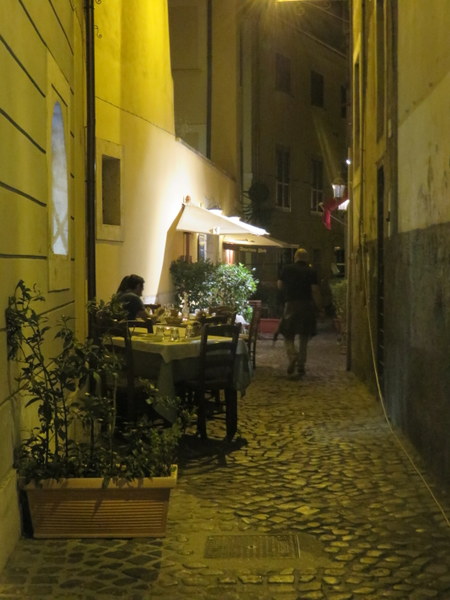
We hardly recognized Antica Taverna when we arrived for lunch on Thursday! We have been eating there for years, 90% of the time in their delightful outdoor area, under the sky in summer and in the enclosed, heated “annex” in winter or rain. The Mayor of Rome, Sindaco Marino, has waged war on what they call tavolino selvaggio or “wild tables,” and has made the restaurants in the centro storico pull their tables to a minimal protuberance. The motorini can go through and cars can pass through the ZTL practically knocking pedestrians out of their way, but the tables have to be cut back. Even in Piazza Navona they have receded.  This new regulation severely restricts the small restaurants like AT that have more than 50% of their seating outside. Jobs were lost in this stupid move, but I doubt Marino will be mayor for long so perhaps the tables will go wild again.
I also started a new blog, Our Weekly Pizza, to chronicle our ongoing mission. Please take a look. If you like you can subscribe, or you can find it on Facebook , Google+ and Twitter.
We are wrapping up November with Christmas preparations. The holiday movie season kicked off with our annual viewing of “Planes, Trains and Automobiles” on Wednesday, and our extensive  collection (I think 28) Christmas movies is queued for viewing. The apartment is decorated except we do not yet have a tree. Hope to pick one up tomorrow. (Much more of a challenge than you might think.)  We have two trips coming up as well: Venice in early December and hiking in the Dolomites over Christmas. I will be sure to post some photos from those expeditions.
What have all of you been up to?

Summer nights

23 Aug
When it is hot, Italy comes alive at night. The number of people dining at 10:00PM or later even on a week night is amazing. People take their lives out-of-doors once the sun goes down.
Fountains and pools of Villa d’Este, beautiful during the day, take on added drama at night.

Fountains and pools of Villa d’Este, beautiful during the day, take on added drama at night.

Although this summer has not been as miserably hot as the past two (2012 was one for the record books), it’s still humid and hard to move around in full sun. The nights are soft and pleasant, and there is a tradition of special events and the opening of venues that normally close at 6:00PM.   Notte d’Estate a Castel Sant’Angelo, Lungo Il Tevere Roma  (a festival along the Tiber), and various other events dot the calendar in Rome.
Last summer we tried to go to Tivoli to see the magnificent Villa d’Este lighted at night. It was a bust because we were driving, directional signs were poor, and we didn’t know what we were looking for. We did find on that first visit that Tivoli is very lively on summer evenings. So during the past year we made two daytrips to Villa d’Este via train to get our bearings. Finding it remarkable,  we decided to spend a night at a B&B and see the gardens by night.  Every Friday and Saturday through September 13 (weather permitting), Villa D’Este opens its gates after dark allowing one to enjoy its magnificent fountains illuminated. The transformation at night is stunning.
We boarded a regionale train from Station Tiburtina on the holiday of Ferragosto (August 15), and checked into the charming B&B al Palazzetto, a recently restored 15th century building.  The proprietor is an architect and his professionalism showed in the fine design. We were warmly welcomed and shown to a comfortable room with one of the most modern bathrooms we have had in Italy.
Delightful, serene dining on a soft summer night

Delightful, serene dining on a soft summer night

The town of Tivoli offers many fine restaurants, and it seems they are open very late to serve those who choose to tour Villa d’Este before dining. We chose one with a fine location on a piazza, Taverna Quintilia, only a few minutes’ walk from the entrance to Villa d’Este.  Taverna Quintilia is a rarity: a true Neapolitan seafood restaurant in Lazio, featuring succulent octopus, fresh marinated alici (anchovies), grilled spigola (sea bass), and more. This was some of the best seafood we have eaten outside of the Cinque Terre and Sicilia.
After dinner we headed over to Villa d’Este, arriving about 9:30PM to find a fast-moving line. The estate is huge so it swallowed the crowd easily and we enjoyed an uncrowded tour. The estate is transformed by the play of light on fountains. It occurred to us that in the U.S. this place would not be allowed to be open at night: it would be too dangerous with the low lighting, uneven walkways, and dark Renaissance staircases. We firmly held hands and thoroughly enjoyed wandering the grounds, watching the families and couples alike enjoying a soft evening – almost cool for August.


The Renaissance-era villa, Cardinal Ippolito II d'Este, son of Alfonso I d'Este and Lucrezia Borgia and grandson of Pope Alexander VI.

The Renaissance-era villa, commissioned by Cardinal Ippolito II d’Este, son of Alfonso I d’Este and Lucrezia Borgia and grandson of Pope Alexander VI.

Beautifully lighted fountains – Renaissance era faces carved into a long wall light a romantic walkway.

Beautifully lighted fountains – Renaissance era faces carved into a long wall light a romantic walkway.

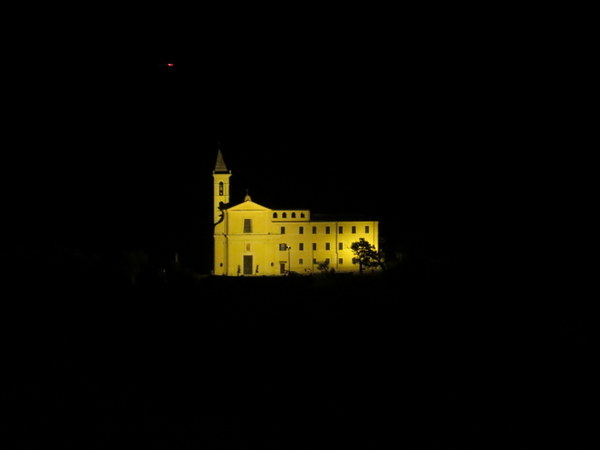
An unidentified church seem s to float in the darkness, just beyond Villa d'Este.

An unidentified church seem s to float in the darkness, just beyond Villa d’Este.

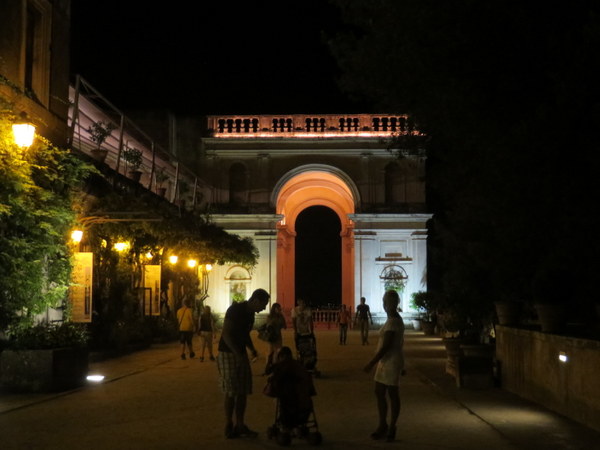
Dramatic lighting of architectural features at Villa d'Este.

Dramatic lighting of architectural features at Villa d’Este.

Tranquil Toscana

13 Jul
In the past couple of days, two regular readers have told me I am not blogging enough, so I finally got my act together to offer up this trip report. Lest you think life is just one big vacation for us, we do still have to cook, shop, do laundry, clean the cat boxes, go to medical appointments, and I might add, work, as that is our reason for being here. Much of what we do daily is not exactly blog-worthy. You, dear readers, only get the good stuff.
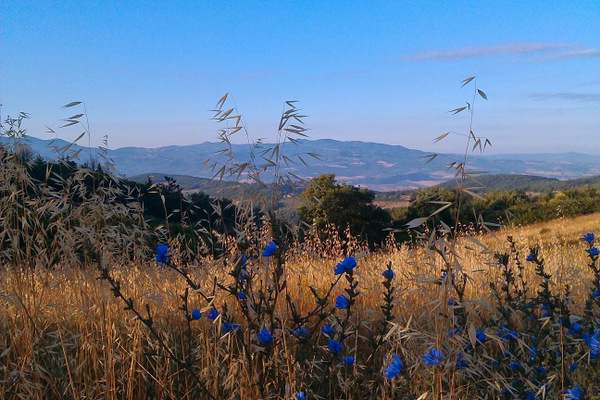
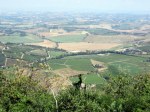
Tuscany offers one spectacular view after another.
I am not sure what I expected when we decided to spend the holiday weekend in Montalcino. Certainly I expected some traffic in the height of summer, maybe mosquitoes as well. We found neither. What we did find was tranquility, uncrowded restaurants, and winemakers anxious to tell us about their wines in private tastings. We prefer off-season travel; we just did not know this would actually be off-season.
We had planned to go to Abruzzo, but at an Embassy auction we acquired a three-night stay at an agriturismo. Therefore, destination decided: Le Ragnaie, less than 4 kilometers outside of Montalcino in the heart of Brunello di Montalcino country.  This is a delightful, peaceful spot, not far off the road but miles away in spirit. We slept 9 hours on Friday night and Saturday night thanks to the absence of 1) AMA trucks picking up trash, 2) seagulls screaming at 3:00AM, and 3) motorini. We feasted on a terrific breakfast spread every morning, a great start to a day in the country.
Le Ragnaie is also a producer of organic wines, with grapes hand-picked and sorted. Guests are welcome to sample and discuss the wines in an intimate setting, which we did with out host, Augustino, and a lovely couple visiting from Sweden. We saw very few North Americans, by the way, anywhere in the area.  I guess most are intent on seeing Venice, Florence and Rome, but really, two or three days out of the mainstream would do any traveler good.
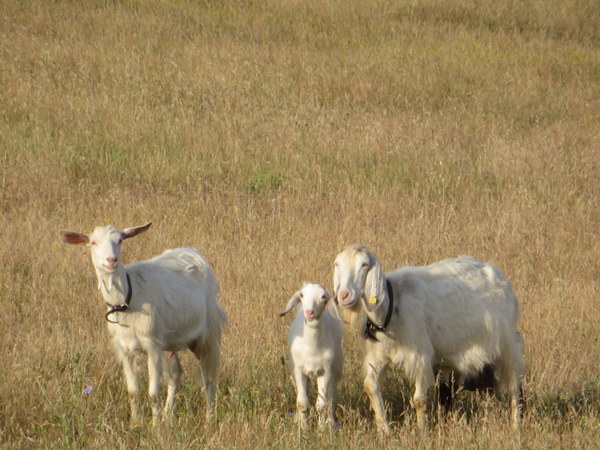
Goat family eyes us warily as we hike along their country road.
Planning to eat those hearty Tuscan meals and to taste our share of Brunello, we started each day with a long walk, in the cool of the morning. As early risers we were rewarded with soft light and encountered only a few locals starting their days. From Le Ragnaie, just across the road is a country lane leading to Villa a Tolli, another agriturismo. We walked past fields of sheep, goats and a donkey, as well as vineyards. Then we turned around and hiked the 2.8 km back to breakfast.
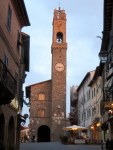
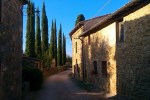
Another morning we parked in Montalcino well before the town was awake, and walked through deserted streets in search of coffee. [The only problem with an agriturismo, B&B, or small hotel is the absence of coffee when we roll out at dawn.] The morning light shined softly on golden Tuscan walls and the empty streets belied the busyness of Monday-to-come. Luckily in Piazza del Popolo we found coffee and fresh pastry at 07:00 to sustain us until our agriturismo breakfast would be ready.
Color added by seasonal flowers really perks up the town, Pienza.
With two days in the area, we spent one taking the magnificent drive to Pienza and Montepulciano. Classic Tuscan scenes unfolded: villas at the end of drives lined by Italian cypress, fields of grain and hay bales, and vast tracts of vines. In Pienza the tempting scent of pecorino wafting out of the shops enticed us to pick up some of the famed cheese, one with pepe nero and the other wrapped in olive leaves. Stop by and we’ll share.
Montepulciano gave our legs a workout. We parked at the bottom of the town and worked our way up to Piazza Grande. Montepulciano makes a fine lunch stop and there are many tempting shops. Since we had the luxury of a car and did not have to worry about handling luggage, we indulged in some gift buying. Now I only have to find those things and remember to pack them when we go to the States in October.
My Italian friend Eleonora told me about a wine she liked from Montalcino, a Brunello from Ventolaio. We found Ventolaio was only a bit beyond our morning walk to Villa a Tolli, so I called late Saturday afternoon to see if we could visit. In my hesitant Italian I asked and was told certainly they were open, please come! Maria Assunta welcomed us with four of her excellent wines accompanied by cheeses, bread with her own fine olive oil, and a big heart. Maria and her son Baldassare told us about their wines, property, history, and family. The entire operation on 89 hectares is run by mom, dad, and two sons. We could not have asked for a better aperitivo! We returned with the boot full of 36 bottles of wine, six of olive oil, and one excellent grappa. The Barton household will be having several dinners planned around Maria Assunta’s fine wines in the months to come. She says the 2010 is going to be one of the very best years for Brunello, so we need to stop by in January for the release. Feel free to place your orders; my handling charge is small.
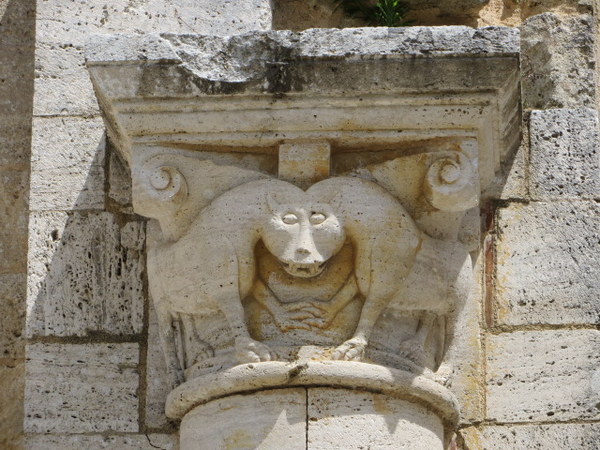
Wonderful detail on a pillar of the Abbey.
Since we were driving, I had to watch my wine consumption and not have to drive too far from restaurant to lodging. (No such problem for Ric who chooses to be the navigator.) Fortunately, there are many fine restaurants in Montalcino. We are fond of Taverna Grappolo Blu. For four years I held a taste memory of their polenta vegetariana and I was not disappointed in the replay. The wine list is a heavy binder; One almost needs to order a glass of wine and an antipasto to sustain one while reading. Another favorite is Ristorante San Giorgio. While many of the restaurants in the more touristy streets and piazzas were almost devoid of patrons, the convivial, family friendly atmosphere of San Giorgio attracted many locals. It boasts a menu ranging from Tuscan favorites to fine pizza and the prices were a terrific relief from what we face in Rome.
Abbey of Sant'Antimo, near Montalcino
Abbey of Sant’Antimo, near Montalcino
Sunday we ventured beyond Montalcino, to Locanda Sant’Antimo in Castelnuovo dell’Abate.  Sunday lunch – or any lunch – under the arbor in the garden is a special experience.  One can drive here in 10 minutes as we did this trip, or one can feast here after walking about two-and-a-half hours from Montalcino to the nearby abbey, as we did four years ago on our first trip to Italy. That hike was our first Italian hiking adventure and while it was fun, we decided once was enough. Still, I would recommend it to anyone who craves a little country experience that borders on orienteering. You can take a bus back to Montalcino from Castelnuovo dell’Abate avoiding a two-way hike.
Speaking of the abbey, Abbazia Sant’Antimo is not-to-be missed. Dating to 1118, it is still an active community of monks today. We popped in at 14:45 to hear the monks chant, which they do six times each day. Much to our surprise, the community is apparently only 4 or 5 monks strong!  I guess the monastic life just doesn’t attract men like it did a few hundred years ago.
Rome’s weather has been great this year: not nearly as hot (yet) as the past two summers. We have hardly used the A/C and the mosquitoes have not been a problem so we have been sleeping with windows open. The downside is the noise. As much as we love Rome, escaping to the country is truly restful, even if I have to drive to get there.
We took about 400 pictures, and I know I am trying to share too many, but if you are motivated to do so, click on any picture below for a slide show.

Day 4: Trains & Etruscans

17 Feb

I am a day late posting this update. Just too tired last night, and today I had to do my Italian grammar homework or suffer the consequences when my tutor shows up tomorrow. Every day here is a test, but I am bound-and-determined that I will speak more-or-less grammatically correct one day. 
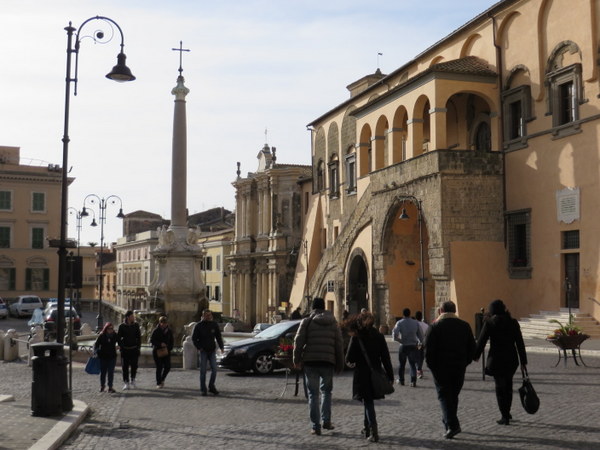
Classic Italian piazza": City Hall, a fountain, people enjoying a stroll.

Classic Italian piazza: City Hall, a fountain, people enjoying a stroll.

After an exhausting but interesting tour by car on Saturday, on Sunday we took a train north along the coast to Tarquinia, another ancient Etruscan city. The Etruscans are very mysterious as there is no literature, no historical record nor religious texts. We have only the knowledge derived from their tombs, which contained “grave goods” and art.
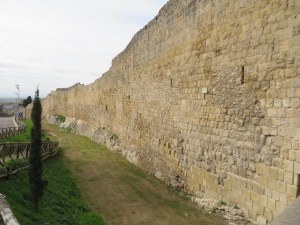
The old wall surrounding Tarquinia.

The old wall surrounding Tarquinia.

The train was a Regionale Veloce meaning it runs a bit faster than the serviceable Regionale found along many rural lines. On the train, one passes the port of Civitavecchia with enormous cruise ships docked to disperse passengers for a day in Rome, as well as other more charming seaside towns that perhaps serve as retreats for city-weary Romans. Tarquinia is more than 2500 years old, but today it may serve as a bedroom community to Rome as one can commute by train in a little over an hour. (We know people at the Embassy that make an hour-and-a-half trip to work, living various places on the coast or in the hills and commuting by train.)
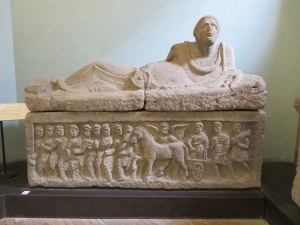
Etruscan sarcophagus.  Note the detail in the carving. About 2500 years old.

Etruscan sarcophagus. Note the detail in the carving. About 2500 years old.

With its remoteness from Rome, few tourists venture to Tarquinia, especially in February. It was serene and uncrowded this sunny Sunday. We enjoyed the National Museum and its treasures without interference, then meandered up the street, through a classic piazza in search of Sunday lunch. We stumbled – luckily – into Ristorante Ambaradam and were soon followed by group after group seeking lunch. What a find! We feasted on insalata di polpo & cicoria ripassata (salad of warm octopus and greens) served on a bed of creamed chickpeas, followed by cacio e pepe (think Italian mac & cheese, but classy and “zippy”) for me, and pasta with a ragu of octopus, tomato, and guanciale with flakes of pecorino for Ric. Alongside was THE BEST puntarelle ever.    Puntarelle is a seasonal favorite, and while I like it the “normal” way (see link), the one at Ambaradam was extra nice featuring olives and little bits of sweet orange, with the anchovy taste played down. Yum! Washed down with a Chardonnay from Lazio, this lunch demanded exercise. As the walk to visit the necropolis was ahead, we were able to shake off the postprandial doziness in the cool fresh air.

The necropolis of Tarquinia features more than 6,000 tombs. Once at ground level, after 2,500 years they are subterranean. One climbs down
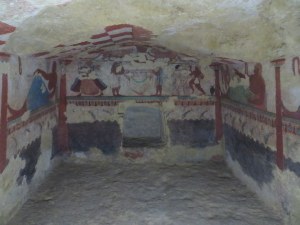
Another beautiful fresco from 2500 years ago.

Another beautiful fresco from 2500 years ago.

steep stairs to view the chambers, decorated with sometimes lively frescoes. The dioramas and renderings reminded me of the Indian burial mounds found in Minnesota. Although I am unaware of any place you can actually enter one in America, the concept seems similar: bury the person with “grave goods” to take them into the next life. We almost missed the entrance to the park (signage is not terrific), but a tour group of French students attracted our attention and we made for the gate ahead of them.
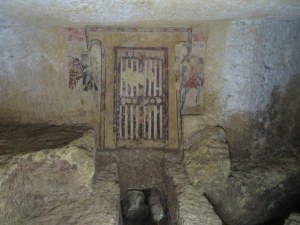
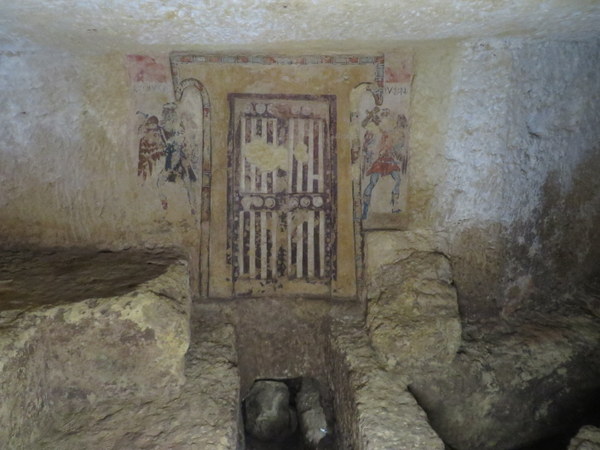
This Etruscan fresco depicts a false door designed to keep the Devil away from the tomb of the departed.

This Etruscan fresco depicts a false door designed to keep the Devil away from the tomb of the departed.

The treasures found in the National Museum came from these tombs: elaborate tombstones and sarcophagi, as well as jewelry, weapons, urns, and other household goods one might need in the afterlife.

We walked a lot in part because the bus service on a Sunday is limited. Here’s a conundrum for you to consider:

  • The museum and necropolis are closed on Monday (very common in Italy) and open Tuesday-Sunday. The two sites are 1.5 km apart.
  • The Tourist Information office is closed on Sunday but open Monday-Saturday
  • The shuttle bus to the tombs does not run on Sunday but does Monday-Saturday
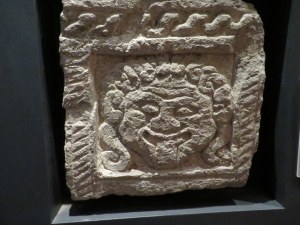
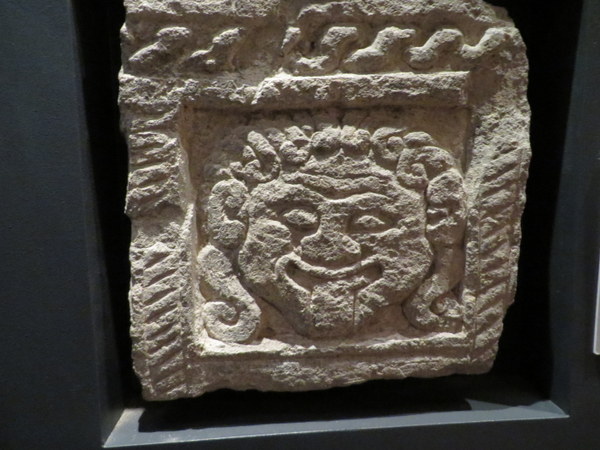
    Fabulous detail of a tombstone.

    Fabulous detail of a tombstone.

Why does the shuttle bus run on Monday when the tombs are closed? Why is the TI closed on Sunday when the museum and tombs are open, but open Monday when the necropolis and museum are closed? Like so many things here, it makes no sense from a service and commerce point-of-view.
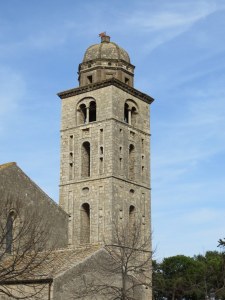
Chiesa di San Francesco Bell Tower, Tarquinia.

Chiesa di San Francesco Bell Tower, Tarquinia.

If you go to Tarquinia on Sunday, be prepared to walk…or take a car. But if you eat cacio e pepe or other Italian specialties, you may want to walk anyway. The train back to Rome offered a chance to nap a bit, far better than driving in my book. 
Day One of Five

13 Feb

Facing another long holiday weekend (the last until Easter) we decided to extend it even more and take five days to explore Rome. We have done so much traveling that the list of things to see and do in Rome continues to grow and we don’t have enough daylight hours to be tourists in our own town. So begins what I like to call i cinque giorni del compleanno di Laurel (the five days of Laurel’s birthday).

Iconic EUR "Square Coliseum", unoccupied but rumored to be destined as Fendi headquarters.

Iconic EUR “Square Coliseum”, unoccupied but rumored to be destined as Fendi headquarters.

There are a lot of mega-sites in Rome: the Coliseum, the Roman Forum, Vatican Museums, Borghese Gallery, the Pantheon. The list goes on and on. And there are so many places the average tourist does not see unless she returns to Rome multiple times. We haven’t even managed to get to all of the neighborhoods yet.

The obelisk and colonnades on buildings, along with wide boulevards, reminded me of Washington, D.C.

The obelisk and colonnades on buildings, along with wide boulevards, reminded me of Washington, D.C.

So today we ventured south to the E.U. R., Mussolini’s site for a planned 1942 world’s fair, the Esposizione Universale Roma, which obviously didn’t happen. Today it is described as a residential and business area. We felt like we had left Rome and traveled to another realm.

The architecture is interesting if cold, distant, and rather lacking in charm. The streets are straight, which is unsettling after so long in Rome. If you took in a certain view, it felt in places a little like Washington, D.C., but not nearly as pretty. Washington, D.C., for all its issues, has beauty. Still we were happy to have seen it as the weather was glorious for the first time in weeks.

San Paolo Fuori le Mura (Ric in foreground).

San Paolo Fuori le Mura (Ric in foreground).

After the E.U.R., we stopped by the Basilica Papale di San Paolo Fuori le Mura, or St. Paul’s Outside the Walls. This is the fourth of four papal basilicas for us, and it has taken more than 3 years to get to all of them. Way off the track for most tourists, no exceptional art such as Raphael, Caravaggio, Michelangelo, or Bernini, but with lovely mosaics and peaceful. Of course since my hometown is named for this saint, it seemed fitting to visit.

This uber-serious saint is the namesake of my home town.

This uber-serious saint is the namesake of my home town.

Alter canopy over the tomb of St, Paul.

Alter canopy over the tomb of St, Paul.

Lunch at Eataly, an afternoon on the couch watching a movie, and shortly dinner at my favorite fancy restaurant in Rome, QuarantaQuattro, where I know Sergio will make a fuss.

When I hovered my mouse over this doodle, my name showed up. Strano!

When I hovered my mouse over this doodle, my name showed up. Strano!

On another note, I was shocked to pull up Google this morning and find my birthday was a Google-Doodle. A Big-Brother moment; I assume they pulled the date from Facebook or Google+. Weird.