Archive | Sights RSS feed for this section

Of castles and kings

29 Jan
Palazzo Reale, the royal residence in the heart of Torino at Piazza Castello.

Palazzo Reale, the royal residence in the heart of Torino at Piazza Castello.

Americans do not usually visit Torino (Turin in English), yet it is a remarkable city that deserves a closer look. We first visited in 2014. That year as a birthday gift for Ric, my train-a-holic spouse, I found the longest trip one could make in a high-speed Frecciarossa train from Roma: a little over 4 hours to Torino. As the ride was the objective, we only stayed one night (see “Motown Italy”). What a mistake. We decided to correct that.
Torinese architecture, the Museum of the Risorgimento in Palazzo Carignano, one of the Savoy Palaces.

Torinese architecture, the Museum of the Risorgimento in Palazzo Carignano, one of the Savoy Palaces.

Setting our sights on getting to know the area and seeing some of the museums as well as palaces of the Savoia, we slipped away this week for 3 nights. The charming B&B A Casa di Giò was our home. Here we found a quiet refuge, incredible hosts and, reinforcing my impression that Americans do not stop in Torino, we were the first American guests to stay in their home. Located near Piazza Castello, the heart of Torino, A Casa di Giò was perfectly located to explore the city on foot.
A typical porticoed street makes for nice shopping, protection from heat or rain.

A typical porticoed street makes for nice shopping, protection from heat or rain.

Torino is pedestrian friendly to a fault. Not once did a motorino creep up my backside as they do in Roma, and drivers actually yielded to pedestrians in the crosswalks. Lovely wide sidewalks under substantial porticos reminded us of Bologna, last winter’s city trip. The wide piazzas and generous parks combined with tree-lined boulevards reminded us a bit of Paris. No wonder! Napoleon’s occupation of the Piemonte resulted in a legacy that left the city of Torino with some of these grand public places.
Apericena is a thing in Torino as well as Milano. Buy a glass of good wine for €7.00 and you get a plate of savories at Mulassano. Stop a few places and you've had cena, Italian for dinner.

Apericena is a thing in Torino as well as Milano. Buy a glass of very good wine for €7.00 and you get a plate of savories at Mulassano. Stop a few places and you’ve had cena, Italian for dinner.

Who goes to Torino? It is very much on the radar of Italians and other Europeans. There’s a vibrant opera and the Piemonte region is also the home turf of the Savoys, Italian royalty that spawned several kings of the newly unified Italy in the 19th century. The patrimony of modern Italy is here. Castles and kings indeed!
La Mole Antonelliana. We tried to ascend, but were foiled by a Japanese film crew that had taken it over for a shoot.

La Mole Antonelliana. We tried to ascend, but were foiled by a Japanese film crew that had taken it over for a shoot.

La Venaria Reale is the Versailles of Torino. It is much easier to get to than Versailles, and far less crowded. We thought we would pass a couple of hours here. We could have spent much of the day! As the vast gardens were in hibernation, we chose to skip them and return sometime on a sunny spring day.
A sprawling estate dating to the 17th century, La Venaria was built as a hunting lodge. In its heyday, the stables housed hundreds of horses and dozens of hunting dogs. The estate has had a history of construction, destruction, additions and renovations so extensive that it is difficult to believe anyone had time to live here. Unfortunately, during the Napoleonic domination, the structures were turned into barracks and the gardens used for military training. The Italian military continued this tradition until 1978, after which it was ransacked to the degree that neither doors nor windows remained. We saw pictures of what a train wreck the property was just a couple of decades ago. Fortunately, those interested in preserving Italian history embarked on a restoration project and since 2007 it has been open to visitors.
This is how crowded La Venaria was.... Most of the people here are the same Japanese film crew we encountered at La Mole.

This is how crowded La Venaria was…. Most of the people here are the same Japanese film crew we encountered at La Mole.

I had some familiarity with the House of Savoy due to my work as a docent at the U.S. Embassy. The main palazzo at the embassy is called Palazzo Margherita as Queen Margherita of Savoy live in it for 20 years. This family has deep roots. Dukes and Counts, Marquis and Marquesses, not to mention Kings of Sardegna, Sicily, and Italy, this family dates back to 1003.
Ceiling detail, La Venaria Reale.

Ceiling detail, La Venaria Reale.

La Venaria is only one of many luxurious palaces ringing the city of Torino built, as the website states to create a refined “Crown of Delights” around the capital, as a demonstration of the magnificence of the House of Savoy. It is good to be the king.
A little something from the Egyptian Museum. Many of the artifacts were transported across the mountains from Genova in military wagons pulled by horses, 19th century style.

A little something from the Egyptian Museum. Many of the artifacts were transported across the mountains from Genova in military wagons pulled by horses, 19th-century style.

While we did not get to see any other palaces or castles from the interior (I can only handle so much majesty in a day), many are in use for other purposes, such as the Museum of the Risorgimento at Palazzo Carignano, and the Municipal Museum of Ancient Art in Palazzo Madama. This website has links to information about all of the Royal Residences.
We did manage to fit in a visit to the impressive Egyptian Museum, the second most important in the world for Egyptology enthusiasts (only the museum in Cairo is considered more important). A five-year renovation was completed less than a year ago, and the result is a well-curated, open, light, and engaging museum. Why is the second-largest collection of Egyptian artifacts in Torino? It all started with a purchase by a Savoy King, Carlo Emanuele I in 1630…. Castles and kings indeed.


A walk in the park

19 Jan
Sometimes a park is just a park. Sometimes it is Italian. Sunday we took a long walk in Villa Ada, Rome’s second-largest park (Villa Doria Pamphilj is the largest) and happened upon some photo-worthy sites.
To look at a map, Villa Ada is close to our home, but it’s a bit of a PITA to get into on foot. We’ve walked along the periphery many times and waded into the shallows, but finally, we had time and good weather on our side so we ventured a bit farther.
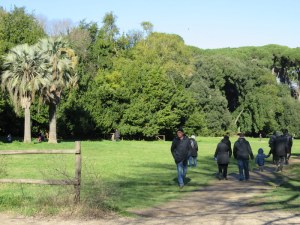
One of the busier paths, Villa Ada. We stuck to the woodsy ones, while most of the Italians embraced the sun.

One of the busier paths, Villa Ada. We stuck to the woodsy ones while most of the Italians embraced the sun.

The grounds and house were once owned by the House of Savoy, Italian royalty. From this family sprang four kings of Italy and also beloved Queen Margherita. Eventually, the estate was purchased by a Swiss gentleman, Count Tellfner, who named it for his wife, Ada. The Savoys bought it back again in the early 20th century turning it into the royal residence until they were ousted in 1946. In the 1950s, it became a public park.
Today Villa Ada is a sprawling landscape of paths, frequented by dog walkers and runners, but it also contains some surprises.
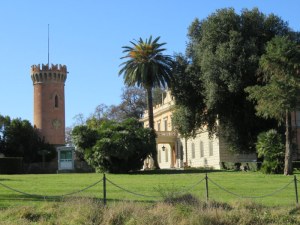
Egyptian Embassy, Villa Ada.

Egyptian Embassy, Villa Ada.

The Egyptian Embassy occupies the old royal residence. It was given to Egypt by the Savoys as a token of their gratitude for the assistance provided during their exile in 1946. Imagine walking through Forest Park in Portland and coming across armed soldiers guarding a foreign embassy. Yeah, it’s that weird.
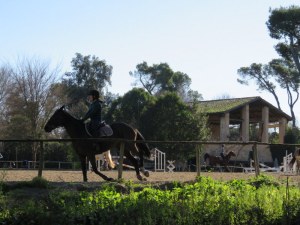
Rounding a corner in a distant end of the park, we came across an equestrian center, 3C – Country Club Cascianese. There were riding lessons in session in the lovely January sun, and it has an air of exclusivity about it, although I always think that when horses are involved. Quite a contrast to the Egyptian Embassy.
Equestrian center, Villa Ada.

Equestrian center, Villa Ada.

We’ll have to go back to explore a few more paths, and there’s an entire quarter of the park we didn’t get to. Much like our beloved Hoyt Arboretum in Portland, after a few visits we should know our way around. 
In the category of NOT a walk in the park, we had an interesting visit to our bank this week. In fact, we had three visits in two days. Ric’s debit card was cracked and required replacement, so we ventured into the main branch of BNL on Via Bissolati. We had to wait about 25 minutes to be served (there’s a take-a-number machine), but the teller was able to give him a new card and PIN on the spot. We were impressed! No waiting for the mail to deliver it to our flat! Who says Italian systems are inefficient?
All’s well until we stopped at the market on the way home. With a huge line at the cashier, my BNL card wouldn’t work.  We trotted down the street to the Parioli BNL and tried my card in the ATM. The ATM took my card! Said it was deactivated! A very nice teller in this branch retrieved it only to tell me my card was no good, that I had to go back to the branch in the center to get a new one and that she needed to destroy my card. She cut it up. 
So off we went the next day to BNL on Via Bissolati. Here the teller told me that my card was perfectly good, according to the system. “It didn’t work yesterday,” I said. He asked to see it. “No, I told you, the woman on Viale Parioli took it and cut it up.” He told me she was wrong, and since I did not bring the card to him, we should file a denuncia (a formal complaint about the “lost” property) with the Carabinieri!
I was doing this in Italian, and I hate it when they tell me “no” because then I have to enter into the realm of the Italian argument, and my skills really suffer. I am just not that eloquent and my pre-rehearsed sentences collapse in a useless heap around me. But one has to push back. If you take the first no and walk away, you absolutely will make things harder for yourself. So I pushed back. “Just because his colleague at the other branch made an error, it should not be my problem,” I told him in grammatically incorrect Italian. Much to my surprise, he agreed and said “Well next time, bring the card here if it doesn’t work,” and he went on to issue me my new card and PIN. Thank God he backed down because I am no match for an Italian who is up for an extended negotiating session!
I am pleased to report that both of us now have access to our funds, but it certainly was not a walk in the park.
Click on the photos below for a better view.

Out and about

5 Dec
So what do we do every day here in Roma? Surely every day cannot be like a vacation. We have to run errands, do laundry, go to the doctor, clean the cat box, drink wine and exercise, just like people everywhere.  But one of the things we do is intersperse the mundane with field trips. We might go to a museum with a special exhibit, to a movie (in English with reserved seats), or revisit a site we saw a few years ago. Such was the case yesterday.
San Giovanni in Laterano's magnificent facade only dates to the 18th century.

San Giovanni in Laterano’s magnificent facade only dates to the 18th century.

We headed out into weak December sun to return to San Giovanni in Laterano, one of the four Papal Basilicas. We last visited in October 2010, so it was about time. 
San Giovanni was the first Christian church established in Roma, by Emperor Constantine in 318 A.D., and it is the home church of the Bishop of Rome, Papa Francesco. In fact, it was the home of all popes until the renovation of St. Peter’s and the expansion of the Vatican during the Renaissance. It is not Italy, it is part of the Vatican State.
Internal view with the Naval service in progress.

Internal view with the Naval service in progress.

On arrival at this magnificent basilica, we found it thronged with military personnel, primarily from the Italian Navy. They were commemorating their patron saint, Santa Barbara. In the U.S., if this were a military event at say the National Cathedral in Washington, D.C., it is unlikely we would have been allowed to wander in and play tourist. But this is Italy, with no separation of church and state by the way, and the only price to entry was having a Carabinieri officer look in my purse to ensure I was not carrying anything explosive.
Renaissance ceiling of the basilica. Stunning!

Renaissance ceiling of the basilica. Stunning!

Instead of an empty church with tourists wandering through, we were fortunate to observe the basilica being used for its intended purpose, a service. Here is a link in Italian about the observance. On land and sea, the Italian Navy celebrated Santa Barbara yesterday, inviting their colleagues from the army, Carabinieri, Vigili del Fuoco (firefighters), and others who share the patron saint. There was an orchestra and chorus that opened the service with a captivating rendition of Handel’s “Thine is the Glory,” sung in Italian. I can only assume that is a piece with some tradition and meaning for the Italian Navy.
Close up of the doors, originally from the Curia. The acorn "studs" date to the 3rd century.

Close up of the doors, originally from the Curia. The acorn “studs” date to the 3rd century.

Though little remains of Constantine’s original church (mostly rebuilt after 1600), the art and architecture are definitely worth a visit. There are massive bronze doors from the ancient Roman Curia (Senate House), moved here in the 17th century, and the golden columns from the Temple of Jupiter which used to stand on the Capitoline Hill. The enormous statues of the 12 apostles stand guard over the nave with a fabulous Renaissance ceiling overhead.
Columns from the Temple of Jupiter.

Columns from the Temple of Jupiter.

The baldacchino over the alter. See the little statues in the upper cage? Those are silver, and are of St. Peter and St. Paul, which contain pieces of their heads.

The Baldacchino over the altar. See the little statues in the upper cage? Those are silver reliquaries of St. Peter and St. Paul which contain pieces of their heads.

Bigger than life St.Matthew.

Bigger than life St.Matthew.

Big big doors, appropriated from the Senate House. The purple smudge is me.

Big big doors, appropriated from the Senate House. The purple smudge is me.

We took our leave as the solemn Mass began. There was another church on our itinerary: Santo Stefano Rotondo.
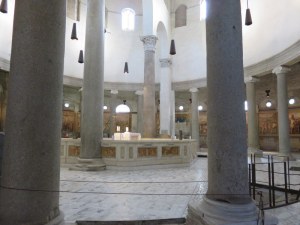
The sanctuary at Santo Stefano Rotondo. The ancient walls wtih frescoes surround the sanctuary.

The sanctuary at Santo Stefano Rotondo. The ancient walls with frescoes surround the sanctuary.

Santo Stefano is an eerie little church built, as the name implies, in the round. Why eerie? This 5th-century church built on top of a Roman Mithraeum and named for the first Christian martyr, Santo Stephano is decorated with frescoes depicting the martyrdom of some 34 saints. No one could describe this scene better than Charles Dickens did:
“To single out details from the great dream of Roman Churches, would be the wildest occupation in the world. But St. Stefano Rotondo, a damp, mildewed vault of an old church in the outskirts of Rome, will always struggle uppermost in my mind, by reason of the hideous paintings with which its walls are covered. These represent the martyrdoms of saints and early Christians; and such a panorama of horror and butchery no man could imagine in his sleep, though he were to eat a whole pig raw, for supper. Grey-bearded men being boiled, fried, grilled, crimped, singed, eaten by wild beasts, worried by dogs, buried alive, torn asunder by horses, chopped up small with hatchets: women having their breasts torn with iron pinchers, their tongues cut out, their ears screwed off, their jaws broken…. So insisted on, and laboured at, besides, that every sufferer gives you the same occasion for wonder as poor old Duncan awoke, in Lady Macbeth, when she marvelled at his having so much blood in him.” Pictures from Italy (1846)
Please click on any photo for a larger view and caption. Warning: some rather gruesome images!
Still Santo Stefano Rotondo is a peaceful site and from what we saw this day visited by few. Off the beaten path? You won’t find many people wandering here, but it is not all that far from the Colosseo, and perhaps a 15-minute walk from San Giovanni in Laterano. Also in the neighborhood, which we visited a couple of years ago, the Case Romane del Celioan extraordinary archeological site of 2nd and 3rd-century Roman houses with vivid frescoes. (Don’t worry about the language on the web page. Just go if you have the chance.)
So this is some of what we do with our spare time. As they say “Roma una vita non basta.” (A lifetime is not enough.)

The Pope doesn’t sleep here

27 Oct
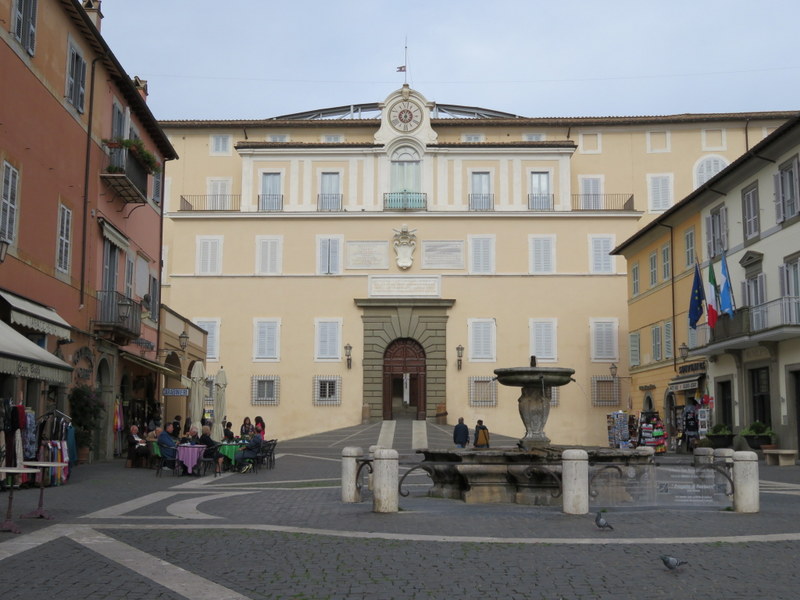
At least the current pope, Papa Francesco, does not sleep in the Apostolic Palace of Castel Gandolfo. He has abnegated the luxury of a vacation residence and opened the doors to the public; At least to anyone willing to pay €10.00 for entrance.
The Apostolic Palace dominates the square in Castel Gandolfo.
In September we visited the Gardens of the Pontifical Villa, thinking we were in Castel Gandolfo. In actuality, the gardens are part of Villa Barberini in Albano Laziale and when we exited the garden tour we were a long walk from the little town of Castel Gandolfo. So we vowed to return while the weather was good.
Pope's view of Lago Albano.
Pope’s view of Lago Albano.
Early in the morning the flow of commuters from small towns storm Stazione Termini like an invading horde. The incoming trains are packed with briefcase-toting-suit-wearers and women tottering on impossibly high heels, and it seems everyone is puffing on a post-commute cigarette. We were blessed with an out-of-Roma trip, against the onrush of workers, accompanied by a very few Romans who actually get to leave the city for work.
A quick 40-minute ride through the countryside, passing Ciampino Airport and a handful of small towns, brought us to Castel Gandolfo. Then a 15-minute slog walk up the hill landed us in the town square where any number of little bars awaited our arrival. We found seats and a cappuccino in the 15-degree Celsius sunshine with a full view of the Apostolic Palace, aka, Papal Palace, aka Pontifical Villa or most commonly in Italian Palazzo Apostolico. Take your pick.
A Bernini angel...at least the audio guide claims it is his work.
A Bernini angel…at least the audio guide claims it is his work.
Writing set of Pope Pius VIII. Sorry about the glare. It is under glass for its protection.
As instructed, 20 minutes before our tour time of 10:00, we approached the guard who welcomed us warmly and sent us up a flight of stairs to enter the museum. We were equipped with audio tour devices and sent on our way to self-guide, well before the clock chimed 10:00. We were the only people in the entire museum!
Now before you get to thinking that we ran giddily through the papal vacation home, jumping on the beds and checking inside the refrigerator, the public is not allowed in any area that would be considered an apartment. The museum consists largely of select papal portraits along with some special accoutrements, and the accompanying audio guide tells some of the fascinating history behind these powerful men.
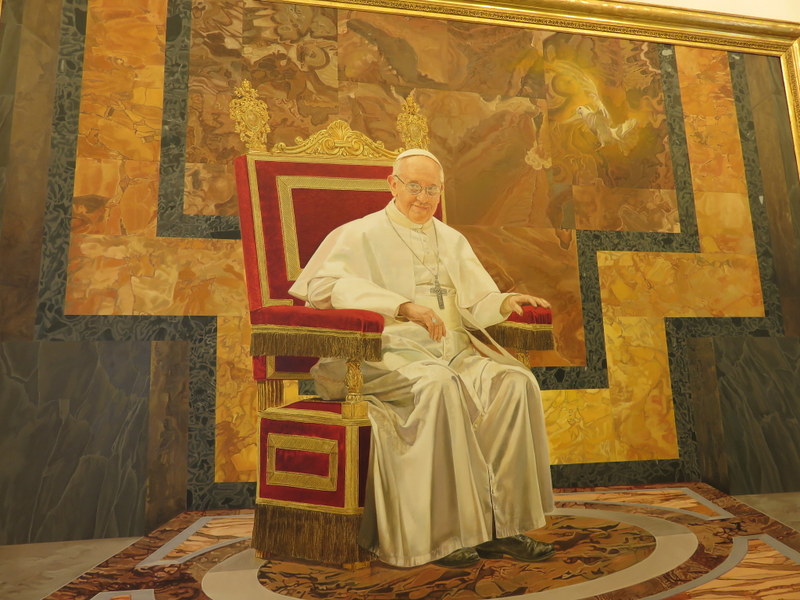
The portrait of Papa Francesco is in a very different style from his predecessors.
We enjoyed the tour very much, even if we did not get to see the Papal bathroom. There’s one of those at Castel Sant’Angelo anyway.
Papal throne and entourage.
In 6 1/2 hours we went from our home to Castel Gandolfo by bus and train, had coffee (always on the agenda), took the tour, and were back home in time for lunch. If one wanted to have lunch in CG — and why not with that view of the lake! — I would actually recommend the 11:00 tour followed by a leisurely lunch. Trains back to Roma are frequent. Would I spend an entire vacation day doing this on my first trip to Roma? Absolutely no. But when you have been here as long as we have, or visit annually like some of our friends, it’s fun to find new places to explore.
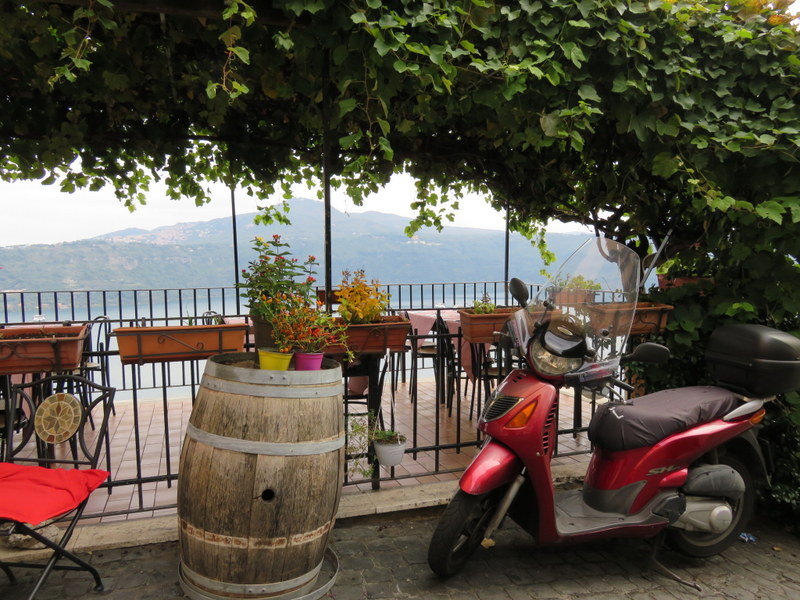
There are many restaurants that take advantage of the fine lake view.
Info on tickets for the sites in Castel Gandolfo and Albano Laziale can be found here.

We have time…

13 Oct
…so we went to Paestum. 
The good things:
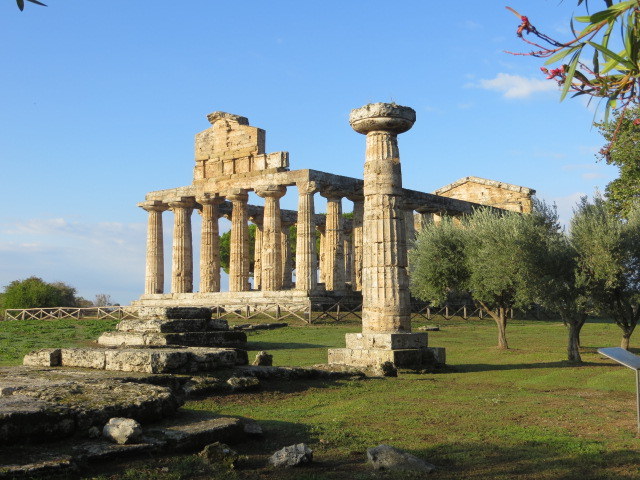
Temple of Ceres.
Temple of Ceres.
  • Very old Greek temples, still standing. One is from 550 B.C! Amazing!
  • Inexpensive lodging at a rather delightful little place. Euro 73.00 per night including an Italian-style breakfast.
  • An excellent — who’d have guessed it?– restaurant right next door to our hotel. Truly a fine meal, nice people, very raffinato (refined, elegant). In fact, we will return this evening. And they give a discount for people staying at our hotel. 
  • There is a nice museum with well-preserved artifacts.
  • It was not crowded and the weather was darn-near perfect.
The drawbacks:
  • It takes a long time to get here. From Roma, door-to-door took us 7 hours including 2 buses, 1 Metro, a Frecciarossa,  Regionale and a 20-minute walk. There was a fair amount of waiting time, partly due to guasto (malfunction) on the rail line. We also got to had to stand up all the way on the Regionale. 
  • There’s the archeological site, the museum, and that’s about it in Paestum.
  • There’s the mare, but the seaside here made the town of Seaside, Oregon (not my favorite place) look like a high-class resort.
  • We stayed one night too long, it seems.
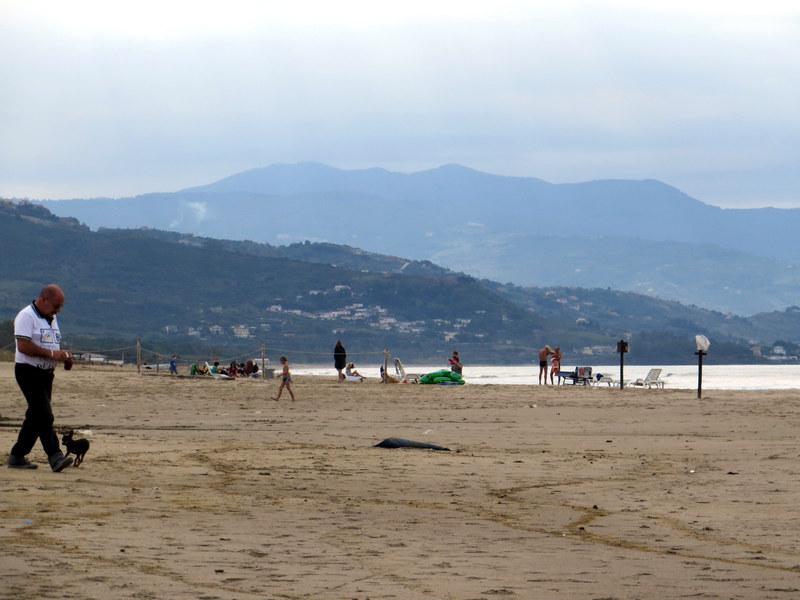
A few hearty souls at the beach. In summer no doubt it is crowded.
Sad little seaside Paestum. I am sure it is lively in the summer, but I suspect it still feels sad.
We seldom go anywhere for one night. In fact, the only place I can think of that we did that was in Tivoli for the summer lights one August. And Tivoli is a hell-of-a-lot easier to get to than Paestum.
We have also seen the impressive Greek temple and ruins in Segesta. Perhaps if one has not seen those, this would knock your socks off. My socks are still on. We did get to be the first people in the archeological site, which was pretty fun. The tour groups showed up about 10:00 as we were exiting looking for an espresso. 
A tour group passes through the archeological site.
Maybe I am also jaded by the dead kitten I saw along one road and the dead rat along another. I have not had the misfortune to see roadkill in all of our travels. This in contrast to meticulous care to remove trash in the ruins.
Temples are lighted at night.
If one were to want to see Paestum (and I understand why it would still be a draw despite my commentary), I would recommend a day trip from the Amalfi Coast or a one-night stay. The nice thing about staying a night is getting to see the temples lighted, and also seeing the site in both morning and afternoon light. We are not people who read every display in a museum or poke into every corner of a site. (Three hours at Pompeii was plenty for us.) If one does like to explore a bit more, perhaps Paestum would warrant more attention. We are happy we came, but a little bored as I write this. I am very happy we did not divert a vacation day-or-two when we were working. But we have time now.  
Surveying work in progress. Only about 30% of the site has been excavated.
Temple of Nettuno.
Temple of Nettuno.
Of course there were ferals around.
Of course, there were ferals around.
A bright spot in the Roman ruins. Only the temples are Greek. The surrounding ruins date "only" to Roman times.
A bright spot in the Roman ruins. Only the temples are Greek. The surrounding ruins date “only” to Roman times.
Ric at Temple of Ceres.
Old Roman road to the sea, which was once much closer.
Old Roman road to the sea, which was once much closer. It’s now about a 20-minute walk via modern road.