Archive | Sights RSS feed for this section

Summer nights

23 Aug
When it is hot, Italy comes alive at night. The number of people dining at 10:00PM or later even on a week night is amazing. People take their lives out-of-doors once the sun goes down.
Fountains and pools of Villa d’Este, beautiful during the day, take on added drama at night.

Fountains and pools of Villa d’Este, beautiful during the day, take on added drama at night.

Although this summer has not been as miserably hot as the past two (2012 was one for the record books), it’s still humid and hard to move around in full sun. The nights are soft and pleasant, and there is a tradition of special events and the opening of venues that normally close at 6:00PM.   Notte d’Estate a Castel Sant’Angelo, Lungo Il Tevere Roma  (a festival along the Tiber), and various other events dot the calendar in Rome.
Last summer we tried to go to Tivoli to see the magnificent Villa d’Este lighted at night. It was a bust because we were driving, directional signs were poor, and we didn’t know what we were looking for. We did find on that first visit that Tivoli is very lively on summer evenings. So during the past year we made two daytrips to Villa d’Este via train to get our bearings. Finding it remarkable,  we decided to spend a night at a B&B and see the gardens by night.  Every Friday and Saturday through September 13 (weather permitting), Villa D’Este opens its gates after dark allowing one to enjoy its magnificent fountains illuminated. The transformation at night is stunning.
We boarded a regionale train from Station Tiburtina on the holiday of Ferragosto (August 15), and checked into the charming B&B al Palazzetto, a recently restored 15th century building.  The proprietor is an architect and his professionalism showed in the fine design. We were warmly welcomed and shown to a comfortable room with one of the most modern bathrooms we have had in Italy.
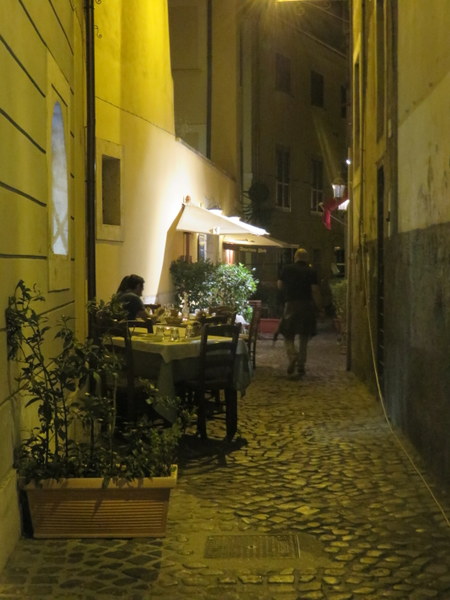
Delightful, serene dining on a soft summer night

Delightful, serene dining on a soft summer night

The town of Tivoli offers many fine restaurants, and it seems they are open very late to serve those who choose to tour Villa d’Este before dining. We chose one with a fine location on a piazza, Taverna Quintilia, only a few minutes’ walk from the entrance to Villa d’Este.  Taverna Quintilia is a rarity: a true Neapolitan seafood restaurant in Lazio, featuring succulent octopus, fresh marinated alici (anchovies), grilled spigola (sea bass), and more. This was some of the best seafood we have eaten outside of the Cinque Terre and Sicilia.
After dinner we headed over to Villa d’Este, arriving about 9:30PM to find a fast-moving line. The estate is huge so it swallowed the crowd easily and we enjoyed an uncrowded tour. The estate is transformed by the play of light on fountains. It occurred to us that in the U.S. this place would not be allowed to be open at night: it would be too dangerous with the low lighting, uneven walkways, and dark Renaissance staircases. We firmly held hands and thoroughly enjoyed wandering the grounds, watching the families and couples alike enjoying a soft evening – almost cool for August.


The Renaissance-era villa, Cardinal Ippolito II d'Este, son of Alfonso I d'Este and Lucrezia Borgia and grandson of Pope Alexander VI.

The Renaissance-era villa, commissioned by Cardinal Ippolito II d’Este, son of Alfonso I d’Este and Lucrezia Borgia and grandson of Pope Alexander VI.

Beautifully lighted fountains – Renaissance era faces carved into a long wall light a romantic walkway.
Beautifully lighted fountains – Renaissance era faces carved into a long wall light a romantic walkway.

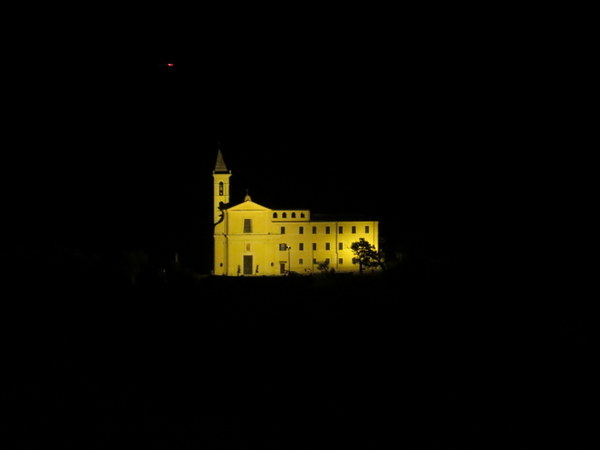
An unidentified church seem s to float in the darkness, just beyond Villa d'Este.

An unidentified church seem s to float in the darkness, just beyond Villa d’Este.
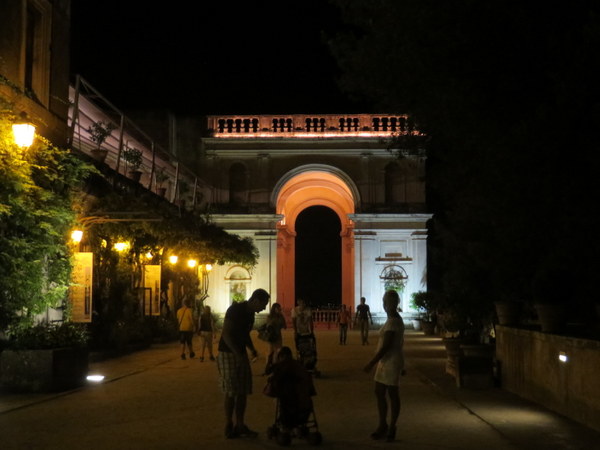
Dramatic lighting of architectural features at Villa d'Este.

Dramatic lighting of architectural features at Villa d’Este.

Motown, Italy

7 Apr
We made a mistake when we visited Torino: we didn’t stay long enough. The trip was a celebration for Ric’s birthday and the goal was to take the longest train trip possible from Rome on a high-speed Frecciarosso.  Torino was a match for that plan, 4 ½ hours each direction, so we set out on the morning of Ric’s birthday expecting to find a pleasant enough city, have a good dinner, then another long train ride back to Rome on Sunday.
No driver! Passengers are free to observe the "view" of a clean tunnel as the train whizzes along.

No driver! Passengers are free to observe the “view” of a clean tunnel as the train whizzes along.

The train is such a joy! Faced with a 4 ½ hour flight I want to slit my wrists, but 4 ½ hours on the train facing my sweetie across the convenient table, gazing out the window, with time to read, nap, and surf the internet, is so fine! The stewards come by with coffee and little snacks, and of course there’s a bar car for light meals and wine. Certainly beats flying.
Torino is indeed a pleasant city. Much of it is new-ish due to heavy damage in WWII, but the predominant architectural style is Baroque. It was the first capital of reunified Italy in 1861 and home of Italy’s royal family, the House of Savoy. Today it is “Motown, Italy:” the headquarters of Fiat, Lancia, Iveco, and Alfa Romeo are here.
With only an afternoon and evening to explore, we had to make a
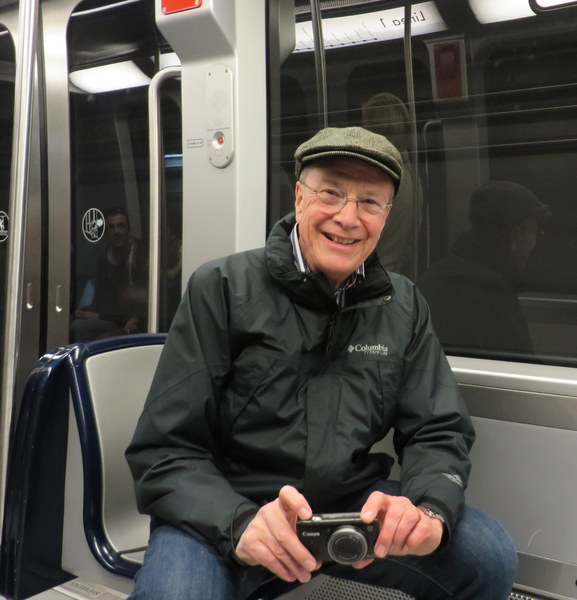
Happy passenger in the Torino Metro.

Happy passenger in the Torino Metro.

smart choice. After a quick lunch, Ric chose the  Museo Nazionale dell’Automobile (The National Automobile Museum) as our first stop. I was prepared to be bored, but hey, it was his birthday so the agenda belonged to him. After all he succumbed to my whims for my 5-day birthday celebration last month.
The first pleasant surprise was the Metrotorino: sleek, modern, Habittrail-like, no graffiti, no crowding, no noise…and no driver! Metrotorino whisked us to within a short walk of the museum. Boredom was not the emotion I felt upon entering. This is an amazingly well-curated exhibit of over 200 vehicles in 200,000 square feet! The collection includes an 1896 Bernardi and an 1899 Fiat, as well as cars by Rolls Royce, Peugeot, Ferrari, Alfa Romeo, Benz, Oldsmobile, and more. There are Formula One cars, family cars, a mock assembly line, films, WWII vehicles, models, perspective on the changing world of automotive transport, man-machine interaction, etc.
I decided the tube the Metro runs in resembles the hamster set up Derek used to have, a Habittrail.

I decided the tube the Metro runs in resembles the hamster set up Derek used to have, a Habittrail.

I thought the Museo Nazionale dell’Automobile would be a bust and was amazingly surprised. I had looked forward to the Museo Nazionale del Cinema  in the Mole Antonelliana. While it certainly documents the development of film, it was a bit heavy on old equipment and artifacts from the earliest days of the cinema. The building itself is fabulous. As we were there at night, and a rainy one at that, we skipped the panoramic elevator noting we need to return on a clear day.
Click any picture below for a slide show featuring some of the exhibits in the Museo Nazionale dell’Automobile. 
And on that note, we really do need to return to Torino. We missed the Egyptian Museum, the Baroque and Rococo palazzi , not to mention the gardens and shopping. The food was excellent and for our single dinner in the city we were fortunate to select Sotto la Mole. It is very small and intimate with a limited menu, beautifully prepared and served.
Ghost Bike detail

Ghost Bike detail

Ghost Bike sculpture in Torino

Ghost Bike sculpture in Torino

Torino is at the foot of the Alps, close to the French border, and the Piemonte Region is well-known for its food and wine. The Alps here beckon for summer exploration, so we will be back and spend more time in Torino on the way. 

Milano Musings

2 Mar

2 March 2014

When you arrive in Milan after living in Rome for awhile, the first thing you notice is how tall the buildings are. (If you are coming from, say, Seattle or Denver, you won’t even notice.)

The Duomo in Milano, during a brief rain-free moment in the evening. It truly is spectacular!

The Duomo in Milano, during a brief rain-free moment in the evening. It truly is spectacular!

In Rome nothing can be taller than St. Peter’s Dome, so the buildings all top out at about 6 floors. This lends an interesting sameness to the architecture of Rome, a unity in height if in no other manner. Also, in Milan, there is a “newness.” As the city was heavily damaged in WWII, one doesn’t find as many old buildings.

The second thing you might notice is the streets: they are wider overall than in Rome, and fewer are winding alleyways. Some areas have broad flat sidewalks without loose stones so you can walk without watching your feet. And it is flat. Rome’s famous seven hills won’t exactly test the legs of someone from Portland, but Milan makes Omaha look hilly.

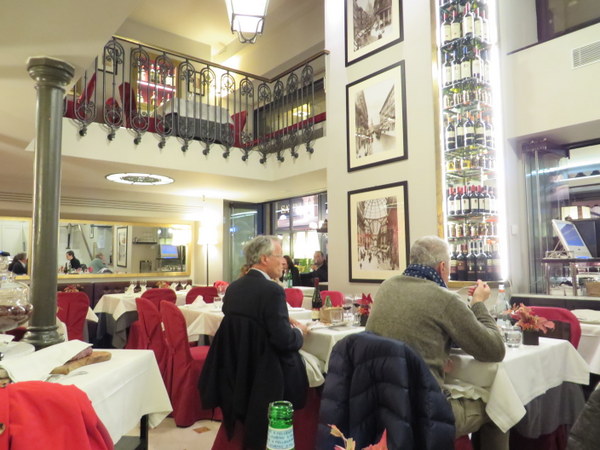
Not your average mall restaurant....

Not your average mall restaurant….

I had need to go to Milan for work, and Ric came to join me for the weekend. Two days in the office passed easily enough and I didn’t have time for any culturally significant outings. Upon Ric’s arrival we headed to Centro Storico to wander around, taking a quaint little tram that dated to 1928.  Now some real behavioral differences began. In Milan, those waiting to board a tram or a Metro train actually let those exiting get off before shoving their way on. Ric and I turned to each other in wonderment! What a delightful change in comportment!

We shopped a bit – after all Milan is the shopping Mecca of Italy – then proceeded to supper in the Galleria Vittorio Emanuele II. To call this a “mall” is like calling Villa Borghese a “playground.” No food court or discount stores here. Rather the likes of Prada, Valentino and Versace. For the record, we didn’t buy anything in the galleria.

Saturday dawned like a Portland March day, but even colder and wetter.

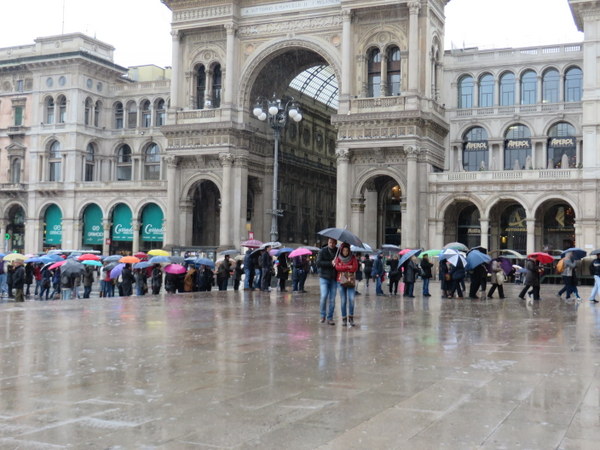
The rain did not deter the crowds waiting in line to enter the Duomo. Glad we arrived before the line was so long.

The rain did not deter the crowds waiting in line to enter the Duomo. Glad we arrived before the line was so long.

It never stopped raining, making for a good museum day. We were impressed at the number of people out despite the rain. Long queues of umbrellas waited patiently to enter the magnificent Duomo, and we narrowly beat the crowd both at the Duomo and for an Andy Warhol exhibit nearby, handily avoiding the long queues because we are early-birds. The Warhol exhibit was eye-opening as we discovered some of Andy’s less-known work, all from the private collection of Peter Brant. Truly amazing that one person could have amassed such a collection from a single artist.

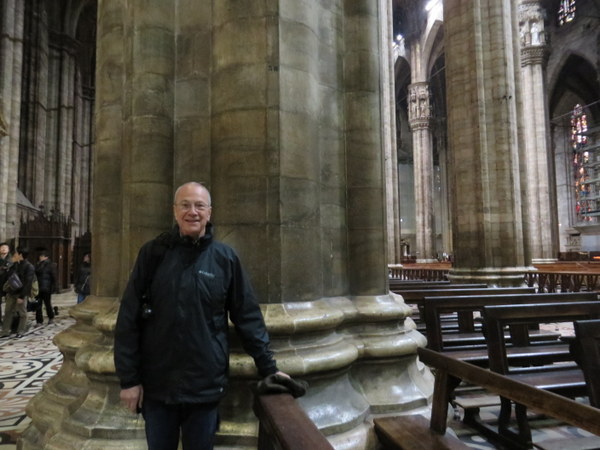
The pillars in the Duomo of Milan are about the size of sequoias.

The pillars in the Duomo of Milan are about the size of sequoias.

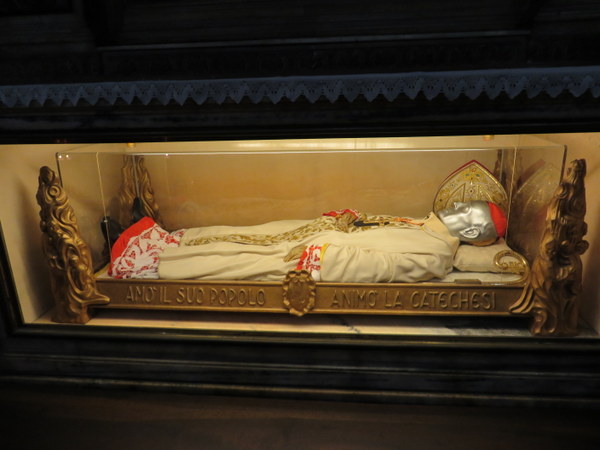
As to the Duomo, this is the fourth largest church in Europe and quite a contrast to most of those we’ve seen in Italy. Ric said “This church seems almost Lutheran,” which is quite insightful as it is predominantly Gothic, reminiscent of the Protestant Churches of Northern Europe. Of course the Lutheran churches in our hometowns lack marble, entombed remains of cardinals on display, or pillars the size of sequoias.

Yes, that's the body of a Cardinal, with a silver death mask. Nothing like this in St. Paul, either.

Yes, that’s the body of a Cardinal, with a silver death mask. There’s nothing like this in St. Paul, MN.

4th longest nave in Christendom, so says my guidebook.

4th longest nave in Christendom, so says my guidebook.

There's nothing quite like this in St. Paul, MN.

There’s nothing quite like this in St. Paul, either.

The afternoon took us to a more obscure museum, Pinacoteca Ambrosiana  where the building was as much art as the contents. This is a fabulous palace with amazing mosaics and inlaid floors. Regrettably, no photos allowed so I cannot show you. Again, a private collection, this time of none other than a Cardinal from the 17th century, Borromeo.  In this vast collection of 1600 items there’s a Caravaggio, Raphael’s original charcoal drawing for his Vatican fresco “The School of Athens,” a Tiziano, a Botticelli or two, a DaVinci, several Brueghels, and a lock of Lucretia Borgia’s blond hair. Oh, and Leonardo’s Codex Atlanticus in its 1119 page glory is in the library at Ambrosiana. We saw 22 pages carefully displayed. (It’s only 500 years-or-so old.) Church work was very profitable back in the old days…. I don’t think Papa Francesco would approve today.

For those looking at this post as a travel guide, we stayed at Hotel Teco, a sweet and relatively (for Milan!) inexpensive hotel at about €137.00 per night including breakfast. We were able to get a VAT exemption as diplomats. To my Embassy friends: don’t overlook the paperwork needed before you travel.  A 17 minute walk or €10.00 cab ride from Milano Centrale, Hotel Teco is convenient to the Metro (5 minute walk to the Rosso), and Tram #1 to the Duomo is about a 7 minute walk. Numerous restaurants including Ristorante Sabatini (the woman at the front desk said ottimo pizza” and she was right!) are a short walk away.  I also like Osteria Mamma Rosa nearby, although we didn’t make it there this trip.

I’ve been to Milan four times for work, and once prior in personal travel. I’ve either lacked time or weather sufficiently pleasant for a trip to the roof of the Duomo. I think we’ll have to take advantage some sunny summer day and hop a train to Milan just for the day and make our way to the top. 

Day 4: Trains & Etruscans

17 Feb

I am a day late posting this update. Just too tired last night, and today I had to do my Italian grammar homework or suffer the consequences when my tutor shows up tomorrow. Every day here is a test, but I am bound-and-determined that I will speak more-or-less grammatically correct one day. 

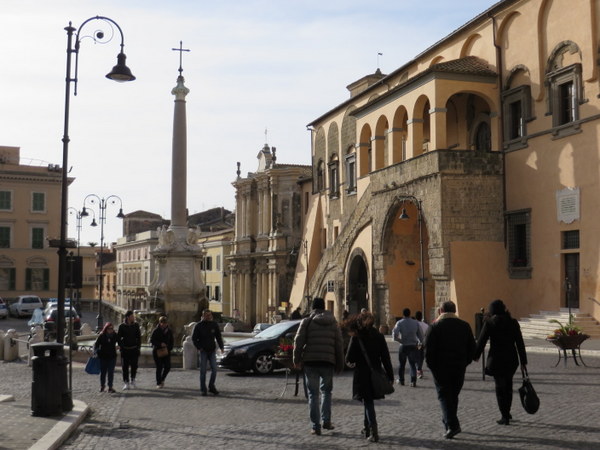
Classic Italian piazza": City Hall, a fountain, people enjoying a stroll.

Classic Italian piazza: City Hall, a fountain, people enjoying a stroll.

After an exhausting but interesting tour by car on Saturday, on Sunday we took a train north along the coast to Tarquinia, another ancient Etruscan city. The Etruscans are very mysterious as there is no literature, no historical record nor religious texts. We have only the knowledge derived from their tombs, which contained “grave goods” and art.

The old wall surrounding Tarquinia.

The old wall surrounding Tarquinia.

The train was a Regionale Veloce meaning it runs a bit faster than the serviceable Regionale found along many rural lines. On the train, one passes the port of Civitavecchia with enormous cruise ships docked to disperse passengers for a day in Rome, as well as other more charming seaside towns that perhaps serve as retreats for city-weary Romans. Tarquinia is more than 2500 years old, but today it may serve as a bedroom community to Rome as one can commute by train in a little over an hour. (We know people at the Embassy that make an hour-and-a-half trip to work, living various places on the coast or in the hills and commuting by train.)

Etruscan sarcophagus.  Note the detail in the carving. About 2500 years old.

Etruscan sarcophagus. Note the detail in the carving. About 2500 years old.

With its remoteness from Rome, few tourists venture to Tarquinia, especially in February. It was serene and uncrowded this sunny Sunday. We enjoyed the National Museum and its treasures without interference, then meandered up the street, through a classic piazza in search of Sunday lunch. We stumbled – luckily – into Ristorante Ambaradam and were soon followed by group after group seeking lunch. What a find! We feasted on insalata di polpo & cicoria ripassata (salad of warm octopus and greens) served on a bed of creamed chickpeas, followed by cacio e pepe (think Italian mac & cheese, but classy and “zippy”) for me, and pasta with a ragu of octopus, tomato, and guanciale with flakes of pecorino for Ric. Alongside was THE BEST puntarelle ever.    Puntarelle is a seasonal favorite, and while I like it the “normal” way (see link), the one at Ambaradam was extra nice featuring olives and little bits of sweet orange, with the anchovy taste played down. Yum! Washed down with a Chardonnay from Lazio, this lunch demanded exercise. As the walk to visit the necropolis was ahead, we were able to shake off the postprandial doziness in the cool fresh air.

The necropolis of Tarquinia features more than 6,000 tombs. Once at ground level, after 2,500 years they are subterranean. One climbs down

Another beautiful fresco from 2500 years ago.

Another beautiful fresco from 2500 years ago.

steep stairs to view the chambers, decorated with sometimes lively frescoes. The dioramas and renderings reminded me of the Indian burial mounds found in Minnesota. Although I am unaware of any place you can actually enter one in America, the concept seems similar: bury the person with “grave goods” to take them into the next life. We almost missed the entrance to the park (signage is not terrific), but a tour group of French students attracted our attention and we made for the gate ahead of them.

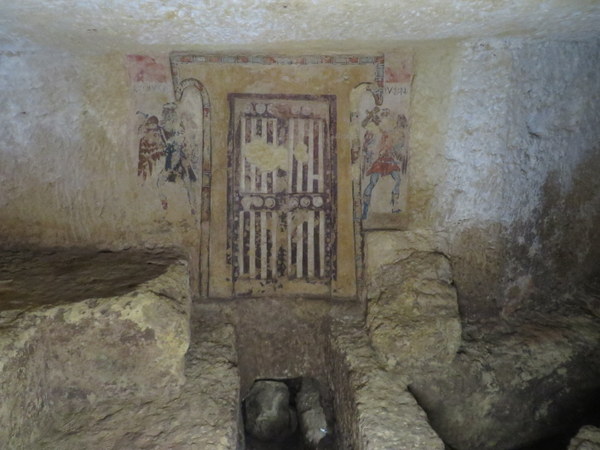
This Etruscan fresco depicts a false door designed to keep the Devil away from the tomb of the departed.

This Etruscan fresco depicts a false door designed to keep the Devil away from the tomb of the departed.

The treasures found in the National Museum came from these tombs: elaborate tombstones and sarcophagi, as well as jewelry, weapons, urns, and other household goods one might need in the afterlife.

We walked a lot in part because the bus service on a Sunday is limited. Here’s a conundrum for you to consider:

  • The museum and necropolis are closed on Monday (very common in Italy) and open Tuesday-Sunday. The two sites are 1.5 km apart.
  • The Tourist Information office is closed on Sunday but open Monday-Saturday
  • The shuttle bus to the tombs does not run on Sunday but does Monday-Saturday

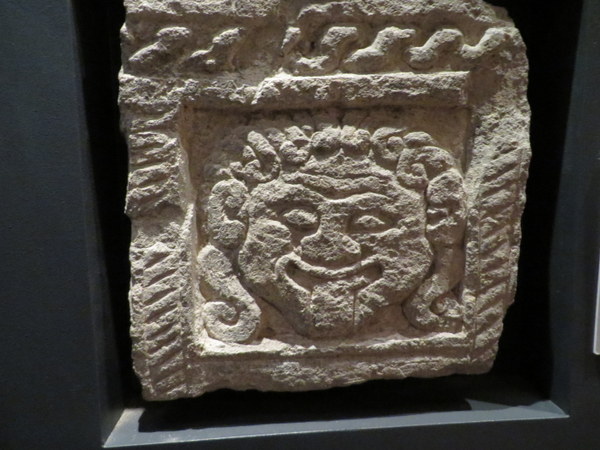
    Fabulous detail of a tombstone.

    Fabulous detail of a tombstone.

Why does the shuttle bus run on Monday when the tombs are closed? Why is the TI closed on Sunday when the museum and tombs are open, but open Monday when the necropolis and museum are closed? Like so many things here, it makes no sense from a service and commerce point-of-view.

Chiesa di San Francesco Bell Tower, Tarquinia.

Chiesa di San Francesco Bell Tower, Tarquinia.

If you go to Tarquinia on Sunday, be prepared to walk…or take a car. But if you eat cacio e pepe or other Italian specialties, you may want to walk anyway. The train back to Rome offered a chance to nap a bit, far better than driving in my book. 

Day 3: Road Trip!

15 Feb

The tiny hill town of Cività di Bagnoregio has been on my list for more than three years. Today, a glorious clear and sunny day, we picked up a Car Share Fiat Panda from the piazza near us and headed north. I can let the pictures speak for themselves: Cività is almost too cute in a medieval-cute sort of way.  Even sweeter, we saw mostly young couples wandering hand-in-hand (Ric thinks they were at the Vatican celebration of engagement yesterday) and young families out for a day together. We meandered the little lanes, admired the views, and tucked into some fine country cuisine.

Cività, founded by the Etruscans 2500 years ago, is called Il paese che muore (the town that is dying) because it has been eroding for centuries. It is said about 12 people live there in winter and 100 in summer. Cats seem to out-number residents at this time of year. Doors lead to nowhere and stairs to a cliff edge. Surrounded by badlands and battered by wind, tourism is keeping it alive.

Click on any photo below for a slide show.

It was exhausting to drive today! We both remarked that our train trips – no matter how long – invigorate us. The car trip had us both tense and tired. We had intended to make another stop, but were weary beyond belief. There are so many places one cannot go by train that we must climb in a car now and then, but it sets our minds at ease that we made the right decision to sell the cars and rely on feet and public transportation for most of our needs.