Archive | Sights RSS feed for this section

Sicilia – II

13 Mar

The weather reports indicate each day will be rainy. Luckily for us, the rain has held off until the afternoon each day, so as early risers we are able to seize the best part of each day.  Since Sicilia is such an outdoor-oriented place, we are blessed, because an entire week of museums was not the plan.

Mozia windmills

Windmills near Mozia, in the salt pans of Western Italy.

We ventured to tiny Mozia, once an important site for Phoenician traders and a very affluent city in its time, today it is an uninhabited island in the midst of the salt pans of western Sicilia.  Once again we are awestruck by the history – the truly ancient history – of this part of the world. You know the old saying: “A hundred miles is a long distance to a European and 100 years is ancient to an American.” When we encounter a place where construction was begun in the 8th century B.C., it gets our attention. Reached by a small launch in a 10-minute ride from the mainland, there’s a fine little museum and the opportunity to explore the island’s many excavations.
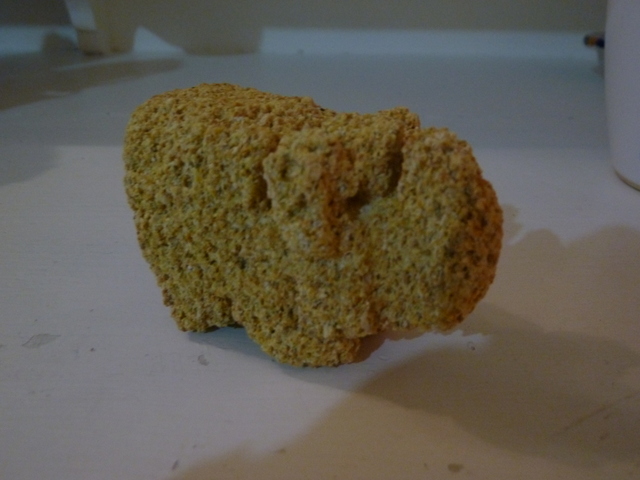
Tufa elephant

Little tufa elephant carved by Peppe Genna.

Perhaps the highlight, though, was meeting Peppe Genna, the “craftsman poet of the saltworks.”  Peppe keeps alive ancient traditions of hand-making palm brooms and carving tufa animals, holding court alongside the lagoon, selling his crafts from the trunk of his car. What a character! You can Google him and hear him recite his poetry in Sicilian dialect.

Across the lagoon from Mozia is Marsala, where the Phoenicians retreated when Mozia was destroyed by Siracusa. Of course Marsala is famous for its wines, and it is heavily influenced by North Africa, resulting in a city the looks quite different from any other we have yet encountered in Italy.  It has a lovely old center, very clean, with beautiful iron-work balconies. Perhaps not s huge vacation destination, but interesting if you are a) in the area, and b) a fan of Marsala wine.

Runis at Mozia

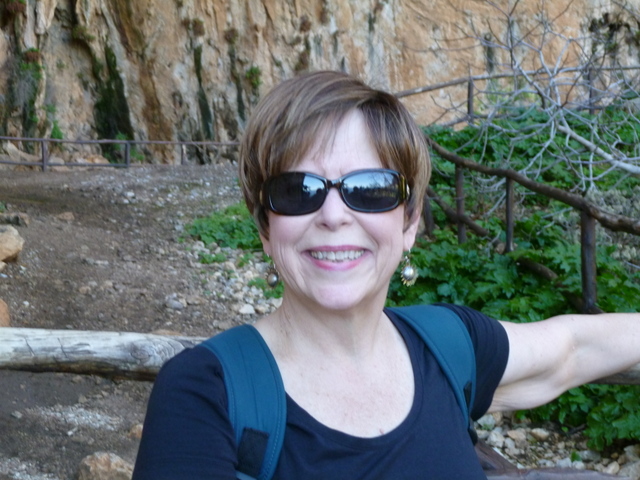
Ruins at Mozia; Yes that’s me in the photo.

Erice continues to hide her head from us. As we returned to Tràpani in the afternoon, she briefly cleared, only to be socked-in again before we could mount an approach as it is quite a long drive to the top.

The food here makes amends for the marginal weather. Luckily we are walking enough to indulge, although we are not filling ourselves with pastries; rather with fish, beautiful vegetables, and fresh pasta. (There’s wine, of course, and some pizza. I am, after all, traveling with Ric.) On Mondays and Tuesdays many restaurants close in low season. Tuesday night we tried three places, in the rain, before we found one open near our apartment. Although light on
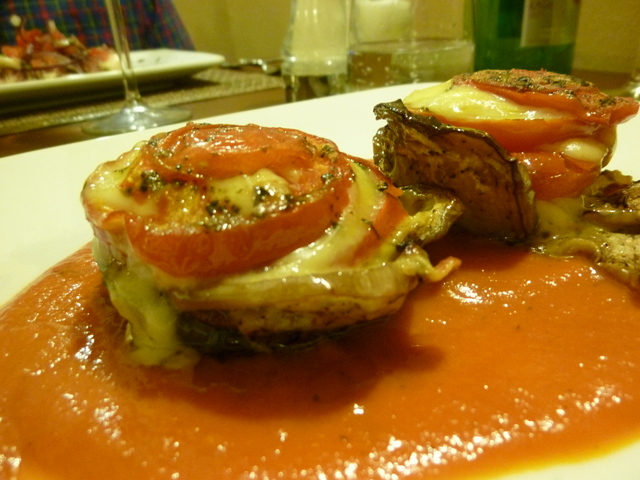
Melanzane torta

Torta di melanzane, carciofi, pomodori e formaggio. Yum!

customers this dreary night, the staff was gracious and the food divine. We feasted on octopus salad, a layered eggplant/tomato/cheese torte, pasta with sea urchins, and pasta alla Norma, prepared with eggplant and artichokes. All washed down with a fine local white wine and the meal rounded out with an almond semifreddo. We slept well after that meal.

Wednesday held a greater threat of rain – and still no view of Erice – so we braced for traffic and headed to Palermo. I was a bit worried about the reputation Palermo has for bad traffic, gritty neighborhoods, and tough characters. Nothing could be further from the truth. We encountered thoughtful, sweet people who helped us at every turn. (N.B: The drivers in Palermo are even less courteous about pedestrians than Roman drivers. That’s the only negative thing I have to say about the city.)

We navigated to a parking lot near a metro station so we did not have to drive through too

Parking chits

Parking chits look much like lottery tickets in Palermo.

much of the city. I knew parking had a “scratch off” system but really didn’t know what to expect. There are no automated ticket vending machines, so I entered a bar and inquired as to where I could buy a ticket. “Da me, signora,” said a soft-spoken, kind man who proceeded to quiz me about our plans for the day and how long we’d park, then explained the system: one ticket per hour paid, free from 14:00-16:00, so I would buy 4 tickets, one for each hour from 11:00-14:00, and 16:00-17:00, then scratch off year, month day and time, and place them on the dash. Interesting system. The parking lot was filled with cars that looked like they had lottery tickets strewn across their dashboards. As far as I can tell, the sweet man in the bar makes €.25 per ticket he sells. Plus the €1.60 we spent on caffé.

Cappella Palatina

Gold mosaics, Middle Eastern influences, the 12th century Cappella Palatina.

Proceeding by metro to the historic center, we browsed Palermo, had lunch, and visited the brilliant and beautiful Cappella Palatina. This is a 12th century masterpiece that combines Byzantine mosaics and Islamic carvings with Latin Christian tradition. Amazing.

Retracing our steps to the metro, we planned on buying tickets at an automated ticket machine, but the two in the station were broken. Figurati! With trains only every half hour, we were desirous of taking the train that was just pulling in, and not having to go to the street again and search for tickets.  So we jumped on the train and I went immediately to the Capotreno and reported our problem. (My Italian serves me well for these little transactions. I felt almost fluent in my fervor to get my problem across. To fail meant a big fine!)  I asked if we could buy tickets from him. He asked me our stop, and told me to be seated, then left. Ric thought he was going to go get his book and write us a ticket for a fine, not for transit. But at our stop, he came out to ensure we were indeed leaving his train, wished us well, and with a smile encouraged us to buy tickets “la prossima volta.”

BTW, no rain until we were returning to Tràpani. Still no Erice in sight.
Sicilia – Part I

11 Mar
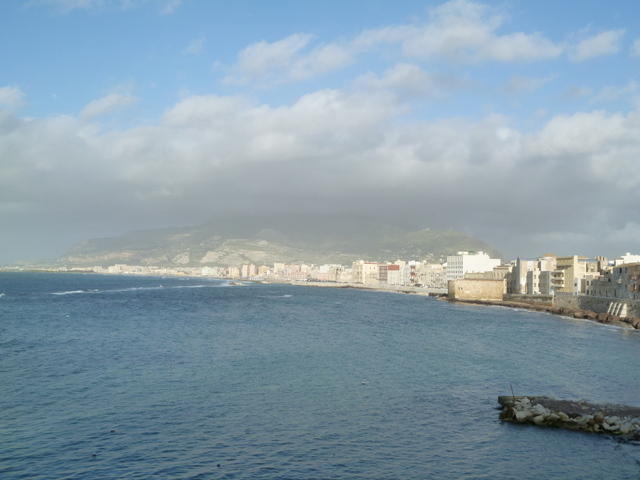
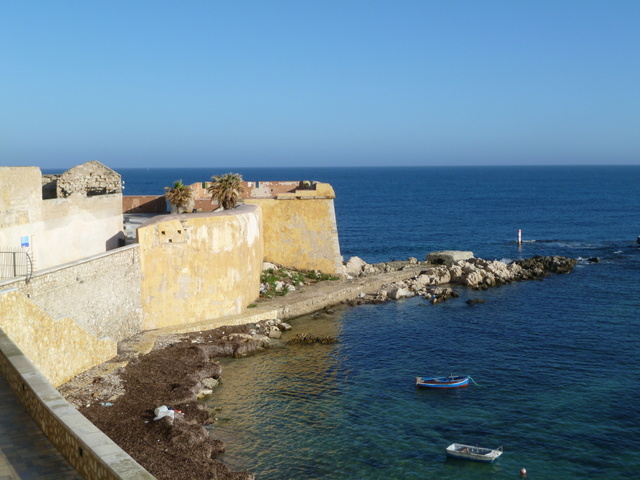
View from apartment, Trapani

City wall of Trapani, as viewed from the terrace of our apartment.

When I said we were going to Sicilia, Italian friends sighed, American colleagues raved, and my dear friend Nicholas whined that he could not be there too.  Thanks to all, I received some great advice on things to do and places to see. Sicilia is beautiful, to say the least, the people are friendly to a fault, and the food is divine.

We took our first flight since arriving in Italy last May. It seemed strange to fly out of Rome instead of taking a train and we were pleased to discover we had not forgotten how to drive, as neither of us had done so for 10 months.

We are staying in the small city of Tràpani in Northwest Sicily. Rather than try to “do” the whole island in one trip, we selected a corner of the region to explore. If we like it – and we do so far – we have plenty of opportunity to return and explore more of this vast and interesting island. With an ocean-front apartment reached via 60 steps (no elevator) we are living local. Luckily we didn’t have to haul our suitcases, although each only weighs 20 pounds or so, because the building has a rope and pulley system to assist in baggage handling. [NB: two-and-half years ago

Laurel in Lo Zingaro

Stopping by the grotto in Lo ZIngaro. People lived here as long as 10,000 yeasr ago.

we stayed in Vernazza in an apartment that had a climb of 57 steps. We struggled with that climb to the point that we really thought about it before we went up or down to minimize the number of trips per day. Now we are both in far better shape with weight loss (both of us), “new legs” and a gym program for me, 6-7km per day walking, and daily jaunts up the 64 steps to our apartment in Roma. The 60 steps in Tràpani are a piece of cake!]


I wanted to stay in Erice, a medieval town about 2400 feet abve Trapani, but Francesco, Rick and Jane were right to advise against it as a base. It has been encased in clouds for 3 days now. It’s much better here at sea level.

Erice in Clouds

Erice is atop the hill hidden in a mass of clouds.

Our arrival day devolved into a miserable rain and chill, warded off by an amazing dinner involving the best caponata we’d ever eaten, fresh fish, and a couscous preparation like none I’ve ever had, served with a whole roasted fish and a tureen of fish broth. With a crisp local white wine, we were satiated and slept a full 8 hours for a change! 

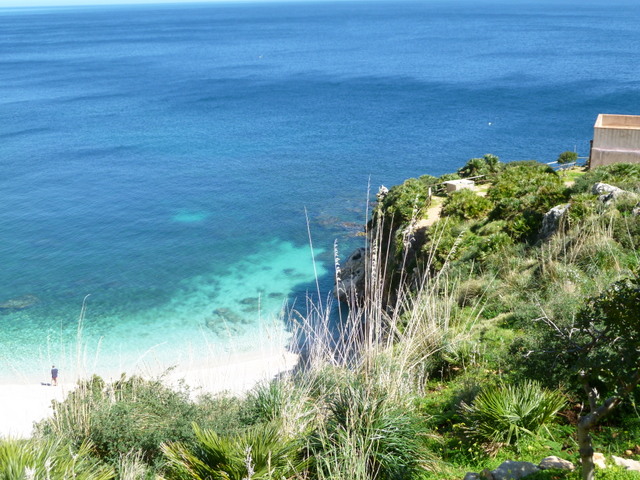
Lo Zingaro

Crystal clear waters far below the trail in Lo Zingaro.

Fortunately Sunday dawned bright and clear, so we headed to La Riserva Naturale dello Zingaro for a hike. What a beautiful and unusual place! It’s a little bit like parts of Hawaii with stark and interesting beauty, unusual plants, and ever-so-quiet. The water is clear with many shades of blue and turquoise contrasting with the lush green of a spring-rain freshened landscape.  I have not been anywhere quite this quiet (only the sounds of birds and the wind) for many many years. We felt far removed from our bustling Roma, which was the point of this vacation. Lizards darted across our path, and the wild flowers opened almost before our eyes

Lizard in sun

Little lizards dart along the trail enjoying the sun. So did we.

as the sun warmed the day. A half-hour or so into the hike, we encountered a small museum dedicated to the contadini (farmers) where an amicable man told us about the activities and dwellings of a typical farm family. We were his first visitors this day so he was ready to chat. My Italian understanding is really coming along, thank God, and we had a decent conversation. There is a grotto along the trail where they have determined people have lived for some 10,000 years. Amazing to consider how ancient this land is. Also, I got some sun as ordered by my doctor who thinks I need more vitamin D.

The hike was a good workout so we indulged in a fine Sunday lunch of fresh fish, fresh pasta, and an arugula salad, enjoying the antics of little children dining with Nonna e Nonno at an adjacent table.

Segesta

Greek temple at Segesta, viewed from afar.

Clouds come and go, with passing showers. The temperature is not warm enough for beach time, but excellent for exploring, so Monday we headed to Segesta, where we saw our first-ever Greek ruins. This is a marvelous time of year to visit without crowds or the dizzying heat of summer. We found ourselves alone beside the magnificent temple, in the ancient arena, and along quiet paths. The temple is huge and well-preserved. One can walk completely around it for an excellent perspective on the architecture. Built in the 5th century, B.C., it has survived at least three earthquakes, and has withstood the ravages of man for so many centuries, but the courthouse in Salem, OR, barely lasted a decade due to poor construction.

After an up-close encounter with the temple, we ascended the hill opposite (305 meters above sea level) where the city used to be, to the location of an ancient arena. There we found gorgeous views back to the temple across fields of wild-flowers in bloom.

Luckily, as this is Italy, one can get a fine espresso freshly pulled by the barista, and

Ric at Segesta

My favorite travel companion in the ancient arena at Segesta.

a freshly made pastry even at an archeological site. Try that at Silver Creek Falls or the Mount St. Helens.Stay-tuned. More to come….

Beyond il Colosseo

20 Feb

Beyond il Colosseo

Every guest wants to see il Colosseo, followed closely by the Vatican Museums, St. Peter’s, Villa Borghese, and many of Rome’s grand and well-known sites. But where do you go once you’ve seen all the most-popular sites? What treasures await those who have more time in Rome? Ric and I have made a point of visiting some lesser-known venues over the past few months and have found some true gems, virtually free of tourists, lacking long lines and crowds.

Palazzo Braschi Museo di Roma

Grand staircase Palazzo Braschi

The art is interesting, but Palazzo Braschi is the star.

New by Roman standards, Palazzo Braschi dates only to the 18th century. Situated adjacent to Piazza Navona, it is a wonder that so few people venture in. The building itself is amazing, with one of the grandest staircases imaginable. Built with Papal wealth, after financial problems plagued the owner the building was sold to the State. After the Second World War, 300 homeless families lived here causing extensive damage, but restoration work resulted in the fine museum we see today.  One hot June day, at the height of tourist season, we found ourselves among a mere handful of people enjoying the cool interior of Palazzo Braschi.  The collection features scenes of Rome as painted during the Renaissance. It’s fun to see how things looked to the artists of the time, but the real star is the Palazzo itself. Revel in the architecture and imagine a time when this was a private residence. 

 Palazzo Colonna 

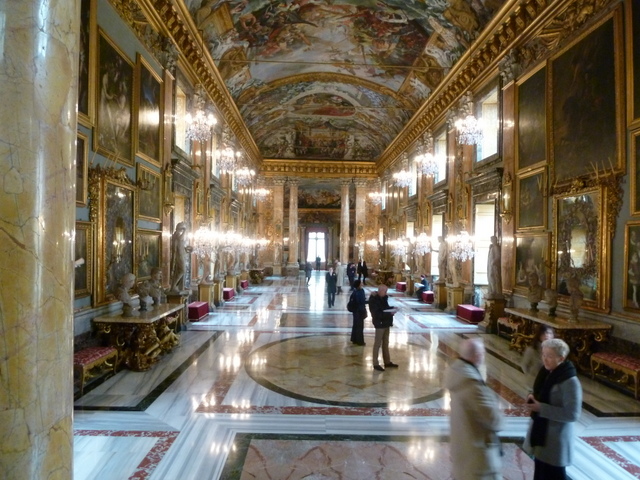
Great Hall Palazzo Colonna

Palazzo Colonna grandeur: only available on a Saturday.

Not every museum is open every day. A truly notable exception is the Palazzo/Galleria Colonna. Open only on Saturdays from 09:00-13:15, one has to plan to see this treasure. As a bonus, there is an English tour at 11:45 (Italian at 11:00).  Just off Via IV Novembre, Palazzo Colonna presents a less-than-stunning edifice. In fact, we have been past this structure dozens of times without realizing the importance of the site and the art within. (The wax museum at street level provides an odd contrast and is no doubt visited by more people daily than Palazzo Colonna sees in a month… or two.)  Once you are inside, it is jaw-droppingly beautiful. If you recall the movie “Roman Holiday” with Audrey Hepburn and Gregory Peck, the final scene of a palace press conference was filmed in Palazzo Colonna. Parts of the palazzo date from the 13th century and there is a claim that “Dante slept here.” Popes and Hapsburgs, feuds and wars, provide background to this enormous and elegant residence and gallery. The family still lives in apartments at the site, explaining perhaps why it is open so few hours each week.

Palazzo Colonna

Palazzo Colonna: You’ll have to take the tour to hear the story of the cannon ball….

Palazzo Farnese

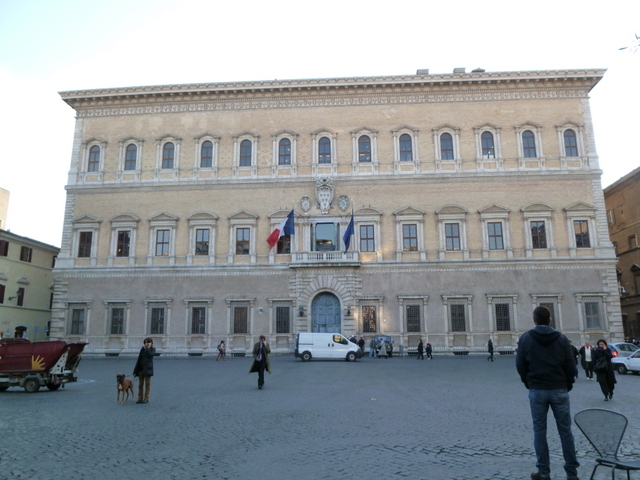
Palazzo Farnese

A formidable façade reveals a grand beauty, seat of the French Embassy.

Another one-day-a-week venue – at least for English speakers –  is the French Embassy to Italy, located in Palazzo Farnese, which is only open for tours in English on Wednesday, and only at 17:00. (French and Italian language tours are also available on Monday and Friday.)  As a working embassy, only portions of the building and grounds are accessible, and one must reserve at least a week in advance; However, for the modest price of €5.00, it is perhaps one of the highest value tours available.  A pope, Michelangelo, Puccini, Annibale Carracci, Queen Christina of Sweden (the proverbial tenant from Hell), and Giacomo della Porta all played a role in the rich history of this palace.  No pictures are allowed inside, but trust me; the severe exterior on Piazza Farnese does no favors to the beauty within. 


Villa Torlonia

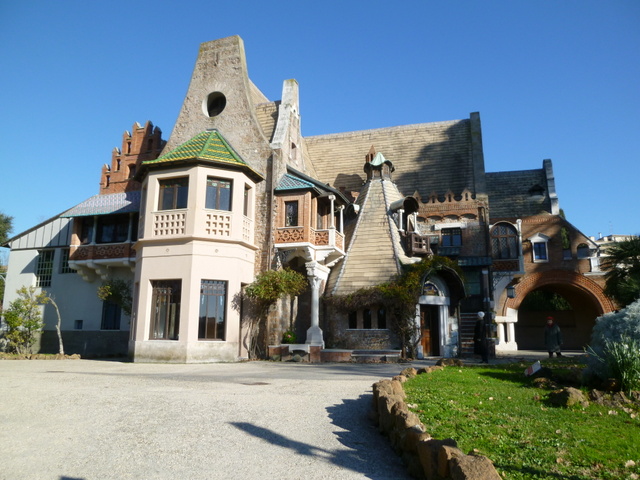
Villa Torlonia

La Casina delle Civette, a curious mix of styles.

This is a truly off-the-beaten-path location even for many Romans, Villa Torlonia is a vast and beautiful park with three diverse villas now serving as museums. Once owned by the Pamphilj family (Villa Pamphilj and Galleria Doria Pamphilj are also properties of this enormously wealthy dynasty), it passed to the Colonna family and finally the Torlonia. The estate was extensively remodeled in the early 19th century. There are winding paths, small lakes and fountains, obelisks, the three museums, and more restoration work in progress.  Mussolini lived in the Casino Nobile for 18 years, renting it for one Lira per year.  You will see families enjoying the grounds, playing, walking, and soaking up the sun from a bench. My favorite building is the Casina delle Civette, House of the Owls. Formerly known as “The Swiss Cabin” and originally a refuge from the grand villa Casino Nobile, it has been transformed through the years with a mixture of architectural styles that almost defy description. Go for the stained glass and enjoy the inlaid wood, medieval influences, mosaics and majolica.  


Villa Medici

Villa Medici

Villa Medici from the garden.

On a recent Sunday, we were among only four Americans touring Villa Medici. Bordering Villa Borghese, above Viale del Muro Torto, just north of Piazza di Spagna, you will find this magnificent palazzo and grounds. Entering from the fortress like side facing Viale Trinità dei Monti, the villa is impressive only in size and age. Sign up for the guided tour and the beauty of this 16th century enclave is revealed. Villa Medici is like most palazzi, steeped in the history of cardinals, artists, architects and even ancient Romans. Today it is the seat of the French Academy in Rome, hosting artists from all over the world in residency fellowships.  The focus of the tour is on the grounds, which are truly magnificent.  Unfortunately with the Tuscan heritage of Cardinal Ricci and Cardinal Ferdinando de’ Medici, much of the original sculpture collection is now in Firenze in the Uffizi. Through restoration and replicas, we can enjoy the site much as it once was.  In the private pavilion of Cardinal Medici admire recently restored frescoes from the 17th century, once covered

Villa MEdici

Niobe suffers from hubris and loses al of her children.

thoughtlessly with many coats of lime, now again visible thanks to one of the artist-in-residence fellows.  And in one of the 16 squares of the garden, we discover the dramatic installation of Niobe and her dying children.  The entire estate was restored in the 20th century, ensuring many generations can continue to enjoy this oasis in the midst of busy Rome. By all means one should see the Colosseum, Forum, Palatine Hill, Borghese Gallery, the Vatican and St. Peter’s. When you’ve seen these historic “must do” sites, when you’ve seen the Caravaggios and the Michelangelos in the magnificent churches, there’s still more to discover in Rome: places where you might just find yourself alone with the art.

Rain in Rome

20 Jan
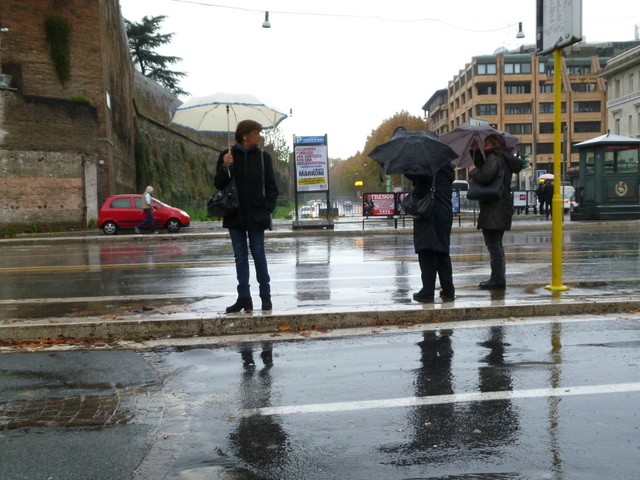
Waiting for the bus in the rain is one of the distinct pleasures of living here.

Waiting for the bus in the rain is one of the distinct pleasures of living here.

20 January 2013.

People bemoan the rain and what it does to their carefully laid plans, especially tourists with a limited schedule and vast lists of “must-dos” in Rome. True, this is a great city for being out-and-about, but the rain forces one to think of new indoor venues, especially when you’ve already seen the biggies: The Vatican, Villa Borghese, the Pantheon, Capitoline Museums, Palazzo Massimo (National Museum of Rome), San Luigi dei Francesi and countless other magnificent churches.

There are many delightful and under-appreciated sites. I wrote of one last summer, when we had Palazzo Braschi Museo di Roma almost to ourselves on a Sunday. I’ve sent many visitors there and received reports of how peaceful and interesting it was.
This great hall was featured in the press conference scene of Roman Holiday with Gregory Peck and Audrey Hepburn.

This great hall was featured in the press conference scene of Roman Holiday with Gregory Peck and Audrey Hepburn.

Usually our Saturday meanderings take us to Campo dei Fiori. This Saturday it was more like a bad day in Portland and not suitable to a 7km walk and marketing. So we ventured into another lesser-known but magnificent museum, Palazzo Colonna. I don’t know how many times I have passed by the rather unimposing edifice on via Nazionale, where the wax museum and various shops do not invite me to linger. But just around the corner, down a small alley-like street with several delightful marble bridges, is the entrance to perhaps the most impressive palazzo we have had the pleasure of visiting. As with many buildings here, the exterior is unremarkable but the interior is incredible. The property itself is gigantic, larger than the Vatican Museums, right in the middle of Rome, yet one can walk by daily, unaware of the treasures within.

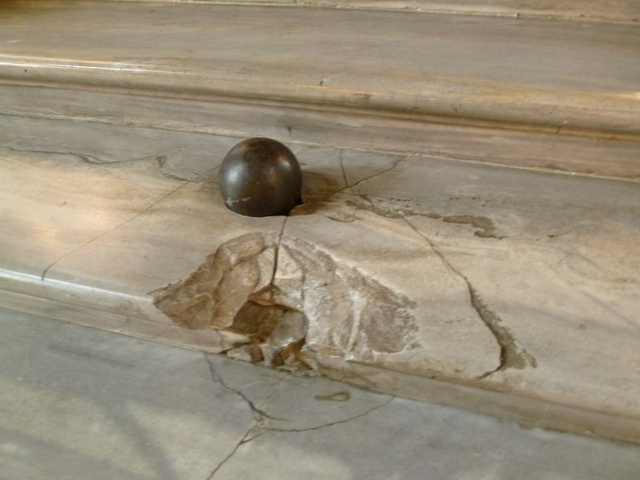
Embedded in the steps of the Great Hall, this cannon ball dates back to the Risorgimento.

Embedded in the steps of the Great Hall, this cannon ball dates back to the Risorgimento.

The family has lived here – yes they still occupy apartments – for eight centuries. Having never lived in one house for more than 8 ½ years, I am in awe of roots that run so deep.  The building is as much art as the collection. Only open Saturday mornings, a visit includes a guided tour by an art historian, and the enthusiasm of the staff is itself a treat to behold.

So if you find yourself in Rome on a rainy Saturday – or even on a sunny one – Palazzo Colonna should be on your list.

Magnificent frescoes and Tromp L'oiel cover the ceilings.

Magnificent frescoes and Tromp L’oiel cover the ceilings.

A Colonna was responsible for defeating the Turks at Lepanto. This table base depicts captured Turks in chains.

A Colonna was responsible for defeating the Turks at Lepanto. This table base depicts captured Turks in chains.

Scenes from a Roman Saturday

23 Dec
A view from Piazzale Napoleone. across P.za del Popolo to the Vatican. Bellissima!

A view from Piazzale Napoleone. across P.za del Popolo to the Vatican. Bellissima!

Saturday we headed out into a beautiful crisp clear day. Our routine each Saturday is to go on foot from our home to Piazza del Popolo, then on down via Ripetta, stopping for caffè e cornetti, and on to Campo dei Fiori where we shop for our fresh fruits & vegetables  (also occasionally baked goods, cheese, salumi).  It takes about 75 minutes for the walk, and we often stop at Piazzale Napoleone to take in the view of the Vatican from above Piazza del Popolo.  Yesterday the view was enhanced by a huge Christmas tree towering above the piazza.

We are “regulars” with some vendors at Campo dei Fiori after so many months of shopping there. Emanuele at the dried fruit-and-nut booth always has something extra for us, or a discount. The family that runs the produce stall I favor, constantly calling back-and-forth. “Zio, how much for La Signora?” or “Papa where are the cranberries?” Hard-working people, appreciative of return business.  Last week Ric had to work on Saturday so I went alone. The guys at the salumeria we patronize missed him and asked me to tell Ric hello for them! We seldom experienced this in Portland, even after half-a-dozen years of going to the PSU Farmer’s Market almost every week. Yet here, in a city many times the size of Portland in population, we are warmly and personally greeted at shops and restaurants we frequent. And they put up with my Italian, God bless them! Emanuele even tries to teach me.

Lights run from Piazza Venezia all the way to Piazza del Popolo, this year in white with blue twinkles. Absolutely stunning!

 In the evening we headed for dinner, walking through the serene Villa Borghese all the way to the Spanish Steps and on into the Centro Storico. Much to our surprise, even at the peak dining hours from 21:00-23:00, there weren’t many people out and about. Perhaps private parties and final weekend preparations took precedence over the usual dining frenzy of a Saturday night.  We meandered the back alleys and enjoyed the lights relatively crowd-free.

Almost every street is draped in lights.

Almost every street is draped in lights.

Panettone

Panettone from Roscioli. None better!

While at Campo dei Fiori Saturday morning we stopped at Roscioli to buy their incredible bread, still warm from the oven, which I will use for the Christmas Day stuffing. The warm, fragrant, pane integrale (whole-wheat bread) enticed us all the way home. As soon as we arrived, I sliced into the middle and we feasted on that good warm bread. We also picked up an artigianale panettone, the traditional Italian Christmas bread. Ours is made with frutti di bosco (berries) and we could not delay our gratification. Had to cut into it for Sunday breakfast.

Completing our Sunday, a trip to see “Big Bambu” at MACRO Testaccio, followed by a Natale organ concert high atop the Gianicolo at San Pietro di Montorio.