Archive | Travel RSS feed for this section

One year

19 May

Italiano

To our friends and family, miscellaneous musings after our first year in Italy. We arrived May 18, 2012.

1. Cats do not need to go outdoors. A windowsill will do.

Dare-devil Janie on the (very wide) window sill. Libby watches from the cat tower. Window screens are a rarity.

Dare-devil Janie on the (very wide) window sill. Libby watches from the cat tower. They traded a Portland garden for a 3rd floor windowsill.

2. When Italians ask “Come stai?” they really mean it. It’s not just in passing, like in the U.S. Here it is a conversation starter.

3. Arugula is fantastic on a sandwich piadina or panino. Lettuce is for salads.

4. A scarf around your neck is really comforting. It keeps the chill off your neck and it looks good, too.

5. Walking is a terrific form of transportation but shoe leather wears out faster than car tires.

6. Parking is colorful: white (free), blue (pay), yellow (restricted) zones are interpreted liberally by drivers.

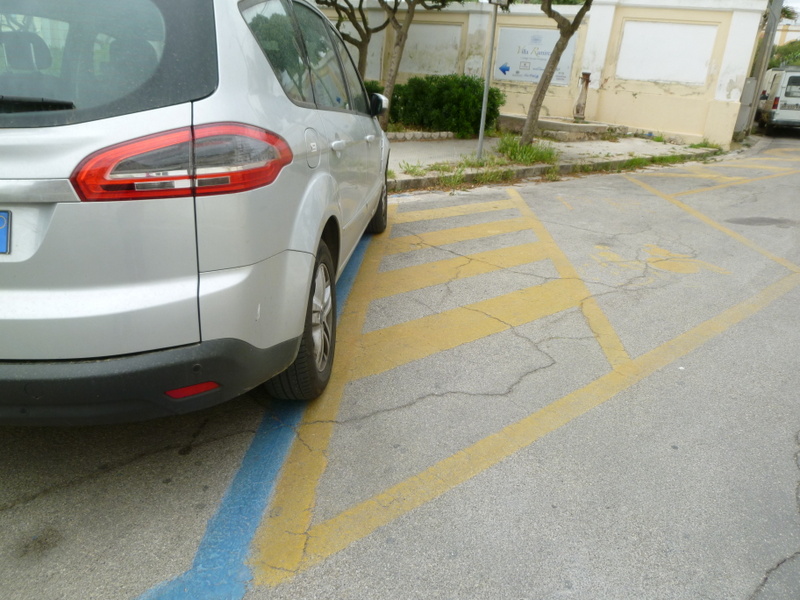
Here we see a car parked in blue stripes (pay) but overlapping onto yellow (reserved in this case for handicapped).

Here we see a car parked in blue stripes (pay) but overlapping onto yellow (reserved in this case for handicapped).

This car is parking in a free zone, as indicated by the white lines...except this is a pedestrian crossing. "Liberal interpretation."

This car is parking in a free zone, as indicated by the white lines…except this is a pedestrian crossing. “Liberal interpretation.”

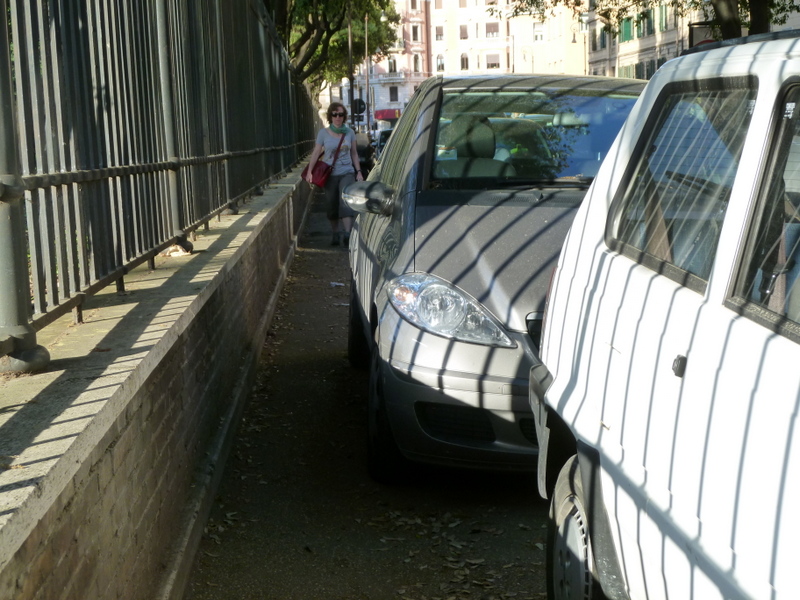
If there's no room in the street, just block a sidewalk. Pedestrians be damned!

If there’s no room in the street, just block a sidewalk. Pedestrians be damned!

7. I’d hate to be in a wheel chair in Rome. (See above)

8. Privacy is an American concept.

9. Dinner does not have to be a protein, a starch, and a vegetable. The American “square meal” is no longer a part of our lives.

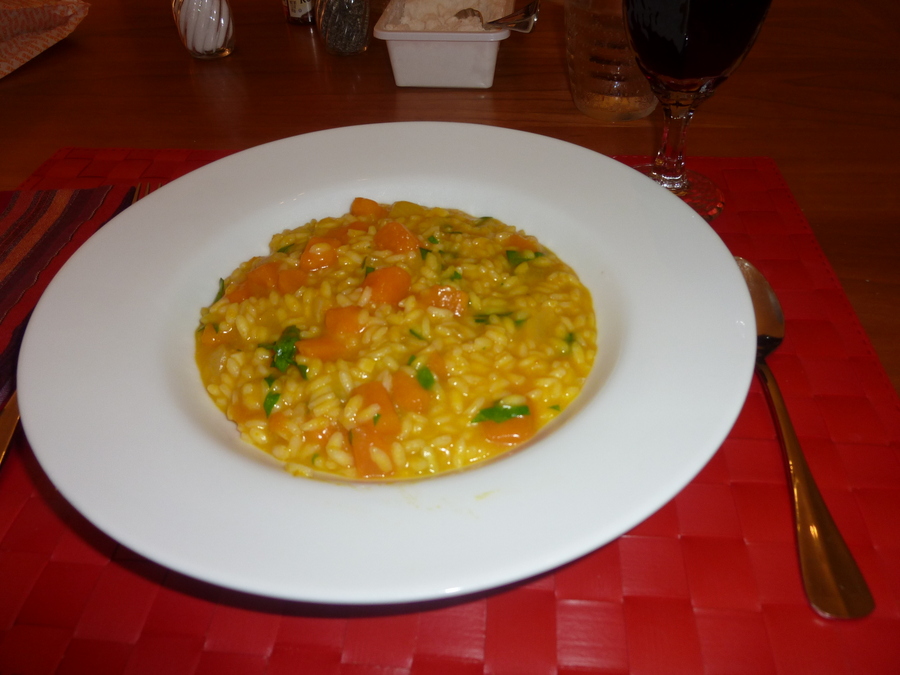
Risotto all zucca

Pumpkin risotto – one dish meal, no meat, delicious local flavors.

10. Fresh flavors need little help. We have tossed out many of our spices.

11. Starbucks is NOT an Italian experience.

No  "Grande Americano" here: a single shot espresso gets us going in the morning. We have a few throughout the day.

No “Grande Americano” here: a single shot espresso gets us going in the morning. We have a few throughout the day. Pastries only on the weekends…or holidays…or vacation.

12. Being a repeat customer is heartily acknowledged. When was the last time your “regular” waiter greeted you with a kiss on the cheek?

Celebrating one year in Italy, here we are in Martina Franca.

Celebrating one year in Italy, here we are in Martina Franca, Puglia.

Fish balls and snow

15 Mar

The food in Sicilia, and most especially our experience in Tràpani, is amazing. It is perhaps the best part of the trip: that and the people.

I am known by many of you to make a fine Köttbullar or Swedish Meatball. Beef, pork and veal meatballs flavored with nutmeg in an artery-clogging cream gravy.  These are the taste of my childhood.

Polpette

“Fish balls’ does not do justice to this masterpiece. Better in Italian “Polpette di Sarde in Sugo.”

Normally I would not be one to order the unfortunately named item “fish balls in sauce.” Luckily it sounds better in Italian. We’ve had “fish balls” twice: once made of swordfish (polpette di pesce spade) in Palermo, but of particular note were the ones we ate last night in Tràpani – polpette di sarde in sugo – made with fresh sardines and pine nuts with mint in a rich tomato-based sauce. I wanted to lick the plate clean. I am going to learn how to make these Sicilian wonders. Anyone who is open to my trial-and-error experimentation please raise your hand, you are invited for dinner.

The polpette antipasto and accompanying fish dinner were the highlight of our day Thursday. The weather, in a word, sucks. Cold, rainy, violently windy, impossible to partake in the outdoor activities we came for. We have barely glimpsed the Egadi Islands we came here to hike. We finally drove to Erice despite the clouds and during a rare respite from the rain, but found it too cold to walk around. Bitingly cold. (We didn’t think to bring puffy jackets and gloves on our spring trip to the south.) So we passed the day reading, writing, napping. Not all that bad for vacation but not what we had in mind. Friday presented us with more of the same only worse. The winds are about 40 mph so we hopped in the car hoping to escape the brutal coastal conditions and headed inland a bit, planning on seeing Monreale and a bit of the countryside off the autostrada. Ha! We were greeted with terrible traffic and closed roads due to flooding, and a downpour that turned into sleet and snow. We turned around. More reading time today and maybe more “fish balls” for dinner.

Sicilia – II

13 Mar

The weather reports indicate each day will be rainy. Luckily for us, the rain has held off until the afternoon each day, so as early risers we are able to seize the best part of each day.  Since Sicilia is such an outdoor-oriented place, we are blessed, because an entire week of museums was not the plan.

Mozia windmills

Windmills near Mozia, in the salt pans of Western Italy.

We ventured to tiny Mozia, once an important site for Phoenician traders and a very affluent city in its time, today it is an uninhabited island in the midst of the salt pans of western Sicilia.  Once again we are awestruck by the history – the truly ancient history – of this part of the world. You know the old saying: “A hundred miles is a long distance to a European and 100 years is ancient to an American.” When we encounter a place where construction was begun in the 8th century B.C., it gets our attention. Reached by a small launch in a 10-minute ride from the mainland, there’s a fine little museum and the opportunity to explore the island’s many excavations.

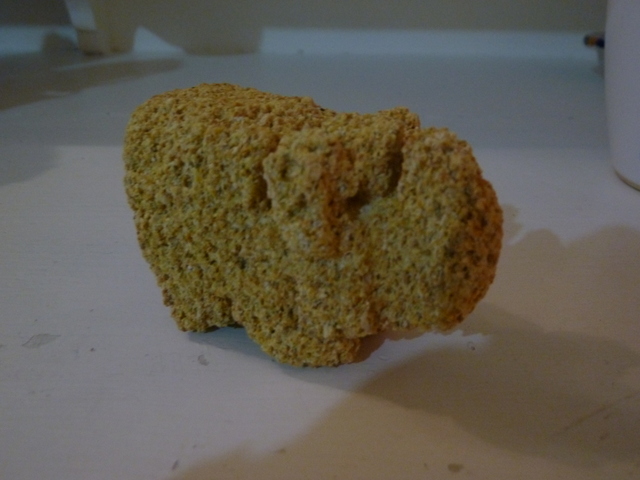
Tufa elephant

Little tufa elephant carved by Peppe Genna.

Perhaps the highlight, though, was meeting Peppe Genna, the “craftsman poet of the saltworks.”  Peppe keeps alive ancient traditions of hand-making palm brooms and carving tufa animals, holding court alongside the lagoon, selling his crafts from the trunk of his car. What a character! You can Google him and hear him recite his poetry in Sicilian dialect.

Across the lagoon from Mozia is Marsala, where the Phoenicians retreated when Mozia was destroyed by Siracusa. Of course Marsala is famous for its wines, and it is heavily influenced by North Africa, resulting in a city the looks quite different from any other we have yet encountered in Italy.  It has a lovely old center, very clean, with beautiful iron-work balconies. Perhaps not s huge vacation destination, but interesting if you are a) in the area, and b) a fan of Marsala wine.

Runis at Mozia

Ruins at Mozia; Yes that’s me in the photo.

Erice continues to hide her head from us. As we returned to Tràpani in the afternoon, she briefly cleared, only to be socked-in again before we could mount an approach as it is quite a long drive to the top.

The food here makes amends for the marginal weather. Luckily we are walking enough to indulge, although we are not filling ourselves with pastries; rather with fish, beautiful vegetables, and fresh pasta. (There’s wine, of course, and some pizza. I am, after all, traveling with Ric.) On Mondays and Tuesdays many restaurants close in low season. Tuesday night we tried three places, in the rain, before we found one open near our apartment. Although light on

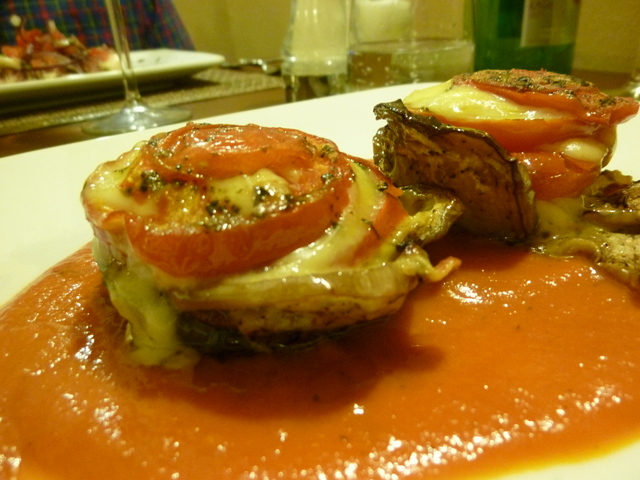
Melanzane torta

Torta di melanzane, carciofi, pomodori e formaggio. Yum!

customers this dreary night, the staff was gracious and the food divine. We feasted on octopus salad, a layered eggplant/tomato/cheese torte, pasta with sea urchins, and pasta alla Norma, prepared with eggplant and artichokes. All washed down with a fine local white wine and the meal rounded out with an almond semifreddo. We slept well after that meal.

Wednesday held a greater threat of rain – and still no view of Erice – so we braced for traffic and headed to Palermo. I was a bit worried about the reputation Palermo has for bad traffic, gritty neighborhoods, and tough characters. Nothing could be further from the truth. We encountered thoughtful, sweet people who helped us at every turn. (N.B: The drivers in Palermo are even less courteous about pedestrians than Roman drivers. That’s the only negative thing I have to say about the city.)

We navigated to a parking lot near a metro station so we did not have to drive through too

Parking chits

Parking chits look much like lottery tickets in Palermo.

much of the city. I knew parking had a “scratch off” system but really didn’t know what to expect. There are no automated ticket vending machines, so I entered a bar and inquired as to where I could buy a ticket. “Da me, signora,” said a soft-spoken, kind man who proceeded to quiz me about our plans for the day and how long we’d park, then explained the system: one ticket per hour paid, free from 14:00-16:00, so I would buy 4 tickets, one for each hour from 11:00-14:00, and 16:00-17:00, then scratch off year, month day and time, and place them on the dash. Interesting system. The parking lot was filled with cars that looked like they had lottery tickets strewn across their dashboards. As far as I can tell, the sweet man in the bar makes €.25 per ticket he sells. Plus the €1.60 we spent on caffé.

Cappella Palatina

Gold mosaics, Middle Eastern influences, the 12th century Cappella Palatina.

Proceeding by metro to the historic center, we browsed Palermo, had lunch, and visited the brilliant and beautiful Cappella Palatina. This is a 12th century masterpiece that combines Byzantine mosaics and Islamic carvings with Latin Christian tradition. Amazing.

Retracing our steps to the metro, we planned on buying tickets at an automated ticket machine, but the two in the station were broken. Figurati! With trains only every half hour, we were desirous of taking the train that was just pulling in, and not having to go to the street again and search for tickets.  So we jumped on the train and I went immediately to the Capotreno and reported our problem. (My Italian serves me well for these little transactions. I felt almost fluent in my fervor to get my problem across. To fail meant a big fine!)  I asked if we could buy tickets from him. He asked me our stop, and told me to be seated, then left. Ric thought he was going to go get his book and write us a ticket for a fine, not for transit. But at our stop, he came out to ensure we were indeed leaving his train, wished us well, and with a smile encouraged us to buy tickets “la prossima volta.”

BTW, no rain until we were returning to Tràpani. Still no Erice in sight.

Sicilia – Part I

11 Mar
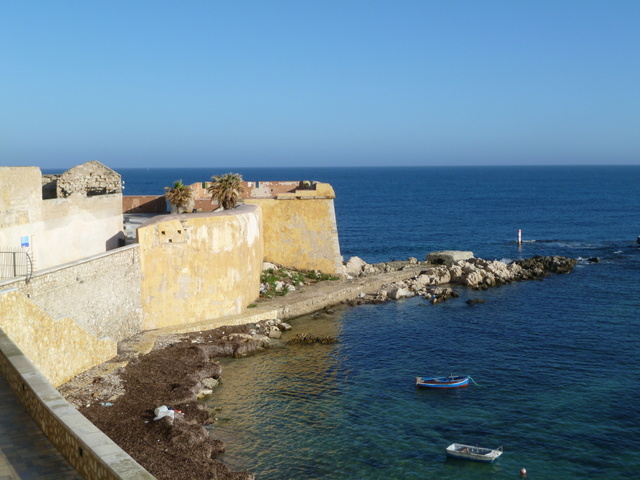
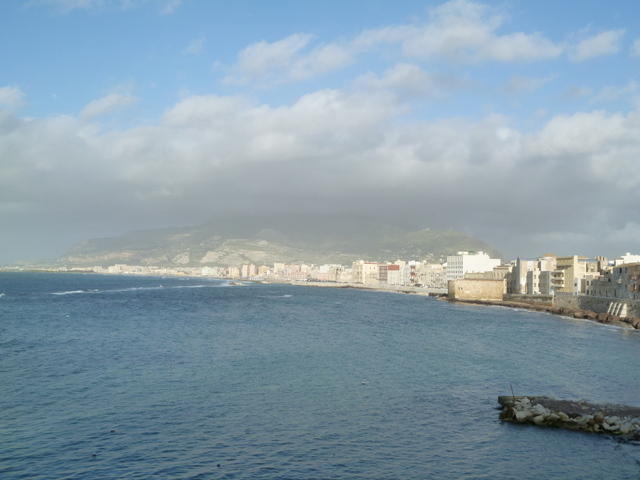
View from apartment, Trapani

City wall of Trapani, as viewed from the terrace of our apartment.

When I said we were going to Sicilia, Italian friends sighed, American colleagues raved, and my dear friend Nicholas whined that he could not be there too.  Thanks to all, I received some great advice on things to do and places to see. Sicilia is beautiful, to say the least, the people are friendly to a fault, and the food is divine.

We took our first flight since arriving in Italy last May. It seemed strange to fly out of Rome instead of taking a train and we were pleased to discover we had not forgotten how to drive, as neither of us had done so for 10 months.

We are staying in the small city of Tràpani in Northwest Sicily. Rather than try to “do” the whole island in one trip, we selected a corner of the region to explore. If we like it – and we do so far – we have plenty of opportunity to return and explore more of this vast and interesting island. With an ocean-front apartment reached via 60 steps (no elevator) we are living local. Luckily we didn’t have to haul our suitcases, although each only weighs 20 pounds or so, because the building has a rope and pulley system to assist in baggage handling. [NB: two-and-half years ago

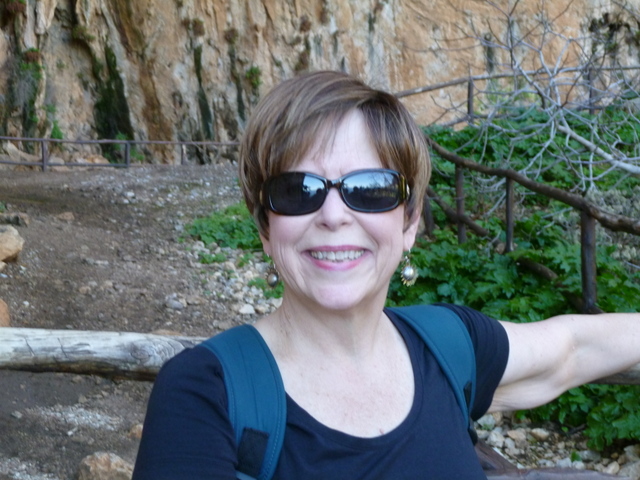
Laurel in Lo Zingaro

Stopping by the grotto in Lo ZIngaro. People lived here as long as 10,000 yeasr ago.

we stayed in Vernazza in an apartment that had a climb of 57 steps. We struggled with that climb to the point that we really thought about it before we went up or down to minimize the number of trips per day. Now we are both in far better shape with weight loss (both of us), “new legs” and a gym program for me, 6-7km per day walking, and daily jaunts up the 64 steps to our apartment in Roma. The 60 steps in Tràpani are a piece of cake!]


I wanted to stay in Erice, a medieval town about 2400 feet abve Trapani, but Francesco, Rick and Jane were right to advise against it as a base. It has been encased in clouds for 3 days now. It’s much better here at sea level.

Erice in Clouds

Erice is atop the hill hidden in a mass of clouds.

Our arrival day devolved into a miserable rain and chill, warded off by an amazing dinner involving the best caponata we’d ever eaten, fresh fish, and a couscous preparation like none I’ve ever had, served with a whole roasted fish and a tureen of fish broth. With a crisp local white wine, we were satiated and slept a full 8 hours for a change! 

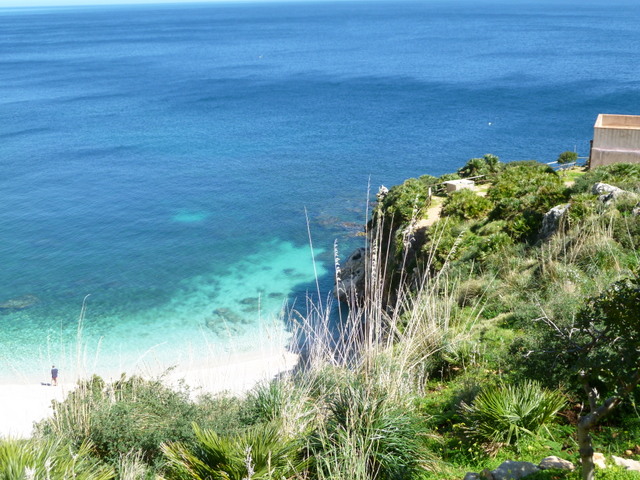
Lo Zingaro

Crystal clear waters far below the trail in Lo Zingaro.

Fortunately Sunday dawned bright and clear, so we headed to La Riserva Naturale dello Zingaro for a hike. What a beautiful and unusual place! It’s a little bit like parts of Hawaii with stark and interesting beauty, unusual plants, and ever-so-quiet. The water is clear with many shades of blue and turquoise contrasting with the lush green of a spring-rain freshened landscape.  I have not been anywhere quite this quiet (only the sounds of birds and the wind) for many many years. We felt far removed from our bustling Roma, which was the point of this vacation. Lizards darted across our path, and the wild flowers opened almost before our eyes

Lizard in sun

Little lizards dart along the trail enjoying the sun. So did we.

as the sun warmed the day. A half-hour or so into the hike, we encountered a small museum dedicated to the contadini (farmers) where an amicable man told us about the activities and dwellings of a typical farm family. We were his first visitors this day so he was ready to chat. My Italian understanding is really coming along, thank God, and we had a decent conversation. There is a grotto along the trail where they have determined people have lived for some 10,000 years. Amazing to consider how ancient this land is. Also, I got some sun as ordered by my doctor who thinks I need more vitamin D.

The hike was a good workout so we indulged in a fine Sunday lunch of fresh fish, fresh pasta, and an arugula salad, enjoying the antics of little children dining with Nonna e Nonno at an adjacent table.

Segesta

Greek temple at Segesta, viewed from afar.

Clouds come and go, with passing showers. The temperature is not warm enough for beach time, but excellent for exploring, so Monday we headed to Segesta, where we saw our first-ever Greek ruins. This is a marvelous time of year to visit without crowds or the dizzying heat of summer. We found ourselves alone beside the magnificent temple, in the ancient arena, and along quiet paths. The temple is huge and well-preserved. One can walk completely around it for an excellent perspective on the architecture. Built in the 5th century, B.C., it has survived at least three earthquakes, and has withstood the ravages of man for so many centuries, but the courthouse in Salem, OR, barely lasted a decade due to poor construction.

After an up-close encounter with the temple, we ascended the hill opposite (305 meters above sea level) where the city used to be, to the location of an ancient arena. There we found gorgeous views back to the temple across fields of wild-flowers in bloom.

Luckily, as this is Italy, one can get a fine espresso freshly pulled by the barista, and

Ric at Segesta

My favorite travel companion in the ancient arena at Segesta.

a freshly made pastry even at an archeological site. Try that at Silver Creek Falls or the Mount St. Helens.Stay-tuned. More to come….

Winter Break: Venice

8 Dec
Embrace winter weather and fewer crowds in Venice.

Embrace winter weather and fewer crowds in Venice.

Going north in the winter or late fall may seem counter-intuitive, unless you are heading for i dolomiti and some skiing. However, for our third trip to Venice – we never tire of her – we chose early December, knowing it would be un-crowded if cool. If you are from a cold climate (I grew up in Minnesota), 7-10⁰ C isn’t all that bad, especially if the sun is out. So we packed some layers and explored Venice in winter once again. Usually we take Trenitalia, but shopping around I found better fares with the new ItaloTreno. These sleek red trains now serve Rome to Venice via Florence, Bologna and Padua, in about 3 1/2 hours. So new and shiny with clean bathrooms and functioning WIFI, they are also incredibly quiet. The Italian State train system, Trenitalia, needs to take note and up its game.

The Grand Canal Apartment, our home in Venice.

The Grand Canal Apartment, our home in Venice.

We like to rent an apartment so there’s a little space to spread out, a refrig-erator, a place to make our morning caffè. Our choice is a one-bedroom apartment in Sestiere San Polo, only a 5 minute walk from the Rialto Bridge and mercato.  Fabbio and Monica offer a cute apartment in a quiet neighborhood where one quickly feels more like a local than a tourist.One of the fun things about returning to a place you’ve been before is re-visiting favorite spots while still discovering new ones. Everyone goes to Piazza San Marco, the Basilica, and the bell tower, the Doge’s Palace, and perhaps the Accademia. People have asked me time and again, how we can spend so much time there. What more can we do in Venice? There’s always something we haven’t seen.

Things to do in Venice when it’s raining

  • Visit the Peggy Guggenheim Collection. In our two prior visits, we had near-perfect weather and eschewed some of the standard art museums in favor of outdoor-oriented activities. On this arrival day it was raining, the perfect excuse for a visit to the renowned Peggy Guggenheim Collection. We were amazed at the accessibility of the art (Picasso, Calder, Mondrian, Modigliani, Pollock) and the lovely palazzo that houses it quite intimately.
  • Walk with the Dinosaurs. We treated ourselves to the Museo di Storia Naturale, (Museum of Natural History),
    Venice's only dinosaur. Picture courtesy of www.msn.ve.it

    Venice’s only dinosaur. Picture courtesy of http://www.msn.ve.it

    housing Venice’s only dinosaur.  This is a wonderfully well-done and captivating museum! I would put it on par with the Smithsonian’s National Museum of Natural History in Washington, D.C., in terms of quality. There was a 10 year restoration project that just ended in 2010, so the exhibits are well-lighted, well-signed, and interesting. One warning, though, little is in English. But since so much scientific language is Latin-based, with a smattering of Italian you can work through much of the information. We practically had the place to ourselves, marveling at an incredible fossil collection, the dinosaur, a fin whale skeleton, and more. There is a rather alarming room of preserved (through taxidermy) animals from the era of Big Game Hunters, which made me sad. But today’s emphasis is clearly on housing the collection and education, not condoning this practice. Children will love this museum, so when you ask yourself what to do with children in Venice, this should be at the top of the list. A great place to escape heat in summer or inclement winter temps.

  • See the Basilica illuminated. We visit the Basilica of San Marco every trip, but usually in the mid-to-late afternoon when the crowds thin. This trip we timed our arrival for the midday illumination. From 11:30-12:30 each day, the church is lighted, bringing the magnificent Byzantine mosaics out of the shadows to all of their glittering glory, which is particularly impressive on a dark day with little available natural light. This is now on my do-not-miss list. (Note to self: Time visit for illumination.) On a December Tuesday the crowds were non-existent and we were enthralled at seeing this museum-piece being used for a simple daily mass in one of the chapels. Nice to know that a church can still be a church. Another great reason to visit in winter.
  • See art in situ at Chiesa Dei Frari or the adjacent Scuola di Grande San Rocco. Dei Frari is one of our favorite churches anywhere for the in situ art, but this trip we opted to visit the adjacent scuola with its amazing Tintoretto paintings.  We were totally alone in the scuola for most of an hour. Incredibile!
  • Other ideas: Explore Venice’s seafaring past at the Museo Storico Navale, offering a peek into Venice as a Mediterranean superpower, trader, ship builder; See the world famous Galleria dell’Accademia (next trip for us). There are also the Correr Museum, Ca’Rezzonico, La Salute Church, the Doge’s Palace. The list goes on.

When the sun shines

  • Take a Lagoon Tour. A bright clear day dictates a lagoon tour for us. We walked from our apartment to Piazza San
    Handcrafted on Murano.

    Handcrafted on Murano.

    Marco so we could justify a delicious breakfast pastry at Pasticceria Rosa Salva, a Venetian institution (Two caffè doppi, two incredible cornetti with almonds, €6.20).  Then we took to the waves and headed to the islands of Murano, Burano and Torcello. The snow-covered mountains loomed in the distance as we made our way across the lagoon.  Murano was just coming alive when we arrived at 10:00.  We have a favorite glass shop on Murano where I like to buy a few pieces of jewelry, Vetreria Venier Giorgio Bruno. To find it, head over the Ponte Longo and turn left, away from the main drag, where you will find Giorgio and Michela Bruno and their little dog Cindy, who likes to hug.
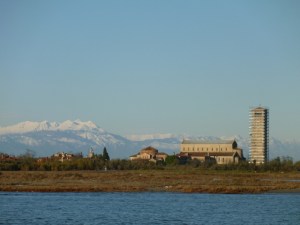
View of Torcello Island and the distant snow-covered mountains. Bellissima!

View of Torcello Island and the distant snow-covered mountains. Bellissima!

From Murano, we headed to Torcello, birthplace of Venice nearly 1500 years ago. The Basilica of Santa Maria Assunta, was first built in 639, and is the object of the visit. Torcello is virtually deserted these days, and on a sunny December day, one can meander along the paved brick path, past tiny houses built for the island’s feral cats (some for humans, too, but not many), to the central piazza and basilica complex, and enjoy a crowd-free experience that seems a million miles from Piazza San Marco. Contemplating the mosaics in the basilica, which date from the 11th & 12th centuries, I can’t help but be amazed, especially out here in what was eventually abandoned as a malaria-infested swamp.

While there are a couple of dining options on Torcello, we headed to Burano, famous for lace and for the beautifully colored houses.  We find Burano enchanting, except for the “barkers” in front of the restaurants on the main piazza. Avoiding these, we chose Ristorante al Vecio Pipa, where the owner oversees everything personally and does not resort to waving people in. He doesn’t have to. We had a decidedly unhealthy but delicious lunch of fried seafood (fritto misto di pesce) and grilled polenta. Unlike in the U.S., there is a light hand with the batter, if you can even call it that, and there are no French fries, thank God. Luckily we walked for hours that day.

The colorful houses of Burano, relfected in a canal.  Everyone has a boat.

The colorful houses of Burano, reflected in a canal. Everyone has a boat.

  • Take a walk. Venice herself is the object of our enchantment. We don’t really need much of an itinerary when the sun shines. We like to discover new-to-us areas of the city and get away from the day trippers, so this trip we took this jaunt. The “Zattere to Piazzale Roma” walk is probably not for a first visit to Venice; it’s more of a second-time-around itinerary, but it is interesting to see some of the neighborhoods where there is more living than touring, and far more Italian spoken than English.  Luckily along this route are several favorites of ours: A gondola repair/construction site, Campo S. Margherita, Pasticceria Tonolo, Chiesa dei Frari, and Scuola di Grande San Rocco. At Tonolo, where the espresso is bold and smooth, divine tiny pastries are only €1.00.
Me consulting the map. Crisp, clear day on the Venetian Lagoon. This view is from Santa Elena, back toward Venice.

Me consulting the map. Crisp, clear day on the Venetian Lagoon. This view is from Santa Elena, back toward Venice.

We like to walk and escape the crowds at Santa Elena and take the vaporetto back with the locals and their dogs. We also take a pre-dinner passeggiata (stroll) along the Strada Nova, one of the straightest streets in Venice. Here there are many places to grab a quick aperitivo, or pick up coffee for morning while enjoying a less-touristy neighborhood. We like to grab a glass of wine and a polpetto (meatball) at Osteria Ca’D’Oro (see below).

We have also used the book “24 Great Walks of Venice” as a guide. I highly recommended it as a way to work off the meals while guiding one’s sightseeing. (Can you tell our trips are meals strung together by miles of walking?) One afternoon, still not worn out completely by the morning’s activities, we hiked over to the Ghetto Nuovo. Venice is where the word “ghetto” first came to mean a Jewish segregated neighborhood. (Originally geto, the word for foundry, the area where Venice’s Jews were isolated in the 1500s.) Again, maybe not the place you go if you are on a two-day time-boxed tour, but when you have time, when you return, when you crave seeing where Venetians live, work and go to school…. You can continue from here through Sestiere Cannareggio and the northern reaches of Venice.
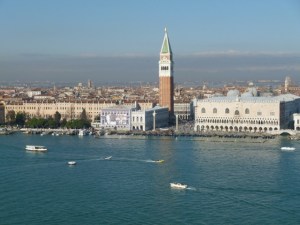
5 minutes from San Marco on a vaporetto, ascend the bell tower at San Giorgio Maggiore and take in this view.

5 minutes from San Marco on a vaporetto, ascend the bell tower at San Giorgio Maggiore and take in this view.

  •  Ascend a bell tower. Many people choose the campanile in Piazza San Marco. We prefer the tower at San Giorgio Maggiore, just across the basin from San Marco. Here is yet another magnificent church: designed by Palladio, with paintings by Tintoretto, capped by a tower that offers a spectacular view of the lagoon. It’s like a 3-D Venice geography lesson to go up in the tower on a clear day, and a 5 minute vaporetto ride from San Marco.

Eating in Venice

When one thinks of dining in Venice, euro signs flash before your eyes. It can be expensive, but there are places the Venetians dine – real people do live here – and these local places are easier on the budget. In “our” neighborhood, we always dine one night at the convivial and unpretentious Pizzeria NoNo Risorto.  Venice is more traditionally fish than pizza, but NoNo does some creative pies, and with i ragazzi (the guys) hanging out, the atmosphere was lively. Ric chose an extraordinary pizza frutti di mare, which was a crust with sauce, no cheese, piled high with baked seafood, some still in their shells: clams, mussels, shrimp and calamari.  The seafood was delicious, baked right on the pizza, but it left him with what amounted to tomato sauce on bread as a base. My choice was the “Maurwulf,” with salami piccante and gorgonzola. I gave Ric a share, but my goodness, it was difficult to part with those pieces. Yum! House wine is a bargain, a good way to save some euros.

We have enjoyed La Zucca in the past, and returned there again for dinner. For me, the return was driven by a taste-memory of their fantastic flan di zucca (pumpkin flan). It is creamy and rich served with ricotta stagionata and toasted pumpkin seeds. Good to share as an antipasto.  The strength here is in the vegetarian dishes, especially the vast selection of creative contorni. I had broccolo romano con uvetta e pinoli.  It was a little “zippy” with some pepperoncini, balanced by the sweet raisins and tender romanesco. The entrees are not classic Italian, IMHO, but more influenced by French and Indian cuisine: roast pork with a dijon sauce, chicken tandoori with lentils, both served with rice, unusual in Italy.  But the food is absolutely delicious and reservations are recommended at least two days in advance because it is a very tiny venue (35 seats).

This is "our" neighborhood in Venice. A greengrocer and a few pubs & cafes make it convenient with a residential feel.

This is “our” neighborhood in Venice. A greengrocer and a few pubs & cafes make it convenient with a residential feel.

We get tired of having to make restaurant choices every now and then on a trip. (And God knows I am not cooking more than espresso!)  In Venice one can take advantage of the pub crawl and join the locals for their cicchetti, sampling several places along the way. We like to start with a spritz (con aperol, for me) at Caffè al Ponte del Lovo. It’s a bright and lively coffee house in the center, close to the Goldoni Theatre. We’ve seen superb-looking hot chocolate here, too, but always opt for a spritz during the passaggiata. Of course a cocktail is served with some light snacks, just enough to carry us to the next stop, Osteria Ca’ D’Oro. Here a plate of cicchetti might involve their famous polpette (meatballs), insalata al polpo (tender octopus salad), tiny swordfish steaks, or the most succulent grilled calamari you have ever tasted. There are vegetarian options, too. Washed down with tiny glasses of house wine at the bar, it will cost less than a couple of panini.  Other classic places for cicchetti are right in “our” neighborhood, too: Cantina do’ Mori, Osteria Bancogiro, and Cantina do’ Spade. For a bit of a splurge, we went to Trattoria di Remigio on the recommendation of i signori Bruno (the Muranesi glass artist). We walked in without a reservation at 19:45, and by 20:15 the place was full and they were turning away walk-ins. This in stark contrast to a vast array of more tourist-path places we passed with few-to-no customers. Fresh seafood is the specialty, featuring Venetian dishes such as sarde in saor, as well as steamed mussels, branzino, and much much more. This is not a softly lighted romantic spot, but rather a bistro-type establishment with good food, well-prepared, where service is efficient as the owners bustle about ensuring everyone is cared for. We will return to this new-to-us spot, only a few minutes’ walk from San Marco.
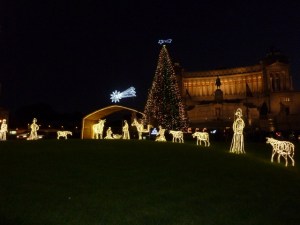
Lights in Piazza Venezia, Roma, 2011.

Lights in Piazza Venezia, Roma, 2011.

So now we are back in Rome for the holiday season. The Immaculate Conception (Immacolata Concezione) is celebrated on December 8, serving much as Thanksgiving does in the U.S. to define the start of the holiday season, which runs through Epiphany on January 6. Returning to Rome we see Christmas light displays and nativity scenes (presepi) popping up everywhere. Last year we were tourists in Rome for Christmas. This year we are residents. What an amazing year! Still having “pinch me” moments!