

Fellow blogger John Henderson has done a wonderful job describing this year’s Christmas scene in Roma. Ric and I did not get to tour lights a lot before leaving for Paris and London, so I wanted to share his impressions and lovely photos. I was pleased to see that Via del Corso did indeed get decked out.
Archive | Uncategorized RSS feed for this section


Guns and The Top of Europe
30 Sep30 September 2015.
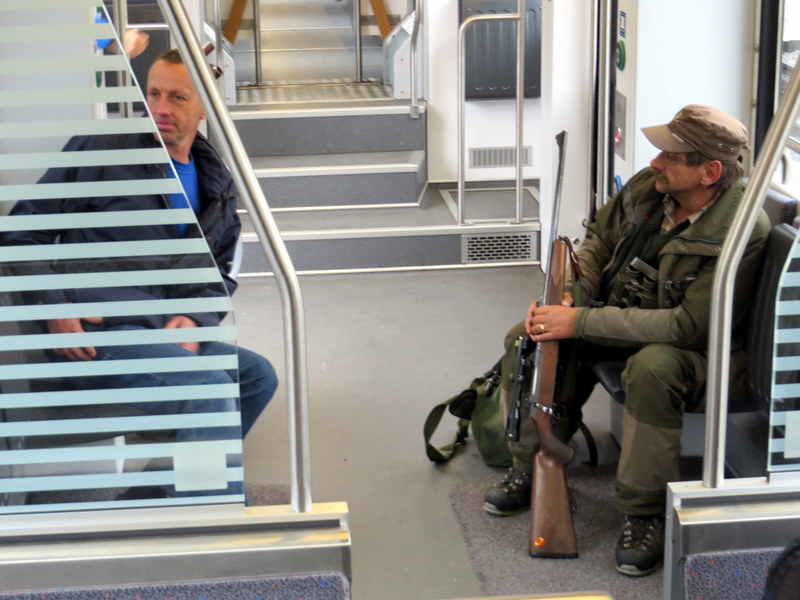
A man gets on the train carrying a gun. What would you do? If I was in France, Spain, Great Britain or the USA, I would dive for cover. But we are in Switzerland, in the Bernese Oberland to be precise, and apparently, no one bats an eye. Neither did we since he walked in accompanied by another local, and even women pushing babies in strollers were undisturbed by the sight. I am not going to pretend I understand the Swiss mindset or even the laws around firearms. This article from Time magazine on the subject is pretty interesting. I am not sure I am more concerned about the fact he was hunting in an area where people hike or carrying a weapon in public.
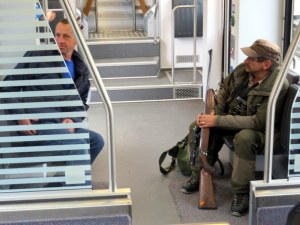
- When we saw this guy get on we got the giggles. Can you imagine if this happened on MAX in Portland? This was on the Wengeralp narrow-gauge cog railway.
Switzerland seems to have its act together. The Swiss have managed to remain neutral in world politics, insulated from European Union issues as they are non-EU, but they take advantage of the Schengen Agreement and the abolishment of internal borders. Still, immigration is highly controlled. They have an admirable environmental record, plenty of water resources, clean air, excellent recycling, a thriving economy with low unemployment. Their public debt is less than 35% of GDP (compared to Italy at 134% and the USA at about 71%). And of course there’s the cheese. High prices do not seem to deter tourists, especially the Japanese who are here in droves and show no reluctance to shell out hundreds of Swiss Francs to see the sights and buy winter fashions. You would not believe the price of a Patagonia jacket here.
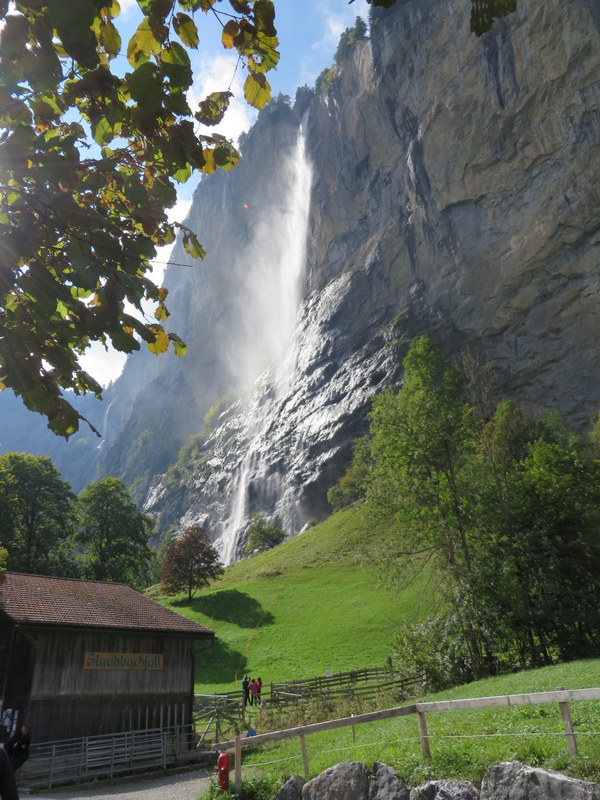
- Staubbach Falls, visible from our vacation rental.
This is our third trip to Switzerland in less than 2 years. Yes, we like it. The food is not as good as Italy, and the coffee almost all comes from a ubiquitous push-button machine found in virtually every café and restaurant. It’s CHF 4.00 for a basic cup of coffee or a single shot of espresso. In fact, everything is quite expensive. While the exchange rate is almost on par with the U.S. dollar, the actual prices are high. A pizza that would cost us about $11.00-12.00 in Italy is about $23.00 here. A small green salad runs $8.50. Wine by the bottle is insanely expensive in restaurants, but one can get a small glass of good local wine for a price less than we experienced in Seattle, Portland, and San Francisco. Why do we come back if it costs so much? The transportation system, the hiking, the natural beauty: Switzerland offers a lot of what we like to do when traveling. And it works, well, like a clock.

- A Jungfraujoch train moves up the mountain. Most of the journey is in a tunnel inside the Eiger and the Mönch.

I have wanted to go to the Jungfraujoch since Matt Lauer went there in 2011 during his annual “Where in the World is Matt Lauer” tour. During our first two Swiss trips in January 2014 and August 2014, we dismissed the trip to the Jungfraujoch as too expensive. It costs CHF 204.40 per person from Lauterbrunnen in the valley to the Jungfraujoch and back. We learned that with certain types of passes one could pay less, so we vowed “the next time” we would make the trip. This is the next time, so we bought both half-fare Swiss passes and a Bernese Oberland Regional Pass. We had to pay a relatively small supplement to go all the way to the Top of Europe (called so because it is the highest train station in Europe). It was worth it!
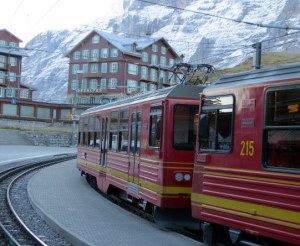
- Jungfraujoch Railroad – our train ready to depart.

Rising at 5:00 AM, we caught the first train up the mountain, in total about 1 hour 45 minutes from the bottom of the valley to the Jungfraujoch, arriving just before 9:00 AM. Some of the “tour” is goofy. The giant snowglobe in the Alpine Sensation was unrefined, and the Ice Palace sculptures were not nearly as nice as those at the Saint Paul Winter Carnival of my youth, but the pure beauty of the pristine mountain was the star, and contemplating the building of such a railroad in the 1890s sobering. Thanks to 100 Italian laborers, the tunnel was built.
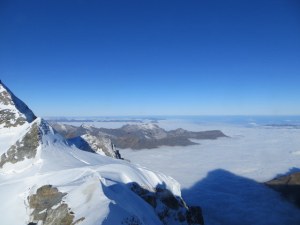
- View from the Top of Europe over the cloud-covered valley. It was very cold outside!
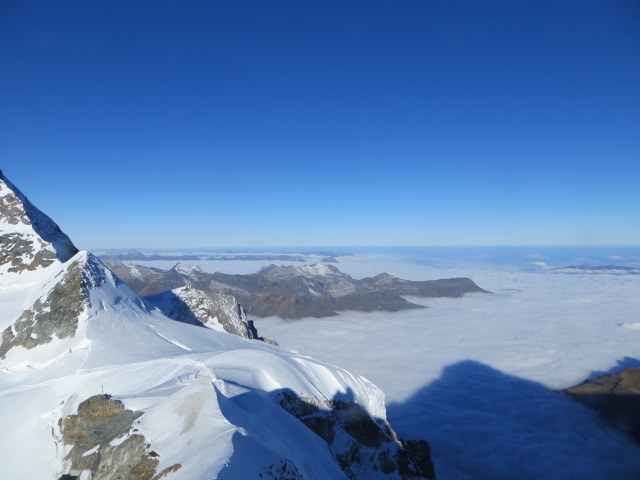
We went outside on the observation platform, but the 33 kph winds combined with the -1.5 Celsius temp reminded us a bit too much of our Minnesota and North Dakota heritage. We lasted long enough to take a few photos. Going on the sledding course was out of the question, as was the glacier walk of 1 1/2 hours roundtrip.
We were at 11,333 feet above sea level. That is lower than the elevation we hiked to in Colorado last month, but a completely different climate. In Colorado, we peeled off layers. Here, I wished I’d had my puffy coat.

- Railway Station at the Top of Europe, inside the mountain.

This was an unforgettable trip and we are glad we did it. Going early was a great strategy, at least with the weather forecast we had. We would be unlikely to go twice, so it truly was a once-in-a-lifetime experience.

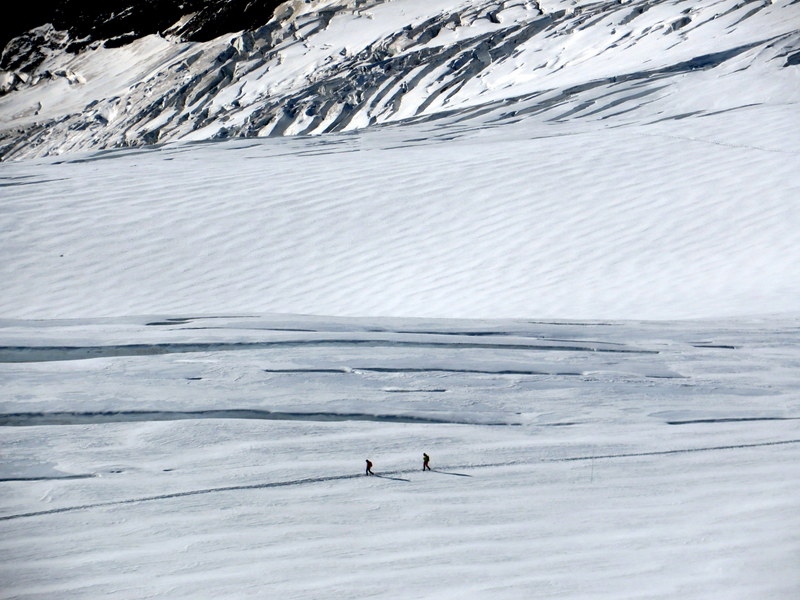
- People walking on the glacier beneath the Jungfraujoch.

- The Eiger pokes above low level clouds as we depart Kleine Scheidegg after our visit on high.
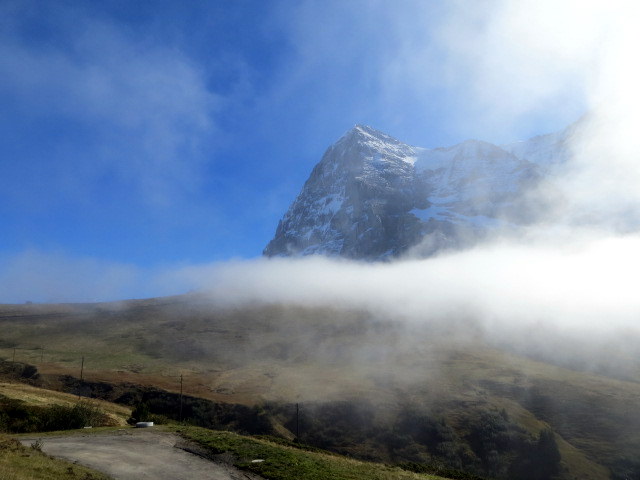

- CHF 30,300 watch available at the highest watch shop in Europe.


- View of the Lauterbrunnen Valley. Our apartment is just a bit to the left of the church.

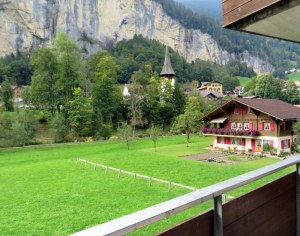
- View from our apartment. We can also see Staubbach Falls from our terrace.

Escape to Emilia-Romagna
8 JunThe heat built fast in Roma. Ten days prior we were putting on our fleece jackets in the morning because it was cold in the apartment, but by the time my brother and sister-in-law arrived June 1, that was no longer a problem: it was getting warm. Luckily for us – if not for our cat sitters – we were leaving Roma. We also left behind the tourist hoards.
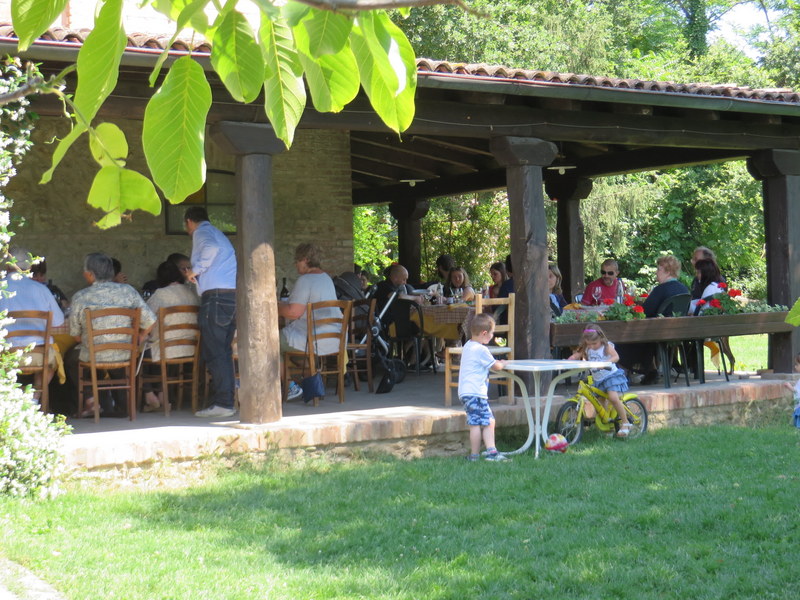
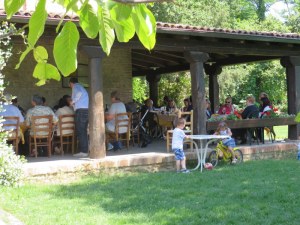
Lunch on the veranda at Corte d’Aibo is a family affair.
Heading to Emilia-Romagna on June 2 (the Festival of the Republic which celebrates the election in 1946 when the monarchy was rejected in favor of a republic), we left behind the Roma tourists only to find throngs of Italians. At least they were at lunch when we arrived at Agriturismo Corte d’Aibo. But that was the holiday and the last day of the Italian four-day weekend. Continuing on to our mountain destination of Montese, we found ourselves the only tourists at the very pleasant Hotel Belvedere .

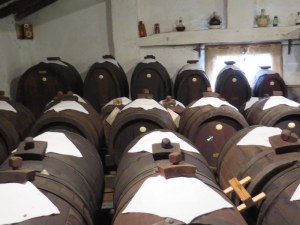
This is not your average balsamico. This is Aceto Balsamico Tradizionale di Modena, another thing entirely.
I found Hotel Belvedere and Corte d’Aibo thanks to Riccardo of Trekking Emilia-Romagna. Somehow my SIL Jane and I hit on going to E-R and hiking, and I was fortunate to stumble upon Riccardo’s company. He put together a great itinerary for us including a tasting and tour at an acetaio called Ca’ dal Non, lunch at the agriturismo, and a guided hike through the mountains, which saw significant action in World War II. The arrangements also included our hotel, breakfasts and dinners. All we had to do was show up and sweat a little on the hike.
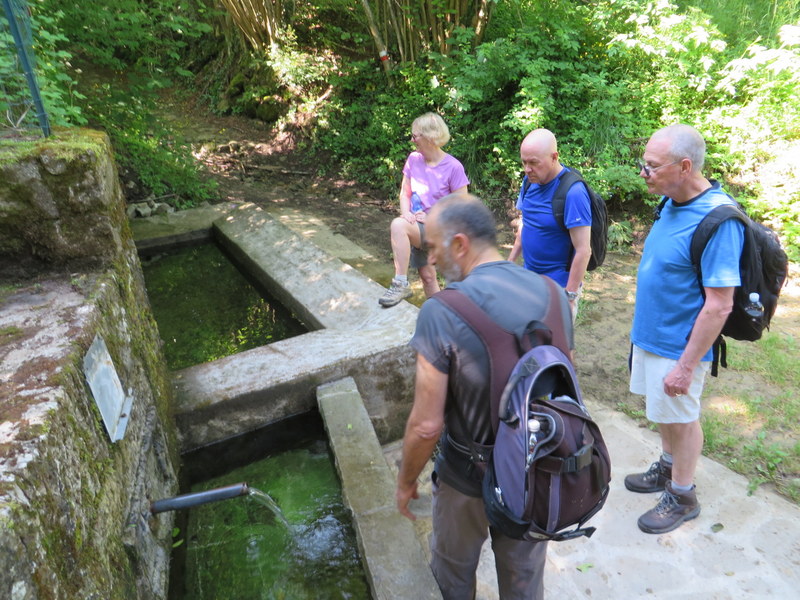
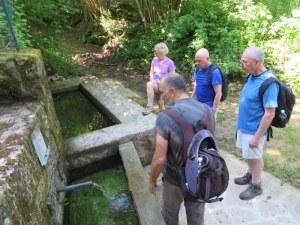
Stefano, foreground, explains a fountain in the mountains to Jane, Rick and Ric. Multiple basins allowed people to use one for drinking water, the next for washing, and a final one for watering livestock.
During our hike, we learned about the flora, fauna and history of the area. The Gothic Line was here, a place where Germany was making a last stance in the north of Italy as the Allied Armies, having fought their way north through the boot, bombed the heck out of them, and unfortunately, also bombed the Italian villages.
We met an older man – he said he was 80 – who upon learning we were Americans said, “The Germans went away, the Americans left, and now there are no porcini.” He was jesting, but memories are long: although we “liberated” the area, the old growth forest was destroyed by both the German occupiers and the liberating armies, so the treasured porcini no longer grow there. We chatted in Italian for a while and when we commented on his good health and energy (after all he was taking the same long hike that was wearing out us 60-somethings) he said “They gave me an organ donor card and I told them ‘take anything you want; none of it works anyway!’”
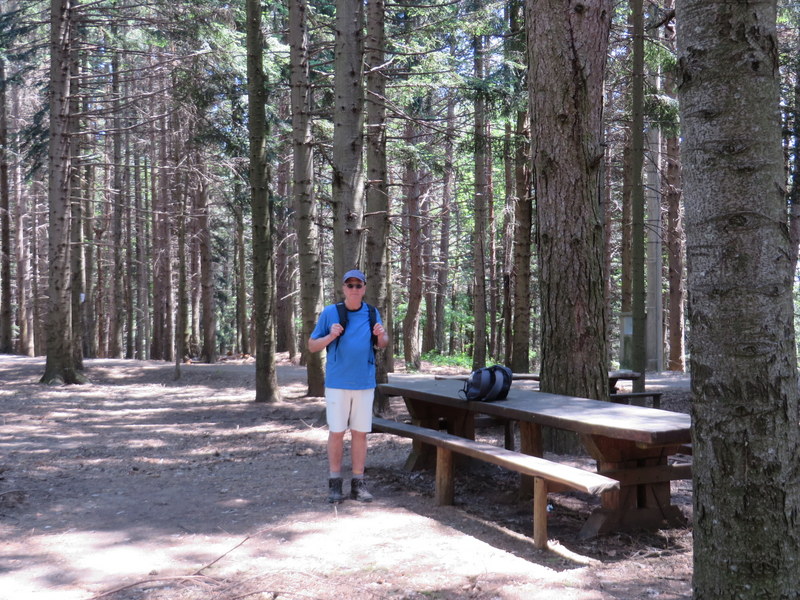
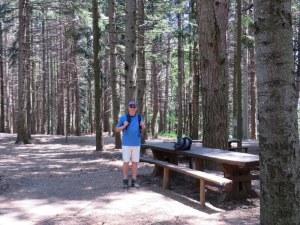
Ric in our woodsy picnic spot, an area frequented by families on Sundays. This one surrounded a church that commemorated the civilians killed in the area.
Stefano, our guide, was a font of information and knew the area well, having grown up nearby in the famous cherry town of Vignola. He speaks excellent English having lived in the U.S. (He loves Seattle!) We lugged along Parmegiano-Reggiano, salume, bread, and fruit for a picnic, along with local Lambrusco and a homemade crostata, all supplied by the hotel. At the end of the trek, my pedometer wrongly said the hike was about 8 km, Stefano said 11, my brother estimated 12. It felt like 18.
We were then treated to a tour of a caseificio or cheese factory at Dal Contadino. This was a multi-generational farm operation producing the famous parmigiano-reggiano as well as ricotta, marmalade, and more. It was fun to visit a typical small family operation and see the incredible labor that goes into making this cheese. The artigianale beers they served with the cheese really hit the spot after hiking. If you ever get a chance to drink White Dog Beer, do it.
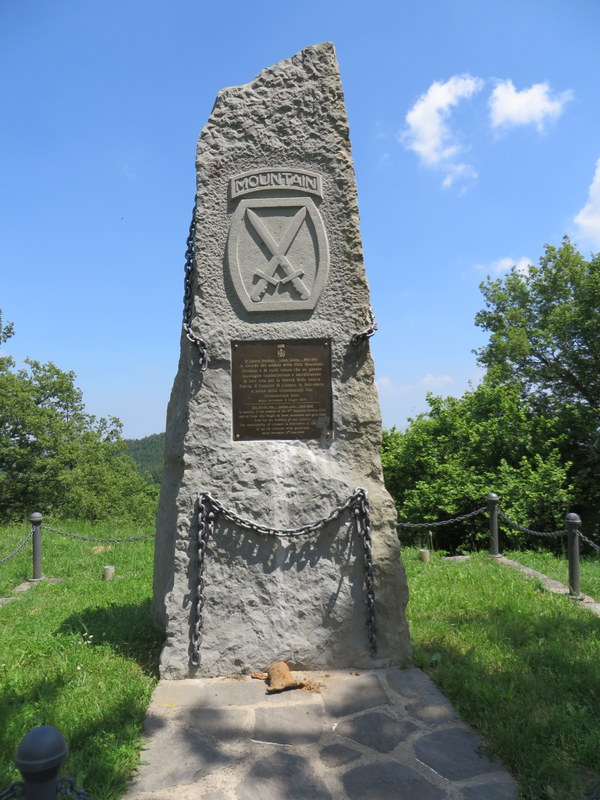
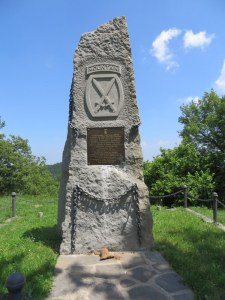
At the top of Mount Belvedere there is a monument honoring the 10th Mountain Division.
I have to say that, whatever the length, the trek barely dented the calories we were consuming. The kind owners of Hotel Belvedere looked after us well. Clean, comfortable rooms with good showers, incredible food from classic pastas for primi to roasted rabbit, pork and steak for secondi. They were also experts in recommending local wines to complement their food and served some of the best grappa around. Compare this with an American town of 3400 people where your choice of wine with dinner might be beer.

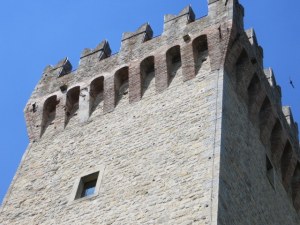
Montese has a castle dating back to the 13th century.
This was not high tourist season. In fact, it seems only August gets pretty busy. Otherwise Montese is off the radar of folks headed to more famous destinations. Nearby one can visit the Ferrari Museum in Maranello, the town of Modena, and even Parma is within reach.
After three nights we somewhat reluctantly said good-bye to Montese and the lovely folks at the hotel, as this was part one of a three-part trip. On to Lago di Garda!
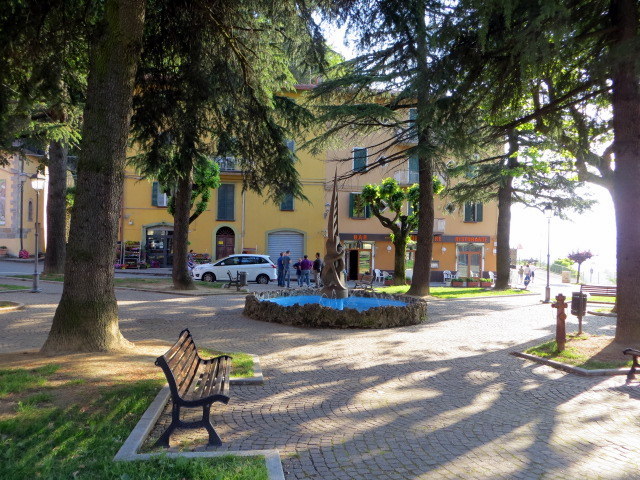
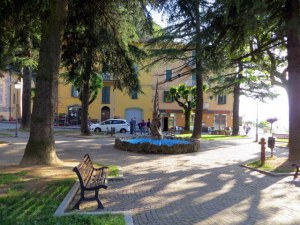
Piazza in Montese, in front of the Hotel Belvedere.

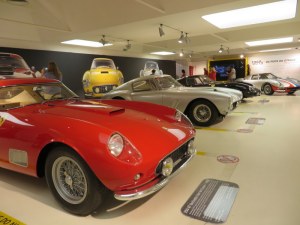
We took one day away from Montese to journey to Maranello and the Ferrari Museum. Quite a collection!
Italy’s Spaghetti Westerns
22 JunMy friend Jonnie Martin is a writer about the western culture in the U.S. She was born a Texan; has written a book about horse ranching, writes for a local newspaper; and blogs about Texas in particular and the West in general, including posts on books, music and movies. She had this to share about Italy’s famed Spaghetti Westerns — Laurel
There is something about being born in Texas that demands that we love all things western, including movies. The first Hollywood films tended to idealize the strong silent cowboy (think Gary Cooper; think early John Wayne). Then in the mid-1960’s, along came the western all’italiana (which we tend to call Spaghetti Westerns). It changed everything.
 These films starred a sly, often sarcastic double-dealing Anti-Hero, and there was a great deal of violence. This new form aimed at deconstructing the traditional western Hero mythology. Despite this, the movies played to huge success in the States, at least partially due to the popularity of Clint Eastwood who starred in some of the best-known of these Italian oaters.
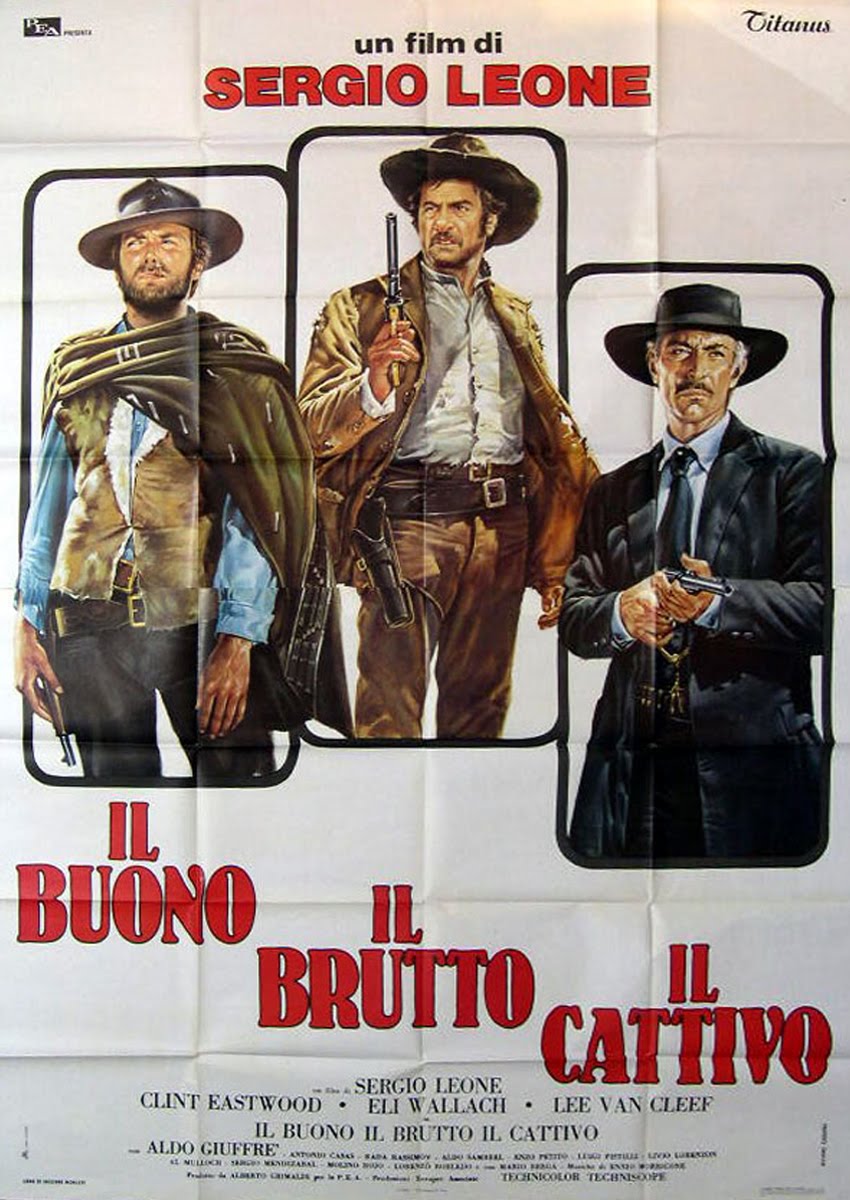
Many resources credit Italian director Sergio Leone for starting the craze (which led to over 600 European Westerns between ’60 and ’80 according to Wiki). Everything was different about this movie – the camera artistry, the music, the play on old classical themes, the titanic struggles between Good and Evil and something that fell in between.
Casts were multi-national. The Dollars Trilogy starred Clint Eastwood, who had begun his career on TV and from this series became an American movie icon. A Fistfull of Dollars, For a Few Dollars More, and The Good, the Bad and the Ugly changed the face of western movies forever.
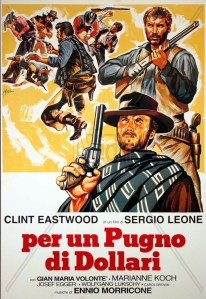 For which I for one am eternally grateful. It was after the peak of Spaghetti Westerns that today’s classics began to appear on the screen – beautiful works of art like Unforgiven, Lone Star, Brokeback Mountain, No Country for Old Men, The Assassination of Jesse James by the Coward Robert Ford. Thanks to the vision of Sergio Leone, we continue to get great works of art depicting the heart of the western experience.

It is still a mystery to me as to why our western heritage remains so persistent in the U.S. psyche. The gunfighters are long gone; cowboys and ranches have been disappearing, the land shrinking for a hundred years, and yet there is some promise of hope here that we will not relinquish.
Although a Texan, I was raised a city girl, and yet I recognize this love of the land and the people who dearly hang on to their way of life. I wrote my first novel WRANGLE about quarter horse racing in South Texas in the 1970s, inspired by my uncle’s Rio Ranch. I write about ranchers and farmers and rodeo athletes in a local newspaper. I blog each week on my website, Jonnie Westerly Notes, about our cowboy culture throughout the States.
I adore these earthy western people; their history; their determination to have a future. I think modern films are a paean to their way of live, more honestly portrayed and lovingly presented in the artistry and classical structure of modern films that had their genesis across the ocean in Italy.
Day One of Five
13 FebFacing another long holiday weekend (the last until Easter) we decided to extend it even more and take five days to explore Rome. We have done so much traveling that the list of things to see and do in Rome continues to grow and we don’t have enough daylight hours to be tourists in our own town. So begins what I like to call i cinque giorni del compleanno di Laurel (the five days of Laurel’s birthday).

Iconic EUR “Square Coliseum”, unoccupied but rumored to be destined as Fendi headquarters.
There are a lot of mega-sites in Rome: the Coliseum, the Roman Forum, Vatican Museums, Borghese Gallery, the Pantheon. The list goes on and on. And there are so many places the average tourist does not see unless she returns to Rome multiple times. We haven’t even managed to get to all of the neighborhoods yet.

The obelisk and colonnades on buildings, along with wide boulevards, reminded me of Washington, D.C.
So today we ventured south to the E.U. R., Mussolini’s site for a planned 1942 world’s fair, the Esposizione Universale Roma, which obviously didn’t happen. Today it is described as a residential and business area. We felt like we had left Rome and traveled to another realm.
The architecture is interesting if cold, distant, and rather lacking in charm. The streets are straight, which is unsettling after so long in Rome. If you took in a certain view, it felt in places a little like Washington, D.C., but not nearly as pretty. Washington, D.C., for all its issues, has beauty. Still we were happy to have seen it as the weather was glorious for the first time in weeks.

San Paolo Fuori le Mura (Ric in foreground).
After the E.U.R., we stopped by the Basilica Papale di San Paolo Fuori le Mura, or St. Paul’s Outside the Walls. This is the fourth of four papal basilicas for us, and it has taken more than 3 years to get to all of them. Way off the track for most tourists, no exceptional art such as Raphael, Caravaggio, Michelangelo, or Bernini, but with lovely mosaics and peaceful. Of course since my hometown is named for this saint, it seemed fitting to visit.

This uber-serious saint is the namesake of my home town.

Alter canopy over the tomb of St, Paul.
Lunch at Eataly, an afternoon on the couch watching a movie, and shortly dinner at my favorite fancy restaurant in Rome, QuarantaQuattro, where I know Sergio will make a fuss.

When I hovered my mouse over this doodle, my name showed up. Strano!
On another note, I was shocked to pull up Google this morning and find my birthday was a Google-Doodle. A Big-Brother moment; I assume they pulled the date from Facebook or Google+. Weird.
 Girovaga