Archive | Wine RSS feed for this section

Small town memories

6 Jul
6 July 2016. My husband loves grappa. Over our years in Italy he has come to appreciate the good stuff versus the lighter fluid they sometimes give you free after dinner in a Roman restaurant. The good stuff, by the way, is usually yellow and aged, sometimes called barrique grappa. 
In 2014, during a trip to Ortisei with family, we stopped at a gelateria with the little grandnephew and grandniece. I noticed a shelf of grappas at the back of the shop and pointed it out to Ric and nephew John.  The young man serving the gelato immediately dropped the scoop into the hands of his colleague and offered to do a tasting for Ric and John at the back of the shop. We walked out a short time later with a most expensive bottle of grappa. Oh, and the rest of us did get gelato. 
Sibona Grappa di Porto. Golden and delicious, just the right ending to a meal. It is a digestivo, after all. (That's Libby in the corner of the banquette.)

Sibona Grappa da Porto. Golden and delicious, just the right ending to a meal. It is a digestivo, after all. That’s Libby in the corner of the banquette. She didn’t drink any.

We loved this grappa! It was smooth and delicious enough to (almost) replace my craving for the occasional Scotch. It proved to be hard to find this particular grappa in Roma, so the next summer, 2015, when we passed two weeks in Ortisei, Ric asked the shop for two bottles: one to drink while visiting and one to take back to the U.S. for a friend. The young man had one bottle in stock but asked us if we would please wait while he went to fetch another. I don’t know if he went home to get it from his private stock or bought it from a competitor, but 15 or 20 minutes later, after we had consumed a gratis gelato, he returned and we sailed off with our two bottles. 
Today we stopped in and went directly to the back of the shop and grabbed a bottle. A clerk asked us if we knew what it was, then stopped mid-sentence: “You were here last year! You waited and bought two bottles!” Unbelievably, even with the thousands of people they serve gelato to in that shop, this woman and her partner (the young man from the prior encounters) remembered us. I guess two bottles is a memorable sale. 
We’ve since found a source in Roma as well as one online, but as far as we know, you cannot get this stuff in the U.S. If anyone finds it, please let us know for future needs. I don’t think we can afford to ship home a carload.

The road less traveled in Austria

23 Feb
People traveling to Europe are often dismayed to find huge crowds everywhere they go. Firenze, Venezia, and Roma, not to mention Paris, Zermatt, Vienna, and Salzburg, are popular for a reason: they are beautiful and there is a lot to see and do. Everyone has heard of them. Everyone wants to go there. We do too. We’ve been to all of these places and many more but we also try to go places that are truly off the proverbial beaten path. Torino, the Val Gardena, Abruzzo, Porto Santo Stefano, and Procida are places unaccustomed to seeing very many North Americans and we’ve enjoyed these visits as an escape from the usual suspects such as the Cinque Terre and Sorrento, though we enjoy the latter as well.
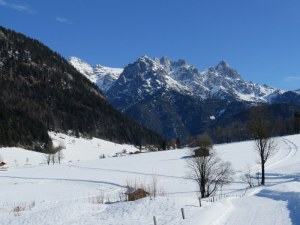
Beautiful country. The only downside is that our hiking is at lower elevations.

Beautiful country. The only downside is that our hiking is at lower elevations.

Continuing to find places new-to-us, this week we are in the Pillerseetal (Pillersee Valley)  of Austria. Specifically, we are between two tiny towns: St. Ulrich am Pillersee and St. Jakob in Haus, staying at the charming and low-key Landhotel Strasserwirt  for some winterwandern or winter hiking on groomed paths. Yeah, it’s a thing in Europe. We’ve done winterwandern in Switzerland and Ortisei as well.
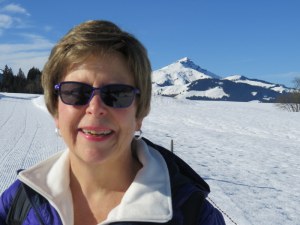
Loving the sun! Had a bit too much of the gray skies and rain in Vienna and Salzburg.

Loving the sun! Had a bit too much of the gray skies and rain in Vienna and Salzburg.

This is a destination patronized mostly by Austrians and Germans, with a smattering of other Europeans. Luckily English is widely spoken in Austria, although my college German comes flooding back at most unexpected moments. (I’m hoping it doesn’t push the Italian out.) The menus can be a little challenging to figure out, but that’s part of the fun. As long as I avoid anything with the word leber (liver) or blut (blood) I should be OK. The wines are excellent, too. We drank a lot of Grüner Veltliner in Vienna and Salzburg. Here we have turned to the Zweigelt, a generally lighter red with notes of berry and cherry, appropriate with the mountain cuisine of the hotel. As always when we leave Italy, we miss the ubiquitous bars with €1.00 espresso shots. There are no damn bars in these tiny towns so we are coffee deprived. 
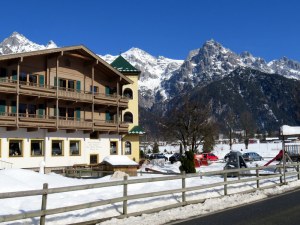
Our home for 4 nights, Landhotel Strasserwirt.

Our home for 4 nights, Landhotel Strasserwirt.

We have certainly found a quiet, no-stress, restful retreat from the city. The scenery is excellent and the prices are low. All-in-all we prefer the hiking in all seasons that the Berner Oberland of Switzerland offers. There the amazing system of lifts and trains and rifugi offering coffee and lunch along the trail are an unbeatable combo, but the prices in Austria make for a more affordable trip. Here is a place a family of four can pass a week enjoying the horses and lessons, two-meals-a-day, and mountain activities nearby for €1700.00. Can you do that in the U.S? I don’t know, but I suspect you’d have to have a car to do it, and here you can do it car-free if you like thanks to the network of trains and buses.
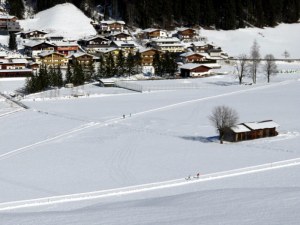
Here we are high above the valley on a hiking trail. with Nordic trails criss-crossing below us. See the tiny people?

Here we are high above the valley on a hiking trail. with Nordic trails crisscrossing below us. See the tiny people?

In the Pillerseetal there is a convergence of downhill skiing, Nordic skiing, and hiking, something for nearly everyone. The Dutch are apparently having their winter break so we see school-age kids and their parents heading to the slopes, but there are no huge crowds.
As I write this we’ve spent 2 ½ days taking hikes of various lengths in decent weather. Some would say it is too warm, and the Austrians would love to see more snow. It has begun to rain this evening and we hope to experience snowfall ourselves before we depart the day after tomorrow. It’s been a very long time since these Minnesota and North Dakota natives have seen significant accumulation.

Unexpected Croatia

23 Jun
In the end we liked Croatia and would probably return; however, we expected to like Croatia more than we did in actuality.  Is it heresy to NOT rave about a place that everyone raves about?
Don’t get me wrong: we are glad that we made the trip and we really enjoyed our extended time with Rick and Jane, but the country did not enchant me as I had thought it might. That’s the problem with expectations: sometimes things do not live up to them.
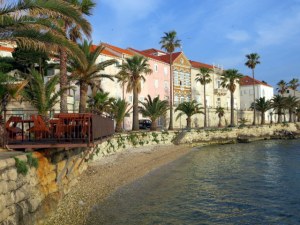
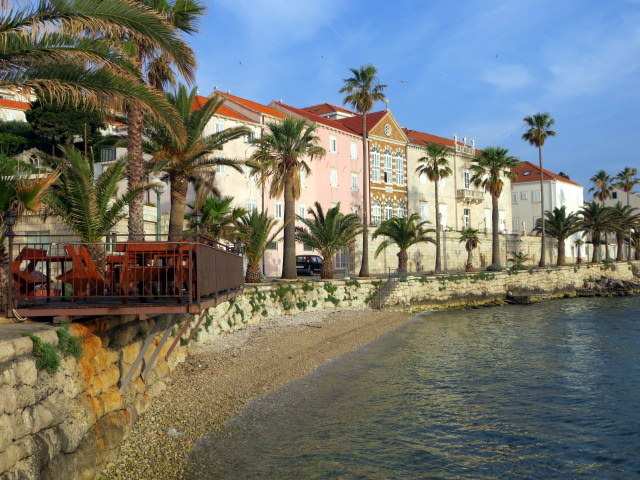
Along the Korčula waterfront in the morning, soft light, pastel colors.

Along the Korčula waterfront in the morning, soft light, pastel colors.

Everyone said we would love it, and we did like many things; the sailors in the group would perhaps like to take a coastal sailing trip and pull in to dine each night since the food and wine are so darn good.

On the plus side

  1. It is beautiful. The waters are clear and the coastline is pristine. The cities are clean and there is no litter.
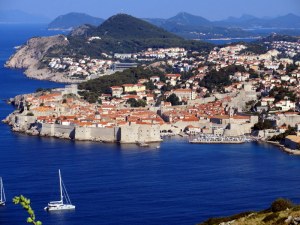
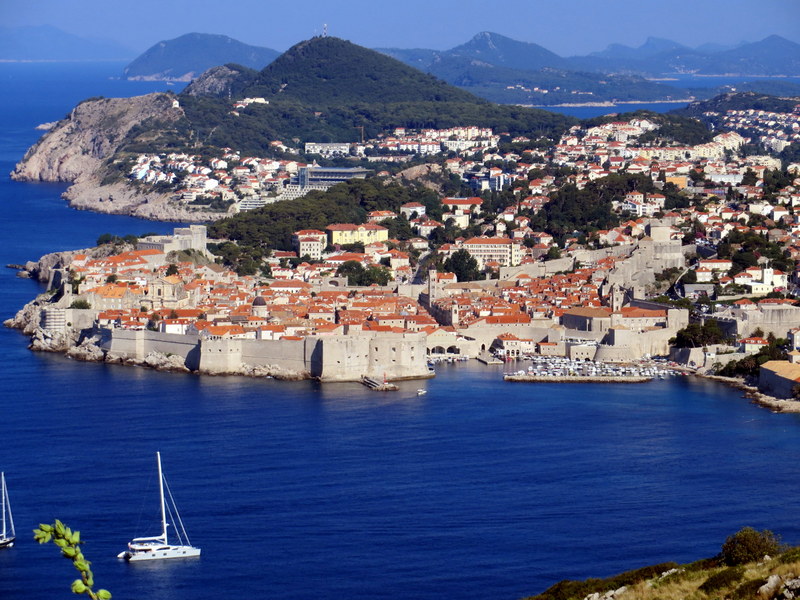
    Above Dubrovnik.

    Above Dubrovnik.

  2. The food is great. Heavily influenced by Italian and other Mediterranean cuisines, it features lots of fresh seafood and is well-prepared and healthy. There was some creativity in the cuisine we enjoyed in Dubrovnik. I expected more of a Balkan meat-and-potatoes diet but was pleasantly surprised.
  3. Dining is not expensive. One night in Dubrovnik (the new port area) we had an excellent two course meal including antipasto, main and contorni (usually sold separately in Italy) plus 2 glasses of wine each for about $68.00 for two. We’ve paid more than that for pizza, wine and fritti in Roma when the exchange rate was poor.
  4. The people are very nice and speak English fluently. While I cannot read much that is written on signs, the spoken English is clear and correct grammatically. They learn it from TV as the dubbing so prevalent in Italy and France does not exist there. Croatians grow up hearing English and reading the Croatian subtitles.
  5. Every single toilet we’ve been in has been, at a minimum, sparkling clean and often very nice. I know this seems odd, but when you have encountered the bathrooms on Trenitalia or in some Roman bars, finding a country full of clean restrooms is a pleasure.
  6. No one is selling Selfie-Sticks, roses, or flying light-up junk in the street. Hallelujah!
Ric and I took a lot of pictures…. Click on any one of these for some highlights from our time on Korčula.

On the other hand…

  1. There is a lack of efficient public transportation within the country so we had lots of windshield time. The train system is non-existent so most long haul travel is bus or ferry (or plane). It can take 4 or 5 hours to go from Dubrovnik to Split by bus, or 4 to 11 (eleven!!!) hours by ferry. Driving is 3.5 hours so that is what we did on our return. If you like to drive, it’s great. But be prepared to spend a lot of time getting from one place to another.
  2. It is dry, at least in Dalmatia. I like a more forested place, a rainforest with big, big trees. This is dry like Hawaii at Kona or parts of California. Obviously a personal preference. Beachgoers would love this climate.
  3. Cruise ships, sometimes 7-a-day in port at Dubrovnik, equal an overload of people clogging the streets. The Old Town in Dubrovnik just cannot handle the strain making…
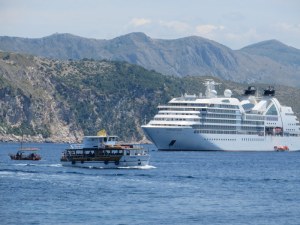
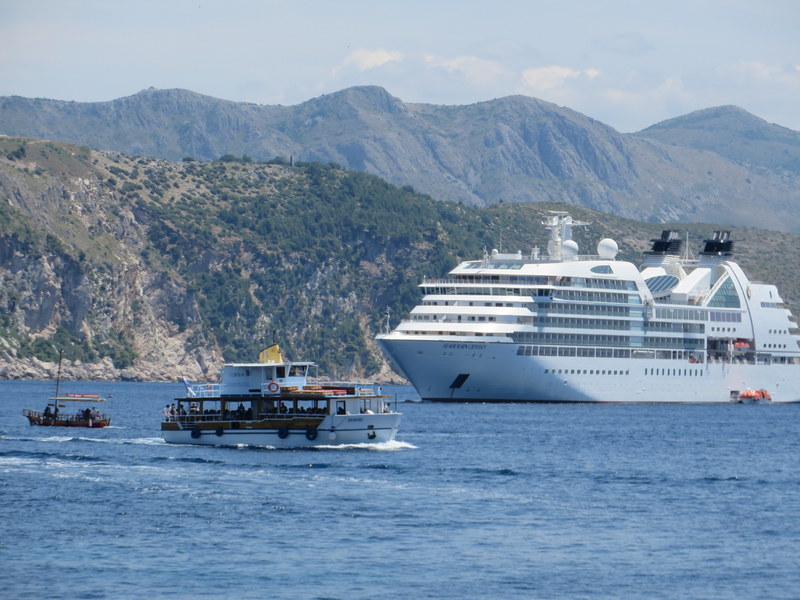
    On a typical day, cruise ships in port - both old and new - plus launches to carry passengers to-and-fro.

    On a typical day, cruise ships in port – both old and new – plus launches to carry passengers to-and-fro.

  4. …Dubrovnik Old Town a caricature of itself. “There is no there, there,” as Gertrude Stein famously said (although about Oakland, CA). Shops and restaurants overwhelm what could be a very pretty, quaint place.
  5. The hawkers in front of restaurants in Dubrovnik  are indefatigable. They thrust menus in your face in an effort to attract your business. Very desperate seeming and annoying, adding to the State Fair atmosphere as one walks down a crowded street.
  6. The lack of racial diversity was odd. Racial minorities were conspicuously absent. I conjecture that because Croatia is not yet in the Schengen Zone, the immigrants arriving in Italy, Greece and Spain are not making their way here. 
I must give the Croatian people credit for their recovery and the building of a tourism industry that provides much-needed capital to its sagging economy. Twenty years after the war, you’d hardly know the war happened except that memories are long and when one engages a Croat in conversation one hears widely varying points of view from “It was better under Tito” to “Thank God the Communists are gone!” But it is difficult to get a feel for Croatian culture when you are so surrounded by TOURISM.
Also kudos to Croatia for good roads, overall. We were impressed by the autostrada, which although of limited presence was well-engineered and the tolls were cheap. Be prepared, though, for sticker shock of a different nature: prices look high but are actually moderate. The Croatian Kuna is about $.15. Yes, fifteen cents to the kuna (hrk). When you see a price on a menu of 110.00 hrk, your mind does a flip thinking “$110.00!!!” but it turns out to be $16.47 for that marvelous grilled tuna! Our four-night apartment rent was a staggering 5416 hrk, but a reasonable enough price in Euros. One throws around 200.00 hrk notes like twenty-dollar bills in the U.S.

 Things we enjoyed

  • Eating. Everything. Croatian prosciutto is delicious and different from Italian. They know what to do with mussels, risotto, and octopus. Pasta is perfection, grilled calamari sublime. Blitva may change my relationship with chard forever. Try sheep’s milk cheese from the island of Pag. It is perfect with their red wine Plavic Mali. See also my blog at Our Weekly Pizza for lovely seaside pizza dining in Korcula.
  • Exploring the island of Lokrum, just offshore of Dubrovnik. Wooded paths, a Napoleonic-era fort, and fantastic views are coupled with an absence of crowds. As in any good Italian location, one could get a good cappuccino on the island, served in a proper cup, not the American standard, Styrofoam.
  • Driving into Montenegro where there are more vestiges of the Communist Era than we saw in our Croatian wanderings. The Bay of Kotor is pretty and we had a nice lunch in Kotor Town, although once again a fortified city has been made a tourist zone and feels unreal.
  • Walking the walls in Dubrovnik, although I wish we had gone at 8:00 AM in the rainstorm when, according to friends who did so, they were the only people up there. The views are great, but it is a conga line that only moves at the speed of the slowest, most out-of-shape person. Thankfully that was not me.
  • Our tour of the Pelješac Peninsula, famous for wines most North Americans have never heard of unless they’ve been in Croatia. Pošip, Dingač, Plavic Mali: all good! People are passionate about their wines and we know why after a day of tasting. Our driver and guide, Petar of Dubrovnik Riviera Tours, was excellent giving us lessons not only in the wines of the region but of the recent history and political turmoil still simmering.
  • The Korčula Island Tour with a driver/guide, including the Ethnographic House in Blato where we were treated to a dose of cultural insight by a kind woman who was preserving the old ways of her family and sharing them passionately with visitors to a museum kept in the family home. It seems the Croatian emigration was akin to the one from Sicily and Calabria in the early 20th century.
  • The War Photo Limited museum in Dubrovnik which gave us some insight into the war specifically in this pretty city we had wandered. It was sobering and moving to think of something so brutal so recently in the Western world.
We like an active vacation and in summer hiking is a favorite thing to do. There is some hiking in Dalmatia, but the dry landscape and the heat limited attractive possibilities for us. We are not beachgoers so that as an activity was out. There are museums, but not the knock-your-socks-off variety so prevalent in Italy that one has to see before dying.  We had a lot of transport time with two day-long professional tours in vans, one day-long self-tour in a car, and one half-day driving back to Split. That’s lot of windshield time in a week for Ric and me. Luckily my brother was driving, or we had a tour guide. 
At the end of the 8 nights/9 days, we wish we had spent more time in Split and less in Dubrovnik. Rick Steves’ Guide to Croatia & Slovenia says:
“While Dubrovnik’s museums are nothing special, the city is one of those places that you never want to leave— the real attraction here is the Old Town and its relaxing, breezy ambiance. While Dubrovnik could easily be “seen” in a day, a second or third day to unwind (or even more time, for side-trips) makes the long trip here more worthwhile.”
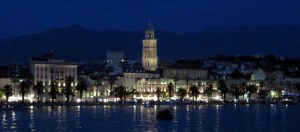
Split is charming lighted at night.

Split is charming lighted at night.

So we planned 4 nights/3 full days. In planning the trip with one night in Split and two on Korčula, we thought the centerpiece of our trip should be the 4-night stay in an apartment high above the Adriatic in Dubrovnik. The Stari Grad (Old Town) was so crowded, hot (breezes were rare) and annoying we could barely stand to pass through it. In our experience, restaurants outside of the Stari Grad were far superior in food and atmosphere, and where the locals go. Thank goodness we stayed outside the old center! 
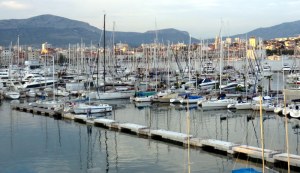
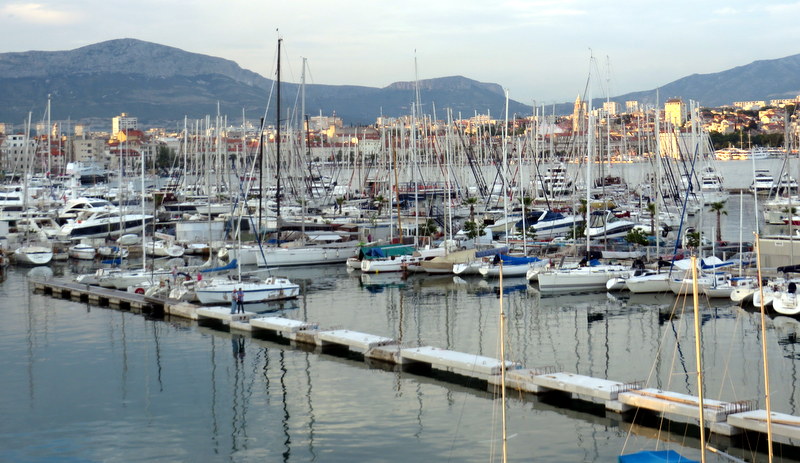
Sailboats crowd the Split marina as the sun colors the town.

Sailboats crowd the Split marina as the sun colors the town.

Split, on the other hand, had a great vibe and we could have spent more than our allotted half-day there had we known. Maybe the Dalmatian Coast of Croatia is more suited to the two-or-three night hops that Ric and I usually avoid.  
If you like beach time and really want to relax, or if you like sailing, the Dalmatian Coast is probably your cup of tea. We are happy to have visited and learned a bit about the history both ancient and recent. We had a great time with my brother and sister-in-law!  We are happy to have dined so well, been treated so kindly, and to have been exposed to the fabulous wines available there. The Italians, the French, and other cultures that have long been overrun by touristic hoards could learn a few lessons in customer service. The Croatians, Montenegrins, and Bosnians have it down. They are very friendly and one is made to feel welcome in a most hospitable way. 

Paris v. Roma – Part I: Cuisine

15 Mar
If Paris is a Grande Dame, Roma is her rambunctious and unruly sister. After a week in Paris, we cannot help but compare and contrast gorgeous Paris to Bella Roma. Each city has much to love and other things that leave you shaking your head.
Great cappuccino at a neighborhood cafe, where locals go. This was not by a tourist attraction. We drank it at the bar and still it was €4.20 FOR ONE. I shudder to think of what they would have charged if we sat down.

Great cappuccino at a neighborhood cafe, where locals go. This was not by a tourist attraction. We drank it at the bar and still it was €4.20 FOR ONE. I shudder to think of what they would have charged if we sat down.

Starting with the obvious, food. On our first trip to Italy in 2010 Ric observed “There are no bad meals in Italy; some are just better than others.” While we can attest to having had one really terrible meal in Italy in the ensuing years, we had two crappy meals in Paris in our first three 3 days and during the week some that were just meh. There is bad food in Paris. Really bad. BUT THE BAGUETTES, oh-la-la! So good and so cheap! Both Roma and Paris have pastry shops and bakeries to be proud of. Baguette versus pizza bianca? Tough choice, but I’d have to go with baguette. French croissants and pain au chocolat beat Italian cornetti IMHO.
The espresso is good in Paris, but pricey by comparison to Roma where one has a God-given right to an inexpensive high-quality shot and a bar available every 300 meters where you can buy it.  They do have Starbucks in Paris but I am not sure that is a good thing; we did not bother to try one. We do like the Cafes Richard brand, of course.
There is ethnic diversity in the Parisian food scene. Walk down the street in Paris and you might see a pattern of restaurants like this
French  Vietnamese  French  Japanese  French  Kebab  Italian  French
In Rome it would look like this
Italian      Pizza     Bar      Kebab     Italian     Pizza      Bar     Italian
Wine is reasonably priced in Italy. We spend far less on wine in Roma than we ever did in the U.S. In fact our wine-and-coffee spending is a fraction of what it was in the U.S., and not because we have
Artful stacking at a cafe in Montmarte.

Artful stacking at a cafe in Montmarte.

cut back on either. In Paris, both wine and espresso are expensive by comparison.  Even house wine is quaffable in Italy, but some wine-by-the glass or carafe in Paris is, well, overpriced and barely drinkable. We have had some fantastic bottles, though one pays dearly at a restaurant.  We missed the Italian tradition of serving snacks with a glass of wine at aperitivo hour.
Water by the bottle, nice and sparkling if you like, is an expectation at every meal in Italy, and a litre will usually cost no more than €2.00 or 3.00.  When we ordered bottled water in Paris we were hit with a €6.00-7.00 price!  However tap water, ordered only by una brutta figura in Italy, is gladly handed out in a carafe in Paris. Free is a very good price.
It was quiet at Versailles the day we went. Only customers in garden cafe.

It was quiet at Versailles the day we went. Only customers in garden cafe.

We did have Boeuf Bourguignon that was practically life-changing. Served with a mountain of mashed potatoes, it was in a little oven-pot in a rich wine sauce heavily laced with bay leaves and bacon. We ate it with good French red wine and hunks of baguette. It was a good thing we had walked about 13 km that day! Quality vegetables beyond salads have been harder to find when dining out. In Italy there are fabulous contorni to be had that are not starchy and white. In fact I am craving a plate of cicoria ripassata now.
Watch for my next post Paris v. Roma – Part II: Street Scene and Getting Around


Guess where we are celebrating our 30th anniversary?

Guess where we are celebrating our 30th anniversary?

Long weekend

22 Feb
The Presidents’ Day long weekend gave us an opportunity to celebrate: my birthday and Valentine’s Day, not the presidents. In Oregon we almost always went to the coast for a few days this time of year. Last year we spent 5 days celebrating in Rome as tourists. This year we had a weekend at an agriturismo in mind, and the opportunity to stock up on wine from a favorite cantina we visited last July. How lucky are we to be able to say “We’re going to Toscana for the weekend”?
Toscana in winter is not for the faint of heart. It is chilly: 32-34 degrees Fahrenheit overnight and maybe high 40s at the highest during the day. (OK, I know the U.S. is in a deep freezer right now and 40 sounds pretty balmy, but that is considered cold here. And we are considerably less acclimated to cold than our Minnesota and North Dakota roots would indicate.) There are no sunflowers, and vineyards are bare, but also there are no crowds, driving is easy, and wineries and restaurants are welcoming.
Last April we bought a stay at Agriturismo Poggio Etrusco at an auction. As readers of this blog are aware, we are on-the-go a lot as I try to burn up all of my paid vacation time before I retire. So it was winter before we found time in the schedule for this trip. 


One of the downsides of a trip to Toscana is that we have to rent a car and I have to drive. Ric is the navigator and manages the GPS, a bitch voice named Bonnie. She drives me mad with her repetitious, annoying flat mechanical voice. And she’s not always right, so we have to have maps as well to double-check her directions. For example, I have no idea how we ended up on a dirt road coming home from one day trip when our outbound portion was all paved. I think Bonnie found a “short cut” to entertain herself. HOWEVER, without Bonnie we would have much more trouble navigating and we have learned to always take her along. We have also learned when to turn her off so we don’t end up in a ZTL.
The upside to renting a car is we have a method to transport massive quantities of wine and olive oil. Our Fiat 500L was luckily big enough to handle the purchases. If we had bought anymore we’d have needed a van. We whiled away the weekend at wineries, visited an abbey we have planned on seeing since our first trip here in 2010, ate too much, and got to know the Montepulciano area better.
The Abbazia di Monte Oliveto Maggiore is a magnificent and off-the-beaten-track place to visit, at least in winter.  It was begun in 1320, which in itself is hard to grasp, and also houses priceless frescoes from the 15th and 16th centuries. One wanders down a forest path to visit this very peaceful place. It was fun to be the only visitors wandering around on our own. The monks make wine, olive oil, herbal remedies, honey, and soaps. An affable young man named Luca was manning the cantina and entertained us with stories and history. An enjoyable aspect to off-season visits is the availability of people like Luca who have time to chat when visitors are not lined up 6 deep. 


One does have to plan meals around restaurant openings especially in the off season. On Friday we arrived at our destination, Poggio Etrusco, a farm that produces olive oil and wine, after 2:00 PM and were directed to try to find something to eat in the town of Montepulciano as there was nothing open in the little hamlet near the farm. On the way to Montepulciano at almost 3:00 PM, we saw a place that in retrospect I can only describe as a Tuscan Tourist Roadside Attraction. Almost like Camp 18 in Oregon. The quality of the food was fine, but sale of products was clearly uppermost in the minds of the staff and owner. You are caused to walk through their retail space on the way to the cavernous dining room; there’s a push toward the €20-€30 bottles of wine (not at lunch, thank you); and walking back through the retail area to pay, there are all kinds of inviting products practically throwing themselves off the shelves at you. That said, it was the only game in – or out – of town and there were Italians eating there too. If we had waited until we got up into Montepulciano we’d have ended up eating cheese, sausage, and oranges standing on a street corner in the cold.
Cavernous Ristorante Pulcino - not my picture but from their website. I wish I had photographed the outside for you!
Cavernous Ristorante Pulcino – not my picture but from their website. I wish I had photographed the outside for you!
We ate some meals at some old favorite places (Grappolo Blu in Montalcino) and also discovered some new ones like Tre Stelle in Sant’Albino. We also enjoyed the luxury of hanging about the farm, entertained by cats, dogs, and chickens, nibbling on pecorino from Pienza, sipping wine provided by our host, eating the aforementioned oranges, in front of a lovely fire in a massive fireplace.  I will say for those who seek a non-touristy experience, winter in Toscana will provide that. As long as you aren’t forced into Ristorante Pulcino. And bring your flannel pajamas.