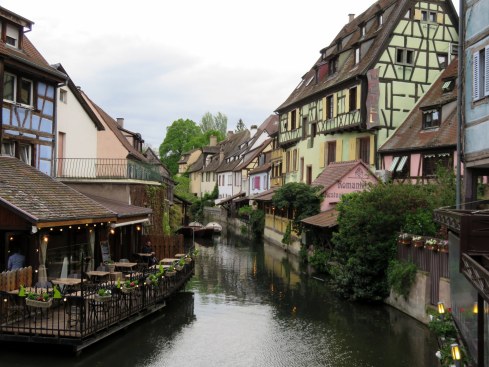
Postcard from England: Stone circles and urban hikes

10 Jun

10 June 2019.

Can it be ten days since we returned from our spring trip? Wrestling with jetlag, re-entry, laundry, and catch-up gardening took more than a week but the last segment of our 6-week trip is worth relating.

The weather gods continued to smile on us. I am sure the citizens of Wiltshire would have liked some rain but it suited us to a T to have sunny days and fluffy clouds. We even shed our jackets a few times.

From Wales we headed to Wiltshire, home to Stonehenge and the Avebury Circle as well as the city of Bath and the ancient city of Salisbury, where we made our base for four nights. Should have made it five nights.This is a rich, full area with much to see and mileage required to see it.

Stonehenge

It is a challenge to depict the size and the impressiveness of Stonehenge.

We barely stopped at Bath, only long enough to see the Roman bath complex. The center of the city was a madhouse of tourists! We had hoped to return another day to see more, but driving in, parking, and driving out bordered on the ridiculous. We had initially planned on staying in Bath, but although I had been trying to book 6 months in advance, lodging was scarce on this Bank Holiday weekend. So we moved on to lodgings in Salisbury.

Stonehenge was first on the agenda and so much more impressive than I expected! We arrived at opening and the crowd was minimal. Efficient buses ported us to the circle, which cleverly is not visible from the Visitors Center so the monument is revealed dramatically. I thought I would at least be interested but seeing Stonehenge in person is a pretty magnificent thing. We found the VC absorbing until late morning when the crowds became annoying, so we took off for Avebury.

Avebury is gigantic! I had read about it but did not have a good grasp until we actually arrived. The henge is so large there is a village inside the circle. With a pub. A great place for lunch and good timing as we were peckish by now.
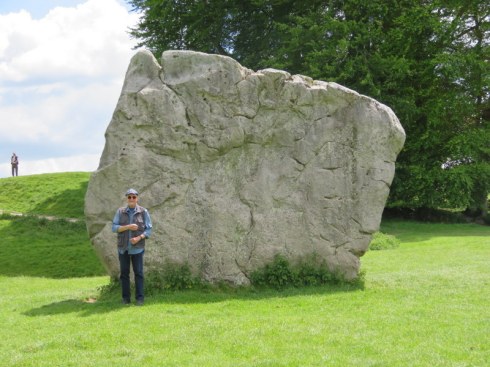
Avebury stone

Ric demonstrates the size of one of the stones in the Avebury Circle.
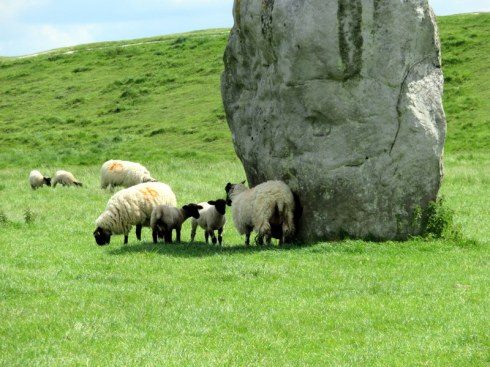
Sheep at Avebury

Sheep and tiny lambs graze freely around the Avebury Circle.

A principal ceremonial site of Neolithic Britain, Avebury is considered to be one of the largest, and undoubtedly the most complex, of Britain’s surviving Neolithic henge monuments. We walked about the stones, enjoying the company of the sheep, and having the good fortune to visit with a guide who could add to our understanding. How did these ancient people have the vision, the strength, and the patience to build these sites? It would be a fantastic place to visit with an archeologist.

Another day we ventured to the ancient site of Old Sarum. If you’ve read Edward Rutherford’s epic novel Sarum this is a must-visit. How fascinating to see the little hill, the castle ruins, and the foundations of the old cathedral! We happened into Old Sarum the day of a Roman re-enactment, luckily arriving before the throngs expecting to watch staged battles. As I re-read Sarum, it is delightful to picture the site with a better understanding of the topography. For an aerial view, click here.
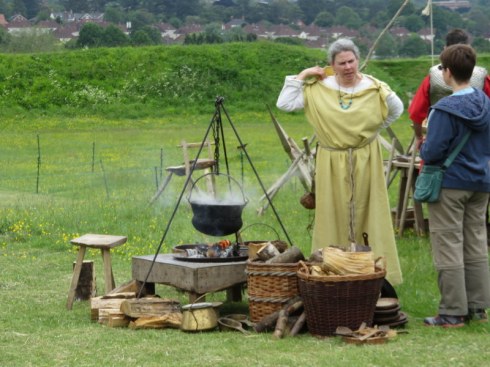
Old Sarum Roman woman

At Old Sarum, a re-enactor demonstrates what Roman life was like.

Re-enactors practice their Roman battle skills prior to an exhibition.
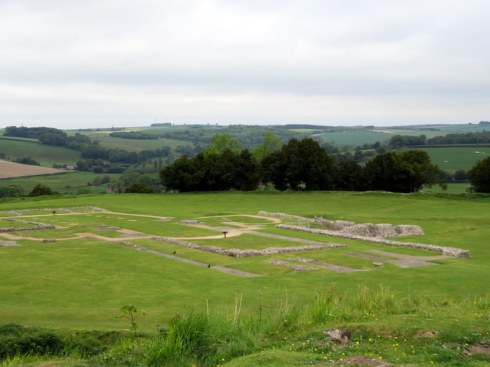
Old Sarum Cathedral

From the castle ruins one can gaze down on the massive foundations of the old cathedral, The cathedral was demolished in the 13th century and the stones used to build the new cathedral and close at Salisbury.


Not to be overlooked is the city of Salisbury itself. On the Sunday we visited, the Cathedral opened its doors to tourists after services so as the congregation gathered for coffee, we gawked at the magnificence. It is almost impossible to comprehend that it was built over the course of only 38 years in the 13th century. Notre Dame took 856 years; Sagrada Familia was started 150 years ago and still isn’ t completed.
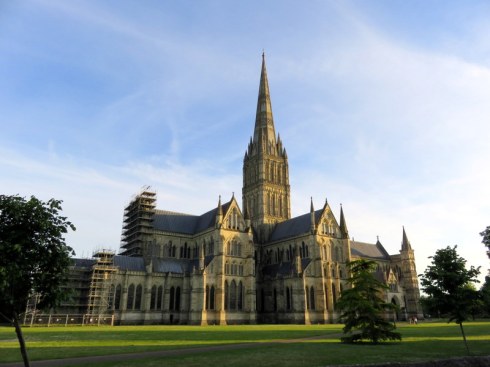
Salisbury Cathedral

We walked through the close after dinner one evening to find the Salisbury Cathedral bathed in a golden glow.

The Cathedral is set in a magnificent close, the largest in Britain at 80 acres. The close contains schools, Diocesan offices, museums, and private residences, some of which are magnificent mansions. Ric and I thought we’d take a short walk through the close one afternoon which turned into well over an hour by the time we passed through it and around the walls back to our lodgings. It’s huge and worthy of further exploration.

Rick and Jane departed from Salisbury while Ric and I hung out for another day and night intending to do very little. We caught up on laundry and then had time to check out the Salisbury City Walk sponsored by the Visitors Center. It was a great overview and lesson in history and culture. Would that we had done this Day One!

Since the day was divine and we were purposefully unscheduled, we decided to wander after lunch. Finding a path along the River Avon, we were soon diverted through a park and into the Harnham Water Meadows along a meandering path with more views of the cathedral, sheep, and eventually the small town of Harnham. This is the kind of thing we love to stumble upon: an “urban hike” or, if our timing is right, “a path to lunch,” as had we known, we could have eaten in a pub situated in an old mill in Harnham.
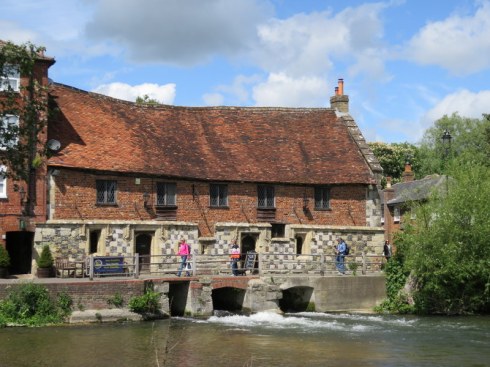
Harnham

This old mill at Harnham is now a popular pub.

So our day off from travel turned into a delightful opportunity to further explore Salisbury and revealed many sights we could have explored with more time. If you choose to stay in Salisbury, give it some time as there is much to enjoy. Good restaurants, too! Check out The Giggling Squid.
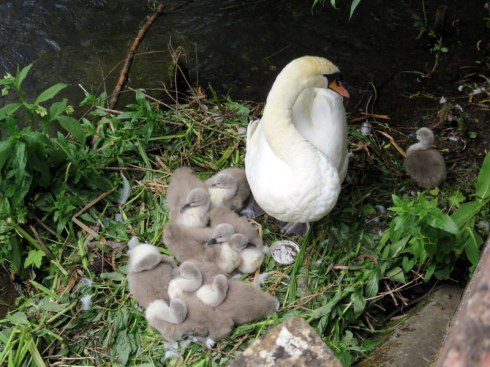
Swan and cygnets

On the River Avon, a swan and her (his?) cygnets settle in for the night.

Our last three nights were in lovely London. We’ve been there many times, last in 2017 for two weeks, so this stop was meant to be a relaxing return to a favorite city before our long flights home.

London did not disappoint. No iconic sights this time, though. We met friends from Seattle for wine and tapas, walked for several hours through Kew Gardens, last visited in autumn and a completely different experience in spring. We ate excellent Indian food at Punjab, took another long urban hike through the sprawling Regent’s Park, and enjoyed a final pub meal with a superb pie at The Queen’s Head.

Herewith a few of our dozens of photos from Kew Gardens. There is a Chihuly exhibition in progress, a lovely surprise.

For the entire trip, I averaged 16000+ steps per day on the Fitbit, about 7 miles, as nearly as I can figure. Not bad compared to what we manage at home.

For now, the consumption of chips, crisps, beer, and scones has stopped. No more Parisian baguettes nor croissants for now. Camembert is off the menu for a while. No full bottles of wine at dinner. SIGH.

Back to reality…and planning the next trip: Italy and Switzerland in September!


Postcard from Wales: Alla fine!

30 May

30 May 2019.

Alla fine! At last, we come to our time in Wales and what a wonderful place it is! Why do so few Americans make their way to Wales? Perhaps it is the lack of big sights. There’s no Uffizi Museum, Tower of London, nor Louvre; no Colosseum, Big Ben, nor Eiffel Tower. What Wales has is beautiful countryside, unspoiled coastline, friendly people, charming pubs, and historical castles.

It does take significant effort to ferret out information and construct an itinerary. Rick Steves does not have the best bead on Wales, in my opinion, and maybe that’s because much of his audience does not have the time to devote to this rural corner of Britain.

Penny Lane Sign

We started our time together with a short Beatles Tour in Liverpool. Paul autographed this sign. From left, me, Ric, Jane & Rick.

Maybe Americans don’t go to Wales because of right-hand drive cars. My brother, the intrepid driver, has experience with “wrong side” driving and we take advantage of his willingness to be the driver when in the UK or even in other European areas where having a car is advantageous (Scotland, Puglia, Croatia, rural Emilia-Romagna). With brother Rick at the wheel and husband Ric in the navigator’s seat, Jane and I could relax and enjoy the scenery from the back seat of the Range Rover.

We all met in Liverpool coming from our various directions. After taking a private “Magical Mystery Tour,” we headed to Caernarfon in North Wales. It is lovely country here, dominated by Snowdonia National Park, but it does take a bit of effort to get around: a lot of windshield time as the going is slow. Without a car, one can use some buses and scenic trains to aid hiking, but a car is quite useful. Easy hikes are not too hard to find with the help of the tourist office. We did find getting detailed walk info in advance of the trip a little challenging but once on site we were happy with walks that included a good pub lunch at the end. We stayed in the Gatekeepers’ Lodge at Plas Dinas Country House. Quite charming and we slept well, ate well, and drank fine whiskey.

Please click on any picture for a slide show and captions.

From Caernarfon, a drive down the coast allowed us a stop in Aberystwyth where the TV drama Hinterland is based. It was a bit dark and brooding on this gray day which is fitting for the show. Watch it if you can. Netflix has it.

By the way, our luck with the weather was amazing. Brother Rick says he always brings the sun to the UK and we only had rain on days we were changing cities, i.e., during car time. Ric and I got wet once since leaving France, and that was in London after Rick flew home. Go figure!

On to St. David’s, Britain’s smallest city. St. David’s is a cathedral city of some historical religious importance and we were drawn to this remote section of Wales for the Pembrokeshire Coast Path. Once in the city, you can just about get around without a car thanks to a bus network, the Celtic Coaster, but having a vehicle and a willing driver makes it easier and faster. The walks were just what I expected of country walking in the UK. We hiked across meadows of sheep and buttercups, along hedgerows, through small copses, past lovely gardens, through kissing gates, and along narrow shoreline paths: all in one walk! In the evenings, dinner was a 10-minute walk from our homey B&B, the Ramsey House. Thank goodness we were walking so much! Big breakfasts then chips and beer at lunch became a habit we need to break.

Click on any photo for a slideshow and captions.

The Welsh language is a major factor in the culture of this part of Wales, separated from the more English-speaking section by the Landsker Line. In Caernarfon and the villages of Snowdonia we heard Welsh spoken often and still heard it a bit in St. David’s. Once we got to the city of Pembroke and on to the Brecon Beacons, the only Welsh we encountered was on the bilingual signs that are required everywhere.

Welsh sign

From menus to road signs and waymarkers, almost everything is presented in both Welsh and English.

Map

Pembroke Castle is very important in Welsh history, indeed in the history of the UK. We took a very informative tour. There is a giant map of Wales in the courtyard which Rick and Jane are shown touring.

One night in a pub in the Brecon Beacons village of Pontsticill, I overheard a table of 30-something men discussing the language with their 60-something waitress.

“Do you have the Welsh then?” asked one of the men.

“Nah, but me grandkids have it at school,” she responded.

Guffaw from the lads. “I could never when I were at school!” said another.

Speaking of the Brecon Beacons, what an extraordinary area! So vast! Although it carries the title National Park, this is nothing like a national park in the United States. These are lands set aside to preserve the way of life as much as to prevent development, so one finds villages and estates right inside the parks, and grazing lands abound as well as farming in sectors. There are no big hotels nor resorts but there are campgrounds and facilities available along with guesthouses, holiday houses, and B&Bs.

It was challenging to find detailed information about walking in Brecon Beacons until we arrived there. We had a faint notion to try a short, local segment of the Offa’s Dyke Path and did a couple of small sections but learned too late about supporting transportation options that would facilitate one-way half-day hikes. A return trip could be more focused. There was a fine walk through sheep pastures to an Iron Age hill fort in the Brecon Beacons. That was pretty darn cool.

We had a very nice house on the edge of Brecon Beacons, at the southern edge of the park, but close to some cute villages with nice options for dining.

Once again, please click for captions and larger photos.

Alle fine (in the end), we had a great trip through Wales and Liverpool was worth exploring as well although our time there was short. We could have extended any location by a night or two and gone deeper and hiked more. Leaves something for “next time.”

We wrapped up our trip in Salisbury, but you’ll have to wait for the next blog to hear about that fine city!


Postcard from Paris: Paris had its own ideas

11 May

11 May 2019.

A two-hour delay followed by a complete cancellation of our train from Bayeux set the stage for the Paris portion of our trip. I learned a new word in French, supprime, that is “removed” or “canceled.” <SIGH> France, why are you so petulant?

So what if we arrived two hours late? Et alors? The day is lovely, we’ll skip our plans to journey to Saint-Denis and instead enjoy the sun (we had been cold in Bayeux) and parade around the Champ de Mars to the Trocadero and back. We had three more days to execute our minimal plan. This is our 6th stay in this delightful city so there are few “must sees” only the desire to walk hand-in-hand, eat well, drink wine. Our first night’s dinner at Le P’tit Troquet was magnifique!

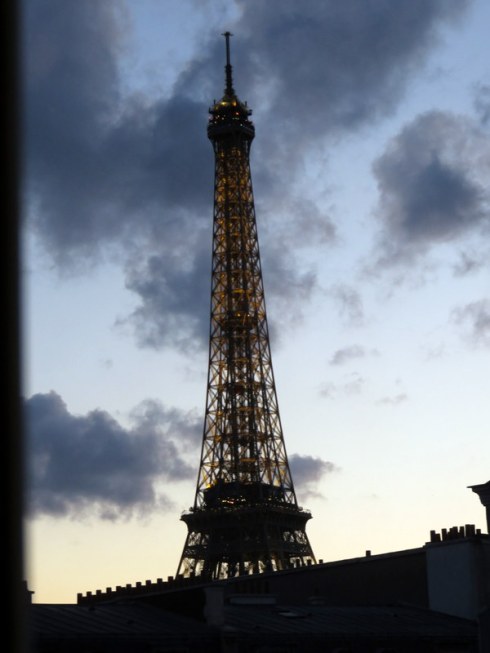
View from our room on the night of arrival.

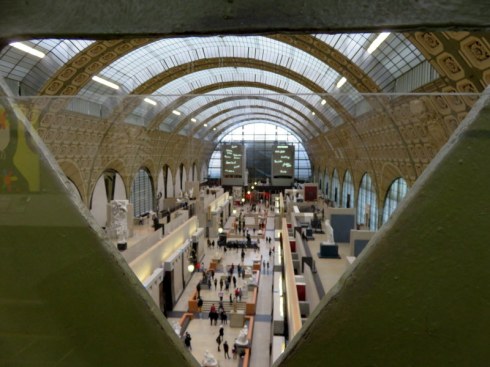
Day 2: So what if it is raining? We will enjoy the Musee d’Orsay! Arriving at opening, tickets in hand, we entered with a small crowd and enjoyed almost an hour with the Impressionists on the 5th floor. Last time we were here, there were schoolchildren everywhere. This time, we were knocked to the side only a couple of times by people with selfie-sticks ensuring those at home would know they’d seen a Renoir in person.

I love Musee d’Orsay as much for its architecture as for its collection.

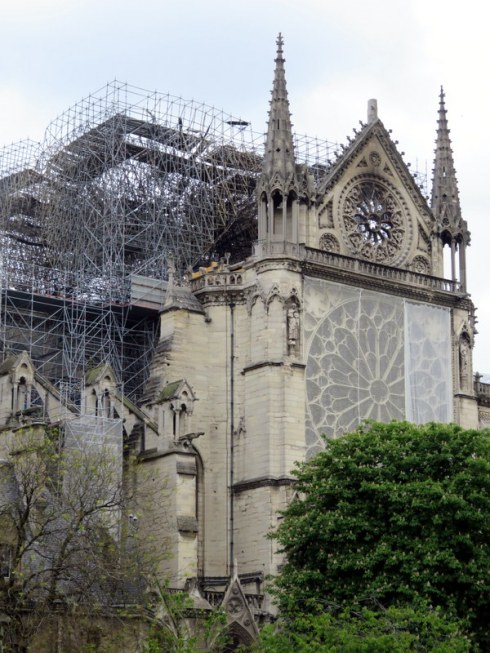
Rain? We walk. It is only a drizzle, like at home. It comes and goes.  Stop in a cafe for espresso and croissant. How Parisian! The Monnaie de Paris was open and uncrowded and pretty interesting, extremely well-done. Ah! Here is the sun, for five minutes. No rain! Lunch at a small place we know (after 6 visits, we have places) across from poor old Notre Dame. Lovely salads and we got to hear the owner’s tale from the “Day of the Fire.”

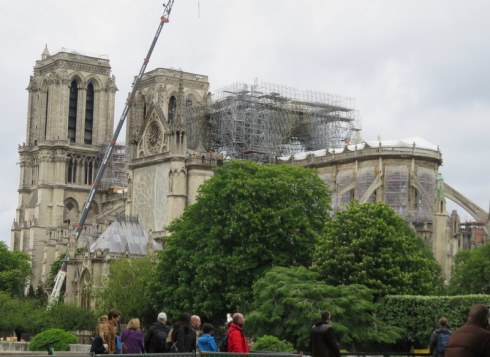
Poor old Notre Dame! Work is underway.

Another view of the icon.

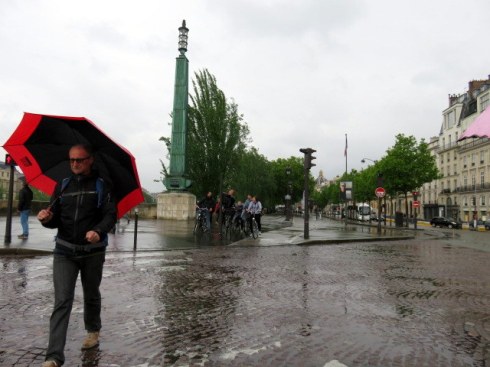
Tres bien! It is not raining. “Let’s cross the river and walk back on the right bank,” suggests Ric. Luckily we hit the porticoes along Rue de Rivoli just before the rain comes, along with thunder and lightning, eventually a DOWNPOUR with hail. As it eases, we jump into the Metro station at Concorde. Non mais oh! A train passes by without stopping and security steps in to close the station. We are unclear but we think a manifestation or maybe just President Macron moving about. It was a holiday (VE Day). We must walk again and now it is raining in earnest. Soaking wet we arrive back at Hotel Relais Bosquet. We must have dinner close by as we already have 20,000 steps on the Fitbit! But of course, the sun comes back at 17:30 and though chilly it was not a bad evening.

Clearing at sundown, once again!

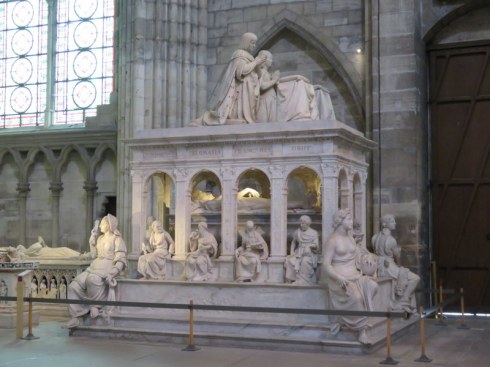
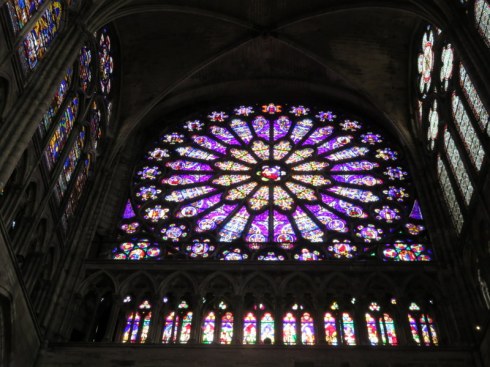
Day 3: The morning is dry, broken clouds, off to see the Basilica of Saint-Denis, right on our Metro line #8. Coffee on the piazza? Mais oui! The church is open but to our chagrin (as this is rather out-of-the-way from Central Paris), a strike has struck and one cannot visit the museum or the tombs of the kings.

We could see a few tombs from the sanctuary but I have no idea whose this is.


`

Basilica of Saint-Denis, resting place of French royalty.

Not to worry, we’ve meant to tour the Opera Garnier! Off we go. But today, instead of being open 10:00-13:00, it opens at 13:00 which is two hours off. Let’s walk to Canal St. Martin, then, for lunch since the weather is holding. Whoops! Here comes the steady rain. We find a store and wait awhile, losing interest in our plan for an outdoor lunch. Abort! Find a Metro. Let’s just go home and find lunch. I also find also a manicure and pedicure to pass the rainy afternoon. Once again, the evening turns nice. At least we are able to make our reservation at Les Cedres du Libnan! A fine evening for a walk and a wonderful meal with Lebanese wine.

This sums up the weather on several of our outings.

Napoleon’s Tomb at Invalides, beautiful under (finally) clearing skies at sunset.

Day 4: Now we are cooking! Today it is mostly cloudy but I need my sunglasses on our urban hike! I will write more on Project Easy Hiker soon, but when you are in Paris and have a couple of hours, the Promenade Plantee aka, La coulée verte René-Dumont is worth exploration. It hardly seemed possible we were still in Paris!

The Promenade Plantee is atop an old railroad viaduct from Bastille southeast toward Bois di Vincennes. Serene!

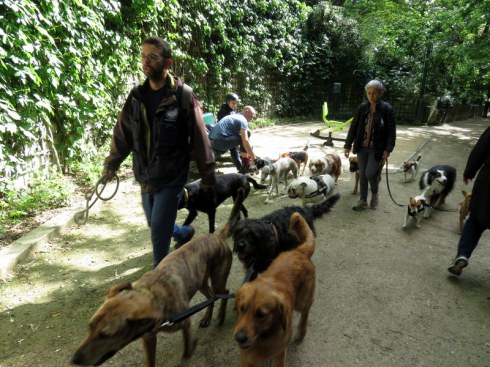
No rain! No umbrella! 10,000 steps on the pedometer before lunch! We won’t talk about the Metro station closure, the wrong way tram, or my leaving Ric behind at the turnstile when his ticket didn’t work. We will speak instead of glorious moules frites, divine Italian food in Paris at Il Sorrentino (Vermentino, grappa, and polpo!), and something to blog about.

These walkers had about 15 dogs between them. Some unleashed, many triple leashed. 15 dogs at 15 Euro per dog maybe 225 Euro for an hour?

It snowed last week in Liguria. At least we weren’t there!

Postcard from Normandy: D-Day, camembert, and more

8 May

8 May 2019.

The famous Invasion in June of 1944 changed Normandy forever and the (mostly) English-speaking hoards have continued to invade for the past 75 years. Luckily the locals are still celebrating the arrival of the Allies and welcoming Americans, Canadians, Brits, and Australians by millions. We ran into a lot of Dutch as well.

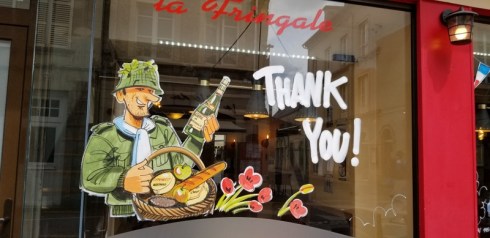
Bayeux is about as close as you can get to the D-Day beaches and not be on them. It was our base for a week. Crowds aren’t bad, but the town and surrounding hamlets, cemeteries, beaches, and museums are gearing up for the 75th Anniversary of D-Day. Windows are painted in greeting, museum exhibits are being reworked, and hoteliers are preparing to clean up.

Window painting, Bayeux, honoring the 75th anniversary.

Window painting in Bayeux, honoring the Invasion 75 years ago.

A tour of the D-Day sites alone could take a week or more. Every village that secured a relic tank or WWII airplane has a museum, and every village has a tank or period airplane, not to mention oodles of ammunition, rusted helmets, German and Allied weapons, medic kits, and uniforms. Our tour guide told us there were 60+ museums in Normandy dedicated to the Invasion. We did not visit them all.

German battery, Pont du Hoc, now a tourist lookout.

This little Dutch boy was having a blast playing in an overgrown bomb crater, Pont du Hoc.

If you have seen “The Longest Day” you know the scene where the parachutist gets caught on the clock tower of the church at Sainte-Mère-Église. True story, kitchily depicted today.

After visiting a couple of (good) museums and spending 9 hours touring sites like Sainte-Mère-Église, Utah and Omaha Beaches, and the German and American cemeteries, we were pretty much on Overlord overload. Still, every time we ventured to another location, a bit more about D-Day was revealed. We realized our grasp of that day — of the entire Invasion — was not equal to the event. Sure we’ve seen movies, read books, maybe even paid attention in high school history class, but being there is sobering and overwhelming. The statistics (numbers of parachutists, numbers of planes, numbers of ships) are mind-boggling.

The logistics make what FedEx does every day look like a children’s party.

We had lunch at the cafe on Utah Beach, built in a building (the only building) that remains from that day. All WWII veterans are invited to sign the bar or any other surface in the cafe.

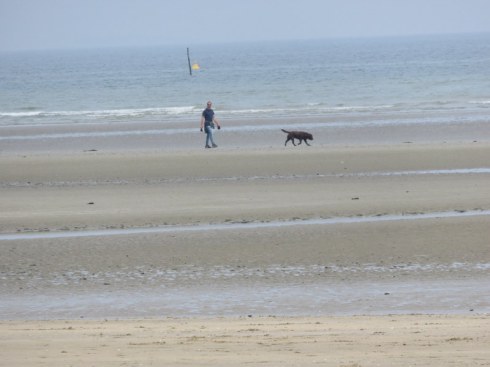
Utah Beach is now for walks with dogs and building sand castles. Like Oregon, it is too cold to go in the water. Except that is, of course, what thousands of men did on D-Day.

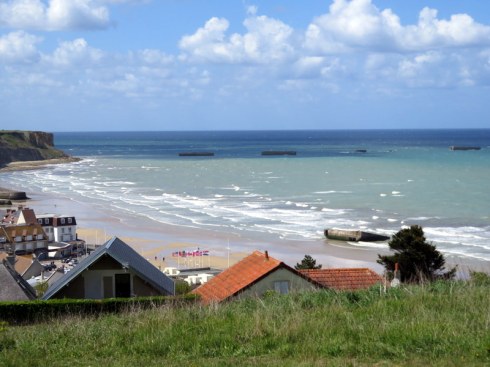
Perhaps the most eye-opening experience for us was seeing Port Winston at Arromanches. This was a Mulberry Harbor, a temporary portable harbor established to support the Invasion until the Allies could secure the ports held by the Germans. Neither of us had read much about this except in our Rick Steves guidebook.

The various components were fabricated in England and sunk in the Thames River to hide them from German surveillance. Shortly after D-Day, they were towed across the Channel and the harbor constructed. Seeing the remains of the caissons and floating piers along with displays and dioramas in the excellent museum brought to life the enormity of the operation.

View from above Arromanches. You can still see some caissons offshore.

WWII photo of the actual temporary harbor.

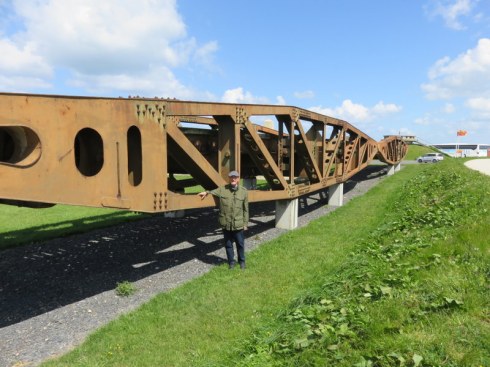
A piece ot the floating roadbed called a “whale” used in Port Winston. Ric for scale.

We had the luxury of a week in Normandy. Plenty of time to absorb the WWII history and ample time to devote to the countryside, medieval history (William the Conqueror was from Caen), and food. I swear my pores are oozing Camembert. We tried to drink enough red wine to whisk those nasty artery blocking fats out as fast as we consumed them. We’d make a nice healthy salad in our apartment in the evening with great local produce, lean chicken, a whisper of olive oil and balsamico, but we’d add Camembert. We did not, however, have butter on our baguettes. The cider, too, is a wonderful thing and quite perfect with the local food. Goes great with mussels freshly harvested and served ala Normande with (God help me!) cream!

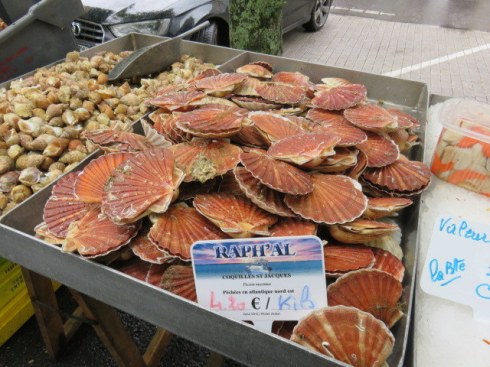
Fresh scallops, anyone? No question that there were not frozen.

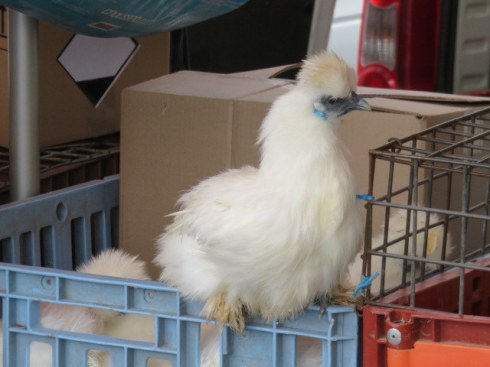
Fresh chicken too. Maybe she’s just for laying?

On the Aure River in Bayeux, two waterwheels are still spinning.

We hiked up La Côte de Grâce above Honfleur for the view of the Pont du Normandy.

In Barfleur, the Fête du Printemps was underway with curious street decoration.

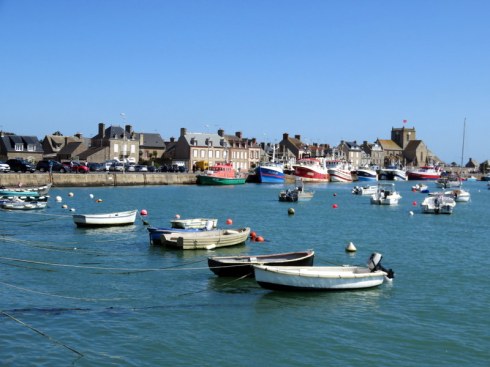
Cute Barfleur, filled this sunny Sunday with French people out for a drive and lunch, which is what we were doing.

One can cover a lot of miles in Normandy without seeing all of it. We confined ourselves to the area from Honfleur in the north to Barfleur near Cherbourg and Caen. We realized part way through the week that this area of France requires additional time if one is to include Mont Saint Michel as well as points north like Etretat.

I guess a return trip is in order. Save me some Camembert.

Postcard from Alsace: Wine, Wisteria, and Storks

30 Apr

30 April 2019.

It is always time for wine in France’s Alsace Region, but only for a short time in the spring do the storks roost here to rear their young. Until we arrived we had no idea about this annual migration nor did we know how revered the storks, or cigognes blanches, are.  They are symbols of happiness and faithfulness bringing fertility and good luck. There is a fun read here from the Seattle Times a few years ago.

Ric captured a close up of this nest with both parents present. They were clicking away at each other, their method of communicating. The nest is perched atop a steeple. Note the supports. The towns build and maintain platforms to support the huge nests.

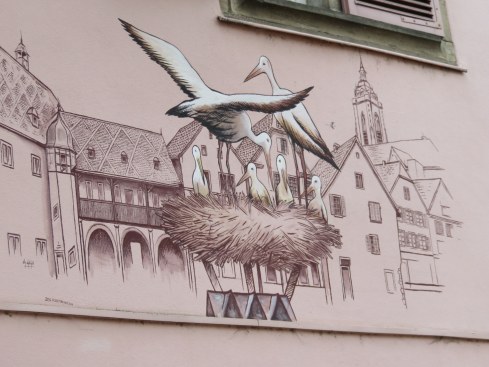
The storks feature prominently in town art,

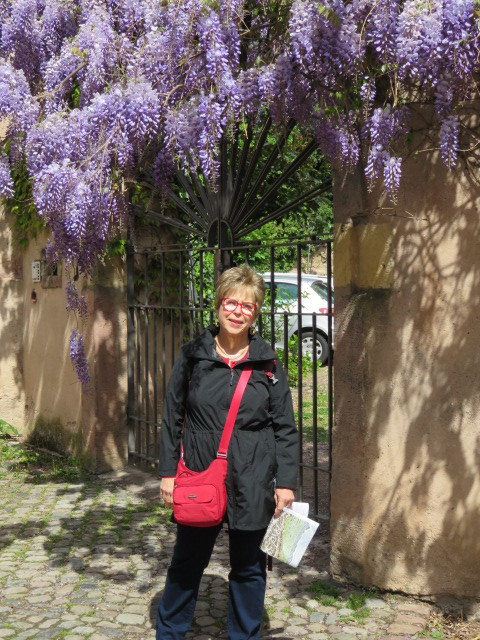
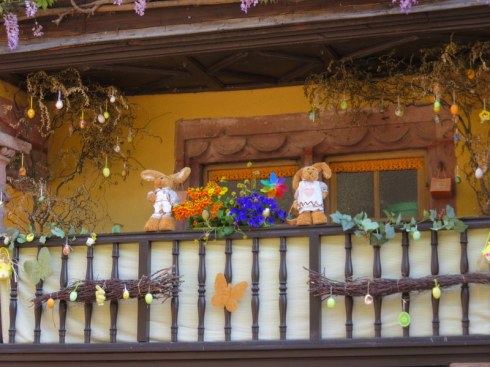
We have had a full itinerary, one day taking a tour of a small portion of the Route des Vins d’Alsace visiting three family-run wineries, and another day exploring the beautiful and tiny villages, spotting storks, and enjoying the seasonal decorations that adorn every house, shop, and square. Wisteria drapes from walls, roofs, and trees, enhanced by bunnies, eggs, and other signs of the just-past Easter holiday. The air is fragrant with lilac.

The wisteria is at its peak while the tulips have just faded.

A day hike through the vineyards got us away from the hordes and tourist buses in Colmar, which has been our base for five nights. There has also been plenty of time to enjoy the local cuisine.

Flammekueche or tarte flambée, depending on your language choice. Think of it as Alsatian pizza. It is FABULOUS.

As usual, we are car-free. I can imagine why a car would be helpful in this region as public transportation is a bit thin. With the help of a taxi driver named Isa, we have managed quite well. Three times Isa took us to villages that were difficult to reach by bus. We feel like we have our own personal driver in Colmar. Three taxis were far more economical than renting a car for 4-5 days.

For now, I will let our pictures do the talking. Between us, we took far too many in four days: almost 500! Watch for a post (soon!) over at Project Easy Hiker as well about our backroads walk from Riqewihr to Ribeauville along with our visit at the Centre de Reintroduction which has helped in stork recovery.

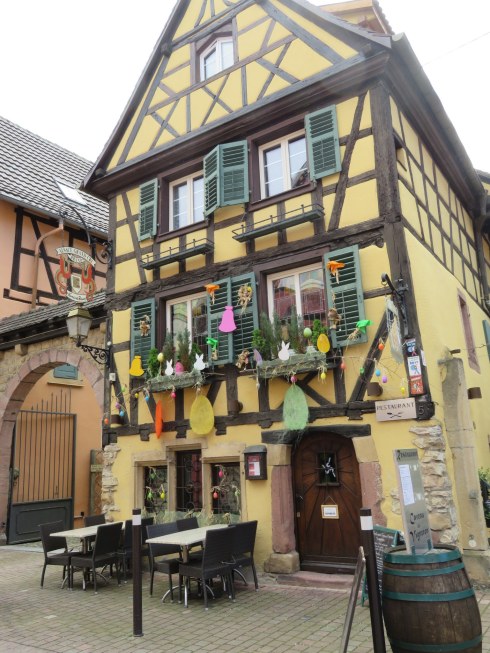
One of the more brightly colored buildings, this one in tiny Riquewihr. Can you see the bunnies in the window boxes?

The decorations would be tacky on one house, kitschy on two, but when every building has them, it is a theme.

Even this restaurant in Turckheim was bedecked. This is where we had the tarte flambée along with seasonal white asparagus, another specialty of the region.

In Alsace, they use some very old wine barrels such as these beautifully decorated ones from a bygone era.

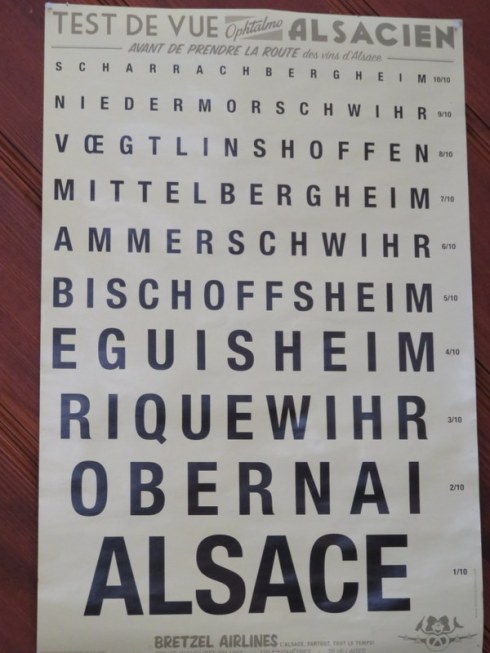
An eye test chart in an Alsatian winery. The real test for me was pronouncing the names.

Even in the overast that predominated our days in Colmar, the buildings are charming. No wonder this area is called “La Petit Venise.”


Girovaga

Formerly GoodDayRome

Skip to content ↓