Plane vs. Train? No contest!

8 Mar
Flying may get you across many miles quickly, but there is nothing enjoyable about the experience. NOTHING. Trains, on the other hand, are simply a pleasure.
Not long after we had returned from our Christmas trip to Paris, London, and Switzerland, our son informed us that his company was sending him to the U.K. for work. Would we meet him in London for a week? How could we not? We had really enjoyed our time in London in December, and had immediately booked a return for April, but when your child is going to be on the same side of the ocean, you go. We don’t get to see any of them often, so this was a treat.
There was just not enough time between our Austrian adventure and an upcoming visit from American friends to allow us to take a leisurely journey by train, so we bit the bullet and bought tickets on EasyJet. (We prefer taking the train and stopping in Paris for a couple of nights.)  I popped for seats in the front of the plane and early boarding to try and minimize our discomfort. We abandoned our reliable roll-aboard cases in favor of large, uncomfortable backpacks so they would fit in the EasyJet overheads. I felt like I was going to tip over backward carrying that pack (although it only weighed about 20 lbs.) on buses and through the terminals.
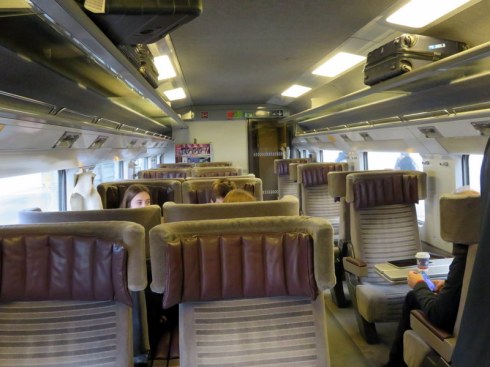
EuroStar interior, photo taken on our December 2015 trip. Spacious. The TGV and FrecciaRossa trains are excellent, too. We like the configuration with the table between us, like you see on the right.

EuroStar interior, photo taken on our December 2015 trip. Spacious. The TGV and FrecciaRossa trains are excellent, too. We like the configuration with the table between us like you see on the right.

Now to the Planes vs. Trains discussion.
If we have a 3-hour train trip to Milano, we can travel door-to-door—from our apartment in Roma to our hotel in Milano—in 5 hours. We are relaxed, have been given espresso and wine on the way, we probably would have had WIFI access, and there would have been no need to disrobe and be x-rayed to prove we are not carrying anything hazardous.
Our 2-hour-and-40-minute flight to London took 8 hours door-to-door. In fact, 4½ hours after leaving home, we were just leaving Roma, taking off from FCO. I don’t need to tell you what the security experience was like, but we walked about a kilometer through the airport just to get to the bus that would drive us to the gate. On board we ate sandwiches that were 75% bread and the coffee was undrinkable.
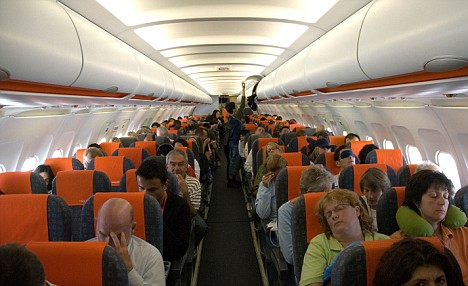
Interior of Easy Jet airplane with passengers. Courtesy of EasyJet. Yeah, this is fun.

Interior of Easy Jet airplane with passengers. Courtesy of EasyJet. Yeah, this is fun.

We will return to London in April–a trip scheduled and partly paid for before Derek’s surprise voyage so no sense canceling. However, we will do the April trip in style: TGV to Paris for a few days, EuroStar to-and-from London, and a 3-night stopover in Dijon on the way home just because. Our roll-aboard bags will be back in service.


Green & Clean Austria

27 Feb
Austria is amazingly clean. Cleaner than I had expected. I had read that Austria is a haven for smokers due to lax laws so I expected to find cigarette butts all over the street and chain smokers in every doorway. Not the truth! Only once did we enter a restaurant where there was significant smoking and they had a separate room for non-smokers. It is simply a country where people care: they pick up after themselves and nurture the environment.  
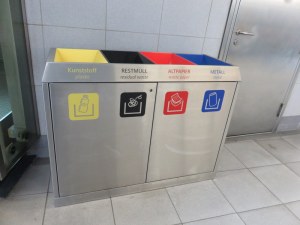
Clearly labeled and frequently emptied recycling center in public. Roma is not quite so neat....

Clearly labeled and frequently emptied recycling center in public. Roma is not quite so neat….

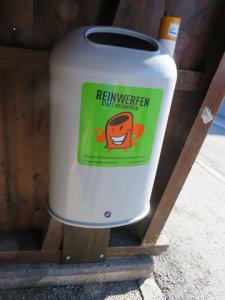
Recycling is widely encouraged and supported by sturdy containers clearly marked for the purpose. They also appear to be emptied frequently. Litterboxes are everywhere, complete with a little smokestack for butts. Never saw one overflowing. We rarely saw a cigarette butt in the street. So very different from Roma. I think we saw dog poop once on the ground in 10 days in-country. I see it ten times on my way to the bus stop in Roma.
Typical refuse receptical in the street. Note the little chimney for butts.

Typical refuse receptacle in the street. Note the little chimney for butts.

In our hotel rooms, we found the usual signs saying that if we wanted to reuse our towels we should having them on the racks and thus save on water use and laundering. Nine-times-out-of-ten when we do this the maid replaces them anyway. Not in Austria! We hung up our towels for reuse and the maid left them.
We actually enjoyed going to the laundromat in Salzburg. There is a small chain called GreenandClean throughout Austria with a couple of outlets in northern Italy. Totally unattended and automatic, it was amusing trying to figure out how the machines functioned. We were there with a mix of locals and travelers all trying to figure out the system. One of the features is that an ecological detergent was used, so one did not add one’s own soap or other ingredients, but signage was a bit obscure so it was difficult to figure this out. Ric noted a young guy put two giant scoops of detergent in his washer anyway. We should have stuck around to see the foam. The place was sparkling clean, so clearly someone comes in to tidy up daily, but it was also obvious that people picked up after themselves. The one laundromat we have visited in Rome has a full-time attendant. Even so, about half of the machines are broken and if you can avoid it, you would not want anything falling on the floor.
Golden Orb Guy statue in Salzburg, gazing up at the fortress.

Golden Orb Guy statue in Salzburg, gazing up at the fortress.

I skipped writing about Salzburg earlier because we had moved on to the Pillerseetal and I wanted to write about that area immediately. That is not to say we didn’t enjoy Salzburg. Quite the contrary! We wish we’d had one more night there even in winter. After reading Rick Steves, it seemed two nights would be sufficient, but he seemed focused on beer drinking. I think he sold Salzburg short. We have loose plans to return in more clement weather for as much as 5 days, affording side trips to Berchtesgaden and the Salzkammergut.
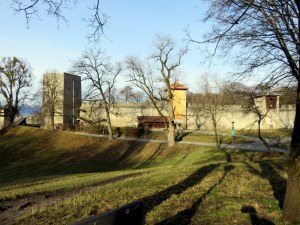
Hohensalzburg Fortress as viewed on our little hike across the Mönchsberg. it is huge!

Hohensalzburg Fortress as viewed on our little hike across the Mönchsberg. it is huge!

With only one full day in the town, we had to choose carefully what to do. Since the day dawned sunny, with rain forecast for the afternoon, we had to be outside. Salzburg’s mountain, the Mönchsberg, afforded us a lovely if chilly hike on a clear morning and the Hohensalzburg Fortress was well worth a visit. We thought it would be a walk-through, but were quite intrigued by the history and the well-curated displays so stayed much longer than anticipated. There’s an app on the free WIFI that serves as a self-guide with a clever cartoon version for children. I think a child of 6-11 would have a blast self-touring the fortress.
One of the things we really love in Europe is that no matter where you go -- even a medieval castle high on a hill -- there will be a quality cappuccino available, served in a ceramic cup.

One of the things we really love in Europe is that no matter where you go — even a medieval castle high on a hill — there will be a quality cappuccino available, served in a ceramic cup.

We did not make time for a concert here in the birthplace of Mozart. His influence is everywhere, right down to the Mozartkugeln or “Mozart’s Balls” sold everywhere.
We only licked windows and did not purchase anything, but Salzburg looked like a great town for fashion as well as mountain sports attire.
The restaurants – at least the ones we found – were not as creative as those we found in Vienna, although Organic Pizza was a highlight. We found plenty of good Grüner Veltliner to drink.
Lovely walk on the Mönchsberg.

Lovely walk on the Mönchsberg.

So why did we like Salzburg better than Vienna? The weather was only slightly better. I think the quaintness of the old town that is highly pedestrianized, the riverside location, the mountains looming over the town, and the views make Salzburg a more Ric-and-Laurel kind of place, a far cry from the big city. We love Roma, but one does get tired of the mess and noise, and when we travel we gravitate to quieter places where the sound of motorini is not omnipresent.
Can I tell you how much we appreciate that train stations are putting in lifts to platforms? After years of hauling our luggage up-and-down stairs between platforms, this is a blessing.

Can I tell you how much we appreciate that train stations are putting in lifts to platforms? After years of hauling our luggage up-and-down stairs between platforms, this is a blessing.

I have to say that in Italy since the stiff fines for tossing cigarette butts in the street went into effect February 1, there are fewer of those overall though in Roma the cracks in the sampietrini are still full of cigarette butts. Apparently no self-respecting Austrian would dream of tossing a one in the street. And why would they need to when the cities and towns provide adequate sanitation stations?
If Roma could put all the mendicants to work cleaning the streets instead of holding their ball caps upside-down outside of bars, it might be a win-win for the city.
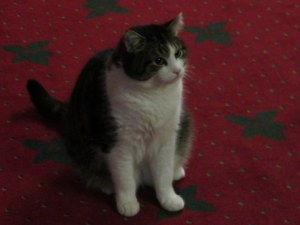
Frankie the hotel cat at Landhotel Strasserwirt.

Frankie the hotel cat at Landhotel Strasserwirt.

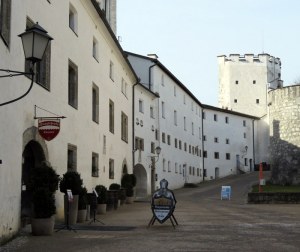
Golden Orb Guy as viewed from the fortress above.

Golden Orb Guy as viewed from the fortress above.

One of the intriguing exhibits in the fortress.

One of the intriguing exhibits in the fortress.

Cute little cafe at the Hohensalzburg Fortress. No plasticware and paper plates.

Cute little cafe at the Hohensalzburg Fortress. No plasticware and paper plates.

The road less traveled in Austria

23 Feb
People traveling to Europe are often dismayed to find huge crowds everywhere they go. Firenze, Venezia, and Roma, not to mention Paris, Zermatt, Vienna, and Salzburg, are popular for a reason: they are beautiful and there is a lot to see and do. Everyone has heard of them. Everyone wants to go there. We do too. We’ve been to all of these places and many more but we also try to go places that are truly off the proverbial beaten path. Torino, the Val Gardena, Abruzzo, Porto Santo Stefano, and Procida are places unaccustomed to seeing very many North Americans and we’ve enjoyed these visits as an escape from the usual suspects such as the Cinque Terre and Sorrento, though we enjoy the latter as well.
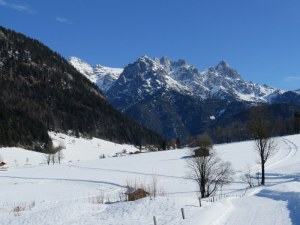
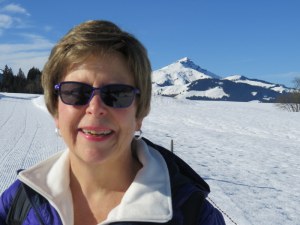
Beautiful country. The only downside is that our hiking is at lower elevations.

Beautiful country. The only downside is that our hiking is at lower elevations.

Continuing to find places new-to-us, this week we are in the Pillerseetal (Pillersee Valley)  of Austria. Specifically, we are between two tiny towns: St. Ulrich am Pillersee and St. Jakob in Haus, staying at the charming and low-key Landhotel Strasserwirt  for some winterwandern or winter hiking on groomed paths. Yeah, it’s a thing in Europe. We’ve done winterwandern in Switzerland and Ortisei as well.
Loving the sun! Had a bit too much of the gray skies and rain in Vienna and Salzburg.

Loving the sun! Had a bit too much of the gray skies and rain in Vienna and Salzburg.

This is a destination patronized mostly by Austrians and Germans, with a smattering of other Europeans. Luckily English is widely spoken in Austria, although my college German comes flooding back at most unexpected moments. (I’m hoping it doesn’t push the Italian out.) The menus can be a little challenging to figure out, but that’s part of the fun. As long as I avoid anything with the word leber (liver) or blut (blood) I should be OK. The wines are excellent, too. We drank a lot of Grüner Veltliner in Vienna and Salzburg. Here we have turned to the Zweigelt, a generally lighter red with notes of berry and cherry, appropriate with the mountain cuisine of the hotel. As always when we leave Italy, we miss the ubiquitous bars with €1.00 espresso shots. There are no damn bars in these tiny towns so we are coffee deprived. 
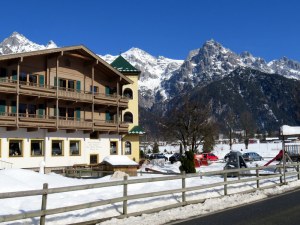
Our home for 4 nights, Landhotel Strasserwirt.

Our home for 4 nights, Landhotel Strasserwirt.

We have certainly found a quiet, no-stress, restful retreat from the city. The scenery is excellent and the prices are low. All-in-all we prefer the hiking in all seasons that the Berner Oberland of Switzerland offers. There the amazing system of lifts and trains and rifugi offering coffee and lunch along the trail are an unbeatable combo, but the prices in Austria make for a more affordable trip. Here is a place a family of four can pass a week enjoying the horses and lessons, two-meals-a-day, and mountain activities nearby for €1700.00. Can you do that in the U.S? I don’t know, but I suspect you’d have to have a car to do it, and here you can do it car-free if you like thanks to the network of trains and buses.
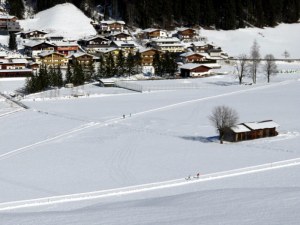
Here we are high above the valley on a hiking trail. with Nordic trails criss-crossing below us. See the tiny people?

Here we are high above the valley on a hiking trail. with Nordic trails crisscrossing below us. See the tiny people?

In the Pillerseetal there is a convergence of downhill skiing, Nordic skiing, and hiking, something for nearly everyone. The Dutch are apparently having their winter break so we see school-age kids and their parents heading to the slopes, but there are no huge crowds.
As I write this we’ve spent 2 ½ days taking hikes of various lengths in decent weather. Some would say it is too warm, and the Austrians would love to see more snow. It has begun to rain this evening and we hope to experience snowfall ourselves before we depart the day after tomorrow. It’s been a very long time since these Minnesota and North Dakota natives have seen significant accumulation.

Night train to Vienna

21 Feb
Does that title conjure up images of The Third Man: Harry Lime and Holly Martins with the lovely Anna prowling about post-WWII Vienna, chasing through dark streets, sewers, and buildings reduced to rubble? The movie paints Vienna as a bleak and dreary place, certainly not the city of Mozart and Schubert.
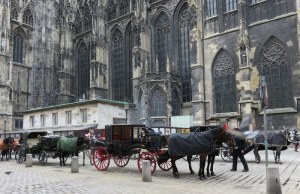
The Stephanskirche in Vienna is very dark and grim inside and out.

The St. Stephens Cathedral in Vienna is very dark and grim inside and out.

We found Vienna to be quite bleak as well. Perhaps it is just the weather, which was rather like Seattle in winter, only colder. Skies were gray on gray, with winds that chill the neck and beg one to wrap the scarf more tightly.  We feasted our eyes on the riches of the Habsburgs in all their excess: The Hofburg Palace, Kunsthistorisches Museum (KHM for short; marvelous!), and the Schönbrunn Palace. We walked through diverse areas of the old city, marveled at the musical heritage of this one small burg, and ate non-Italian food for days. We did miss our €1.00 espresso shots and accessibly priced Italian wines, but my, the bread and pastries were tasty!
Settling in for a night on the train.

Settling in for a night on the train.

The night train was fun and we would gladly do it again. We had a large private compartment for less than the price of two one-way airline tickets and a night in a hotel plus airport transportation on both ends. The compartment even had a bathroom, although coaxing hot water out of the shower proved to be an impossible task. We slept far better than we expected to and greeted the new day in Austria with breakfast served in our compartment. All-in-all it was a lovely evening and night, affording us the opportunity to hit the streets of Vienna upon arrival.
The Schoenbrunn Palace of 1441 rooms rivals Versailles. It dates to the 16th century when it was, of course, built as a hunting lodge. Inside is 18th century Rococo.

The Schoenbrunn Palace of 1441 rooms rivals Versailles. It dates to the 16th century when it was, of course, built as a hunting lodge. Inside is 18th century Rococo.

The Habsburg wealth and excess gave us pause to consider excesses and royalty. It seemed even more excessive than that which we have seen elsewhere in Europe. Perhaps because Austria is now such a small country it is difficult to reconcile with the once great status of the empire and the family that acquired such wealth.  It is a wonder the Austrian people didn’t do to the Habsburgs what the French did to the Louis XVI and Marie-Antoinette in the French Revolution. (Nota Bene: Marie-Antoinette was a Habsburg by
The backyard at the Schoenbrunn Palace.

The backyard at the Schoenbrunn Palace.

birth.) Empress Elizabeth, AKA, Sisi, seemed to be worshiped in the eponymously named museum within the Hofburg Palace. While it was fun to see the gowns and elegance of the time, she was a tragic narcissist who had ankle-length hair, a penchant for the finest chocolate Demel could deliver, and despised being married to the Emperor. Not much to admire in my book. 
For more on the riches and sights of Vienna please click on any picture below for a slide show. 
The silver lining to winter city-trips is that sites are not crowded. While weather prohibited sipping coffee in a sunny square, we enjoyed crowd-free touring and waltzed right into the museums and palaces. To be fair, even with 2 ½ days we failed to see all Vienna had to offer. Wish we’d had time for the Klimt Museum at the Belvedere Palace.
Typical wurstel stand in Vienna. YEs, they are much patronized. No, we did not.

Typical wurstel stand in Vienna. Yes, they are much patronized. No, we did not.

The food surprised us. Our dinners were anything but formula Austrian. Fresh fish and creative treatment of vegetables surprised us, although of course one can find schnitzel, too. Wine by the bottle is expensive compared to our beloved Italy, but restaurants offer a remarkable selection of wines by-the-glass at prices that make a bottle seem unnecessary. We are now big fans of Grüner Veltliner, the exceptional Austrian white wine.
The Vienna U-Bahn employs an honor system we’ve not seen before. There are no turnstiles or gates. You are responsible for buying and carrying a validated ticket or pass, and there are spot checks. We sashayed on-and-off a few times, then the last morning on our way to the train station encountered an army of ticket checkers at Schwedenplatz – at least a dozen strong – randomly looking at tickets and passes. The system made transit quite smooth. I wonder if it could be made to work in Rome?
My travel companion of 31 years and a bottle of prosecco to start the trip.

My travel companion of 31 years and a bottle of prosecco to start the trip.

For anyone planning a trip to Vienna, I have three recommendations.
  1. Hotel Stefanie is just past the Danube Canal to the north of the Ringstrasse. Old-world in style, but upgraded for modern travel with powerful showers of never-ending hot water (unlike Base Camp Barton in Rome), WIFI, and an enormous breakfast buffet. The tram to the center runs right by the front door. Off-season we paid €106.00 per night.

    Lovely fish and vegetable dish at El Hans. Delectible and pretty.

    Lovely dorado and bok choy with potatoes at El Hans. Delectable and pretty.

  2. We had incredible meals at El Hans and ef16 both within walking distance of the hotel. Certainly you can get Wienerschnitzel, but why do so when there is freshly grilled octopus, calamari, trout, pumpkin soup, violet mashed potatoes, and figs at every turn? How does Austria manage to do vegetables so much better than Switzerland?
  3. A transit pass for three days was very worthwhile. Although we walked 9-10 km daily, the weather frequently made jumping on the tram a good idea. No need to buy a Vienna Card. As seniors, every museum gave us a discount upon asking (the low end of senior defined as a youthful 61). 
More to come…Salzburg and the Pillerseetal ahead!


Things to do in Roma

11 Feb
I am frequently asked for ideas on what to do in Roma. After all, we have people house-and-cat-sitting all the time, often for 2 or 3 weeks. And living here, we certainly have to get beyond the usual suspects.
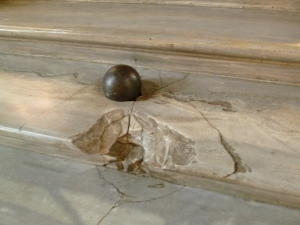
Embedded in the steps of the Great Hall of Galleria Colonna, this cannon ball dates back to the Risorgimento.

Embedded in the steps of the Great Hall of Galleria Colonna, this cannon ball dates back to the Risorgimento.

Everyone knows the Colosseum and Vatican, and probably the Galleria Borghese. While these should not be missed, there are many other lesser-known sights to consider. You might also enjoy reading my blog on the subject of off-the-beaten-track ideas.

Palazzi, museums, events, and exhibits

From April-November 12, 2017, there are once again special events in the Forums, a guided walk through Caesar’s Forum at night, and a multi-media show in the Forum of Augustus. You can find info at Viaggio nei fori. There’s nothing like a lovely outing after dark on a warm summer night. Take a break during the heat and head out after an early dinner for these events. I would do both, if not necessarily on the same night. If you have trouble reserving online, do not hesitate to call. They speak English.
Domus Romane at Palazzo Valentini is not the usual Roman ruin. Everyone we send here says it is one of the best things they did in Roma. Beneath a government building in the center of Roma, just off Piazza Venezia, are the excavated ruins of a Roman palazzo. You walk across a Plexiglas floor to view them, enhanced with a multimedia presentation to illustrate what things looked like 2000 years ago. Only three English tours daily so be sure to reserve online in advance.
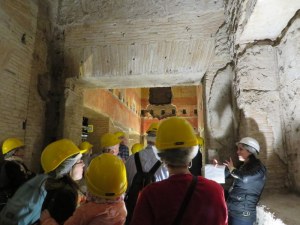
Hard-hat tour of Nero's

Hard-hat tour of Nero’s “Golden House,” the Domus Aurea.

Domus Aurea, Nero’s Golden Palace. Who can resist? It is legendary, although the goldenness is long gone. The restoration project is ambitious given the size. Visit the website and click on “Opening Hours.” Be aware, it is cold underground and even in summer you’ll need a jacket!
We went to Villa Torlonia a couple of years ago on a sunny February Sunday and enjoyed it very much. Recent guests told us that more has been done and one can even visit Mussolini’s bunker from WWII. The entrance fee to see all of the buildings is a little expensive, IMHO, but worth seeing for architecture buffs. La Casina della Civette is quite unique.  The Mussolini Bunker is priced separately from the main buildings.
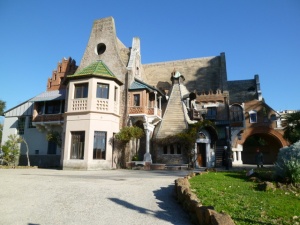
Villa Torlonia

La Casina delle Civette at Villa Torlonia, a curious mix of styles.

Galleria Colonna  is only open on Saturday mornings with an English tour at noon. We went early and had a wander around, then took the tour. Lovely private collection in an amazing building. The Colonnas are an ancient Roman family and members still live in the palazzo in private apartments. We have not been to the Princess’ Apartments, but British friends said they were great, so we need to go back.
Palazzo Farnese, the French Embassy to Italy. This is an historic building with Michelangelo’s art and frescoes worth straining your neck to see. English tours only on Wednesday at 17:00 and you must reserve a few weeks in advance for security reasons.
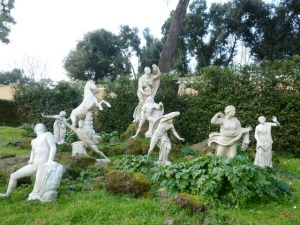
Villa Medici

Niobe suffers from hubris and loses al of her children. Gardens of Villa Medici.

Villa Medici, the French Art Academy in Roma. Open Tue-Sun with English tours three times each day. You will see what the gardens of a Renaissance Roman villa night have looked like.
The Palazzo delle Esposizioni has special art exhibits that are usually worthwhile. Recently we saw French Impressionists from the Phillips Collection in Washington, D.C. Very busy Sundays when Roman families seem to flock to museums. 
Palazzo Braschi Museo di Roma near Piazza Navona is an under-visited, very tranquil museum. Cool on a warm day and certainly a respite from the rain should that occur. Featuring art depicting Roma in days gone by.
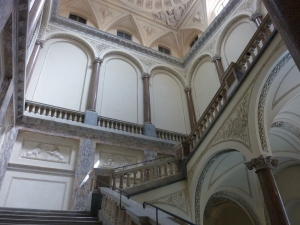
The massive staircase at Palazzo Braschi was like an Escher painting.

The massive staircase at Palazzo Braschi is like an Escher painting.

Galleria Doria Pamphilj in the historic center is also under-appreciated. It is yet another private collection in the old family digs. The collection includes Bernini, Caravaggio, Tiziano, Raffaello, and several Flemish Old Masters. The audio guide is excellent.
The Quirinale, the President’s Palace. Only recently opened for regular tours, thanks to President Sergio Matterella. Previously it was the Papal Palace (pre-Vatican days) and also housed four kings of Italy. Like visiting the White House, but security is less stringent and it’s fancier.
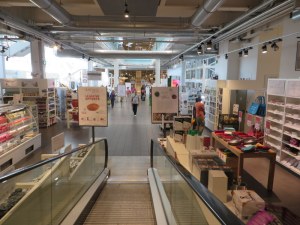
Riding the moving ramp down at Eataly. This is a huge place, built in what was an abandoned air terminal.

Riding the moving ramp down at Eataly. This is a huge place, built in what was an abandoned air terminal.

Eataly has two locations, a small one in Piazza della Repubblica, and the Mother Ship near Stazione Ostiense. I believe the larger store is worth the trip. Easy to stop on your way home from Ostia Antica (see below) with many choices for lunch. Eataly features Italian-made food products and a few non-food items. It is a showcase for all good things in the Italian food culture. Getting there once you reach Stazione Ostiense is a bit interesting, as I mentioned in my blog. You must persevere!
Looking to leave the crowds behind? Villa Farnesina is hidden away in Trastevere. Commissioned during the Renaissance by Agostino Chigi, a Sienese banker, it contains frescoes by Raphael and is lightly attended. 
Churches worth seeing: Santa Maria Sopra Minerva, St. Ignazio, San Clemente (the famous layered church), San Giovanni in Laterano, St. Paul’s Outside the Walls, Santa Maria Maggiore, Santa Prassede, San Luigi dei Francesi (the seat of the French Catholic Church in Rome) and others too numerous to mention. 
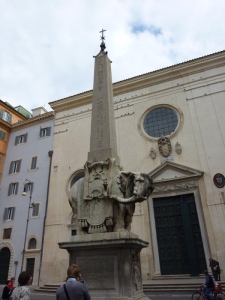
Bernini's elephant obelisk, Santa Maria Sopra Minerva.

Bernini’s elephant obelisk, Santa Maria Sopra Minerva.

Guided Tours

There are two places we highly recommend guided tours: The Vatican and The Colosseo/Foro Romano/Palatino.
Walks of Italy  does a special tour of the Vatican Museums and St. Peter’s, “The Pristine Sistine.” I highly recommend it. It is not inexpensive, but the groups are small (only 12 people), the guides are educational and entertaining, and you get to the Sistine Chapel before it is a hot mess of people.
For the sites of Ancient Rome, the Colosseo/Foro Romano/Palatino, a private guide is a great idea. For about €50-55 per hour, you get a personalized experience. Sonia Tavoletta (soniatavoletta63@gmail.com) and Francesca Caruso (francescainroma@gmail.com) are excellent. They will customize anything you want. If you have four-or-more people in your party, this is less expensive on a per person basis than many organized tours. 

Day Trips
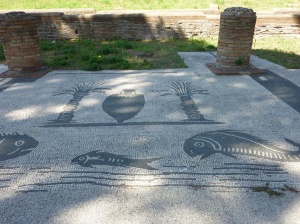
Ostia Antica. In the

Ostia Antica. In the “Piazzale delle Corporazioni” or Square of the Guilds. Mosaics depict services and products.

Ostia Antica is less than an hour away from Roma by local train out of Stazione Ostiense. What the volcano did at Pompeii, time and the river did to Ostia Antica. These are actually well-preserved for Roman ruins, and I find the Rick Steves’ audio guide (MP3 available at his website) and the guide in his book are excellent for self-touring.
Orvieto is a one-hour train ride from Roma Stazione Termini and a fascinating Umbrian hill town. There is a nifty funicular that glides up from the train station to the plateau. Great place to wander, see the Duomo, have lunch, shop a little. Again, I have to turn to Rick Steves and encourage you to consult his guide to make good use of your time. The underground tour is worthwhile!
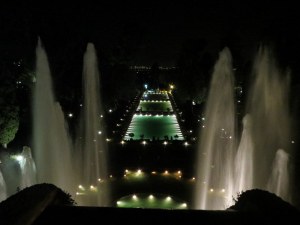
Fountains and pools of Villa d’Este, beautiful during the day, take on added drama at night.

Fountains and pools of Villa d’Este, beautiful during the day, take on added drama at night.

Tivoli is about an hour by train from Stazione Tiburtina and an excellent trip any time of the year. We’ve gone in August for the evening light displays at Villa d’Este, which makes a wonderful one-night trip (see my prior post here). We’ve gone to Villa d’Este in September and April as well, and to Hadrian’s Villa (Villa Adriano) in May one year. Villa d’Este is easily done by train, but I would suggest having a car to try to go to Villa Adriano. Alternatively, take a bus tour from Roma. (Haven’t done this myself but there are options through many tour companies if you care to research it.) I think Villa Adriano would be best with a guide. It’s vast and a bit confusing.
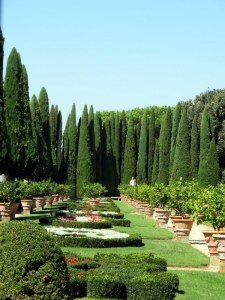
Formal gardens, Lazio Albano, the Papal Gardens

Formal gardens, Albano Laziale, papal estate.

Castel Gandolfo and the Papal Palace. The Apostolic Palace is where the popes up until Papa Francesco went to relax and escape the heat of Roma. Papa F doesn’t relax and eschews the trappings of papal wealth. Bravo! Thus, one can visit the palace almost any old time. Castel Gandolfo is a lovely little town with good restaurants in addition to the fantastic Papal Palace. It would be hard to combine with my next suggestion because the gardens one visits in the Vatican by Train tour are actually in neighboring Albano Laziale, but if you enlist a taxi and make lunch a quick panino you just might manage to do both in a day. 
The Vatican by Train  is an all-day event. You start with about 90 minutes to tour the Vatican Museums. (It is not enough time for the entire museum so you must pick a facet, a corner, and see what you can. We chose the Pinacoteca, which we had to ourselves for most of an hour.) Then you have a walking tour of the Vatican Gardens, which leads you to the San Pietro train station where you catch your private train to Albano Laziale and a tour of the papal estate there. You ride a train through these gardens as well. An audio guide is provided.
There are many other possibilities: Sperlonga for the beach, Frascati just because (porchetta and local Frascati wine), Tarquinia for the Etruscan museum and tombs (stunning!)…. 

Miscellany

10 Things you can do for Free in Rome from Italy magazine.
Coop Culture is the official ticket site for many Italian sites. Check them before using a consolidator, who will add on fees.  If you are going to the Colosseo without a guided tour, get your skip-the-line tickets from Coop Culture.
The Roma Pass can be worthwhile if you do the Colosseo, et.al., one day and the Galleria Borghese the next, making those your first two entries with the pass. Otherwise, forget it.
Transportation tickets/passes. You can buy tickets for single trips for €1.50 at any edicola (newsstand) or tabaccheria (tobacconist). There are also passes for 24, 48 and 72 hours at €7.00, €12.50, and €18.00 respectively, which are usually available at the edicola or tabaccheria. A 7-day pass is €24.00. Details at ATAC.com. Note that few buses sell tickets on board. Buy before you board and validate or risk a huge fine. 
Transit Trip Planning is available here. If you are traveling with a smartphone, download ProBus, AutoBusRoma, or Moovit. You can research bus routes and get an estimate on when the next bus will arrive.
The books 24 Great Walks of Rome, Rome the Second Time, and 111 Things to Do in Rome are great for inspiration! I found all of them either at Amazon.com or Powells.com.
Movies in English are shown every week. Usually, they are posted on Friday for movies from Saturday through the following Wednesday. Check here for what’s on. Some of the theatres do not sell popcorn or anything else to eat or drink, so eat before you go.
Now you see why they say Roma una vita non basta! (Rome – a lifetime is not enough!)
If you have a favorite place I haven’t mentioned, please leave a comment.

Girovaga

Formerly GoodDayRome

Skip to content ↓