

Ric and I were able to “adopt” a daughter, a Marine serving in the embassy, and invited to attend her promotion from Corporal to Staff Sergeant Megan now serves our embassy in Bulgaria. We are looking to adopt another Marine soon.
Ric and I were able to “adopt” a daughter, a Marine serving in the embassy, and invited to attend her promotion from Corporal to Staff Sergeant Megan now serves our embassy in Bulgaria. We are looking to adopt another Marine soon.
Rome is ever-changing and full of surprises. Around almost every corner is not only a bit of history, but also encounters with people, art, and experiences that are in contrast with the setting. Sometimes it is a statue that has been there for years and years…

…but frequently we see performance art or installations that are more temporary.
Walking through the Villa Borghese one sunny Saturday in January, we happened upon a temporary installation of warriors on horseback, along with this rather unusual giant head. All made of a lightweight resin, I think. A few weeks later they had vanished.

This installation was in Villa Borghese near Piazza Napoleone in January. Now it’s gone…

Part of the same installation as the warriors
Another day in Piazza del Popolo, there was live art for Carnivale.

Many things to be found happen in Piazza del Popolo: Trains, politicians, concerts, street performers.
And yet another, this duo entertaining a crowd with a Zen-like balancing act.

Yes, also in Piazza del Popolo.
My favorite of late was walking into Piazza del Popolo on a Saturday and finding a shiny-red train engine on display with a backdrop of churches from the 17th century.

21st Century train, 17th Century piazza
Frequently on my way to work I see this lovely parade of horses being exercised.
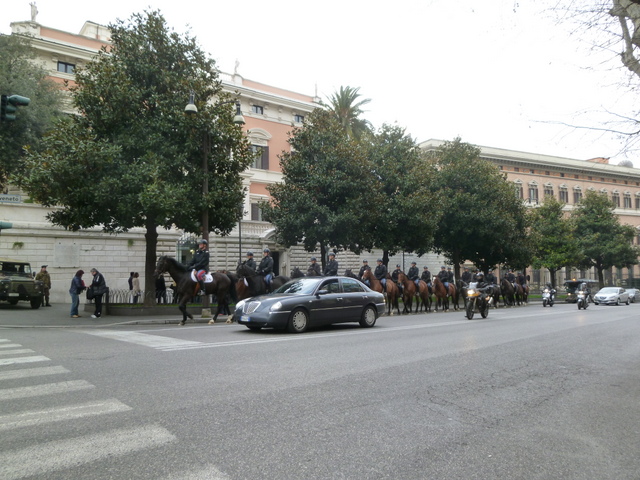
Many days the police exercise their horses, parading up the Via Veneto into Villa Borghese.
Yesterday we took a walk up Monte Mario, the highest hill in Rome at 139m (456 ft). Lovely day, fluffy clouds, not too hot, great view of Rome from above, and this.

Jeans drying in the sun, Parco Riserva Monte Mario
Never boring!
Banking, shopping, mammograms: there are many differences here in bella Italia.
Banking was invented in Italy. In fact, the oldest bank in the world is Monte dei Paschi di Siena, which is in deep doo doo over some questionable transactions…but I digress. We needed to open an Italian bank account so we could pay some local doctors’ bills. The process of opening the account was akin to closing on a house, only more difficult. It took several days and 3 visits to the bank, but no money was deposited until the account was open and we had a fistful of documents in hand to prove it. Only then were we allowed to deposit money.
And about depositing money: We get reimbursement checks from various sources that we deposit here rather than send back to the U.S. for deposit. One day I popped into the bank with four checks, totaling about $150. No deposit slip is necessary; you just tell the teller your account number. For a deposit of four checks, 10 pieces of A4 paper are generated. Each check requires two (one for me, one for the bank), and the deposit itself requires two (same drill). I signed five times to deposit four checks. They are very nice people, very accommodating, and the experience is very personal, as opposed to the no-human-touch-required ATM deposit. As long as our balance is correct…but many trees sacrificed their lives.
On the other hand, no trees are harmed in creation of bank statements: everything is electronic and self-service. When we opened our account, we received a random-code-generator token for secure access. It’s quite efficient and more advanced than the 3 online banking systems we access in the U.S.
Paying bills is a matter of making a wire transfer. If you want to pay a doctor’s bill, unless you are paying in cash which is quite common, you need the doctor’s International Banking Number as well as bank name. Simple and not too costly. I marched into the bank armed with this information only to be asked by the teller “what is this payment for?” Hmmm, seems a bit intrusive and personal to ask what I am paying a doctor for. How detailed to get? I mean what if you had something rather, um, sensitive and personal done? Do you blurt out “pap smear” or “wart removal?” (Neither of which were involved I might add.) I opted for a rather vanilla “medical consultation,” then hours later realized that without an invoice number, perhaps the recipient of the payment might find information beyond the patient name useful in matching payment to service. Still, a potentially awkward moment; No HIPAA rules here. I’m sticking with “medical consultation.”

Campo dei Fiori market. Let the vendor select your produce or risk a scolding.
Shopping has oh-so-many differences from the U.S. First, it can be rather disjointed. Megastores are few, and out in the suburbs. One may need to go to many stores to accomplish what a stop at Target would do. I like small businesses and wandering around Rome, so it’s an opportunity to poke my head into various establishments. But sometimes it is hard to know where to go to get what. Light bulbs, for example, are most likely in an electrical shop, although there are some in the larger grocery stores. Need a curling iron? Don’t try a beauty supply store; go to an appliance and electronics shop. Cosmetics? A profumeria of course. If all else fails, try a ferramenta, which is a household goods store with everything from toilet paper to wine glasses, but in the tiniest stores!
Store hours also need to be considered. The larger grocery stores are usually open continually, but a ferramenta or an electrical shop might close from 13:30-16:00. A large wine shop near us does this, even on a busy Saturday, as does Ric’s favorite men’s clothier. They re-open from 16:00-20:00. Since one does not eat before 21:00, these are prime shopping hours. Even the electronics giant Euronics takes la pausa on Saturday and they close on Sunday, limiting recreational shopping. Quality of life versus consumerism: interesting concept.
At the outdoor markets, like Campo dei Fiori (think large Farmers’ Market in the U.S.) one never touches the produce. Let the nice vendor help you. Be prepared for questions like “What are you going to use them for” when you ask for tomatoes: “For sauce or to eat?” You’ll get different tomatoes based on the answer. Or the fish monger might ask “How many people is this for,” then argue with you about whether you are buying enough. (He’ll also want to know your method of preparation.)

Pat the Bunny? No eat the bunny, Babyfood in flavors attuned to Italian tastes. I have not seen equine….
In the grocery store produce department, one dons a plastic glove, then bags, weighs, and prices one’s own produce. You won’t forget to do that more than once,because if in a moment of American-ness you get distracted and head for the checkout, the cassa will send you trotting back through the store to price the goods, holding up the entire line while you do so. Che imbarazzante! (I’ve only done it once.)
Milk is sold in shelf-stable cartons that do not have to be refrigerated until after opening, and eggs are always on the shelf at room temp. There is a staggering variety of pasta of course, and the best tuna ever, packed in olive oil. Who needs mayonnaise? Ethnic foods (Mexican, Thai, Chinese) are impossible to find in a regular store. There are specialty shops, but I have not sought them out yet. However, if your infant likes parmesan cheese, salmon, or rabbit, there’s a baby food for that.
 This picture says almost all you need to know about getting a mammogram here: there is no virtually useless “gown.” Just strip to the waist and belly up to the bar. I was warned by the Embassy Health Unit what to expect, and provided a paper gown to take along, but geez, really, did I want to be la Americana there with the Italian women, the only one shielding her girls with a flimsy gown that was mostly coming off anyway? So I went along with local custom. But there’s one more surprise for those of us from a sheltered, HIPAA-indoctrinated, North American, law-suit inspired environment: many of the mammographers are men.
As I entered the office of the senologist (breasts are their only business), I saw a man in scrubs with long gray hair, a little wild, who resembled an aging 60s rock musician. “Please God, don’t let that be my mammographer,” I pleaded silently. I waited with the other women and was relieved to be summoned to an exam room by a lovely young woman; Take off everything from the waist up and so we begin. But could this be a straightforward get-it-done process? Of course not! She’d get me arranged in the machine then open the door to the adjoining suite and ask a question. She set me up again, and with my breast pressed inextricably between two plates of glass, open the door to the reception area and talk to another person. At one point she left me hanging (literally and figuratively) for about 2 minutes while she went through yet a third door and talked to someone else! At the end of the session she motioned to the chair where I had left my clothes and said I should make myself comfortable (Si accomodi usually means make yourself comfortable, have a seat; but I now know it can also be used as for “lay back and relax”) and wait for the doctor. To me comfortable (and relaxed!) is fully dressed, so I began to suit up. I had just put my bra on and had my arms in the sleeves of my blouse when a man in a white coat opened Door Number 3 and my tech beamed with a cheery Ciao bello! Buongiorno! As they consulted over some technical issue (I don’t know if he was a doctor or a computer technician), I buttoned my blouse and donned my sweater. Standing there awkwardly I asked if I should wait. “Sì” and another wave to the chair.
About 40 seconds later in sweeps another young woman who escorts me into the room where I thought the aging rocker was. Yup; He’s the doctor. I figured he was going to give me the “all clear” and I’d be on my way. Huge office with a desk on one side, mammograms up on the large computer screens, which the doctor is studying. On the other side of the office is an exam table, which the nurse escorts me to and tells me to undress. I ask: “What are we doing?” “An exam” she says, perplexed. I had heard they do ultrasounds on most everyone…. So I strip to the waist again and lay down (Si accomodi!), only to be left there, half-naked and certainly not comfortable, while the doctor makes a phone call and the nurse comes-and-goes a couple of times. They ask me for my last films (not handy – they are in Oregon), and finally the doctor does the ultrasound. I give great credit for thoroughness. My favorite part (tongue firmly in cheek) was when he motioned bare-breasted me 20 feet across the huge office to see my mammogram close up, and then back again to the complete the exam. My only question is why they even allowed me to dress between the two exams. I suspect an Italian woman would not do so, would know she was moving on through Door Number 1 for the sonogram.
In our own environment we know pretty-much what to expect, and I think in North America medical personnel tend to explain — maybe even over-explain — what you are to do, what is going to happen, what to expect. Here there seems to be a great assumption that one already knows what to expect. And of course in North America we have huge body-consciousness/privacy issues. Not worth having here….
I can hardly wait for a trip to the gynecologist.
The food in Sicilia, and most especially our experience in Tràpani, is amazing. It is perhaps the best part of the trip: that and the people.
I am known by many of you to make a fine Köttbullar or Swedish Meatball. Beef, pork and veal meatballs flavored with nutmeg in an artery-clogging cream gravy. These are the taste of my childhood.
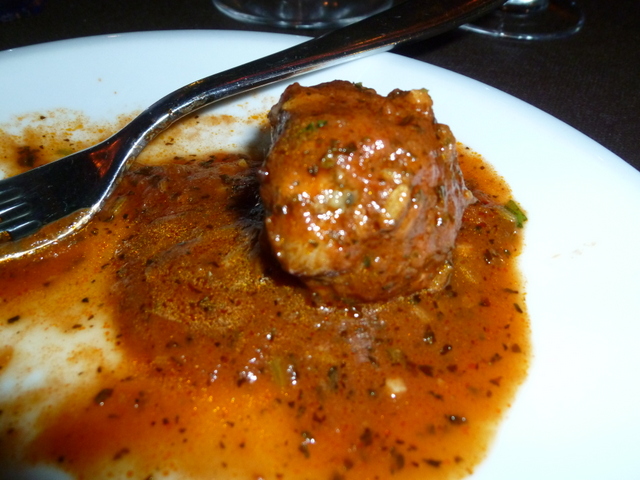
“Fish balls’ does not do justice to this masterpiece. Better in Italian “Polpette di Sarde in Sugo.”
Normally I would not be one to order the unfortunately named item “fish balls in sauce.” Luckily it sounds better in Italian. We’ve had “fish balls” twice: once made of swordfish (polpette di pesce spade) in Palermo, but of particular note were the ones we ate last night in Tràpani – polpette di sarde in sugo – made with fresh sardines and pine nuts with mint in a rich tomato-based sauce. I wanted to lick the plate clean. I am going to learn how to make these Sicilian wonders. Anyone who is open to my trial-and-error experimentation please raise your hand, you are invited for dinner.
The polpette antipasto and accompanying fish dinner were the highlight of our day Thursday. The weather, in a word, sucks. Cold, rainy, violently windy, impossible to partake in the outdoor activities we came for. We have barely glimpsed the Egadi Islands we came here to hike. We finally drove to Erice despite the clouds and during a rare respite from the rain, but found it too cold to walk around. Bitingly cold. (We didn’t think to bring puffy jackets and gloves on our spring trip to the south.) So we passed the day reading, writing, napping. Not all that bad for vacation but not what we had in mind. Friday presented us with more of the same only worse. The winds are about 40 mph so we hopped in the car hoping to escape the brutal coastal conditions and headed inland a bit, planning on seeing Monreale and a bit of the countryside off the autostrada. Ha! We were greeted with terrible traffic and closed roads due to flooding, and a downpour that turned into sleet and snow. We turned around. More reading time today and maybe more “fish balls” for dinner.
The weather reports indicate each day will be rainy. Luckily for us, the rain has held off until the afternoon each day, so as early risers we are able to seize the best part of each day. Since Sicilia is such an outdoor-oriented place, we are blessed, because an entire week of museums was not the plan.

Windmills near Mozia, in the salt pans of Western Italy.
We ventured to tiny Mozia, once an important site for Phoenician traders and a very affluent city in its time, today it is an uninhabited island in the midst of the salt pans of western Sicilia. Once again we are awestruck by the history – the truly ancient history – of this part of the world. You know the old saying: “A hundred miles is a long distance to a European and 100 years is ancient to an American.” When we encounter a place where construction was begun in the 8th century B.C., it gets our attention. Reached by a small launch in a 10-minute ride from the mainland, there’s a fine little museum and the opportunity to explore the island’s many excavations.
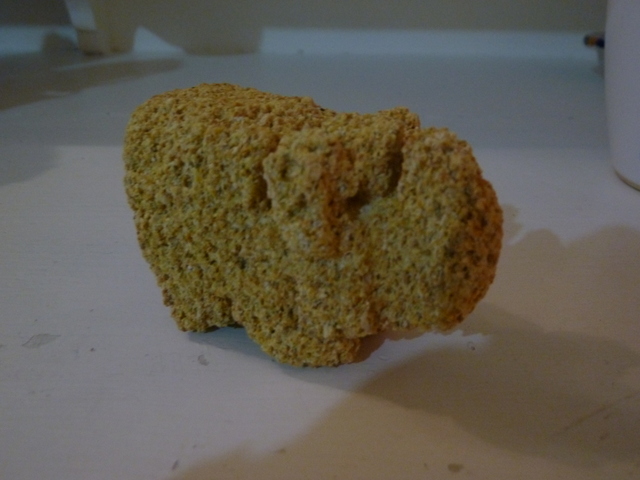
Little tufa elephant carved by Peppe Genna.
Perhaps the highlight, though, was meeting Peppe Genna, the “craftsman poet of the saltworks.” Peppe keeps alive ancient traditions of hand-making palm brooms and carving tufa animals, holding court alongside the lagoon, selling his crafts from the trunk of his car. What a character! You can Google him and hear him recite his poetry in Sicilian dialect.
Across the lagoon from Mozia is Marsala, where the Phoenicians retreated when Mozia was destroyed by Siracusa. Of course Marsala is famous for its wines, and it is heavily influenced by North Africa, resulting in a city the looks quite different from any other we have yet encountered in Italy. It has a lovely old center, very clean, with beautiful iron-work balconies. Perhaps not s huge vacation destination, but interesting if you are a) in the area, and b) a fan of Marsala wine.

Ruins at Mozia; Yes that’s me in the photo.
Erice continues to hide her head from us. As we returned to Tràpani in the afternoon, she briefly cleared, only to be socked-in again before we could mount an approach as it is quite a long drive to the top.
The food here makes amends for the marginal weather. Luckily we are walking enough to indulge, although we are not filling ourselves with pastries; rather with fish, beautiful vegetables, and fresh pasta. (There’s wine, of course, and some pizza. I am, after all, traveling with Ric.) On Mondays and Tuesdays many restaurants close in low season. Tuesday night we tried three places, in the rain, before we found one open near our apartment. Although light on
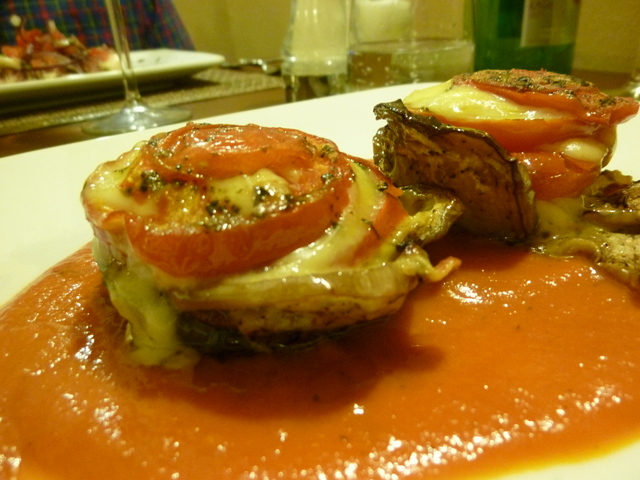
Torta di melanzane, carciofi, pomodori e formaggio. Yum!
customers this dreary night, the staff was gracious and the food divine. We feasted on octopus salad, a layered eggplant/tomato/cheese torte, pasta with sea urchins, and pasta alla Norma, prepared with eggplant and artichokes. All washed down with a fine local white wine and the meal rounded out with an almond semifreddo. We slept well after that meal.
Wednesday held a greater threat of rain – and still no view of Erice – so we braced for traffic and headed to Palermo. I was a bit worried about the reputation Palermo has for bad traffic, gritty neighborhoods, and tough characters. Nothing could be further from the truth. We encountered thoughtful, sweet people who helped us at every turn. (N.B: The drivers in Palermo are even less courteous about pedestrians than Roman drivers. That’s the only negative thing I have to say about the city.)
We navigated to a parking lot near a metro station so we did not have to drive through too

Parking chits look much like lottery tickets in Palermo.
much of the city. I knew parking had a “scratch off” system but really didn’t know what to expect. There are no automated ticket vending machines, so I entered a bar and inquired as to where I could buy a ticket. “Da me, signora,” said a soft-spoken, kind man who proceeded to quiz me about our plans for the day and how long we’d park, then explained the system: one ticket per hour paid, free from 14:00-16:00, so I would buy 4 tickets, one for each hour from 11:00-14:00, and 16:00-17:00, then scratch off year, month day and time, and place them on the dash. Interesting system. The parking lot was filled with cars that looked like they had lottery tickets strewn across their dashboards. As far as I can tell, the sweet man in the bar makes €.25 per ticket he sells. Plus the €1.60 we spent on caffé.

Gold mosaics, Middle Eastern influences, the 12th century Cappella Palatina.
Proceeding by metro to the historic center, we browsed Palermo, had lunch, and visited the brilliant and beautiful Cappella Palatina. This is a 12th century masterpiece that combines Byzantine mosaics and Islamic carvings with Latin Christian tradition. Amazing.
Retracing our steps to the metro, we planned on buying tickets at an automated ticket machine, but the two in the station were broken. Figurati! With trains only every half hour, we were desirous of taking the train that was just pulling in, and not having to go to the street again and search for tickets. So we jumped on the train and I went immediately to the Capotreno and reported our problem. (My Italian serves me well for these little transactions. I felt almost fluent in my fervor to get my problem across. To fail meant a big fine!) I asked if we could buy tickets from him. He asked me our stop, and told me to be seated, then left. Ric thought he was going to go get his book and write us a ticket for a fine, not for transit. But at our stop, he came out to ensure we were indeed leaving his train, wished us well, and with a smile encouraged us to buy tickets “la prossima volta.”
BTW, no rain until we were returning to Tràpani. Still no Erice in sight.
 Girovaga