Feeling German in Italy

25 Jul
A nice Italian man - who lives in NYC - offered to take our photo high in the Alpe at Puflatsch.

A nice Italian man – who lives in NYC – offered to take our photo high in the Alpe at Puflatsch.

I am feeling rather German – or perhaps more accurately, Austrian – right now for three reasons.

  1. I bought a pair of hiking shorts for the first time in 12 or 13 years. Thanks first to my vascular surgeon, but also to my personal trainer, my legs are in better shape than they have been in 25 years;
  2. We are drinking beer with lunch;
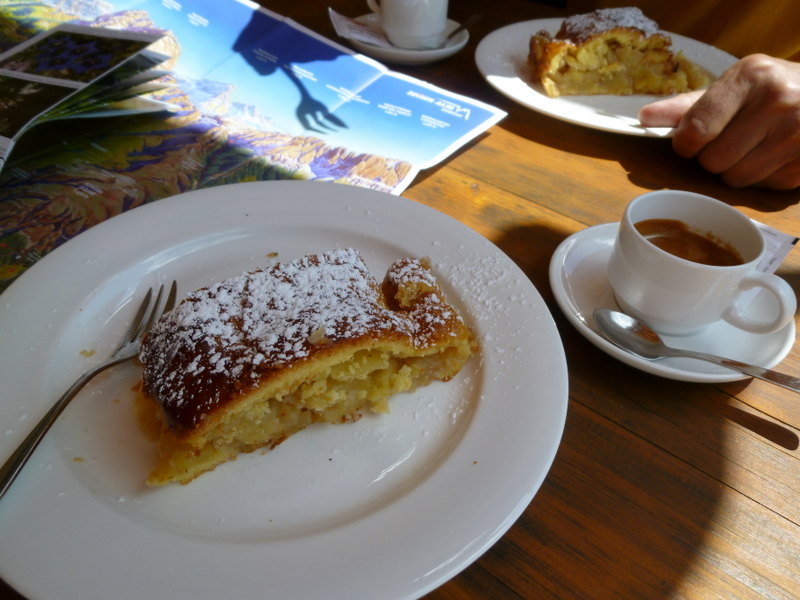
  3. We are eating apple strudel every day.

Even some of my high-school-and-university German is flooding back into my head, crowding the Italian I work so hard to speak. The other day I asked for a spiesekarte (menu) at a restaurant. What deep and obscure part of my memory bank did that come from?

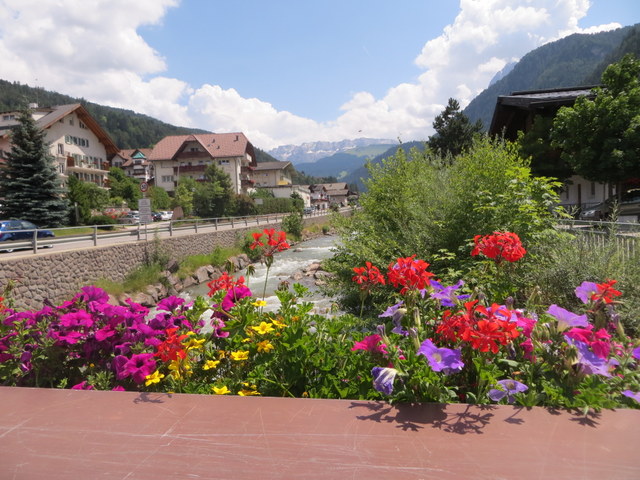
We are in far northern Italy, the Val Gardena, an area that was Austrian until the end of WWI and has kept its flavor more German than Italian. Here we see menus with spaghetti aglio, olio e pepperoncini alongside weinerschnitzel and strudel.

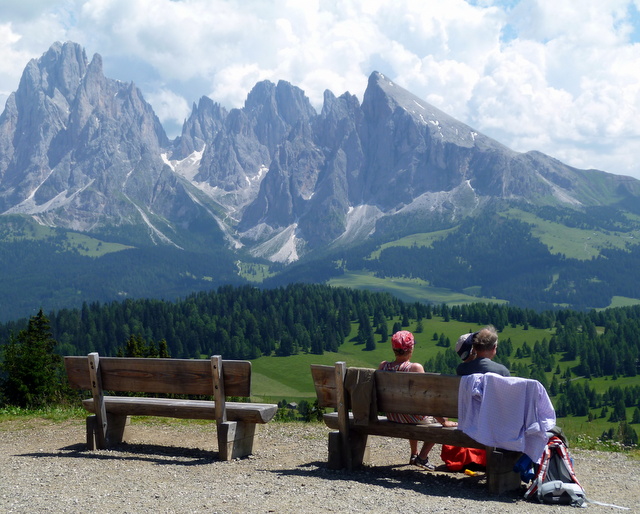
This is a hiker’s paradise. First stop, the Alpe di Siusi, the largest high-alpine meadow in Europe.  We scoped out the area on our

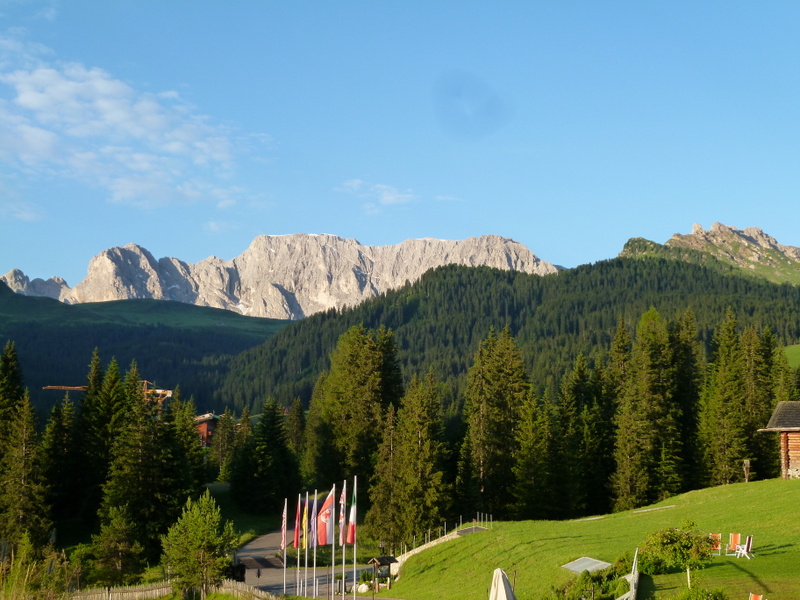
Sunrise on the mountains as seen from our hotel at Saltria.

Sunrise on the mountains as seen from our hotel at Saltria.

2012 trip to Ortisei and made a two-night stay in the meadow a priority this year so we could hike more up in the alpe (meadow). We chose the Hotel Saltria  for its relative remoteness. One train, two buses and the cable lift/gondola up to the meadow made for a varied travel day, proving you can visit the alpe without a car.  Hotel Saltria is a half-pension hotel: both breakfast and dinner are included in the per person price, something we’ve not experienced before, preferring to find our own dining options. Did I mention this place is remote? There are no other dining options. The food was plentiful and nicely done.

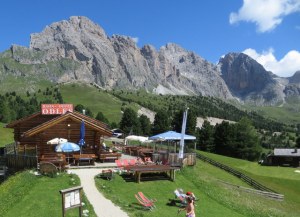
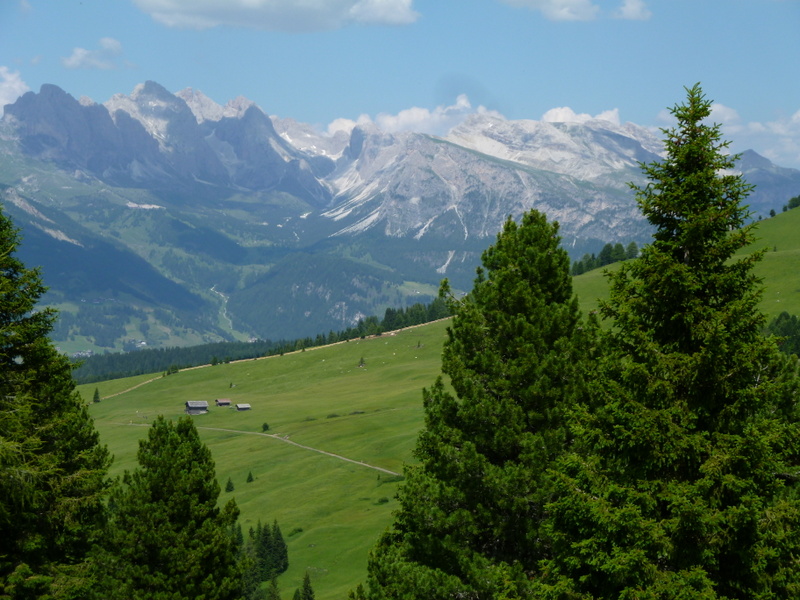
I didn’t really understand the Alpe di Siusi until we had visited. It sits at about 6000-6500 feet with mountain peaks towering over the meadow. The meadow is rolling, with tiny barns, haying operations, herds of cows and horses, crisscrossed with hiking paths for every level of fitness and dotted with wonderful little places called rifugi, refuges where one can take sustenance, quaff a beer, or spend the night. Ric said the word “refuge” brought to mind a rustic lean-to to shelter to use in case of inclement weather. Far from his description, in a rifigio you can find food to rival a café in a major city.

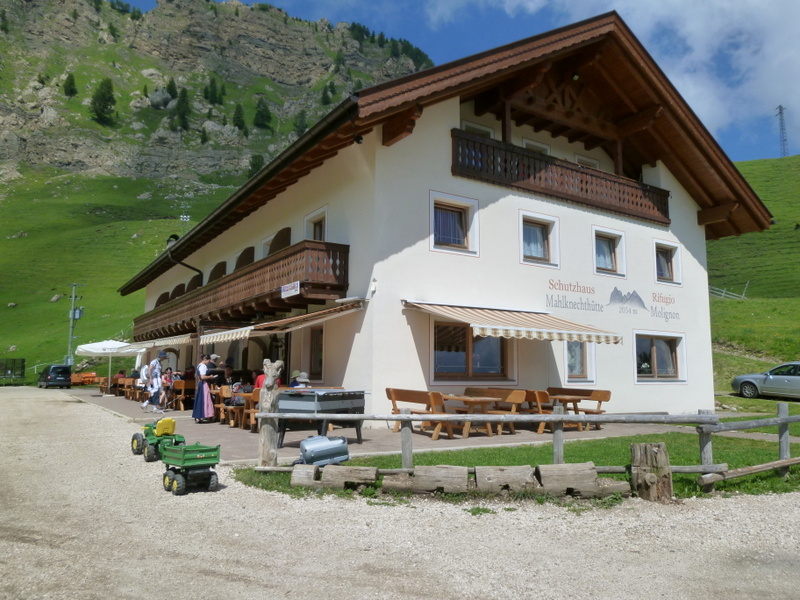
Rifugio means a place to refresh, eat, even take a room for the night.

Rifugio means a place to refresh, eat, even take a room for the night.

Monday we took the first bus out of Saltria, connected to a chairlift at Panorama, and set out on a four hour excursion, a loop that had us walking to a point where we could make our descent to the hotel at the end. This up-and-down hike allowed a stop for second-breakfast at cute Rifugio Molignon, serving apple strudel and great coffee.  We marched on through alpine splendor, ending at another rifugio for lunch before taking a final chairlift down.  For those seeking this particular journey, and for the record so I can look back at this blog and remember, after ascending to Panorama, we hiked to Rifugio Molignon, and then on to Rifugio Zallinger, ending at the Florian lift, using trails 2 & 7. It’s briefly described in Rick Steves’ guide where he calls the hike “moderately strenuous.” We’d agree!

Tuesday we only had time for a two-hour trek, but what a walk it was! Taking the Puflatsch-Bullaccia chairlift, we toured the north side of the Alpe di Siusi, looking back at the previous day’s venue and taking in the view down into the Val Gardena and little Ortisei, where we were to spend the next four nights. From the very edge of the Alpe di Siusi we could make out Castelrotto and see far to the north toward Austria before moving on to complete our hike, descend the Alpe and make check-in time at Ortisei. For the record, trails PU and 14 make a nice moderately easy loop.

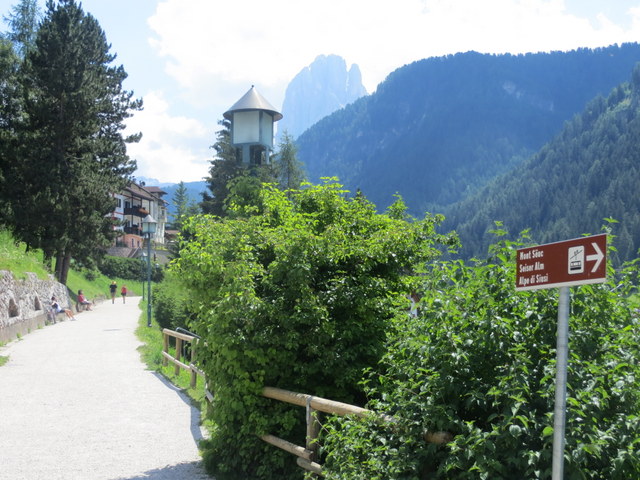
The trails are amazingly well-signed. You barely need a map once you have a vague idea of the area you wish to hike. The landscape

Well-signed trails make it easy to find your way.

Well-signed trails make it easy to find your way.

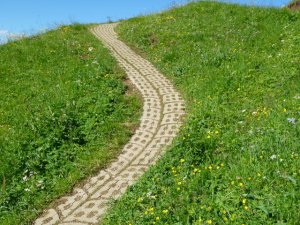
changes from lush meadow with wildflowers to alpine scrub, with rushing streams – some of which need to be forded – as well as forested glades. You hear only the sound of cowbells on the breeze, occasional bleating of goats, and the voices of passing hikers. Pure serenity seasoned with the odor of freshly mowed hay. Some paths are carefully laid rock while others are more traditional dirt. All are well-engineered for drainage. It is much easier to navigate than the Cinque Terre and much less crowded.

We made it to Ortisei Tuesday evening. But that part of the trip will have to keep for another post.  Time for dinner, but I cannot resist adding a few more photos to illustrate the beauty of this area.

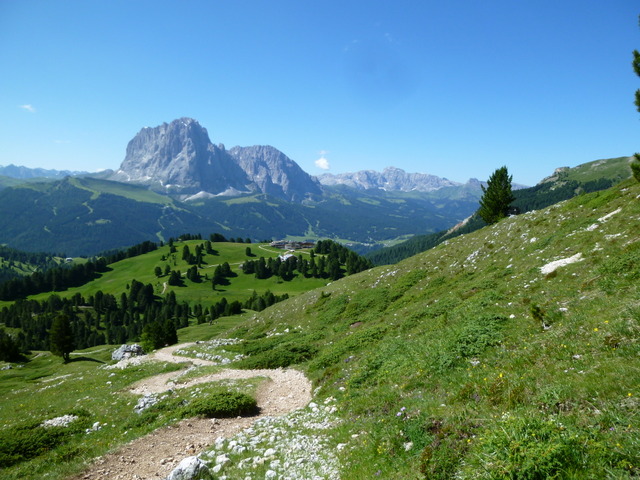
The varied landscape of the Alpe di Siusi.

The varied landscape of the Alpe di Siusi.

Chairlift at Florian

The way up…and the way down. Chairlift at Florian.

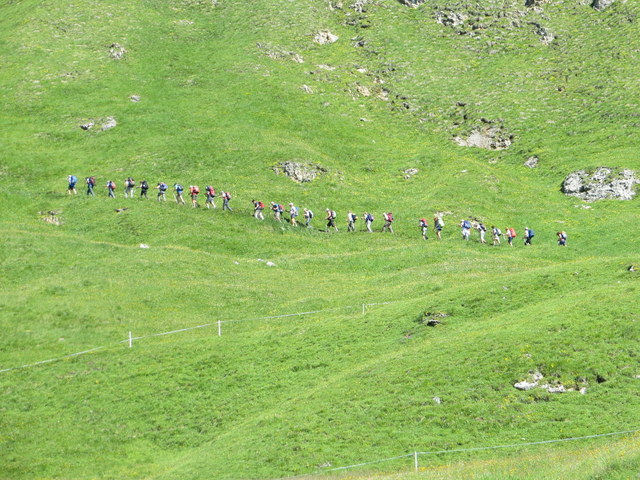
One of the fun aspects of hiking here is seeing the path you travel unfurl behind or in front of you.

One of the fun aspects of hiking here is seeing the path you travel unfurl behind or in front of you.

An apple a day keeps the doctor away....Does it count if it's in your strudel?

An apple a day keeps the doctor away….Does it count if it’s in your strudel?

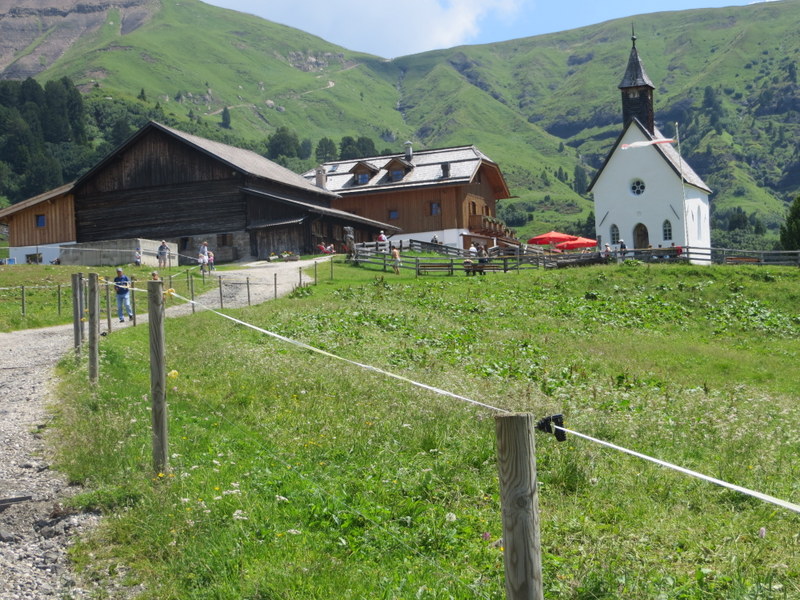
Rifugio Zallinger. Amazing location!

Rifugio Zallinger. Amazing location!

You can hike from rifugio to rifugio, for snacks, meals, rest, restroom. What a concept!

You can hike from rifugio to rifugio, for snacks, meals, rest, restroom. What a concept!

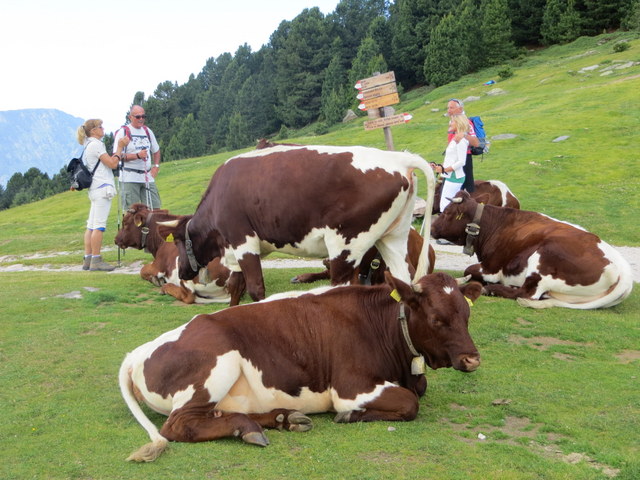
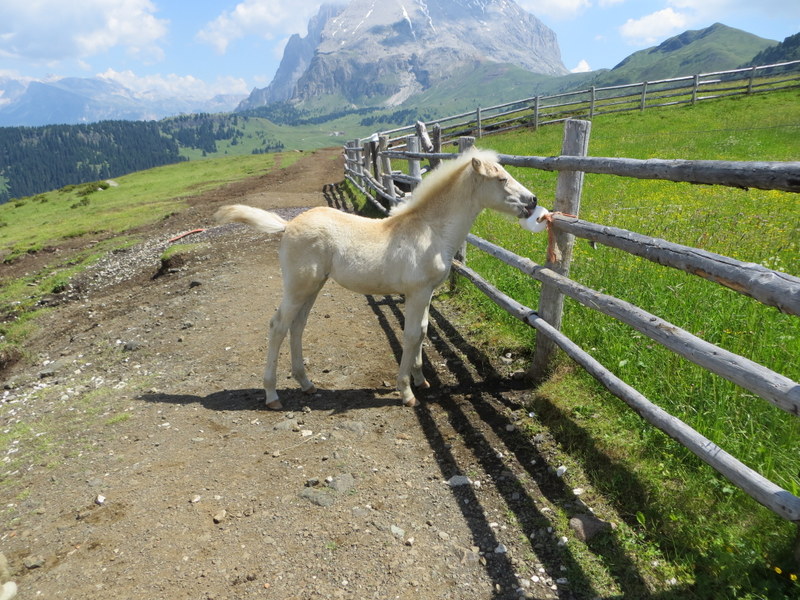
One segment led through a pasture with horses and cows.

One segment led through a pasture with horses and cows.

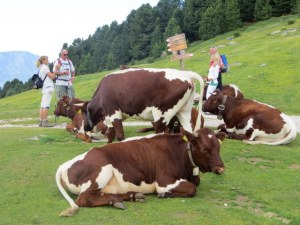
Cows have the right of way.

Yes, this is the trail. Cows have the right of way.

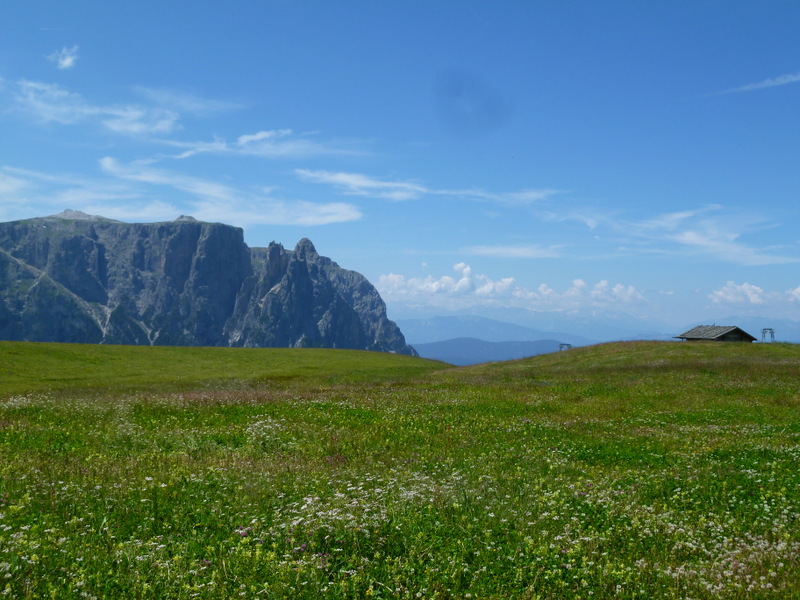
Alpine meadow view of the Sciliar

Alpine meadow view of the Sciliar

Cat on suitcase

Ric’s overbonded cat Janie planted herself on his suitcase as if to say “Don’t go.”

An evening with an American princess

18 Jul

America does not produce royalty…at least not too often. There was Princess Grace (Kelly) of Monaco, and we have Queen Noor of Jordan, but do you know about Principessa Rita Boncompagni Ludovisi of Rome? La Principessa is the former Rita Jenrette, a name which especially my Texas readers may remember. Rather then go into much about her, I offer this link, “The Renovation,” from the New Yorker as a bit of background.

Rita Jenrette Boncompagni Ludovisi explains the family crest and history of the villa.

Rita Jenrette Boncompagni Ludovisi explains the family crest and history of the villa.

Now back to my story. Wednesday evening I was invited on a special tour with a group from the Embassy. I am a docent for the Embassy and give tours, so I have been immersing myself in the history of the fabulous estate, which dates back to the time of Julius Caesar. When an American hears the word “villa,” we think “big fancy house.” Here a villa is often a park-like estate (Villa Borghese), with several buildings which may be grand palazzi (palaces) or simpler hunting lodges and villas as in the large-house definition.  Back in the day (think the Renaissance and the Baroque Period), Villa Ludovisi surrounded and included the site of the U.S. Embassy, the Palazzo Margherita. It comprised many acres and included several palazzi. It had been transformed over the years in many ways, and the property was sub-divided in the 19th century to create the great neighborhood surrounding the Via Veneto.

The tree Henry James sat under and wrote about.

The tree Henry James sat under and wrote about.

A mere stone’s throw from the Embassy is the charming Casino dell’Aurora, once part of this vast Villa Ludovisi, and now the home of the Boncampagni Ludovisi family. La Principessa Rita is overseeing the renovation of the house and the preservation of the historical documents and priceless art within. She personally conducted a delightful tour and greatly increased my understanding of this noble family. She is bright, articulate, kind, and passionate about her project, this fabulous renovation. Goethe, Henry James, Stendahl, and Nathaniel Hawthorne were only a few of the historic and notable guests. The family boasts two popes, one of which was Pope Gregorio, he of Gregorian calendar fame. I was privileged to see some of the original sketches created during the research of the calendar. Can you imagine? Original sketches from the 16th century?

Imagine having this over your dining room table? Fresco by Guercino, one of the most famous artists of his day. 17th Century, baroque.

Imagine having this over your dining room table? Fresco by Guercino, one of the most famous artists of his day. 17th Century, baroque.

There is a Michelangelo in the garden, frescoes by Guercino, and the only Caravaggio ever painted on a ceiling; not a fresco but in oil. My knowledge of famous Italian artists is growing, but I cannot begin to describe the who-and-what of everything in this very private museum.  The art alone is valued beyond €300,000,000. Bill Gates once offered to buy the place, practically sight unseen.

Amazingly, only within the past two years, ruins beneath the villa were discovered that are believed to be those of one of Julius Caesar’s palaces, conjectured to be the place he wooed Cleopatra when she was in Rome.

Princess Rita is a natural story-teller as one would expect from a Texan. What a joy it was to see this villa and meet the princess from Texas! 

Playful fresco with putti. Original, never restored.\ from the 16th Century.

Playful fresco with putti. Original, never restored; from the 16th Century.

Rita with bust of Julius Caesar, who had a palace on the same site, it seems.

Rita with bust of Julius Caesar, who had a palace on the same site, it seems.

Only Caravaggio ever painted on a ceiling.

Only Caravaggio ever painted on a ceiling. Too large for me to capture completely, sorry.

La Principessa and me. She remained cool on a hot day and I was melting. Perhaps her Texas blood prepared he for Rome. The chairs are papal "thrones" about 450 years old.

La Principessa and me. She remained cool on a hot day and I was melting. Perhaps her Texas blood prepared her for Rome. The chairs are papal “thrones” about 450 years old.

Waterless Weekend

14 Jul
This eroded lion head fountain is the only source of water for our while building of 14 condos. He's over 100 years old.

This eroded lion/hippo/whatever-head fountain is the only source of water for our whole building of 14 condos. He’s over 100 years old.

Living in Rome is a dream; we pinch ourselves almost daily. But for two days, it’s been a bit scomodo (inconvenient). We have had no water in the apartment. We had showers Saturday, but since about 12:30 yesterday, nothing. It seems the pump is out. Apparently the city feeds the property (a condominium building, about 110 years old), and the distribution is via an electric pump underground, accessed through a scary stairway.  The portiere (superintendent) is away for the weekend as he gets half of Saturday and all of Sunday off. And there is no one else to call. No management firm we are made aware of. Ric and I tried to reset the circuit breaker on the pump yesterday, to no avail. But thought we were just being stupid Americans not knowing what to do or who to call in an emergency.  Then today our 80-something-year-old neighbor, Signora Vyta (who may actually have lived in this building her entire life from what I understand), asked us to go with her to the pump and see if we could fix it. She was fed up. She’d called the portiere with no result, no answer, and she wanted to try and fix it. So Signora Vyta oversaw a second attempt telling Ric (in Italian) what to do to reset it and told us this happens a lot. Apparently never when we are at home. Just our luck this time!

Ric makes the umpteenth trip to fill a bucket. We have tons of bottled water on hand, too, because that's what we do in Rome.  And there's always wine.

Ric makes the umpteenth trip to fill a bucket. We have tons of bottled water on hand, too, because that’s what we do in Rome. And there’s always wine.

So how do we function with no water? We haul buckets in from the only functioning source on the property, a tiny little old-fashioned, 100-plus-year-old fountain, now controlled with a spigot. We use gravity to flush, and we went to the Embassy today to shower, a 2-hour round trip. I heated water on the stove to wash dishes, just like camping in the 1960s with my parents.

What’s worse, we had to cancel a dinner party planned for tonight! We’ve decided being without water actually sucks more than an Internet outage.  I only hope Emilio, our portiere, knows where to hit the pump with his magic hammer to get it back online tonight. 

Gravity flush. Just keep a bucket close by.

Gravity flush. Just keep a bucket close by.

Even further away…

13 Jul
Another cute Italian village, nestled in the Gran Sasso.

Another cute Italian village, Castelli nestled in the Gran Sasso.

Santo Stefano was only the beginning of our long weekend in Abruzzo.

Do you ever yearn for deserted roads? How about hiking trails with no oncoming foot traffic, nor any foot traffic at all for that matter? Have you encountered ponies in the woods? Or restaurants where you pay half of what you’d pay in the big city? Plus lovely people delighted to help you practice your Italian and artisans of magnificent pottery? Welcome to Abruzzo, in particular, welcome to Castelli.

Castelli is known for its ceramics, but is less famous – and less touristed – than the Tuscan destination of Deruta. We learned of Castelli quite by accident. In May, on our way home from Puglia we decided to spend a night in the mountains. On that trip, we selected a hotel in the tiny hamlet of Ornano Grande, right beneath the highest peak on the Italian peninsula, the Corno Grande.  Il padrone of the hotel told us we had to go to Castelli before we left the area. “Bellissima” he said, and he was right. It is rated as one of the most beautiful villages in Italy.  That brief taste convinced Ric and I we had to return to Abruzzo and to Castelli. Then, in what can only be described as a happy coincidence, when we mentioned this lovely place to an Italian friend he said, “That’s my mother’s home!” So with an insider’s knowledge we were directed first to Santo Stefano and then to Castelli and environs for continued rest and relaxation.

Castelli is tiny: really tiny. A couple of restaurants, minimal lodging choices, a generous number of

Abruzzo is not the pizza capital of Italy, but this salmon, mozzarella and pistachio pizza was to die for.

Abruzzo is not the pizza capital of Italy, but this salmon, mozzarella and pistachio pizza was to die for.

ceramicists. The views are amazing and the town has a great “hang out” factor, but lodging is not abundant. There are a few agriturismos in the area, and the Parco Nazionale Gran Sasso has a resort hotel nearby, but we wanted to be more in town. Luckily we found B&B Vecchio Mulino (Old Mill). There Luciana made us welcome at her modest but pristine home. Originally a mill, 13 years ago it was remodeled into a five room B&B. A quieter place does not exist. Only the babble of the nearby stream and the occasional crow of her rooster provided background noise.  Old Buc, her dog, quit barking once he knew we were guests, and the new kitten kept us entertained.  Goats, horses, chickens, and bees round out the livestock, and Luciana puts her homemade acacia honey on the breakfast table each morning.  As it was in a jar equipped with a pump, I almost had to restrain Ric from squirting it directly into his mouth.  Once again, we slept for 9 hours each night.

Castelli ceramics institute: gigantic nativity figures. Absolutely stunning in person.

Castelli ceramics institute: gigantic nativity figures. Absolutely stunning in person.

We hiked, we shopped for ceramics, and we ate too much: A perfect getaway! The residents were only too happy to help us find our way and enjoy the treasures of the area. One man, a ceramicist, encouraged us to go to the Istituto D’Arte “F.A.Grue” Castelli  (Institute of Ceramics) just up the road. This is a 107-year-old institution that attracts students and artists from all over. When we saw him later in the day, he we very disappointed we had not seen it – yet.  In fact, when we tried to go there it seemed closed.  By now it was almost 7:00PM, but he phoned his sister, who works at the school and arranged a private tour for us. It was truly a highlight!

Only 2 hours from Rome, we’ll go back for fresh, cool mountain air. Forest hiking, beautiful views, and the welcoming Abruzzese people again when we get a chance.  Following are a few pictures from the region.

There are two Castel del Montes in Italy: a true castle in Puglia and this charming town in Abruzzo. It suffered damage in the L'Aquila earthquake.

There are two Castel del Montes in Italy: a true castle in Puglia and this charming town in Abruzzo. It suffered damage in the L’Aquila earthquake.

Lovely fresco in Castle del Monte.

Lovely fresco in Castle del Monte.

Mosaic inlaid in a wall in Castel del Monte.

Mosaic inlaid in a wall in Castel del Monte.

Roadside picnic stop in Abruzzo, on our way to Castelli. A herd of cattle relaxed, unencumbered by a fence, just around the corner.

Roadside picnic stop in Abruzzo, on our way to Castelli. A herd of cattle relaxed, unencumbered by a fence, just around the corner.

This little guy was looking for apples or carrots.... Acted more like a puppy than a pony.

This little guy was looking for apples or carrots…. Acted more like a puppy than a pony.

I didn't get a great shop of this work in progress. The pony kept getting in the way. Momma horse was hauling firewood out of the woods.

I didn’t get a great shop of this work in progress. The pony kept getting in the way. Mamma horse was hauling firewood out of the woods.

Away from it all

8 Jul

People planning a visit to Italy often ask how to get away from it all: How to get off that proverbial beaten track, or through Rick Steves’ magical back door. They want to see places without so many tours and tour groups. We’ve found some less-visited spots in Rome (Beyond il Colosseo) but I daresay we really had a true escape in Abruzzo.

A rustic interior, furnished as it might have been hundreds of years ago.

A rustic interior, furnished as it might have been hundreds of years ago.

July 4 we headed out for Santo Stefano di Sessanio on the recommendation of Italian friends. “One night” they said. “You have to stay here one night.” The whole town is under renovation having been literally abandoned after WWII. The hotel is called Albergo Diffuso  because the rooms are scattered about in former residences. Peace reigns supreme with quaint streets, simple cuisine, and rustic but comfortable accommodations. As in much of Italy, building code is not what one might expect in North America. Case in point, the “stairway” to the bedroom portion of our suite was really more of a ladder, reminiscent of something one would find leading to the hayloft in a barn.  We loved the rustic simplicity combined with modern conveniences: candlelight, energy-saving switches, but a soaking tub and bath fixtures to rival many hotels. All surrounded by this charming, under-renovation village. Our rate included a suite, dinner, breakfast and a picnic basket to take away with us for lunch on the road the next day. English spoken? Some, yes, especially by the hotel staff; not so much in the shops or restaurants. Other guests were Italian. We met only one American couple passing through and a Canadian couple

currently living in Pescara. Here are a few more pictures from the hotel and town of Santo Stefano.

Deep soaking tub. Clearly not the type of plumbing one had 500 years ago.

Deep soaking tub. Clearly not the type of plumbing one had 500 years ago.

Ladder to our comfortable bedroom. one of many things I love about Italy. In North America building codes would never let this fly.

Ladder to our comfortable bedroom. One of many things I love about Italy: In North America building codes would never let this fly.

Ric in our rustic bedroom. A terrific night's sleep awaited us.

Ric in our rustic bedroom. A terrific night’s sleep awaited us.

One of the artigianale shops in Santo Stefano.

One of the artisanal shops in Santo Stefano.

What has been restored is picturesque. With all the work in progress, it will become even more lovely as it is restored.

What has been restored is picturesque. With all the work in progress, it will become even more lovely as it is restored.

For entertainment and exercise, we made our way to the rocca, or fortress, above Calascio, just down the road a piece. Situated at 1460m (4790 feet), we ascended on foot from the village of Calascio, about 820 feet of gain.  While much of the walk was on a paved road, the last bit was a scramble over rocks that afforded an unparalleled view of the castle, and just might have worked off the lunch Geppetto served us at his bettola (in English we’d say dive but it really was a cute little café).  We were virtually alone at the rocca. A few people came by car to the rifugio just below the rocca and walked up the last little bit, but we were the only ones who made the entire trek, which afforded us an ever-changing view of the landscape.

The rocca (fortress) above Calascio, as seen from about 820 feet below.

The rocca (fortress) above Calascio, as seen from about 820 feet below.

On our hike up to the rocca, the view from just above the village of Calascio.

On our hike up to the rocca, the view from just above the village of Calascio.

Getting closer as we climb, the size of the fortress is impressive.

Getting closer as we climb, the size of the fortress is impressive.

The last bit is a scramble over narrow trails and rocks.

The last bit is a scramble over narrow trails and rocks.

Of course such an outing demanded an Abruzzese dinner, which was served in what we Americans might call a tavern, reminiscent of pioneer days. Dining is hearty in this region: lamb, porchetta, roasted potatoes, strong cheeses. At night there was no noise, no light. We slept for 9 hours, something we never do in Rome.

Old fireplace in the "tavern" where one finds Abruzzese cuisine.

Old fireplace in the “tavern” where one finds Abruzzese cuisine.

Breakfast room, rustic and cozy.

Breakfast room, rustic and cozy.

Elegantly packed by the hotel, enjoyed along the roadside in Abruzzo.

Elegantly packed by the hotel, enjoyed along the roadside in Abruzzo.

We moved on to Castelli, but I’ll save that for a following post.

Girovaga

Formerly GoodDayRome

Skip to content ↓