Tag Archives: Rome

The Streets of Rome

22 Apr

Rome is ever-changing and full of surprises. Around almost every corner is not only a bit of history, but also encounters with people, art, and experiences that are in contrast with the setting. Sometimes it is a statue that has been there for years and years…

Statue

…but frequently we see performance art or installations that are more temporary.

Walking through the Villa Borghese one sunny Saturday in January, we happened upon a temporary installation of warriors on horseback, along with this rather unusual giant head. All made of a lightweight resin, I think. A few weeks later they had vanished.

Warriors on horseback

This installation was in Villa Borghese near Piazza Napoleone in January. Now it’s gone…


Terracotta head

Part of the same installation as the warriors


Another day in Piazza del Popolo, there was live art for Carnivale.

Street performers

Many things to be found happen in Piazza del Popolo: Trains, politicians, concerts, street performers.

And yet another, this duo entertaining a crowd with a Zen-like balancing act.

Yes, also in Piazza del Popolo.

Yes, also in Piazza del Popolo.

My favorite of late was walking into Piazza del Popolo on a Saturday and finding a shiny-red train engine on display with a backdrop of churches from the 17th century.

Frecciaroosso engine

21st Century train, 17th Century piazza

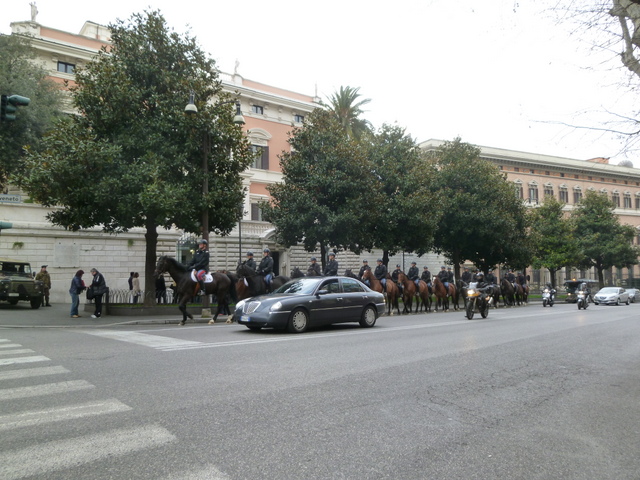
Frequently on my way to work I see this lovely parade of horses being exercised.

Cavelli di polizia

Many days the police exercise their horses, parading up the Via Veneto into Villa Borghese.

Yesterday we took a walk up Monte Mario, the highest hill in Rome at 139m (456 ft). Lovely day, fluffy clouds, not too hot, great view of Rome from above, and this.

Monte Mario

Jeans drying in the sun, Parco Riserva Monte Mario


Never boring!

Beyond il Colosseo

20 Feb

Beyond il Colosseo

Every guest wants to see il Colosseo, followed closely by the Vatican Museums, St. Peter’s, Villa Borghese, and many of Rome’s grand and well-known sites. But where do you go once you’ve seen all the most-popular sites? What treasures await those who have more time in Rome? Ric and I have made a point of visiting some lesser-known venues over the past few months and have found some true gems, virtually free of tourists, lacking long lines and crowds.

Palazzo Braschi Museo di Roma

Grand staircase Palazzo Braschi

The art is interesting, but Palazzo Braschi is the star.

New by Roman standards, Palazzo Braschi dates only to the 18th century. Situated adjacent to Piazza Navona, it is a wonder that so few people venture in. The building itself is amazing, with one of the grandest staircases imaginable. Built with Papal wealth, after financial problems plagued the owner the building was sold to the State. After the Second World War, 300 homeless families lived here causing extensive damage, but restoration work resulted in the fine museum we see today.  One hot June day, at the height of tourist season, we found ourselves among a mere handful of people enjoying the cool interior of Palazzo Braschi.  The collection features scenes of Rome as painted during the Renaissance. It’s fun to see how things looked to the artists of the time, but the real star is the Palazzo itself. Revel in the architecture and imagine a time when this was a private residence. 

 Palazzo Colonna 

Great Hall Palazzo Colonna

Palazzo Colonna grandeur: only available on a Saturday.

Not every museum is open every day. A truly notable exception is the Palazzo/Galleria Colonna. Open only on Saturdays from 09:00-13:15, one has to plan to see this treasure. As a bonus, there is an English tour at 11:45 (Italian at 11:00).  Just off Via IV Novembre, Palazzo Colonna presents a less-than-stunning edifice. In fact, we have been past this structure dozens of times without realizing the importance of the site and the art within. (The wax museum at street level provides an odd contrast and is no doubt visited by more people daily than Palazzo Colonna sees in a month… or two.)  Once you are inside, it is jaw-droppingly beautiful. If you recall the movie “Roman Holiday” with Audrey Hepburn and Gregory Peck, the final scene of a palace press conference was filmed in Palazzo Colonna. Parts of the palazzo date from the 13th century and there is a claim that “Dante slept here.” Popes and Hapsburgs, feuds and wars, provide background to this enormous and elegant residence and gallery. The family still lives in apartments at the site, explaining perhaps why it is open so few hours each week.

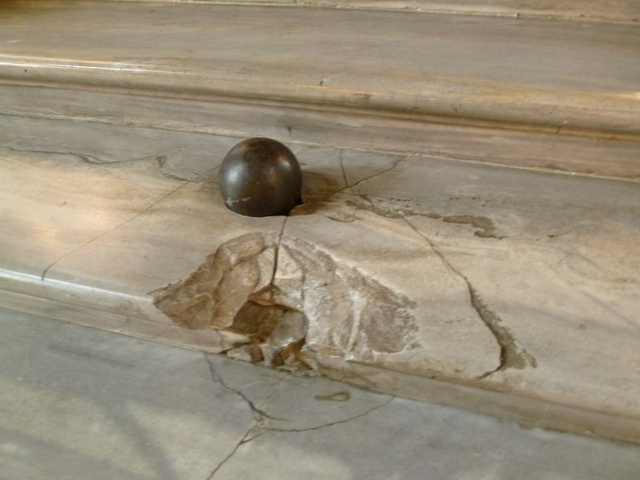
Palazzo Colonna

Palazzo Colonna: You’ll have to take the tour to hear the story of the cannon ball….

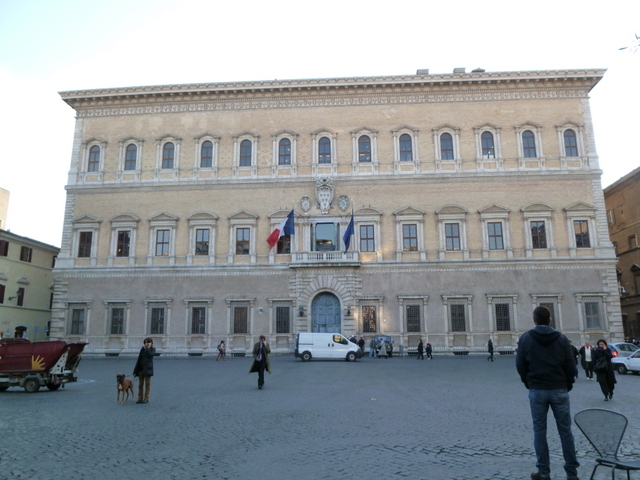
Palazzo Farnese

Palazzo Farnese

A formidable façade reveals a grand beauty, seat of the French Embassy.

Another one-day-a-week venue – at least for English speakers –  is the French Embassy to Italy, located in Palazzo Farnese, which is only open for tours in English on Wednesday, and only at 17:00. (French and Italian language tours are also available on Monday and Friday.)  As a working embassy, only portions of the building and grounds are accessible, and one must reserve at least a week in advance; However, for the modest price of €5.00, it is perhaps one of the highest value tours available.  A pope, Michelangelo, Puccini, Annibale Carracci, Queen Christina of Sweden (the proverbial tenant from Hell), and Giacomo della Porta all played a role in the rich history of this palace.  No pictures are allowed inside, but trust me; the severe exterior on Piazza Farnese does no favors to the beauty within. 


Villa Torlonia

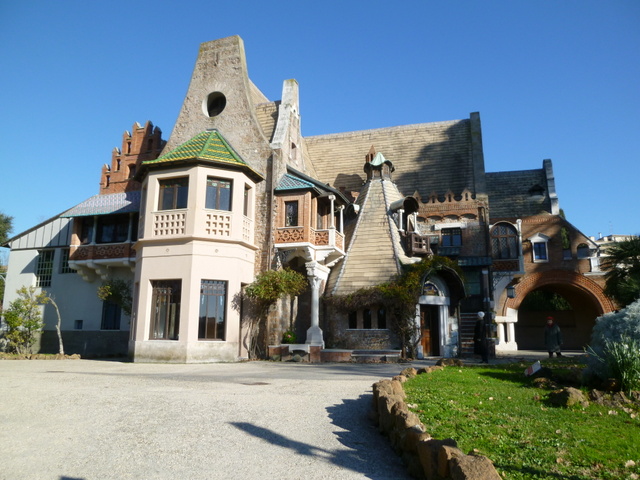
Villa Torlonia

La Casina delle Civette, a curious mix of styles.

This is a truly off-the-beaten-path location even for many Romans, Villa Torlonia is a vast and beautiful park with three diverse villas now serving as museums. Once owned by the Pamphilj family (Villa Pamphilj and Galleria Doria Pamphilj are also properties of this enormously wealthy dynasty), it passed to the Colonna family and finally the Torlonia. The estate was extensively remodeled in the early 19th century. There are winding paths, small lakes and fountains, obelisks, the three museums, and more restoration work in progress.  Mussolini lived in the Casino Nobile for 18 years, renting it for one Lira per year.  You will see families enjoying the grounds, playing, walking, and soaking up the sun from a bench. My favorite building is the Casina delle Civette, House of the Owls. Formerly known as “The Swiss Cabin” and originally a refuge from the grand villa Casino Nobile, it has been transformed through the years with a mixture of architectural styles that almost defy description. Go for the stained glass and enjoy the inlaid wood, medieval influences, mosaics and majolica.  


Villa Medici

Villa Medici

Villa Medici from the garden.

On a recent Sunday, we were among only four Americans touring Villa Medici. Bordering Villa Borghese, above Viale del Muro Torto, just north of Piazza di Spagna, you will find this magnificent palazzo and grounds. Entering from the fortress like side facing Viale Trinità dei Monti, the villa is impressive only in size and age. Sign up for the guided tour and the beauty of this 16th century enclave is revealed. Villa Medici is like most palazzi, steeped in the history of cardinals, artists, architects and even ancient Romans. Today it is the seat of the French Academy in Rome, hosting artists from all over the world in residency fellowships.  The focus of the tour is on the grounds, which are truly magnificent.  Unfortunately with the Tuscan heritage of Cardinal Ricci and Cardinal Ferdinando de’ Medici, much of the original sculpture collection is now in Firenze in the Uffizi. Through restoration and replicas, we can enjoy the site much as it once was.  In the private pavilion of Cardinal Medici admire recently restored frescoes from the 17th century, once covered

Villa MEdici

Niobe suffers from hubris and loses al of her children.

thoughtlessly with many coats of lime, now again visible thanks to one of the artist-in-residence fellows.  And in one of the 16 squares of the garden, we discover the dramatic installation of Niobe and her dying children.  The entire estate was restored in the 20th century, ensuring many generations can continue to enjoy this oasis in the midst of busy Rome. By all means one should see the Colosseum, Forum, Palatine Hill, Borghese Gallery, the Vatican and St. Peter’s. When you’ve seen these historic “must do” sites, when you’ve seen the Caravaggios and the Michelangelos in the magnificent churches, there’s still more to discover in Rome: places where you might just find yourself alone with the art.

Scenes from a Roman Saturday

23 Dec
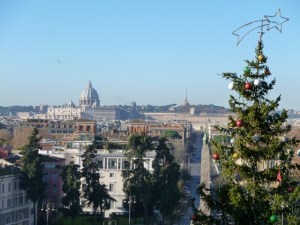
A view from Piazzale Napoleone. across P.za del Popolo to the Vatican. Bellissima!

A view from Piazzale Napoleone. across P.za del Popolo to the Vatican. Bellissima!

Saturday we headed out into a beautiful crisp clear day. Our routine each Saturday is to go on foot from our home to Piazza del Popolo, then on down via Ripetta, stopping for caffè e cornetti, and on to Campo dei Fiori where we shop for our fresh fruits & vegetables  (also occasionally baked goods, cheese, salumi).  It takes about 75 minutes for the walk, and we often stop at Piazzale Napoleone to take in the view of the Vatican from above Piazza del Popolo.  Yesterday the view was enhanced by a huge Christmas tree towering above the piazza.

We are “regulars” with some vendors at Campo dei Fiori after so many months of shopping there. Emanuele at the dried fruit-and-nut booth always has something extra for us, or a discount. The family that runs the produce stall I favor, constantly calling back-and-forth. “Zio, how much for La Signora?” or “Papa where are the cranberries?” Hard-working people, appreciative of return business.  Last week Ric had to work on Saturday so I went alone. The guys at the salumeria we patronize missed him and asked me to tell Ric hello for them! We seldom experienced this in Portland, even after half-a-dozen years of going to the PSU Farmer’s Market almost every week. Yet here, in a city many times the size of Portland in population, we are warmly and personally greeted at shops and restaurants we frequent. And they put up with my Italian, God bless them! Emanuele even tries to teach me.

Lights run from Piazza Venezia all the way to Piazza del Popolo, this year in white with blue twinkles. Absolutely stunning!

 In the evening we headed for dinner, walking through the serene Villa Borghese all the way to the Spanish Steps and on into the Centro Storico. Much to our surprise, even at the peak dining hours from 21:00-23:00, there weren’t many people out and about. Perhaps private parties and final weekend preparations took precedence over the usual dining frenzy of a Saturday night.  We meandered the back alleys and enjoyed the lights relatively crowd-free.

Almost every street is draped in lights.

Almost every street is draped in lights.

Panettone

Panettone from Roscioli. None better!

While at Campo dei Fiori Saturday morning we stopped at Roscioli to buy their incredible bread, still warm from the oven, which I will use for the Christmas Day stuffing. The warm, fragrant, pane integrale (whole-wheat bread) enticed us all the way home. As soon as we arrived, I sliced into the middle and we feasted on that good warm bread. We also picked up an artigianale panettone, the traditional Italian Christmas bread. Ours is made with frutti di bosco (berries) and we could not delay our gratification. Had to cut into it for Sunday breakfast.

Completing our Sunday, a trip to see “Big Bambu” at MACRO Testaccio, followed by a Natale organ concert high atop the Gianicolo at San Pietro di Montorio.

Fear of Speaking

14 Nov

Pasquino, the most famous “talking statue” in Rome. Used since the 16th century to post messages and claims.

Italiano  

Lately I find myself thinking about language a lot. In Rome one hears a polyglot of tongues, from French and German to Swedish, Senegalese and Chinese. I have been asked for help by a Chinese tour guide, whose English was perfect, but who knew only the fewest words in Italian. In the market I heard an immigrant vendor speak almost simultaneously in Italian, English, German and Pakistani. On a bus headed to via Appia Antica, a French woman sought help in Italian, but the bus was full of Germans and English-speakers, no Italians. I was surprised to find my Italian was the common denominator as she spoke no English and we managed quite well in our shared foreign tongue. Yet English is the usual common denominator, the language in which an Italian and a German, for example, will engage to find clarity.

Old joke:

What do you call a person who speaks three languages? Trilingual.

What do you call a person who speaks two languages? Bilingual.

What do you call a person who speaks one language? American.

I want to be fluent in Italian, but my progress is so erratic. One day I am sailing through the Roman landscape, doing my errands, giving directions  in Italian to people in the street (people are always asking me for directions), answering the office phone without totally losing my cool at the sound of an Italian voice, and navigating the whole hospital experience. I learn something new in Italian every single day and think how marvelous it is that after less than 6 months in Rome, I am not only surviving but thriving. Then the next day, I am totally flummoxed when the fishmonger asks me how I am going to prepare the fish. Dashed by the reality of my limitations, I struggle to stand up and walk talk again.

I pride myself on my English skills:  I am often asked to edit others’ work, I am consulted on English usage, and I am even funny in English, I am told.  When I worked with a group of linguists in the U.S., we challenged each other with word games, had in-depth discussions about usage, and compared grammatical structures of languages from Arabic to French to Japanese. How I admire multi-lingual people! Yet I am here, in a love affair with this bel paese, where they speak one of the most beautiful-sounding languages on the planet, and I feel like a 3-year-old in my language skills. I may get the gender right, but screw up the conjugation. I can only use four of the 21 tenses and I misuse prepositions all the time. How many times have I hit a point in a conversation where I have no idea what the right word is because my vocabulary is so small? (Non so la parola in italiano, ma….)

I tune in-and-out of conversations around me. Some days it is just too difficult and I revert to tourist-speak or totally block-out the people speaking mellifluous Italian around me.  I was in my doctor’s office again the other day for post-surgery bandage removal. He and another doctor were chatting away while they cut off the mummy-wraps. I know they wondered if I was following along, and in fact may have been gauging my comprehension, but I was on a different plane.  I was a bit stressed and had much on my mind that day (not to mention the fact that they were wielding scissors across my tender thighs). I tuned out when it would have been a marvelous opportunity to practice. Will the day come that I comprehend everything being said around me?

When we learn a language, we accomplish so much. It honors the people and the culture. Learning the language allows us to stand on our own and helps us navigate challenging situations without having to pray that someone else will come along with the language skills to help. I’ve written about how great the hospital staff was, and because we each knew some of the others’ language, with un misto di lingue I made it through.  But what if Ric and I land in a situation where there is no misto? What if I have to make a go of it in Italian for health, safety, or legal reasons? I must become fluent. I have no right to assume someone will speak English here for my convenience.

When we learn the local lingo, we can participate in a conversation, not simply ask and answer survival questions. On a personal level, I want to be able to engage people in Italian. I envy these very social people who can chit-chat about anything, everything, and nothing. Mastery will allow me to better serve my employer and represent my country. I want to be able to make people laugh in Italian on purpose, not because I am so terrible at it.

I should give myself some credit for progress. In the three months I have been taking private lessons here, I have progressed thanks to the tutelage of my fantastic instructor.  (Who will think I am sucking up when she reads this.) She makes me speak and causes me to think on the spot and try to muddle through in Italian.  In fact, I think in just 6 months of living here, I have made more progress than I did in the prior 2 ½ years of community college classes, because outside of the classroom in Portland, I was surrounded only by English. Here the situational immersion is obviously of benefit, but those classes in the U.S. gave me a valuable foundation to build on. (Grazie Lina & Kathy!)

However, when someone speaks English better than I speak Italian, I will always go to that safe place, unless I get over my fear.  I fear being wrong, miscommunicating, looking stupid. So what I am going to do about it? Reading and writing are an important part of becoming more sophisticated in the language. I do quite well at comprehension in simple readings and on the Internet. And although it takes a lot of effort, I am starting to be able to write more clearly in Italian. The process of forming sentences in writing, using my own thoughts, is powerful. I am tired of learning phrases like “Dobbiamo prenotare le camere in albergo per nostra vacanze.” (Pimsleur, I love you, but come on!)

Here is my plan, my commitment:

  • I am going to write at least part of this blog in Italian as well as English
  • I am going to put myself out there and attempt to engage more people in spontaneous conversation in Italian
  • I am going to work comprehensively on one new vocabulary word a day. This means not a simple definition, but to more fully understand words with multiple meanings, words that are nouns and verbs, words that have colloquial expressions intimately tied to them.

Here is a link to this same material in Italian. (GoodDayRome, now in Italian, too!) By the time I post this, it will have been edited by my instructor as I have made this a part of my formal training. Over time, I pray the correction ratio will plummet as I get stronger.

She laughed when she read the part about “sucking up.”