Archive | Food RSS feed for this section

Escape to Emilia-Romagna

8 Jun
The heat built fast in Roma. Ten days prior we were putting on our fleece jackets in the morning because it was cold in the apartment, but by the time my brother and sister-in-law arrived June 1, that was no longer a problem: it was getting warm. Luckily for us – if not for our cat sitters – we were leaving Roma. We also left behind the tourist hoards.
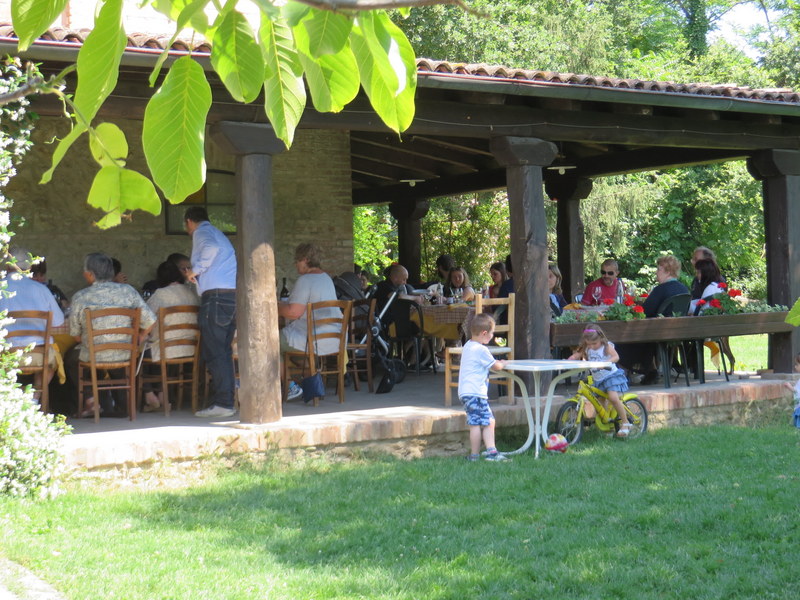
Lunch on the veranda at Corte d'Aibo is a family affair.

Lunch on the veranda at Corte d’Aibo is a family affair.

Heading to Emilia-Romagna on June 2 (the Festival of the Republic which celebrates the election in 1946 when the monarchy was rejected in favor of a republic), we left behind the Roma tourists only to find throngs of Italians. At least they were at lunch when we arrived at Agriturismo Corte d’Aibo. But that was the holiday and the last day of the Italian four-day weekend. Continuing on to our mountain destination of Montese, we found ourselves the only tourists at the very pleasant Hotel Belvedere .
This is not your average balsamico. This is Aceto Balsamico Tradizionale di Modena, another thing entirely.

This is not your average balsamico. This is Aceto Balsamico Tradizionale di Modena, another thing entirely.

I found Hotel Belvedere and Corte d’Aibo thanks to Riccardo of Trekking Emilia-Romagna. Somehow my SIL Jane and I hit on going to E-R and hiking, and I was fortunate to stumble upon Riccardo’s company. He put together a great itinerary for us including a tasting and tour at an acetaio called Ca’ dal Non,  lunch at the agriturismo, and a guided hike through the mountains, which saw significant action in World War II. The arrangements also included our hotel, breakfasts and dinners. All we had to do was show up and sweat a little on the hike.
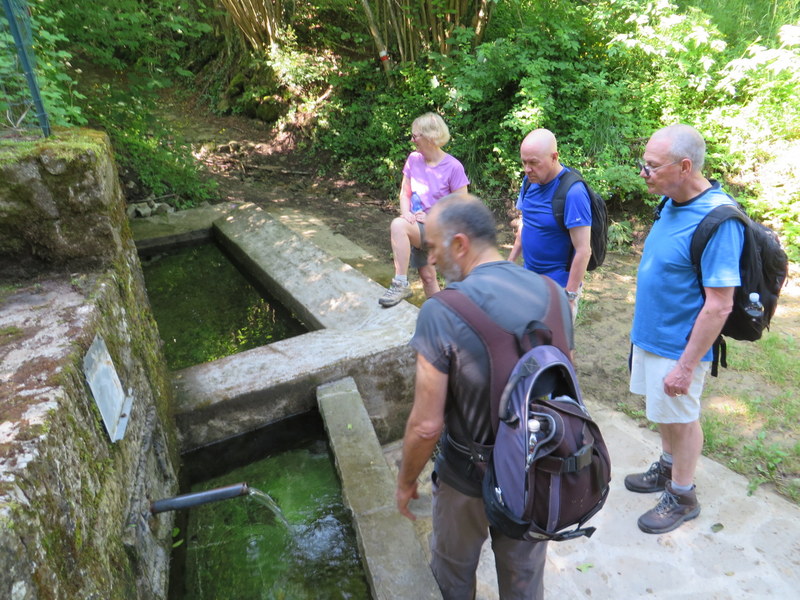
Stefano, foreground, explains a fountain in the mountains to Jane, Rick and Ric. Multiple basins allowed people to use one for drnking water, the next for washing, and a final one for watering livestock.

Stefano, foreground, explains a fountain in the mountains to Jane, Rick and Ric. Multiple basins allowed people to use one for drinking water, the next for washing, and a final one for watering livestock.

During our hike, we learned about the flora, fauna and history of the area. The Gothic Line was here, a place where Germany was making a last stance in the north of Italy as the Allied Armies, having fought their way north through the boot, bombed the heck out of them, and unfortunately, also bombed the Italian villages.
We met an older man – he said he was 80 – who upon learning we were Americans said, “The Germans went away, the Americans left, and now there are no porcini.” He was jesting, but memories are long: although we “liberated” the area, the old growth forest was destroyed by both the German occupiers and the liberating armies, so the treasured porcini no longer grow there. We chatted in Italian for a while and when we commented on his good health and energy (after all he was taking the same long hike that was wearing out us 60-somethings) he said “They gave me an organ donor card and I told them ‘take anything you want; none of it works anyway!’”
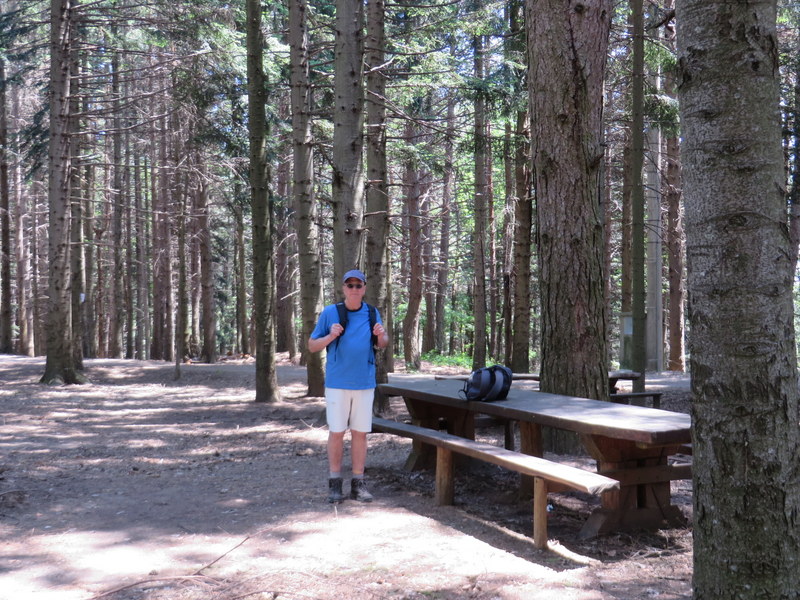
Ric in our woodsy picnic spot, an area frequented by families on Sundays. This one surrounded a church that commemorated the civilians killed in the area.

Ric in our woodsy picnic spot, an area frequented by families on Sundays. This one surrounded a church that commemorated the civilians killed in the area.

Stefano, our guide, was a font of information and knew the area well, having grown up nearby in the famous cherry town of Vignola. He speaks excellent English having lived in the U.S. (He loves Seattle!) We lugged along Parmegiano-Reggiano, salume, bread, and fruit for a picnic, along with local Lambrusco and a homemade crostata, all supplied by the hotel. At the end of the trek, my pedometer wrongly said the hike was about 8 km, Stefano said 11, my brother estimated 12. It felt like 18.
We were then treated to a tour of a caseificio or cheese factory at Dal Contadino.  This was a multi-generational farm operation producing the famous parmigiano-reggiano as well as ricotta, marmalade, and more. It was fun to visit a typical small family operation and see the incredible labor that goes into making this cheese. The artigianale beers they served with the cheese really hit the spot after hiking. If you ever get a chance to drink White Dog Beer, do it.
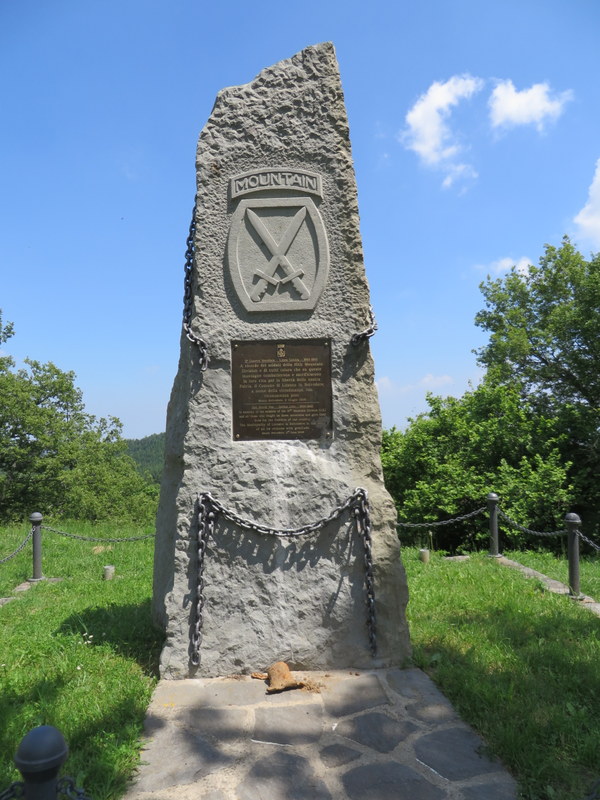
At the top of Mount Belvedere there is a monument honoring the 10th Mountain Division.

At the top of Mount Belvedere there is a monument honoring the 10th Mountain Division.

I have to say that, whatever the length, the trek barely dented the calories we were consuming. The kind owners of Hotel Belvedere looked after us well. Clean, comfortable rooms with good showers, incredible food from classic pastas for primi to roasted rabbit, pork and steak for secondi. They were also experts in recommending local wines to complement their food and served some of the best grappa around. Compare this with an American town of 3400 people where your choice of wine with dinner might be beer.
Montese has a castle dating back to the 13th century.

Montese has a castle dating back to the 13th century.

This was not high tourist season. In fact, it seems only August gets pretty busy. Otherwise Montese is off the radar of folks headed to more famous destinations. Nearby one can visit the Ferrari Museum in Maranello, the town of Modena, and even Parma is within reach.
After three nights we somewhat reluctantly said good-bye to Montese and the lovely folks at the hotel, as this was part one of a three-part trip. On to Lago di Garda!
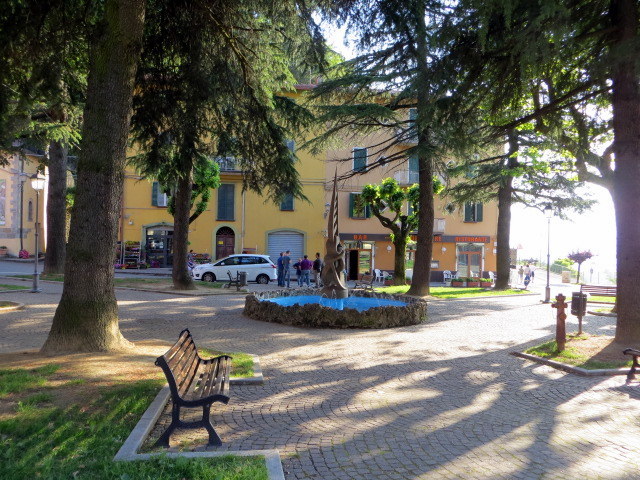
Piazza in Montese, in front of the Hotel Belvedere.

Piazza in Montese, in front of the Hotel Belvedere.

We took one day away from Montese to journey to Maranello and the Ferrari Museum. Quite a collection!

We took one day away from Montese to journey to Maranello and the Ferrari Museum. Quite a collection!

Paris bits and pieces

1 Apr
By now I am used to functioning in two languages. I understand most of what I see in print in Italian, with the exception of the newspaper as it is written in run-on sentences with obscure terminology and archaic verb tenses. When someone speaks directly to me, I understand most of what they are saying if I get the context to start. When I need to communicate me la cavo (I get along) even if my grammar is not perfect.
When we embarked on our trip to Paris I was hit by the realization that I would not understand much of anything from menus to street signs, and I certainly would  not understand spoken French.  Going to France was the most foreign thing we had done since we first traveled to Italy in 2010.
We found ourselves speaking in an odd combination of Italian and English. I am used to speaking Italian to our servers, technicians and shop people in Italy, so that’s the first language that sprang from my lips, combined with mangled French pronunciation. “Prendo il boeuf bourguignon, per favore.” I could not get past grazie to merci until mid-week. In one restaurant, we mixed up languages sufficiently to have the waitress convinced we were Italians who spoke little English. When we said “Merci bonsoir” at the end of the evening, she cheerily replied “Grazie, anche a te!”
There was little hope for me in pronouncing French street names. My Italian-addled brain insists that “Place” must be pronounced PLAH-chay. Once in awhile we’d hear Italian being spoken by other visitors and it was a joy to hear and understand.
Shopping in a French market reminded me of our first trip to Italy when we tried to figure out what things were. Like in Italy, lots of offal was available, from tripe to lambs heads (sorry vegetarians). The Super U was rather ordinary, but some of the shops are magnificent. We found ourselves taking a lot of pictures of store windows and displays.
Here are some Easter treats. Each store had a theme: fish, chickens, cows, even a little mole poking his head above the ground. All gorgeous and expensive. Click on any picture for a slide show.
Fashion windows are creative and the bakeries difficult to resist. The bejeweled athletic-style shoes are Dior. I love the ducks sporting sunglasses and the colorful men’s accessories. Ric showed no interest in blue shoes.


Avocados, artichokes and cabbages are arranged attractively. I wish I had taken a picture of the huge strawberries artfully displayed. In the Place du Madeleine area, boutiques with high-end chocolates, teas, cheeses, and wines seemed like museums. 


We also found time to see the major sites as we wandered the city. At the end of seven days of tromping about Paris my pedometer reported 162,222 steps. We covered some ground, but there’s so much left on the list that we must go back…but later in the spring so we can enjoy the gardens and maybe take our coats off. 

Paris v. Roma – Part I: Cuisine

15 Mar
If Paris is a Grande Dame, Roma is her rambunctious and unruly sister. After a week in Paris, we cannot help but compare and contrast gorgeous Paris to Bella Roma. Each city has much to love and other things that leave you shaking your head.
Great cappuccino at a neighborhood cafe, where locals go. This was not by a tourist attraction. We drank it at the bar and still it was €4.20 FOR ONE. I shudder to think of what they would have charged if we sat down.

Great cappuccino at a neighborhood cafe, where locals go. This was not by a tourist attraction. We drank it at the bar and still it was €4.20 FOR ONE. I shudder to think of what they would have charged if we sat down.

Starting with the obvious, food. On our first trip to Italy in 2010 Ric observed “There are no bad meals in Italy; some are just better than others.” While we can attest to having had one really terrible meal in Italy in the ensuing years, we had two crappy meals in Paris in our first three 3 days and during the week some that were just meh. There is bad food in Paris. Really bad. BUT THE BAGUETTES, oh-la-la! So good and so cheap! Both Roma and Paris have pastry shops and bakeries to be proud of. Baguette versus pizza bianca? Tough choice, but I’d have to go with baguette. French croissants and pain au chocolat beat Italian cornetti IMHO.
The espresso is good in Paris, but pricey by comparison to Roma where one has a God-given right to an inexpensive high-quality shot and a bar available every 300 meters where you can buy it.  They do have Starbucks in Paris but I am not sure that is a good thing; we did not bother to try one. We do like the Cafes Richard brand, of course.
There is ethnic diversity in the Parisian food scene. Walk down the street in Paris and you might see a pattern of restaurants like this
French  Vietnamese  French  Japanese  French  Kebab  Italian  French
In Rome it would look like this
Italian      Pizza     Bar      Kebab     Italian     Pizza      Bar     Italian
Wine is reasonably priced in Italy. We spend far less on wine in Roma than we ever did in the U.S. In fact our wine-and-coffee spending is a fraction of what it was in the U.S., and not because we have
Artful stacking at a cafe in Montmarte.

Artful stacking at a cafe in Montmarte.

cut back on either. In Paris, both wine and espresso are expensive by comparison.  Even house wine is quaffable in Italy, but some wine-by-the glass or carafe in Paris is, well, overpriced and barely drinkable. We have had some fantastic bottles, though one pays dearly at a restaurant.  We missed the Italian tradition of serving snacks with a glass of wine at aperitivo hour.
Water by the bottle, nice and sparkling if you like, is an expectation at every meal in Italy, and a litre will usually cost no more than €2.00 or 3.00.  When we ordered bottled water in Paris we were hit with a €6.00-7.00 price!  However tap water, ordered only by una brutta figura in Italy, is gladly handed out in a carafe in Paris. Free is a very good price.
It was quiet at Versailles the day we went. Only customers in garden cafe.

It was quiet at Versailles the day we went. Only customers in garden cafe.

We did have Boeuf Bourguignon that was practically life-changing. Served with a mountain of mashed potatoes, it was in a little oven-pot in a rich wine sauce heavily laced with bay leaves and bacon. We ate it with good French red wine and hunks of baguette. It was a good thing we had walked about 13 km that day! Quality vegetables beyond salads have been harder to find when dining out. In Italy there are fabulous contorni to be had that are not starchy and white. In fact I am craving a plate of cicoria ripassata now.
Watch for my next post Paris v. Roma – Part II: Street Scene and Getting Around


Guess where we are celebrating our 30th anniversary?

Guess where we are celebrating our 30th anniversary?

Pizza addicts

1 Feb
As many of you know, pizza is a major food group – and always has been – for Ric. 
Spring 2013 at Dar Poeta.
When I met Ric in 1984, I thought pizza was a once-in-awhile treat, something eaten at Pizza Hut, for a child’s birthday party, or all-too-often pizza at my house was a frozen one from Totino’s consumed as Sunday night supper. Marrying Ric changed my ways. I don’t always make the bed in the morning, especially if one of the cats is sleeping on it, and now I know that pizza is nature’s most perfect food, meant to be consumed at least weekly.
Moving to Italy added a layer of adventure and charm to our pizza eating. As we eat at least 52 pizzas a year, I thought documenting the journey a worthy endeavor both for us (“Where did we eat last weekend?”) and for those who dream of eating pizza all over Italy. I hope you will join the journey and click on over to my newest blog, Our Weekly Pizza.
Buon appetito!

Toto, we’re not in Kansas anymore

23 Jan
Iconic symbols of the city, dating back to the 12th or 13th century, there were once as many as 180 towers.

Iconic symbols of the city, dating back to the 12th or 13th century, there were once as many as 180 towers.

We’re not in Kansas Roma anymore. We stepped off the train in Bologna (pronounced “bow-LONE-ya”) and I thought perhaps we had left Italy entirely. In fact it looked like we had arrived in a newly constructed airport facility, but we were in the new “High Speed Bologna Centrale.”  There was a noticeable freshness to the facility, good signage, wide walkways, no cigarette butts, and plenty of escalators: until we reached the end of the new facility and had to lug our cases up a steep flight of depression-era station steps.
Bologna's high-speed train terminal. Clean, bright, chairs available! We're not in r\Roma any more.

Bologna’s high-speed train terminal. Clean, bright, chairs available! We’re not in Roma any more.

The differences between Bologna and Roma continued to astound us. Beautiful porticoes dating back centuries separate pedestrian traffic from automotive. Clean streets, no overflowing waste bins. People walk in more-or-less straight lines and keep to the right except to pass. Oncoming pedestrians do not block the sidewalks: they make way for you! This is truly not like Roma, where walking down the sidewalk is like a game of chicken and when you swerve to avoid an oncoming body, you may very well step in dog poop. 
Bologna is a lovely city if not one full of E-ticket sites. Sitting in the bread-basket of Italy, it is known for its cuisine and we worked hard at sampling as much of that as possible.
Another notable difference in Bologna: little or no double-parking and no one parks in the pedestrian crosswalks. In Roma there is hardly a pedestrian crosswalk that has not been turned into parking.
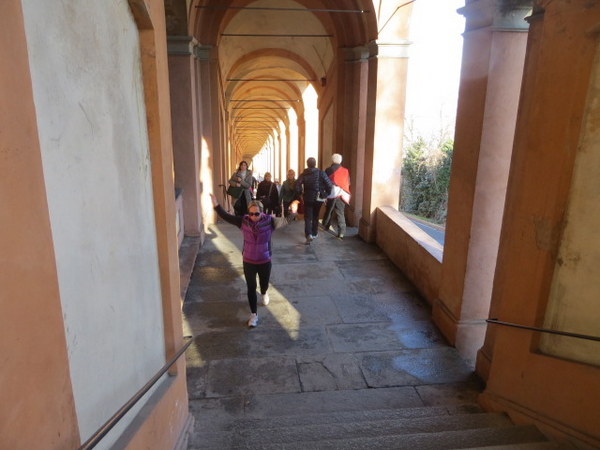
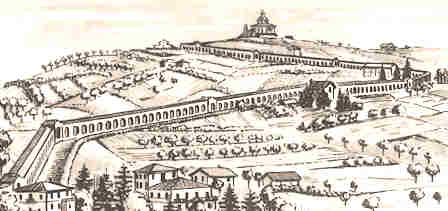
We had lovely weather, so rather than spend time indoors, we took a phenomenal urban trek, the Percorso della Madonna di San Luca. This is a walk of about 4 km (2.4 miles), 2.3 km of which is steadily uphill. The walk is entirely covered by the famous porticos of Bologna, and is the longest continuous section of portico-covered walkway in the world. There are 666 arches. In that final 2.3 km, the altitude gain is a respectable 722 feet (220m), a workout indeed! We were impressed by the number of people doing the percorso on a cold but sunny Sunday. Afterwards we of course rewarded ourselves with a fine tagliere and wine, accompanied by a salad for the health of it.
Many run up the 2 km. to the sanctuary. Show-offs.

Many run up the 2 km. to the sanctuary. Show-offs.

Interesting view showing inside and outside of the extraordinary covered walkway.

Interesting view showing inside and outside of the world’s longest covered walkway.

Not only does the path go up over 700 feet in altitude over 2.3 km, there are in excess of 300 stairs. Ugh!

Not only does the path go up over 700 feet in altitude over 2.3 km, there are in excess of 300 stairs. Ugh!

A view from the sanctuary looking toward the mountains of Emilia-Romagna.

A view from the sanctuary looking toward the mountains of Emilia-Romagna.

If I had seen this view before making the trek, I might not have done it. :-)

If I had seen this view before making the trek, I might not have done it. 🙂

The food was great, although we like Ligurian and Sicilian food better overall. But the Bolognese are justifiably proud of the quality of food. We had four meals there and each was a winner. We did not research restaurants ahead of time, but merely wandered into what looked good. One cannot do that everywhere. Of course we – actually Ric – ate mortadella, which is the Bologna delicacy that has been transformed into the unfortunate American “bologna.” And so the Oscar Meyer song is now stuck in my head. (Personally I am not a fan of either the Bolognese delicacy nor the American lunch meat.)
A typical Bolognese "tagliere" or cutting board of assorted salumi.  Mortadella on the left.

A typical Bolognese “tagliere” or cutting board of assorted salumi. Mortadella on the left.

Street performers are everywhere in Italy. Bologna is the first place we have seen bubble blowers. Kids had a great time running after them.

Street performers are everywhere in Italy. Bologna is the first place we have seen bubble blowers. Kids had a great time running after them.

Aperitivi are a huge thing in Bologna, like in Milano. The cafes are crowded even in winter.

Aperitivi are a huge thing in Bologna, like in Milano. The cafes are crowded even in winter.

The only fault we found with Bologna is that it’s a little lacking in charm. The porticoes that are elegant also make for a sameness. (Actually there was a second flaw: people still do not scoop the poop.) We will be back in June on a trek through the area, heading to the hills outside of Bologna for some hiking. We’ll see what she’s like in summer when the trees and flowers are blooming!
N.B. – I have decided to use Italian city names from now on, therefore Roma and Firenze not Rome and Florence. I think it is rather bizarre of any language to change a perfectly pronounceable city name from the original language, an idiosyncrasy driven home to me when my hometown of St. Paul Minnesota was referred to as “Sao Paolo” by an Italian bureaucrat.