Archive | Hiking RSS feed for this section

Hairy coos but no kilts

26 Sep
26 September 2016. City versus country is an age-old traveller debate. Do we spend time in the great museums and wonderful restaurants of Paris, London, and New York, or do we head to small towns and rural settings where life is less rushed? What do we do if the great outdoors delivers pouring rain and we cannot enjoy the activities we planned? What if our expectations are not met and what do we expect anyway? 
The view from our B&B.

The view from our B&B.

We’ve had a touch of both city and country in the past three weeks. Ric and I are wrapping up a trip to Paris and the northern U.K. This is a challenging type of travel to pack for. City-chic in Paris, dressy enough for dinner in a Michelin-starred restaurant, but hiking boots and weather-resistant layers for the great outdoors. Luckily we managed to pack in our usual 21-inch-rollaboard-plus-daypack combo.
It is difficult to imagine having too much time in Paris. We had three full days this time and still we have not managed to do everything on our long list although we’ve been there four times in the past 18 months. The weather was perfect with warm-but-not-hot days and evenings pleasant enough for outdoor dining. We’ve found some amazing places to dine that do not break the bank and a new-to-us B&B experience that kept the budget further in check. Despite a complete lack of French language skills, Paris is beginning to feel quite comfortable.
We moved on to York, England, where we hooked up with my brother and sister-in-law for a two-week driving adventure. When on our own we use public transportation exclusively, but there are places in the rural U.K. that are difficult if not impossible to see without a car, so my brother became the chauffeur, Ric and the SatNav guided the way, while Jane and I enjoyed the scenery.
Here we are atop Edinburgh Castle. A windy day, but sunny and warm by Scottish standards.

Here we are atop Edinburgh Castle. A windy day, but sunny and warm by Scottish standards.

Our path was from York to Keswick in the Lakes District, then on to Edinburgh, Granton-on-Spey along the Whisky Trail, and finally the Isle of Skye. Wow! One place more beautiful than the next. Our three truly small-town experiences — Keswick, Grantown-on-Spey, and Portree on Skye — absolutely astounding.
Sheep-dotted meadows, moors, dales and fells, bubbling burns, torrential waterfalls, and always the sheep. It was everything and nothing we expected.
I did not expect it to be so thickly wooded and rugged in The Lakes District. I expected to hike through meadows of sheep and cows, not forests and rocky ridges. The hike we took at Castle Crag was labeled “easy” and four miles long. Much like in the Val Gardena, “easy” was subjective and how they measured a mile elusive. It might have been miles-as-the-crow-flies, but we estimated seven walking versus the published four.
I did not expect to have my husband fall in love with Scotch whisky. Ric has always been a whiskey man: bourbon, Jack Daniels, and the like. Prior to this, I could not get him to sip my whisky, as in the stuff from Scotland. Along for the ride on a distillery tour, he finally saw the light and has come over to the bright side. The difference? The tastings revealed the complexities and variations in whiskies from the different “noses” to flavors of honey, vanilla, caramel, fruit, smoke, and peat. Something for everyone, just like with wine. 
I expected fish-and-chips and pubs everywhere. The former were prominent on nearly every menu, but once outside of York and Edinburgh, a proper pub was elusive. Cafes and bars (not our beloved Italian bars, mind you) yes, but not the clubby dens we enjoyed in London. 
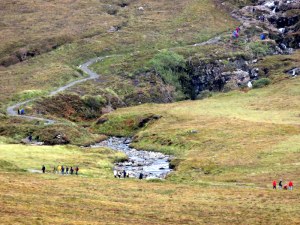
The Fairy Pools on Skye...look at the line of hikers! I wonder at the adverse impact on the moor.

The Fairy Pools on Skye…look at the line of hikers! I wonder at the adverse impact on the moor.

I don’t know quite what I expected of moors, but it was fascinating to experience these bleak yet beautiful landscapes. I thought they were always lowlands and did learn they can be at higher elevations. I also observed how fragile they are and worry that the ridiculous numbers of us visiting will have an adverse impact. 
I did not expect to be so amazed by the food. In the tiniest town of our trip, Portree, on the Isle of Skye, we had perhaps the best situation of all: three dinners to rave about, and spoiled for choice on the whisky selections before and after. The one downfall was an overall poor selection of wines. A stone’s throw from France, Italy, and Spain, with EU-friendly import possible, but prominently featured was Concha y Toro and a few Australian wines.
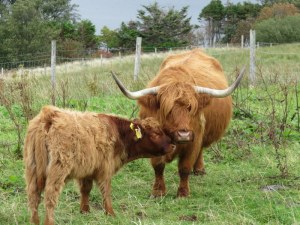
Highland Cattle are often called "Hairy Coos" or "Hielan Coos." Love the baby seeking reassurance from mama.

Highland Cattle are often called “Hairy Coos” or “Hielan Coos.” I love the baby seeking reassurance from mama.

I did expect to see the famous “hairy coos” of the highlands, aka, Highland Cattle and lots of kilt-wearing Scotsmen. We finally saw the cows our next-to-last day on Skye, but the only kilt-wearers were the occasional bagpipers. I’ve seen more kilts in Roma when the lads came to see a game against a local team.
Please click on any picture to see a slideshow of some of the stunning sites we enjoyed.
Now back to Paris and on to Rome, by train all the way, of course!


Animal encounters

22 Jul
Mr. Marmot relaxes below the Seceda gondola.

Mr. Marmot relaxes below the Seceda gondola.

22 July 2016. Cows abound in the Alpe di Siusi and the Val Gardena in Italy’s north. True wildlife is a little harder to find. In fact, we’ve been hoping to spot a marmot here or in Switzerland for the past 4 years. We’ve taken “marmot trails” and seen nothing but cartoonish signs claiming the critters were about. Finally, the other day, we not only saw a marmot, but Ric captured a fine photo that I wanted to share with you. And for fun, here are a few more pictures of the animals that dot the trails we have traversed for the past 3 weeks.
Please click on any photo for a better view and a caption. 


Easy hiking

16 Jul
16 July 2016. We unabashedly take hikes rated as “easy” these days. Having injured both knees over the past two years, hikes labeled “moderately strenuous” are now usually just plain strenuous for us. Altitude gain doesn’t bother us too much once we are acclimated, but tough footing, disappearing trail signs, and steep descents give us cause to pause and think about how much we value our lives.
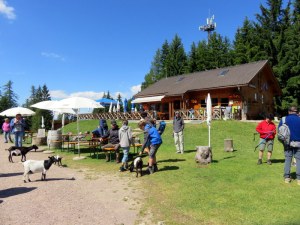
Marinzen is a lovely rifugio. Many people just ride up to hang out and not even hike.

Marinzen is a lovely rifugio. Many people just ride up to hang out and not even hike.

According to the book “Walking Guide Around the Alpe di Siusi,” the hike we chose for Friday, #10 for the record, was to be an easy hike. It was depicted as a round trip that was to take 2.5 hours with 214 meters of altitude gain and loss. We are slow hikers, so we figured even if it took 3 hours, we’d be fine, and there were two rifugi where we could get lunch. Piece of proverbial cake. Ha!
The Marinzen chairlift. Scenic, but such a cold wind this day! It goes up, up, up into the trees ahead.

The Marinzen chairlift. Scenic, but such a cold wind this day! It goes up, up, up into the trees ahead.

The lift to our starting point at Marinzen leaves from Castelrotto at the base of the Alpe di Siusi. Marinzen is an older chairlift. Nothing wrong with it, but it is less comfy than some others in the area. It is a long ride, about 20 minutes, and this day, in JULY no less, it was cold, about 9 degrees Celsius (48 Fahrenheit) with a biting northerly wind. Brrrrr. Once we hit the trees we were shielded from the wind and the sun came out. At the top, we found a delightful refugio with baby goats only a couple of weeks old. They (the rifugio, not the goats) served great strudel, one of the best we’ve had, and a perfect cappuccino. God, I love hiking in Italy! We could have stayed awhile, but there was a hike to do.
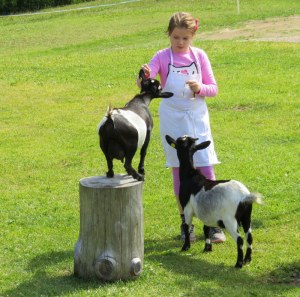
Goats being fed parsley stems at Marinzen.

Goats being fed parsley stems at Marinzen.

The hike starts on a gravel road then veers off across a meadow with a faint track leading to a shrine. Past the shrine is a trail sign. We knew to follow #12. The path steepened so we took out the hiking sticks. It was a steady climb, but not bad, with occasional rocky sections, nothing horrible. We are, after two weeks here, acclimated to the elevation and the level of activity. Still, as we trudged on I felt it better to go forward because I really did not want to go back down that steep trail. My knees and my nerves dislike steep descents. A couple of places it was hard to discern the exact trail but we were able to look up and spot the CAI red and white sign and determine the proper path.
Looking back toward Marinzen as we set off on Trail #12. Such a promising start!

Looking back toward Marinzen as we set off on Trail #12. Such a promising start!

Younger people were passing us by, but we persevered. Then we came to a place where the trail might have gone straight or might have taken a left steeply uphill to a set of log steps with a railing. I was tempted to go straight, but a man was coming down from the left so it seemed a good bet that was the trail. No sign, of course. The next part was navigable, although basically a deer path with a steep drop off to the right. So glad we had our hiking sticks! Up and up we went, the drop to our right so steep that a misstep would mean waving goodbye and planning a funeral. Then we encountered an avalanche of boulders blocking the trail. It looked like a landslide from a long time ago. I wanted to turn back, but knowing how challenging the ascent had been, it made me weak in the knees to even think about it. Was there a trail that continued after the boulder field? Ric bravely scrambled up to see. Yes, he thought we could make it, so grabbing handholds on the boulders and carefully placing our feet so as to not twist an ankle or take a header over the cliff, we managed to clamber over the 40 feet of boulders blocking our way. It was not something one would expect on an “easy” hike.
Rest stop view. By this point most of the harrowing parts were over. Looking down on the valley where Castelrotto sits.

Rest stop view. By this point most of the harrowing parts were over. Looking down on the valley where Castelrotto sits.

Continuing on, now aided occasionally by some log railings to prevent a disastrous fall, at last we came to a lovely overlook with a picnic table, perfect for a rest. This was just over an hour into our supposedly 2.5-hour round trip, but we still had a long way to go. We could see the Cabinovia Alpe di Siusi and it was still a long way off. We knew our objective was past the line of the lift as it ascended. Our 1:25,000 scale hiking map showed we were past the rocky areas, but we hit one last bit of scree to navigate in an area of some water run-off then, luckily, the trail veered into the forest and the deer-path-with-a-drop-off disappeared in favor of a woody path with some rocks and roots. Relief! Eventually we joined a road and walked easily to Hotel Frommer. Walking time was about 2 hours. We are not fast, but we were moving as best we could. I think the trail is severely mislabeled at 1 hour. 
We were so concentrating on hiking that we did not take trail pictures. Oh I wish I had a picture of the boulder field and Ric crossing it! Here, the deer path is bordered by a fence to prevent falling. Not the case everywhere along this trail

We were so concentrating on hiking that we did not take trail pictures. Oh, I wish I had a picture of the boulder field and Ric crossing it! Here, the deer path is bordered by a fence to prevent falling. Not the case everywhere along this trail

In fact, in post-hike wonderment, I went seeking more information on this trail, which was very hard to find. A source I found in Italian put this section alone at 2 hours with 400 meters of elevation change given the ups-and-downs. This is, to our point-of-view, more accurate. Ric used his altimeter app to check the altitude at several points and determined the authors just checked the altitude at Marinzen and the altitude at Frommer and did the math, not accounting for higher points along the way. Losers. Oh, and the second source rated the trail intermedio, not easy.
Can you see the little blue ovals? That is the cabinovia that whisks people up-and-down from the Alpe di Siusi. We are nearing the end of the hike, having passed under it.

Can you see the little blue ovals? That is the cabinovia that whisks people up-and-down from the Alpe di Siusi. We are nearing the end of the hike, having passed under it.

Starving by now, our strudel long forgotten, we decided to have lunch at Hotel Frommer. But there was no one in sight. Seemed closed. Time to break out the emergency trail mix and, unbelievably, wait for a bus to rescue us. Since we are in a land where travelers and hikers are catered to with public transportation, we found while sitting at our little picnic rest area that there is a bus that stops at Hotel Frommer. Score! The next portion of the hike was to be on a different trail, and the signs indicated perhaps an hour, but based on the experience to this point, we had our doubts. We did not want to chance it. In 20 minutes a bus came along and for €8.50 per person we rode down in comfort, all the way to Castelrotto, instead of finishing the hike.
Note the sign at teh bottom, 1 hour to Marinzen. We were 2+ at this point on the "easy" hike.

Note the sign at the bottom, 1 hour to Marinzen. We were 2+ at this point on the “easy” hike.

In a bit of a snit since we have now done three hikes from this book and two of them severely under-estimated the duration, I wrote a very thorough email to the author, who had invited feedback. Wouldn’t you know, the email bounced. I’ve tracked down the publisher in Castelrotto and forwarded our thoughts to an “info@” email address. No reply as yet.
Thank goodness we are experienced enough to weather a hike like this. Thank God we didn’t have small children along! Or a dog! Our old collie would’ve been impossible to get over the boulder field. The book has warnings about hikes not suitable for kids, but this particular trek carried no such warning. Surely things change in trail maintenance over the years, and this book is 6-years-old now, but I guarantee that boulder field has probably been there since before local hero Luis Trenker was in utero. It was not an “easy” hike.
Baby goats!
Baby goats!

 
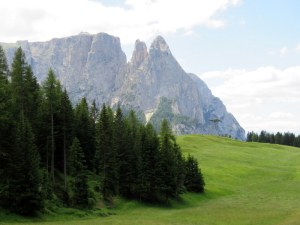
It's all about the view and I love this one of the Sciliar and Punta Santner.

It’s all about the view and I love this one of the Sciliar and Punta Santner.

Training cats

2 Jul
2 July 2016. Cats are considered untrainable, for the most part. They use the litterbox, but beyond that, it is pretty difficult to train a cat, unless you live in Italy and can take your cat on the train! Yes, Janie and LibbyJean are on vacation in the Dolomites. A few days ago we loaded them on a Trenitalia Frecciargento bound for Bolzano, where Taxi Ivan Moroder met us for the trip to Ortisei. In years past, Ric and I have taken the pullman (bus) service, which is very nice; However, with the cats along plus luggage and supplies for a month, we popped for a transfer service. It was so nice we may never take the bus again.
Janie showed a lot curiosity on the train.

Janie showed a lot curiosity on the train.

Libby hyperventilated much of the time. They don't find the train as relaxing as we do.

Libby hyperventilated much of the time. They don’t find the train as relaxing as we do.

I cannot say the cats enjoyed the train; they tolerated it. You can take a cat on a train without paying, but the cat has to go in the luggage storage area, which is very limited and they would be subject to constant disruption including people poking fingers in their crates. So we bought four standard-class seats at the super-economy rate of €29.00 per occupant. The capotreno never batted an eyelash at two seats occupied by cats. We let them take turns sitting (crated) on the table so they could see us and look out the window, which seemed to entertain Janie, who at 20 is ever-adaptable, in particular. Libby is not fond of strangers nor strange situations and even hissed at a little girl who got too close to her kennel. 
The long trip was worth it and the girls seem to have taken to the new digs, with a sunny terrace overlooking the village. 
A terrace with a view, even for cats. We see them peeking out between the slats on the railing.

A terrace with a view, even for cats. We see them peeking out between the slats on the railing.

Sunrise on the iconic Sassolungo as seen from our terrace.

Sunrise on the iconic Sassolungo as seen from our terrace.

Our terrace overlooks the lovely village of Ortisei.

Our terrace overlooks the lovely village of Ortisei.

We have an incredible apartment at Residence Astoria (#5 if you want to take a peek) with views over the valley and up Mont Seuc. We can see the round red cable cars rising from the valley to the top of Mont Seuc and if we peer around the corner of the terrace we can see the Sassalungo. Last summer we enjoyed our two weeks in Ortisei so much we decided to go for four weeks this year and take the cats along. We really do miss the girls incredibly when we are gone, and while during our significant travels there has been a parade of fabulous cat sitters (you know who you are!), we decided to close up the city apartment like so many Romans do when they go on summer holiday. Lots of apartments allow dogs but not cats. Then we met Justine and Siegfried who said yes to cats, but no dogs as they have their own cat. We signed up on the spot. 
My favorite hiking companion neare teh chapel at Rasciesa.

My favorite hiking companion near the chapel at Rasciesa.

Me on the Rasciesa hike.

On the Rasciesa hike.

We have already put in two days of hiking but are taking it easy adjusting versus last year when we pushed it the first day. See my entry for July 6, 2015, in this too-long post about hiking last year. This year we took one of our favorite hikes on Day 1, the Rasciesa Ridge, but it still tired us out. We walk a lot in Rome and everywhere we travel and would expect to have greater endurance; However, when we consider that Rome is sea level and flat, while Rasciesa is at about 2100 meters/6900 feet, no wonder we felt the exertion. 
Day 2, today, saw us on a forested path overlooking the valley. We got some kilometers in and managed to return to town moments before a huge thunderstorm hit. The weather is really everything we hoped it would be. The high today was about 21 Celcius/70 Fahrenheit. In Rome it was 34 C/93 F. I needed a sweater to go to dinner last night. It’s a nice temperature range for outdoor activity. 
Colorful bicycles are all over the village of Selva, celebrating the Sellaronda.

Colorful bicycles are all over the village of Selva, celebrating the Sellaronda.

Noah's Arc fountain in Selva, just down teh valley from Ortisei.

Noah’s Arc fountain in Selva, just up the valley from Ortisei.

We will suffer through August in Rome, taking walks at 06:00 and hiding in the apartment during the hottest hours as much as possible. The beauty of Rome in August is that so many people leave the city that traffic is greatly diminished making sleeping more peaceful and the streets less chaotic. 
I am not sure how much I will blog this month. I am hoping to read more and study Italian when I am not out busting my butt on the trails. We shall see. So for now, we wish you all a great summer, and Happy Independence Day to our compatriots in the U.S! 
How to know when you are in the part of Italy that was formerly Austria. There's nothing like a beer at elevensies!

How to know when you are in the part of Italy that was formerly Austria. There’s nothing like a beer at elevensies!


Return to Monte Mario

13 Apr
13 April 2016. As we looked down on Roma from 450-foot-high Monte Mario, the highest point in town, I contemplated how wonderful it was to be hiking at 10:30 AM on a Tuesday and how lucky we are to be doing so in Roma. Ah, retirement is good!
Thanks to Melissa for this nice picture of Bill, me and Ric at Lo Zodiaco, overlooking Rome from the west.

Thanks to Melissa for this nice picture of Bill, me and Ric at Lo Zodiaco, overlooking Rome from the west.

Today we retraced our route from Thanksgiving 2012, aided once again by the book “Rome the Second Time: 15 Itineraries That Don’t Go to the Colosseum.”  We were joined by friends and fellow-embassy retirees, Bill and Melissa, who had not yet made this trek. Very few minutes into the hike one completely forgets one is surrounded by a major city. All you hear is birds singing. Climbing past views of St. Peter’s Basilica and ever higher above the quartiere of Prati, after about 45 minutes one emerges at the Bar/Restaurant Lo Zodiaco, a perfect place for refreshment and contemplating the city at your feet.
The Madonna peaks through the trees as we descend Monte Mario.

The Madonna peaks through the trees as we descend Monte Mario.

The second part of the “hike” becomes urban, with some rather intense traffic, then one enters the woods yet again, enjoying views over the soccer stadium, a shiny Madonna high on the hill, and finally the Foro Italico (formerly Mussolini’s Forum) and the Stadio dei Marmi. It is an area of Roma that most visitors don’t see, but it is a treat to explore these pockets of the city a piede (on foot) and work off post-hike lunch before even eating it. 
We ate pizza at a convenient location along the Tevere by the Foro Italico. Our Weekly Pizza would only rate this place at 6-out-of-10 points, but it was convenient and we four enjoyed wrapping up our urban trek with lunch at the very Italian hour of 13:30. Ahhhh, retirement!
Click on any picture below for a better view.