Archive | Language RSS feed for this section

A walk in the park

19 Jan
Sometimes a park is just a park. Sometimes it is Italian. Sunday we took a long walk in Villa Ada, Rome’s second-largest park (Villa Doria Pamphilj is the largest) and happened upon some photo-worthy sites.
To look at a map, Villa Ada is close to our home, but it’s a bit of a PITA to get into on foot. We’ve walked along the periphery many times and waded into the shallows, but finally, we had time and good weather on our side so we ventured a bit farther.
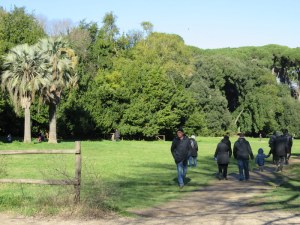
One of the busier paths, Villa Ada. We stuck to the woodsy ones, while most of the Italians embraced the sun.

One of the busier paths, Villa Ada. We stuck to the woodsy ones while most of the Italians embraced the sun.

The grounds and house were once owned by the House of Savoy, Italian royalty. From this family sprang four kings of Italy and also beloved Queen Margherita. Eventually, the estate was purchased by a Swiss gentleman, Count Tellfner, who named it for his wife, Ada. The Savoys bought it back again in the early 20th century turning it into the royal residence until they were ousted in 1946. In the 1950s, it became a public park.
Today Villa Ada is a sprawling landscape of paths, frequented by dog walkers and runners, but it also contains some surprises.
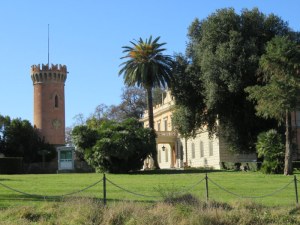
Egyptian Embassy, Villa Ada.

Egyptian Embassy, Villa Ada.

The Egyptian Embassy occupies the old royal residence. It was given to Egypt by the Savoys as a token of their gratitude for the assistance provided during their exile in 1946. Imagine walking through Forest Park in Portland and coming across armed soldiers guarding a foreign embassy. Yeah, it’s that weird.
Rounding a corner in a distant end of the park, we came across an equestrian center, 3C – Country Club Cascianese. There were riding lessons in session in the lovely January sun, and it has an air of exclusivity about it, although I always think that when horses are involved. Quite a contrast to the Egyptian Embassy.
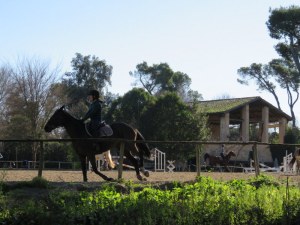
Equestrian center, Villa Ada.

Equestrian center, Villa Ada.

We’ll have to go back to explore a few more paths, and there’s an entire quarter of the park we didn’t get to. Much like our beloved Hoyt Arboretum in Portland, after a few visits we should know our way around. 
In the category of NOT a walk in the park, we had an interesting visit to our bank this week. In fact, we had three visits in two days. Ric’s debit card was cracked and required replacement, so we ventured into the main branch of BNL on Via Bissolati. We had to wait about 25 minutes to be served (there’s a take-a-number machine), but the teller was able to give him a new card and PIN on the spot. We were impressed! No waiting for the mail to deliver it to our flat! Who says Italian systems are inefficient?
All’s well until we stopped at the market on the way home. With a huge line at the cashier, my BNL card wouldn’t work.  We trotted down the street to the Parioli BNL and tried my card in the ATM. The ATM took my card! Said it was deactivated! A very nice teller in this branch retrieved it only to tell me my card was no good, that I had to go back to the branch in the center to get a new one and that she needed to destroy my card. She cut it up. 
So off we went the next day to BNL on Via Bissolati. Here the teller told me that my card was perfectly good, according to the system. “It didn’t work yesterday,” I said. He asked to see it. “No, I told you, the woman on Viale Parioli took it and cut it up.” He told me she was wrong, and since I did not bring the card to him, we should file a denuncia (a formal complaint about the “lost” property) with the Carabinieri!
I was doing this in Italian, and I hate it when they tell me “no” because then I have to enter into the realm of the Italian argument, and my skills really suffer. I am just not that eloquent and my pre-rehearsed sentences collapse in a useless heap around me. But one has to push back. If you take the first no and walk away, you absolutely will make things harder for yourself. So I pushed back. “Just because his colleague at the other branch made an error, it should not be my problem,” I told him in grammatically incorrect Italian. Much to my surprise, he agreed and said “Well next time, bring the card here if it doesn’t work,” and he went on to issue me my new card and PIN. Thank God he backed down because I am no match for an Italian who is up for an extended negotiating session!
I am pleased to report that both of us now have access to our funds, but it certainly was not a walk in the park.
Click on the photos below for a better view.

Signs

12 Dec

So many interesting and amusing signs. Thought I’d share a few.

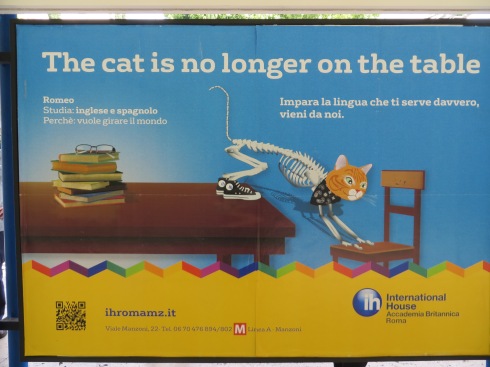
Add for an English-language school. What does this have to do with learning English?

Add for an English-language school. What does this have to do with learning English?


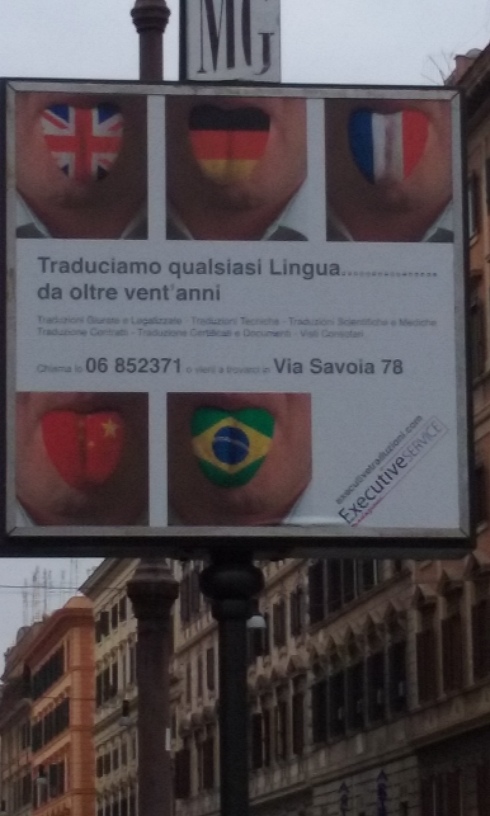
Gives new meaning to multilingual. The Italian word "lingua" means tongue.

Signboard advert: Gives new meaning to multilingual. The Italian word “lingua” means tongue. 


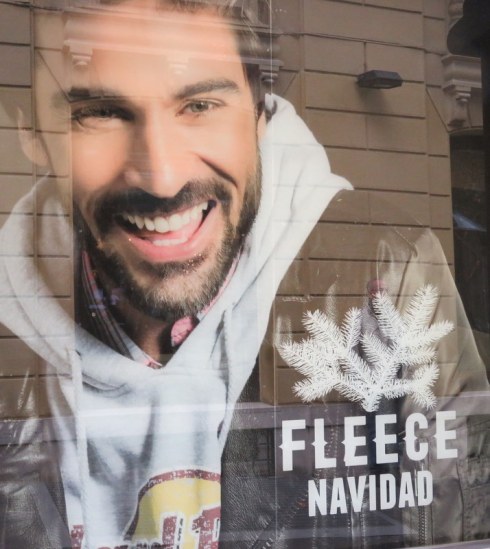
Fleece Navidad...Get it? American Christmas music is huge here, considering there is not a lot of Italian seasonal music, but I don't know if non-Englosh speakers would really understand this pun. In Italian fleece, as in a jacket, is "pile."

Fleece Navidad…Get it? American Christmas music is huge here, considering there is not a lot of Italian seasonal music, but I don’t know if non-English speakers would really understand this pun. In Italian fleece, as in a jacket, is “pile.”


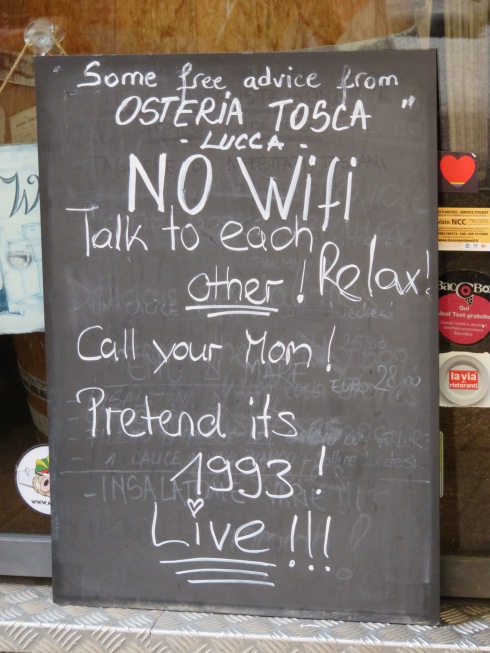
I know this was a favorite from a blog I posted recently. Worth another share.

I know this was a favorite from a blog I posted recently. Worth another share.


Land of many languages

11 Jul
The Val Gardena is home to the Ladin people, an ethnic group of the South Tyrol with their own language, culture, and traditions. Repressed under Fascism, the language and culture is now embraced and celebrated in this small region. The language is spoken by an estimated 84% of the people in our favorite town of Ortisei and is spoken in the home as a means of  keeping the language alive. But as one cannot communicate outside the small Ladin region without other languages, almost everyone speaks German and Italian (education is all in Italian), and many people also speak English fluently, which is helpful with the numbers of non-German and non-Italian tourists.
Embracing this linguistic variety can cause confusion among visitors. We have been here five times now, and the other day got into an argument about the name of the main piazza in Ortisei. I said it’s Piazza San’Antonio and Ric said, “No, it is Piazza San Antone.” How could we not know that? Here’s why:
Sign in the piazza: Italian, German and Ladin names for the same piazza in Ortisei.
Even the town itself has three distinct names. In Ladin, it means “place of nettles.” Luckily we have not encountered any of the stinging variety.
Does trail #9 lead to 3 places? No. All are names for the same cute town.
Some place names are vastly different. The other day we were taking a trail we had not intended to hike. We were not really lost, just a bit off course. At a junction where we had to make a decision, we saw a couple descending so I waited to see if they could clarify our choice. First try, in Italian I asked, “Parla Italiano o Inglese.” Blank stare, then the man says, Deutsch.”  “Do you speak English?” I ask. “A little,” he responded. When I asked where they had come from, he answered with “Langkofelhütte.” Luckily I knew that was the German for Rifugio Vicenza and not our destination, that we should take the other path. How can the same place have such wildly different names?
A final note, many signs at restaurants, etc., are in Italian, German and English to help the majority of travelers. But translations being what they are, sometimes they are amusing. At this rifugio (one of the nicest we have seen) the hills were steep, but what we really needed was some coffee.
IMG_4947

What’s in a name?

3 Jul
Learning a new language and living in a different culture give me pause to think about a lot of things. I look at English with a new eye, too, with all its warts and bump and irregularities.  Imagine how hard it is to learn when there are three varying spellings and meanings for a word that is homophonic such as their, there and they’re? Or read (past tense) and red? Or present tense read (reed) and past tense read (pronounced red)? And of course we park in the driveway but drive in a parkway.  Yes, English is nuts.homophones
The fact that languages change the spelling and pronunciation of city and country names is confusing and I have to wonder what self-important systems these are that insist on changing labels. Why is Firenze “Florence” in English?  Why is Venezia “Venice?” For someone making train reservations in Italy, it is mighty confusing as the national train system only accepts Italian names.  Type in “Naples” and you get nothing as only Napoli delivers results. Why do we not learn these native city names as the original language intends?
FirenzeThis practice runs both ways:  London becomes “Londra” in Italian; Paris becomes “Parigi,” and Nice becomes “Nizza.”  It took me about a year to understand an Insalata Nizza was the popular menu item I knew as Niçoise.  Once, when asked my hometown by an Italian official, I had to state it as “Sant Paolo” because the person I was giving it to did not comprehend St. Paul. One of my favorites in Italian: “Paesi Bassi” which literally means low lands but, in fact, represents The Netherlands, a far cry from the Dutch, De Nederland.151.jpg-parigi
I cannot comment on how languages with Cyrillic or Kanji or Arabic characters handle this phenomenon, but there are hundreds of examples in European languages alone. The good old U.S.A. is pronounced “yousa” and written “Usa” in Italian.  Stati Uniti isn’t bad enough, they have to change how the acronym is applied.  For that matter why is Italia “Italy” in English? Why is it necessary to change München to “Munich?” Can we not learn these pronunciations? (OK, Goteborg, in Swedish, is tough! It’s something like “YET-a-boar-ay.” No wonder we call it Gothenburg.)
From now on I am going to use the original language city names in my blog and wherever possible.  I am such a rebel.

Paris bits and pieces

1 Apr
By now I am used to functioning in two languages. I understand most of what I see in print in Italian, with the exception of the newspaper as it is written in run-on sentences with obscure terminology and archaic verb tenses. When someone speaks directly to me, I understand most of what they are saying if I get the context to start. When I need to communicate me la cavo (I get along) even if my grammar is not perfect.
When we embarked on our trip to Paris I was hit by the realization that I would not understand much of anything from menus to street signs, and I certainly would  not understand spoken French.  Going to France was the most foreign thing we had done since we first traveled to Italy in 2010.
We found ourselves speaking in an odd combination of Italian and English. I am used to speaking Italian to our servers, technicians and shop people in Italy, so that’s the first language that sprang from my lips, combined with mangled French pronunciation. “Prendo il boeuf bourguignon, per favore.” I could not get past grazie to merci until mid-week. In one restaurant, we mixed up languages sufficiently to have the waitress convinced we were Italians who spoke little English. When we said “Merci bonsoir” at the end of the evening, she cheerily replied “Grazie, anche a te!”
There was little hope for me in pronouncing French street names. My Italian-addled brain insists that “Place” must be pronounced PLAH-chay. Once in awhile we’d hear Italian being spoken by other visitors and it was a joy to hear and understand.
Shopping in a French market reminded me of our first trip to Italy when we tried to figure out what things were. Like in Italy, lots of offal was available, from tripe to lambs heads (sorry vegetarians). The Super U was rather ordinary, but some of the shops are magnificent. We found ourselves taking a lot of pictures of store windows and displays.
Here are some Easter treats. Each store had a theme: fish, chickens, cows, even a little mole poking his head above the ground. All gorgeous and expensive. Click on any picture for a slide show.
Fashion windows are creative and the bakeries difficult to resist. The bejeweled athletic-style shoes are Dior. I love the ducks sporting sunglasses and the colorful men’s accessories. Ric showed no interest in blue shoes.


Avocados, artichokes and cabbages are arranged attractively. I wish I had taken a picture of the huge strawberries artfully displayed. In the Place du Madeleine area, boutiques with high-end chocolates, teas, cheeses, and wines seemed like museums. 


We also found time to see the major sites as we wandered the city. At the end of seven days of tromping about Paris my pedometer reported 162,222 steps. We covered some ground, but there’s so much left on the list that we must go back…but later in the spring so we can enjoy the gardens and maybe take our coats off.