Archive | Trains RSS feed for this section

Trains, buses, and the Tube

4 Jan
It’s the little stories, observations, and encounters along-the-way that we remember far longer than we recall the stats we learn during a museum tour or even recall in our mind’s eye the finest art in a cathedral. That is certainly the case with our trip to Paris, London, and Switzerland during the Christmas season.
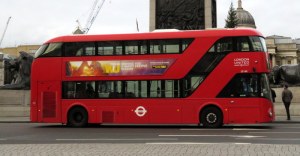
Love the double deckers. Sitting up front on top gives one an impressive view.

Love the double deckers. Sitting up front on top gives one an impressive view.

I have been trying to think of a way to blog about this trip. You’ve seen plenty of pictures of Christmas lights in Roma, Milano, and Paris (plus blogger John Henderson did a far better job than I ever could about Roma). A litany of the sites we saw is just another travelogue.
For the next few posts, I will share some vignettes, stories, and observations from our 4-countries-in-2-weeks trip. First up, a bit about transportation differences.
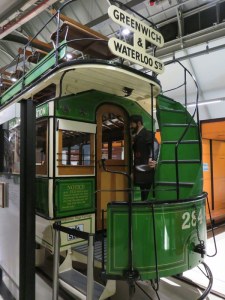
London Transportation Museum: Old-style bus.

London Transportation Museum: Old-style bus.

Italian trains and buses are anything but quiet. Bangladeshi housekeepers call their mamas in the old country on the super-affordable plan from TIM. Single travelers call everyone in their contact list (Sono in treno! Sono sul autobus!) to inform them of their transit woes. Families en route to their holiday travel with bags of food to sustain them and everyone is chatting ALL THE TIME. Ric’s mom came from the school of never let a moment pass in silence, but they would put her to shame. Italians are social creatures and constantly in touch. What they did before cell phones I cannot imagine, although personal conversation is still a strong suit. Texting happens, sure, but talking is far more prevalent. Who has so much to say? Ric and I can sit for an hour without speaking a word. We call it “companionable silence,” well-developed in 31 years.
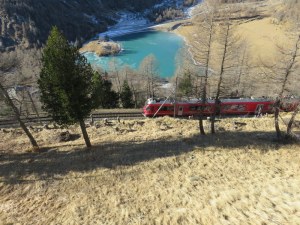
Bernina Express . Just threw this one in as a beauty shot.

Bernina Express. Just threw this one in as a beauty shot.

In Paris, if you talk too loud on the bus or Metro you get the stink eye from the French. Conversations are sotto voce and cell phones are not used except to text, peruse Facebook, or other non-intrusive activity. How pleasant it is! The Swiss are similarly low-key, reserved, and, well, Swiss.
In London, we found people chatting a bit more, but in both Paris and London we saw a lot of people reading on the Tube, Metro or bus. Reading actual books, not on devices. One seldom sees a book pulled out on an Italian bus and it would be impossible to do on the Rome Metro since you are always cheek-by-jowl with scarcely room to change your mind. You cannot read on a Roman bus because most of them lack shock-absorbers and the kidney-pounding you take going over cobblestones makes it impossible to focus on a book.
The Metro in Rome is a dog pile. People are in constant motion. There is no queue. People can barely descend from the train before would-be riders crush forward. I have been pushed aside by young people and middle-aged men with no consideration for my gender, age, or the fact I might be dragging luggage. It is a free-for-all. The stations are filthy, the trash bins overflowing, and of course, the great tradition of graffiti covers trains as well as walls.
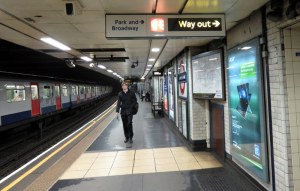
London Tube station. Excellent signage, lighting, acoustics. Far from Rome.

London Tube station. Excellent signage, lighting, acoustics. Far from Rome.

Ah, London and Paris, with your orderly queues, updated stations, and avoidance of unnecessary conversation! You can actually hear the announcements in a British or French tube station. The Tube stations in London are spotless, with no graffiti at least where we traveled. Even the older stations are well-maintained. I love the Parisian Metro stations that have the glass dividers that keep people from falling into the tracks and define the exit and entry points. Several Parisian men actually offered me their seats and no one pushed past me as though I were invisible. In London, we were able to sit down on the Tube most trips, thanks to a preponderance of trains and well-designed cars. Double-decker buses are, by the way, a delightful way to tour the city. I love how everyone is disciplined enough to get on at the front and off in the middle. Not quite that way in Roma…
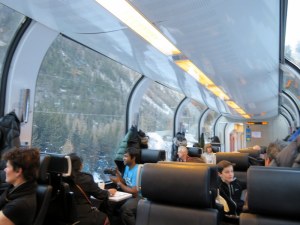
Bernina Express interior. Lovely, quiet, comfy. Coffee cost us €4.50 each however. On Trenitalia you get one free.

Bernina Express interior. Lovely, quiet, comfy. Coffee cost us €4.50 each, however. On Trenitalia you get one free.
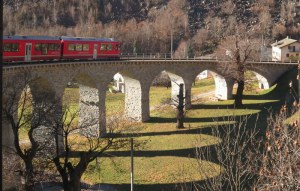
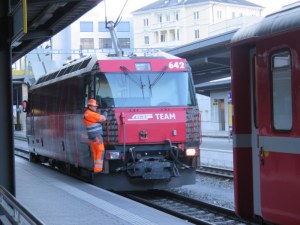
The Swiss train stations are oases of calm in a calm country. Well-signed, immaculate, orderly, no pushing or shoving (except by foreigners who carry their own habits along). The trains may not be as posh as the Frecciarossa or Italo Treno, but they are comfortable. With no discounting and no complimentary wine (sniff!), the Swiss railroad must be making some serious francs.
Italy, we love you! We love your trains and your warm-hearted people. We love not needing a car to travel all over the city, country, and continent. You do coffee better than anywhere we’ve lived or traveled, and we miss your food when we are out-of-the-country, but you could be just a smidge quieter and stand in line now-and-then.

The Great Railway Adventure

2 Jan
I love to travel by train. Even hours and hours is fine by me. Train travel beats air travel and its many indignities. Four hours in a plane makes me want to slit my wrists whereas four hours in a train is just a good start.
The Bernina Express on the famous Brusio spiral viaduct.

The Bernina Express on the famous Brusio spiral viaduct.

To my husband, trains are a religion. Not only does he enjoy riding in them, he can watch them for hours. He delights in rolling stock of all types, and thrills at seeing railroad workers address their tasks. How many thousands of photos he has taken! He also is fascinated by all types of transportation from pedicabs to delivery vehicles. There’s not an Ape 50
Action shot.

Action shot.

that escapes his camera’s eye.
When I suggested London for Christmas by train, with a stop in Paris and return through Switzerland, he had agreed before I finished saying “Bernina Express.” While we did, in fact, sleep in four countries over the two-week period, this was not “If it’s Tuesday it Must be Belgium.”
I’ll leave you at the end of this post with a few photos,  but first the route. The final plan included nine train trips in 15 days. Good thing we have time.
Roma to Milano – 2h:55m
Milano to Paris – 7h:26m
Paris to London – 2h:17m
London to Paris – 2h:29m
Paris to Zurich – 4h:03m
Zurich to Chur – 1h:15m
Chur to Tirano – 4h:13m
Tirano to Milano – 2h:32m
Milano to Roma – 3h:55m
During the last segment, the full-to-capacity train broke down and we had to transfer to a new train resulting in a 1-hour delay. We were only a little annoyed, and we got a partial credit from Trenitalia as a result of the delay.
Yes, that is a remarkable 32 hours-or-so in trains, blissfully snoozing, chatting, reading, writing, and watching the lovely scenery. I would not recommend this type of schedule for people on their average trip to Europe. One would not want to spend as much transit time as we did on a typical two-week vacation; However, we have time, a true blessing of retirement and living in Europe.
I have more to blog about in the coming days. Stay tuned! Click on any picture for a slideshow or a closer look.


The Pope doesn’t sleep here

27 Oct
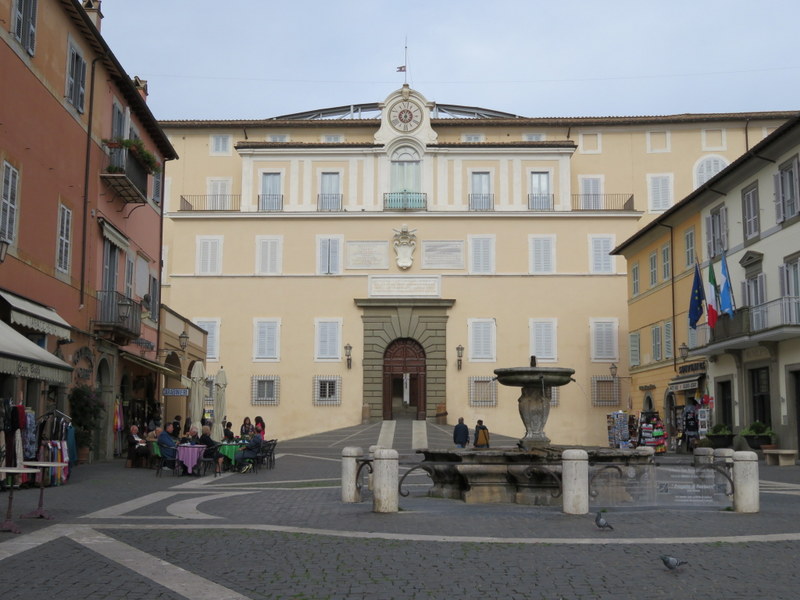
At least the current pope, Papa Francesco, does not sleep in the Apostolic Palace of Castel Gandolfo. He has abnegated the luxury of a vacation residence and opened the doors to the public; At least to anyone willing to pay €10.00 for entrance.
The Apostolic Palace dominates the square in Castel Gandolfo.
In September we visited the Gardens of the Pontifical Villa, thinking we were in Castel Gandolfo. In actuality, the gardens are part of Villa Barberini in Albano Laziale and when we exited the garden tour we were a long walk from the little town of Castel Gandolfo. So we vowed to return while the weather was good.
Pope's view of Lago Albano.
Pope’s view of Lago Albano.
Early in the morning the flow of commuters from small towns storm Stazione Termini like an invading horde. The incoming trains are packed with briefcase-toting-suit-wearers and women tottering on impossibly high heels, and it seems everyone is puffing on a post-commute cigarette. We were blessed with an out-of-Roma trip, against the onrush of workers, accompanied by a very few Romans who actually get to leave the city for work.
A quick 40-minute ride through the countryside, passing Ciampino Airport and a handful of small towns, brought us to Castel Gandolfo. Then a 15-minute slog walk up the hill landed us in the town square where any number of little bars awaited our arrival. We found seats and a cappuccino in the 15-degree Celsius sunshine with a full view of the Apostolic Palace, aka, Papal Palace, aka Pontifical Villa or most commonly in Italian Palazzo Apostolico. Take your pick.
A Bernini angel...at least the audio guide claims it is his work.
A Bernini angel…at least the audio guide claims it is his work.
Writing set of Pope Pius VIII. Sorry about the glare. It is under glass for its protection.
As instructed, 20 minutes before our tour time of 10:00, we approached the guard who welcomed us warmly and sent us up a flight of stairs to enter the museum. We were equipped with audio tour devices and sent on our way to self-guide, well before the clock chimed 10:00. We were the only people in the entire museum!
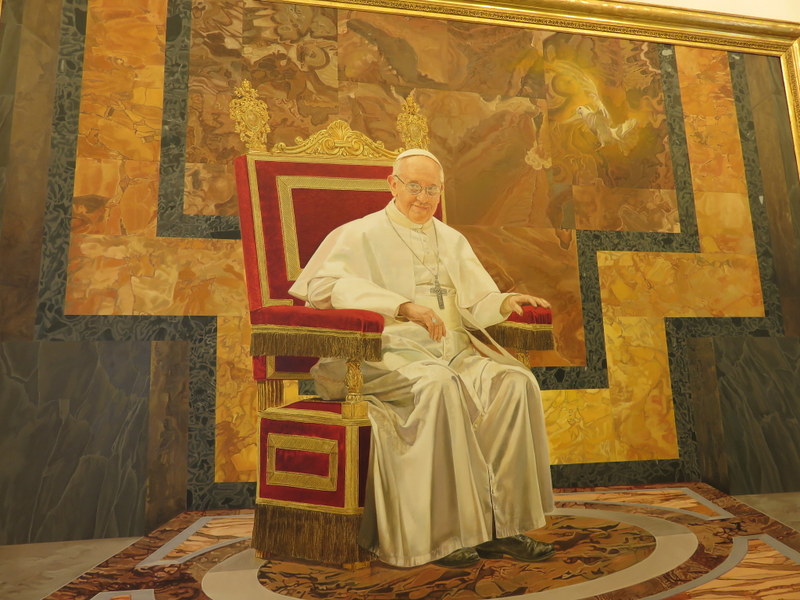
Now before you get to thinking that we ran giddily through the papal vacation home, jumping on the beds and checking inside the refrigerator, the public is not allowed in any area that would be considered an apartment. The museum consists largely of select papal portraits along with some special accoutrements, and the accompanying audio guide tells some of the fascinating history behind these powerful men.
The portrait of Papa Francesco is in a very different style from his predecessors.
We enjoyed the tour very much, even if we did not get to see the Papal bathroom. There’s one of those at Castel Sant’Angelo anyway.
Papal throne and entourage.
In 6 1/2 hours we went from our home to Castel Gandolfo by bus and train, had coffee (always on the agenda), took the tour, and were back home in time for lunch. If one wanted to have lunch in CG — and why not with that view of the lake! — I would actually recommend the 11:00 tour followed by a leisurely lunch. Trains back to Roma are frequent. Would I spend an entire vacation day doing this on my first trip to Roma? Absolutely no. But when you have been here as long as we have, or visit annually like some of our friends, it’s fun to find new places to explore.
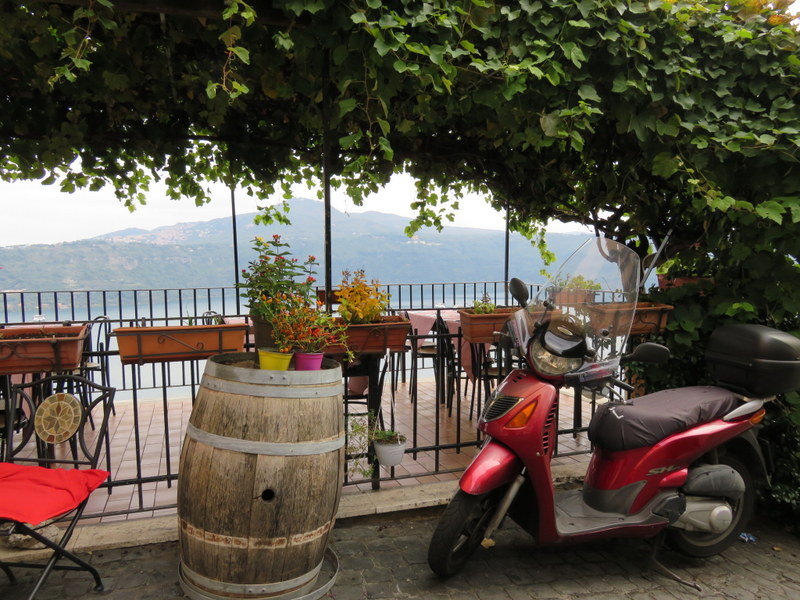
There are many restaurants that take advantage of the fine lake view.
Info on tickets for the sites in Castel Gandolfo and Albano Laziale can be found here.

Guns and The Top of Europe

30 Sep
30 September 2015.
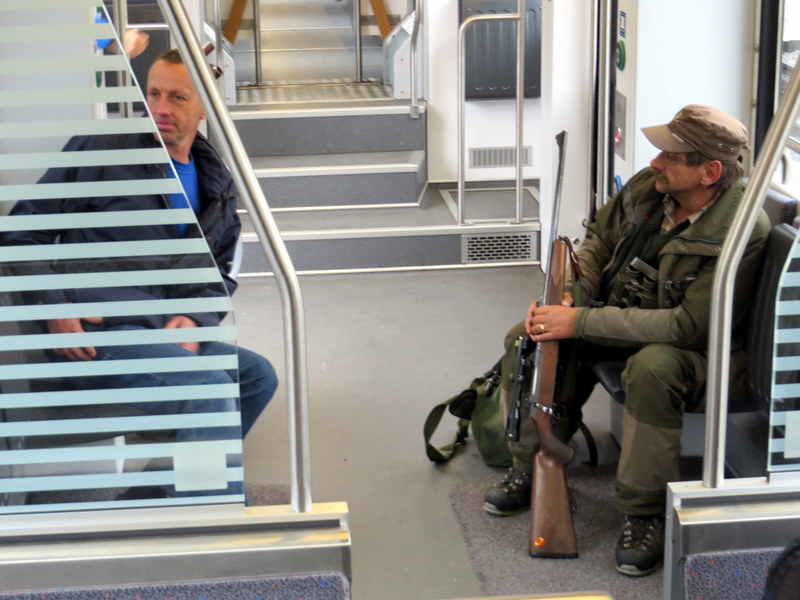
A man gets on the train carrying a gun. What would you do? If I was in France, Spain, Great Britain or the USA, I would dive for cover. But we are in Switzerland, in the Bernese Oberland to be precise, and apparently, no one bats an eye. Neither did we since he walked in accompanied by another local, and even women pushing babies in strollers were undisturbed by the sight. I am not going to pretend I understand the Swiss mindset or even the laws around firearms. This article from Time magazine on the subject is pretty interesting. I am not sure I am more concerned about the fact he was hunting in an area where people hike or carrying a weapon in public. 
When we saw this guy get on we got the giggles. Can you imagine if this happened on MAX in Portland? This was on the Wengeralp narrow-gauge cog railway.
Switzerland seems to have its act together. The Swiss have managed to remain neutral in world politics, insulated from European Union issues as they are non-EU, but they take advantage of the Schengen Agreement and the abolishment of internal borders. Still, immigration is highly controlled. They have an admirable environmental record, plenty of water resources, clean air, excellent recycling, a thriving economy with low unemployment. Their public debt is less than 35% of GDP (compared to Italy at 134% and the USA at about 71%). And of course there’s the cheese. High prices do not seem to deter tourists, especially the Japanese who are here in droves and show no reluctance to shell out hundreds of Swiss Francs to see the sights and buy winter fashions. You would not believe the price of a Patagonia jacket here.
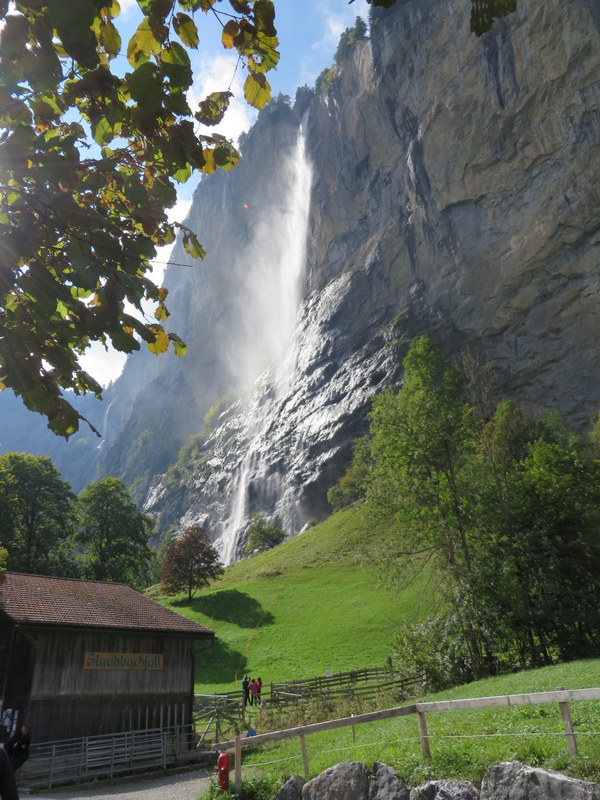
Staubbach Falls, visible from our vacation rental.
This is our third trip to Switzerland in less than 2 years. Yes, we like it. The food is not as good as Italy, and the coffee almost all comes from a ubiquitous push-button machine found in virtually every café and restaurant. It’s CHF 4.00 for a basic cup of coffee or a single shot of espresso. In fact, everything is quite expensive. While the exchange rate is almost on par with the U.S. dollar, the actual prices are high. A pizza that would cost us about $11.00-12.00 in Italy is about $23.00 here. A small green salad runs $8.50. Wine by the bottle is insanely expensive in restaurants, but one can get a small glass of good local wine for a price less than we experienced in Seattle, Portland, and San Francisco. Why do we come back if it costs so much? The transportation system, the hiking, the natural beauty: Switzerland offers a lot of what we like to do when traveling. And it works, well, like a clock.
A Jungfraujoch train moves up the mountain. Most of the journey is in a tunnel inside the Eiger and the Mönch.
I have wanted to go to the Jungfraujoch since Matt Lauer went there in 2011 during his annual “Where in the World is Matt Lauer” tour. During our first two Swiss trips in January 2014 and August 2014, we dismissed the trip to the Jungfraujoch as too expensive. It costs CHF 204.40 per person from Lauterbrunnen in the valley to the Jungfraujoch and back. We learned that with certain types of passes one could pay less, so we vowed “the next time” we would make the trip. This is the next time, so we bought both half-fare Swiss passes and a Bernese Oberland Regional Pass. We had to pay a relatively small supplement to go all the way to the Top of Europe (called so because it is the highest train station in Europe). It was worth it!
Jungfraujoch Railroad - our train ready to depart.
Jungfraujoch Railroad – our train ready to depart.
Rising at 5:00 AM, we caught the first train up the mountain, in total about 1 hour 45 minutes from the bottom of the valley to the Jungfraujoch, arriving just before 9:00 AM. Some of the “tour” is goofy. The giant snowglobe in the Alpine Sensation was unrefined, and the Ice Palace sculptures were not nearly as nice as those at the Saint Paul Winter Carnival of my youth, but the pure beauty of the pristine mountain was the star, and contemplating the building of such a railroad in the 1890s sobering. Thanks to 100 Italian laborers, the tunnel was built.
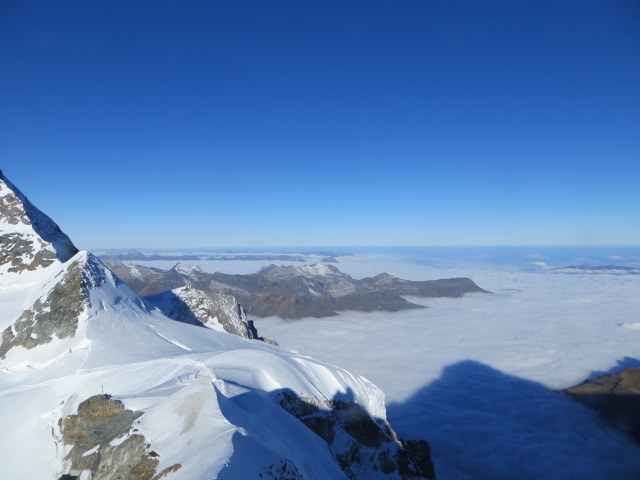
View from the Top of Europe over the cloud-covered valley. It was very cold outside!

We went outside on the observation platform, but the 33 kph winds combined with the -1.5 Celsius temp reminded us a bit too much of our Minnesota and North Dakota heritage. We lasted long enough to take a few photos. Going on the sledding course was out of the question, as was the glacier walk of 1 1/2 hours roundtrip. 
We were at 11,333 feet above sea level. That is lower than the elevation we hiked to in Colorado last month, but a completely different climate. In Colorado, we peeled off layers. Here, I wished I’d had my puffy coat.
Railway Station at the Top of Europe, inside the mountain.
This was an unforgettable trip and we are glad we did it. Going early was a great strategy, at least with the weather forecast we had. We would be unlikely to go twice, so it truly was a once-in-a-lifetime experience. 


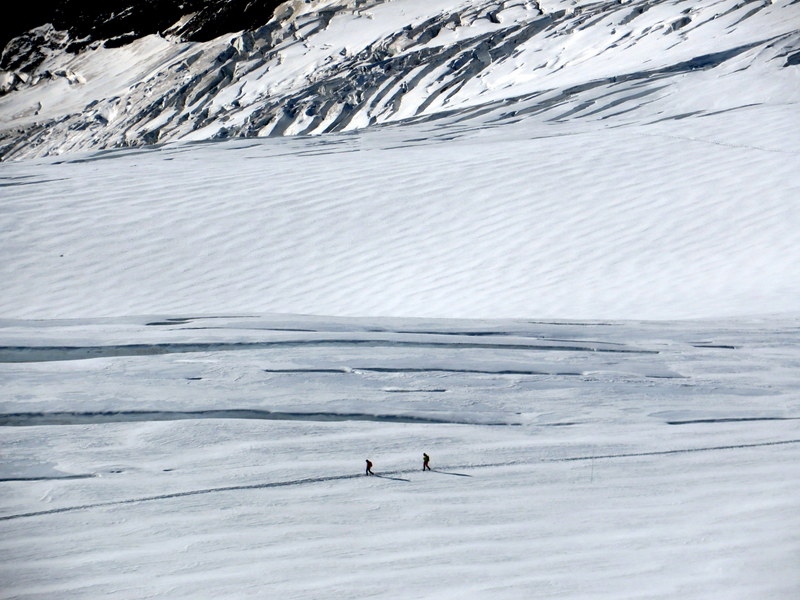
People walking on the glacier beneath the Jungfraujoch.
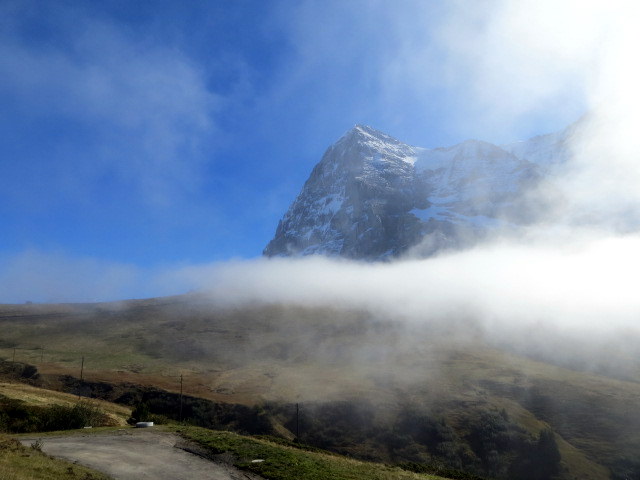
The Eiger pokes above low level clouds as we depart Kleine Scheidegg.
The Eiger pokes above low level clouds as we depart Kleine Scheidegg after our visit on high.
CHF 30,300 watch available at the highest watch shop in Europe.
View of the Lauterbrunnen Valley. Our apartment is just a bit to the left of the church.
View from our apartment. We can also see Staubbach Falls from our terrace.

Castel Gandolfo: Vatican by train

13 Sep
One of the goals we have in staying in Italy for some time to come is to continue exploring our own backyard, i.e., Roma and environs. We’ve enjoyed some less-visited sights over the past three years, and continue to look for new ones. Afterall, una vita non basta!
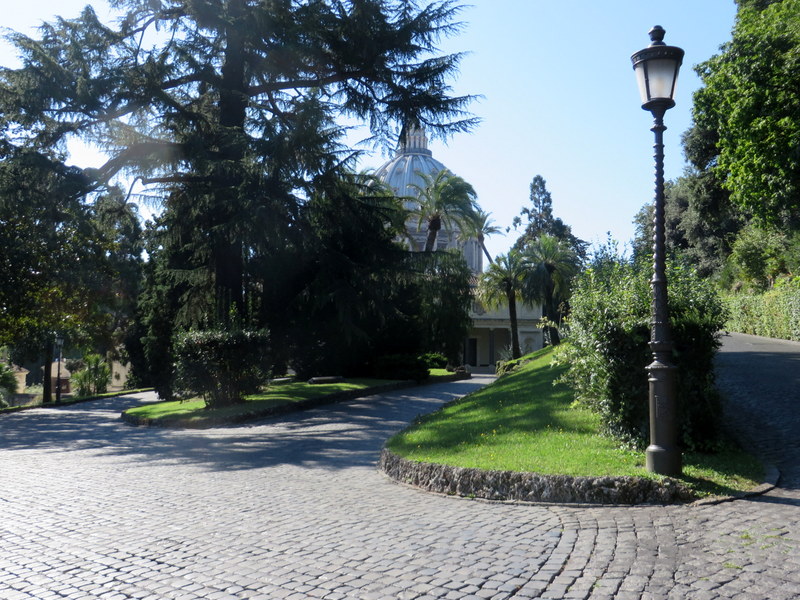
St. Peteràa from the inside. A view from the garden, where the Pope takes his daily walk.

St. Peter’s from the inside. A view from the garden, where the Pope takes his daily walk.

Early last week a new tour was announced in the Italian press: Vatican by Train. That got Ric’s interest pretty fast. According to the press, the tour, called “Vatican by Train Full Day” would run only on Saturdays and the first run was September 12. We could be on-board for the maiden voyage!
Here’s what the Vatican website had to say
With the exceptional opening of the Barberini Gardens and of the Museum of the Apostolic Palace, the Pontifical Residence of Castel Gandolfo welcome the public at large.
Visitors who book the Vatican by Train will have access to the Vatican Museums, the Sistine Chapel, the Vatican Gardens and to the botanical and architectural wonders of the Pontifical Residence, known by as the “second Vatican”.
Further exploration revealed an ambitious schedule and the likelihood of a 13 hour day away from home, but we have time…. The schedule for the day broke down like this (wording from the Vatican website)
8.00 am: Avoid the queue at the entrance. Tour of the Vatican Museums and Sistine Chapel with an audio guide;
10.00 am: Walking tour of the Vatican Gardens with an audio guide;
11.00 am: Departure from Train Station of the Vatican City State to Albano Laziale and transfer to the Pontifical Villas by shuttle;
12.30 pm: Tour of the Pontifical Villas (Villa Barberini) by tourist train with an audio guide;
1.30 pm: End of the tour and exit from the Pontifical Villas.
Free time
4.45 pm: Transfer from the Pontifical Villas to the train station of Albano Laziale by shuttle;
5.18pm: Departure from the Train Station of Albano Laziale to the Roma San Pietro Station
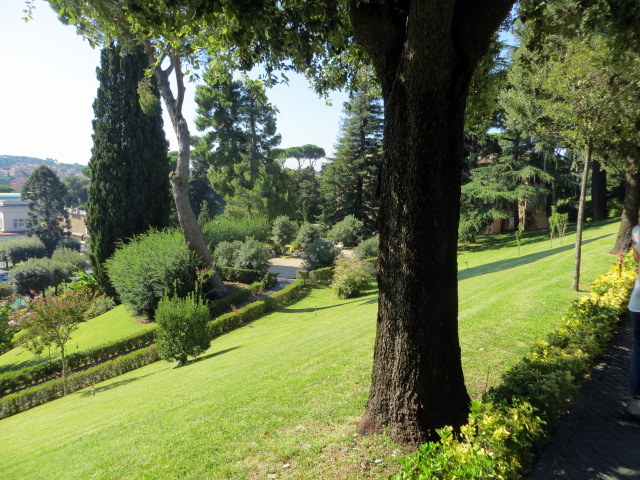
Beautiful lawns fall away toward teh train station. Hard to imagine all of this is inside Vatican City.

Beautiful lawns fall away toward the train station. Hard to imagine all of this is inside Vatican City.

Leaving home about 06:30, we arrived at the museum entrance a few minutes before 8:00, fortified by cappucino e cornetto at a nearby bar. It was clear lunch would be a long way off and we had miles to go before we ate. We were admitted quickly, as promised with our voucher. Exchanging it for tickets and an audio guide took a few minutes, but by 8:25 we were outside the Pinacoteca, which we had decided would be our focus.
There is no way one can “do” the Vatican Museums in less-then-two hours. A few people we spoke to later in the tour tried a mad dash to the highlights such as the Sistine Chapel and Hall of Maps, but everyone eventually realized this was not a best-of-the-Vatican tour.
Fountain in the Vatican Gardens, reminiscent of Villa d'Este.

Fountain in the Vatican Gardens, reminiscent of Villa d’Este.

Our decision to focus on the Pinocateca was fortuitous: We were completely alone for at least 20 minutes. Just Ric and me, fabulous works of art, and a dozen guards hunched over their smartphones. (Whatever did museum guards do before they had smartphones?) Some tour groups arrived, stopped at major works then moved quickly on. We took our time, saw the entire gallery, then had a brief rest before the garden tour. If you ever want to be alone in the Vatican Museums, head for the Pinocateca at opening.
Under clear blue skies and warm-not-hot sun we were escorted through the Vatican Gardens by a group of uniformed guides and a number of “suits” and journalists. The museum officials were shepherding the inauguration carefully, ensuring it went smoothly. And it mostly did.
Bougainvilla still in bloom, the Vatican Gardens.

Bougainvilla still in bloom, the Vatican Gardens.

Our garden tour was also audio-guided, and we had a wee map with audio points described, but it was difficult to know where our group of about 100 people was and when we should punch up each number. Still it was beautiful, not at all what I expected, and while not encompassing the entire tour (which according to the website is 2 hours long) it was a good overview.
We ended at the Vatican train station, a seldom-used and closed-to-the-public relic of a prior era. Thanks to Papa Francesco, more of the Vatican properties are being opened to mere mortals and the chance to take the train out of this station was a strong motivator for us.
Not the steam train the media portrayed....

Not the steam train the media portrayed….

We expected a steam train. All the news media featured a vintage train, but on arrival we found a modern Trenitalia train of the type used on the FR lines. It was fine, comfortable and air-conditioned, but not the historic experience expected. I have to wonder if there was another train that day, but all of the articles I’ve found were written before the 12th and so I think the pictures are “file photos” and certainly not from the event we attended.
We had a nice ride to the station at Albano Laziale, where buses met us and ferried us through narrow streets and up the hill to the entrance to the gardens. There, we boarded a trenino to tour the estate, again with audio guide. Absolutely stunning is all I can say. I had no idea Domitian had a summer palace here, but then why wouldn’t he? The history is, as with almost any grand villa in Italy, long and complex. What remains is a place of beauty comparable to Versailles. Some is wooded, some planted in formal gardens, and there is a farm. Did you know the Pope has a farm? Chickens, white goats, cows, bees: everything one needs in a self-sustaining estate.
Click on any photo to enlarge it or for a slideshow.
Wrapping up about 14:40, we had three hours of free time. We set off to find a restaurant along the lake, where we had lunched a couple of years ago. But wait, where the hell was the lake? Pulling up Googlemaps we found we were in Albano Laziale, not Castel Gandolfo. Duh! Not close to the lake, we started wandering the town, which was mostly closed for la pausa. Not a lot of restaurant options we could see, but peeking down a little alley Ric spotted a trattoria. From where we stood it looked closed, although someone was inside sweeping up. “Siete aperti?” I asked. “Sí! Accommodatevi!” We took a cute table on the patio just as a group of Americans we knew trooped in. They, too, had been surprised by ending in Albano Laziale. They had a reservation for lunch 3 km away in Castle Gandolfo! Feeling slightly less stupid for misunderstanding, we relaxed and prepared to enjoy lunch. We were fortunate to have a little family from the U.K. join us at a neighboring table and engaging in conversation we discovered they had expected to end the tour at the Apostolic Palace in Castel Gandolfo. Surprise!  Perhaps all of the English-speakers misunderstood? Maybe the Vatican website was less-than-clear? Nonetheless, I can highly recommend Trattoria Rosmarino should you make the trip to Albano.
Cin cin! At Trattoria Rosmarino. Highly recommend!

Cin cin! At Trattoria Rosmarino. Highly recommend!

A long lunch ate up the free time (pun intended). There are a number of ruins and sites in Albano for the more industrious tourist, but we had been on-the-go since dawn with not much energy left, so a luxurious lunch was perfect. Back on the shuttle bus before 16:30, we arrived at San Pietro Station just in time to get a train to the tram to go back home, another adventure in public transportation for us.
Isaac, our dining partner at Rosmarino.

Isaac, our dining partner at Rosmarino.

We were very confused about the relationship between the estate we toured in Albano and the Apostolic Palace at Castel Gandolfo. A little map-based research showed they are on the same property, but the gardens are accessed by the public through Albano, and the Apostolic Palace is at the other end, the north end, closer to the lake. One can visit the Apostolic Palace, any day but Sunday, and only in the morning, and apparently only through the month of October, presumably to be revived in the spring.
I suspect another day trip to the area is in our near future.
For more information on all of the tours, go to the Vatican’s Online Ticket Office.