Archive | Trains RSS feed for this section

Night train to Vienna

21 Feb
Does that title conjure up images of The Third Man: Harry Lime and Holly Martins with the lovely Anna prowling about post-WWII Vienna, chasing through dark streets, sewers, and buildings reduced to rubble? The movie paints Vienna as a bleak and dreary place, certainly not the city of Mozart and Schubert.
The Stephanskirche in Vienna is very dark and grim inside and out.

The St. Stephens Cathedral in Vienna is very dark and grim inside and out.

We found Vienna to be quite bleak as well. Perhaps it is just the weather, which was rather like Seattle in winter, only colder. Skies were gray on gray, with winds that chill the neck and beg one to wrap the scarf more tightly.  We feasted our eyes on the riches of the Habsburgs in all their excess: The Hofburg Palace, Kunsthistorisches Museum (KHM for short; marvelous!), and the Schönbrunn Palace. We walked through diverse areas of the old city, marveled at the musical heritage of this one small burg, and ate non-Italian food for days. We did miss our €1.00 espresso shots and accessibly priced Italian wines, but my, the bread and pastries were tasty!
Settling in for a night on the train.

Settling in for a night on the train.

The night train was fun and we would gladly do it again. We had a large private compartment for less than the price of two one-way airline tickets and a night in a hotel plus airport transportation on both ends. The compartment even had a bathroom, although coaxing hot water out of the shower proved to be an impossible task. We slept far better than we expected to and greeted the new day in Austria with breakfast served in our compartment. All-in-all it was a lovely evening and night, affording us the opportunity to hit the streets of Vienna upon arrival.
The Schoenbrunn Palace of 1441 rooms rivals Versailles. It dates to the 16th century when it was, of course, built as a hunting lodge. Inside is 18th century Rococo.

The Schoenbrunn Palace of 1441 rooms rivals Versailles. It dates to the 16th century when it was, of course, built as a hunting lodge. Inside is 18th century Rococo.

The Habsburg wealth and excess gave us pause to consider excesses and royalty. It seemed even more excessive than that which we have seen elsewhere in Europe. Perhaps because Austria is now such a small country it is difficult to reconcile with the once great status of the empire and the family that acquired such wealth.  It is a wonder the Austrian people didn’t do to the Habsburgs what the French did to the Louis XVI and Marie-Antoinette in the French Revolution. (Nota Bene: Marie-Antoinette was a Habsburg by
The backyard at the Schoenbrunn Palace.

The backyard at the Schoenbrunn Palace.

birth.) Empress Elizabeth, AKA, Sisi, seemed to be worshiped in the eponymously named museum within the Hofburg Palace. While it was fun to see the gowns and elegance of the time, she was a tragic narcissist who had ankle-length hair, a penchant for the finest chocolate Demel could deliver, and despised being married to the Emperor. Not much to admire in my book. 
For more on the riches and sights of Vienna please click on any picture below for a slide show. 
The silver lining to winter city-trips is that sites are not crowded. While weather prohibited sipping coffee in a sunny square, we enjoyed crowd-free touring and waltzed right into the museums and palaces. To be fair, even with 2 ½ days we failed to see all Vienna had to offer. Wish we’d had time for the Klimt Museum at the Belvedere Palace.
Typical wurstel stand in Vienna. YEs, they are much patronized. No, we did not.

Typical wurstel stand in Vienna. Yes, they are much patronized. No, we did not.

The food surprised us. Our dinners were anything but formula Austrian. Fresh fish and creative treatment of vegetables surprised us, although of course one can find schnitzel, too. Wine by the bottle is expensive compared to our beloved Italy, but restaurants offer a remarkable selection of wines by-the-glass at prices that make a bottle seem unnecessary. We are now big fans of Grüner Veltliner, the exceptional Austrian white wine.
The Vienna U-Bahn employs an honor system we’ve not seen before. There are no turnstiles or gates. You are responsible for buying and carrying a validated ticket or pass, and there are spot checks. We sashayed on-and-off a few times, then the last morning on our way to the train station encountered an army of ticket checkers at Schwedenplatz – at least a dozen strong – randomly looking at tickets and passes. The system made transit quite smooth. I wonder if it could be made to work in Rome?
My travel companion of 31 years and a bottle of prosecco to start the trip.

My travel companion of 31 years and a bottle of prosecco to start the trip.

For anyone planning a trip to Vienna, I have three recommendations.
  1. Hotel Stefanie is just past the Danube Canal to the north of the Ringstrasse. Old-world in style, but upgraded for modern travel with powerful showers of never-ending hot water (unlike Base Camp Barton in Rome), WIFI, and an enormous breakfast buffet. The tram to the center runs right by the front door. Off-season we paid €106.00 per night.

    Lovely fish and vegetable dish at El Hans. Delectible and pretty.

    Lovely dorado and bok choy with potatoes at El Hans. Delectable and pretty.

  2. We had incredible meals at El Hans and ef16 both within walking distance of the hotel. Certainly you can get Wienerschnitzel, but why do so when there is freshly grilled octopus, calamari, trout, pumpkin soup, violet mashed potatoes, and figs at every turn? How does Austria manage to do vegetables so much better than Switzerland?
  3. A transit pass for three days was very worthwhile. Although we walked 9-10 km daily, the weather frequently made jumping on the tram a good idea. No need to buy a Vienna Card. As seniors, every museum gave us a discount upon asking (the low end of senior defined as a youthful 61). 
More to come…Salzburg and the Pillerseetal ahead!
 

Trains, buses, and the Tube

4 Jan
It’s the little stories, observations, and encounters along-the-way that we remember far longer than we recall the stats we learn during a museum tour or even recall in our mind’s eye the finest art in a cathedral. That is certainly the case with our trip to Paris, London, and Switzerland during the Christmas season.
Love the double deckers. Sitting up front on top gives one an impressive view.

Love the double deckers. Sitting up front on top gives one an impressive view.

I have been trying to think of a way to blog about this trip. You’ve seen plenty of pictures of Christmas lights in Roma, Milano, and Paris (plus blogger John Henderson did a far better job than I ever could about Roma). A litany of the sites we saw is just another travelogue.
For the next few posts, I will share some vignettes, stories, and observations from our 4-countries-in-2-weeks trip. First up, a bit about transportation differences.
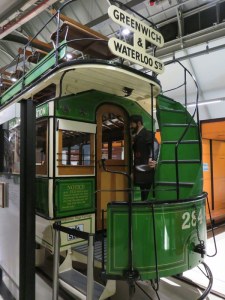
London Transportation Museum: Old-style bus.

London Transportation Museum: Old-style bus.

Italian trains and buses are anything but quiet. Bangladeshi housekeepers call their mamas in the old country on the super-affordable plan from TIM. Single travelers call everyone in their contact list (Sono in treno! Sono sul autobus!) to inform them of their transit woes. Families en route to their holiday travel with bags of food to sustain them and everyone is chatting ALL THE TIME. Ric’s mom came from the school of never let a moment pass in silence, but they would put her to shame. Italians are social creatures and constantly in touch. What they did before cell phones I cannot imagine, although personal conversation is still a strong suit. Texting happens, sure, but talking is far more prevalent. Who has so much to say? Ric and I can sit for an hour without speaking a word. We call it “companionable silence,” well-developed in 31 years.
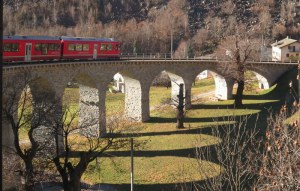
Bernina Express . Just threw this one in as a beauty shot.

Bernina Express. Just threw this one in as a beauty shot.

In Paris, if you talk too loud on the bus or Metro you get the stink eye from the French. Conversations are sotto voce and cell phones are not used except to text, peruse Facebook, or other non-intrusive activity. How pleasant it is! The Swiss are similarly low-key, reserved, and, well, Swiss.
In London, we found people chatting a bit more, but in both Paris and London we saw a lot of people reading on the Tube, Metro or bus. Reading actual books, not on devices. One seldom sees a book pulled out on an Italian bus and it would be impossible to do on the Rome Metro since you are always cheek-by-jowl with scarcely room to change your mind. You cannot read on a Roman bus because most of them lack shock-absorbers and the kidney-pounding you take going over cobblestones makes it impossible to focus on a book.
The Metro in Rome is a dog pile. People are in constant motion. There is no queue. People can barely descend from the train before would-be riders crush forward. I have been pushed aside by young people and middle-aged men with no consideration for my gender, age, or the fact I might be dragging luggage. It is a free-for-all. The stations are filthy, the trash bins overflowing, and of course, the great tradition of graffiti covers trains as well as walls.
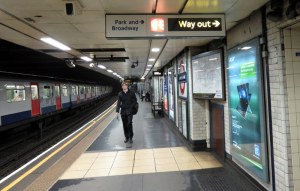
London Tube station. Excellent signage, lighting, acoustics. Far from Rome.

London Tube station. Excellent signage, lighting, acoustics. Far from Rome.

Ah, London and Paris, with your orderly queues, updated stations, and avoidance of unnecessary conversation! You can actually hear the announcements in a British or French tube station. The Tube stations in London are spotless, with no graffiti at least where we traveled. Even the older stations are well-maintained. I love the Parisian Metro stations that have the glass dividers that keep people from falling into the tracks and define the exit and entry points. Several Parisian men actually offered me their seats and no one pushed past me as though I were invisible. In London, we were able to sit down on the Tube most trips, thanks to a preponderance of trains and well-designed cars. Double-decker buses are, by the way, a delightful way to tour the city. I love how everyone is disciplined enough to get on at the front and off in the middle. Not quite that way in Roma…
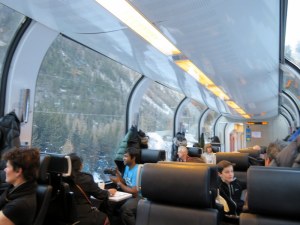
Bernina Express interior. Lovely, quiet, comfy. Coffee cost us €4.50 each however. On Trenitalia you get one free.

Bernina Express interior. Lovely, quiet, comfy. Coffee cost us €4.50 each, however. On Trenitalia you get one free.

The Swiss train stations are oases of calm in a calm country. Well-signed, immaculate, orderly, no pushing or shoving (except by foreigners who carry their own habits along). The trains may not be as posh as the Frecciarossa or Italo Treno, but they are comfortable. With no discounting and no complimentary wine (sniff!), the Swiss railroad must be making some serious francs.
Italy, we love you! We love your trains and your warm-hearted people. We love not needing a car to travel all over the city, country, and continent. You do coffee better than anywhere we’ve lived or traveled, and we miss your food when we are out-of-the-country, but you could be just a smidge quieter and stand in line now-and-then.

The Great Railway Adventure

2 Jan
I love to travel by train. Even hours and hours is fine by me. Train travel beats air travel and its many indignities. Four hours in a plane makes me want to slit my wrists whereas four hours in a train is just a good start.
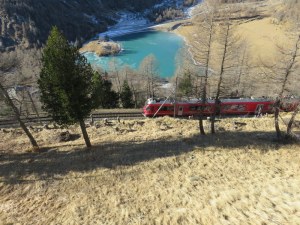
The Bernina Express on the famous Brusio spiral viaduct.

The Bernina Express on the famous Brusio spiral viaduct.

To my husband, trains are a religion. Not only does he enjoy riding in them, he can watch them for hours. He delights in rolling stock of all types, and thrills at seeing railroad workers address their tasks. How many thousands of photos he has taken! He also is fascinated by all types of transportation from pedicabs to delivery vehicles. There’s not an Ape 50
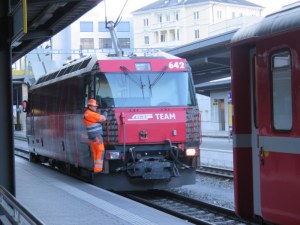
Action shot.

Action shot.

that escapes his camera’s eye.
When I suggested London for Christmas by train, with a stop in Paris and return through Switzerland, he had agreed before I finished saying “Bernina Express.” While we did, in fact, sleep in four countries over the two-week period, this was not “If it’s Tuesday it Must be Belgium.”
I’ll leave you at the end of this post with a few photos,  but first the route. The final plan included nine train trips in 15 days. Good thing we have time.
Roma to Milano – 2h:55m
Milano to Paris – 7h:26m
Paris to London – 2h:17m
London to Paris – 2h:29m
Paris to Zurich – 4h:03m
Zurich to Chur – 1h:15m
Chur to Tirano – 4h:13m
Tirano to Milano – 2h:32m
Milano to Roma – 3h:55m
During the last segment, the full-to-capacity train broke down and we had to transfer to a new train resulting in a 1-hour delay. We were only a little annoyed, and we got a partial credit from Trenitalia as a result of the delay.
Yes, that is a remarkable 32 hours-or-so in trains, blissfully snoozing, chatting, reading, writing, and watching the lovely scenery. I would not recommend this type of schedule for people on their average trip to Europe. One would not want to spend as much transit time as we did on a typical two-week vacation; However, we have time, a true blessing of retirement and living in Europe.
I have more to blog about in the coming days. Stay tuned! Click on any picture for a slideshow or a closer look.


The Pope doesn’t sleep here

27 Oct
At least the current pope, Papa Francesco, does not sleep in the Apostolic Palace of Castel Gandolfo. He has abnegated the luxury of a vacation residence and opened the doors to the public; At least to anyone willing to pay €10.00 for entrance.
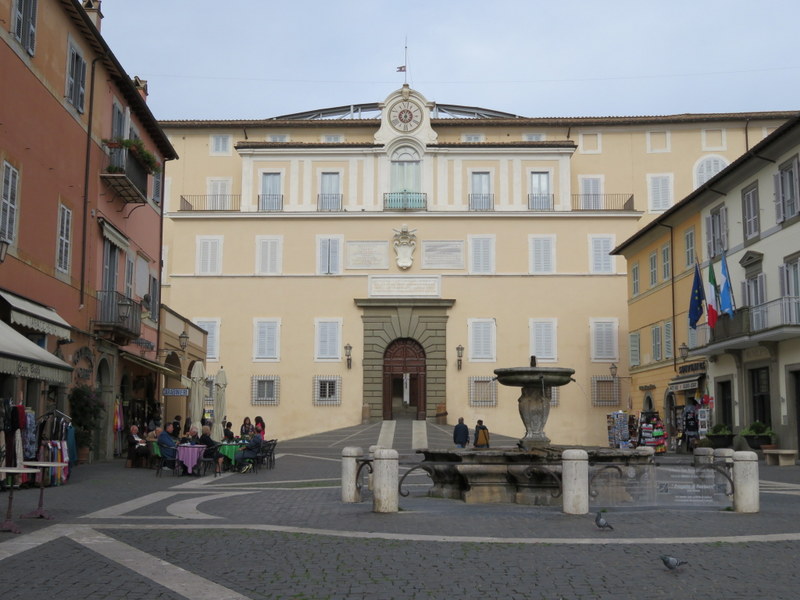
The Apostolic Palace dominates the square in Castel Gandolfo.
In September we visited the Gardens of the Pontifical Villa, thinking we were in Castel Gandolfo. In actuality, the gardens are part of Villa Barberini in Albano Laziale and when we exited the garden tour we were a long walk from the little town of Castel Gandolfo. So we vowed to return while the weather was good.
Pope's view of Lago Albano.
Pope’s view of Lago Albano.
Early in the morning the flow of commuters from small towns storm Stazione Termini like an invading horde. The incoming trains are packed with briefcase-toting-suit-wearers and women tottering on impossibly high heels, and it seems everyone is puffing on a post-commute cigarette. We were blessed with an out-of-Roma trip, against the onrush of workers, accompanied by a very few Romans who actually get to leave the city for work.
A quick 40-minute ride through the countryside, passing Ciampino Airport and a handful of small towns, brought us to Castel Gandolfo. Then a 15-minute slog walk up the hill landed us in the town square where any number of little bars awaited our arrival. We found seats and a cappuccino in the 15-degree Celsius sunshine with a full view of the Apostolic Palace, aka, Papal Palace, aka Pontifical Villa or most commonly in Italian Palazzo Apostolico. Take your pick.
A Bernini angel...at least the audio guide claims it is his work.
A Bernini angel…at least the audio guide claims it is his work.
Writing set of Pope Pius VIII. Sorry about the glare. It is under glass for its protection.
As instructed, 20 minutes before our tour time of 10:00, we approached the guard who welcomed us warmly and sent us up a flight of stairs to enter the museum. We were equipped with audio tour devices and sent on our way to self-guide, well before the clock chimed 10:00. We were the only people in the entire museum!
Now before you get to thinking that we ran giddily through the papal vacation home, jumping on the beds and checking inside the refrigerator, the public is not allowed in any area that would be considered an apartment. The museum consists largely of select papal portraits along with some special accoutrements, and the accompanying audio guide tells some of the fascinating history behind these powerful men.
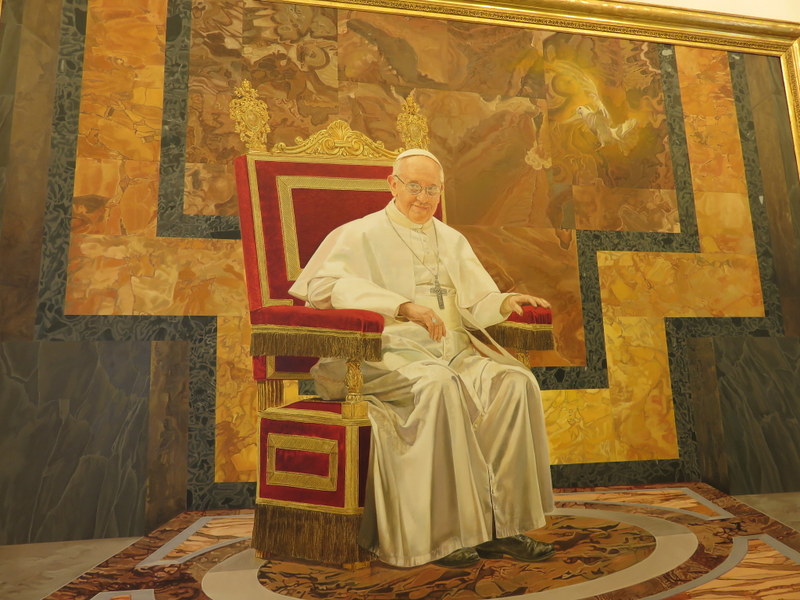
The portrait of Papa Francesco is in a very different style from his predecessors.
We enjoyed the tour very much, even if we did not get to see the Papal bathroom. There’s one of those at Castel Sant’Angelo anyway.
Papal throne and entourage.
In 6 1/2 hours we went from our home to Castel Gandolfo by bus and train, had coffee (always on the agenda), took the tour, and were back home in time for lunch. If one wanted to have lunch in CG — and why not with that view of the lake! — I would actually recommend the 11:00 tour followed by a leisurely lunch. Trains back to Roma are frequent. Would I spend an entire vacation day doing this on my first trip to Roma? Absolutely no. But when you have been here as long as we have, or visit annually like some of our friends, it’s fun to find new places to explore.
There are many restaurants that take advantage of the fine lake view.
Info on tickets for the sites in Castel Gandolfo and Albano Laziale can be found here.

Guns and The Top of Europe

30 Sep
30 September 2015.
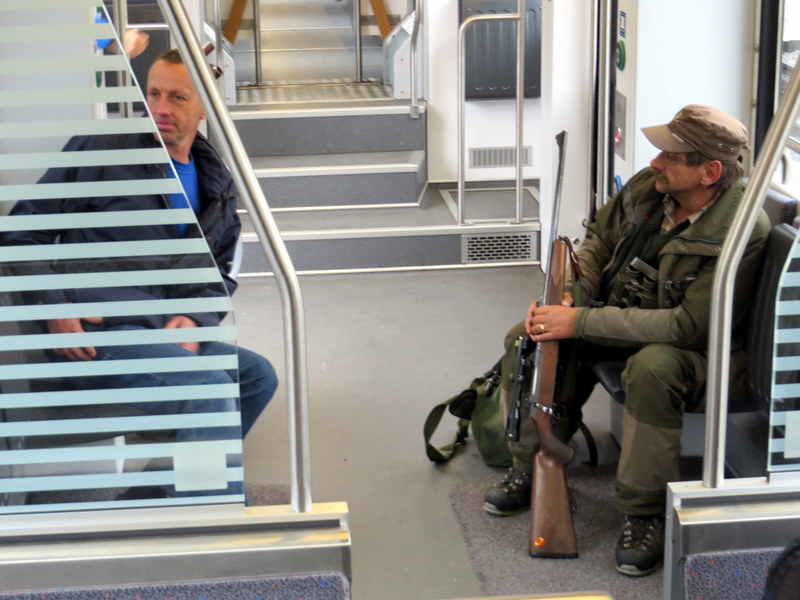
A man gets on the train carrying a gun. What would you do? If I was in France, Spain, Great Britain or the USA, I would dive for cover. But we are in Switzerland, in the Bernese Oberland to be precise, and apparently, no one bats an eye. Neither did we since he walked in accompanied by another local, and even women pushing babies in strollers were undisturbed by the sight. I am not going to pretend I understand the Swiss mindset or even the laws around firearms. This article from Time magazine on the subject is pretty interesting. I am not sure I am more concerned about the fact he was hunting in an area where people hike or carrying a weapon in public. 
When we saw this guy get on we got the giggles. Can you imagine if this happened on MAX in Portland? This was on the Wengeralp narrow-gauge cog railway.
Switzerland seems to have its act together. The Swiss have managed to remain neutral in world politics, insulated from European Union issues as they are non-EU, but they take advantage of the Schengen Agreement and the abolishment of internal borders. Still, immigration is highly controlled. They have an admirable environmental record, plenty of water resources, clean air, excellent recycling, a thriving economy with low unemployment. Their public debt is less than 35% of GDP (compared to Italy at 134% and the USA at about 71%). And of course there’s the cheese. High prices do not seem to deter tourists, especially the Japanese who are here in droves and show no reluctance to shell out hundreds of Swiss Francs to see the sights and buy winter fashions. You would not believe the price of a Patagonia jacket here.
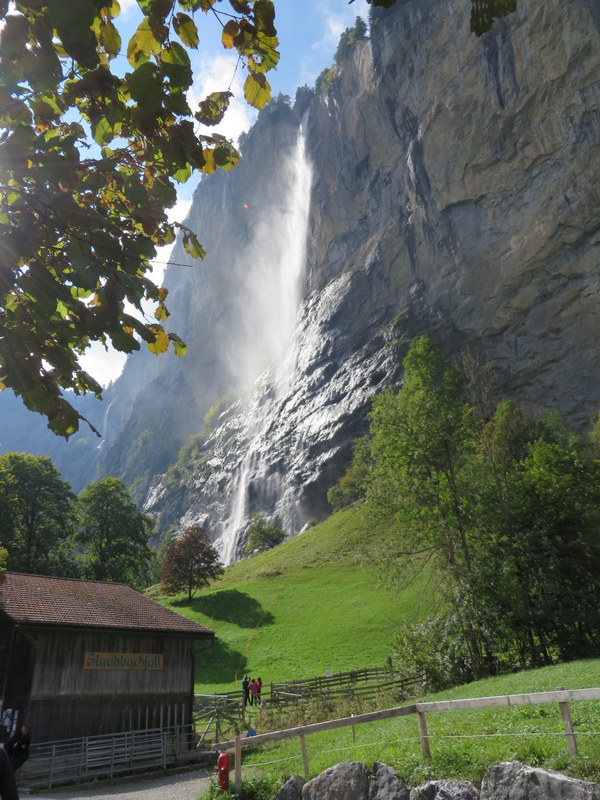
Staubbach Falls, visible from our vacation rental.
This is our third trip to Switzerland in less than 2 years. Yes, we like it. The food is not as good as Italy, and the coffee almost all comes from a ubiquitous push-button machine found in virtually every café and restaurant. It’s CHF 4.00 for a basic cup of coffee or a single shot of espresso. In fact, everything is quite expensive. While the exchange rate is almost on par with the U.S. dollar, the actual prices are high. A pizza that would cost us about $11.00-12.00 in Italy is about $23.00 here. A small green salad runs $8.50. Wine by the bottle is insanely expensive in restaurants, but one can get a small glass of good local wine for a price less than we experienced in Seattle, Portland, and San Francisco. Why do we come back if it costs so much? The transportation system, the hiking, the natural beauty: Switzerland offers a lot of what we like to do when traveling. And it works, well, like a clock.
A Jungfraujoch train moves up the mountain. Most of the journey is in a tunnel inside the Eiger and the Mönch.
I have wanted to go to the Jungfraujoch since Matt Lauer went there in 2011 during his annual “Where in the World is Matt Lauer” tour. During our first two Swiss trips in January 2014 and August 2014, we dismissed the trip to the Jungfraujoch as too expensive. It costs CHF 204.40 per person from Lauterbrunnen in the valley to the Jungfraujoch and back. We learned that with certain types of passes one could pay less, so we vowed “the next time” we would make the trip. This is the next time, so we bought both half-fare Swiss passes and a Bernese Oberland Regional Pass. We had to pay a relatively small supplement to go all the way to the Top of Europe (called so because it is the highest train station in Europe). It was worth it!
Jungfraujoch Railroad - our train ready to depart.
Jungfraujoch Railroad – our train ready to depart.
Rising at 5:00 AM, we caught the first train up the mountain, in total about 1 hour 45 minutes from the bottom of the valley to the Jungfraujoch, arriving just before 9:00 AM. Some of the “tour” is goofy. The giant snowglobe in the Alpine Sensation was unrefined, and the Ice Palace sculptures were not nearly as nice as those at the Saint Paul Winter Carnival of my youth, but the pure beauty of the pristine mountain was the star, and contemplating the building of such a railroad in the 1890s sobering. Thanks to 100 Italian laborers, the tunnel was built.
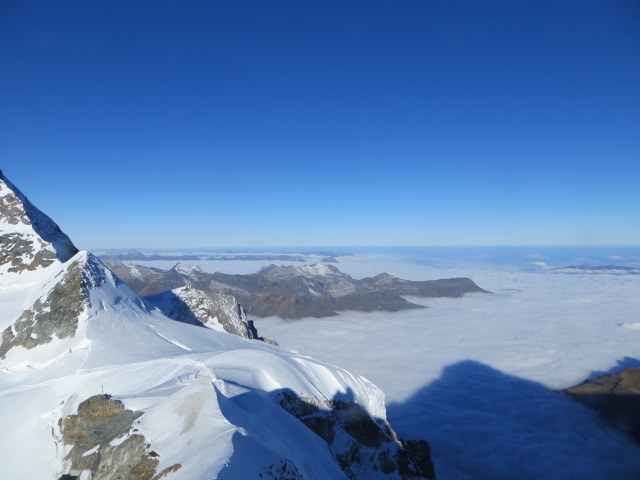
View from the Top of Europe over the cloud-covered valley. It was very cold outside!

We went outside on the observation platform, but the 33 kph winds combined with the -1.5 Celsius temp reminded us a bit too much of our Minnesota and North Dakota heritage. We lasted long enough to take a few photos. Going on the sledding course was out of the question, as was the glacier walk of 1 1/2 hours roundtrip. 
We were at 11,333 feet above sea level. That is lower than the elevation we hiked to in Colorado last month, but a completely different climate. In Colorado, we peeled off layers. Here, I wished I’d had my puffy coat.
Railway Station at the Top of Europe, inside the mountain.
This was an unforgettable trip and we are glad we did it. Going early was a great strategy, at least with the weather forecast we had. We would be unlikely to go twice, so it truly was a once-in-a-lifetime experience. 


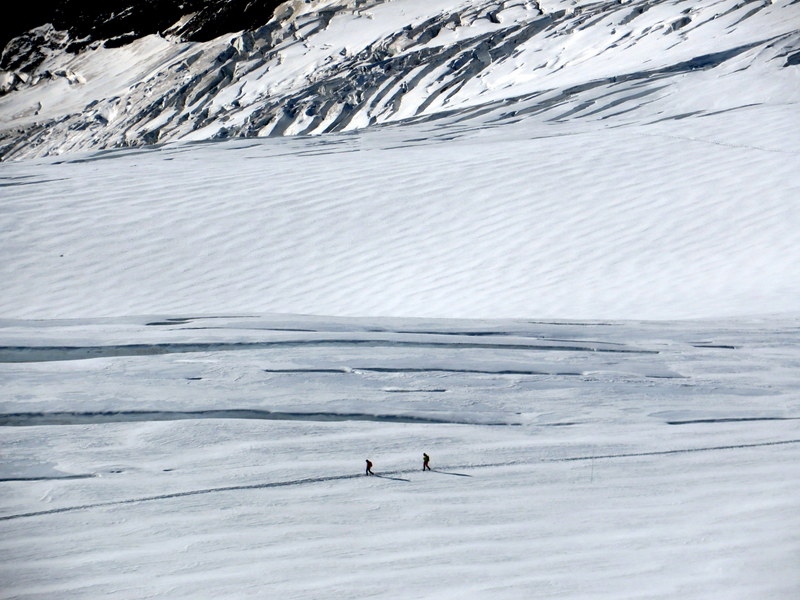
People walking on the glacier beneath the Jungfraujoch.
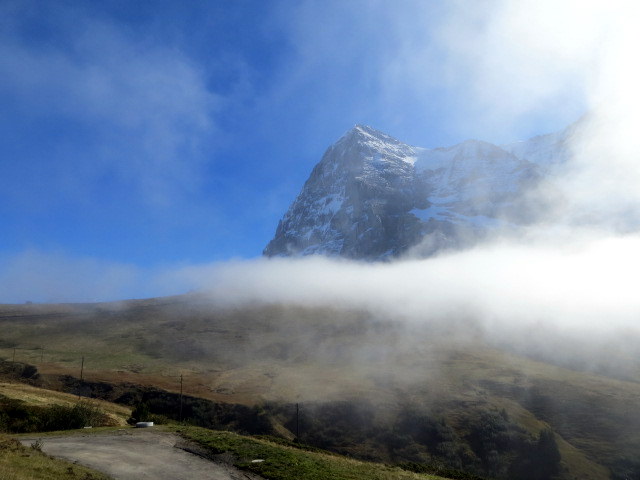
The Eiger pokes above low level clouds as we depart Kleine Scheidegg.
The Eiger pokes above low level clouds as we depart Kleine Scheidegg after our visit on high.
CHF 30,300 watch available at the highest watch shop in Europe.
View of the Lauterbrunnen Valley. Our apartment is just a bit to the left of the church.
View from our apartment. We can also see Staubbach Falls from our terrace.