
We are in the Wild West now my friends. We find ourselves in beautiful Durango, Colorado for the final stage of our U.S. Megatrip. We wrapped up our Seattle visit to the tune of a rare thunderstorm, returned to Portland for some final errands and socializing, and moved on to the great state of Colorado. (Hover over or click on each picture for the caption.)

The Pacific Science Center features some over-sized instruments. Here William plays the guitar.

Elizabeth on the giant chair. The Pacific Science Center is a great way to spend a rainy afternoon.
I feel terrible that in my last post I neglected to mention Susan & Larry and Gayle & Dennis with whom we also enjoyed terrific meals during the first Portland segment. We ate our way through the city.
Upon our return to Portland for the second visit, we picked up awesome new eyeglasses – my first non-red glasses in about 30 years – and enjoyed a few more dinners with good friends. We’ve had a Lebanese mezza, Northwest salmon barbecue, sushi, more brew pub lunches, and breakfast at a very hip Portland spot, Tasty and Alder. Thanks to John & Janet, Diana and the fabulous Femmes, Jim & Wanda, and J.C. & Maarja! Notice we have not had Italian food at all (except the pizzas previously reviewed at Our Weekly Pizza).

Our temporary home, an urban apartment on the Willamette River. The Steel Bridge is incredibly busy.

Looking northeast from the apartment it was a little more serene.

I love the public art in downtown Portland. So fun to wander the streets after 3 years away!
Durango is high-altitude living. My brother’s house in the valley sits at 7500 feet/2286 meters above sea level. That takes some getting used to. That is higher than most of the hiking we do on the ridges and high meadows in the Dolomites.
We needed to spend a couple of days getting used to the elevation in this high valley with little energetic exercise, so we took a ride on the Durango & Silverton Narrow Gauge Railroad. Thirty-one years ago Ric and I had our first vacation together and it was to Durango to ride the D&SNGRR. I am delighted to say the railroad has endured as fantastically as our relationship. The ride is a trip through time with authentic coaches, a coal-fired steam engine from the 1880s, and a narrator in character that relates stories of the era. It is an exceptionally beautiful ride through the mountains. I am pleased to say the Animas River is more-or-less of normal color after the toxic spill a few weeks ago, and is expected to recover.

The D&SNGRR chugs along about 200 feet above the Animas River.

My rail fan companion of 31 years enjoyed the trip.

Amazing that this railroad was built in the 1880s. Maximum speed on the route about 15 mph.
Once acclimated to the altitude, my brother and sister-in-law took us on a high-elevation hike to Engineer Mountain. For the record, we hiked to “Bus Stop” which is known in our family as “The Lunch Log.” Friends, this hike started at 10,660ft/3249m, and we climbed to 11,617ft/3541m. The round trip was about 5 miles, so not a bad climb, except for the fact that these flatlanders were hiking to an elevation higher than the peak of Mount Hood in Oregon (11,250ft/3429m). We feel pretty pleased with ourselves that we did it without fainting or hyperventilating.

Engineer Mountain looms above the trail. Beautiful walk through piney woods.

Mountain lake along the trail to the ridge below Engineer Mountain.
Today we took a Path to Breakfast, enjoying a 4-mile jaunt through the valley and down into the city of Durango where we indulged in an American-style breakfast. We were fortunate to have the company of Australian Shepherds, Quip and Millie, as well as humans Jane and Susan. We have not hiked with dogs in years and it added a lot of fun to the hike. Jane spotted bear tracks on the trail – a sizable bear with a paw as big as a small human foot – a reminder that this land is still wild. Even more fortunate, we were given a ride home from Durango.
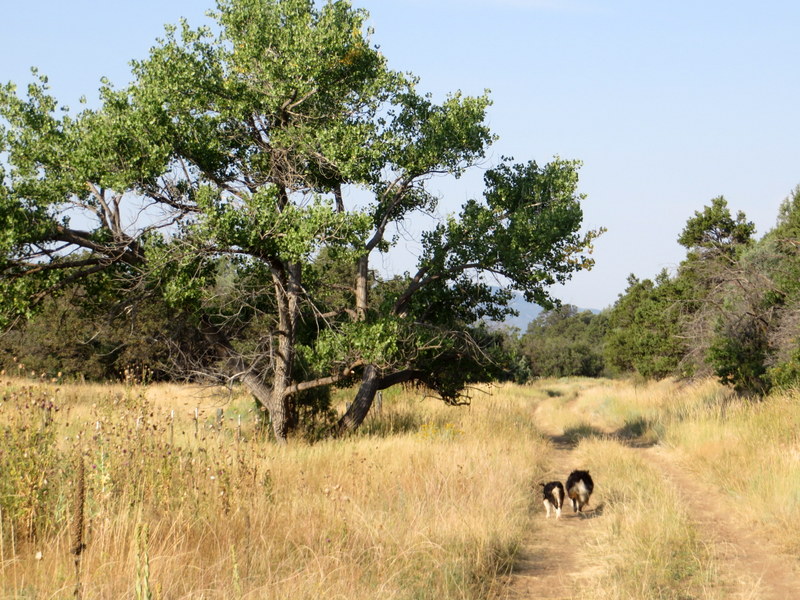
Milly and Quip on the path to breakfast, Durango.
We have a few more days stateside. You’ll hear from me again, no doubt, as I get my head around the inevitable compare-and-contrast Italy and the U.S.

Sharon and Catherine photo bomb me.





















 Girovaga