8 May 2016. I have written before about the pleasure of returning to a place. You can relax in the familiarity and explore beyond the usual locales of first-time tourists. Our third trip to London in four months afforded us an opportunity to get beyond Big Ben. We were familiar with the Tube, the bus system, and the city in general. We did not need a map at every turn. We were able to go into neighborhoods previously ignored by us, to find museums less patronized, and to generally enjoy this great city, even if it was unseasonably cold.
That does not mean our trip was trouble free. Oh no! Our travels are usually problem-free and easy going. No missed trains, no bungled reservations, no illnesses, good meals, and few budget surprises. Pick your favorite cliché: Smooth as silk; Easy as pie; Clear sailing; A bed of roses. This time was somewhat different. We encountered a multitude of weird and annoying little things – things we came to call “wrinkles” in our trip. Perhaps because we were familiar with London, we were able to shrug off the annoyances with a dose of humor.
I’ve interspersed this narrative with some pictures so you can see we really had a lovely trip.

When touring Windsor Castle, Ric and I both felt a Disney-like quality. It was all so perfect! So serene! No litter, no eating, no smoking, and the grass “just so.”

Another lovely view of Windsor Castle. The weather was the best we had in a week in London.
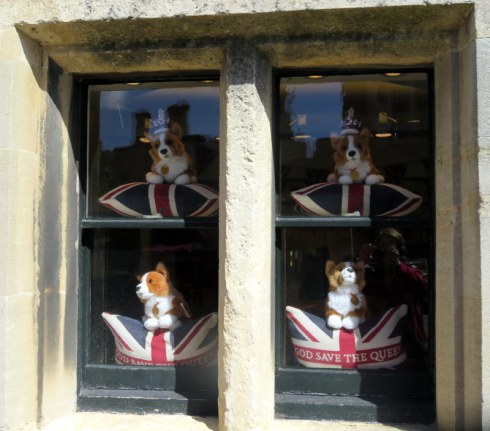
Gift shoppe at Windsor full of corgis — stuffed corgis.
We usually have terrific success with our lodging choices. Whether apartments, B&Bs or hotels, we usually have no complaints or they are so minor we don’t say anything. The flat we had this time in London was hardly a nightmare, but the lack of attention to detail became laughable. One or two “little things” I would brush off, but this place was chock full of wrinkles: Non-working lamps (yes we replaced the bulbs); no wastebaskets; VRBO advertised king-sized bed was a double, not even a queen; non-working heaters (did I mention it was cold?); No hot pads in the kitchen which we did not discover until we had a hot casserole ready to come out of the oven; A washer/dryer combo all-in-one that did such a bad job I had to iron our jeans because they came out of the dryer wrinkled in a way I did not know denim could wrinkle.
Somebody from the staff needs to stay here a few nights and realize what improvements could be made. (See Dear Vacation Rental Property Owner.)
The management sent a taxi to pick us up at St. Pancras as part of the service. The taxi driver apparently could not find the taxi rank and his non-English accent was so thick we could not understand him when he called to coordinate. We had to pay for a cab to the flat, no one offered to reimburse us, and they told us “this happens all the time.” WTF?
We had ordered groceries to be delivered by Waitrose, which has been described as the British Whole Foods. We had done this in March when we rented in a different location and it was flawless. This time, the delivery was quite late and we had plans. I called Waitrose and was told he should be there soon. It took three calls in all, only to find out the driver could not locate our building due to construction in the area. Seriously? I had to go out and walk around the area – about a 4 block square area of densely packed buildings – to find him and lead him in.
Then we had THE GREAT OVEN DISASTER. Our last night, a Friday, we decided to stay in, eat a pizza and salad, and watch a movie. We stopped at Waitrose where we’ve purchased fresh-made take-out pizzas before (yes our standards slipped this one night). I pre-heated the oven and after about 20 minutes Ka-BOOM! The inside glass door of the oven exploded, sending shards of glass flying all over the kitchen. It was safety glass, so the danger of getting cut was minimal, but it was scary, messy, and annoying. The outer oven door glass somehow stayed intact.
I was so stunned I neglected to take an illustrative picture. It looked a lot like the over door in the picture at the top left of this link. If you Google the topic you’ll find it seems to happen a lot. Boh!
Obviously, we were not cooking our takeaway pizza in that oven. We were already in our jammies and not inclined to get dressed again, so we called up Deliveroo for our postcode. We’d seen the ads throughout our week in London so we gave it a whirl. Great service! Twenty-three minutes after placing an order on their website, the delivery guy pulled up to our door on his motor scooter. It was not great pizza, but it was hot and it was delivered to our door.

The Imperial War Museum is a fine museum covering wars from WWI forward. Not very busy on this clear, cold day.

Imperial War Museum, view to the main hall.

Montgomery’s jeep at the Imperial War Museum.

St. Paul’s Cathedral, our neighbor this trip.
In yet another flat-related “wrinkle,” Ric left his wedding ring on the nightstand, remembering he might have done so when we were already locked up and keys pushed through the mail slot. Any attempt to go back or contact management to let us in (on a Saturday morning of a holiday weekend at 08:00) would have caused us to miss the EuroStar. The staff redeemed itself with true honesty: the cleaning service found the ring and it is being shipped back to us.

Sand dog. Saw this little guy sculpted at Piccadilly Circus. Where do you suppose the sculptor got the sand?

This red telephone box was the model for all the booths to come. Still in pristine condition unlike most of them these days. Near the Royal Academy.

I don’t know what is cuter here: The little children on a school outing in their safety vests or the double-decker bus painted to promote Hawaiian pizza (which is a travesty in Italy).
Finally, we had a couple of transportation wrinkles.
Waiting at Gare de Lyon in a lounge area, two French army soldiers with automatic weapons and a uniformed security guy from SNCF (French national train system) appeared. The SNCF guy asked us to move along for “security reasons” and they cleared the area! We lost no time in beating a retreat to our departure hall, although that meant waiting in the cold. No idea what was going on.
We always hope for minimal drama on the way home. Who wants to end a trip with stress? We got up at 4:30AM in order to make a train at 5:40AM out of Dijon. We were traveling all the way back to Roma from Dijon, 13.5 hours on 3 trains, so we dragged our sleep-deprived selves out before dawn. (Fortunately, our hotel room was equipped with a Nespresso machine. Heaven!) Arriving at the station, we got on the train, and there it sat. Apparently the conductor was a no show. Our 40 minutes to change trains in Lyon ticked away. If we missed the connection we would not get to Rome that night and the cat sitters were leaving, not to mention the prepaid ticket on Trenitalia that would be worthless if we missed the connection. Luckily when the conductor arrived the train driver stepped on it and we had a few minutes in Lyon to catch our connection. Whew!

Tombstones in Postman’s Park, London, a park which grew out of a former burial ground. It includes a Memorial to Heroic Self Sacrifice as well.

Did you know? The inspiration for the contemporary wedding cake was the steeple of St. Bride’s Church, in London in the 18th century. The baker supposedly had this view out of his window in Ludgate.

It may look like spring in London, but it was cold enough to wear gloves every day. The tulips did not care.
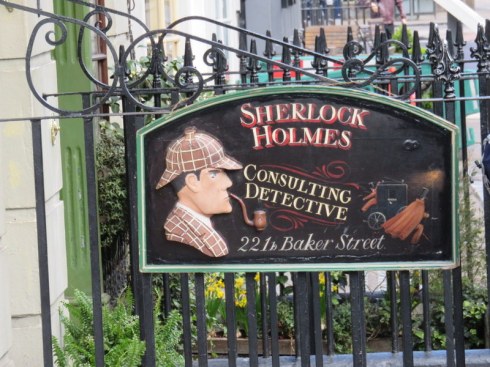
Fools for Sherlock that we are, we did tour 221B Baker Street. it’s cute and fun. We also took a walking tour of Sherlock sites with Brit Movie Tours. Very well done!
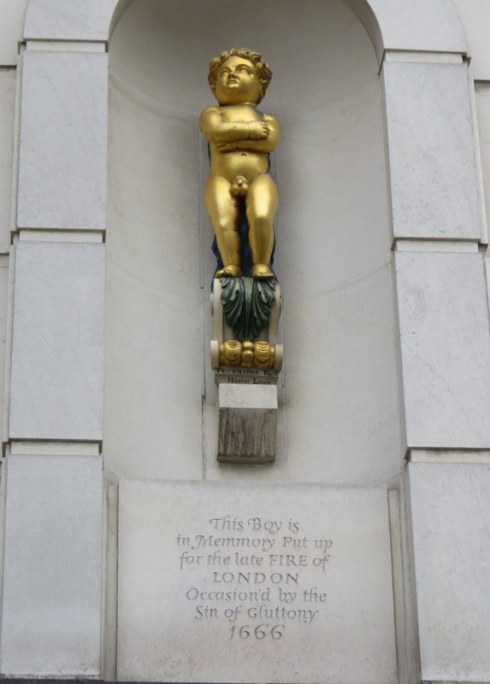
Fat Boy or the Golden Boy of Pye Corner, is a monument at the spot where the Great Fire of 1666 was stopped.

Last unshrouded picture of Big Ben for awhile. The Elizabeth Tower and the clock will undergo extensive renovation soon.
And a few more snaps from our Paris food tour. We’ve not done a food tour anywhere before but this will not be the last one. Terrific fun!

Bread chandelier, Poilâne Bakery, St. Germaine. This place has an amazing history. I have posted a link at the bottom of the page.

Poilâne again. A beautiful and tasty product,

These are chocolates, not marbles, at the very high-end chocolatier, Patrick Roger, I think 3-4 Euros per piece. Luckily our food tour included some product tastes.

Tiger prawns. Note the lemon included for perspective. Small lemon, but still!

Location of our post food tour feast. It means “the last drop.”
As I mentioned at the start, familiarity with a location just adds to the enjoyment. Our first two trips were focused on the classic must-sees (see entries about our Christmas trip here and here, and about our March trip). This time we wandered in diverse and historic neighborhoods, sought out places locals eat lunch, visited the Museum of London (well-curated and much patronized by school groups) and the Imperial War Museum (lightly attended, highly recommended), saw a show (“The Book of Mormon,” which was hilarious), went to the Handel & Hendrix in London exhibit, shopped, and took a ride on an historic steam railroad thanks to out friends from the East Midlands, Nigel and Carol. This third trip only whetted our appetite for more. London, we will be back. But maybe not for awhile…
Tags: Deliveroo, Exploding oven, Imperial War Museum, London, Museum of London, Paris, Windsor Castle

 Your cane (pronounced KHAN-ay) may greet you at the door, but not allow you to lean on him for stability. One day on the bus we overheard an American couple remark “Look, cane parking!” when they saw a sign saying such and a little metal hook planted in the wall. It was, of course, a place to park your dog with a leash tie-up.