Getting home from a trip there’s a lot to do in a jet-lagged state: unpacking, laundry, restocking the pantry and refrigerator, doing the delayed fall garden chores, convincing the cats we still love them.
But the real work starts once jet lag passes: organizing photos and updating our books. This takes hours and hours to ensure the accuracy of every recommended URL, the schedules for buses and lifts, the most recent transportation pass offers, and to write up new hikes and changes to prior recommendations. Ah, retirement! But this is a job.
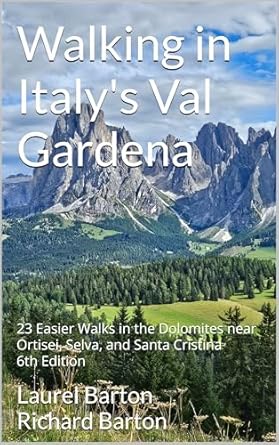
January 1 we published the 4th edition of “Walking in Switzerland’ Berner Oberland” and January 18, “Walking in Italy’s Val Gardena” came out in its 6th iteration.
For those dreaming about these locations, we offer inspiration to plan the trip with logistics seldom found concisely presented online. From transportation to trailheads, each walk or hike is described clearly so you can be certain every hike is within your ability.
Here’s a description of each book and a link to purchase in the US. For other markets, consult your respective Amazon site.
There are many hiking guides to Italy’s Dolomites featuring long treks of 4-6 hours, as well as multi-day ventures and the famous via ferrata. What makes this one so special? This is a guide to easier options for walking in Italy’s breathtaking Val Gardena! Seniors, people with children, and anyone who wants to experience the mountains but not climb them will benefit from the 23 walks that are carefully described.
We guide the hiker through the breathtaking scenery using itineraries suitable for anyone who likes to walk, likes to be in nature, and who enjoys Italy, but may not have the stamina for longer, more strenuous hikes.
This unique guide includes 23 walks in-and-near the Val Gardena towns of Ortisei, Selva, and Santa Cristina, as well information on when to visit, how to get around without a car, and sample itineraries to help you plan your stay of 3, 5, 7 or more nights. Of special interest will be the easy hikes in the amazing Alpe di Siusi.
Included are maps, directions to the trailheads, walking time and distance, where to eat along the trail, beautiful photographs, and details on how to use the system of mountain lifts and buses to access the high meadows and breathtaking Dolomite views. You will discover delightful rifugi, mountain restaurants offering shelter and great food making each walk a special expedition. In addition, every walk is accessible by public transportation!
The authors travel to Ortisei frequently exploring this mountain paradise discovering and documenting the walks to share with you so you can be certain every hike is within your ability.
Switzerland’s Berner Oberland is a hiker’s paradise, whether you like easy paths or dream of attempting the Via Ferrata. This book will guide you through breathtaking scenery using itineraries suitable for anyone who likes to walk, likes to be in nature, but may not have the stamina for longer, more strenuous hikes. Seniors, people with children, and anyone who wants to experience the mountains but not climb them will benefit from the 21 walks that are carefully described. Also included are instructions on local transportation, sample itineraries to help you plan your stay of 3, 5, 7 or more nights, and suggestions for other excursions as well as rainy-day ideas.
The authors travel to Switzerland frequently exploring this mountain paradise completely via public transportation, discovering and documenting the walks. Even non-walkers will revel in the scenery as they ride mountain trains and enclosed gondola cars to amazing vistas.
What do I do after a European trip and after the book updates are published? Plan the next trip! Most likely with a cat or two in my lap.
Most of you think we are on vacation, walking familiar trails, snapping pictures of stunning vistas, and sipping an aperol spritz on the deck.
Sure, we do all of that. But this is a working trip. New editions of our two books Walking in Italy’s Val Gardenaand Walking in Switzerland’s Berner Oberland were released in January 2025, requiring us to check routes and supporting facts. We always try to find something new to experience and recommend as well.
We will not recommend any walk we haven’t done ourselves so we end up taking new trails often.
Sometimes a hike or walk we have included in the book no longer meets our standards. There is one in our Val Gardena book that has not been well maintained and no longer has an appeal. It will be replaced by one we have come to love.
In the past week in Switzerland, we’ve tried three supposed easy-hikes and came away with mixed results: Two unsuitable and one we are not sure is quite easy enough.
WALK ONE: Not the ending we expected
We had high hopes of recommending a Giro di Lauterbrunnen (Circuit of Lauterbrunnen) or in German, Lauterbrunnen Rundweg. For years we have noticed a trail partway up the cliff side, traversing cow-infested meadows and crossing tracks for the Wengernalpbahn train. We have walked that path from the south edge of Lauterbrunnen to the middle of the village where we descended on a paved road, but we knew it went farther. Maps enticed us to see if it would be feasible to extend it to the north, descend to the river, and walk back to the village, offering terrific views of the village from one end to the other as well as a good 3 ½ mile walk.
In fact, one CAN do this hike IF one has the footing of a steinbock.
SteinbockorIbexfamily, verysure–footed. Courtesy of IamExpat.
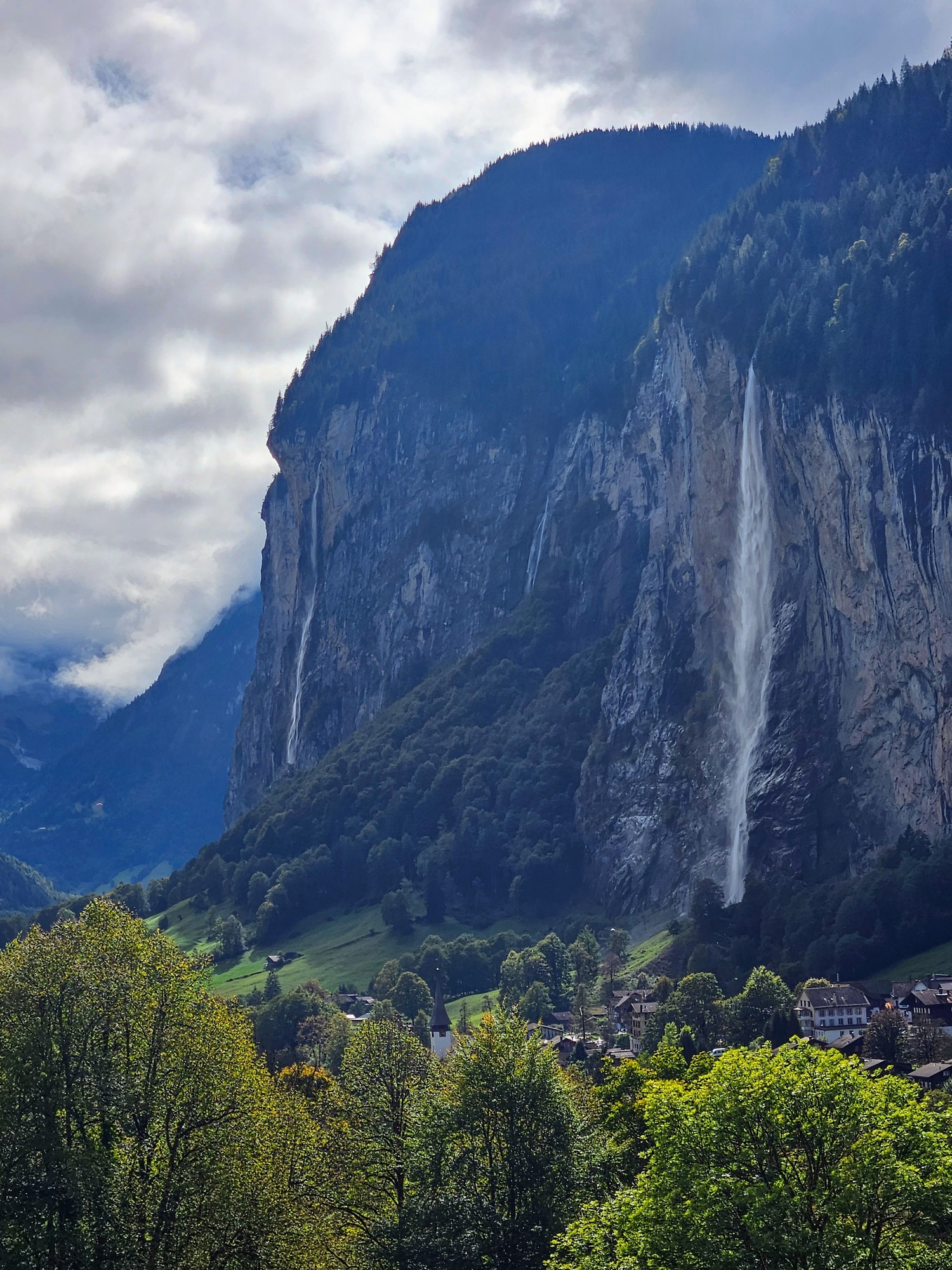
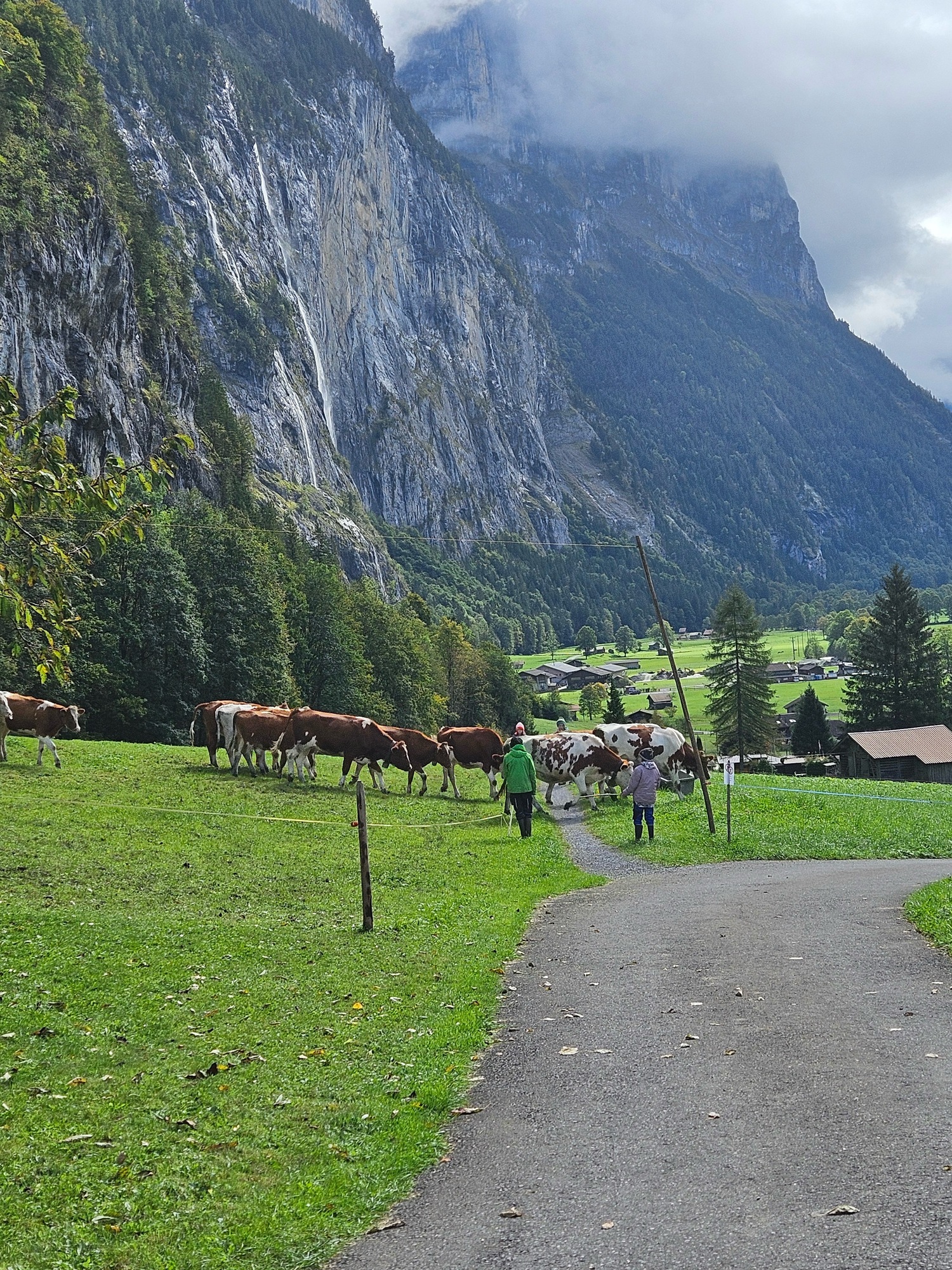
We thoroughly enjoyed the mostly flat walk, witnessing a herd of cows who welcomed their humans who had come to move them to a new pasture; taking pictures of the mountain train; wandering past a settlement of summer cabins and remote farms. The views were as we hoped including the Staubbach Falls, the train station, the Grütschalp cable car, and the entire village at our feet like a model train layout.
Bubbling streamA gentle pathDramatic viewsCows are moved from one pasture to another to do the mowing.View of the cable car across the valley
Then we came to the descent through the forest. Concrete forms designed to keep the farm road stable (to me, difficult to walk on) transitioned to dirt road, then, after a barrier prohibiting vehicles, a steeper, rocky downhill. As we hesitantly started down — using our hiking sticks mind you — Ric suddenly careened, fast-footing in a not-quite-controlled manner, finally stopping himself after about 30 feet by grabbing ahold of a convenient metal pole supporting a trail directional sign. I followed with terrific hesitation and concern for Ric, who much to his credit never lost his feet.
I did not think to snap a photo of the really bad area. these two pictures will give you an idea of our flat trail becoming steeper. On the left, the road starts to descend past a farm and it was fine. On the right, Ric is standing just above the final building on the farm and after that point, we rounded a corner and found a “no vehicles” barrier.
Here’s where it started to get steepRic, about 100 meters above our bail-out
The next bit of trail was even steeper and more treacherous looking. It did not seem safe nor prudent to proceed. A 40-year-old with good knees, strong hips, and no sense of their own mortality would not hesitate to descend, but we have none of those criteria going for us, so we turned back. A broken hip would not enhance our experience. Luckily going back to the paved road into the village was under a mile.
This is a particularly local section of Lauterbrunnen: there just are not tourist lodgings on this road. Although there is one small holiday let, coming from the village the paved road leads to a retirement apartment building, local farms, and then to the route we walked.
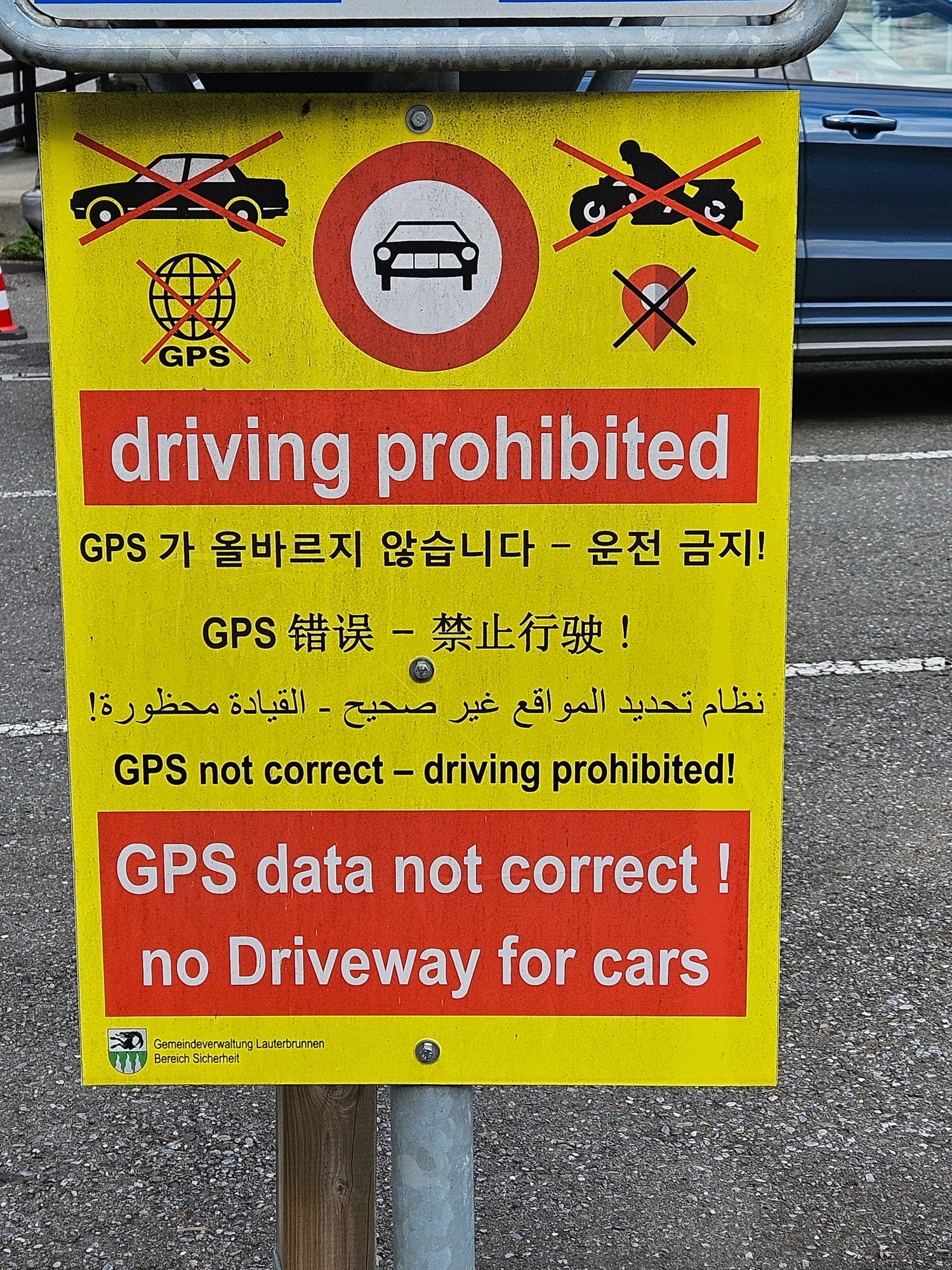
Still, people who have no business driving here in their rental cars insist on touring the roads where they are warned not to drive. How much clearer can it be that this sign is at the entrance to the road? Can you tell it is such a problem they have to post it in multiple languages?
On our descent we saw three cars, one after another, come up and encounter problems. One driver tried to turn around in the patio/driveway of a local who came out and gave him a finger-wagging dressing-down. Immediately behind this confused lad, three guys in a BMW stopped, realized they were blocked, tried to turn into a lane not much wider than a footpath, and banged into a raised sewer cover. Ouch! Hope they had insurance! Hot on their tail was another pair of guys who at least had the good graces to look abashed at having driven into the forbidden area.
Last year some yokel tried to drive up to the car-free town of Wengen and got stuck on the trail. They had to be airlifted out by a helicopter. Can you imagine how excited their car rental agency was?
Our search for a circular walk of Lauterbrunnen did not work out but the ending was quite entertaining. I feel sorry for the locals who deal with this day-in-and-day-out, though.
WALK TWO: Too dull to finish
We have spent precious little time on Lake Brienz: we have one lovely lakeside walk in our book, from the tiny village of Iseltwald to Giessbach Falls. We endeavored to find a route on the south shore of the lake, close to Interlaken but away from the tourist hoards. Sad to say, our walk at Ringgenburg while definitely off-the-beaten and offering nice lake views, was so dull we stopped halfway through and caught a bus back.
WALK THREE: Good potential
A couple of years ago a local resident of Thun told me about a loop route at Aeschi bei Spiez, above the lake town of Spiez, about an hour from Lauterbrunnen. The Aeschi Bänkli Rundweg takes in the cow-studded meadows above Spiez, distant peaks, and stunning views of Lake Thun. At 4+ miles it seemed doable — and we did it — but has some downsides that have us hesitant to recommend it. One half is largely paved roads where you can walk abreast. The other half is not paved and consists in part of faint paths across grass and some other very narrow paths. We had to do a bit of way-finding to decipher the best route and made a couple of misjudgments. Can’t have that in a book so we’d have to re-walk the route to get a good fix on foolproof directions.
Cow-studded meadowsGood signs overallNarrow path between electric wires on pasturesStunning geology
One half of the hike is relentlessly up-up-up and the other a constant descent. There is little undulation nor flat walking. The ascent was gentle but still, two miles of constant uphill for a total of 568 feet; the descent was not steep but needed constant attention. While relatively easy, this walk might be a Category 2 or 3 walk in our book, but we certainly cannot recommend it as pram worthy (Category 1), and I would hesitate to take small children as there were several sections of very narrow paths bordered by electrified pasture wires. What could go wrong?
Pluses: truly quiet, uncrowded, locals only. No sign of the usual tourist throngs who flock to the waterfalls of Lauterbrunnen and the higher mountain vistas. There were many cows, a llama and alpaca farm, a small ranch, and the possibility of a meal along the way: except on Mondays when those restaurants take their rühe tag. (We were there on a Monday, the “rest day.” We ended up with grocery store sandwiches in the village. No Aperol Spritz.)
We are unlikely to include this one in the book, but I am always amazed by the Swiss ability to create walking routes centered on even the smallest villages. They are mostly well-signed, interconnected, and not only recreational but often a route easily incorporated in a day’s errands. There is a national network of barrier-free trails as well, meaning everyone can enjoy the outdoors right from a train station.
I guess if you grow up walking through pastures, you think nothing of narrowly skirting an electric fence.
Now back to my Aperol Spritz while you watch this video of the Wengernalpbahn that crossed our path Walk 1 above.
On the streets of every village are traces of the alpabzüg, the annual descent of the cows from mountain grazing pastures (alps) to the valley villages and towns. The cows and their people take the same routes every year, some of which are the very paths hikers use. It is a big deal and a steady rain after is welcome, at least by me, to remove those telltale streaks. A cow must do what a cow must do, and hundreds have made the descent in the past few days.
We have seen many “cow parades” over the 10 years we have been coming to the Jungfrau Region as well as some in other parts of the country. Sometimes there are formal festivals with costumes for both cows and humans. Sometimes it is a farmer simply walking down the street with his 5 or 6 cows when he has the notion to descend. When we hear the giant bells clanging, we run to the street or window (along with many others) to watch the ancient tradition.
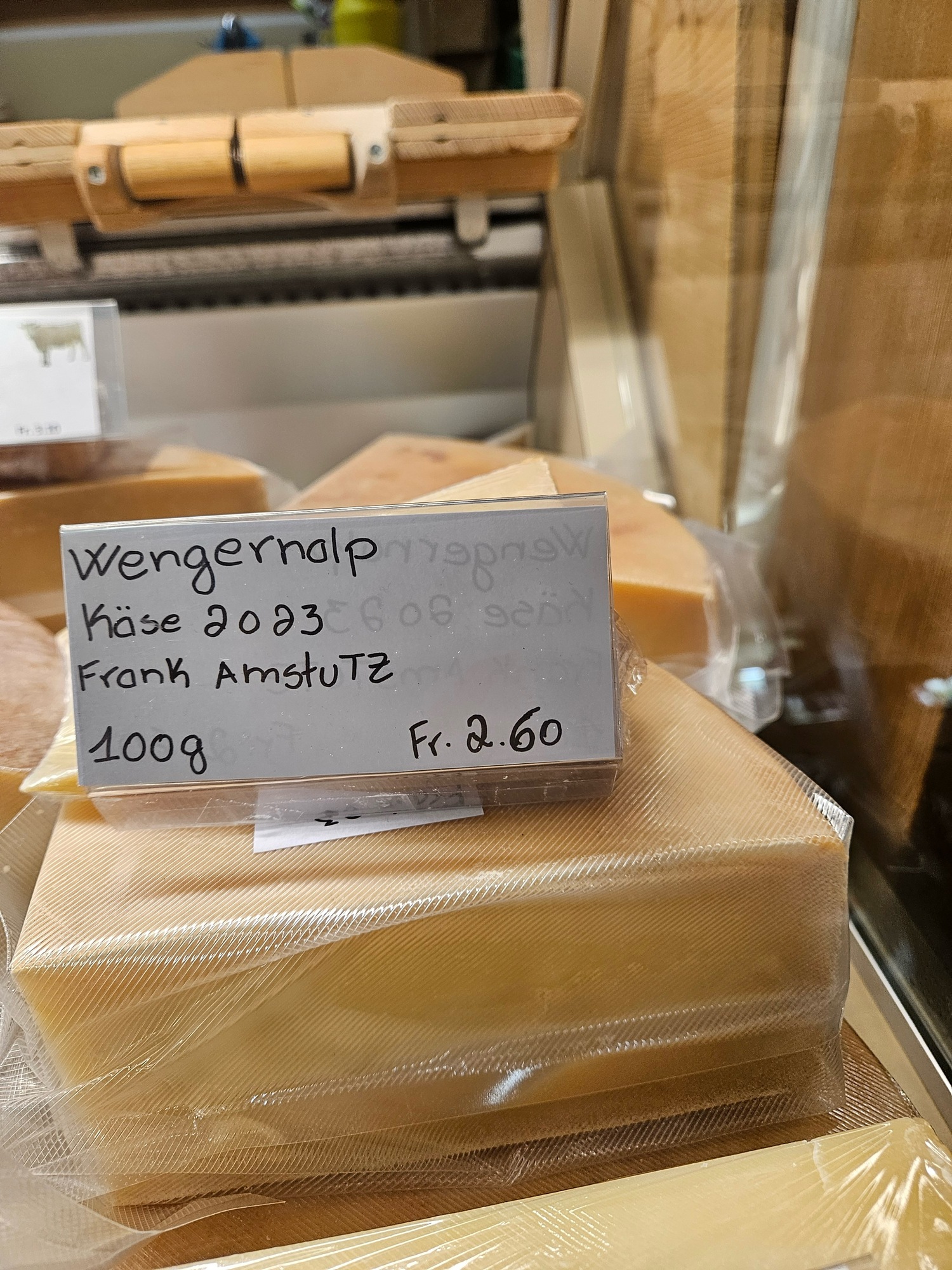
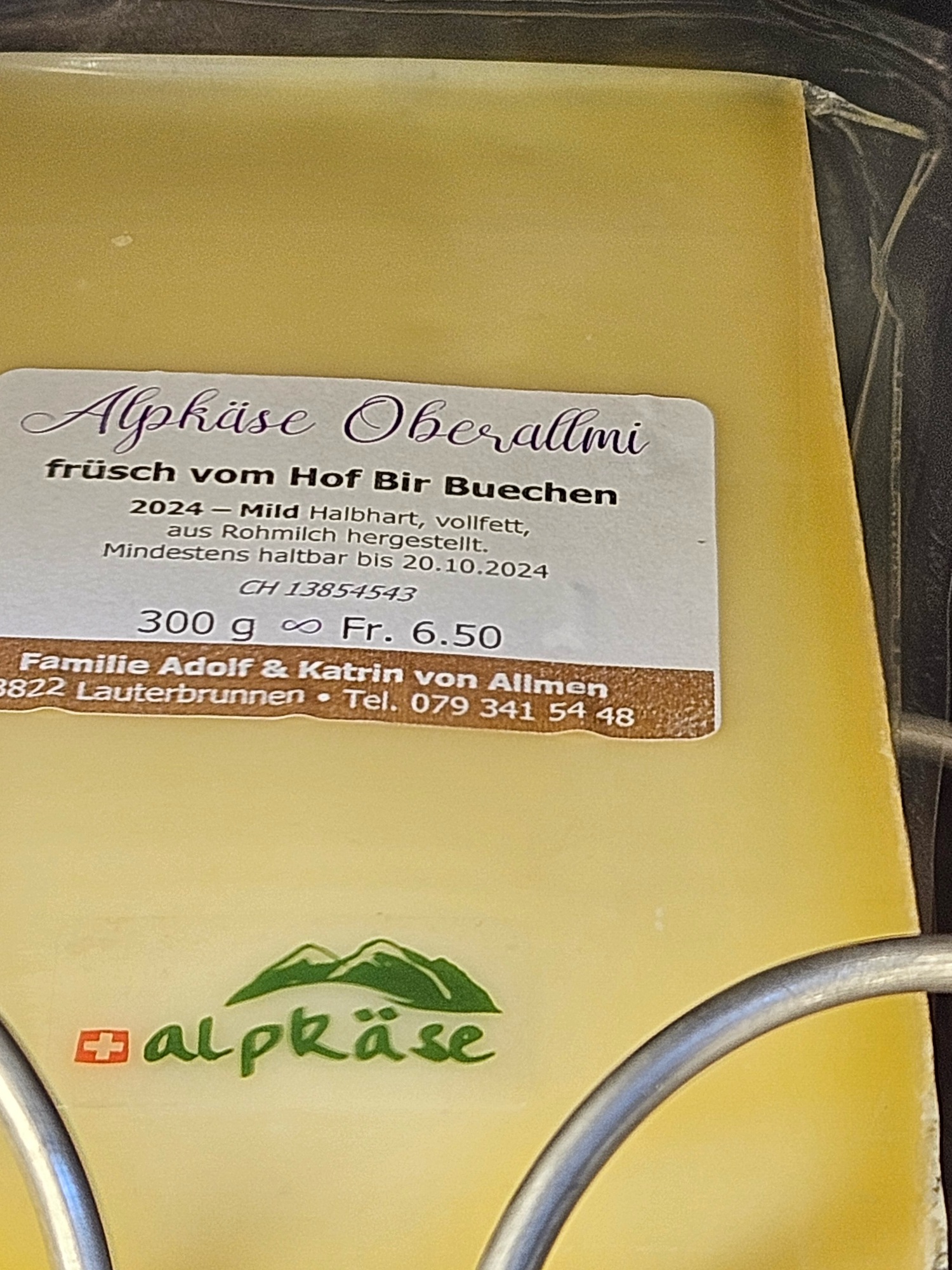
After the descent, the villages celebrate with the chästeilet, or cheese festival, a gathering for music, food, dancing and, of course, the selling of the alpkäse, or cheese made while the cows are feeding on lush mountain grass. Each farmer marks their cheese with their farm name. When we go to the local grocery stores, we can see the products of the various farms displayed. Occasionally we see entrepreneurial farmers selling their cheeses in vending machines along the road along with beverages, dried apple slices, and other snacks.
Two cheeses labeled in the grocery store case, one from Stechelberg and another form Wengernalp. The third entry is in a vending machine outside the farm along a road many walk through the valley.
Festivals can be tiny or grand in scale. At little Winteregg, which is where the little cliff top train from Grütschalp to Mürren crosses paths with hiking and cycling trails, we found a small gathering of farm folk with cakes and drinks (beer, schnapps, coffee) available. No entertainment. Just the cheesemakers whose hut is nearby and the farmers who supply the milk.
Winteregg’s 2023 festival, a community gathering right next to the hut where the cheese is made.
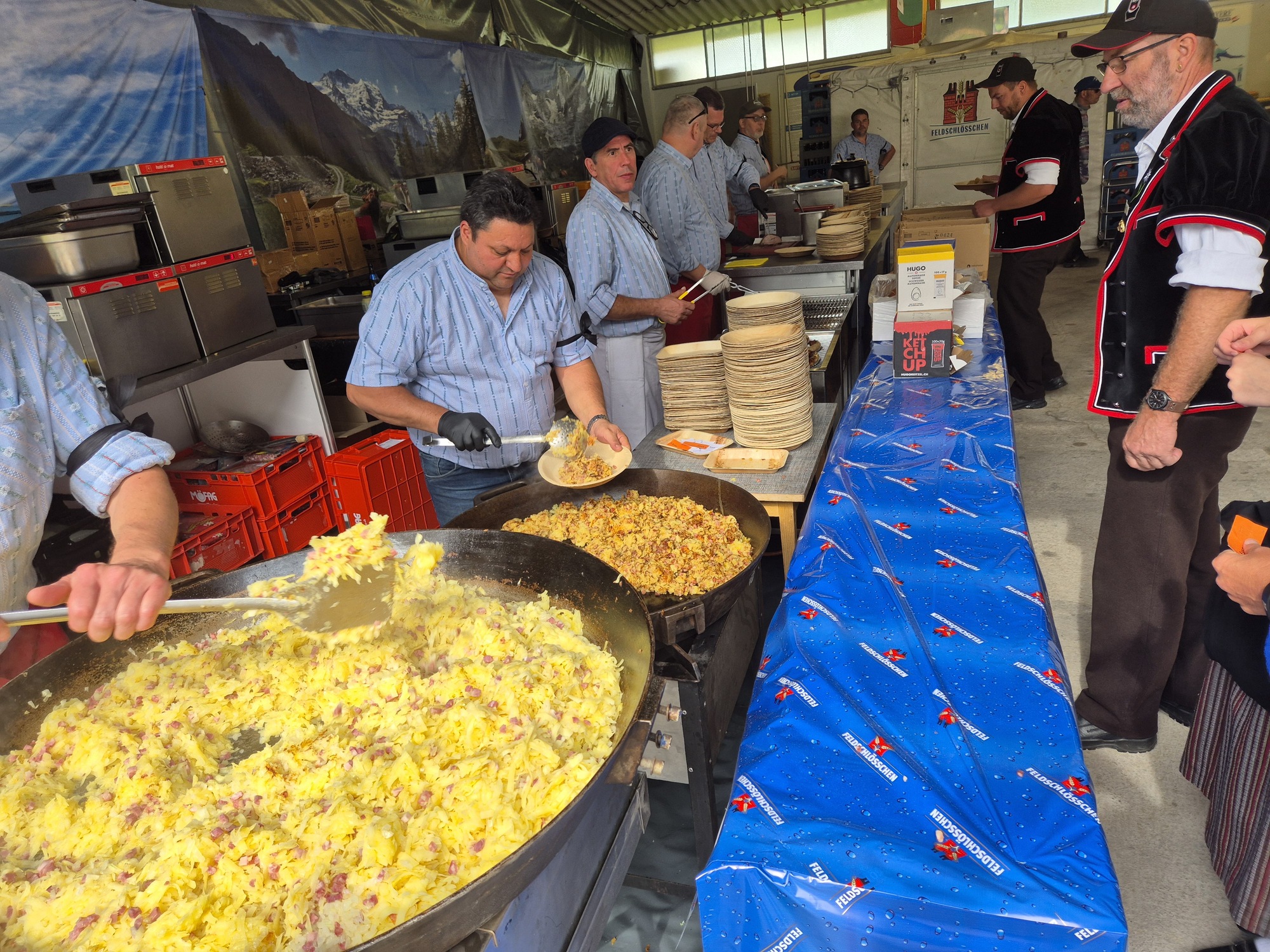
Three and a half kilometers away, as the crow flies (12 km by car, but you cannot drive there) is Wengen, which put on a grand chästeilet Saturday and Sunday a week ago. An evening and a day of celebration with music and massive quantities of food, table space for hundreds of people, gigantic cheeses, and handmade goods for sale. You could arrange to purchase a cow share. (Not sure if that means alive or butchered.) For a community of 1,300 permanent residents, it was an amazing event.
Wengen’s chästeilet is a huge affair for the surrounding farms, locals, and tourists. Massive wheels of cheese, samples, crafts for sale, and a community feed with vats of rösti and other local fare. Of course there was beer, homemade cakes, and coffee.
Last year someone tried to drive to Wengen. We know the path: it leads up from Lauterbrunnen and is clearly marked not for driving. Cringe-worthy video here.
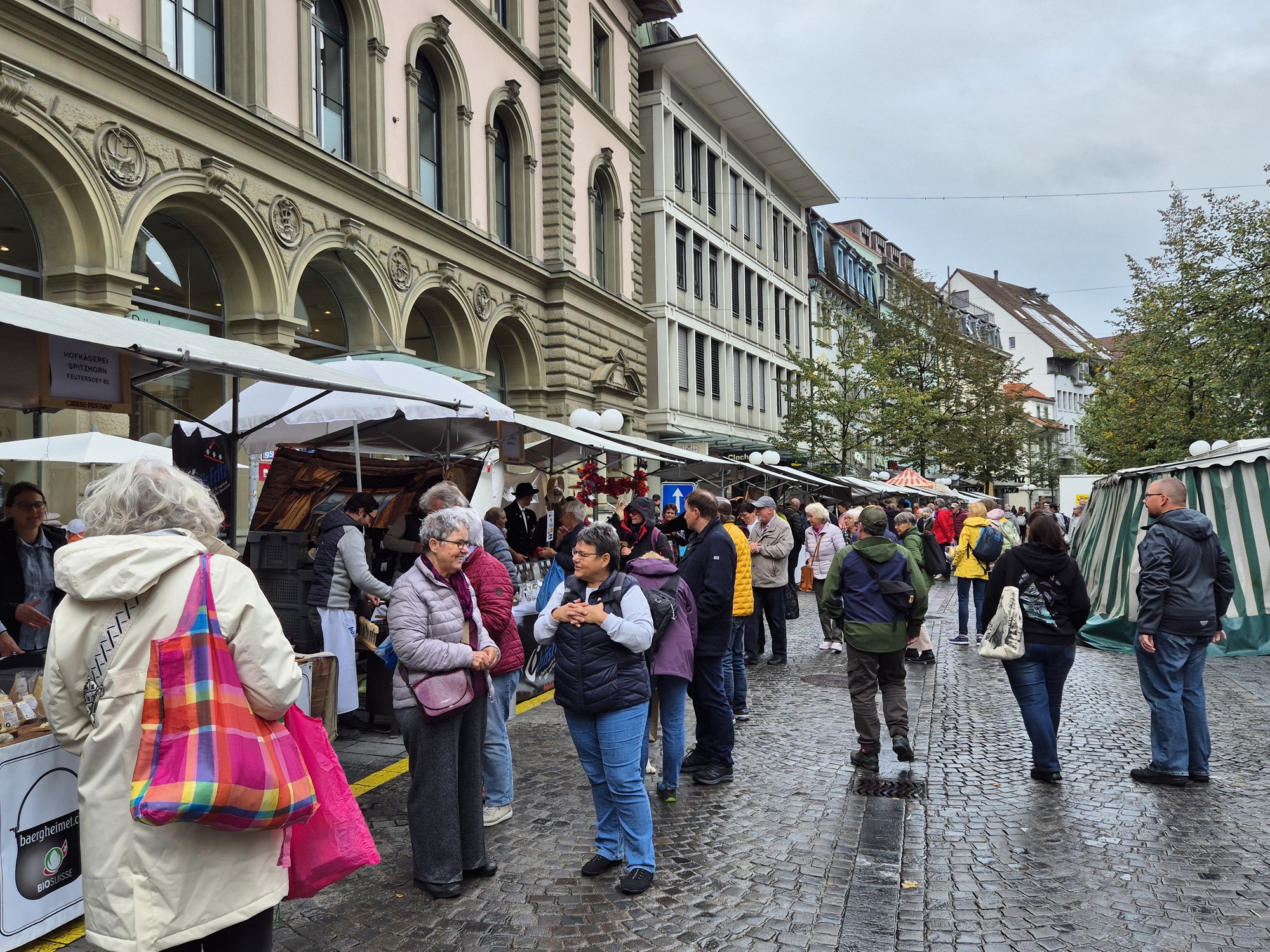
Today we attended the cheese festival in Thun (pronounced ‘tune,’) 42 km away on the shores of Lake Thun. Thun is much larger at 42,000+ people, and draws farmers’ production from all over the Canton of Bern, so the festival is huge. Here they call it käsefest. There must have been 40 vendors as the Thun festival is all about sampling and selling. Cows milk cheese, goats milk cheese (it’s not all feta or chèvre), sheeps milk cheese, organic or not, they had it. Need your fondue or raclette cheese stash fortified for the coming cold months? Buy direct from the farmer at the Thun käsefest. Perhaps chilli pepper laced alp cheese or an herb-flecked mild cheese is more to your liking.
The French may have over 400 types of cheese, but the farmers of the Canton must have at least that many varieties of alp cheese.
The cheese festival was conducted next to the farmers market in charming Thun on the Aare River and included not only sampling, but cheese made on site. Each farm had its own kiosk.Click on any photo for a better view.
Frankly, we are a bit cheesed-out at this point, so we bought some great dark chocolate. Swiss, of course.
I am ready to burn all the clothes I brought along. Two months of a capsul wardrobe makes me realize why I do not have the discipline for such minimalism at home. Still, we dutifully packed our clothes today for the last transfer before flying home and will deal with the decision of keep, toss, or donate next week.
As we wrap up two months of travel, I find myself with miscellany to impart. I jot down things I think will make a good blog then occasionally use it as fodder inspiration.
No one topic stands out so perhaps a brief summary of crap I am thinking about things you might be interested in.
No bedbugs! We have escaped the Scourge of Europe 2023! Perhaps our long stay in Lauterbrunnen has been key. We have two nights near Zurich starting tomorrow but I am prepared to shine for the little rascals. I had what I think were bedbug bites in Florence in 1972. Do not care to repeat.
Weather irregularities. It has been warm and sunny almost the entire four weeks in Lauterbrunnen and actually dry for most of our stay. A blessing for certain versus last year (See More rainy day plans) but existentially frightening as we should be having days cool enough for a jacket even in the afternoon and nights so cold you need gloves in the morning. Instead, I wish I had packed a sundress and sandals for some days. (Many women are wearing them.)
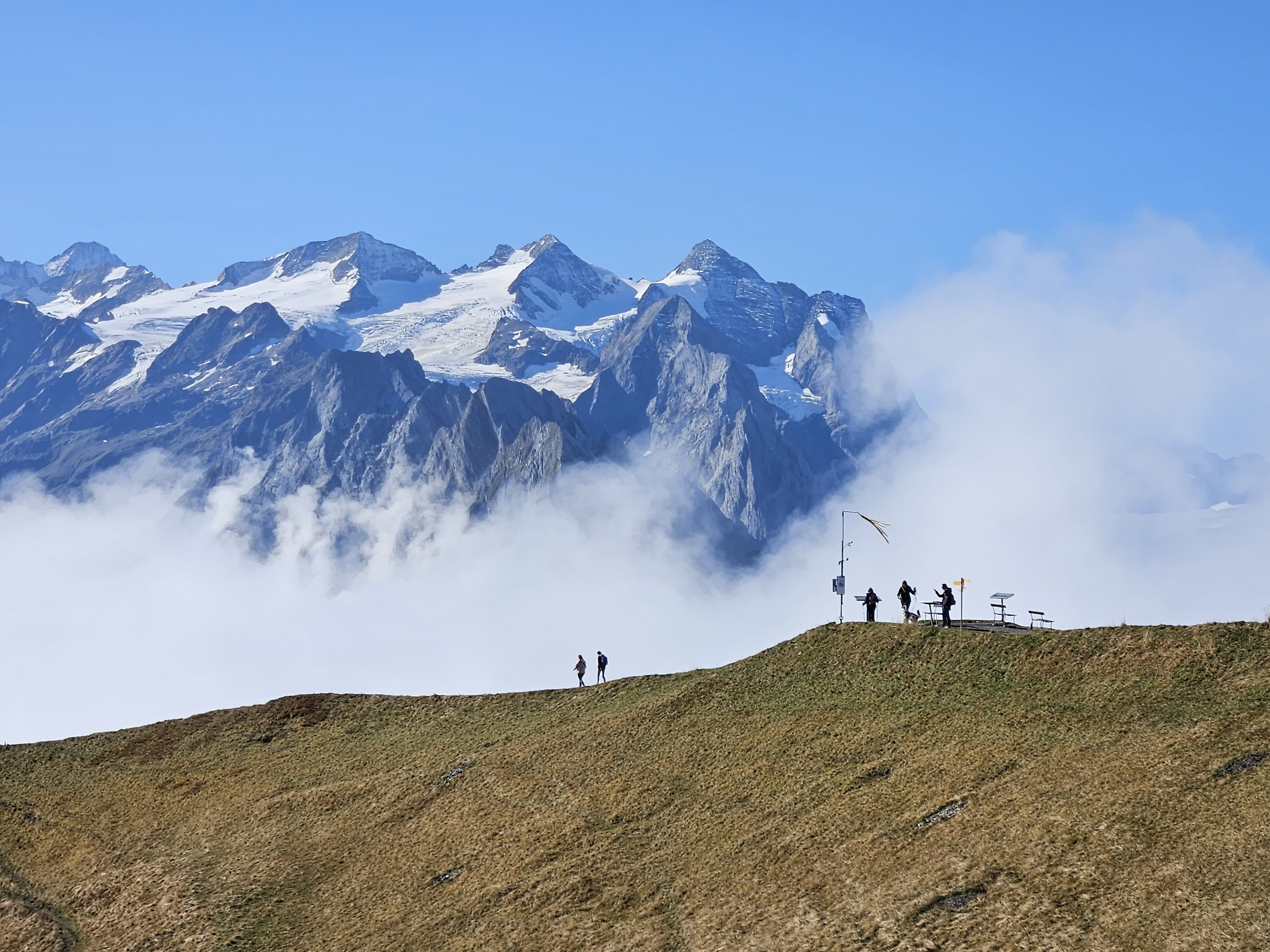
Simply gorgeous weather, although sometimes you have to get above the clouds to find it. Here, at Alpine Tower, Meiringen, CH.
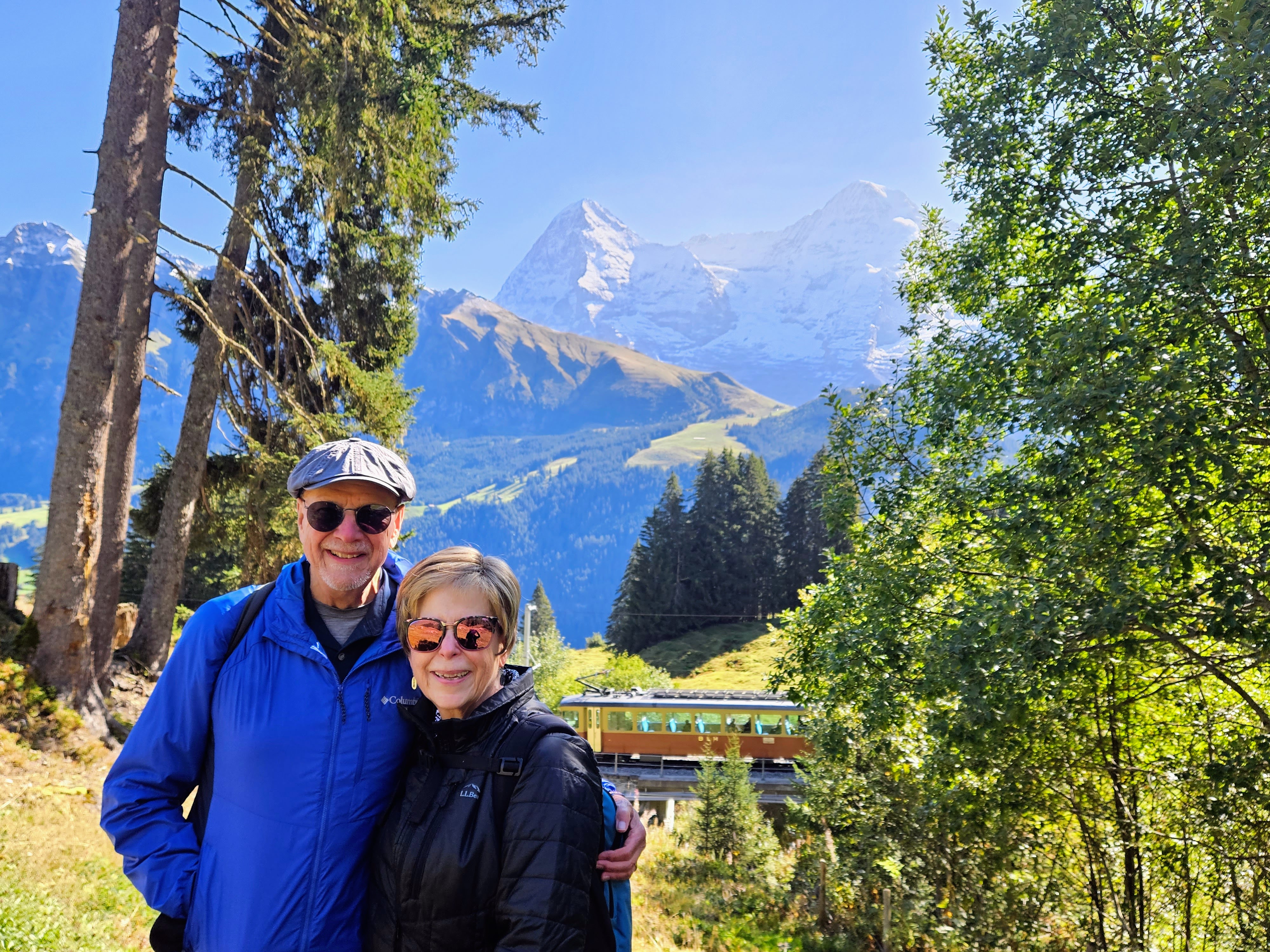
This is my favorite trip picture, hiking from Grütschalp to Mürren with the little mountain train that runs along the cliff and the Eiger and Mönch in the background. Another glorious day!
Long stays are the best. Settling in for four weeks in a favorite location is delightful. We have stayed in Lauterbrunnen and vicinity about 140 nights over the past 10 years. Why do we come back? We have a great time here. It is familiar, we love the apartment we have stayed in for most of those nights, we know what we are going to do while here yet we always find new places to explore and enjoy. Staying here requires little planning. We simply live and enjoy these incredible surroundings and the car-free lifestyle Europe affords. Maybe a little like people who have a lake cabin they spend the entire summer at. In my youth, I had friends whose families did that. It seemed narrow to me, to spend all of your vacation in the same place, yet here I am many decades on and I get it.
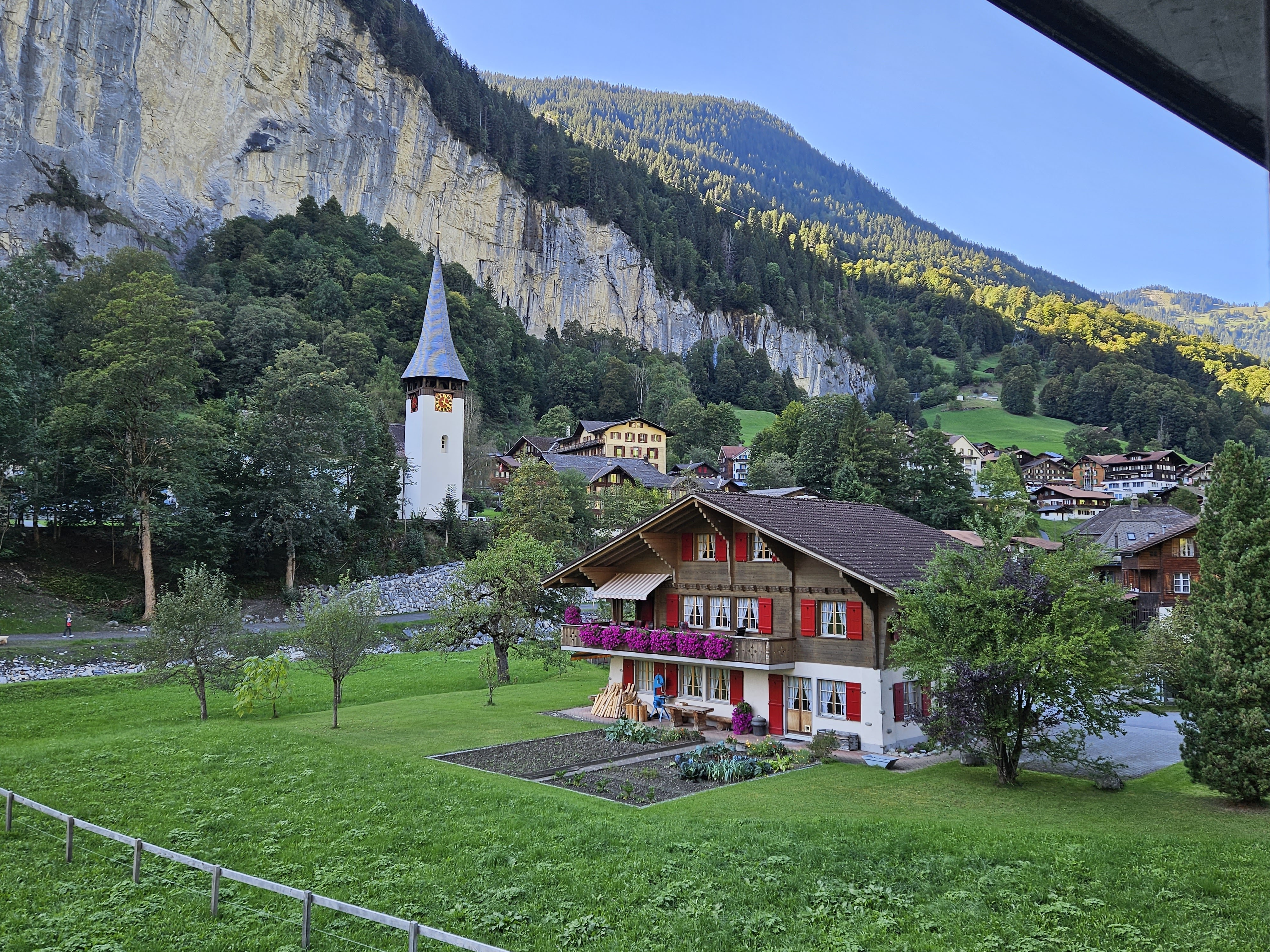
The view from our balcony at Ey Hus 6. The church in the background chimes the hour, 24 hours a day. You get used to it.
Paperless Travel. I used to pack along an inch-thick stack of confirmations, tickets, and related travel paperwork. I gave up hard copy books as soon as I got my first tablet (2011, I think) but still, there were all those printed documents. NO MORE. All of our passes and tickets are finally, as of this trip, on our phones. All confirmations saved only in email. I do bring a proper hiking map for the mountainous area we frequent, but that is it. The train conductors scan QR codes from our phones and we never have to visit a ticket machine.
Cooking while traveling. Anathema to some, but I like to cook while we are traveling. I get creative with what we can do with limited ingredients and locally available products. Each trip seems to embrace some consistent theme. This year we ate a lot of arugula salads (various preparations) and various pastas. I discovered a new-to-me balsamic chicken recipe and riffed a red-onion chutney to go with the chicken that will be a staple at home. Also, breakfast burritos. Switzerland finally has available some Mexican foods like guacamole, black beans, and tortillas. A few years ago, we started being able to get Asian products like coconut milk, Basmati rice, edamame, and Thai red curry paste. Years past we’ve had trends in chicken curry, chicken soup and pot pie, and giant salads featuring apples, spinach, blue cheese, and dried cranberries. It’s not all sausage and fondue when you cook at home.
Ethnic foods. Each year we find more and more non-Swiss options even in the villages of this small corner of Switzerland. Italian has been around for a bit but now there are two very good Italian places (not just pizza) we can get to by a short train ride which is a novel way to travel to dinner. We finally found a Thai place in Interlaken a few trips ago and the surge in Indian visitors has led to a number of Indian restaurants. Perhaps our favorite this trip was “discovering” a Lebanese restaurant in Interlaken.
Delicious Pad Thai at “sree manee Isaan Thai” in Interlaken.
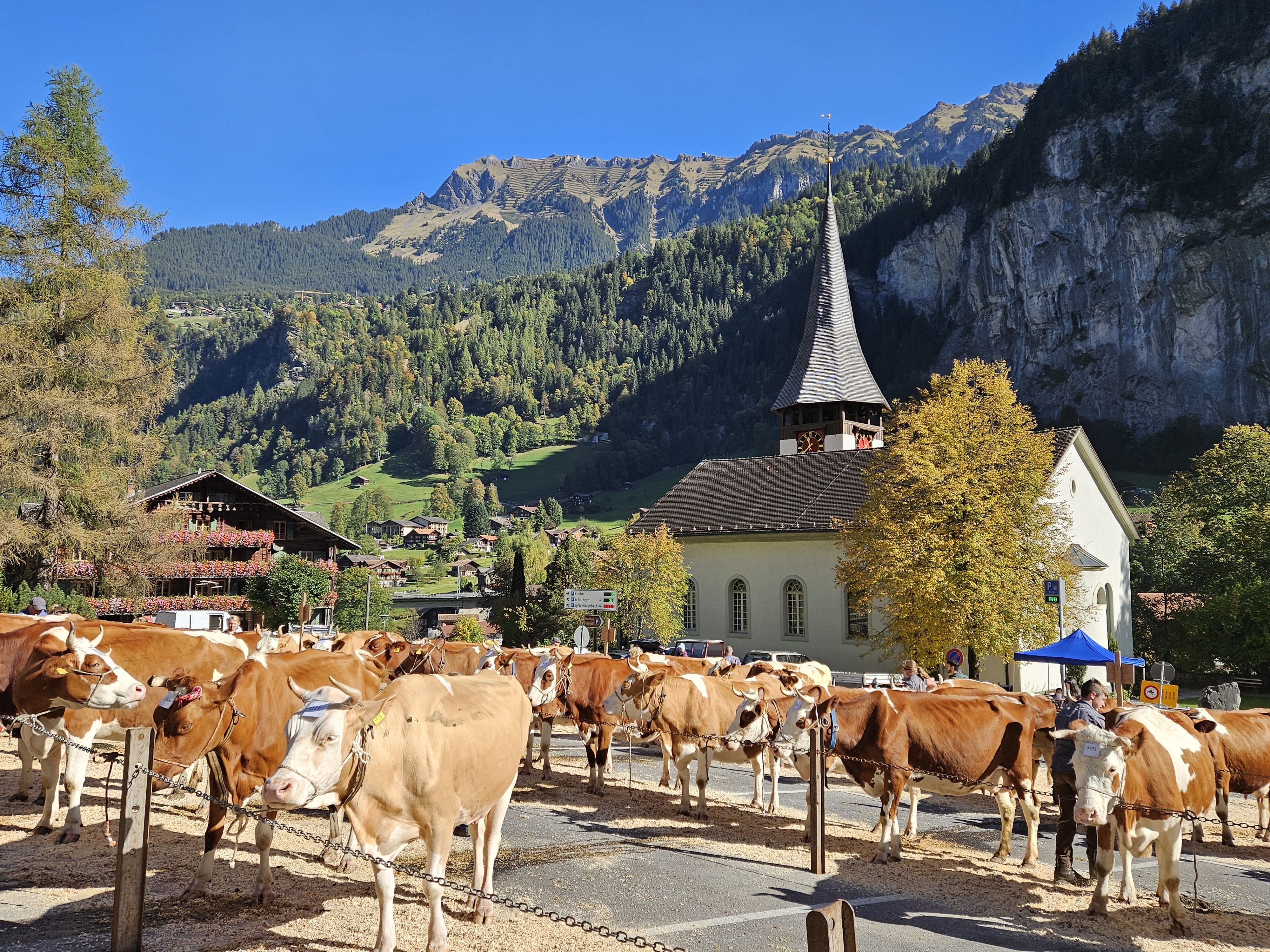
Cows, cows, and more cows. We have seen cow parades more this year than any other: Little informal groups passing through town and tying up traffic. Large parades of 100 decked out in flowers. Scheduled parades with multiple stops to drop off cattle at various low altitude pastures when returning en masse from the high alps. Today there was a cow show in the church parking lot. Never have I ever imagined such an event. Of course there was beer, schnapps, and cake. Why not?
Just the tail end of a small cow parade coming through Lauterbrunnen as they veer off to their valley pasture.
Today’s Cow Show in a most picturesque location between the church and the waterfall. Each cow had a numbered tag on its forehead, secure with a headband of sorts. About 100 cows and a lot of mooing.
Off to Zug tomorrow. Who knows what fodder for the blog our final days will offer?
Equinox greetings to you! Fall is upon us as the weather has cooled here in the Berner Oberland and the trees have just been touched with bits of yellow and gold promising a lovely display in the weeks to come. There has been ample rain so the trees are not stressed. I have great hopes for good color!
But pizza is the topic today. We have revived the Pizza Venerdi (Pizza Friday) tradition of our days in Rome for the past five Fridays. While we are not in Italy, all five have been superior to the pizza we get near our home, but then the pizzaioli are from Italy and know what they are doing.
Pizza for two and a bottle of Italian wine on a pedestrian alley in Annecy, France.I ragazzi (the guys) in the kitchen at Sapaudia, Annecy, France. In Kandersteg we enjoyed pizza at the Chalet Hotel Adler. Third year we’ve had their pizza and it is excellent thanks to the Italian cooks. Our friends Gene and Cathy journeyed over from Lauterbrunnen to join us for pizza, beer, and a walk in the Kandersteg Valley on a very warm afternoon.My son called this a crime against humanity. I discovered pizza with salmon when we lived in Italy and I get it whenever I am able.It’s best with Gorgonzola and arugula but the mascarpone, capers, and onions were nice, too. In Pontresina at Nostra Pizzeria.
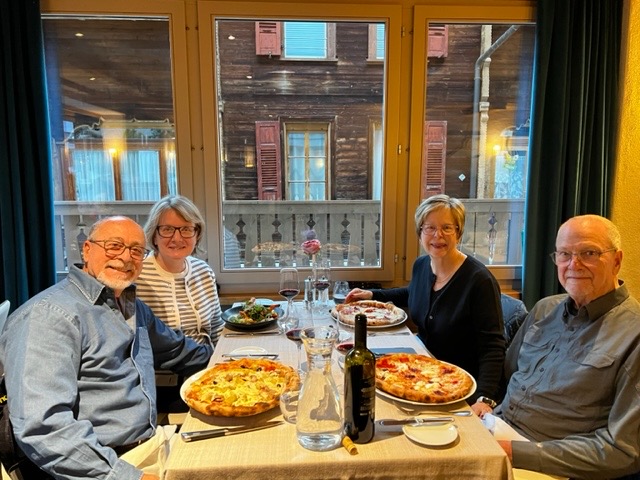
Last night we welcomed our dear friends John & Janet to Lauterbrunnen and took them up the mountain by train to dinner in Wengen at Maya Caprice. A good time was had by all.
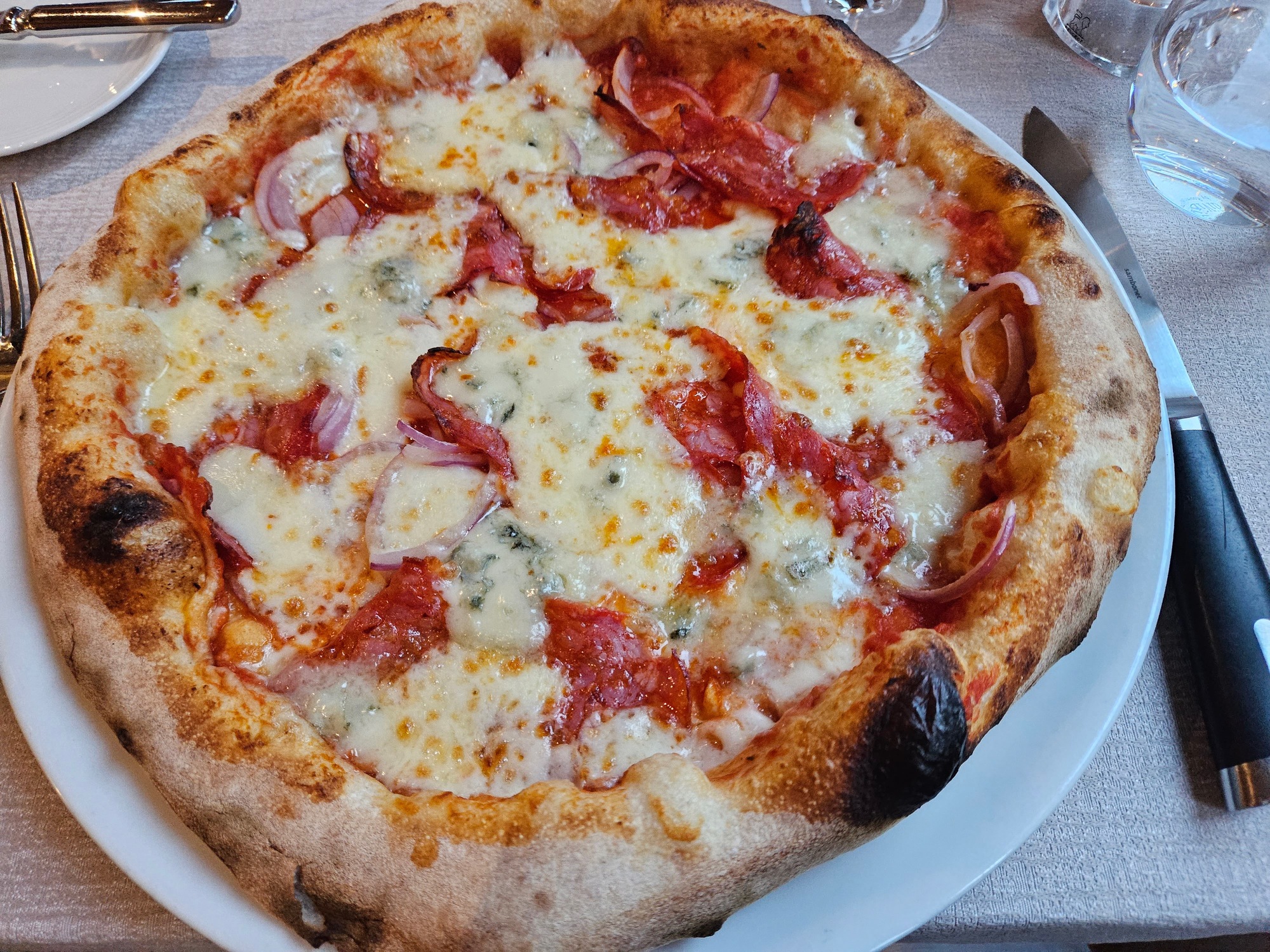
Pizza Maya from Maya Caprice. Spicy salami, Gorgonzola, and red onions. The crust was perfection!
We have three more times to celebrate Pizza Venerdi here in Switzerland. Stay tuned!



















 Girovaga