Postcard from Alsace: Wine, Wisteria, and Storks

30 Apr

30 April 2019.

It is always time for wine in France’s Alsace Region, but only for a short time in the spring do the storks roost here to rear their young. Until we arrived we had no idea about this annual migration nor did we know how revered the storks, or cigognes blanches, are.  They are symbols of happiness and faithfulness bringing fertility and good luck. There is a fun read here from the Seattle Times a few years ago.

Ric captured a close up of this nest with both parents present. They were clicking away at each other, their method of communicating. The nest is perched atop a steeple. Note the supports. The towns build and maintain platforms to support the huge nests.
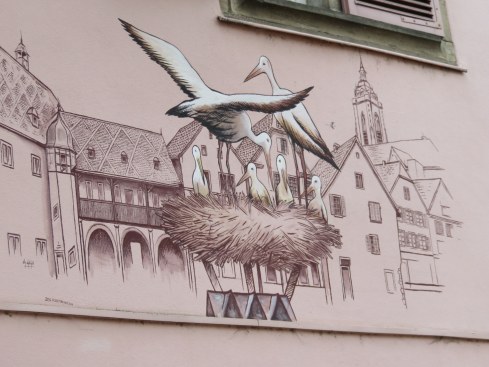
The storks feature prominently in town art,

We have had a full itinerary, one day taking a tour of a small portion of the Route des Vins d’Alsace visiting three family-run wineries, and another day exploring the beautiful and tiny villages, spotting storks, and enjoying the seasonal decorations that adorn every house, shop, and square. Wisteria drapes from walls, roofs, and trees, enhanced by bunnies, eggs, and other signs of the just-past Easter holiday. The air is fragrant with lilac.
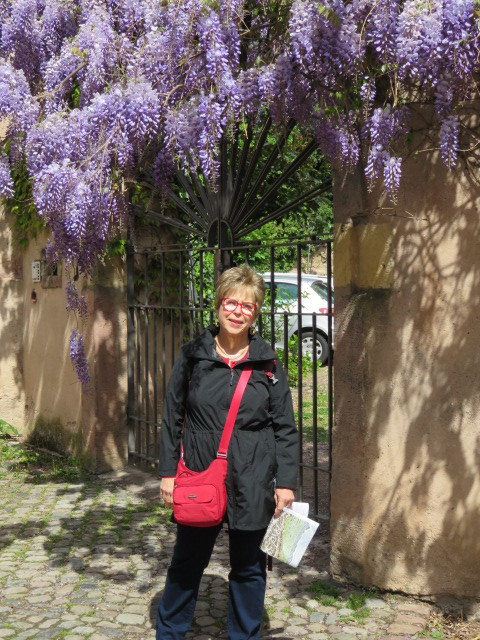
The wisteria is at its peak while the tulips have just faded.

A day hike through the vineyards got us away from the hordes and tourist buses in Colmar, which has been our base for five nights. There has also been plenty of time to enjoy the local cuisine.

Flammekueche or tarte flambée, depending on your language choice. Think of it as Alsatian pizza. It is FABULOUS.

As usual, we are car-free. I can imagine why a car would be helpful in this region as public transportation is a bit thin. With the help of a taxi driver named Isa, we have managed quite well. Three times Isa took us to villages that were difficult to reach by bus. We feel like we have our own personal driver in Colmar. Three taxis were far more economical than renting a car for 4-5 days.

For now, I will let our pictures do the talking. Between us, we took far too many in four days: almost 500! Watch for a post (soon!) over at Project Easy Hiker as well about our backroads walk from Riqewihr to Ribeauville along with our visit at the Centre de Reintroduction which has helped in stork recovery.

One of the more brightly colored buildings, this one in tiny Riquewihr. Can you see the bunnies in the window boxes?
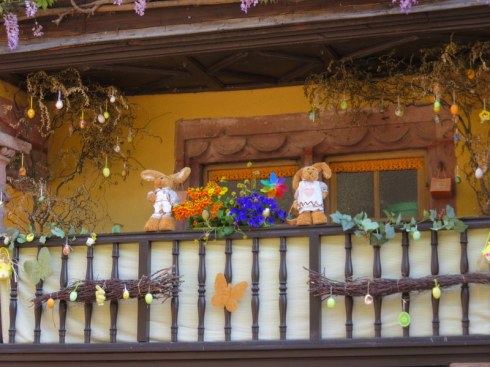
The decorations would be tacky on one house, kitschy on two, but when every building has them, it is a theme.
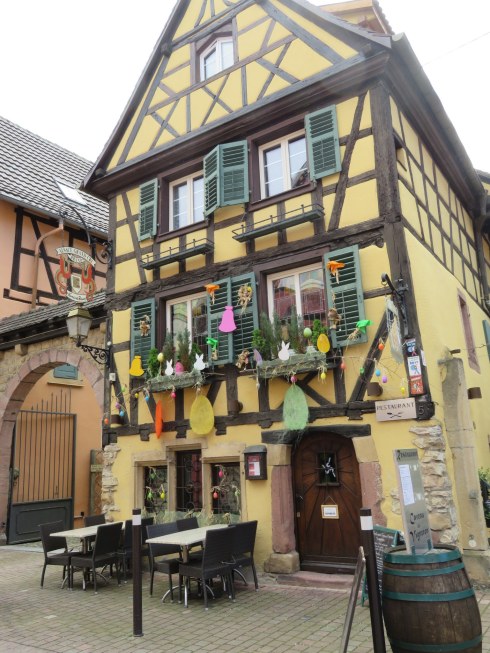
Even this restaurant in Turckheim was bedecked. This is where we had the tarte flambée along with seasonal white asparagus, another specialty of the region.

In Alsace, they use some very old wine barrels such as these beautifully decorated ones from a bygone era.
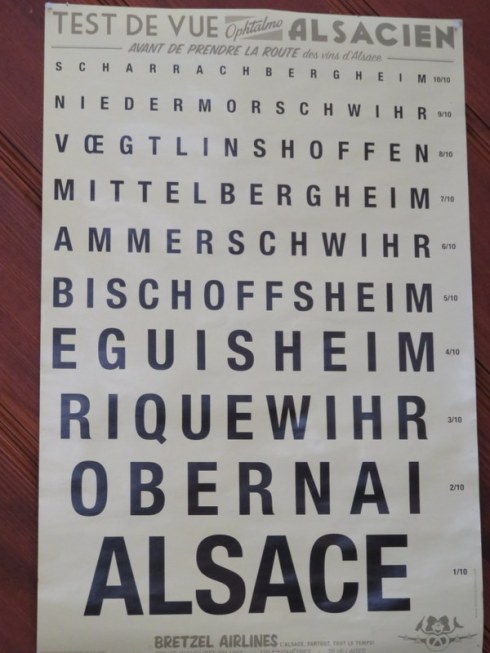
An eye test chart in an Alsatian winery. The real test for me was pronouncing the names.
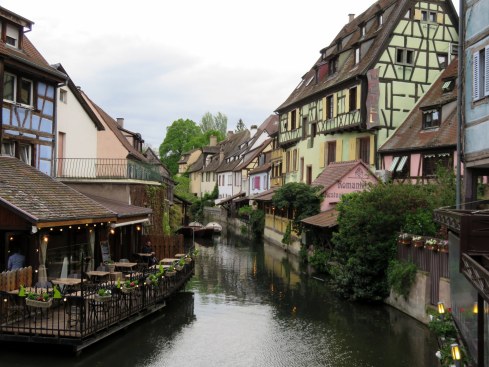
Even in the overast that predominated our days in Colmar, the buildings are charming. No wonder this area is called “La Petit Venise.”


Southern (Oregon) Coast surprises

29 Mar
29 March 2019.
Where does one go for a break when one lives on the Oregon Coast? Another part of the coast, naturally.
When we lived in Portland, Cannon Beach was our coastal-town-of-choice. We usually enjoyed two, 3-or-4-night off-season stays each year, often with dog in tow. In fact, knowing we enjoyed Cannon Beach even in colder weather led us to decide to live on the coast.
However, in 30-odd years of living in Oregon, we had never ventured south of Florence! It was high time to go before the tourist season kicks in and Highway 101 becomes a convoy of gigantic RVs pulling tiny cars.
For one reason or another, we chose Bandon as our base and we were delighted with the decision.  It is less than four hours from home: far enough for a getaway but not so far as to require a driving marathon which neither of us enjoys.
Because the immediate post-Lewis and Clark history of the Oregon Coast is one of exploration and shipping, there are myriad lighthouses so in my mind I dubbed this The Lighthouse Tour, but there were other surprises awaiting us: among them, cranberries, sheep, and lakes.

Cranberries

I knew we grew cranberries in Oregon. I did not know they were grown so close to the ocean. Turns out Coos and Curry counties are the epicenter of the industry. The well-ordered, burgundy-hued fields would make Marie Kondo proud. There are many bogs and sloughs in the Bandon area but these fields, clearly visible from the Pacific Coast Scenic Byway (aka, Highway 101), were dry. Seems they are only flooded to harvest the berries. Wouldn’t that be fun to see?

We did not get a good shot of the cranberry fields, but they are not “bogs” at least at this time of year. They are fields rimmed with berms to allow flooding for harvest. Photo by KnightedAirs

Sheep

Who knew the southern Oregon coast was prime territory for sheep? As green as the area is, we felt transported to Scotland where sheep grazing within view of the ocean is commonplace. While sheep farms are not as common here as in the Willamette Valley or Central Oregon we also were not traveling on an Interstate so we traveled closer to the pastoral views. Something about sheep always makes me happy.

Sheep and cows graze with a view of the ocean, Cape Blanco,

Lakes

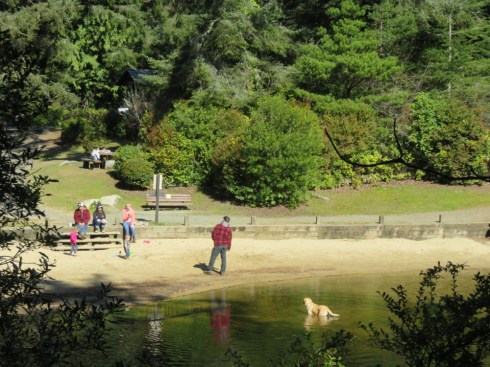
Oregon is not lake country. Rivers we have. The Pacific Ocean, of course. As I hail from “The Land of 10,000 Lakes,” Oregon has always seemed a little light on freshwater bodies. Driving along 101 south of Florence, there are a lot of lakes, some due to dams created by the famous Oregon dunes. It really is a peaceful drive from Florence to points south, unlike 101 near us. While the photo below is of a tiny lake, some are huge. Look up Siltcoos Lake or Tahkenitch Lake.

Lake Marie in Umpqua State Park, a stone’s throw from an ocean beach but fun — and safe — for kids and dogs.

The Trip

We spent four days exploring, mostly under clear skies. Bandon makes a nice base with some good restaurant choices, plenty of lodging options, and a choice of river or ocean views. We chose the Bandon Inn, on a hill overlooking the old town where one can walk to many restaurants.

Sunrise view of the Coquille River, Bandon, from the Bandon Inn.

Our travel day south afforded an opportunity for a few scenic stops between Newport and Coos Bay. One of our favorite coffee stops is in Yachats at the Green Salmon, with the best pour-over coffee we’ve found. Amazing pastries, too, and you could have a different sandwich every day for a month. They will lace any drink with CBD if you like. We never get past the pastries and coffee. Haven’t tried the CBD.
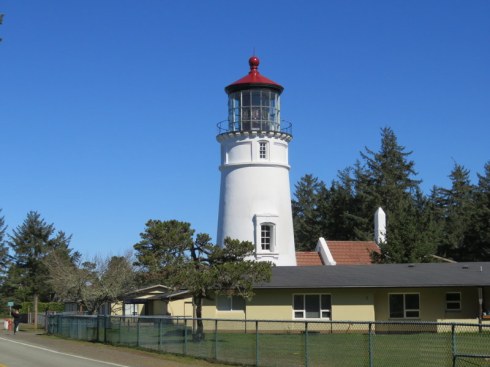
Bypassing Cape Perpetua, having visited there several times, we proceeded to the dramatic Oregon Dunes and the Umpqua Lighthouse in the eponymous state park.

The Umpqua Lighthouse still operates, now as a Private Aid to Navigation (PATON) as the personnel assigned to the Coast Guard station were relocated in 2008. It shines with a distinctive red and white Fresnel lens.

This is what people like to do at the Oregon Dunes. Only a few hardy souls out in March, but ATVs are available to rent at many locations nearby.

Arriving in Bandon about 16:00, we had time for a loop through the old town, where we discovered that night’s dining destination, Bandon Brewing Co., where pizza reigns! (Watch for a review over at Our Weekly Pizza very soon.)
Heading south the next day our focus was on Cape Blanco and Port Orford. Further south there were road closures and delays due to landslides last month, so we limited our wandering a bit. Cape Blanco turned out to be a delightful stop with an easy walk to the closed-until-April light. We were the only visitors on this warm and surprisingly wind-free morning. Imagine the hardships in living in this remote location when the light was built in 1869?

The Cape Blanco Lighthouse can be toured during limited hours, April-October.

From this viewpoint on Cape Blanco, it is easy to see how important the lighthouses were to ships navigating the Oregon Coast.

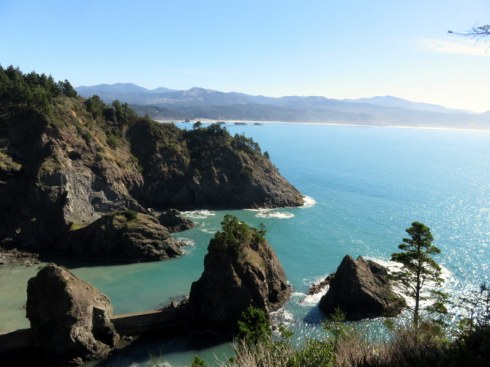
Port Orford is a dot on the map but Port Orford Heads State Park and a surprising ocean-front restaurant make it a perfect combination for outdoor fun and refreshment. Port Orford Heads offers a network of paths with remarkable views far out-to-sea made even more interesting by the unique rock formations. Here we saw one formation that looked like a whale and another resembling a henge sunk into the Pacific. We spotted our first whales of the season, beginning their northward migration to the feeding grounds in Alaska. It was shirtsleeve weather by late morning, convincing us that spring was at hand.

Lovely view of the entrance to Nellie’s Bay at Port Orford. From this bay, the Coast Guard used to launch their lifeboat. There is a museum dedicated to these brave “surfmen” as they were known.

Offshore islands at Port Orford Heads. This is a terrific whale watching viewpoint. See the “henge” far out to sea?

We could have spent the day on a handy bench overlooking the whales’ path, but growling stomachs called us to lunch at The Redfish. The cafe’s ocean view was surpassed only by the cuisine. Their fish tacos were the best I have eaten. Ever. Well-seasoned, grilled rockfish, encased in grilled tortillas (firmer for the grilling so they don’t fall apart) with a tasty, non-drippy slaw, and an underpinning of queso fresco plus salsa fresca. We passed on the fries and were rewarded with a large side salad dressed with a compelling citrus vinaigrette. I wish we lived closer. Or that they would move.

The Redfish Cafe at Battle Rock Wayside Park. best fish tacos ever.

Another day we passed in-and-near Coos Bay. First stop: Shore Acres State Park. Our promised sunny day started out with patchy fog and cleared to cold and windy near the ocean, far from the shirtsleeve weather of Port Orford. We were almost alone for an hour-long exploration that included the amazing formal gardens at Shore Acres, on the former estate of timber baron Louis Simpson.
From the website:
The initial holding was purchased from Louis J. and his wife, Lela G. Simpson, in 1942, and included the Simpsons’ oceanfront estate with its formal garden. Later additions were acquired from other owners between 1956 and 1980. The garden fell into disarray in the period 1942-1970 but it has been restored to perhaps an even grander scale than that achieved by Louis Simpson. “Shore Acres” was the name given by the Simpsons to their large estate on the spectacular Cape Arago sea coast. The house sat on a precipitous bluff overlooking the rocky ocean shore. The Simpson family was important in the development of the Coos Bay area, beginning with Captain Asa M. Simpson, who founded the town of North Bend after his arrival on Coos Bay in 1855. Simpson and his sons were leaders in shipping and the lumber industry. They owned land from Cape Arago to North Bend.

Almost alone at Shore Acres on a day of pounding surf and cold winds.

Dramatic surf at Shore Acres.

The former Louis Simpson Estate is now a state park, Shore Acres. I am told the current garden is more beautiful than the Simpson’s was. They have the best gift shop we’ve been in. Ever.

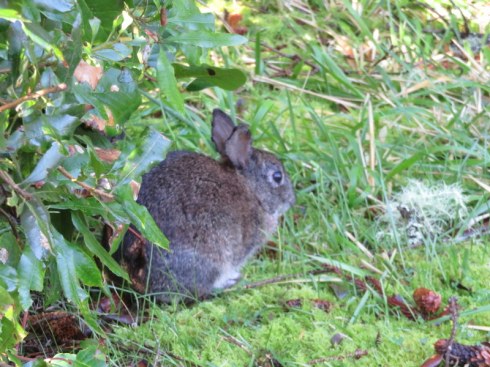
Found this tiny bunny having a snack at Shore Acres. We never see them in Lincoln City. He was so small, maybe 2 pounds.

Not far away, the lighthouse at Cape Arago once kept ships from harm. When you see the rocks all along this part of the coast, even far offshore, it is no wonder shipwrecks were common and lighthouses necessary.
Moving on, the aquarium at Charleston was closed (one of the perils of off-season travel is fewer days open and shorter hours) so we headed to Coos Bay. The heyday of lumber that built this port has passed but there is a tidy downtown core with a pleasant boardwalk and, surprisingly, a railroad museum whose open day our visit coincided with. Fish tacos from Sharkbites didn’t quite compare to the Redfish but they were of excellent quality.

Oregon Railway Museum. This outdoor museum is best savored on a dry day. You can walk through many cars, including some ancient cabooses. Limited hours.

There is a nice boardwalk along the waterfront of this calm natural harbor.

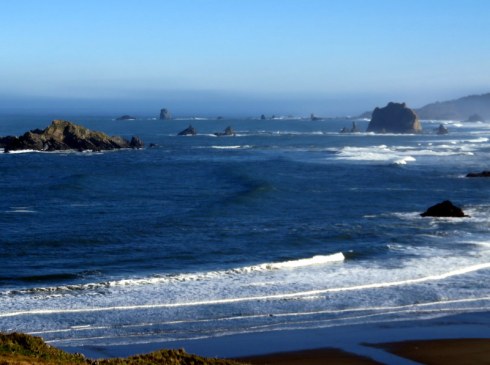
One can spend a nice morning just taking in the views from Bandon itself. When the sun is at your back, the Pacific shows itself best. Once again, we found ourselves virtually alone while we tromped around Coquille Point in Kronenberg County Park on a mild March morning. A lovely loop with vast views takes one along the cliffside to see the Oregon Islands National Wildlife Refuge bursting with bird life. Table Rock, Cat & Kittens Rocks, and Face Rock are among the formations that capture the imagination.

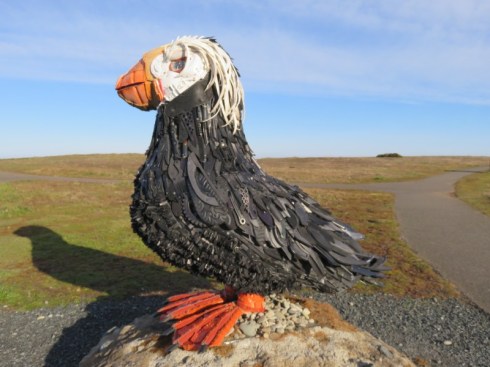
Cosmo the puffin watches over the Coquille Point Nature Preserve. He is made of plastic pollution found in the ocean, part of a project called “Washed Ashore.”
Face Rock, one of the fanciful formations off the coast at Bandon.

While there are many dining options in Bandon — we tried several — the Bandon Brewing Co., Bandon Coffee Co., and Edgewaters were our favorites. Edgewaters was so impressive we dined there twice. Seafood Romesco (like a cioppino), a creative arugula salad, and a unique preparation of calamari caught our attention, as well as a decent local wine list. For the population, Bandon’s restaurant options far surpass those in Lincoln City.
I thought of this as The Lighthouse Tour as they are abundant on the coast. Between Lincoln City and Port Orford, we passed lights at Yaquina Head, Heceta Head, Umpqua, Coquille, Cape Blanco, and Cape Arago. But we found much more than lighthouses in our south coast break. Next stop: France in late April!
If you would like to know more about walks and hikes, head on over to Project Easy Hiker for a companion piece.

Second edition: “Walking in Italy’s Val Gardena”

2 Feb
2 February 2019.
If anyone ever tells you writing a book is difficult, ask them how the editing and publishing process went.  Publishing is to writing as cooking is to eating: It takes a lot longer to create the meal than to eat it. At least it does for me, self-published as I am. The writing process was a piece of cake. Floundering through Kindle Direct Publishing gave me a stomach ache.  In fact, the author page links still are not working on all Amazon sites. Grrrr.

Ric on a new walk at Passo Gardena, with Jimmy Hutte in the distance. Many of our walks feature great places to relax and have lunch along the trail.

It has been a while since I last posted in November. We’ve been very busy. The last trip was, in part, to update our book and at last, we have published the second edition of “Walking in Italy’s Val Gardena!” (NOTE: In January 2025 the 6th edition was published and this link updated.) Now containing 23 hikes (previously 20) and updated information as of autumn 2018, this is the book to take along on a trip to Ortisei or anywhere in Italy’s Val Gardena. There’s not much written in English in detail on this part of Italy. 
We had such a magnificent trip again last fall that I could hardly wait to get this published. Alas, the writing and (worse) editing process did take some time, but now the content is fresca fresca fresca, as our Italian friend Pellegrino used to say.

The approach to Fermeda on one of our new walks. How about having pizza with this view?

If you have never been to the Dolomites, put it on your list and spend a week. Heck, spend a month if you love hiking and mountains. Our best trip ever was passing the month of July parked in Ortisei while we did the initial research and writing the first edition.
Click on over to Amazon.com and get your copy, paperback or Kindle. Also available worldwide on Amazon.it, Amazon.co.UK, Amazon.de, or any other country Amazon site you buy from.
Note the first edition is still out there because that is where the reviews are. I am hoping to see some reviews of the Second Edition soon! (Hint Hint.)
I will be back with a new post soon about cooking while traveling. Until then, Ciao!

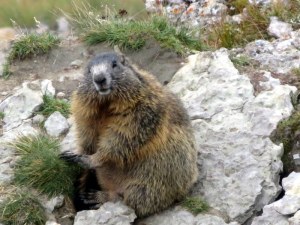
This little marmot was hanging out with his “madness” at Seceda, above Ortisei. Hiking directions are in our book.

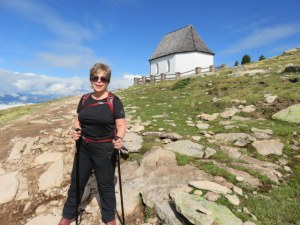
We make a point of hiking to this little chapel at Rasciesa each trip.

Also from one of our new walks at Passo Gardena. What a view!

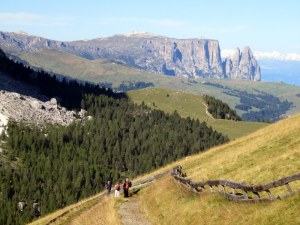
On the trail from Ciampinoi to Passo Sella, a marvelous view of the Sciliar.

Bits and pieces from our 2018 trip

15 Nov
15 November 2018.
Our trip photos rotate on my screen saver and stir up memories to the point I don’t want to pause them so I can use the laptop. We have been home for a month and are still talking about our trip to Italy and Switzerland while planning for another adventure in the Spring.
Some are funny, some unusual, and there are cats.

Cats, cats, cats

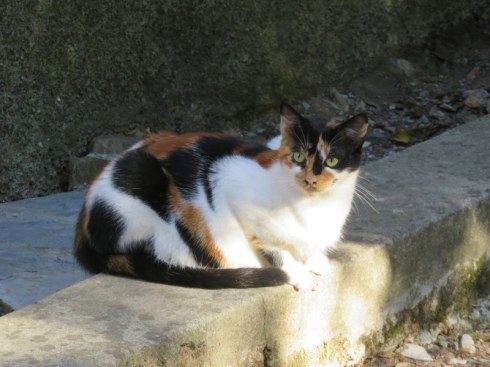
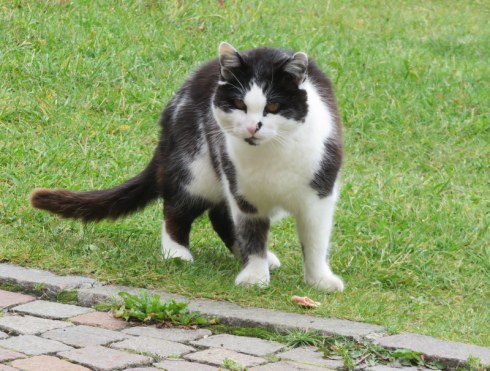
We love cats and seldom get good photos. Somehow they know when the shutter is about to click and they look away. I had pretty good luck this trip.

High above Rapallo, Italy, we found a charming hotel and restaurant with about a dozen dependents who happily posed for us.

Another of the lovely cats of Montallegro near Rapallo.

A cold, glacial stream satisfied this hardy neighborhood cat. Lauterbrunnen, SW.

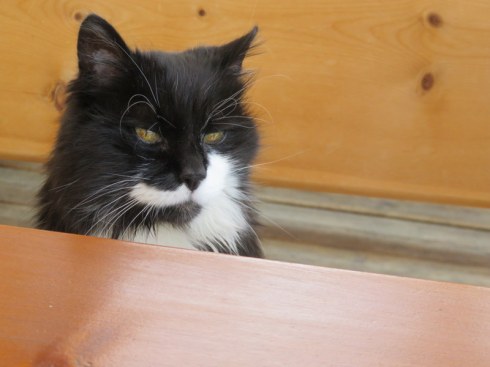
This little guy joined us for lunch one day in the mountains and shared our prosciutto. Fermeda Hütte near Santa Cristina, Italy.

We were enjoying strudel and espresso when the chef came out to offer this little guy his breakfast: thinly sliced prosciutto. Alpe di Siusi, Italy.

Signs and Labels

Amusing word choices and translations that don’t work.
I am sorry that  I neglected to take a picture of the sign above a place for parking bicycles that called it a “Bike Reck.”

Watch out for those dangerous, rampaging suckler cows! Seen all over Switzerland.

3-out-of-four in English. But we know what they mean. Pontresina, SW.

The lift had an official sign saying 4 people could ride in it, but this hand-written note warned us it was only safe for 2 people to go down. Beat the Paris elevator we had last year that only accommdated one person.

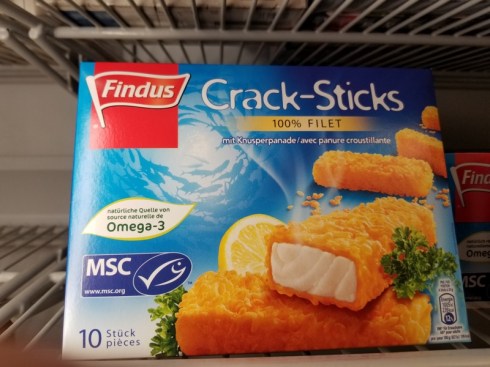
Findus is a big brand in frozen foods in Italy, but this product name in Switzerland threw us. They were good but not addictive.

Throughout Austia one can find the amusingly named Mozart’s Balls.

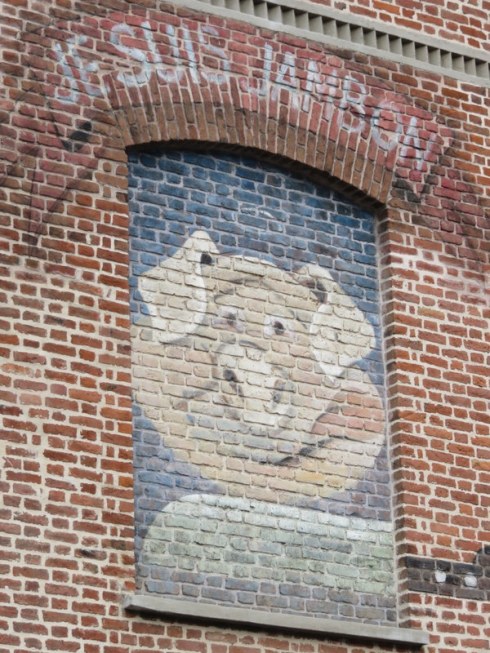
I am ham. Milan, IT. And why French?

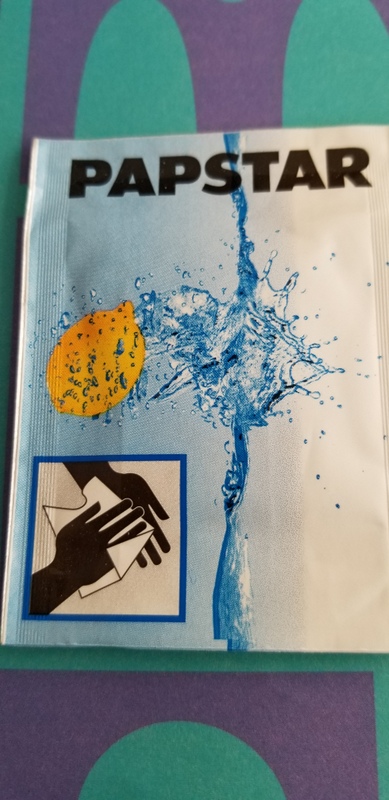
Funny name for a hand wipe (Lausanne, SW).

Vending

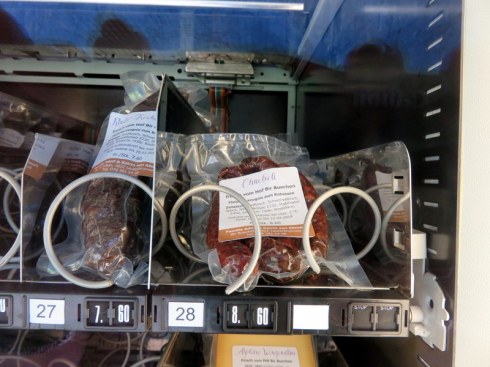
Honor kiosks and roadside cheese vending were among our favorites.

Cheese vending machine found along a rural road in the Lauterbrunnen Valley, SW.

Same machine dispensed sausage.

Truly an honor kiosk: cheese and honey in an artful roadside box.

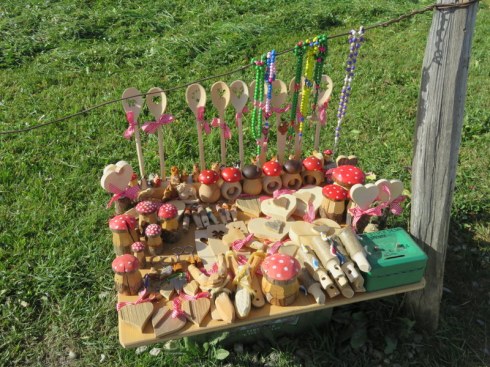
An enterprising person laid these out for purchase on the honor system, 5 Euros per item. Alpe di Siusi, Italy.

Uncategorized

No idea how to classify these gems.

10:30 in the morning is a great time for a beer break when you are hiking with your baby. Near Passo Sella, Italy.

Ric found this facility in a men’s room in the Val Gardena.

Postcard from Switzerland: Places the guidebooks don’t tell you about

17 Oct
17 October 2018.
Travel guidebooks are a favorite genre for me and I am a voracious consumer of their wisdom. Go to Europe without Rick Steves? I think not! Fodor’s, Frommer’s, Lonely Planet. and Cicerone guides also populate my Kindle.
Sometimes, though, guidebooks exclude the good stuff and include way too many formula places. We found two worthy outings near Lausanne that Steves’ and Fodor’s books barely mention. In fact, Rick Steves poo-poohs one of them. It was only because I picked up a brochure locally that we were clued in.

Les Pléiades 

We are drawn to high places that include trains and that is what led us to explore this area above Vevey just a few kilometers from Lausanne. The name Les Pleiades refers to the star cluster that is also called the Seven Sisters. I’ve no idea why this mountaintop is so named, but they have incorporated an exhibit called the Astro Pleiades to teach some basics about astronomy. It is dedicated to Claude Nicollier, the first astronaut from Switzerland. It’s actually a clever exhibit, but the draw on this sunny day was the view.

Me on the trail, Les Pleiades.

We found a bit of fall color at Les Pleiades.

Lake Geneva sparkles 1000 meters (3280 feet) below while there is a peek at Mont Blanc 60 miles away. (We stayed in Chamonix, at the foot of Mont Blanc, for 3 nights in 2016 and never saw the damn thing!) The train ride up is charming, a bit of a commuter route to outlying residential pockets from Vevey, but as the train winds higher, it becomes more and more rural. Each stop is on-demand only. At the top, trails abound along with a full-service restaurant. We took a very early train and enjoyed complete solitude for an hour until the next train pulled in full of day hikers young-and-old as well as a half-dozen mountain bikers.

Lac Leman/Lake Geneva far below on a stunning day at Les Pleiades.

You can just see Mont Blanc’s snow-capped peak. Hard to tell it is almost 16000 feet high.

Rochers-de-Naye

This is one of the most fun trains we have ridden outside of the Berner Oberland. A narrow-gauge cogwheel train transports you from urban Montreux through forests and tunnels, to 2042 meters above sea level, about 6700 feet. There were stunning views on each side of the train as we chugged ever-upward. Stations served everything from the Swiss Hotel Management School to middle-of-nowhere cabins.
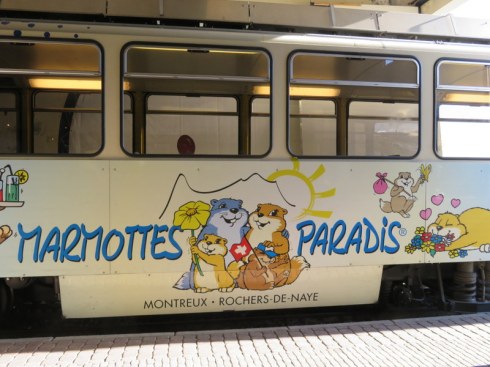
At the top, we found a tunnel to a viewpoint and a restaurant only open on weekends. There was also a cafeteria not-yet-open even at 10:30 and “Marmot Paradise” without marmots. The perils of off-season travel. But again, the views: stunning.
The alps as seen from Rochers de Naye above Montreux, Switzerland.

The marmots must have been in paradise because they were nowhere to be seen at Rochers de Naye this October day.

There are a number of short hikes available as well as long, challenging ones. You can hike up part way or down a very long way if your knees can take the beating. I think it would be beautiful in springtime although the fall color was not bad. A clear winter day would be spectacular and apparently, there is a Santa Claus themed event for the holidays. For the adventurous, there are yurts to overnight in.
At 11:00 a train pulled in packed with daytrippers, apparently arriving in time for the view and lunch. We were glad we came up early even though the marmots were hiding and there was no coffee available.

A fork in the lake, outside the Nestle Alimentarium in Vevey.

Lausanne and environs were fun to explore. The city itself reminds me a bit of Paris, although without as much charm. I have to keep reminding myself that we are, in fact, in Switzerland. We liked the waterfront in Vevey and if we returned, that is where we would lodge. Chateau de Chillon in Montreux was interesting enough, and we did take a boat trip to France for lunch, which was easier on the budget than dining in Lausanne.

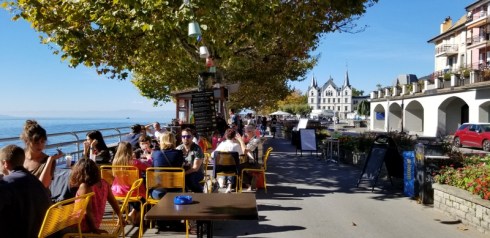
Sunday lunch along the lively lakefront in Vevey. Did I mention how terrific the weather has been?

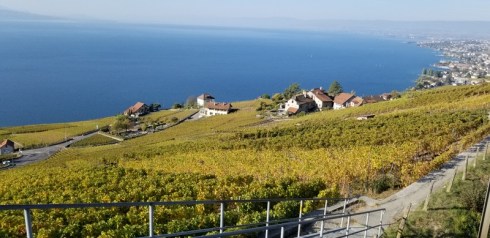
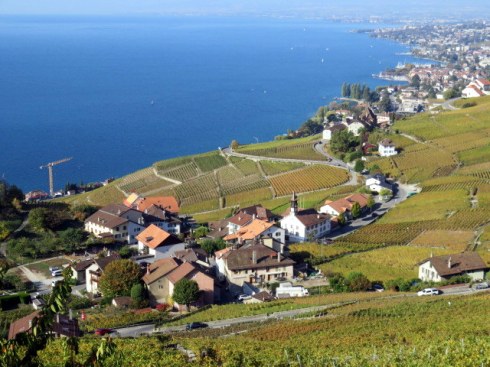
Another activity we enjoyed that is in the guidebooks was a saunter through the Lavaux Vineyard Terraces, a UNESCO site. You take a modern, sleek, SBB train to a hamlet, then make your way through the terraced vineyards and other small towns on paths, roads, and the terraces themselves, ending up in a small town beside the lake where another train takes you back. In season, one can do a gastronomic tour as well as sample wines in small vineyard huts. Alas, the harvest is long over and we hiked sober.

Walking through the Lavaux Vineyard Terraces UNESCO site.

Little villages and grand chateaus with vineyards growing right up to their walls.

Tomorrow we fly home, so no more postcards for now. Maybe a miscellany/catch-up piece once I get over jet lag!

So long!

Girovaga

Formerly GoodDayRome

Skip to content ↓