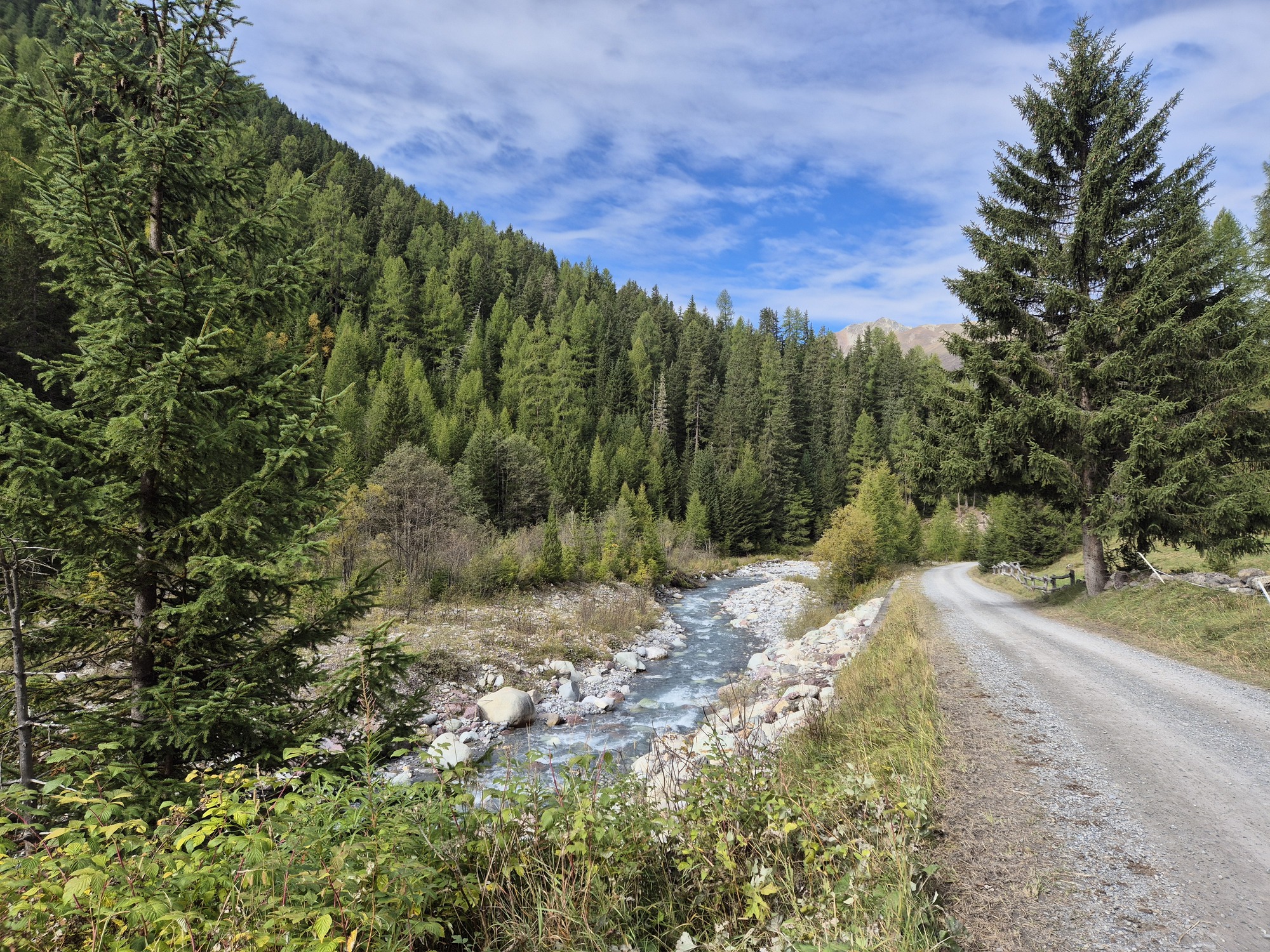
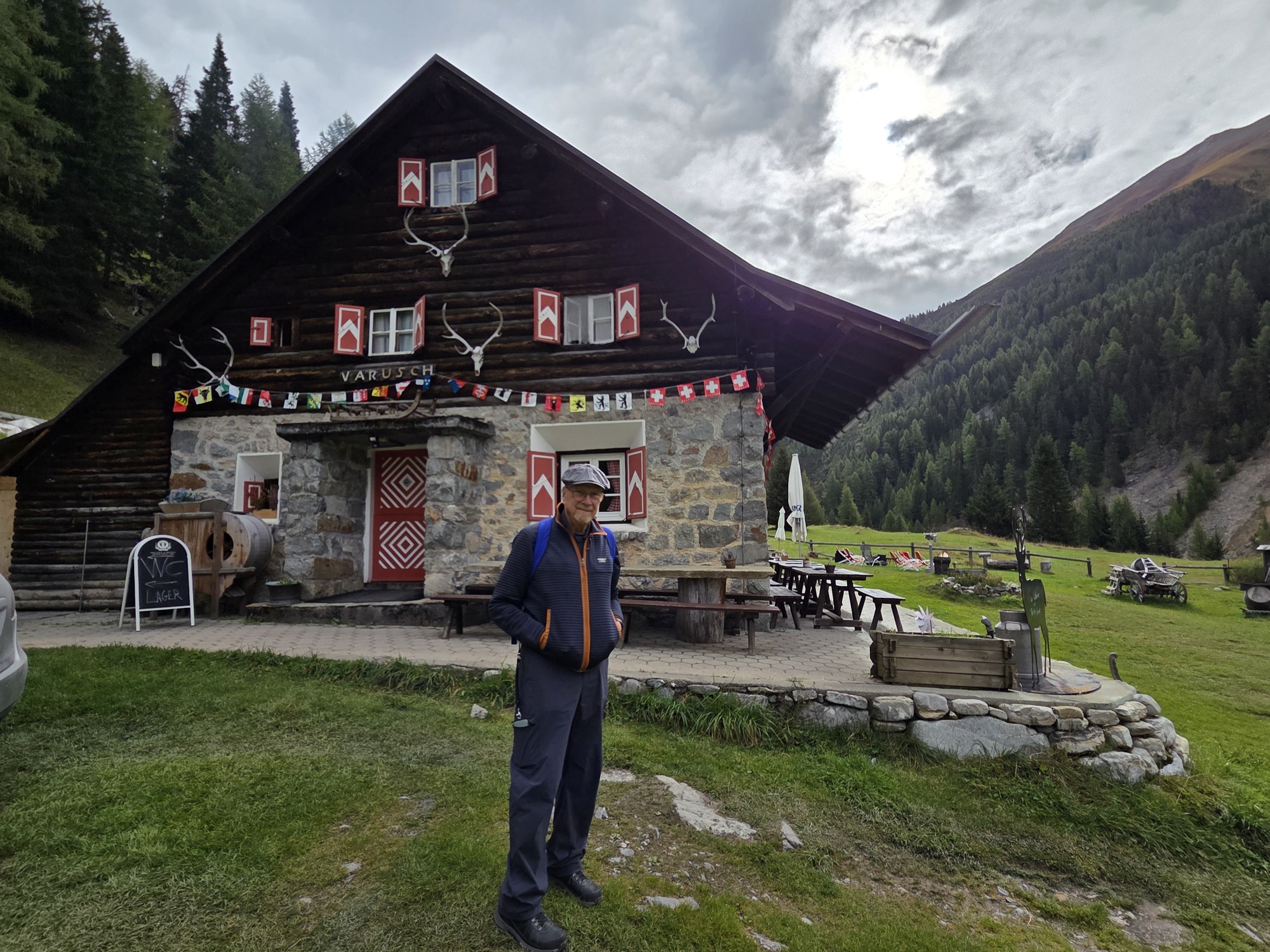
A freshly made cappuccino in a ceramic cup in the middle of forested mountains, above a rushing river, at 5856 feet above sea level. What’s not to love?
Today is our third full day of a 6-week trip. First stop, Samedan, Switzerland, which will have many of you powering up Google Maps to figure out where-in-Hell are they now?
Jet lag is still present, but the fog is clearing by the day. Flatlander legs (Forest Grove is at 210 feet and flat as a crepe) are adjusting to hills and sea level lungs are slowly adapting to mile-plus-high altitude. We are sleeping at 5650 feet!
But first an aside: you are likely wondering where I have been since my April 27 post about a trip we were about to take. For reasons I will not go into, that trip never happened. Rest assured, all is well at Casa Barton. Last spring’s trip will be a 2026 event.
Our trips largely consist of meals strung together by long walks. We call them “Paths to Lunch.” Today it was a path to cappuccino with a lunch at trail’s end. Try to do that in the United States.
The hike yesterday, Day 2, was near the Swiss National Park or Parc Naziunal Svizzer in the local dialect of Rhaeto-Romansh. We are in the Engadine region of the Canton of Graubünden in the southeast part of the country. St. Moritz may ring a bell, the glitzy resort town known as the birthplace of alpine tourism and featured in some James Bond films as well as many others. Engadine or Engadin means “Valley of the En” and the “En” river is perhaps better known outside the region as the “Inn,” the very one that runs through Innsbruck, Austria.
This is not high season and Samedan is not a major tourist destination at least outside of ski season, so we are finding it peaceful and uncrowded. Mostly Swiss traveling about. Previously we spent 2 weeks in nearby Pontresina, which we enjoyed very much, but Pontresina is a hot bed of tourism versus Samedan. This is a more local experience.
Our modest day 2 hike was started at the last bus stop whose route took us through tiny villages, past grazing sheep and cows, and into dense forest. There were no personal vehicles allowed past this point. To get to the National Park you traverse the area on foot at this location. Or take the “tourist shuttle.” We hoofed it through the forest above the rushing Ova da Varusch to the aptly named Parkhütte Varusch. Here we indulged in a late morning perfect cappuccino at the midway point of our 90-minute hike. Sheer bliss. We encountered very few people with our early start (on the trail by 9:15) and were the first customers at the hütte. The hike requires no special equipment save sturdy shoes as the first half of the trail has plenty of roots and rocks and wet places. The forest is pristine; there are no sounds of traffic unless a plane flies over. We didn’t even hear anyone talking. Just the rushing river which must be a sight to see during spring melt.
Laurel above the river in the forest; A perspective on the river with the easy-hiker road below; The easy road back; Ric at the coffee stop; The Tourist Shuttle.
Thus refreshed, we took the ultimate easy-hiker route down a road that the shuttle runs on. Many cyclists were using it to go up the valley and a fair number of walkers chose the groomed route as well.
Arriving back at the start, the 11:08 bus had left 5 minutes prior and the next one was not until 12:15. Time for an early lunch break! Does it get any better than a path to cappuccino and lunch?
Today, we hiked to a fabulous glacier view at Morteratsch. This was at >6300 feet. Color us tired!
It has been quiet on the Girovaga front for many weeks. I see I last posted in February to announce the 2025 editions of our books. Recently I was asked if there was a problem with the blog since a friend hadn’t seen anything lately, so I guess it is time to shake off the dust and revive this thing.
The daffodils have faded and all that remains are the green stems feeding the bulbs for their off-season dormancy and tulips came and went too quickly but in oh-so-stunning display! Flowering trees are giving way to leafy canopies while drifts of pink and white petals color the streets too briefly. The azaleas are gaudily brilliant with rhododendrons coming on strong. Vineyards are in bud, tomato plants cautiously set out, and from gardeners-to-farmers-to-vignerons, fingers are crossed against a late-season frost.
Sleeping with the window open in this rare time when we need neither furnace nor A/C is a treat. Molly and Sven certainly think so. The other night I heard three large flocks of geese passing in the wee hours. Life goes on.
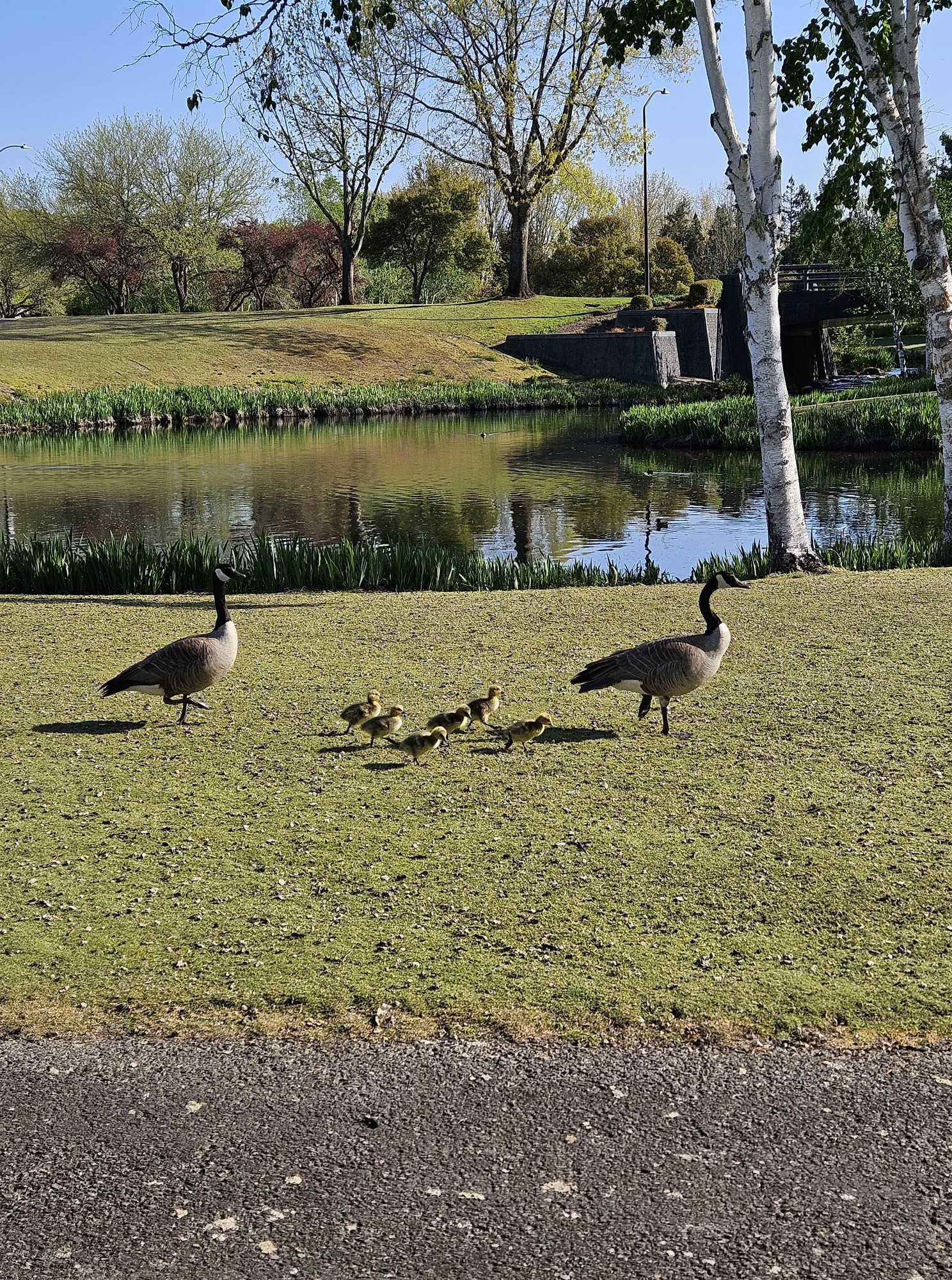
It is mid-spring in the Willamette Valley and the surest sign to me that summer approaches is the appearance of baby waterfowl. We spotted the first ducklings last Monday (could they even have been 24 hours old?) at Fernhill Wetlands and at least three families of geese delighted our walk on Wednesday at Dawson Creek. Makes me smile every time and we take photos of them paddling after dad with mom as rear guard.
Family parade, Dawson CreekDad doesn’t like Ric taking a picture so closeFuzzy GoslingsDucking no bigger than a lily pad
As to travel, May will find us wandering in Yorkshire and Ireland. You may recall, if you’ve been reading along for some time, that we planned to go to Ireland in 2023 but mid-trip we took a detour (See Why we are in Switzerland and not Ireland). This year we are resurrecting that itinerary with a week in Yorkshire as a pre-amble with a plan to do with some coastal and countryside walking. We’ll meet my brother and SIL in Dublin for a two-week road-trip mid-month.
We hope you’ll follow along the next three weeks and see what we can find to entertain ourselves. Perhaps there will be goslings and ducklings and surely lambs!
Getting home from a trip there’s a lot to do in a jet-lagged state: unpacking, laundry, restocking the pantry and refrigerator, doing the delayed fall garden chores, convincing the cats we still love them.
But the real work starts once jet lag passes: organizing photos and updating our books. This takes hours and hours to ensure the accuracy of every recommended URL, the schedules for buses and lifts, the most recent transportation pass offers, and to write up new hikes and changes to prior recommendations. Ah, retirement! But this is a job.
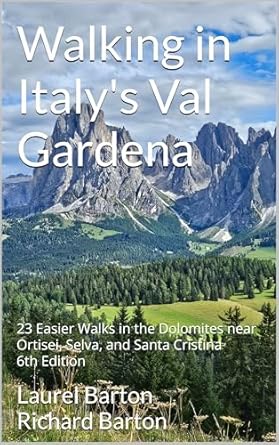
January 1 we published the 4th edition of “Walking in Switzerland’ Berner Oberland” and January 18, “Walking in Italy’s Val Gardena” came out in its 6th iteration.
For those dreaming about these locations, we offer inspiration to plan the trip with logistics seldom found concisely presented online. From transportation to trailheads, each walk or hike is described clearly so you can be certain every hike is within your ability.
Here’s a description of each book and a link to purchase in the US. For other markets, consult your respective Amazon site.
There are many hiking guides to Italy’s Dolomites featuring long treks of 4-6 hours, as well as multi-day ventures and the famous via ferrata. What makes this one so special? This is a guide to easier options for walking in Italy’s breathtaking Val Gardena! Seniors, people with children, and anyone who wants to experience the mountains but not climb them will benefit from the 23 walks that are carefully described.
We guide the hiker through the breathtaking scenery using itineraries suitable for anyone who likes to walk, likes to be in nature, and who enjoys Italy, but may not have the stamina for longer, more strenuous hikes.
This unique guide includes 23 walks in-and-near the Val Gardena towns of Ortisei, Selva, and Santa Cristina, as well information on when to visit, how to get around without a car, and sample itineraries to help you plan your stay of 3, 5, 7 or more nights. Of special interest will be the easy hikes in the amazing Alpe di Siusi.
Included are maps, directions to the trailheads, walking time and distance, where to eat along the trail, beautiful photographs, and details on how to use the system of mountain lifts and buses to access the high meadows and breathtaking Dolomite views. You will discover delightful rifugi, mountain restaurants offering shelter and great food making each walk a special expedition. In addition, every walk is accessible by public transportation!
The authors travel to Ortisei frequently exploring this mountain paradise discovering and documenting the walks to share with you so you can be certain every hike is within your ability.
Switzerland’s Berner Oberland is a hiker’s paradise, whether you like easy paths or dream of attempting the Via Ferrata. This book will guide you through breathtaking scenery using itineraries suitable for anyone who likes to walk, likes to be in nature, but may not have the stamina for longer, more strenuous hikes. Seniors, people with children, and anyone who wants to experience the mountains but not climb them will benefit from the 21 walks that are carefully described. Also included are instructions on local transportation, sample itineraries to help you plan your stay of 3, 5, 7 or more nights, and suggestions for other excursions as well as rainy-day ideas.
The authors travel to Switzerland frequently exploring this mountain paradise completely via public transportation, discovering and documenting the walks. Even non-walkers will revel in the scenery as they ride mountain trains and enclosed gondola cars to amazing vistas.
What do I do after a European trip and after the book updates are published? Plan the next trip! Most likely with a cat or two in my lap.
Every trip has a name or a theme. We have had the “Mountains, Lakes and Sea” trip of 2018 (See the trip plan Mountaintop to Sea Level ), “The Grand Tour” of 2017 (See Tourists Again), and the “We’re Back” trip of 2021 after missing 2020 due to a worldwide plague, to name a few. (See Hey Europe! We’re Back!.)
This year, in my mind, the theme was “Return to Roma” as it has been 8 years since we moved from Rome back to the US.
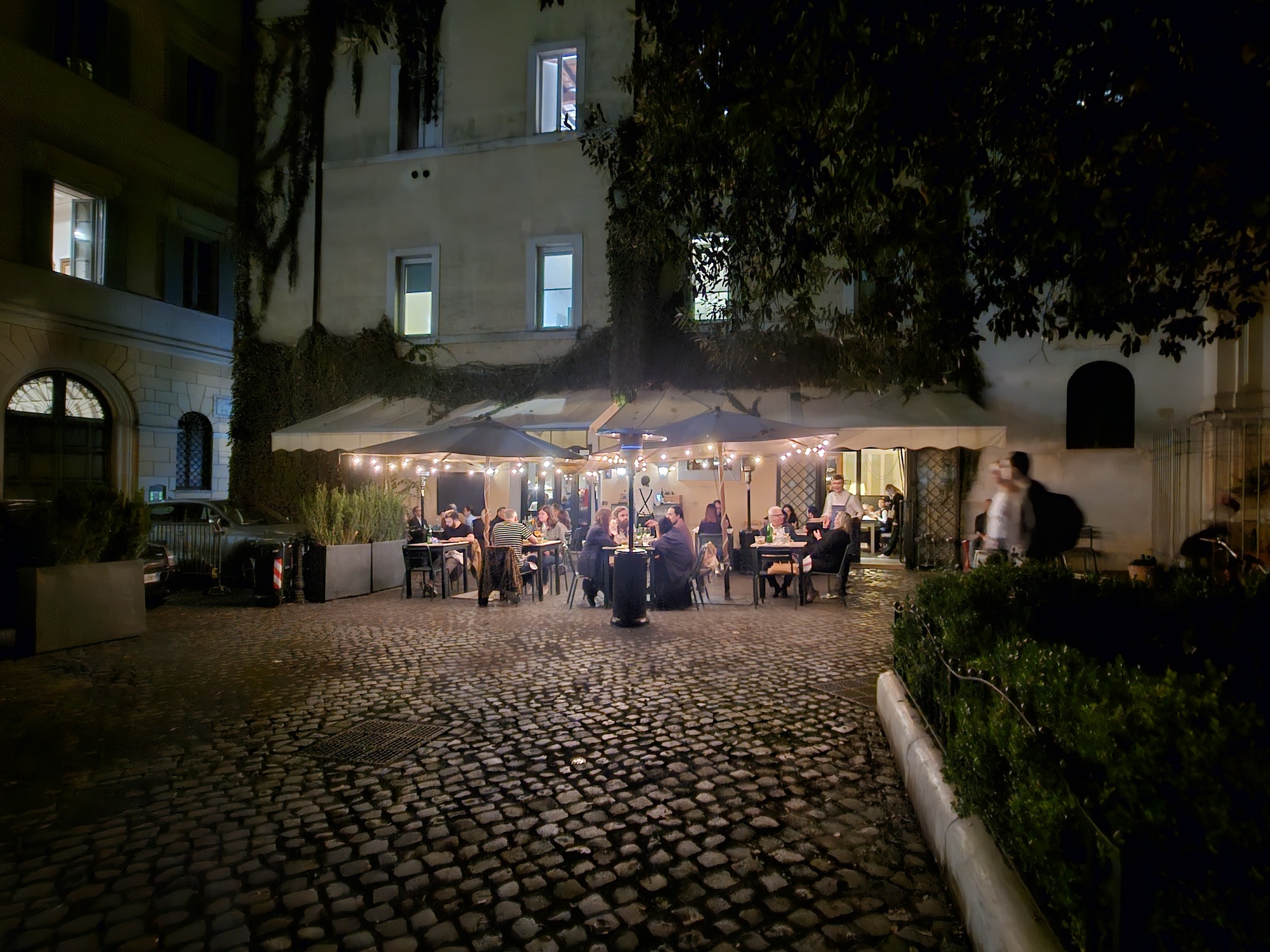
Scenery walking back after dinner is one of the delights of Roma. A 2-mile walk goes by quickly.
We loved our time this trip in the usual locations of Ortisei and Lauterbrunnen, and enjoyed the Italianness of Locarno even though it is in Switzerland. Wrapping up our eight weeks with a gastronomic tour of Rome, the subtitle might be “A Reacquaintance Tour: Eating our way through Rome.”
We often talked about missing Roman restaurants: Our neighborhood favorite, Taverna Rossini, the best pizza places we found and wrote about for our blog Our Weekly Pizza, the fish place we traveled an hour to-and-from it was so good, the authentic Sicilian food. These neighborhoods, walking routes, coffee bars, restaurants, and pizzerias called to us. It was time to return and eat our way through town while revisiting old haunts.
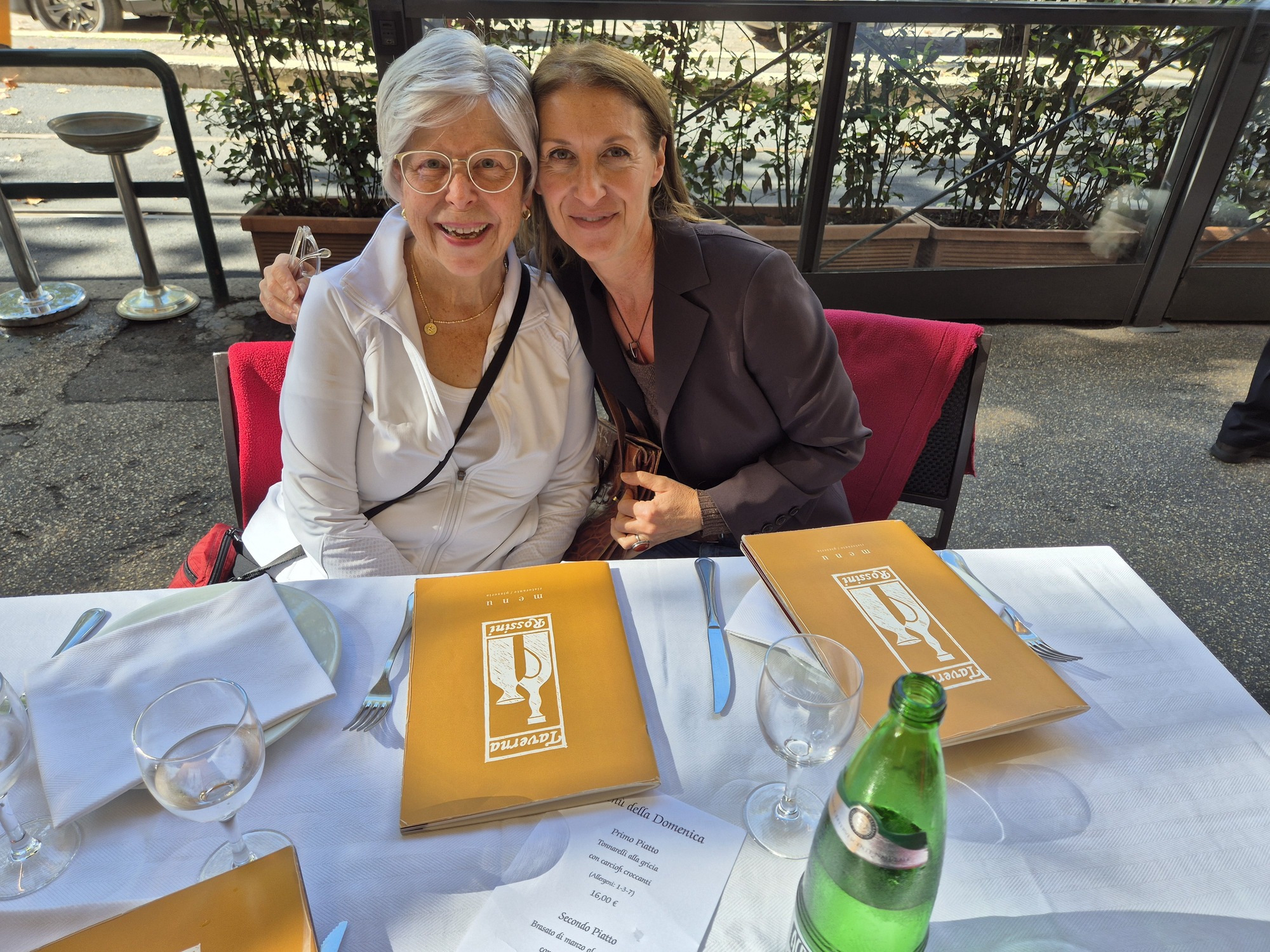
Lunch at Rossini with our friend Eleonora.Rossini: still a fabulous ristorante.
We had not been in town for 30 minutes when my love/hate feelings welled up. This crazy town continues to perplex and amaze. A fabulous double espresso in 30 seconds for €2.00! A taxi across town for €15! Ancient sites harboring a cat sanctuary and a wealth of art-free-for-the-viewing in vast basilicas and churches. People who weave back and forth on sidewalks and narrow streets. Tour groups coming at you like a tidal wave. The buses still ghost you and are uncomfortable at best, but the taxi drivers were, to a person, polite, efficient, and helpful. What’s up with that, Rome?
My hips and back took a beating on the sampietrini (aka cobblestones). Ric and I remembered we really liked to hold hands when walking in Rome and not only from affection but to keep each other stable and upright.
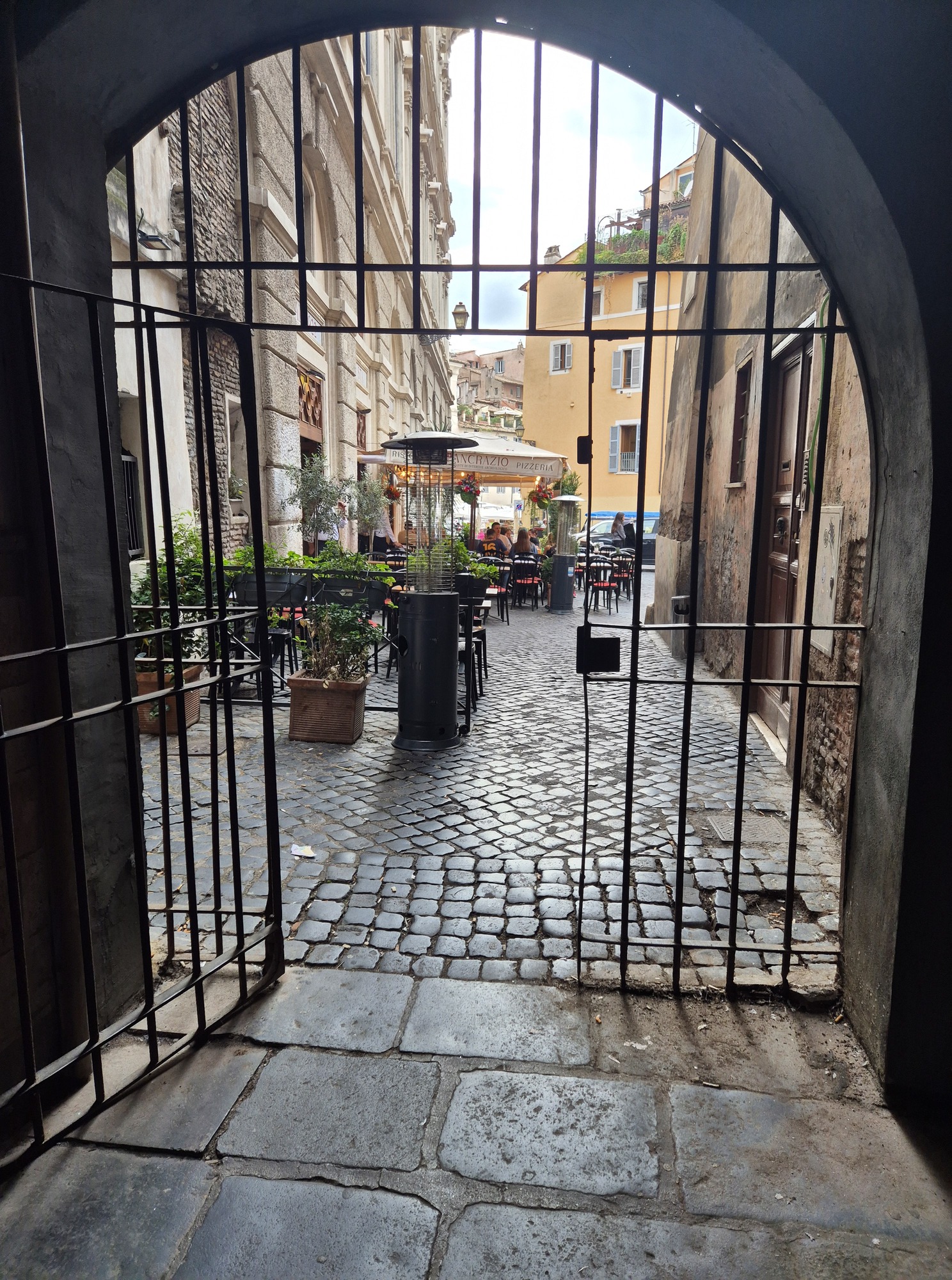
A scorciatoia (shortcut) through the maze in the historic center.
The old routes came back to us easily enough. The way through Villa Borghese we walked to-and-from work; the route we took from home to Piazza del Popolo to Campo de’ Fiori to go shopping every Saturday. Some of the vendors we used to buy from are still in the same stalls.
We dined at a couple of favorite pizzerias, La Pratolina and Da Remo. Still great: in fact they seem untouched by the intervening years. Even some of the servers are the same people we remember.
Our old standby, Antica Taverna, was not as good as we remember but it has suffered a change of ownership. It was nostalgic to sit there, on an obscure vicolo, and reminisce about our many dinners there including a Christmas Eve before I was blogging, Thanksgiving of 2012, and New Years of 2014. We ate there about once a month for over four years. Taverna Rossini, the neighborhood joint where we took all of our guests, was still so good we went there twice this trip!
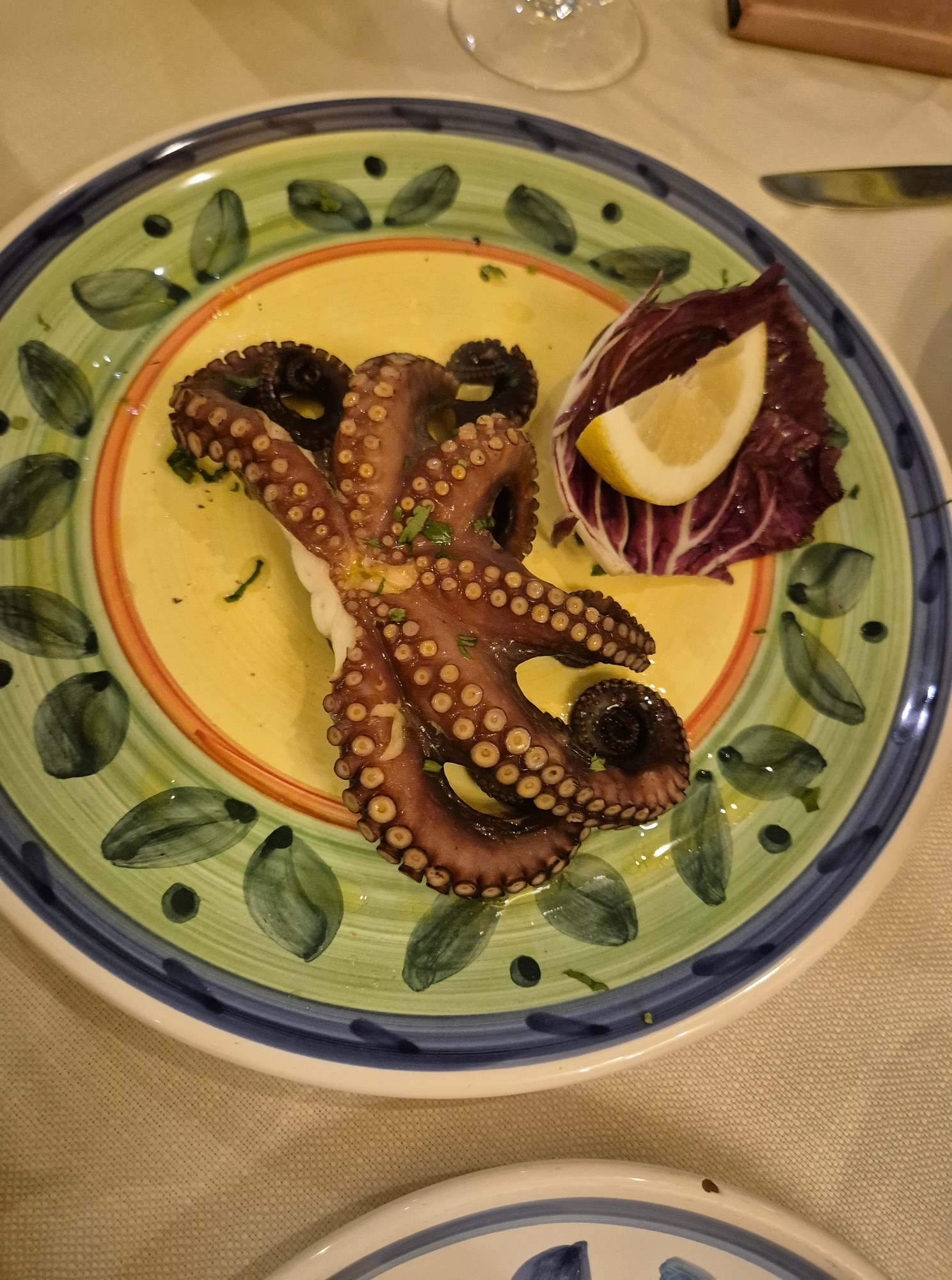
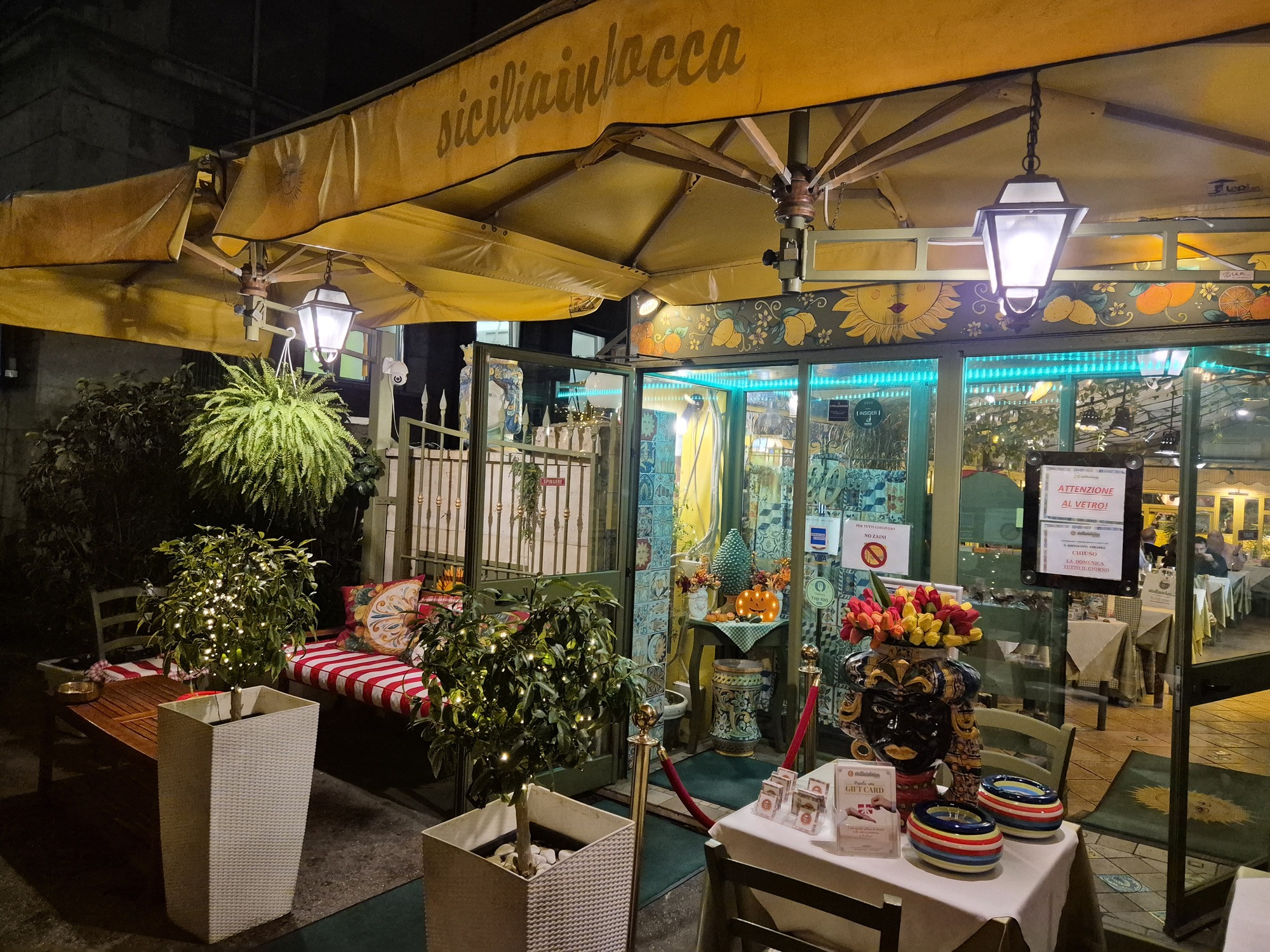
Finding good Sicilian food outside of Sicily is a challenge, but Siciliainbocca did not disappoint. We happened by on a Tuesday, which was couscous night. Couscous ala Pesce is my favorite memory of Sicilian food, and it was memorable. No wonder Elon Musk dines here! (The cabbie told us about Elon’s visit, but we went there anyway.) Donna Fugata wine, an octopus appetizer, grilled calamari for Ric. We left happy and walked back the 2 miles to our hotel as penance for all we consumed.
Polpo a favorite!Siciliainboca means “Sicily in your mouth” or, more elegantly, flavors of Sicily.Fabulous Couscous alla Pesce.
We found some fun, new places to eat as well. Lunch has always been hard for us in Italy because they like to offer big lunches of pasta and traditional main courses or pizza. We like salads and sandwiches. Two new eateries we recommend, Cabullo (3 locations) and Molly’s Garden, are a welcome change. Molly’s, in particular, appeals as they know what they are doing with eggs, and they make a delicious wrap. Osteria La Quercia was so good I forgot to take food photos. They only use fresh ingredients guaranteed by small breeders and farmers, organic companies, and seafood from the Lazio coast. (Click on any photo for a better view.)
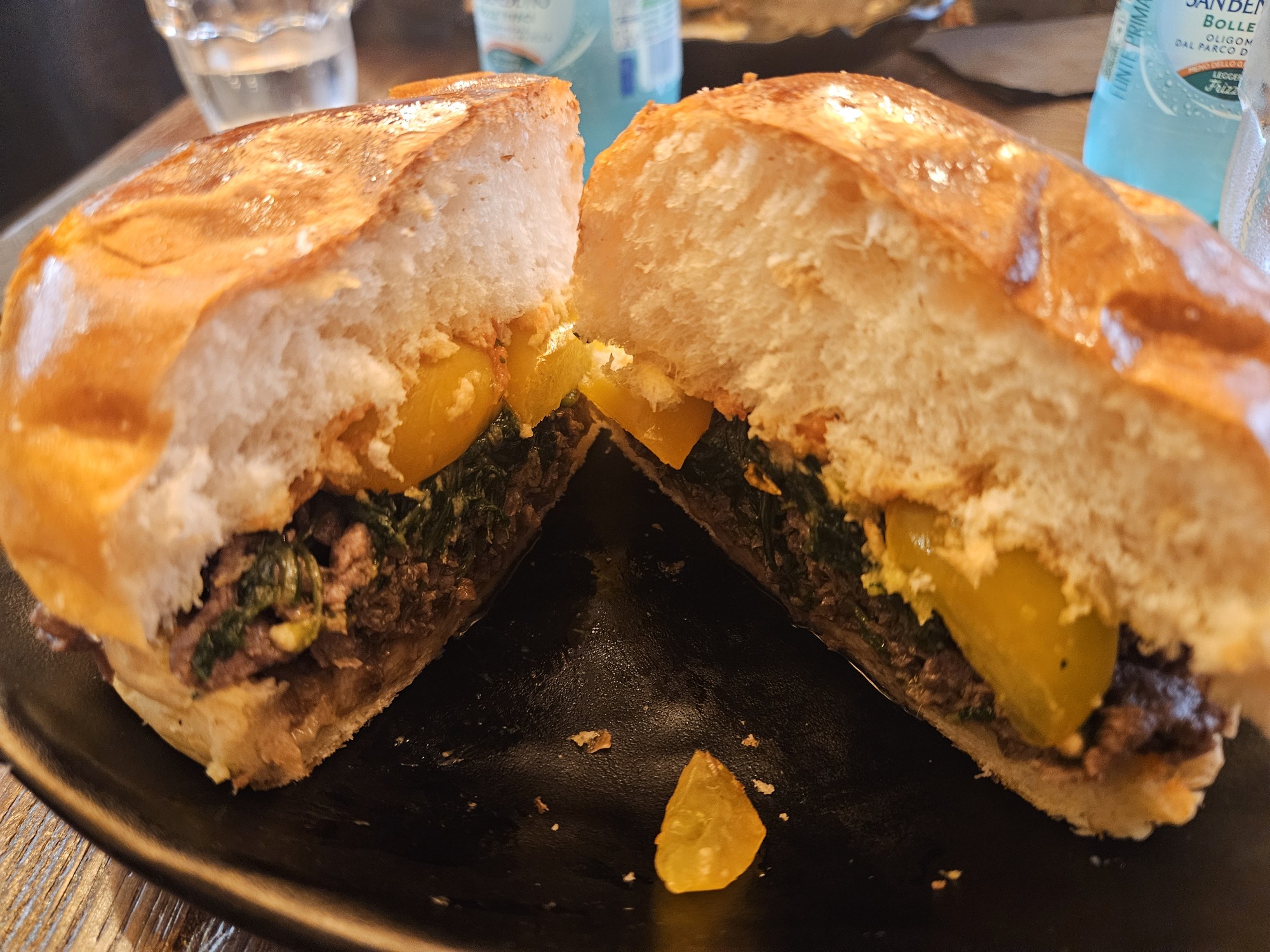
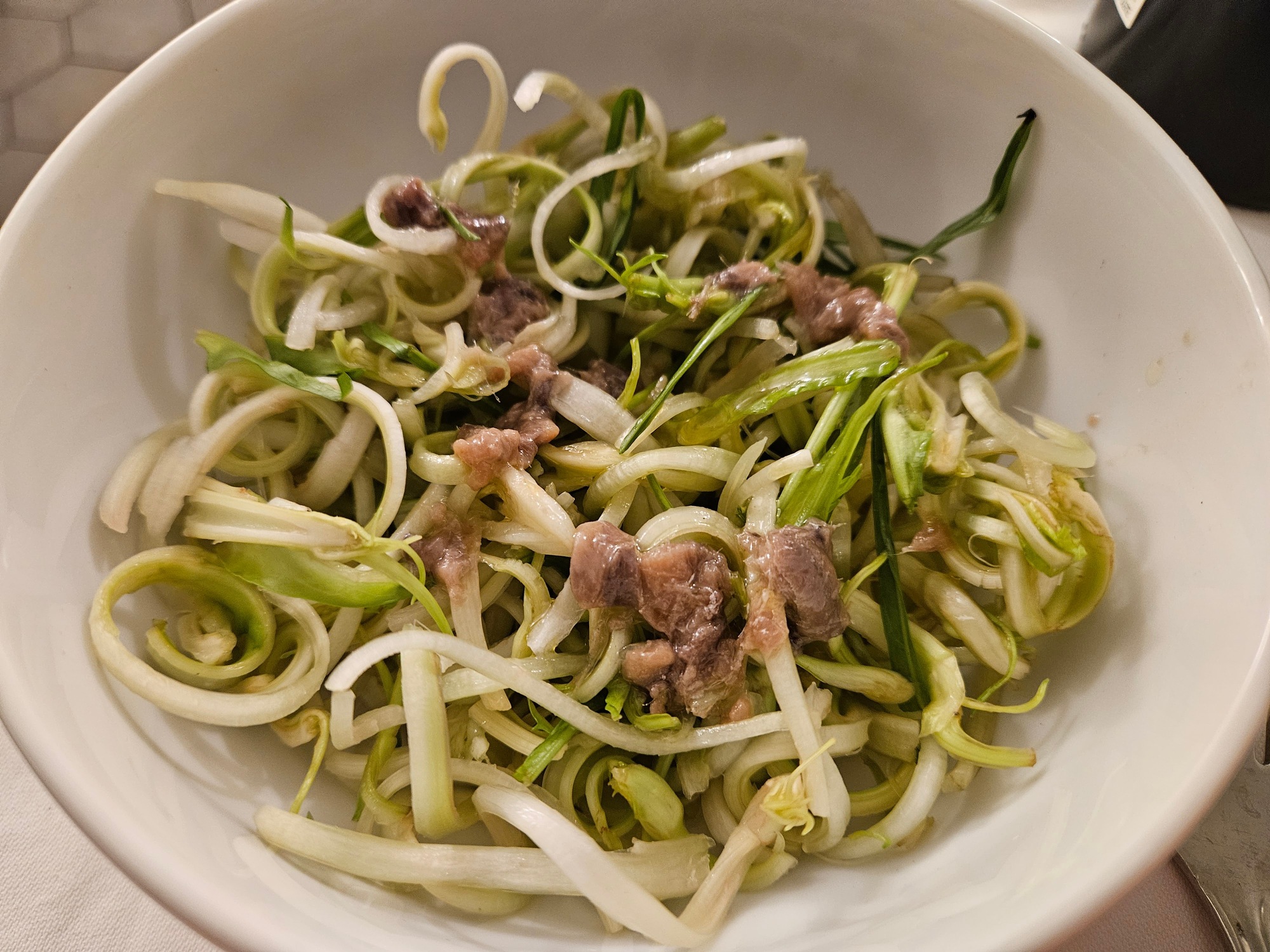
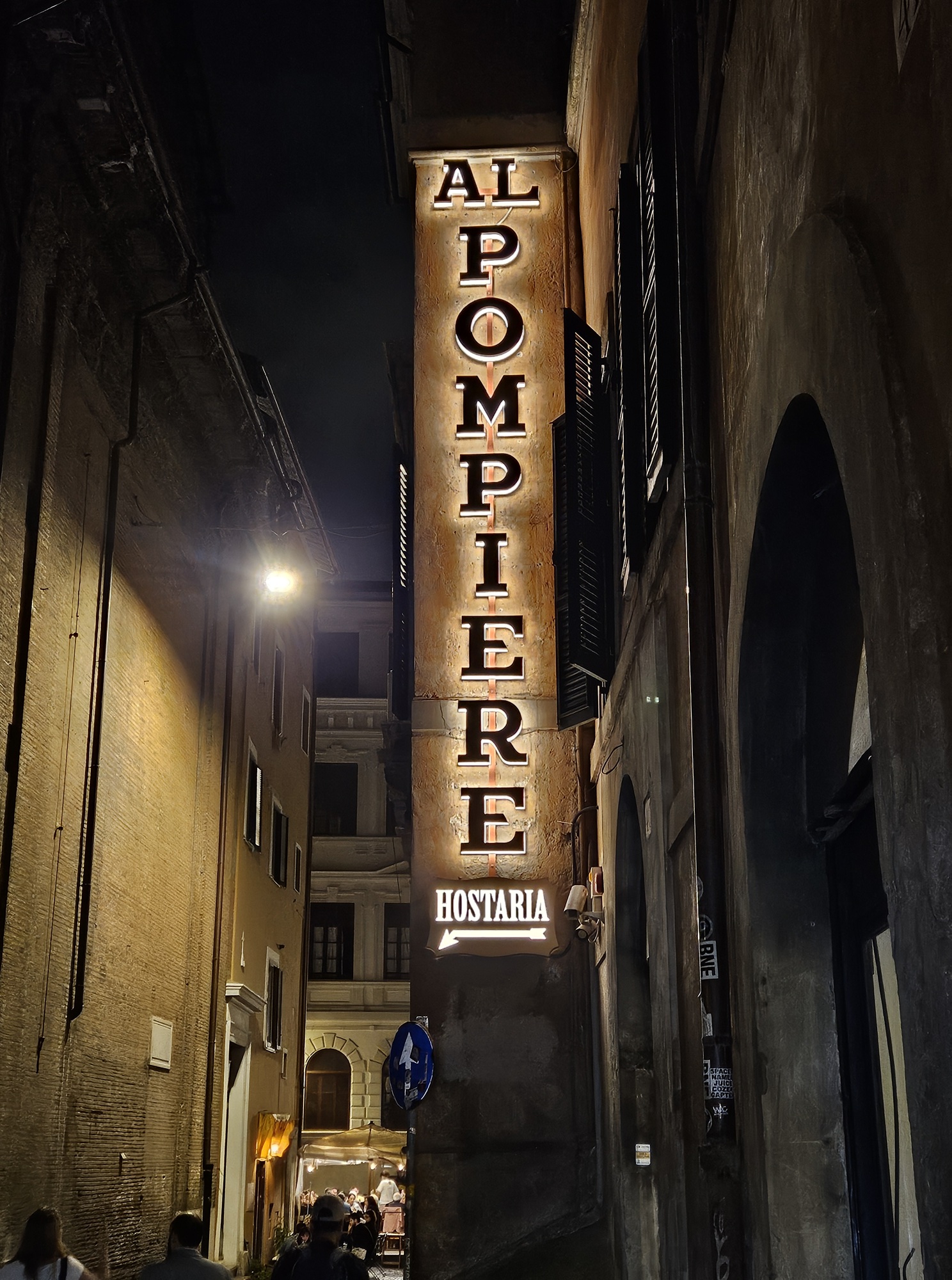
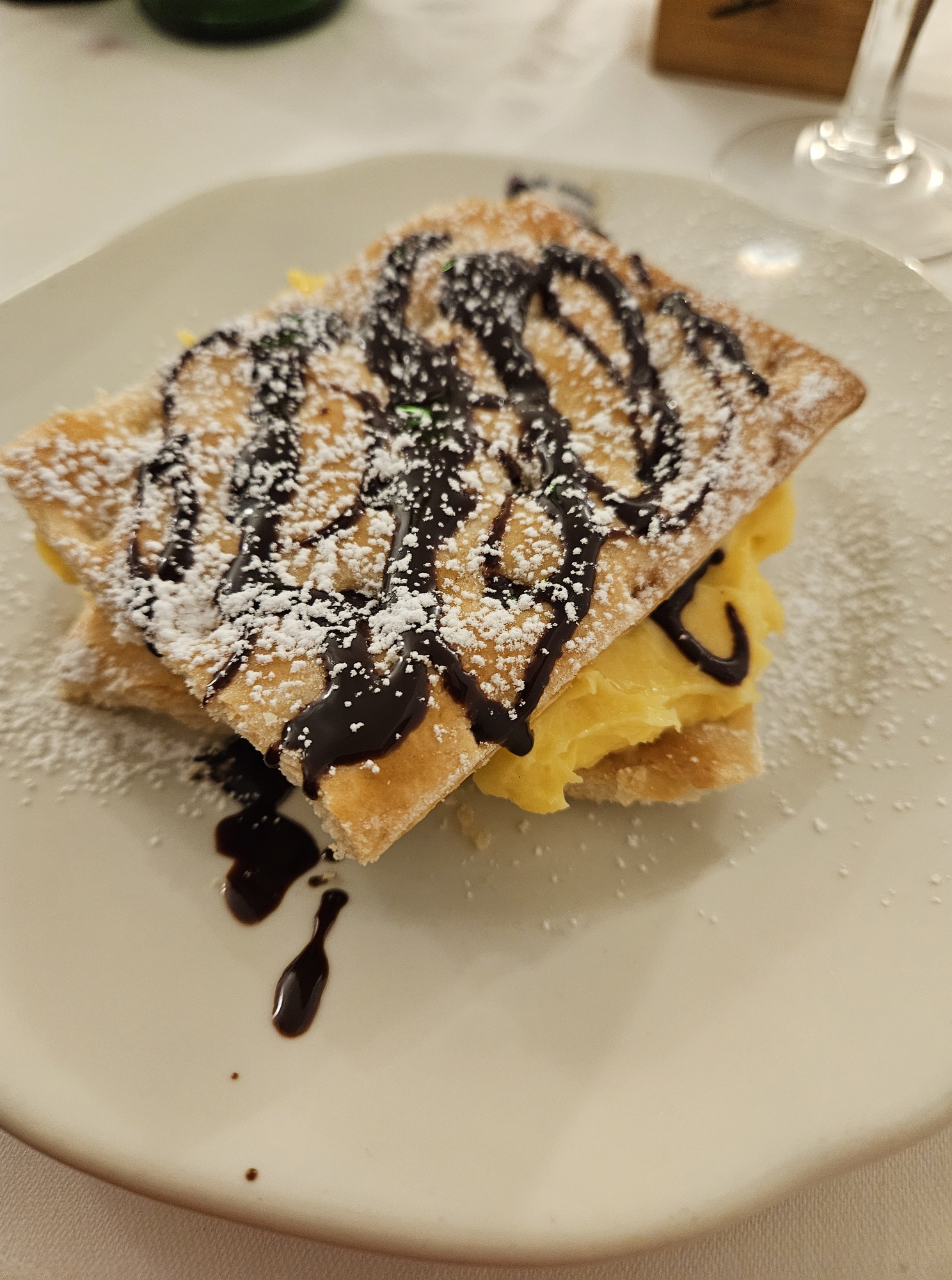
Cabullo’s counter. Everything made fresh in house.Cabullo sandwich with marinated beef, cicoria,and peppers on a house made bun.Molly’s philosophy.Turkey wrap at Molly’s.Molly’s interior: the bar.Puntarelle, a favorite and only available seasonally. Near Largo Argentina, but in a quiet piazza, where food is respected and traditions adhered to. At Al Pompiere, millefoglie. Osteria La Quercia, a stone’s throw from Campo de’ Fiori but a world apart.
Our final dinner of the trip was at Al Pompiere, well known yet for all the years we lived in Rome we had not visited. It was our loss! Family owned and operated, the padrone waited on us in the tradition of old hosterie (osterias). Classic Roman food: puntarelle (a salad of chicory sprouts with anchovy vinaigrette), carciofi alla giudia (fried artichokes), fiori di zucca (fried zucchini flowers stuffed with cheese and anchovy, battered, and fried) and much much more.
Without fail, everywhere we dined at night we were glad we had reserved. Any place decent and not too touristy was full and tables do not turn like they do in the US.
We found our way to a leather shop we used to patronize in Trastevere. There are leather shops all over the historical center, and some of their products might actually be made in Italy, but Ciufetti is the real deal. We arrived at opening and told the owner we used to come here many years ago. He told me it has been in business since 1955, the year he was born. He and his wife now run it and are open 7 days a week! He loves it! They make all of their leather products in house and sometimes, when tourists discover them, they literally get their stock cleaned out because people recognize the value and the quality at a fraction of the prices in the tourist shops.
Signor Ciufetti at work in his shop.In Trastevere, easy to miss if you aren’t looking for it.
The city is getting ready for a Papal Jubilee year in 2025 and as a result there is construction and restoration everywhere. All the tram lines are down. The Metro Line C is still not complete and screened fencing blocks vast sections of the historic center limiting views. There is scaffolding everywhere and it seemed like every fountain was dry and being repaired. If this was my first visit to Rome I might be annoyed at how much is blocked but we saw it as a reminder that Rome has been changing for millennia and will continue to do so.
Screening hides much of the area around the Forum as they try to get Metro Line C completed.
I planned to get transit passes for the week we are here, but they proved remarkably hard to find. Luckily, we did not invest because the buses have been impossible and after two buses did not materialize (ghosted) twice in our first afternoon, we had to find a taxi to take us back. At that point we decided to go a piedi (on foot) or take taxis. Period.
Speaking of feet, in Rome we far exceeded the mileage we had in Richmond early in the trip (see 61000 Steps). In 8 days in Rome, we walked over 56 miles and I had almost 162,000 steps on my pedometer, an average of >20,000 per day. it helps when you can’t get a bus. (Trip total on the pedometer was a respectable 950,000.)
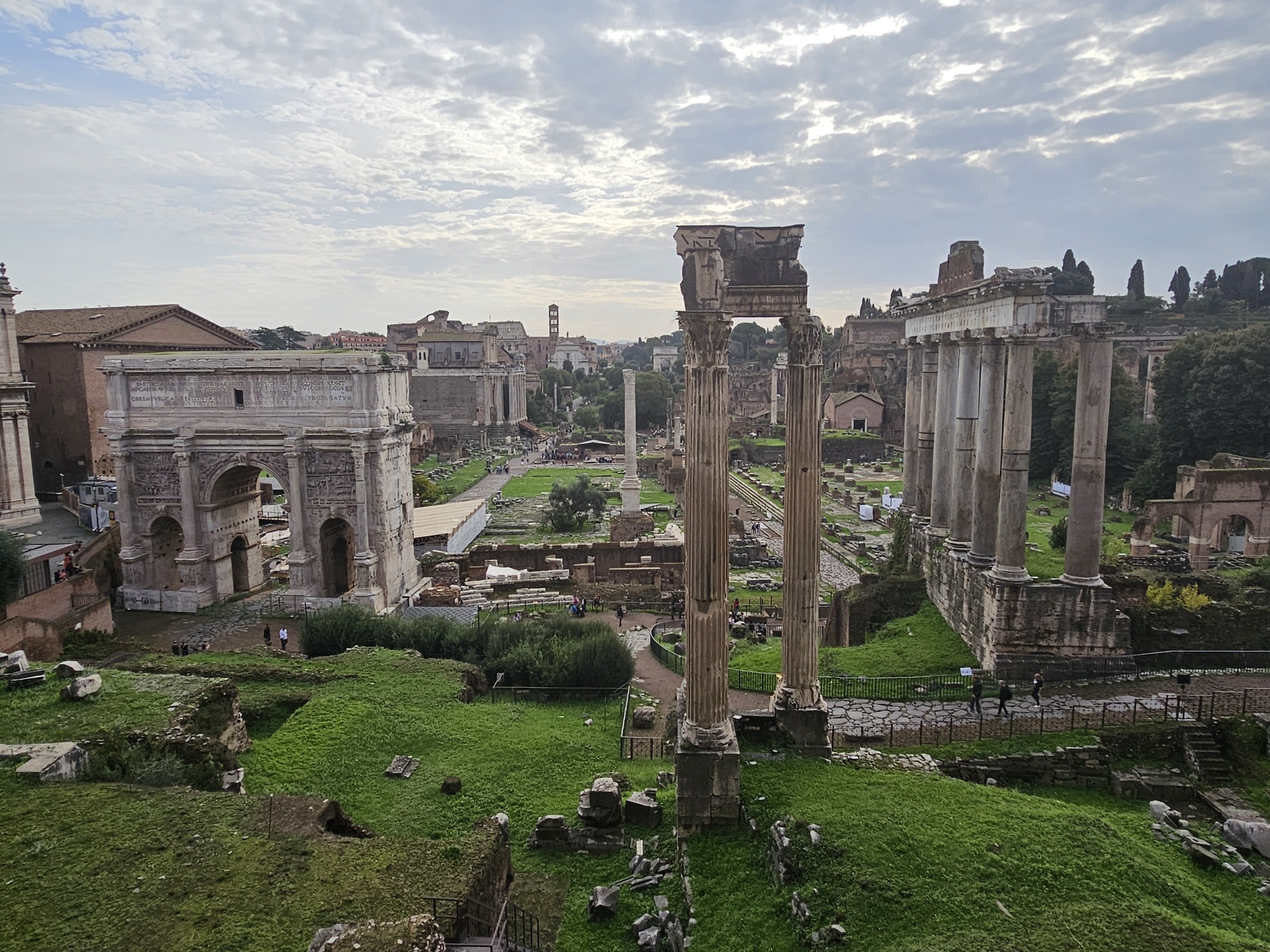
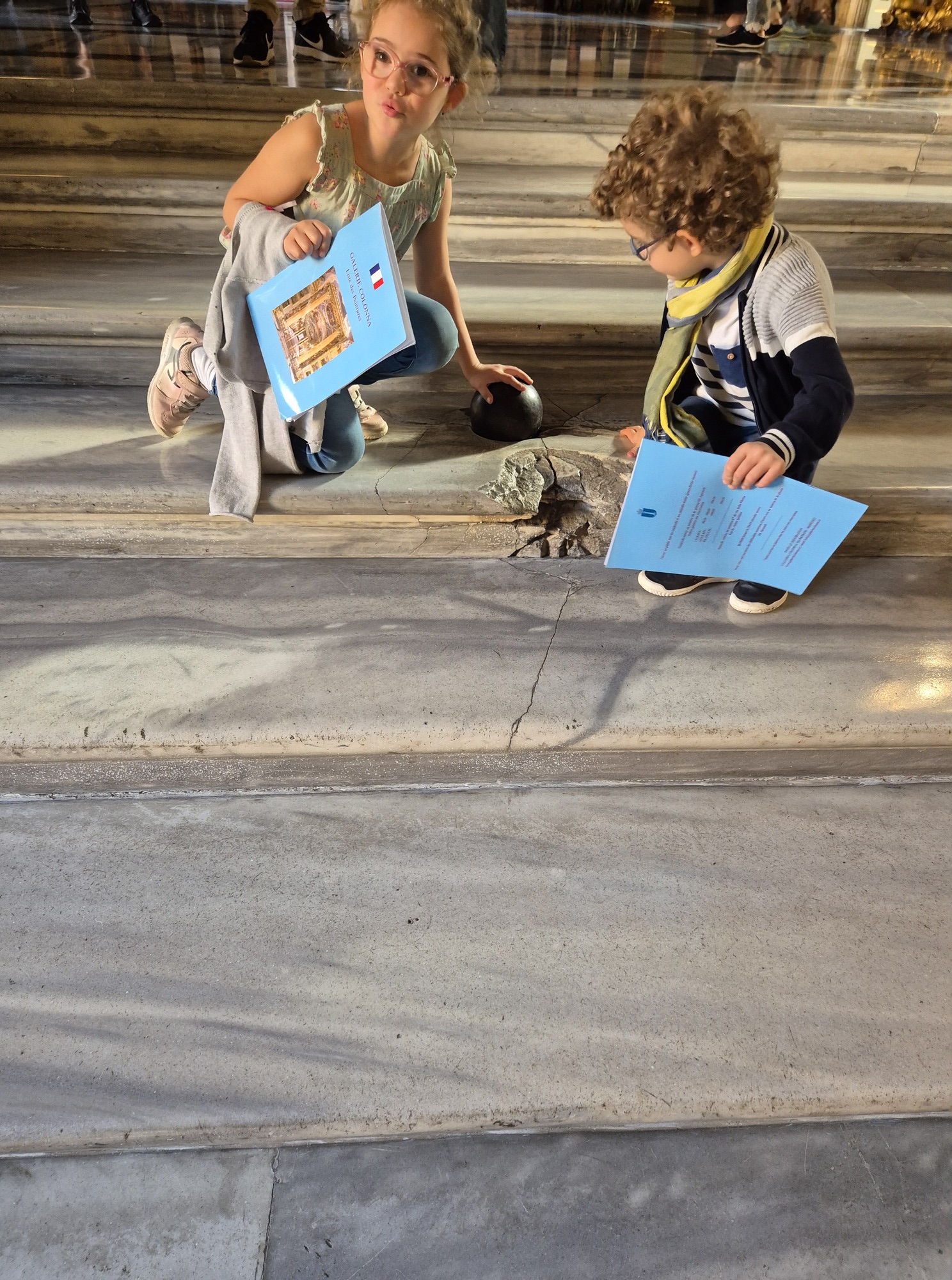
“Bigfoot” one of the remaining chunks of a statue of Constantine, Capitoline Museum. Gorgeous Forum view from the Capitoline Museum. We had the place to ourselves.Cats in Largo ArgentinaExamining a cannon ball and it’s damage in Palazzo Colonna.A very small portion of the gardens at Palazzo Colonna.Forma Urbis
I should author a book called “Rome the Umpteenth Time” highlighting the places we visited that were new-to-us. Rome may seem static, but she is always undergoing change.
We had, remarkably, never been to the Capitoline Museums. Underappreciated, vast, uncrowded, with amazing statuary and Renaissance art plus a drop-dead perfect view over the Roman Forum. We passed a quiet hour with few other patrons around and no massive tour groups.
Palazzo Braschi, Museo di Roma, offers insight into how Rome has changed over the millennia, and startlingly over the past 100 years. We had visited once in 2012, but seeing these exhibits again made me realize my annoyance at the current state of pre-Jubilee clean up is a mere hiccup in this city’s progress. It would be nice if they were not renovating all the fountains at the same time.
Largo Argentina, long known as a cat sanctuary, opened the sacred area in the past few years enabling one to descend to the area where the Roman senators murdered Julius Caesar. (You cannot walk in that site but still impressive!) And the cats are there too. Bonus.
Forma Urbis, a new museum housing the surviving fragments of a stunning marble map of Rome carved early in the 3rd Century. An 18th Century grand map overlays the fragments showing the relationship to more modern locations. Hard to understand until you see it and the lights go on. A remarkable display.
Galleria Colonna was another repeat. We were there in 2013, as I wrote about in the blog Rain in Rome. This time, we had dry, lovely fall weather and were able to tour the fabulous gardens which are not open when it’s wet. The gardens alone were worth the price of admission. The Princess Isabella Apartments are an extra-cost add on that we popped for and were also worthwhile. Isabella was from a wealthy Lebanese family and married a Colonna prince. She used these fabulous apartment to entertain her guests. Interesting articles here (in Italian, so use Google Translate to enable your favorite language). Il Filo Rosso Tra Beirut e Roma della principessa Isabelle Helene Sursock and Isabelle Colonna l’ultima regina.
We had a lovely extended stay of 8 nights, with mild weather, great sites old and new, excellent meals at old favorites and two new-to-us restaurants that we were sorry we could not visit multiple times. The mileage on foot helped (we hope!) defray impact of the consumption of fine Roman cuisine.
Holding hands is nice even after 40 years of doing so.
Most of you think we are on vacation, walking familiar trails, snapping pictures of stunning vistas, and sipping an aperol spritz on the deck.
Sure, we do all of that. But this is a working trip. New editions of our two books Walking in Italy’s Val Gardenaand Walking in Switzerland’s Berner Oberland were released in January 2025, requiring us to check routes and supporting facts. We always try to find something new to experience and recommend as well.
We will not recommend any walk we haven’t done ourselves so we end up taking new trails often.
Sometimes a hike or walk we have included in the book no longer meets our standards. There is one in our Val Gardena book that has not been well maintained and no longer has an appeal. It will be replaced by one we have come to love.
In the past week in Switzerland, we’ve tried three supposed easy-hikes and came away with mixed results: Two unsuitable and one we are not sure is quite easy enough.
WALK ONE: Not the ending we expected
We had high hopes of recommending a Giro di Lauterbrunnen (Circuit of Lauterbrunnen) or in German, Lauterbrunnen Rundweg. For years we have noticed a trail partway up the cliff side, traversing cow-infested meadows and crossing tracks for the Wengernalpbahn train. We have walked that path from the south edge of Lauterbrunnen to the middle of the village where we descended on a paved road, but we knew it went farther. Maps enticed us to see if it would be feasible to extend it to the north, descend to the river, and walk back to the village, offering terrific views of the village from one end to the other as well as a good 3 ½ mile walk.
In fact, one CAN do this hike IF one has the footing of a steinbock.
SteinbockorIbexfamily, verysure–footed. Courtesy of IamExpat.
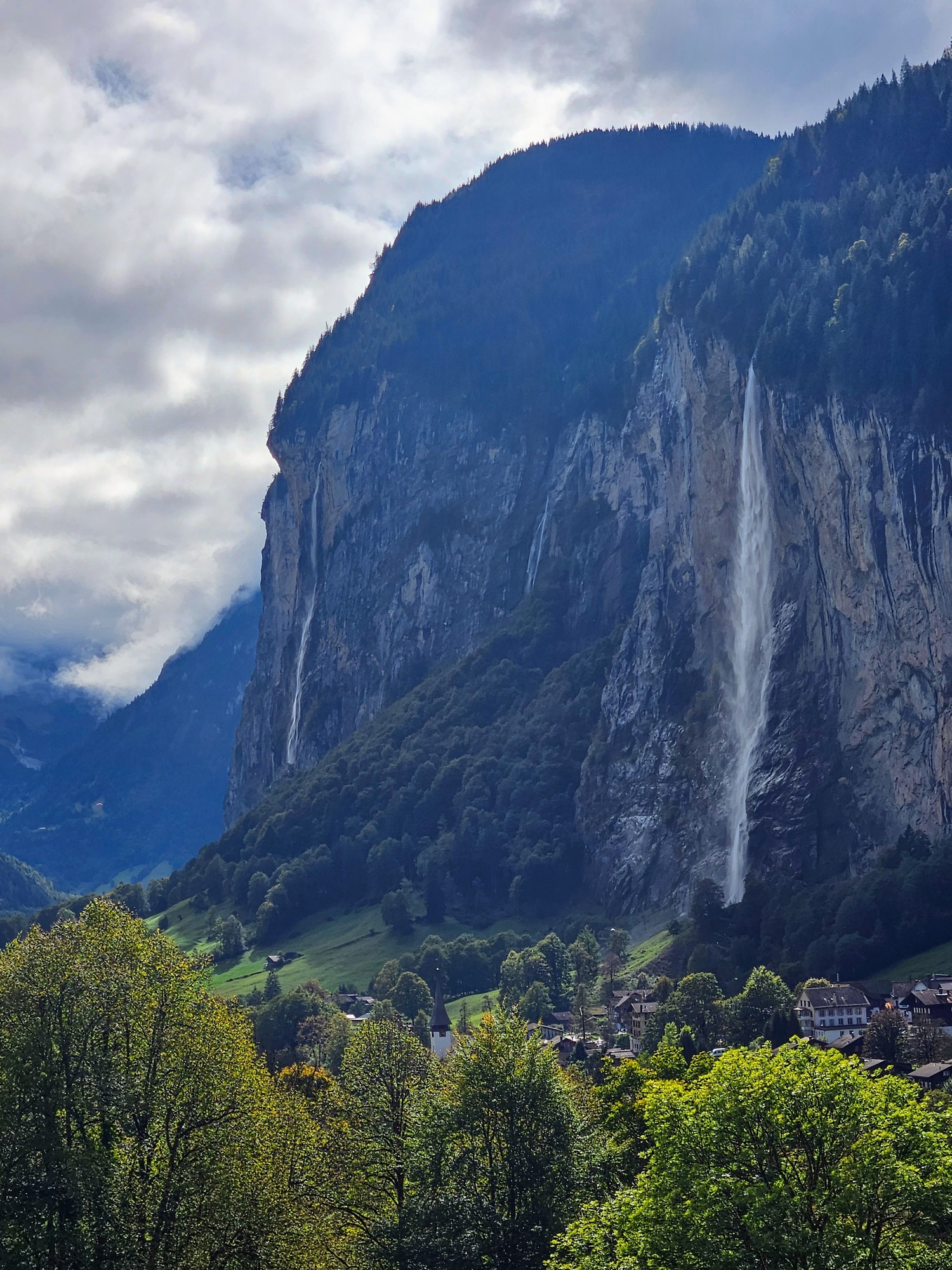
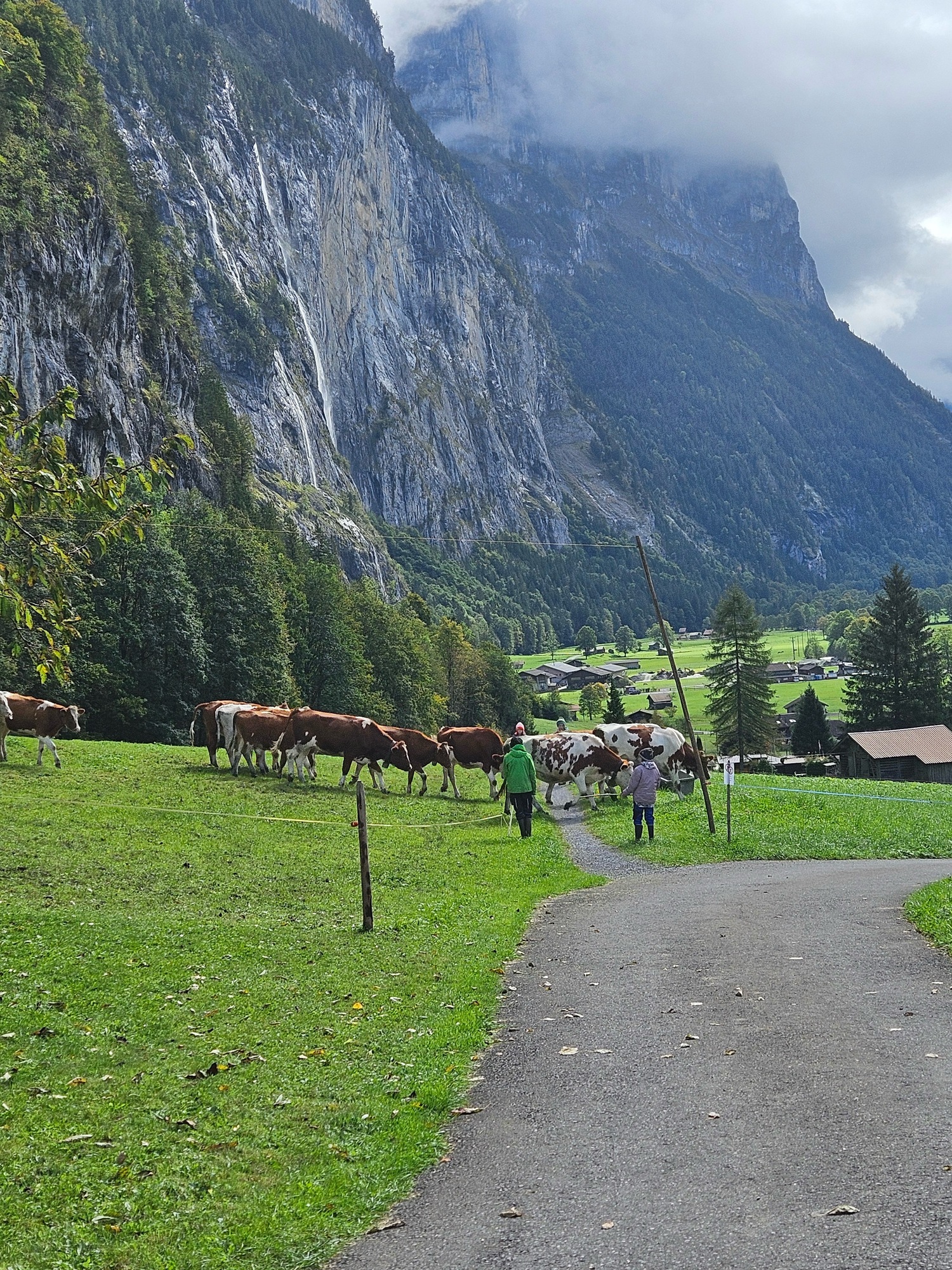
We thoroughly enjoyed the mostly flat walk, witnessing a herd of cows who welcomed their humans who had come to move them to a new pasture; taking pictures of the mountain train; wandering past a settlement of summer cabins and remote farms. The views were as we hoped including the Staubbach Falls, the train station, the Grütschalp cable car, and the entire village at our feet like a model train layout.
Bubbling streamA gentle pathDramatic viewsCows are moved from one pasture to another to do the mowing.View of the cable car across the valley
Then we came to the descent through the forest. Concrete forms designed to keep the farm road stable (to me, difficult to walk on) transitioned to dirt road, then, after a barrier prohibiting vehicles, a steeper, rocky downhill. As we hesitantly started down — using our hiking sticks mind you — Ric suddenly careened, fast-footing in a not-quite-controlled manner, finally stopping himself after about 30 feet by grabbing ahold of a convenient metal pole supporting a trail directional sign. I followed with terrific hesitation and concern for Ric, who much to his credit never lost his feet.
I did not think to snap a photo of the really bad area. these two pictures will give you an idea of our flat trail becoming steeper. On the left, the road starts to descend past a farm and it was fine. On the right, Ric is standing just above the final building on the farm and after that point, we rounded a corner and found a “no vehicles” barrier.
Here’s where it started to get steepRic, about 100 meters above our bail-out
The next bit of trail was even steeper and more treacherous looking. It did not seem safe nor prudent to proceed. A 40-year-old with good knees, strong hips, and no sense of their own mortality would not hesitate to descend, but we have none of those criteria going for us, so we turned back. A broken hip would not enhance our experience. Luckily going back to the paved road into the village was under a mile.
This is a particularly local section of Lauterbrunnen: there just are not tourist lodgings on this road. Although there is one small holiday let, coming from the village the paved road leads to a retirement apartment building, local farms, and then to the route we walked.
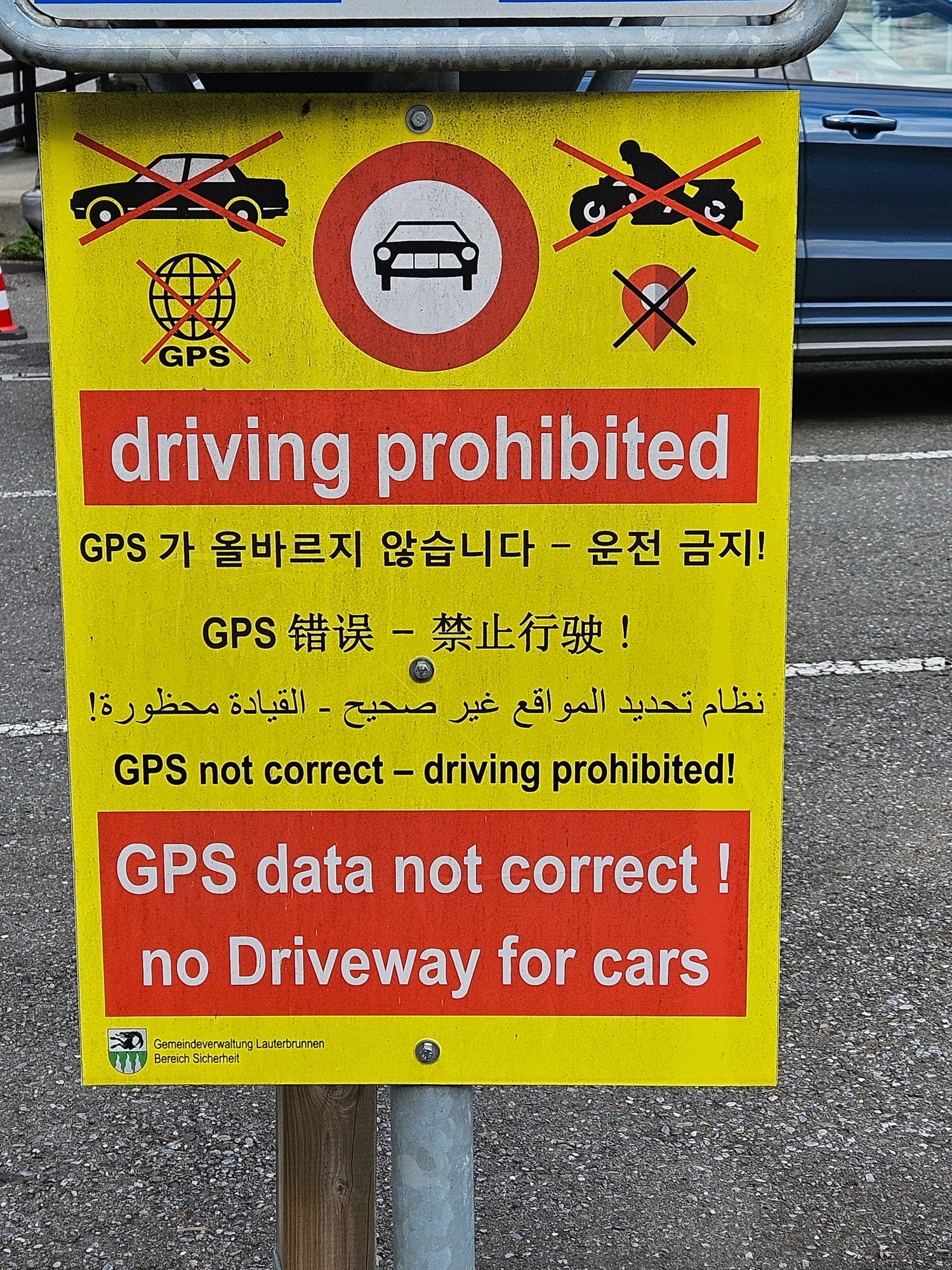
Still, people who have no business driving here in their rental cars insist on touring the roads where they are warned not to drive. How much clearer can it be that this sign is at the entrance to the road? Can you tell it is such a problem they have to post it in multiple languages?
On our descent we saw three cars, one after another, come up and encounter problems. One driver tried to turn around in the patio/driveway of a local who came out and gave him a finger-wagging dressing-down. Immediately behind this confused lad, three guys in a BMW stopped, realized they were blocked, tried to turn into a lane not much wider than a footpath, and banged into a raised sewer cover. Ouch! Hope they had insurance! Hot on their tail was another pair of guys who at least had the good graces to look abashed at having driven into the forbidden area.
Last year some yokel tried to drive up to the car-free town of Wengen and got stuck on the trail. They had to be airlifted out by a helicopter. Can you imagine how excited their car rental agency was?
Our search for a circular walk of Lauterbrunnen did not work out but the ending was quite entertaining. I feel sorry for the locals who deal with this day-in-and-day-out, though.
WALK TWO: Too dull to finish
We have spent precious little time on Lake Brienz: we have one lovely lakeside walk in our book, from the tiny village of Iseltwald to Giessbach Falls. We endeavored to find a route on the south shore of the lake, close to Interlaken but away from the tourist hoards. Sad to say, our walk at Ringgenburg while definitely off-the-beaten and offering nice lake views, was so dull we stopped halfway through and caught a bus back.
WALK THREE: Good potential
A couple of years ago a local resident of Thun told me about a loop route at Aeschi bei Spiez, above the lake town of Spiez, about an hour from Lauterbrunnen. The Aeschi Bänkli Rundweg takes in the cow-studded meadows above Spiez, distant peaks, and stunning views of Lake Thun. At 4+ miles it seemed doable — and we did it — but has some downsides that have us hesitant to recommend it. One half is largely paved roads where you can walk abreast. The other half is not paved and consists in part of faint paths across grass and some other very narrow paths. We had to do a bit of way-finding to decipher the best route and made a couple of misjudgments. Can’t have that in a book so we’d have to re-walk the route to get a good fix on foolproof directions.
Cow-studded meadowsGood signs overallNarrow path between electric wires on pasturesStunning geology
One half of the hike is relentlessly up-up-up and the other a constant descent. There is little undulation nor flat walking. The ascent was gentle but still, two miles of constant uphill for a total of 568 feet; the descent was not steep but needed constant attention. While relatively easy, this walk might be a Category 2 or 3 walk in our book, but we certainly cannot recommend it as pram worthy (Category 1), and I would hesitate to take small children as there were several sections of very narrow paths bordered by electrified pasture wires. What could go wrong?
Pluses: truly quiet, uncrowded, locals only. No sign of the usual tourist throngs who flock to the waterfalls of Lauterbrunnen and the higher mountain vistas. There were many cows, a llama and alpaca farm, a small ranch, and the possibility of a meal along the way: except on Mondays when those restaurants take their rühe tag. (We were there on a Monday, the “rest day.” We ended up with grocery store sandwiches in the village. No Aperol Spritz.)
We are unlikely to include this one in the book, but I am always amazed by the Swiss ability to create walking routes centered on even the smallest villages. They are mostly well-signed, interconnected, and not only recreational but often a route easily incorporated in a day’s errands. There is a national network of barrier-free trails as well, meaning everyone can enjoy the outdoors right from a train station.
I guess if you grow up walking through pastures, you think nothing of narrowly skirting an electric fence.
Now back to my Aperol Spritz while you watch this video of the Wengernalpbahn that crossed our path Walk 1 above.