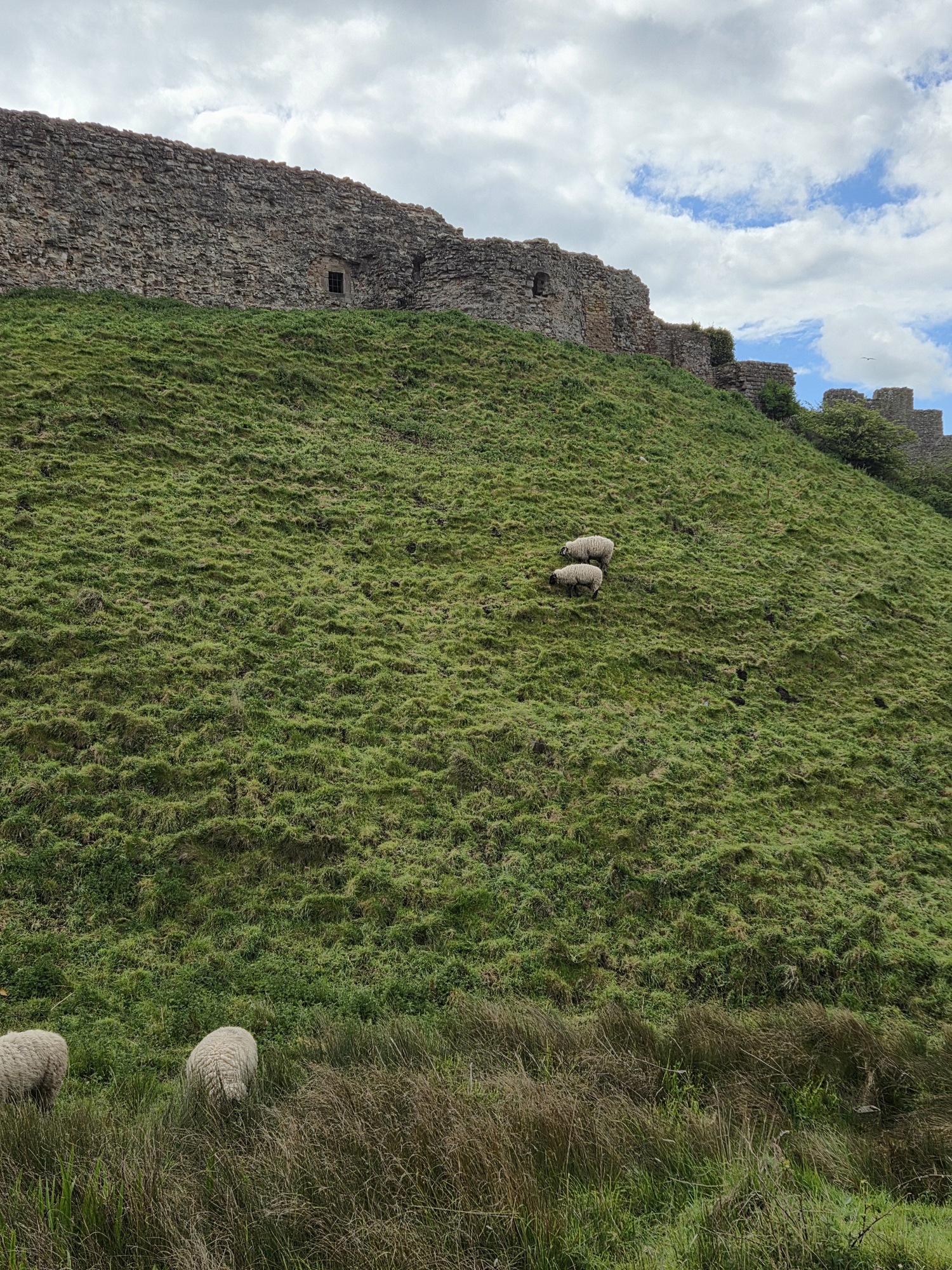
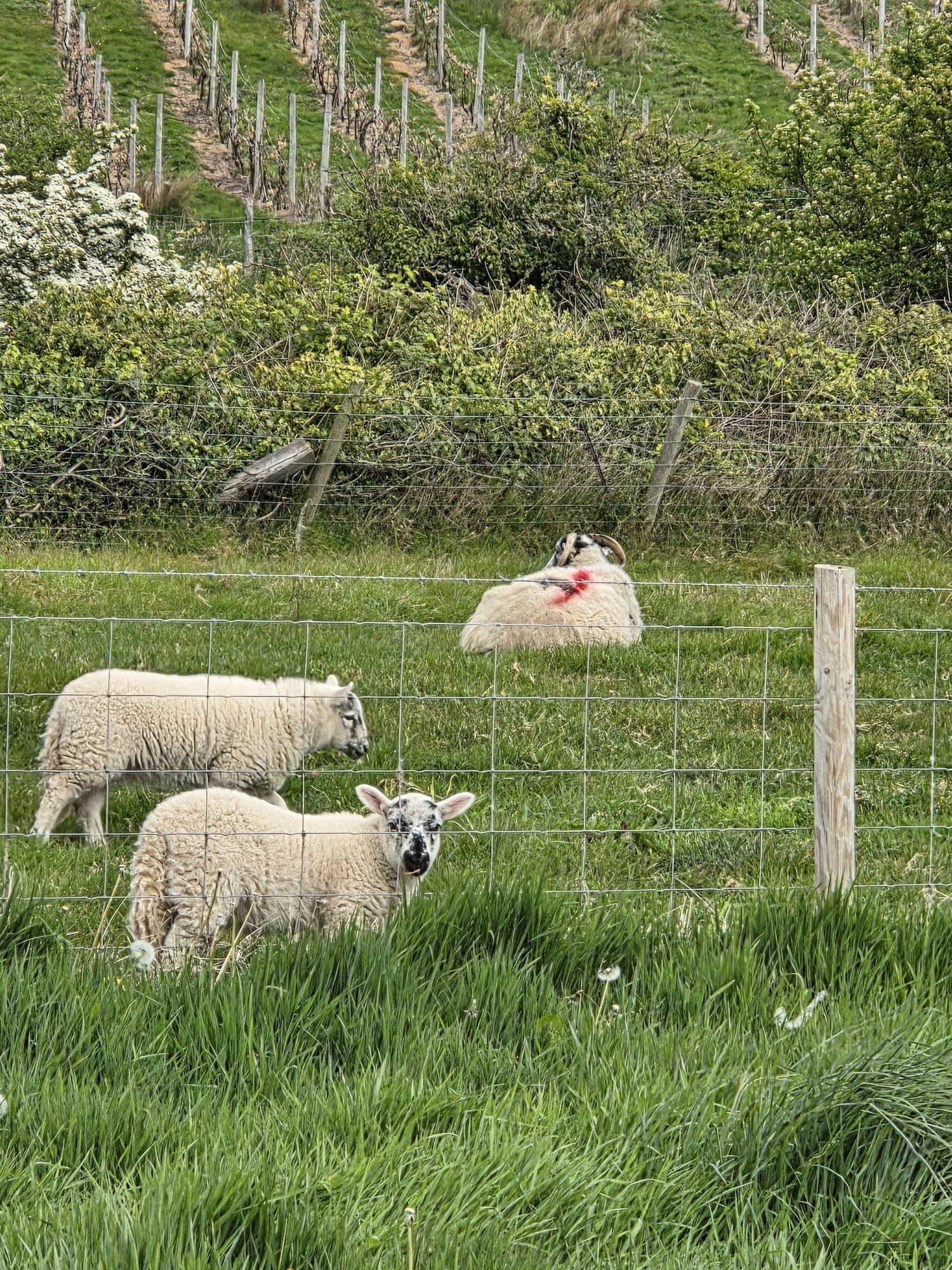
It started last Sunday with a delightful walk around the periphery of Berwick-upon-Tweed in Northumberland. We walked four miles around Elizabethan-era town walls and on a coastal trail then ended via a nature path and the historic ruins of the eponymous castle, now the domain of sheep.
Sheep safely graze under castle ruins in Berwick-upon-Tweed, UK.
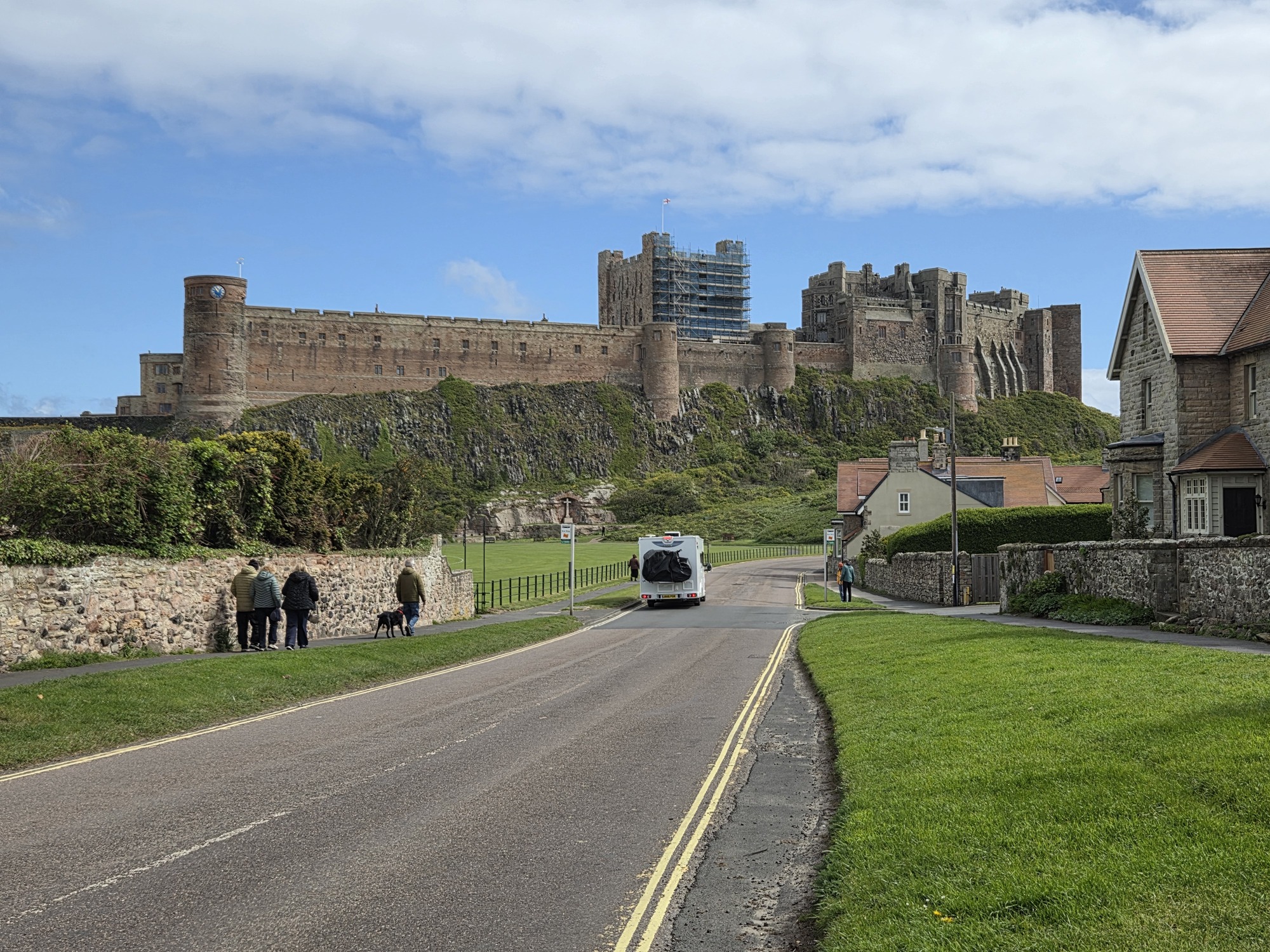
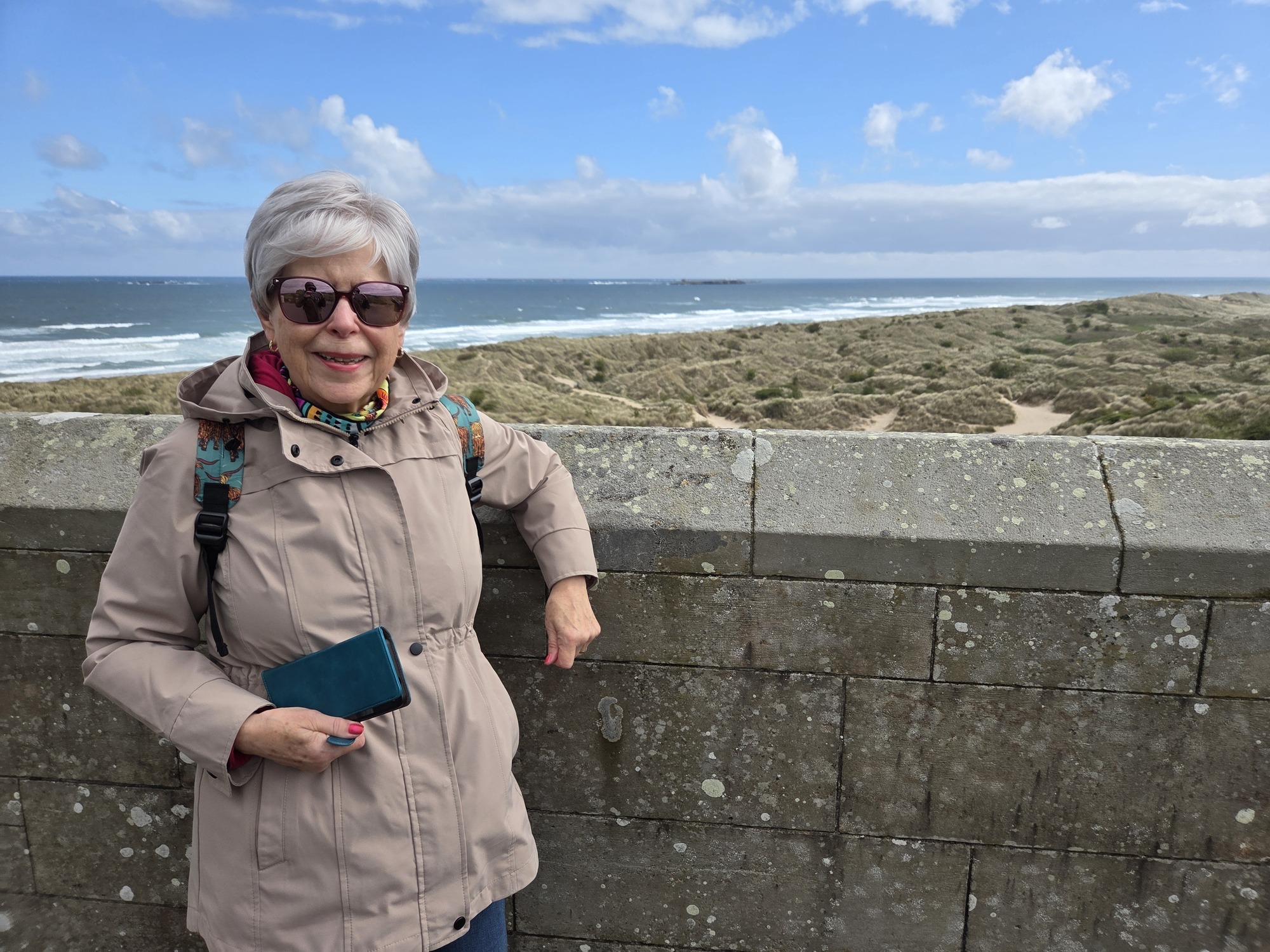
Unusually cold weather with high winds (24mph gusting to 35 or more!) found us at another castle on Monday, Bamburgh (BAM–bruh) on the rugged coast of Northumberland. It just was not the day to walk the coastal trail so we tramped around an enormous and well-restored castle. Thank goodness for a cozy pub in which to retreat after the tour!
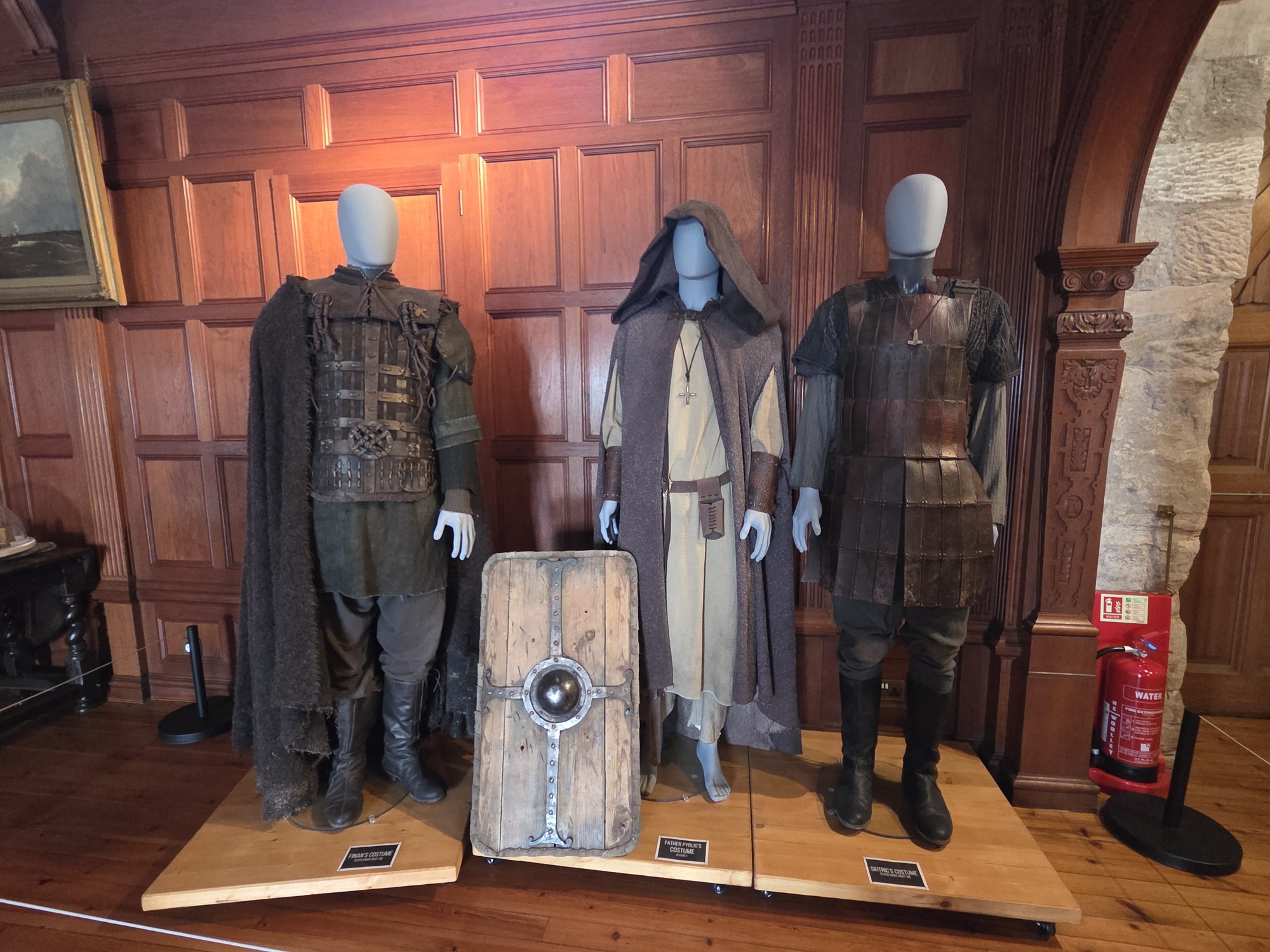
The imposing Bamburgh Castle, with history dating back 1400 years, privately owned by the Armstrong family and featured in The Last Kingdom. Rebuilt by the Normans after the conquest. Yes, it is bloody cold and WINDY here on the North Sea. Not an easy hiker day so good for castle crawling. At least we got out of the wind. Bamburgh Castle featured costumes and props from the series The Last Kingdom.
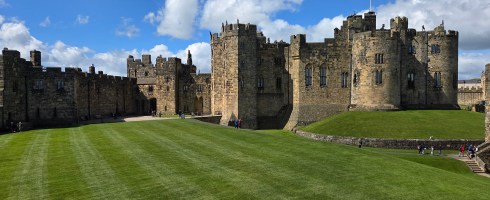
Tuesday, it was time for Alnwick (AHN-ick) Castle. Still not easy-hiker weather with high, gusting winds and a moderate threat of rain (which never materialized) we boarded the bus again for a trip down the coast, this time to the village of Alnwick. Much more village than town, dominated by the recognizable stand-in for Hogwarts in a couple of the Harry Potter movies and was also a Downton Abbey filming location. This is a very elegant castle, privately owned by the 12th Duke of Northumberland. His “other” castle is down the road at Warkworth.
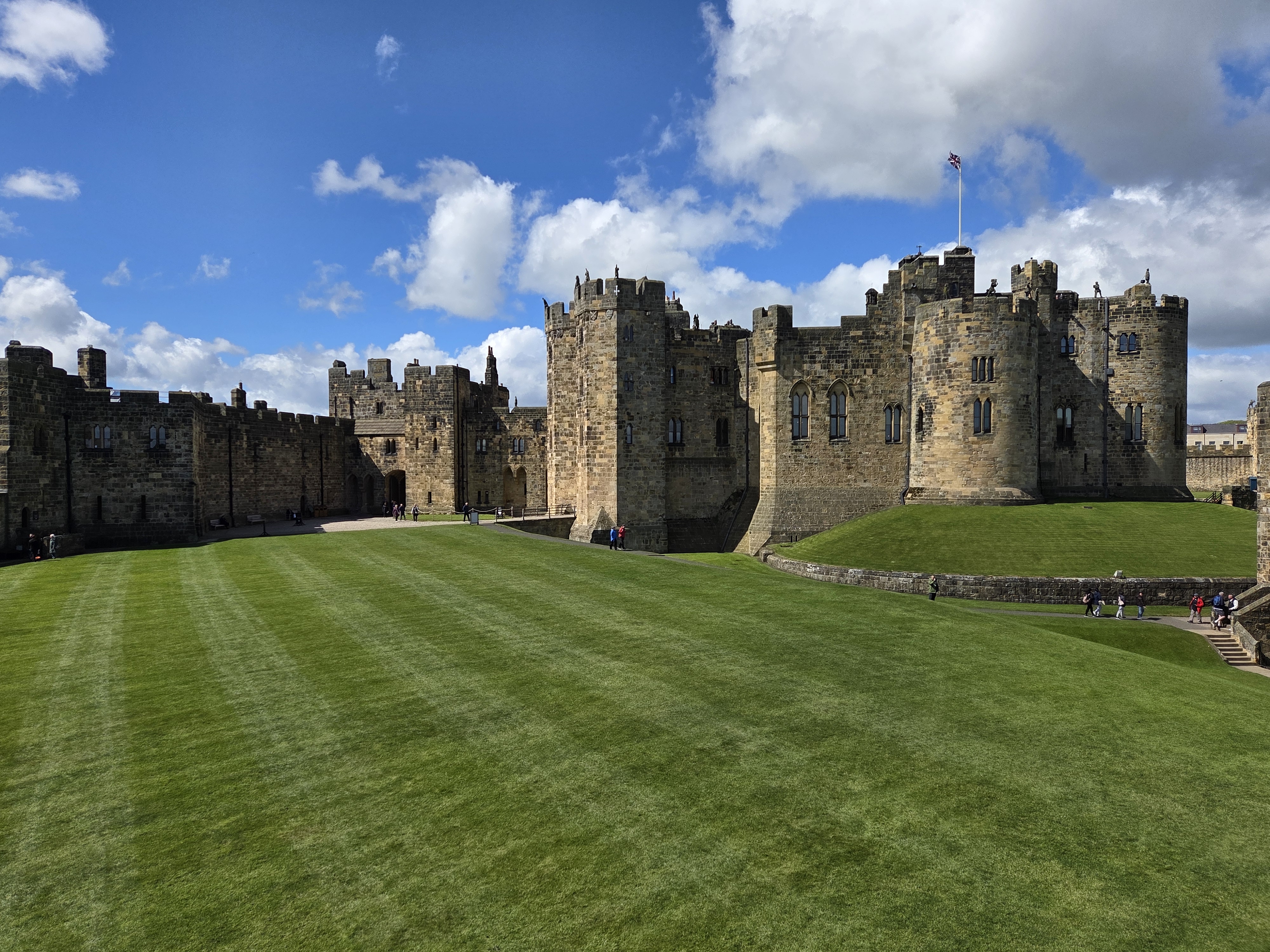
Alnwick Castle is exceedingly elegant. The family lives in it during winter, but moves out during high touring season. The St. Cloud University in Minnesota occupies part of the castle for a semester abroad program. Students live and study here.
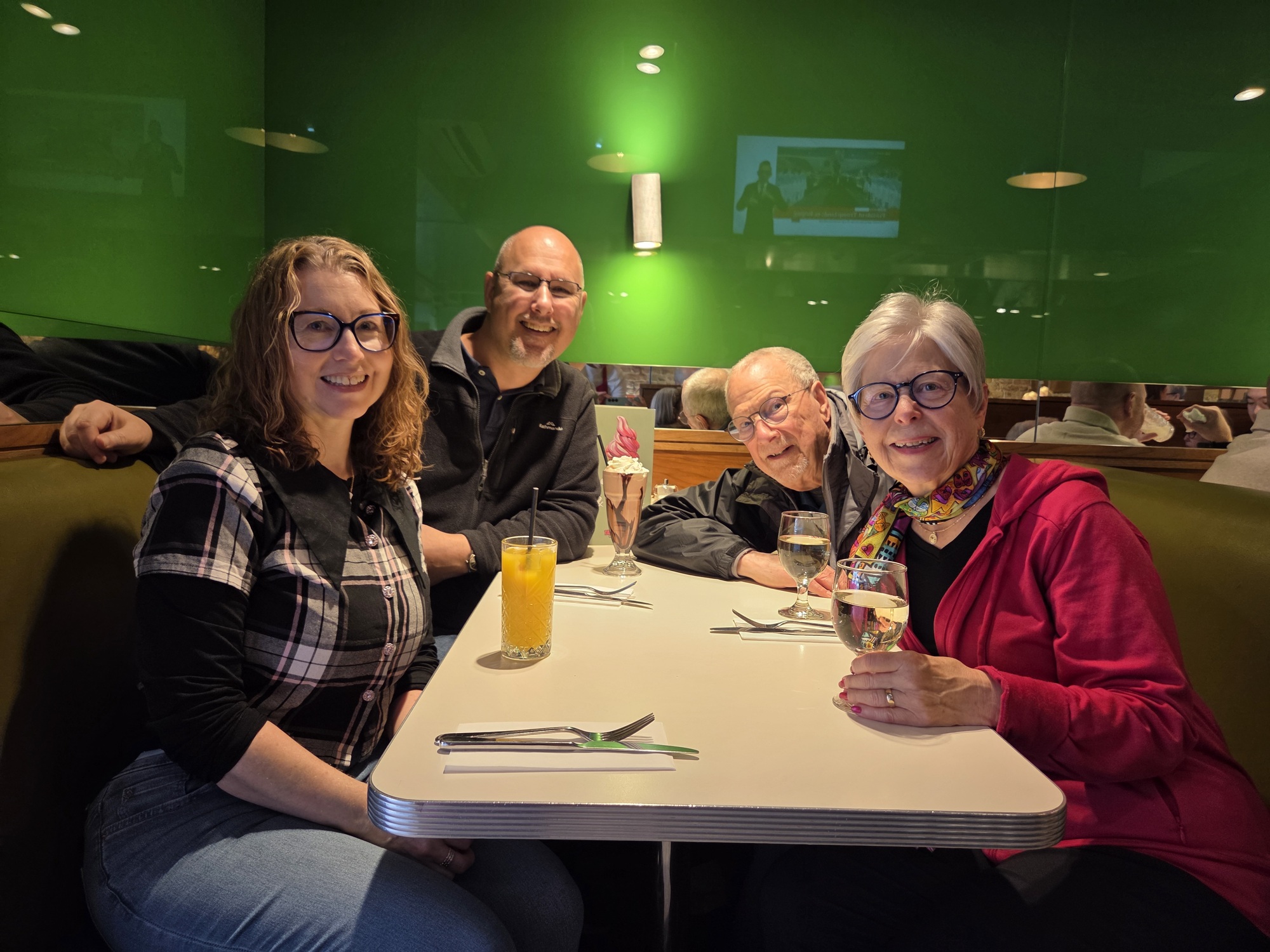
Wednesday’s weather was dreadful in forecast and actuality as of 7:00AM, so I texted our friends in Edinburgh to see if they were free for lunch. Edinburgh is less than an hour’s train ride north on a lovely LNER train. Castles were not on our mind; having inside places to visit was and museums abound in this historic city. Arriving in Edinburgh at 10:30 AM, the skies were clearing and the city was buzzing so we did what we like to do: we walked. A lot. And of course our route led us past another historic and grand castle, Having visited before we did not make the climb but the views were great, the weather lovely if still cool, and seeing our friends after eight years, a delight! And we walked our socks off!
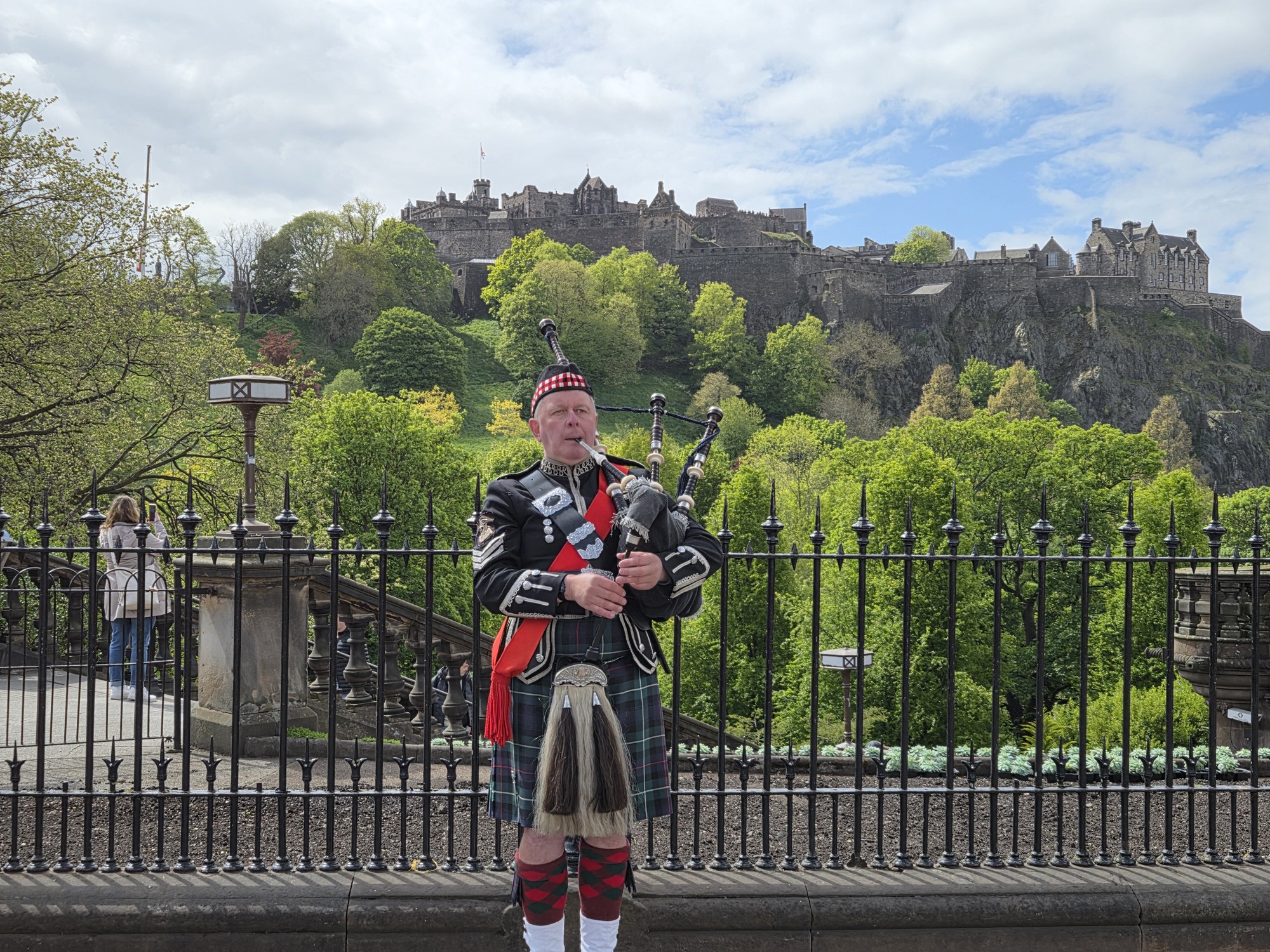
High above the Princes Street Gardens, perches the castle. We were treated to a noon concert by this talented piper. Angela and Chris visited us exactly 8 years ago in Lincoln City. We were glad we all recognized each other. :-)
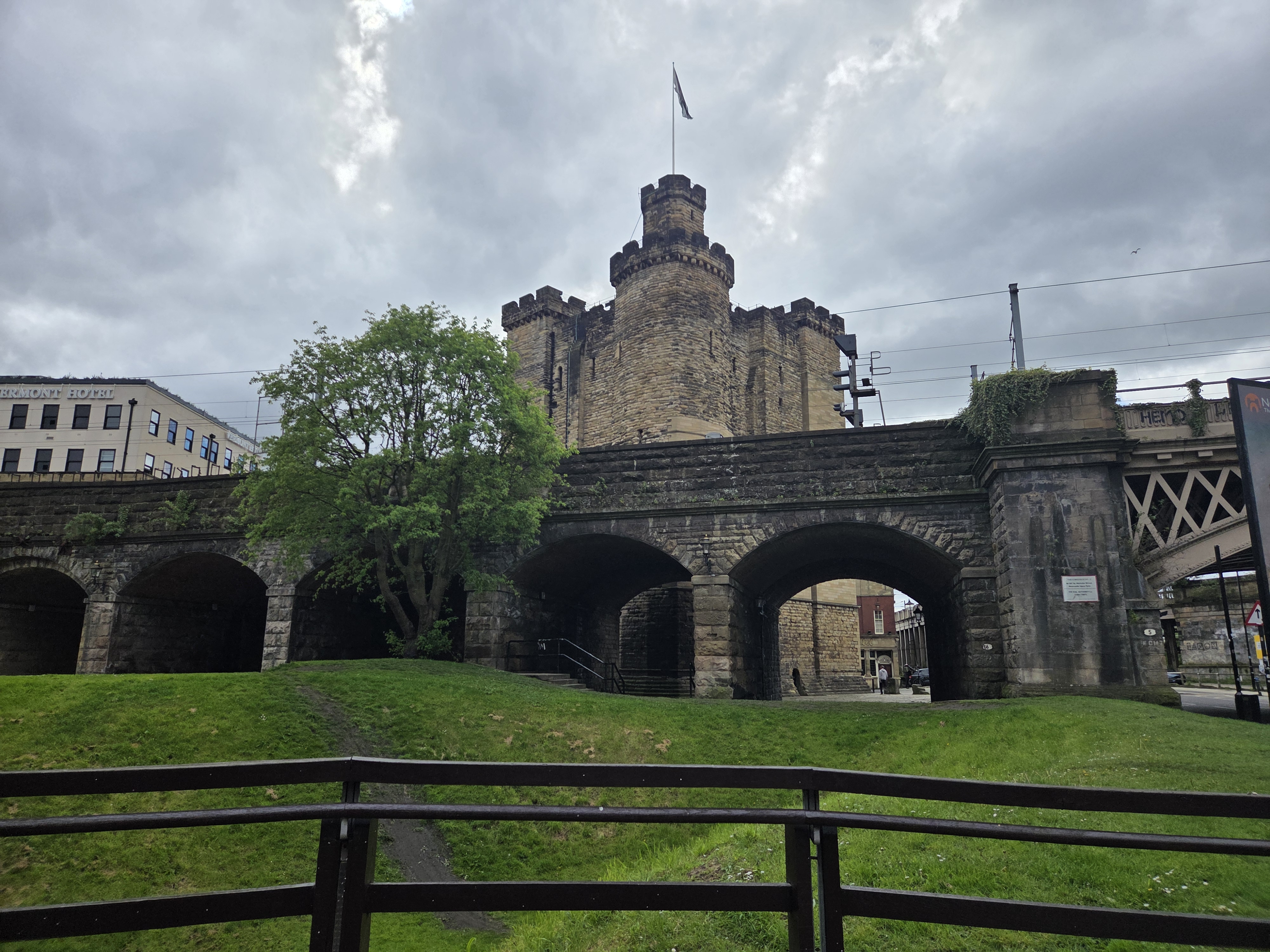
Alas Thursday was a travel day, moving on to Newcastle-on-Tyne so no castle tours. Of course on Friday we had to go see the castle at Newcastle, aka Castle Garth.
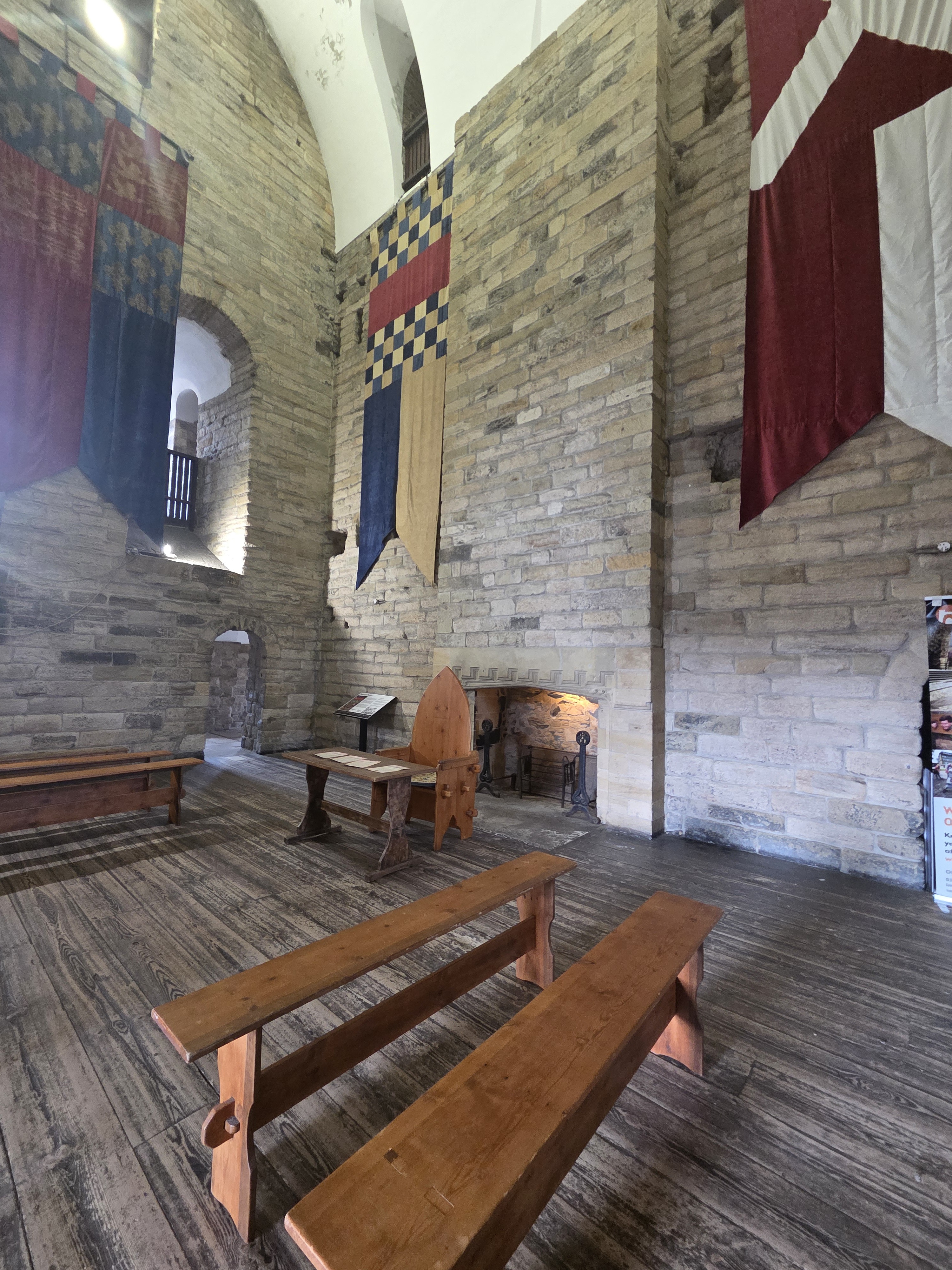
The Castle Garth with magnificently maintained and restored keep. We climbed and climbed spiral stone staircases to the upper levels. The Great Hall of the keep is magnificent Norman architecture. Though the site was earlier used as a Roman fort, the first castle was built by William the Conqueror’s son, Robert Curthose in 1080 as the New Castle upon Tyne. Henry the II built the stone keep.
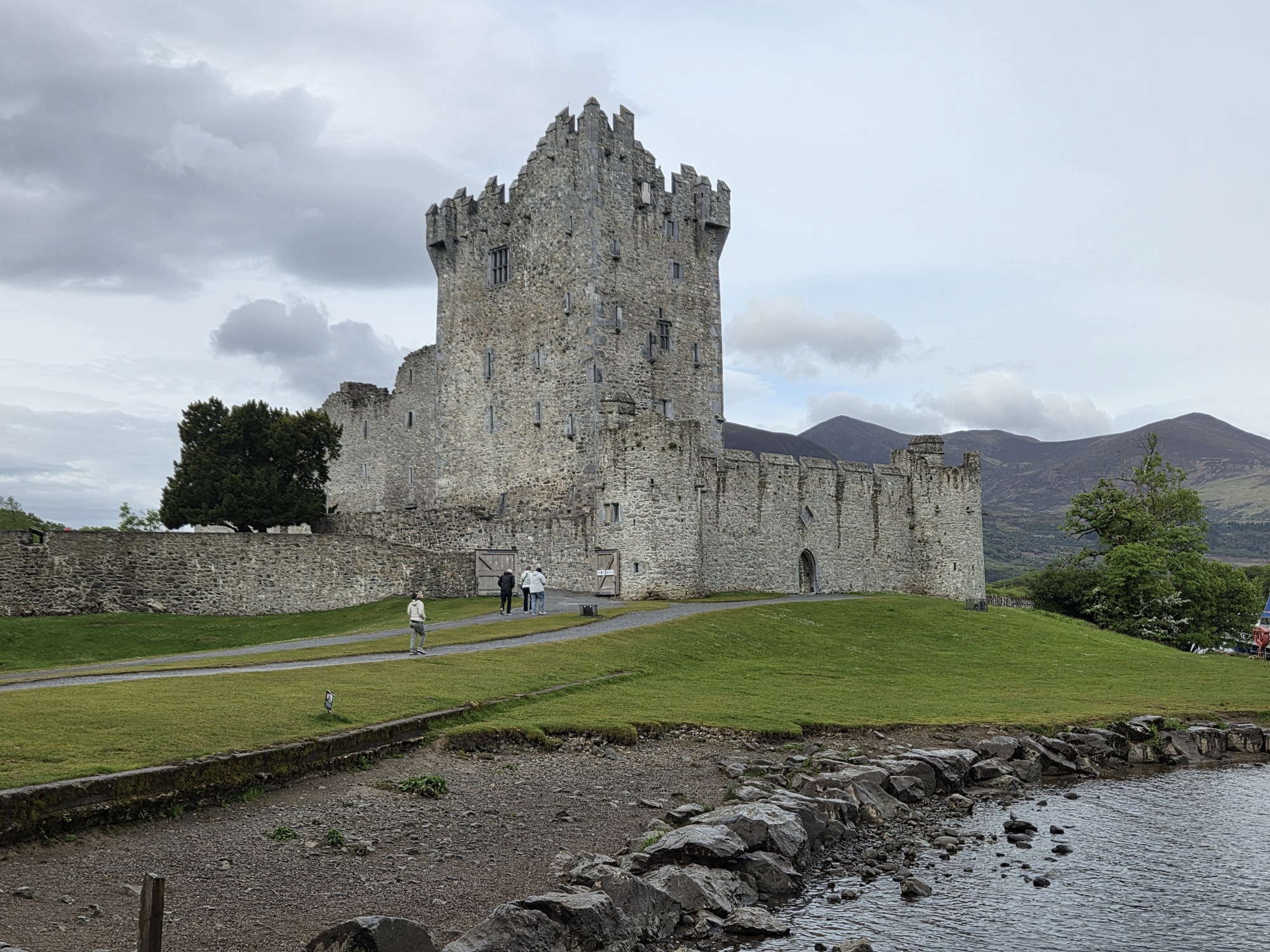
So we moved on to Ireland Saturday, arriving in Killarney in time for dinner. What should we encounter our first morning, our first outing, our first stop today? A castle!
Ross Castle, Killarney National Park.
Easy-hiking resumed today. We have a week of outings in the national park planned. Weather may be drizzly but we’ve left the cold North Sea and its winds behind so we aren’t going to let the light rain get in the way too much. Plus there are scads of cozy pubs for warming up.
The first sign that something was up in Whitby appeared when we changed trains in Middlesbrough, Yorkshire. Half-a-dozen young people dressed in black, Victorian-inspired attire looked out-of-place among the travelers in casual Saturday clothes, taking their dogs to walk the paths of the Esk River Valley. Of course, Whitby, with its abbey ruins, evocative atmosphere, and local stories, was Bram Stoker’s inspiration for his famous work, “Dracula” when he visited here in 1890.
Today, Whitby, a British seaside resort town on the edge of the North York Moors National Park, hosts twice-a-year Goth Weekends, and the faithful flock here dressed to kill. Arriving at the station we found hundreds of Goth-dressed observers here to honor the legend. 80-year-olds in expensive, custom apparel rub shoulders with families with young children in suitable garb and teenagers in thrift store castoffs and elaborate makeup. Luckily, the weather on Saturday was perfect for promenading through town and making the pilgrimage trek up the 199 steps to the abbey.
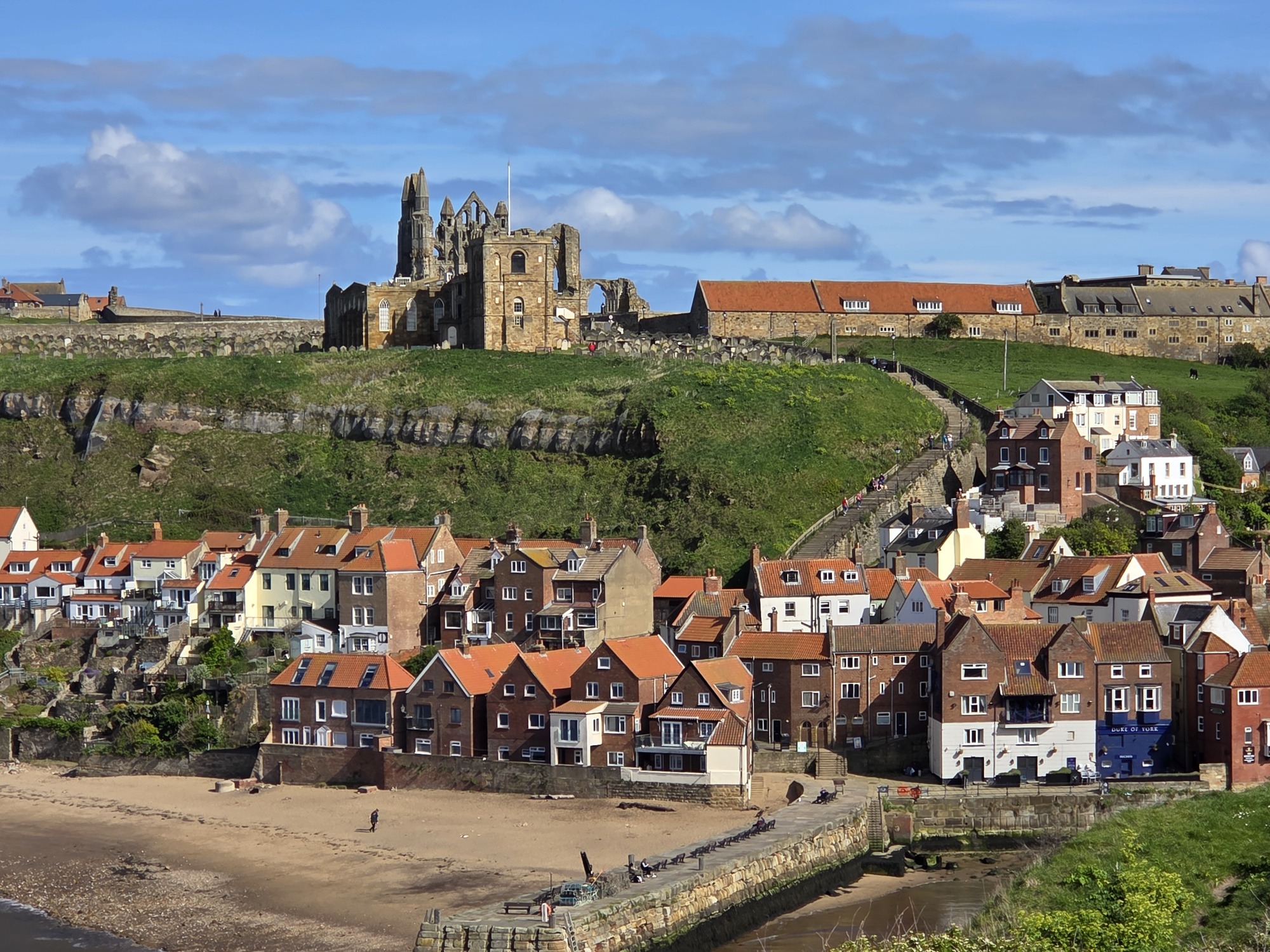
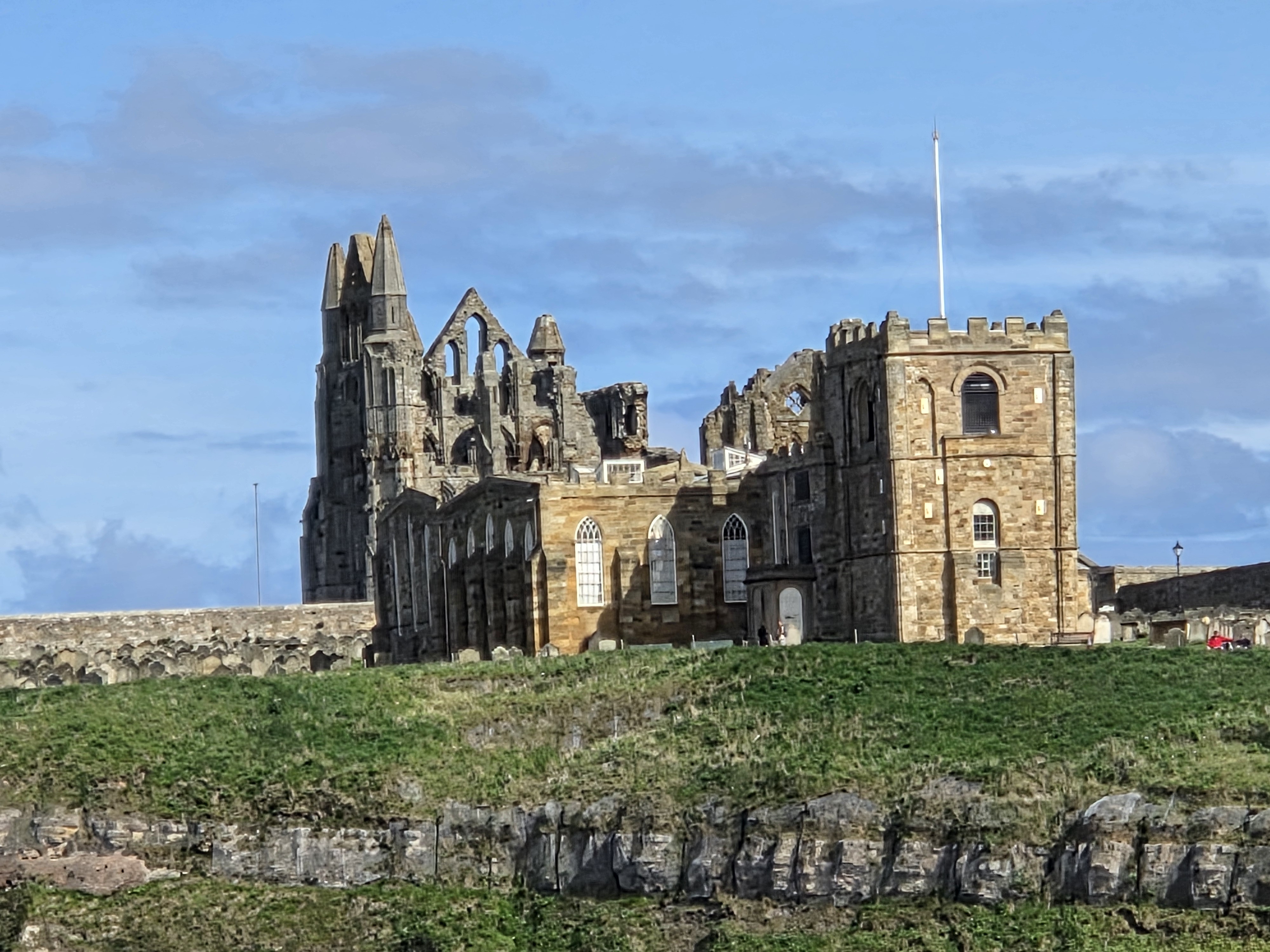
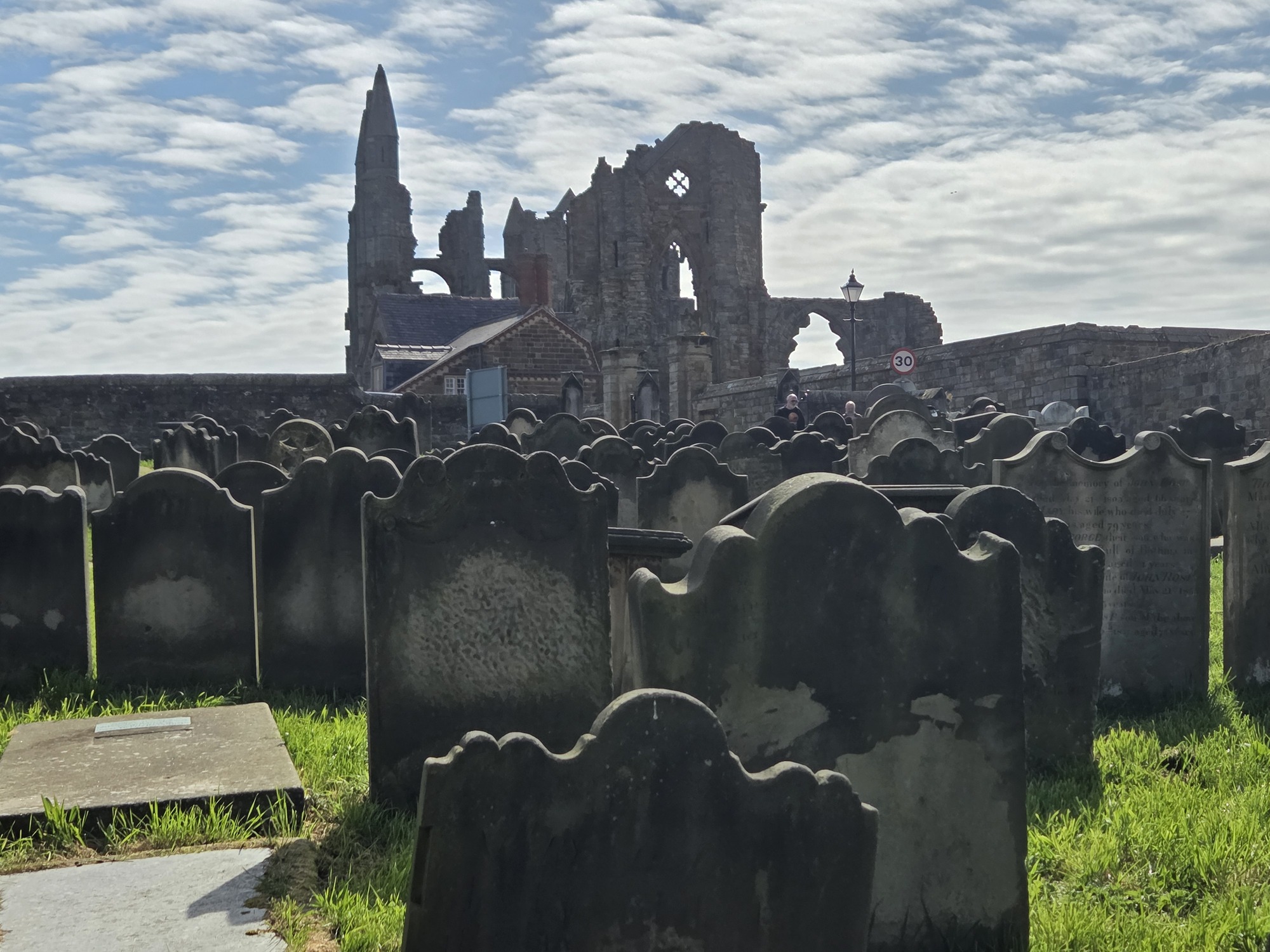
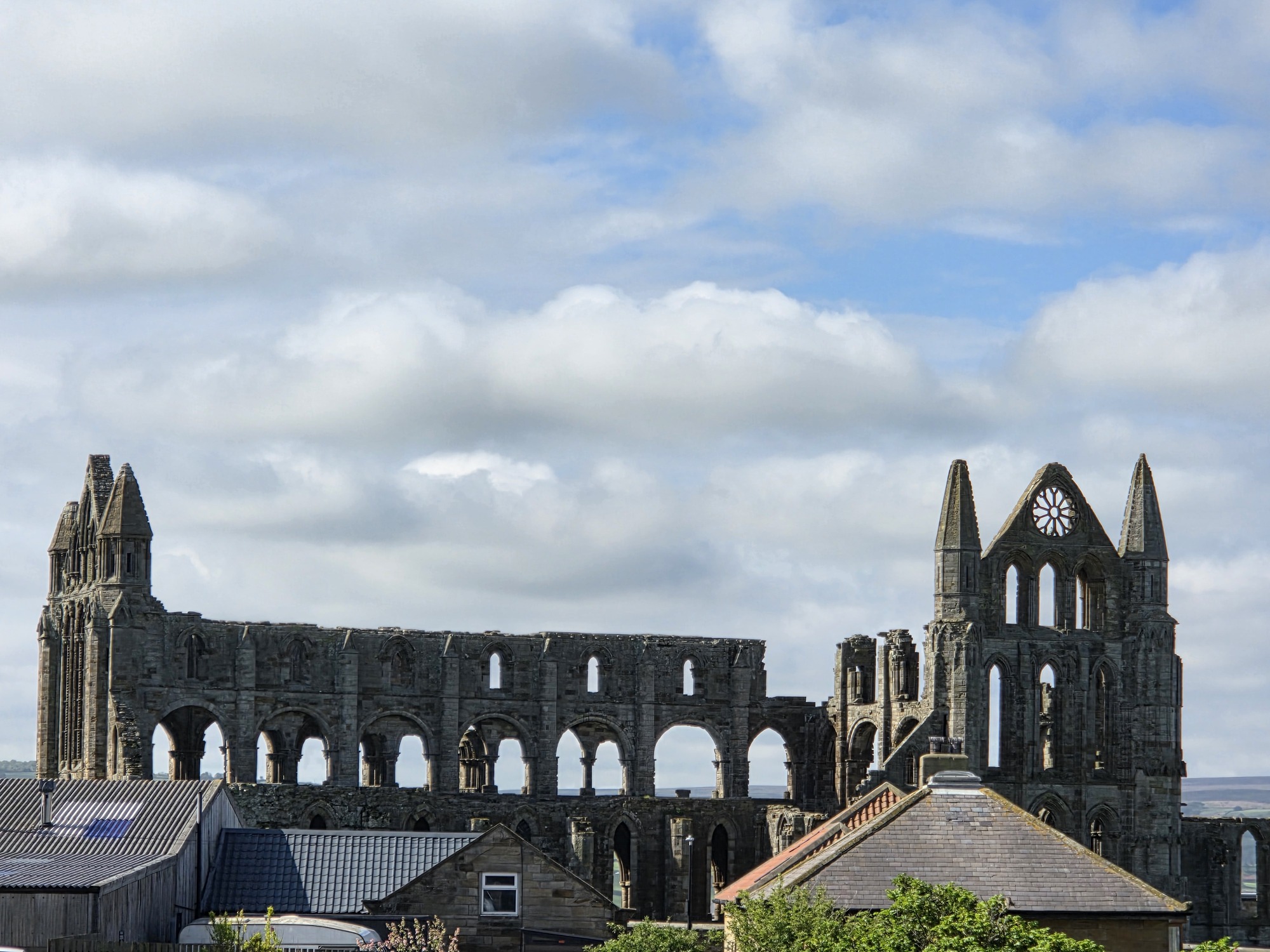
View of the Whitby Abbey ruins with brooding St. Mary’s Church in front. Note the long — 199 steps — staircase. Yup, we climbed it with our rubbery, flatlander live-in-a-house-without-stairs knees.
The steps would have to wait. We had only just arrived by the scenic train through the Esk River Valley. It was a long and eventful travel day: London to York by lovely first-class train with a stressful change to a bus from York to Middlesbrough. The train was late and the planned bus left five minutes before we arrived at the stop, which was a quarter mile trudge with luggage from the train station. Our connection in Middlesbrough threatened to become a four-hour delay but the train service LNER fortuitously added an extra bus as it was a heavy travel day in a Bank holiday weekend. All of England was on the move!
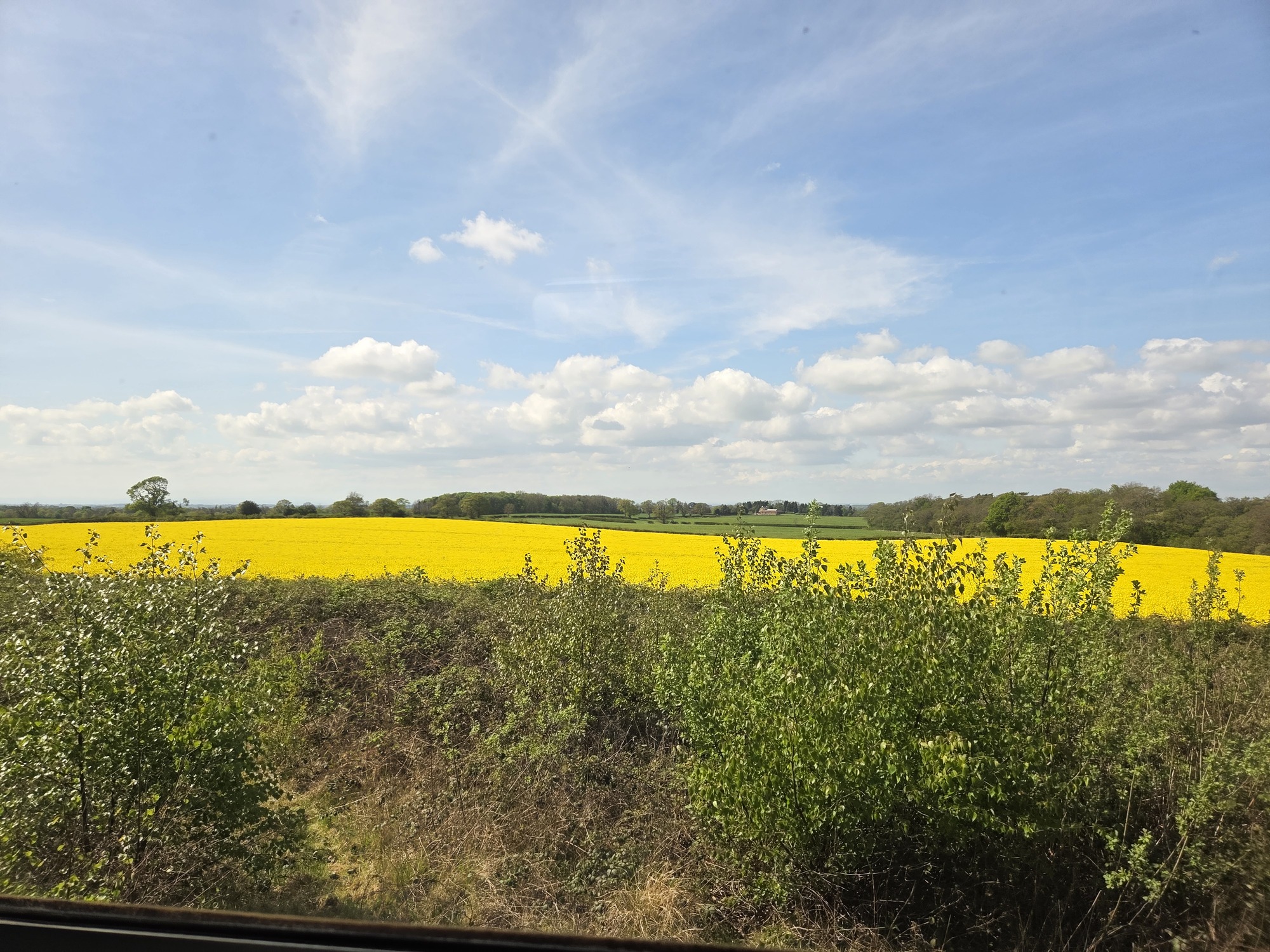
A two-plus hour bus ride is not a choice we make if it is possible to avoid. Work on the rail line to Whitby caused the routing. Availing ourselves of seats at the front of the bus and had a splendid view of little villages and quaint farms, and the unintelligible commentary of the driver. Overall, it was not bad. The subsequent train ride to Whitby was delightful! Bouncing new lambs in verdant fields; hedgerows and dry-stone walls criss-crossing the countryside; canary-yellow fields of rapeseed; walkers and their dogs enthusiastically boarding the train after their treks.
We are passing a week in Whitby. There is ancient history here: the original abbey was founded as a monastery in the 7th century. The Vikings destroyed it, but the Benedictines resurrected the site as an abbey in 1078, after the Norman Conquest. We can thank Henry VIII for destroying the abbey during his war on Catholicism creating picturesque ruins. Most infamously, the abbey was Bram Stoker’s vision for his novel.
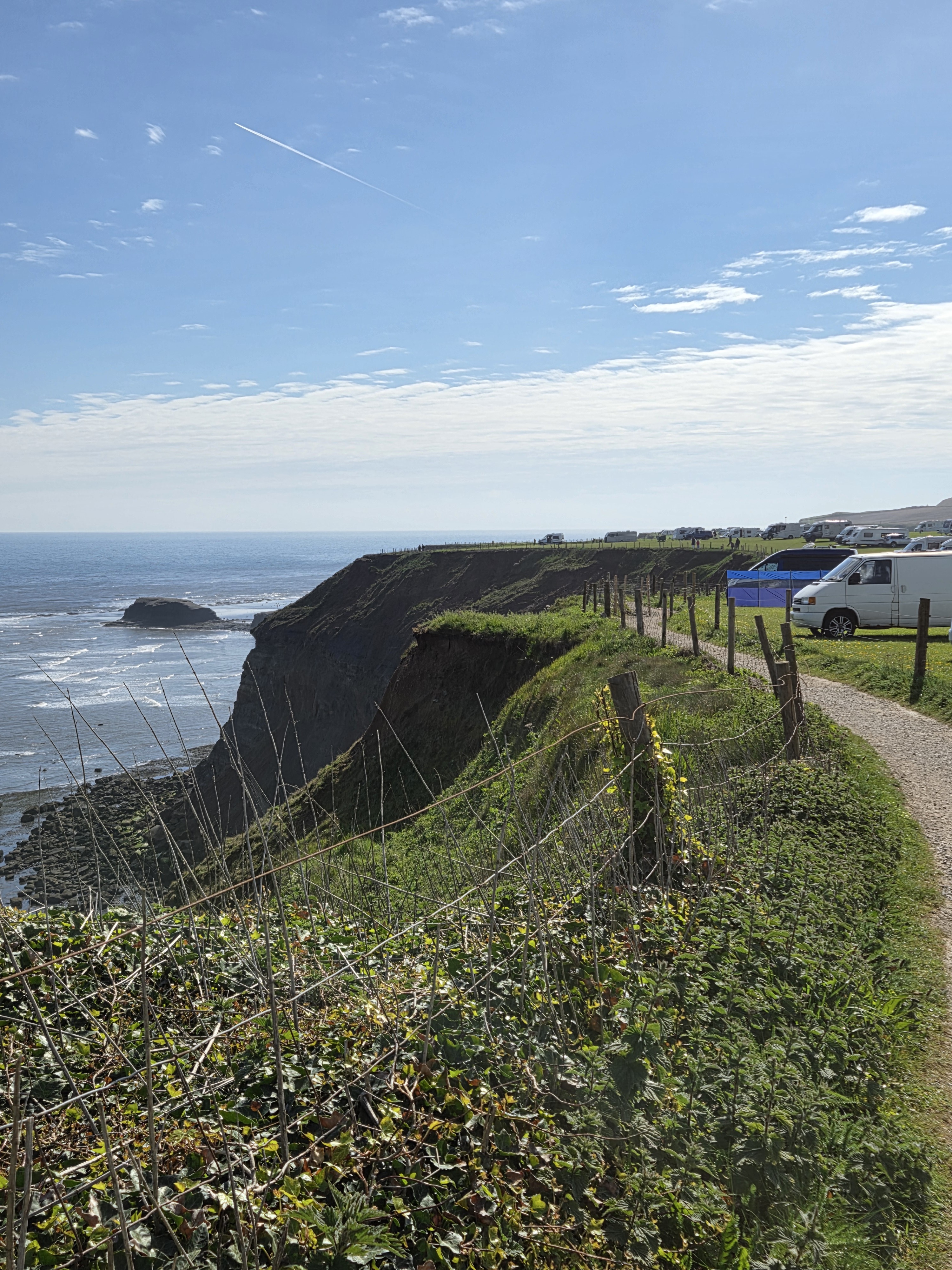
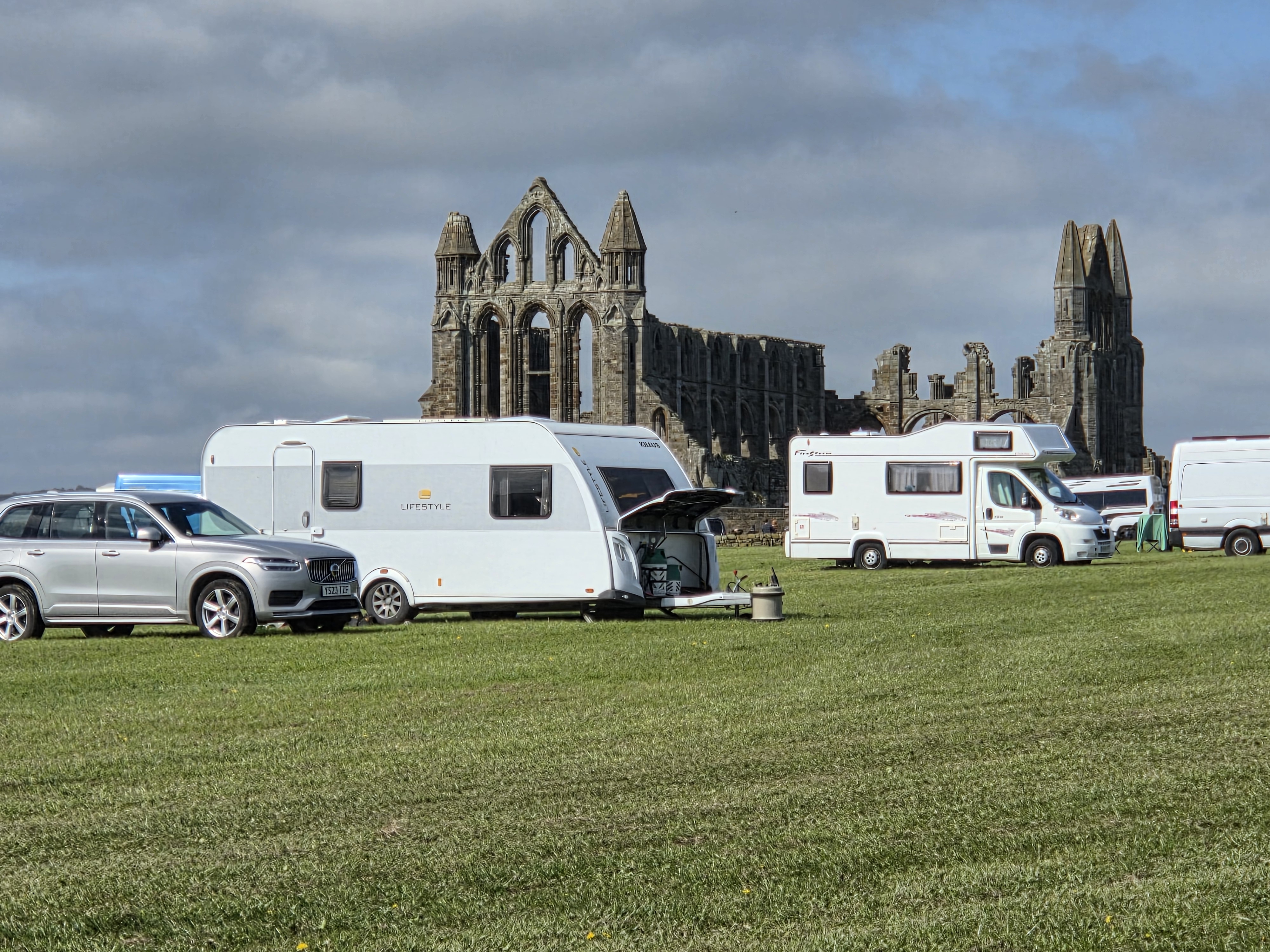
What Bram Stoker saw, more-or-less, from his perch on the bluff. Today, a caravan park nudges up against it on the other side and The Cleveland Way passes directly by.
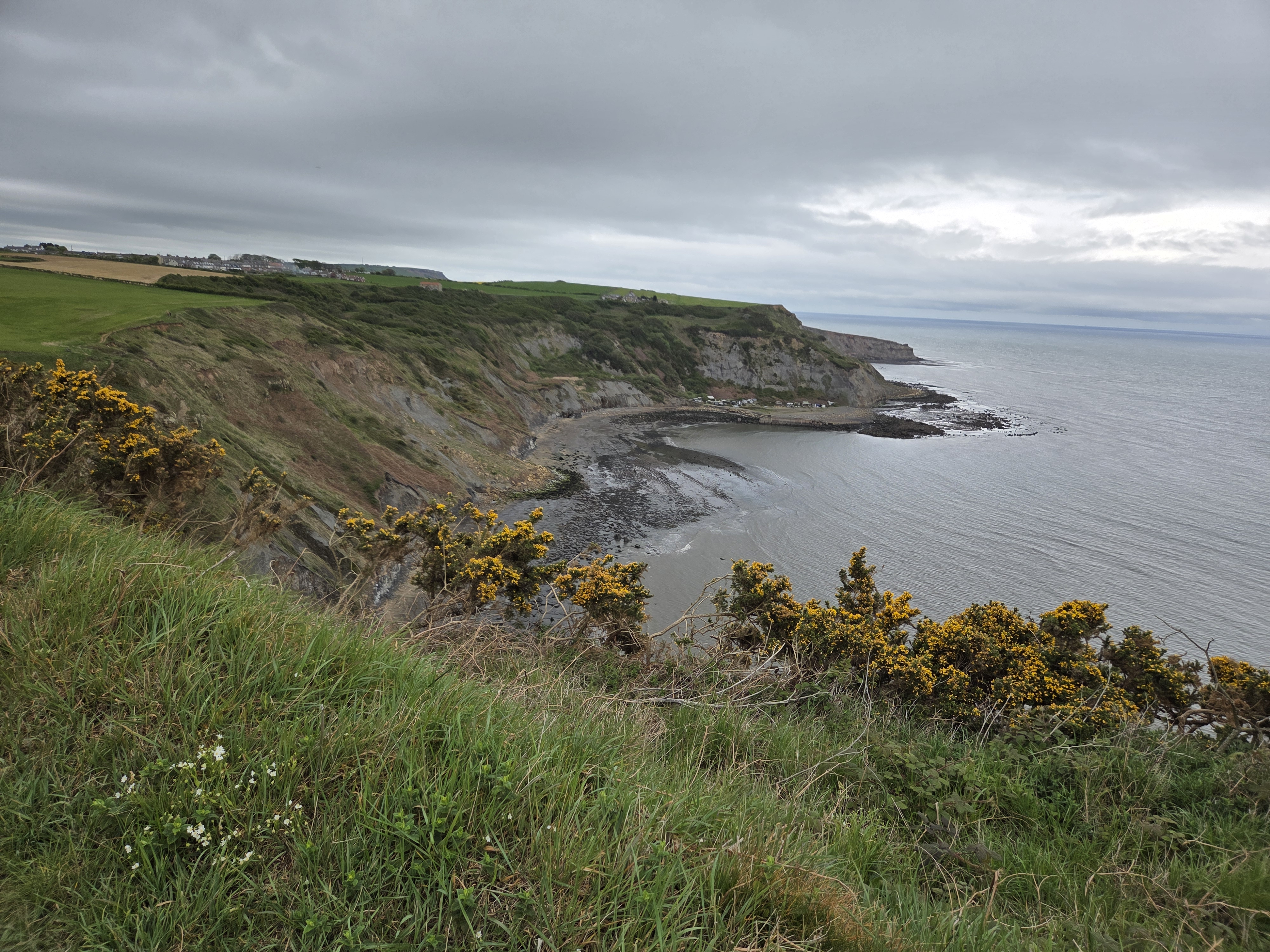
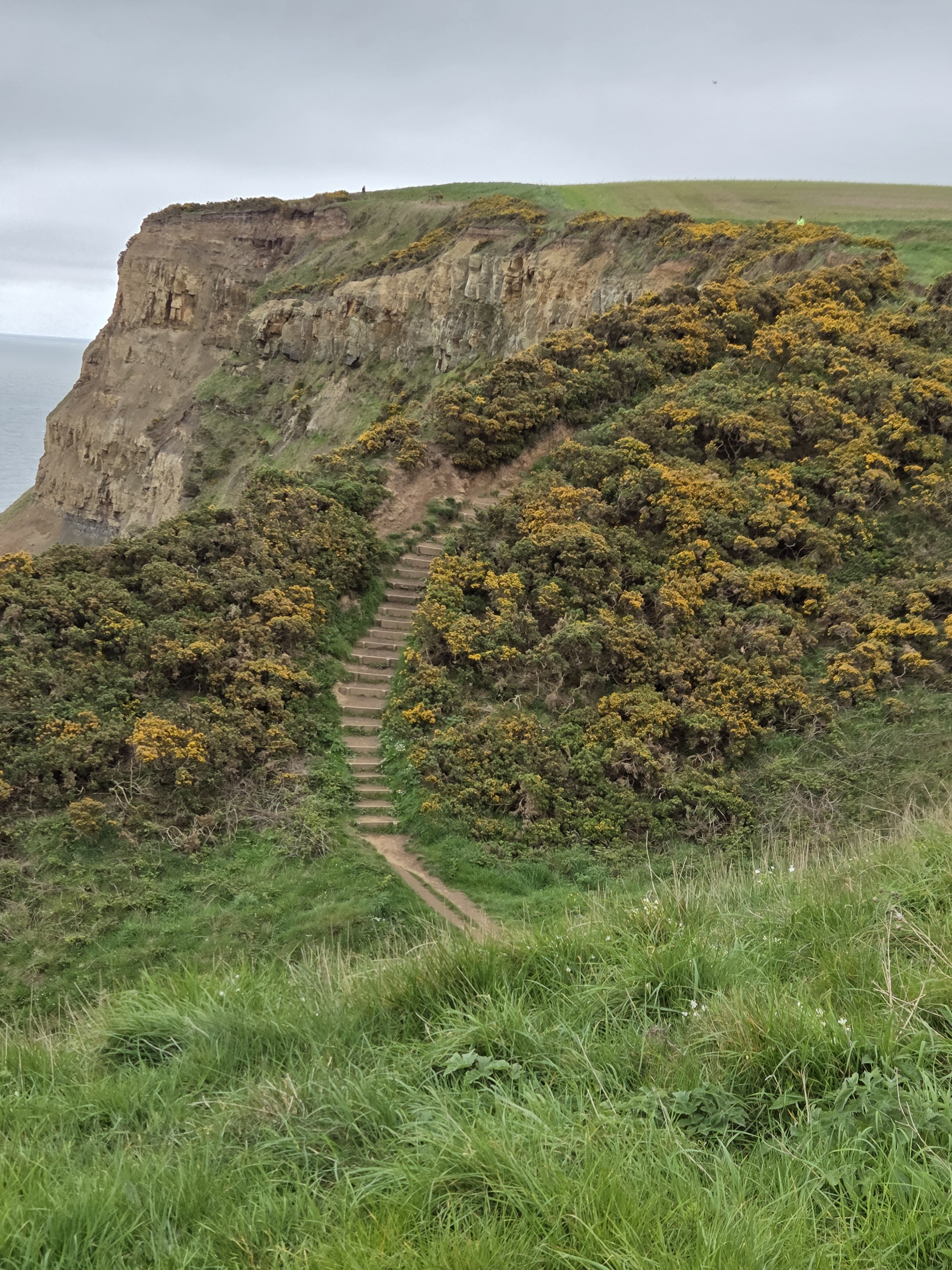
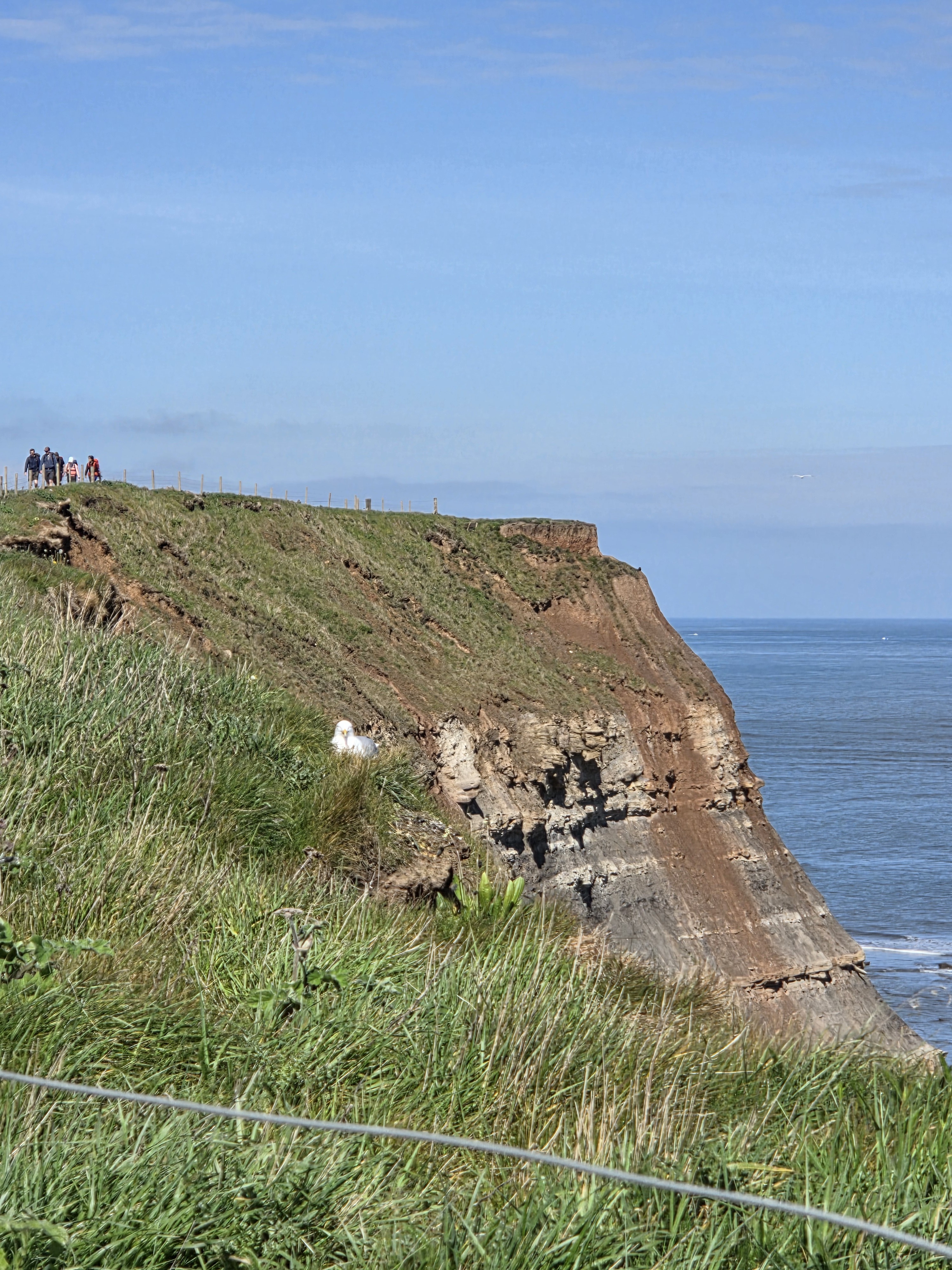
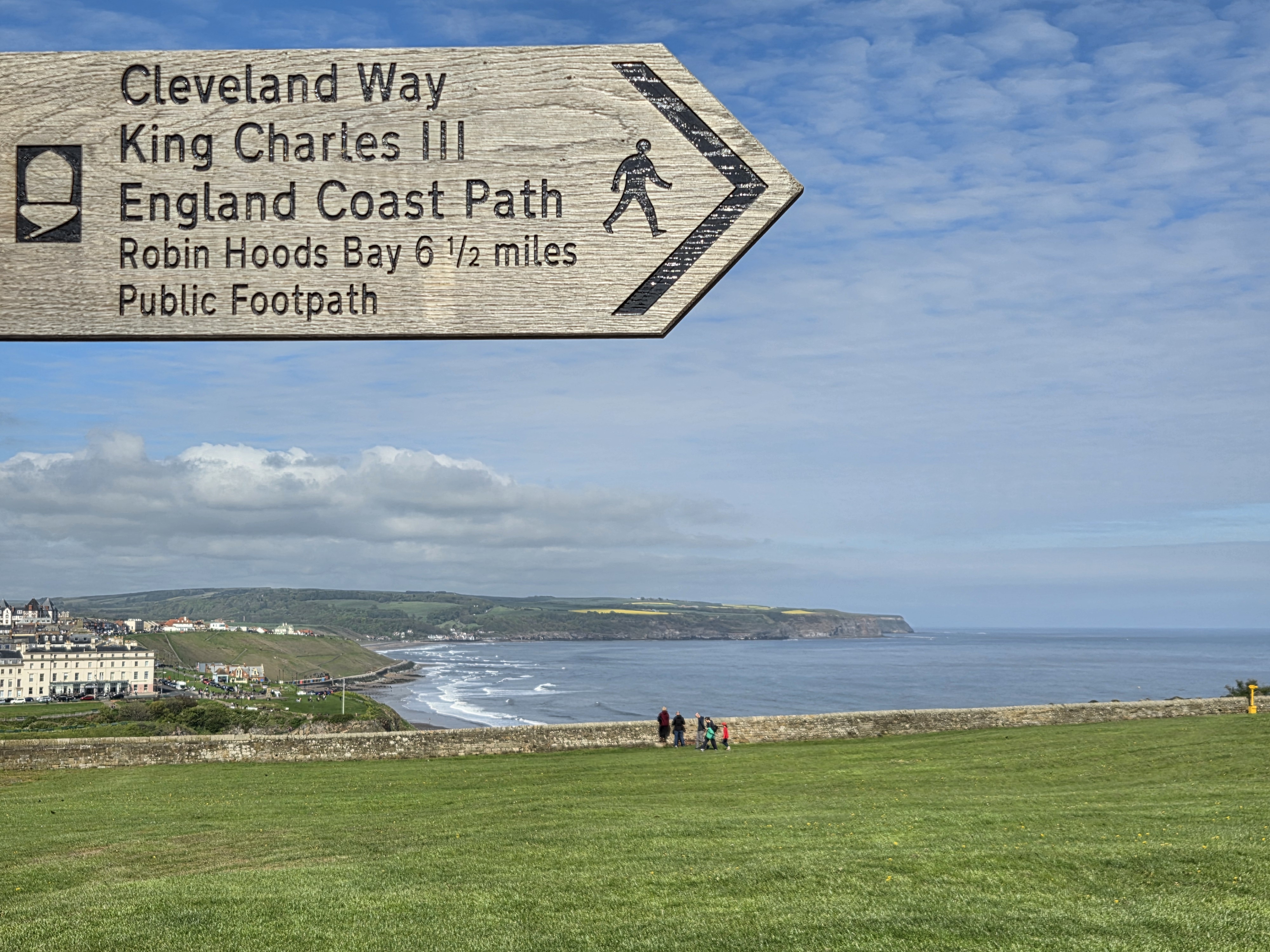
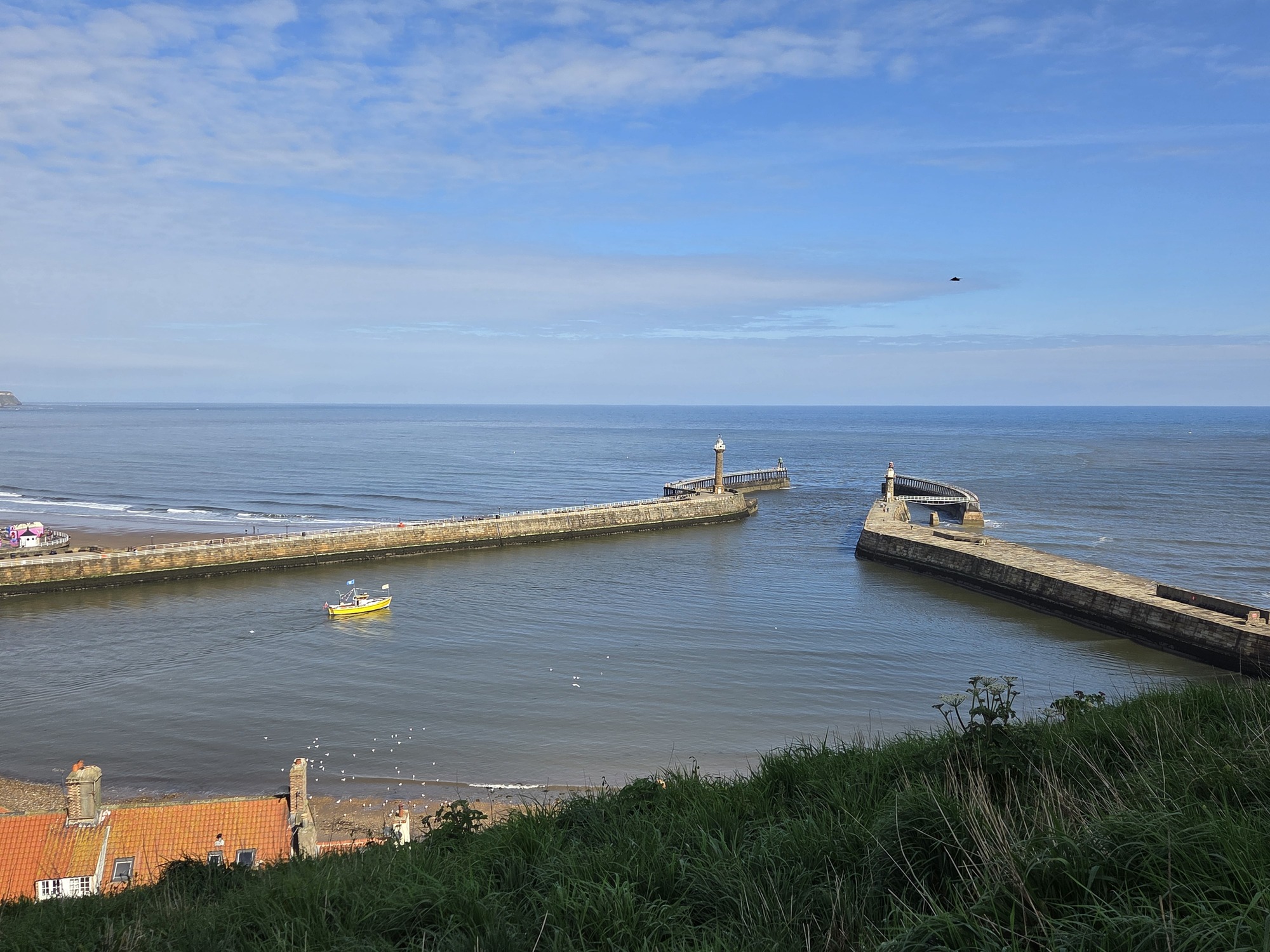
It’s chilly this week, but the rain has held off at least while we are walking. The extensive 109-mile Cleveland Way runs through this area, where we are walking daily in the North York Moors National Park including short coastal sections of the Cleveland Way. Very scenic, hugging the cliffs above rocky beaches and steep headlands, sometimes quite windy.
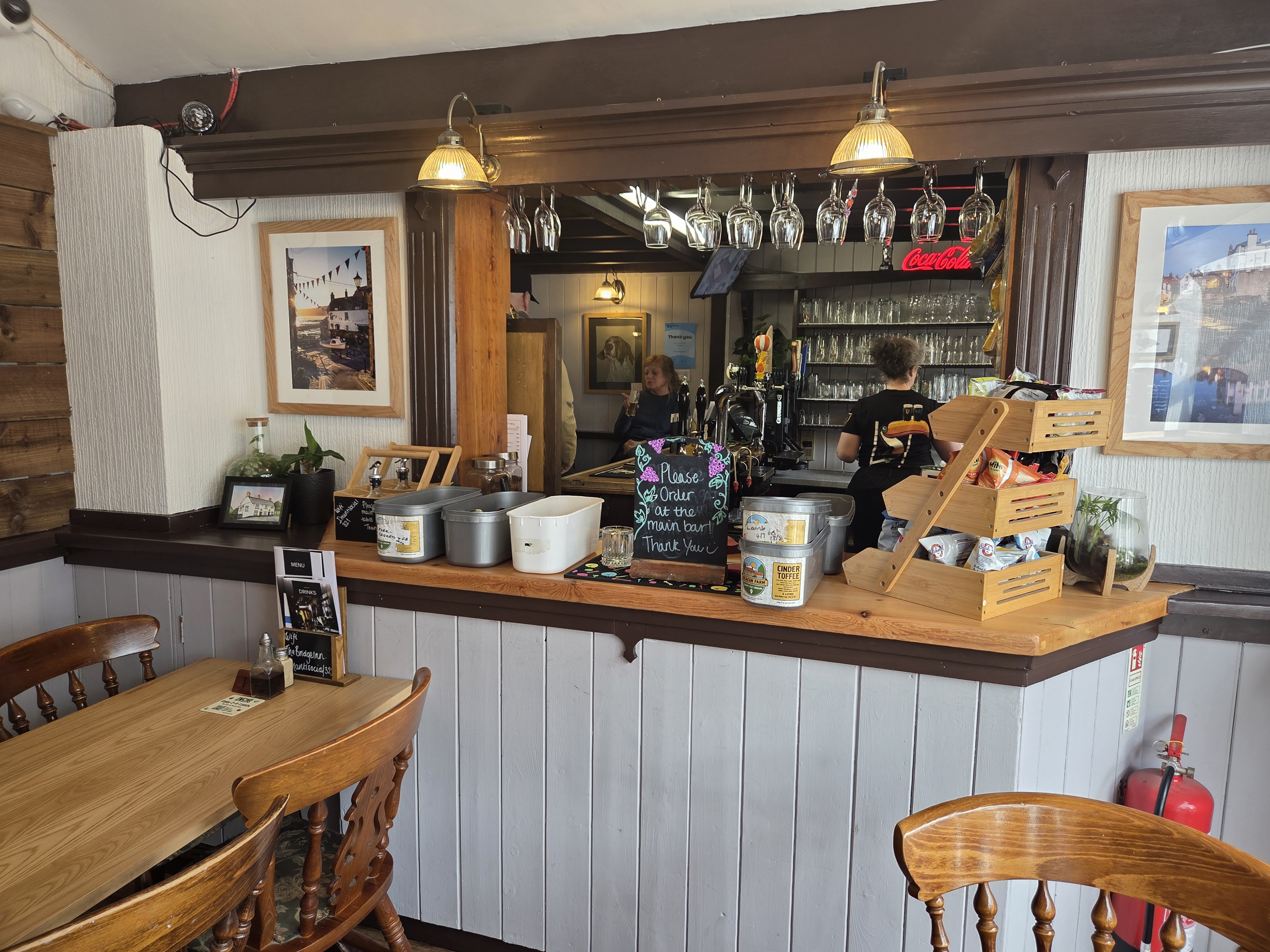
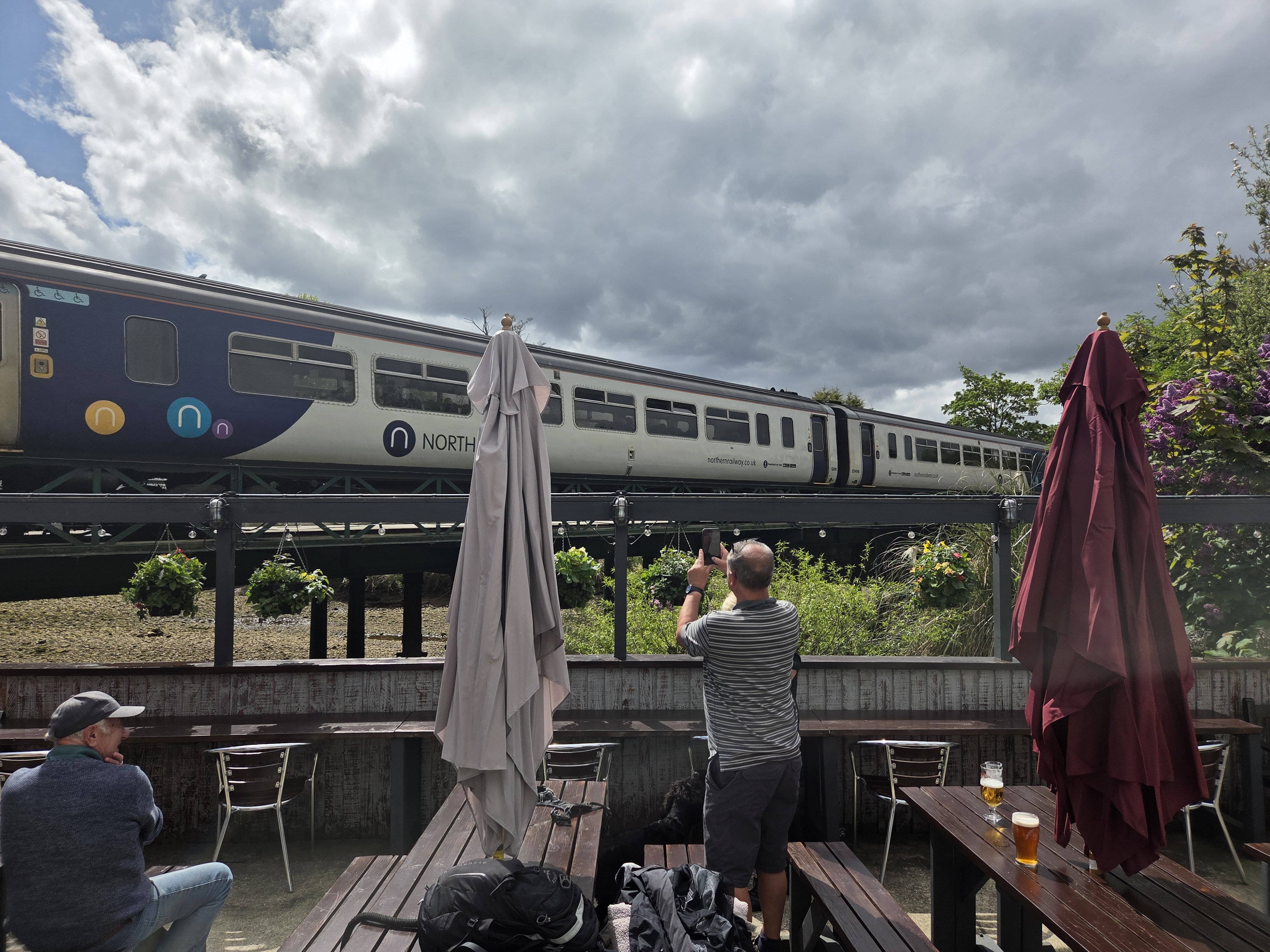
We’ve had a couple of “path to lunch” outings, with a charming pub awaiting mid-walk.
A random selection of photos from the week so far. Please click on a photo for a brief caption, if interested.
Sadly, the North York Moors Railway is not running to Whitby due to the same works on the line that plagued our arrival.
Our apartment for the week meets all our criteria: ground floor, washing machine, walk-in shower, full kitchen, and a coffee-pod machine. We no longer stay where we lug suitcases up stairs or climb over steep-sided British tubs to use the shower. If I am going to injure myself, I will do it outdoors, not in the shower.
We have not heard one word of American-accented English, and only once a couple speaking anything other than English. Most of our fellow travelers are from the UK, it seems.
From here, we head to Northumberland and the town of Berwick-on-Tweed. More from there soon!
Venice doesn’t call to me, she screams at me to come and visit. It’s been four years since we last cast eyes on La Serenissima. You’d think after 11 visits we’d have seen all there is to see. Since we were staying an hour down the train line (Ferrara) and the day was fall perfection, we hopped a Frecciarossa and made the count an even dozen.
The challenge was to find something unique away from the crowds at San Marco and Rialto. Thanks to the 2025 Architecture Biennale, I found a walking tour that took us to places we did not know you could access, in particular, the Arsenale, which used to be off-limits except for The Biennale exhibits held in the Arsenale South. Now the northern section is open on a limited basis and the route to get there is astounding.
A brief historic diversion is in order if you do not know what the Arsenale is. It dates to 1104 and was the shipbuilding center of the Venetian Republic and lasted until Napoleon ruined things in 1797. It was the largest industrial complex in Europe before the Industrial Revolution. Wikipedia has a fine synopsis if you want to know the details and see some renderings. https://en.wikipedia.org/wiki/Venetian_Arsenal. Click on any picture for a better view..
The Arsenale: The approach to Tesa 105; Art in Tesa 105; Inside along the tese (old workshops); Waterfront inside. Imagine Venetian ships being built here 1000 years ago.Notice NO CROWDS.
The walking tour is called “Castello, Naval Art and Traditions.” No, it is not a Rick Steves Triple Triangle Must See tour. That is the beauty of it. Instagrammers have not descended en masse. Monday to Friday from 8:00-17:00 you can visit through Tese 105, an exhibit space and bar on the north side.
How you get there is circuitous, and that is the fun of a Venice walk, zig-zagging down various calle, up and down countless bridges, discovering new-to-you sights, second-guessing your location and direction, taking more pictures than you can fathom. We saw very few people anywhere on our route and most of them seemed to be local residents. We especially enjoyed the elevated metal walkway along the Laguna Nord wall of the Arsenale. Perfect waterfront view and luckily not a windy day or it could be a mite unpleasant. Click on any picture for a better view.
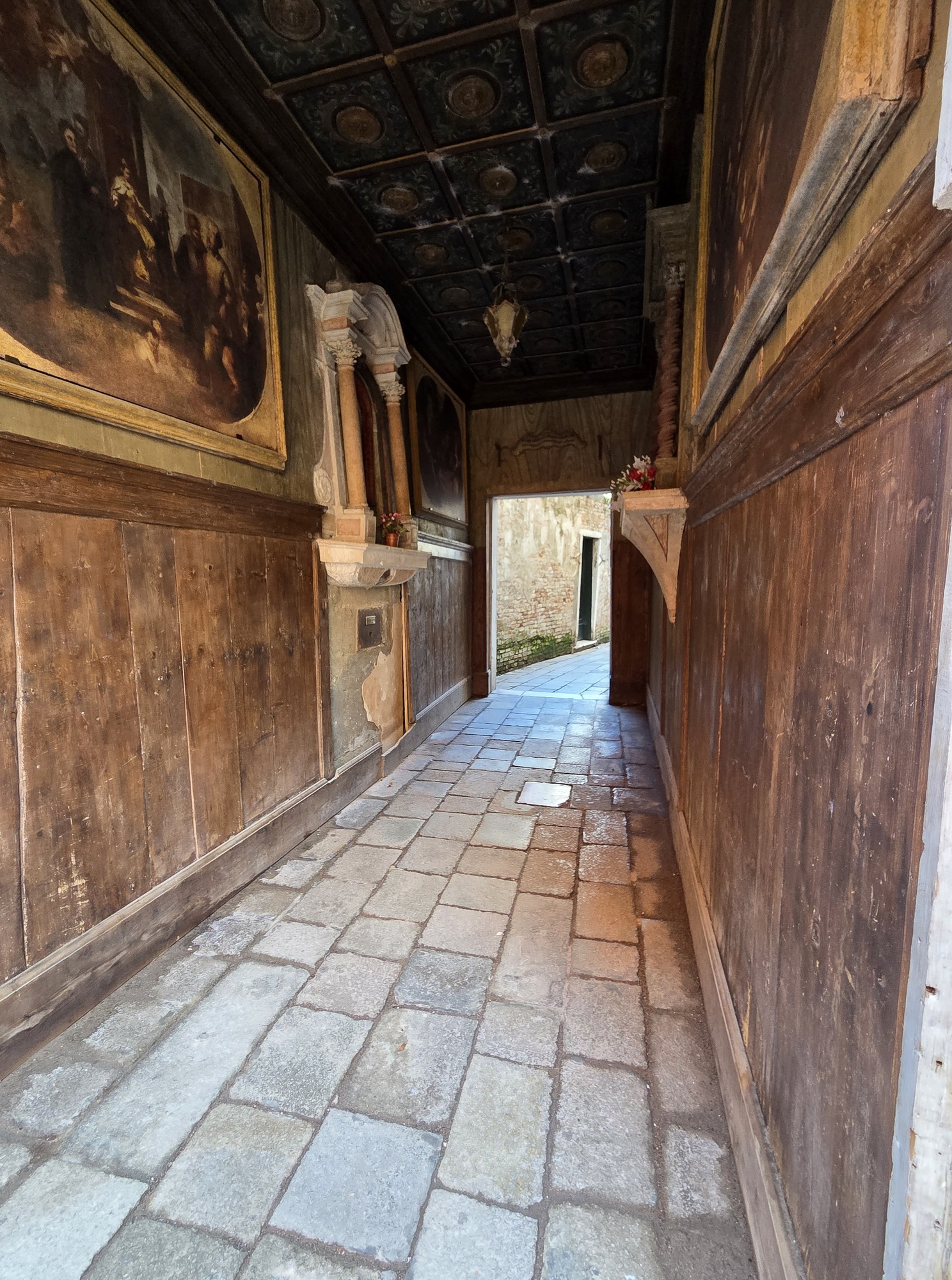
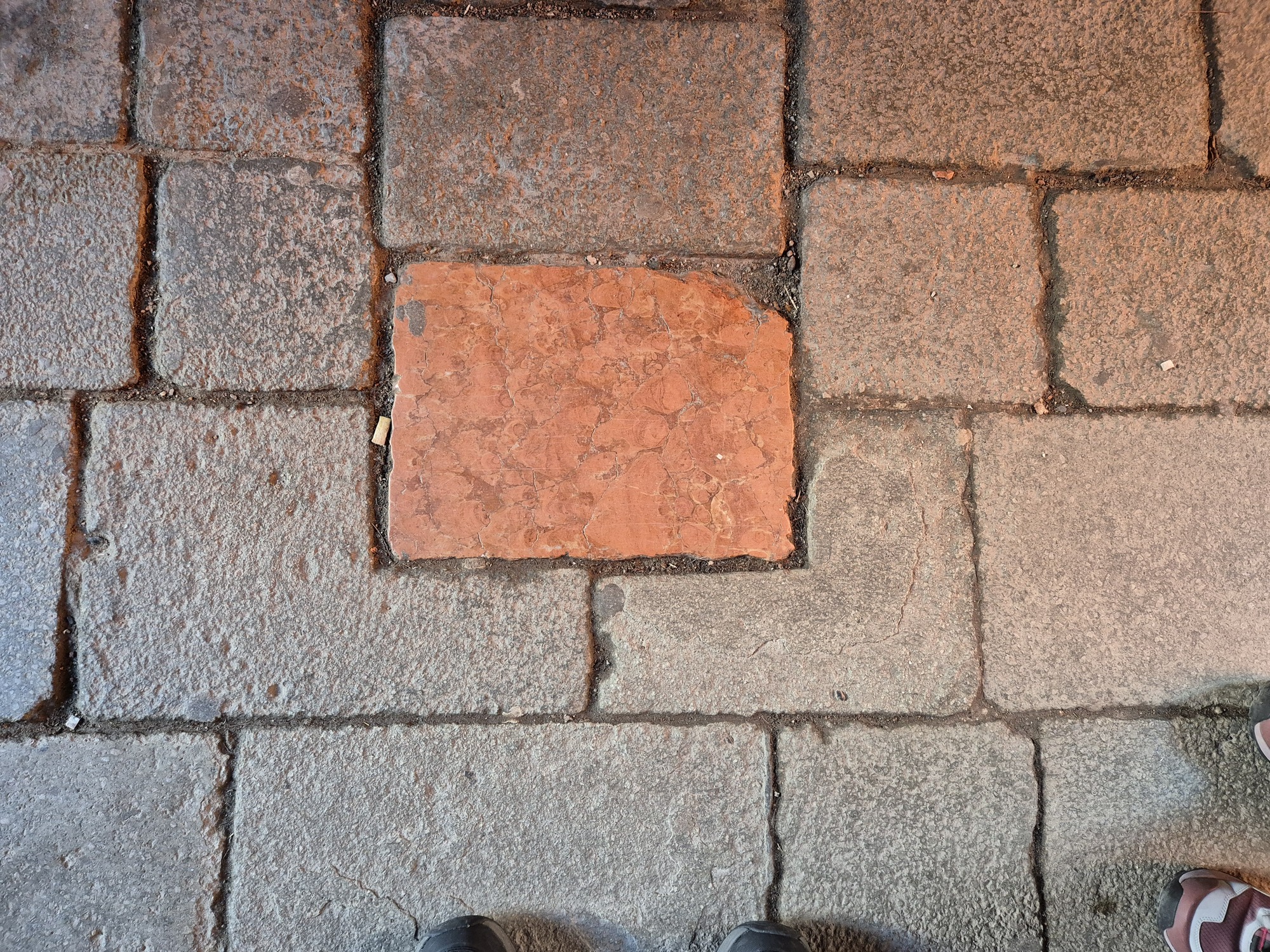
Top Row: Baroque Church in a narrow calle, far from the crowds of San Marco; A sotoportego (underpass) with a shrine dedicated to the Madonna for ending the plague in 1630; The Plague Stone is the only red stone in Venice and is said to bring bad luck if you step on it.
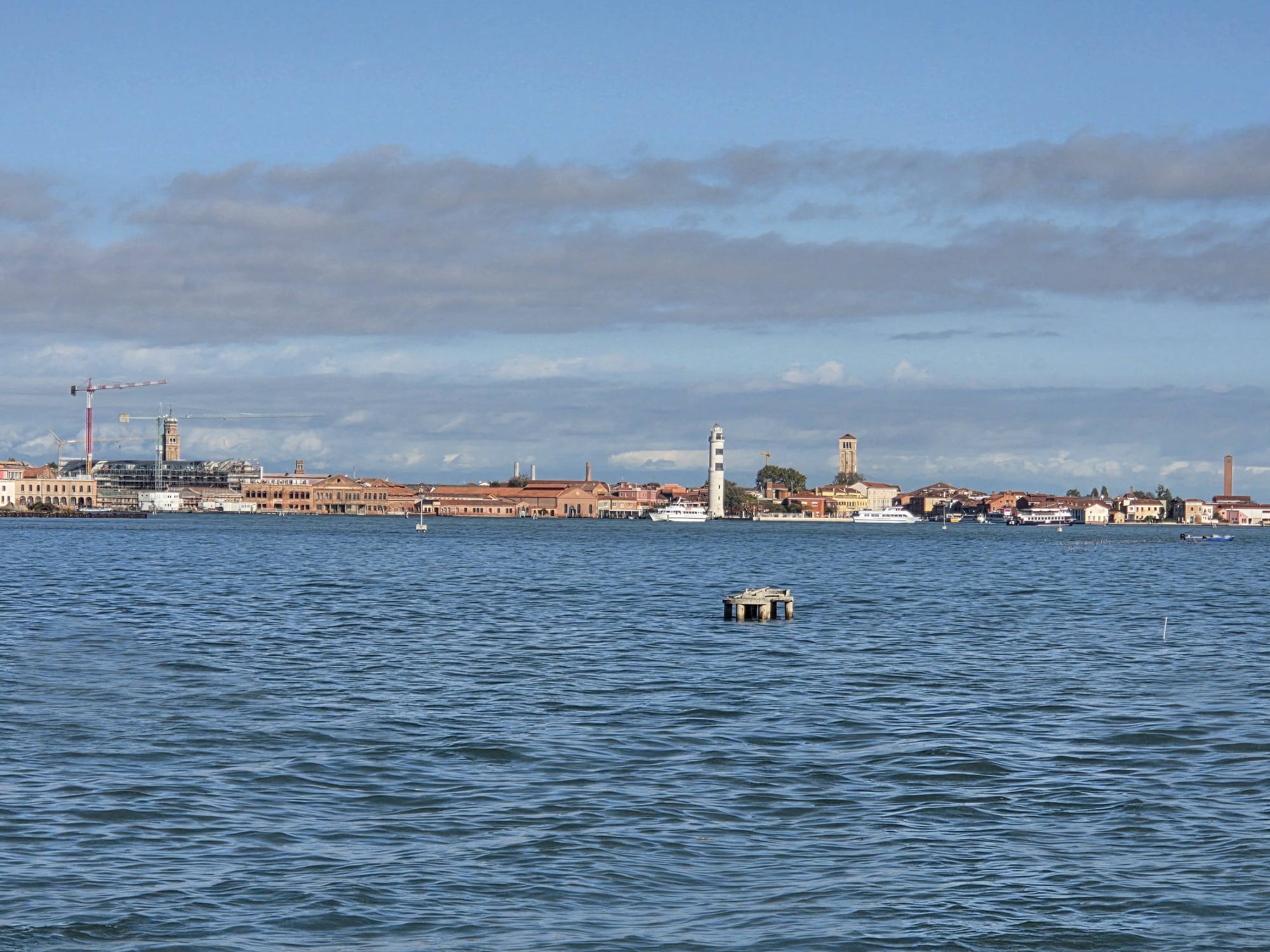
Bottom Row: The metal walkway along the imposing wall of the Arsenale; View of Murano from the walkway.
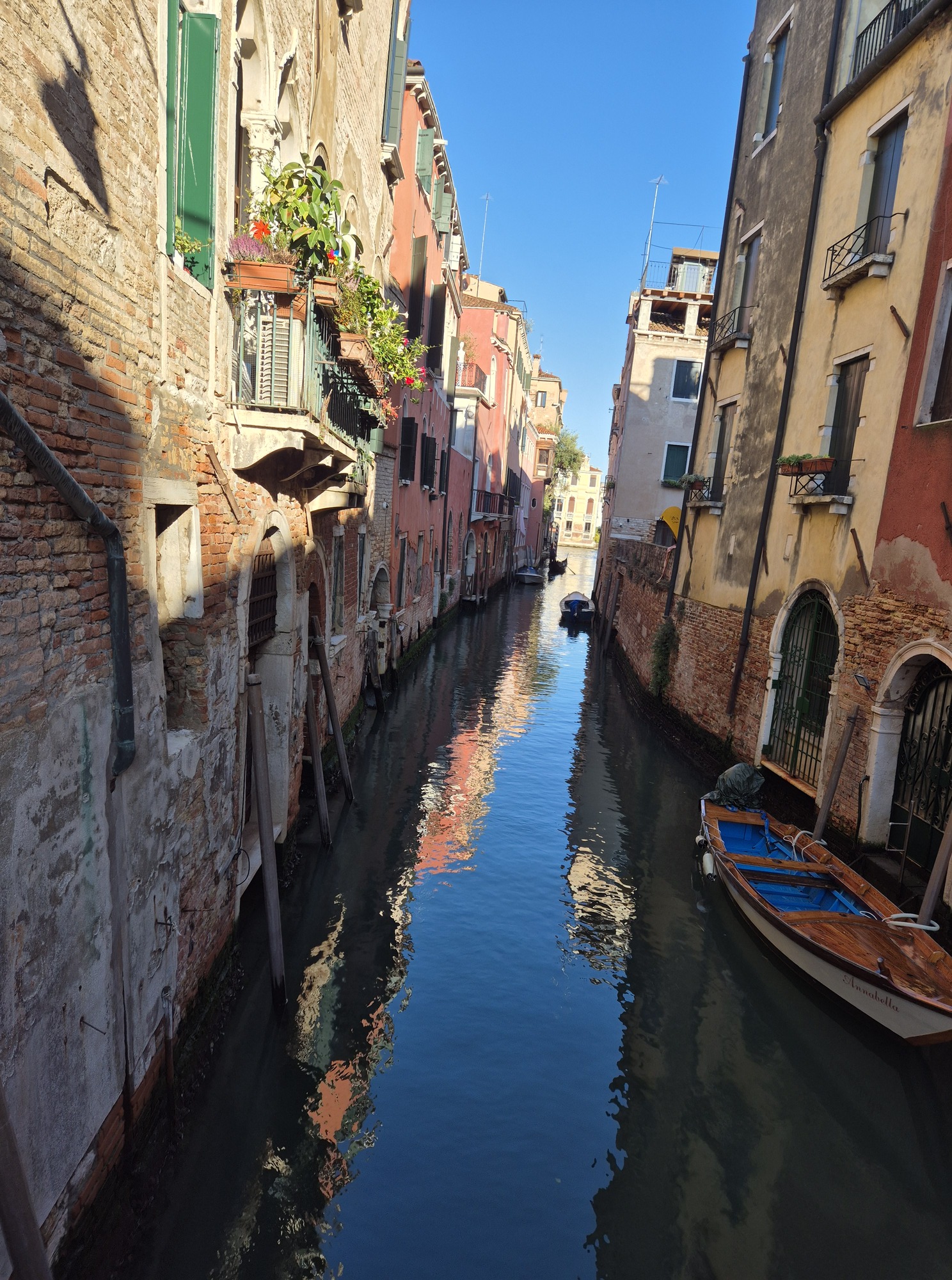
A few more Venice pics on a delightful October day with glorious light.
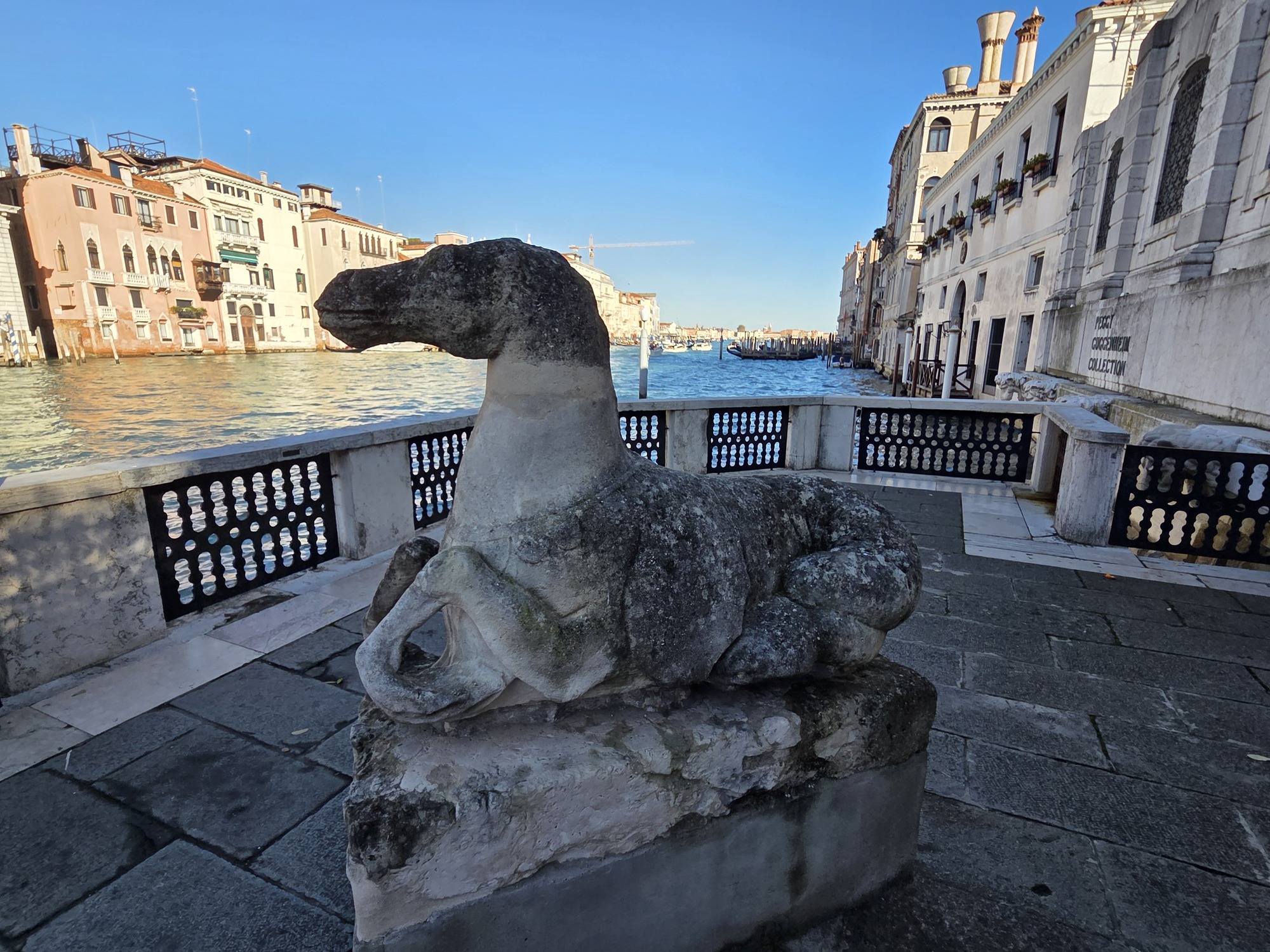
Top Row: Grand Canal view; Quiet canal; On the Guggenheim’s terrace. Middle: Selections from the Guggenheim Collection; Bottom: Peggy’s view of the Grand Canal.
This portion of our trip, two weeks in Ferrara, was day-trip centered. We dislike, in general, a lot of short stays of 2 and 3 nights, preferring a week, or more, as a base. In other words, SLOW TRAVEL This has served us well in hiking locations like Ortisei and Lauterbrunnen as well as in cities like Paris, London, Rome, and even Venice. In those places we’d head out on a hike or out to see a sight, returning as needed to our digs for meals or just to rest. Doing day trips from Ferrara, however, was challenging as we had several very long days door-ro-door with significant transit time. The good news is, that transit was by train. The downside is that a lot of the trains are regionale, meaning “local” trains that transport people to work and school and stop at many many places and ae often full of high school students.
Upside? We had a great apartment and delightful host. I got to speak Italian quite a bit as it is not a prime tourist destination. I don’t think I heard one native English-speaker until our last night in town, and she was married to an Italian raising bi-lingual children.
The food in Ferrara was excellent: cappelletti with pumpkin and ragu, pasticcio, and a tremendous pizza at Settantatrepercento, aka 73%, the percent hydration in their perfect crust.
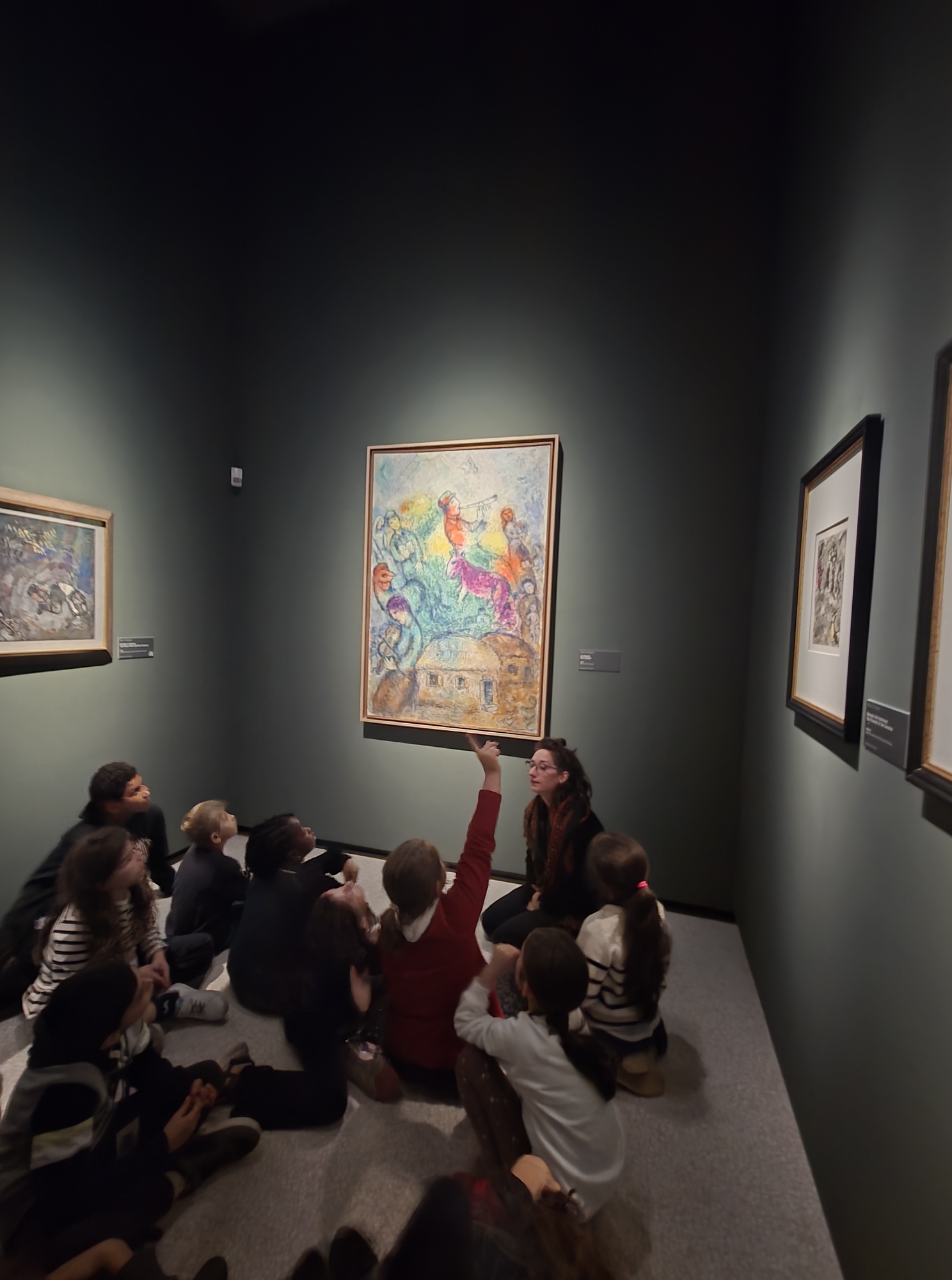
Ferrara is a very old city with an interesting history involving the Dukes of Este and the Papal governance after the duchy failed to produce an heir. We had great food and an insightful private walking tour. We walked the entire ancient perimeter wall (mostly intact) of about 6 miles, and saw an amazing Chagall exhibit that happened to be in town. We filled in with myriad day trips by train: Padova, Ravenna, Florence, Bologna, none of which had we visited in many years. Truly enjoyed seeing them again. Those mosaics in Ravenna! The Scrovegni Chapel in Padova! Florence was not as crazy with people as we feared it would be and we found a delightful trattoria where it seemed mostly locals were lunching. Venice still screams at me to come back and spend a few more nights. Click on any picture for a better view (unimpeded by captions).
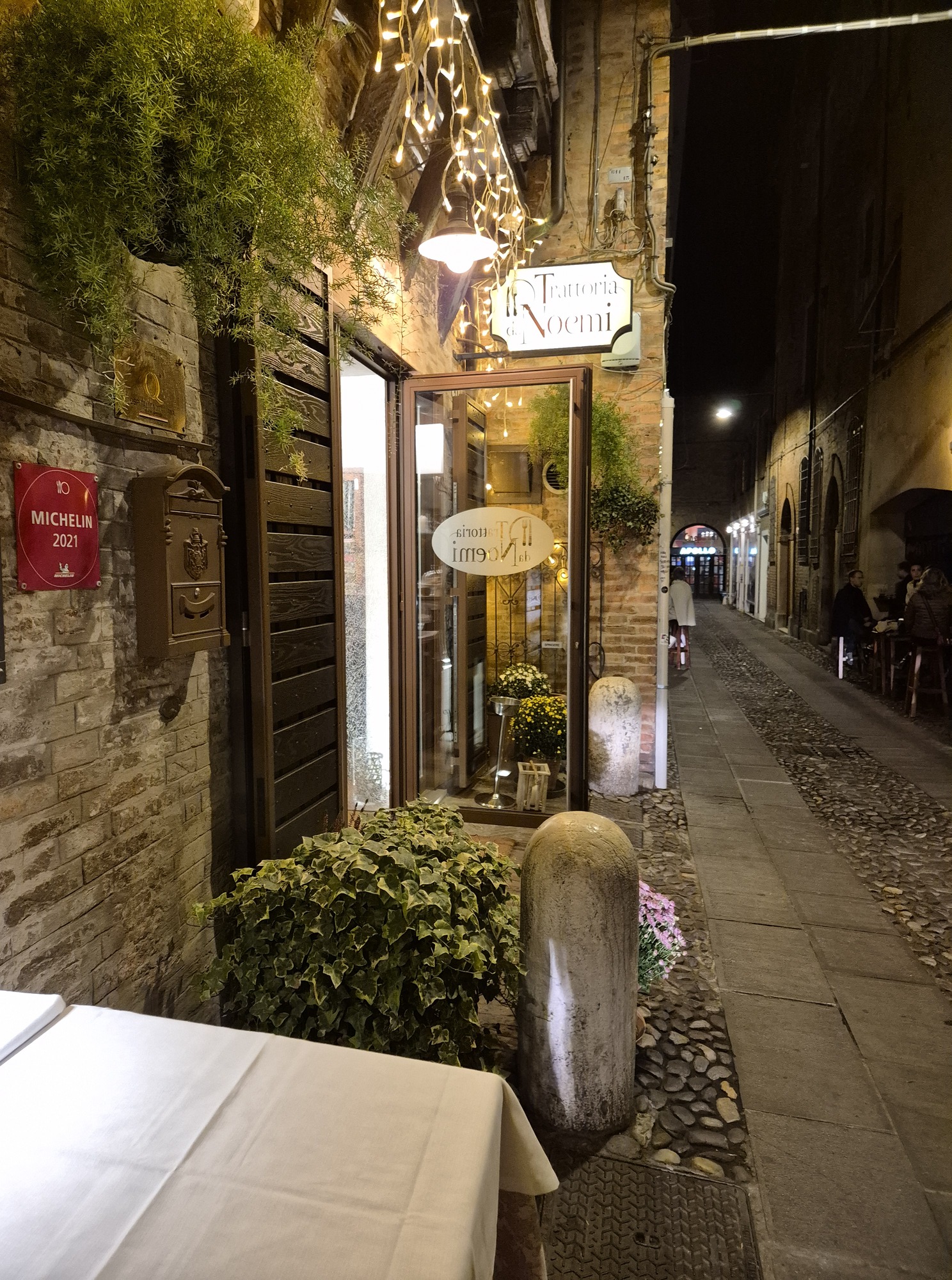
Path on top of the 500 year old Ferrara wallThe wall from path below. Most of it is intact.Lovely, level path for cycling and walking.Ferrara city plan, depicting the city of the 17th century.The chevron bricks on the right installed in the Este duchy. on the left, the cobbles of the papacy which dominate the streets today.On our tour, outside the cathedral.It is still spritz season! We found “our” bar in Ferrara the second night. Outstanding pizza at 73%.Trattoria di Noemi became our favorite. Intro to the extensive Chagall exhibit.Chagall’s “Russian Village,” 1929. Charming style.School group very enrolled in their teacher’s discussion of Chagall.
Samedan, (see Graubunden Wrap-up) our first two-week leg, was excellent and probably our favorite. Lots of outdoor time, great Swiss trains, mostly good weather, well-equipped apartment and a lovely host. It’s a tiny town that does not draw tourists like its neighbors. They speak Italian as well as German, so that worked nicely.
Basel was interesting in itself, but harder to day-trip from as it turned out (see Basel Wrap-up). Everything in Switzerland was relatively easy to reach and there are cute towns and villages everywhere with ancient castles and charming streets. France was more challenging to reach due to poor transportation connections. We had hoped to spend more time in the Alsace but it was too difficult without a car. The best of the Black Forest in Germany is also a bit far removed from Basel to visit by train. To us, a decent day-trip should be within an hour by public transport. 90 minutes is OK, but two hours each way is a non-starter.
Ferrara tested our plan to try a base with regional day trips. We would not do it again and that is not to detract from Ferrara. Some of the rural places I counted on visiting by bus became impossible due to the schedules. Oh to have Swiss transportation everywhere!
We learned that we still do not want to drive. Thought about it twice, in Basel and in Ferrara, but rejected it as too stressful. In Basel, the cost of the rental was cost-prohibitive (about CHF 140.00 per day!) though the driving would have been more efficient and supported a wider range of options. In Italy, the cost to rent was not awful, but parking in Ferrara is at a premium and in some of the cities we visited by train, very hard to park as well, not to mention the dreaded ZTLs where you get fined if you enter.
We also learned that a first visit to an area should probably be in the 3-to-5 night range. Better to leave wanting more time than less. You can always go back. That does mean moving around more and less of what we see as SLOW TRAVEL. As we plan our trip for next fall, we are already thinking of visits to some of our favorites again, after a year off from Ortisei and Lauterbrunnen. But we’ll add in some new stops as well, as we continue to look for more places to call “favorite.”
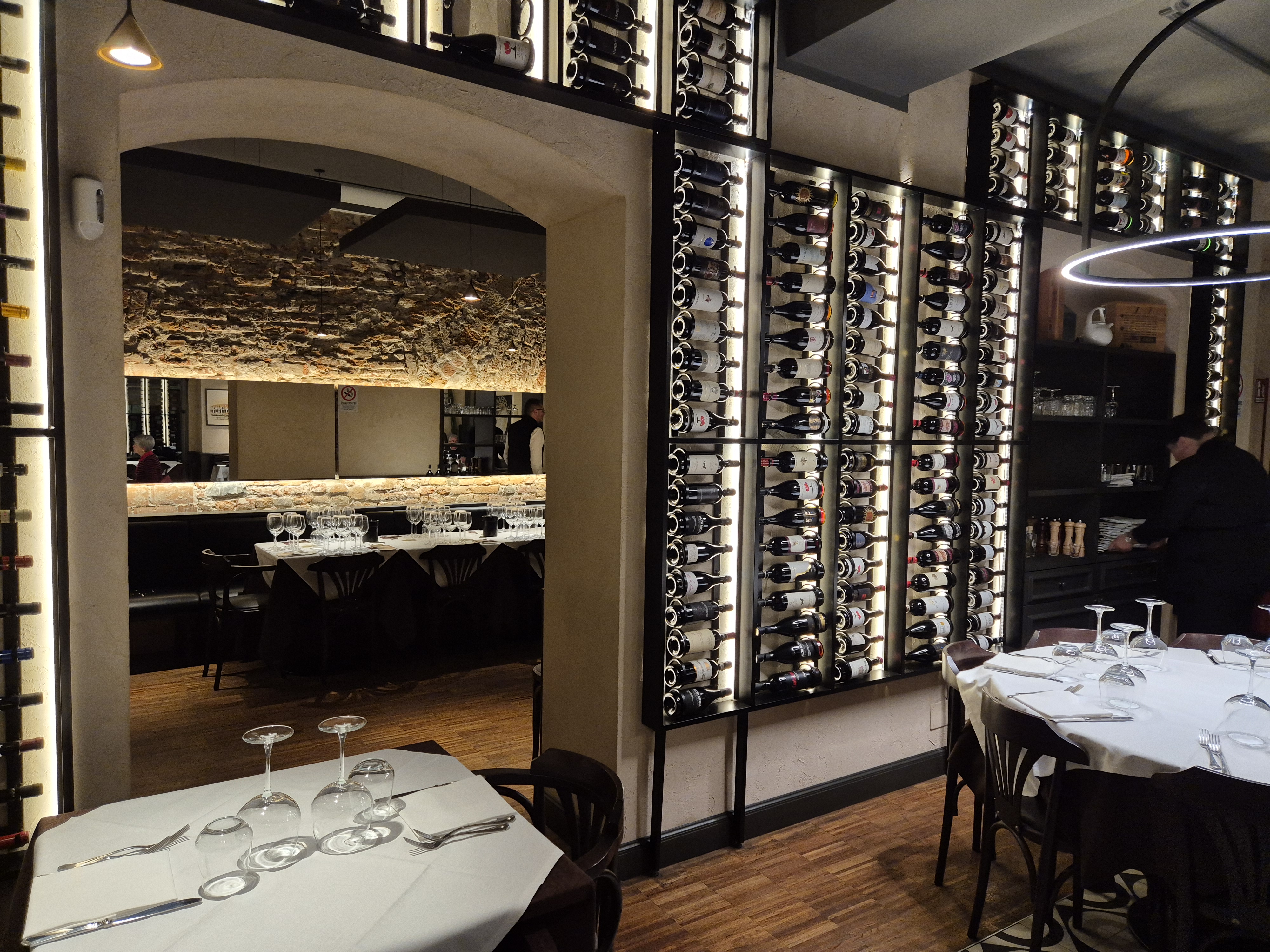
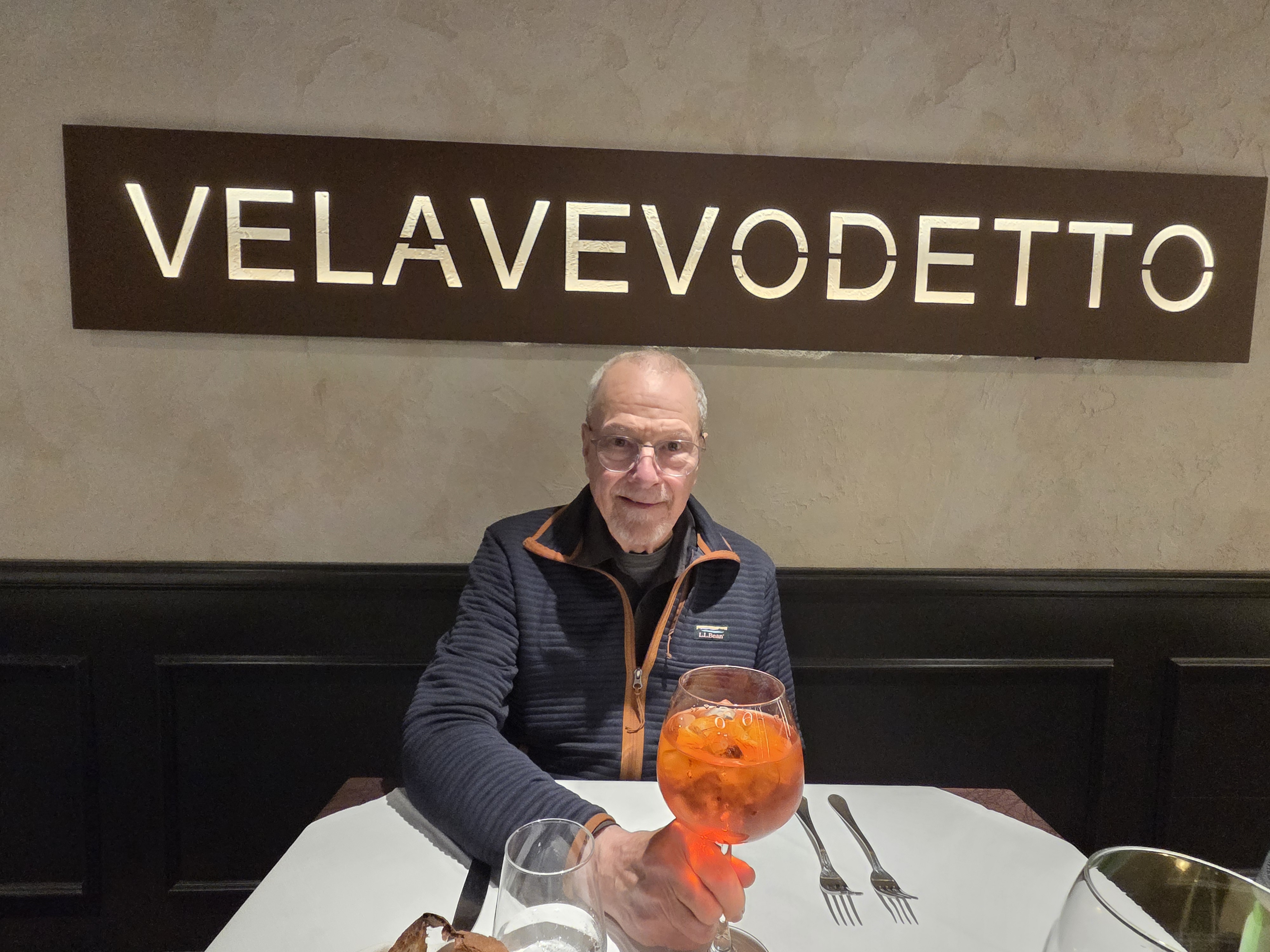
We wrapped up with a pre-flught stay in Milan, which is usually an annual stop for us. We have a favorite hotel and a restaurant we have dined at for over a decade, but this year we discovered a new-to-us restaurant called Velavevodetto. The original, Flavio Velavevodetto (Flavio, I told you so), is in Rome but we never managed to get there during our residence. We love Roman food so a tram trip across Milan on a pleasant October evening was appealing. It was terrific. Have to arrange a stop there again next fall.
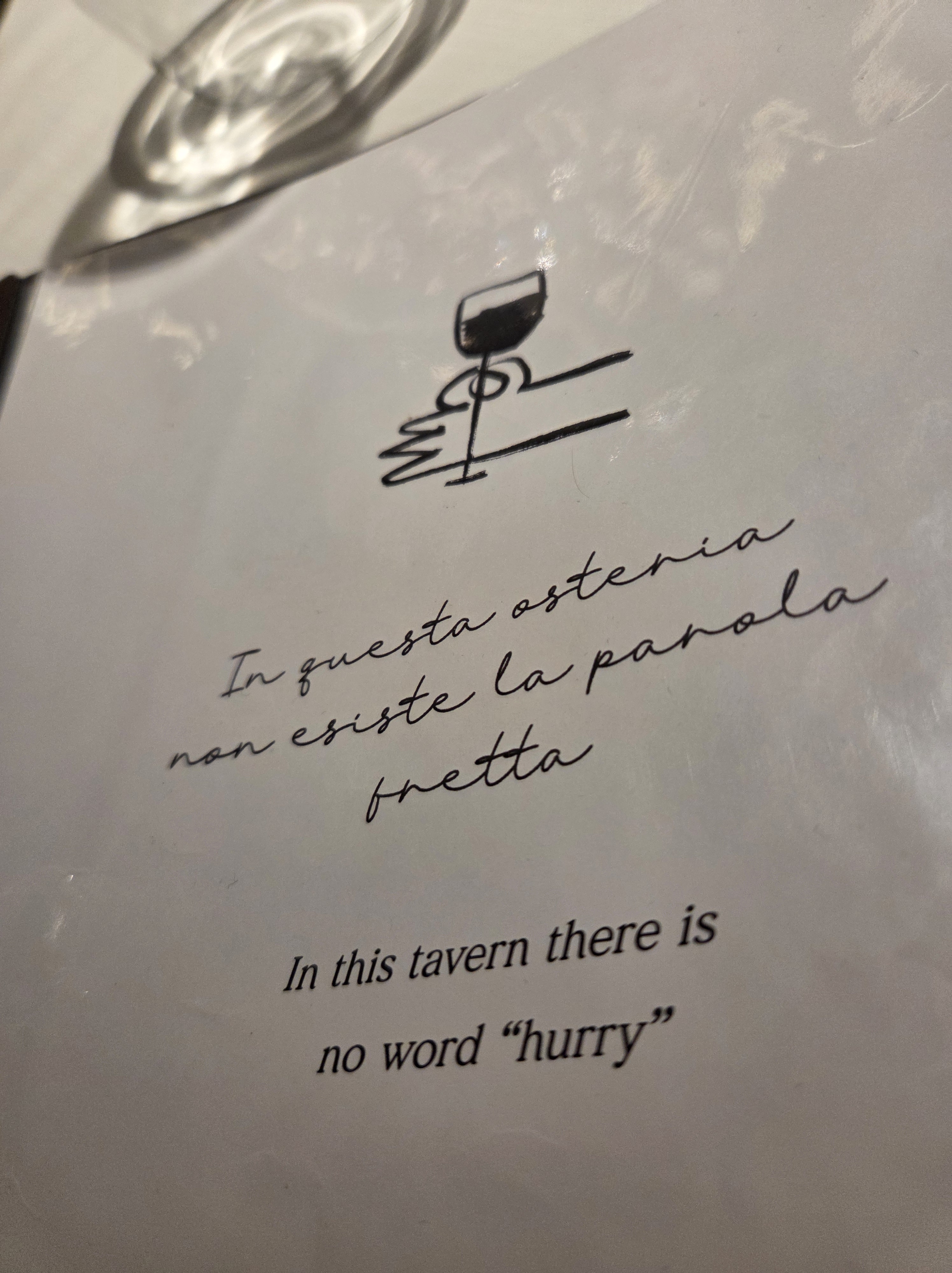
Elegant interior, lots of wine.From the menu, the philosophy.A Roman suppli, a bit like an arancino. Even Ric’s tripe looks delish. My pollo alla RomanaVelavevodetto means “I told you so!”
Schweizerdeutsch and Italian mix with occasional Chinese and other tongues and reverberate off the buildings in our neighborhood. Children play outside and even adults glide by on scooters and bikes, laden with packages from the nearby Migros. Apartments blocks are six-stories high and and tightly packed, as with any high-density city. Parking is scarce. This normal, middle-class neighborhood in a vibrant city has been our home these past two weeks.
We chose Basel as a base for two reasons: (1) It is somewhere we have never spent any time and (2) its location in the tri-country region, the Dreiländereck (border triangle) of Switzerland, Germany and France, offered the opportunity to explore a small part of Germany, the French Alsace, and this pocket of Switzerland.
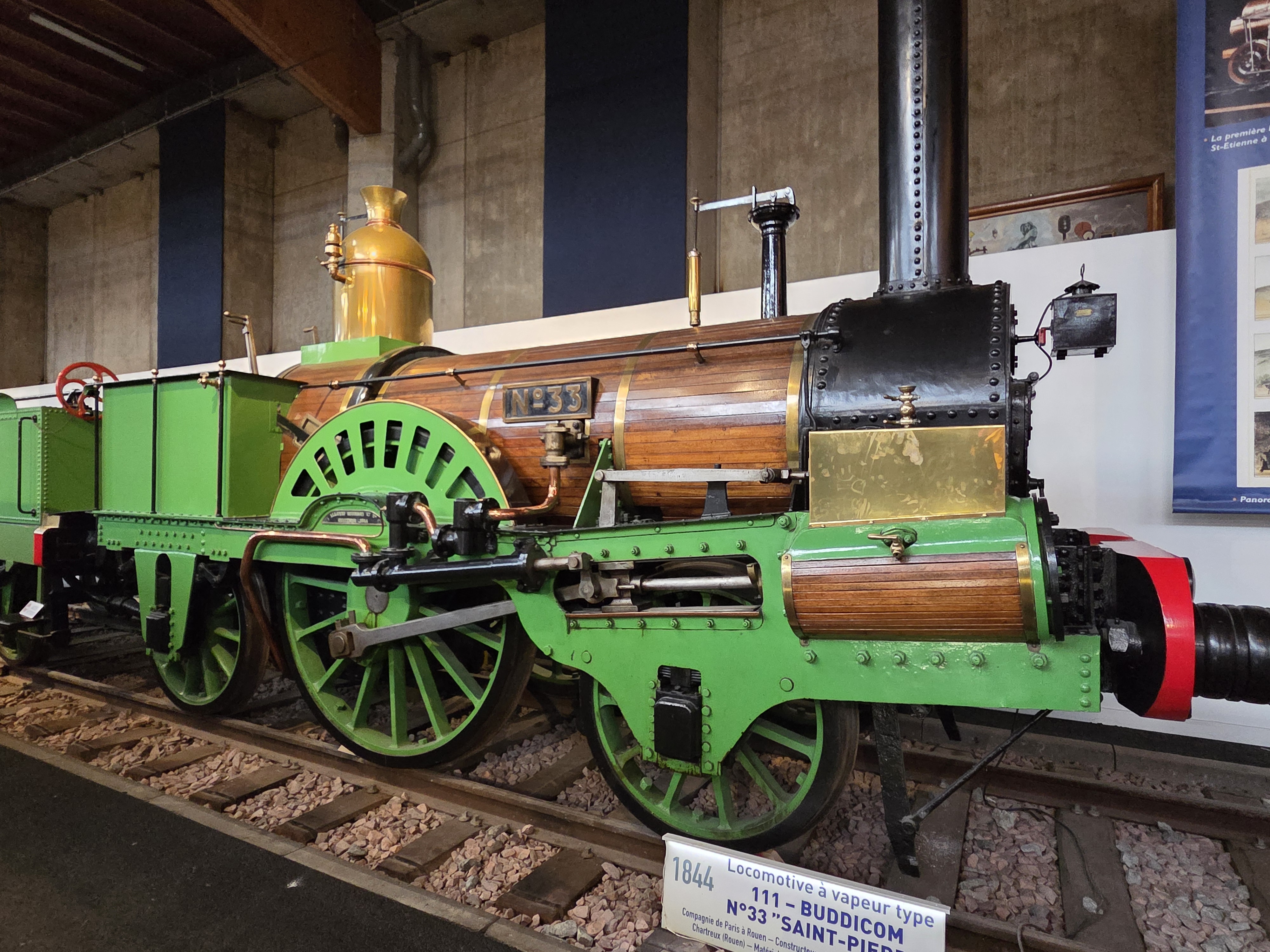
Ric at Cité du Train, the largest railway museum in Europe, with a vintage carriage; One of many vignettes staged in older railroad carriages, this one depicting an Italian family in 3rd class early 20th century.The oldest locomotive in the collection.
This year’s plan is to spend two weeks in each of three mostly new-to-us locations, establish a base, and explore the area. Samedan, our earlier stop, we had passing familiarity with as we had stayed in nearby Pontresina twice (see On the Road Again). Our familiarity with Basel extended to changing trains here several times over the years and grabbing a coffee in the station.
Our apartment is on the 3rd floor (4th American) of a late 20th century building: in other words, modern. Jennifer, our kind host, fully remodeled the unit a couple of years ago so it is quite comfortable and easy to live in. The windows have great soundproofing and automated shutters, critical as those charming neighborhood sounds become annoying when the gathering across the street, watching a match on Saturday night, cheering and jeering, are still doing so at bedtime. There are three grocery stores within easy hoofing distance, and the tram stop is the next block over.
Basel is a nice, medium-size city with a charming Alt Stadt (old city). People slip in-and-out of German, Swiss German, French, Italian, and English seamlessly. As a crossroads for centuries (the Mittlerebrücke is one of the oldest bridges on the Rhine and in the 14th century became a significant crossing for international trade) the residents are accustomed to foreigners, although these days many visitors are here to take a Rhine River cruise, or to finish one.
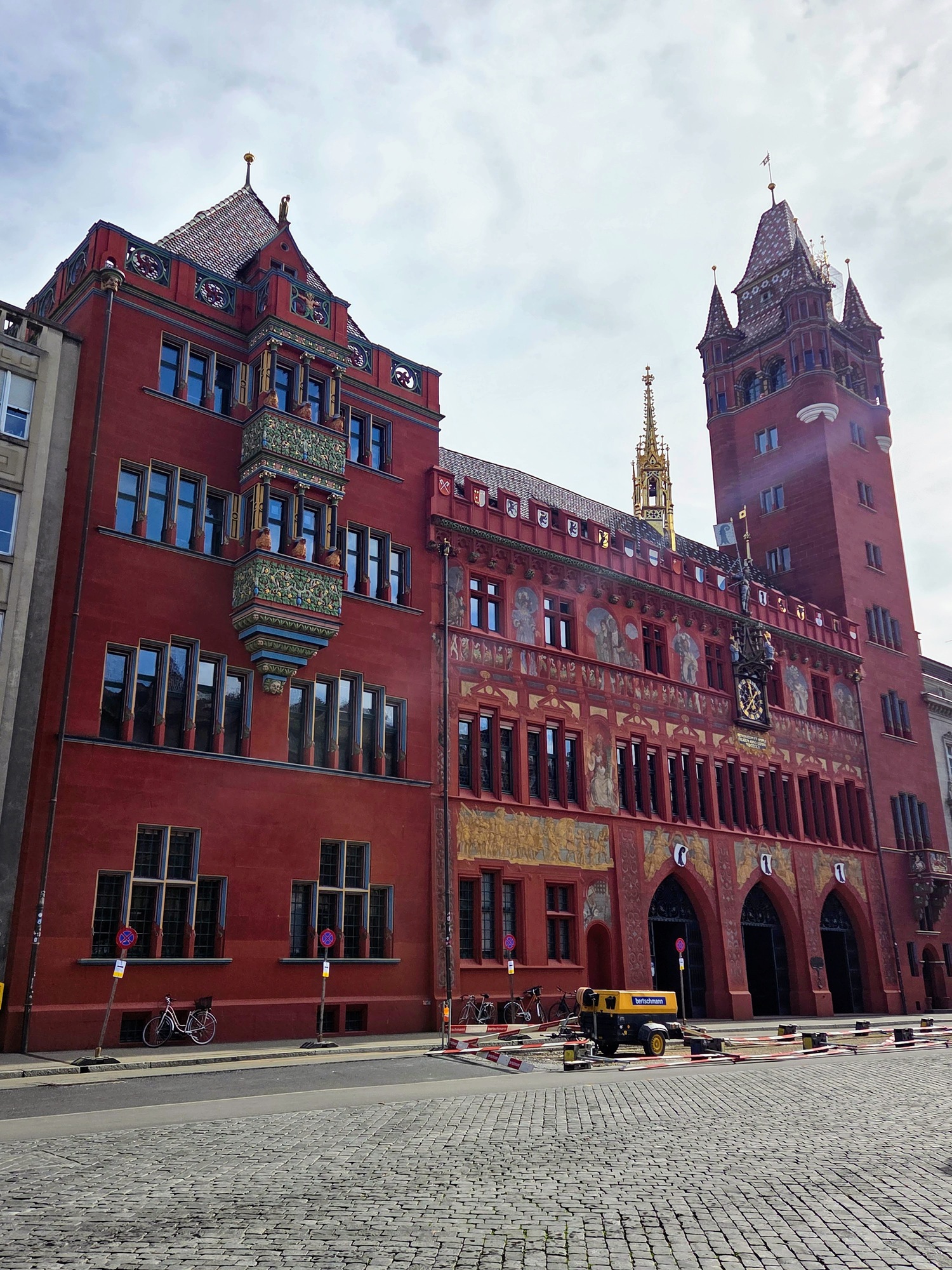
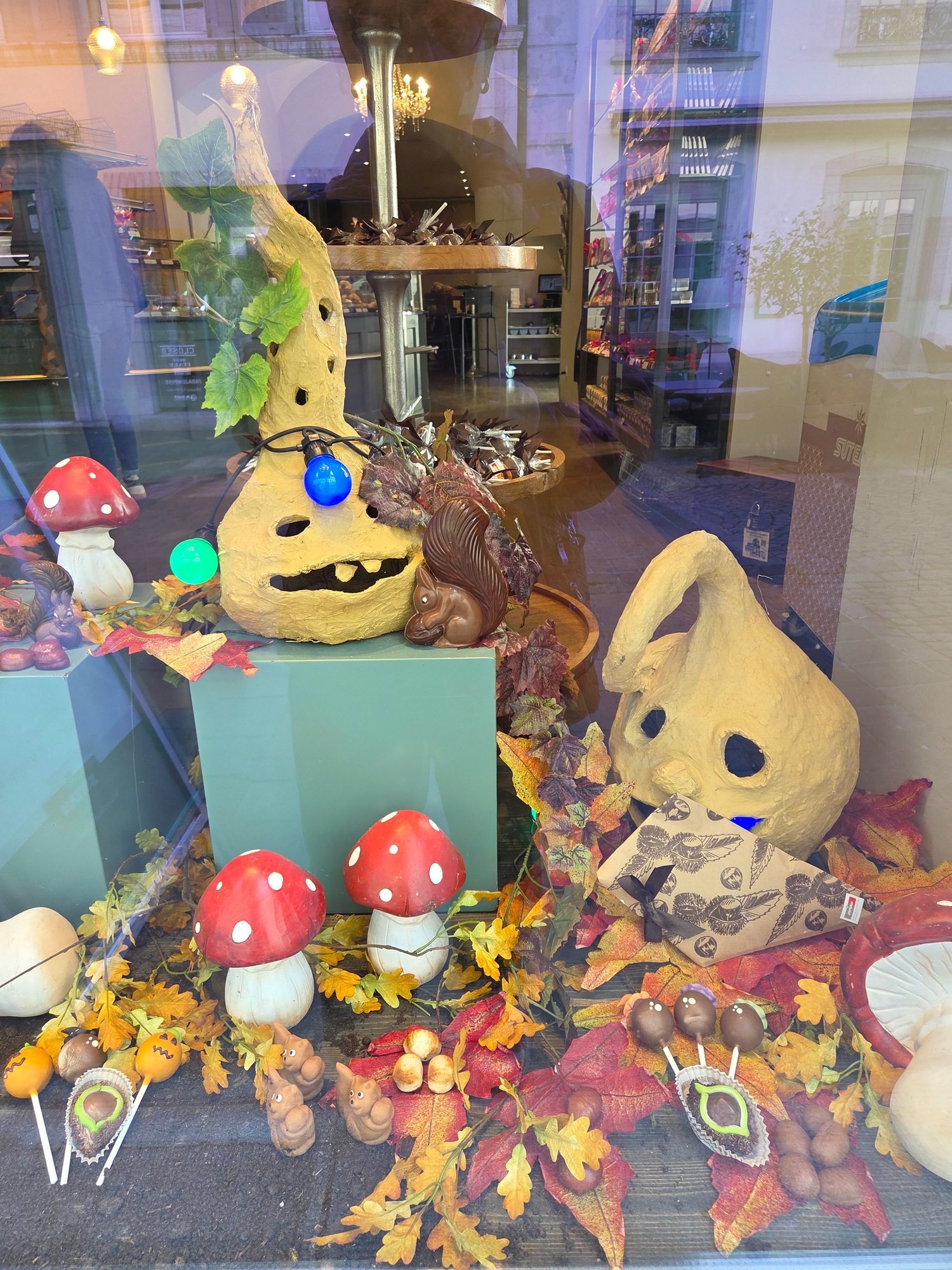
The Basel Rathaus, 500 years old. The Swiss pronounce it ROTE-haus which is a play on the color red; Halloween window decor; My delightful Pacific omelet at Sunday brunch
Exploring has been challenging without a car. I thought briefly about renting one for two or three days, but I find that stressful overseas. I do not even like driving at home so one of the benefits of our travel method is not having to drive AT ALL. The trains are, of course, amazing, but transit times can be frustrating. It takes 1.5 to more than 2 hours each way for some of the places I had scoped out to visit. That’s fine a couple of times a week, but not daily.
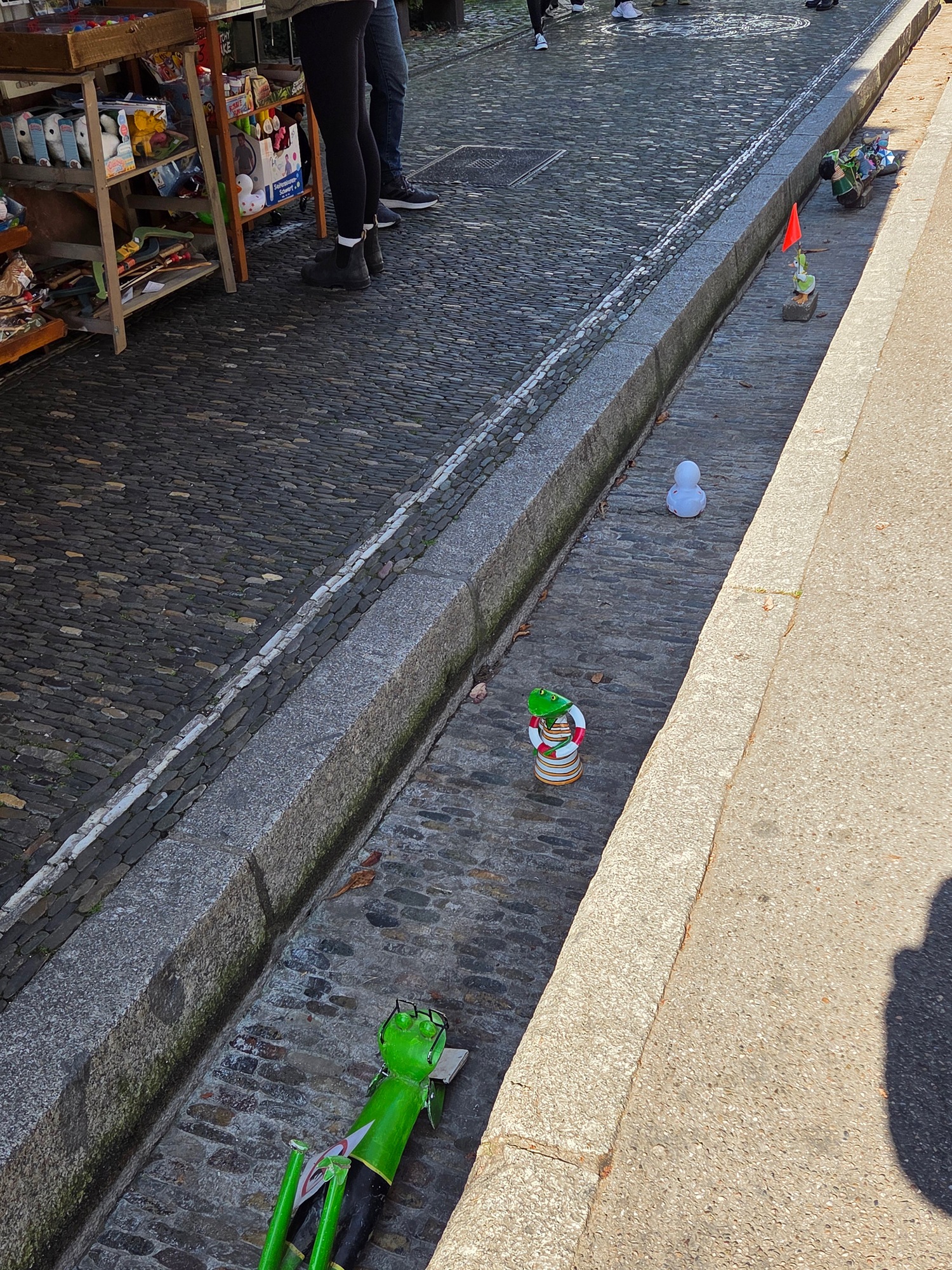
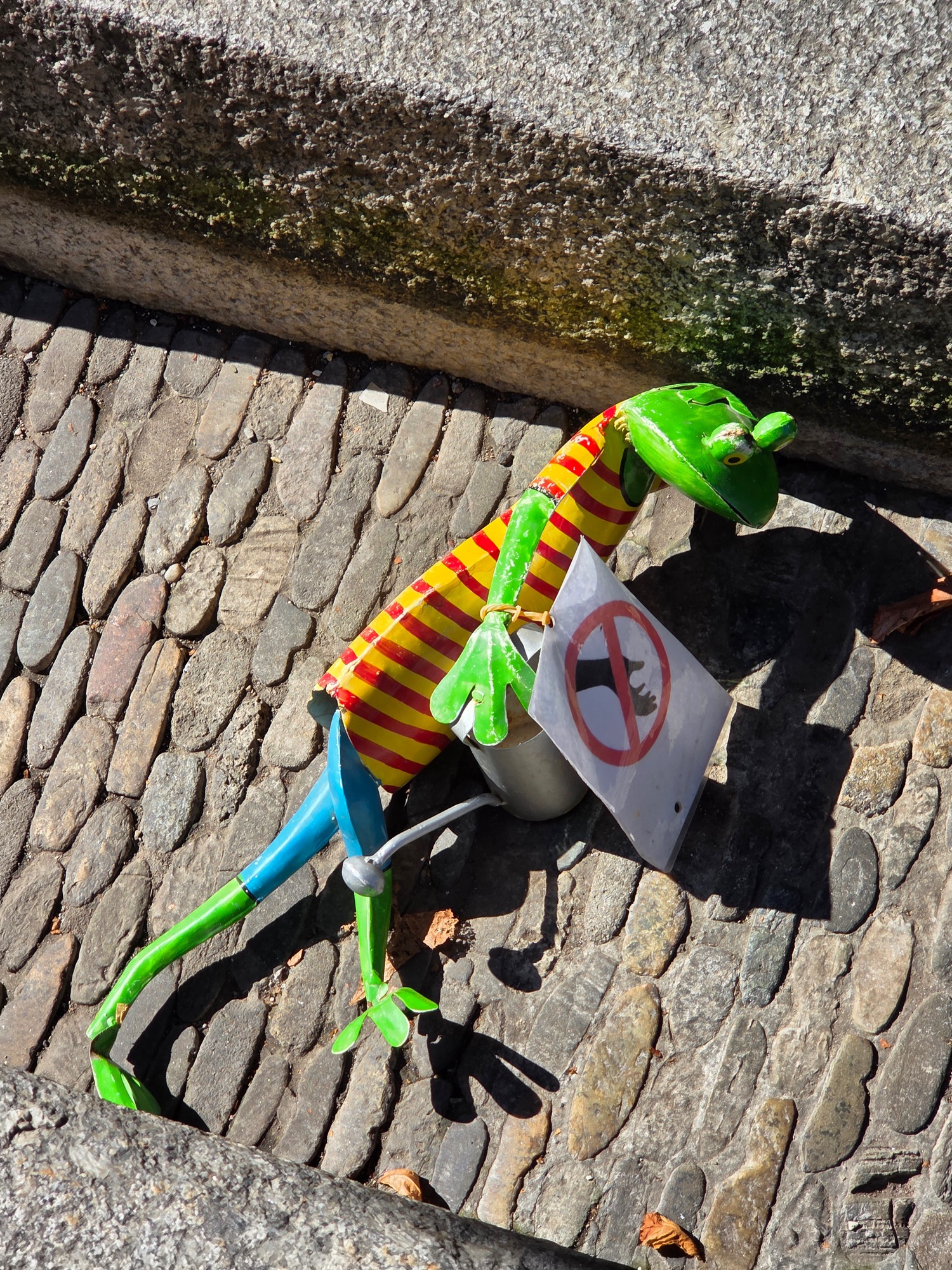
Scenes from Freiburg im Breisgau: The Munster from the top of the Schlossberg; The unique channels in the street to manage water accentuated with little figures in front of a toy store.
Still, we found things to do and visited some lovely and interesting places.
Our path to lunch “art” walk (Crossing Borders) was obscure but lovely and so very close to the city yet far away in atmosphere.
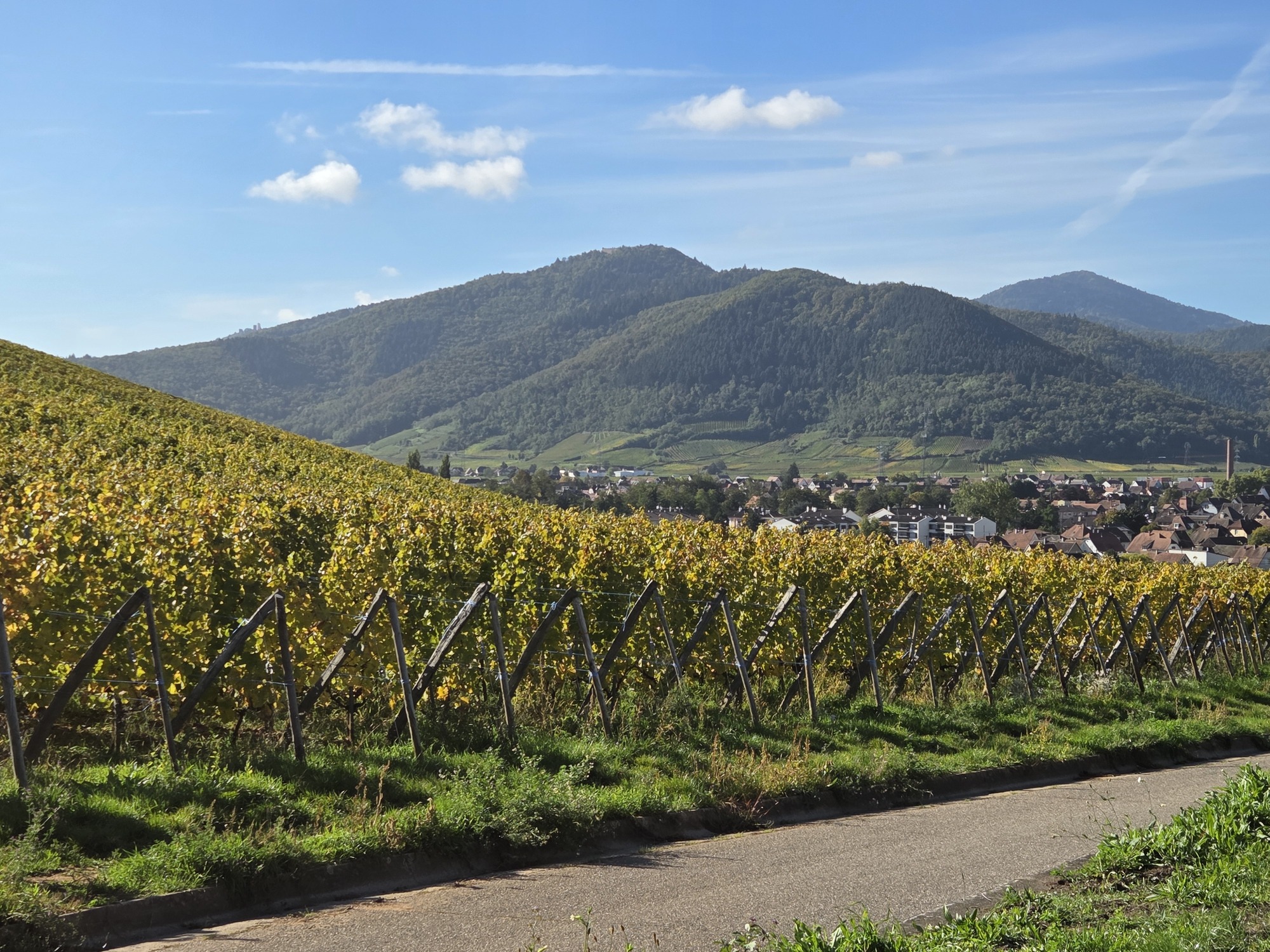
A circuit through vineyards above Turckheim and lunching on an Alsatian specialty, the Tarte Flambé.
Visiting the old towns of Solothurn, Freiburg im Briesgau, Neufchâtel, and Rheinfelden, each with its own character and few tourists.
The largest railway museum in Europe, the Cité du Train at Mulhouse (muh-LOOZ) France. Unbelievably well curated and interesting.
An informative and free city walking tour in Basel (tips appreciated and well worth it).
The Basel Zoo where we were introduced to species with which we were unfamiliar. Black-and-rufus Sengi, anyone?
A walk in an Alsatian wetland La Petite Camargue Alsacienne, just a quick train ride into France, near the airport, but a world apart.
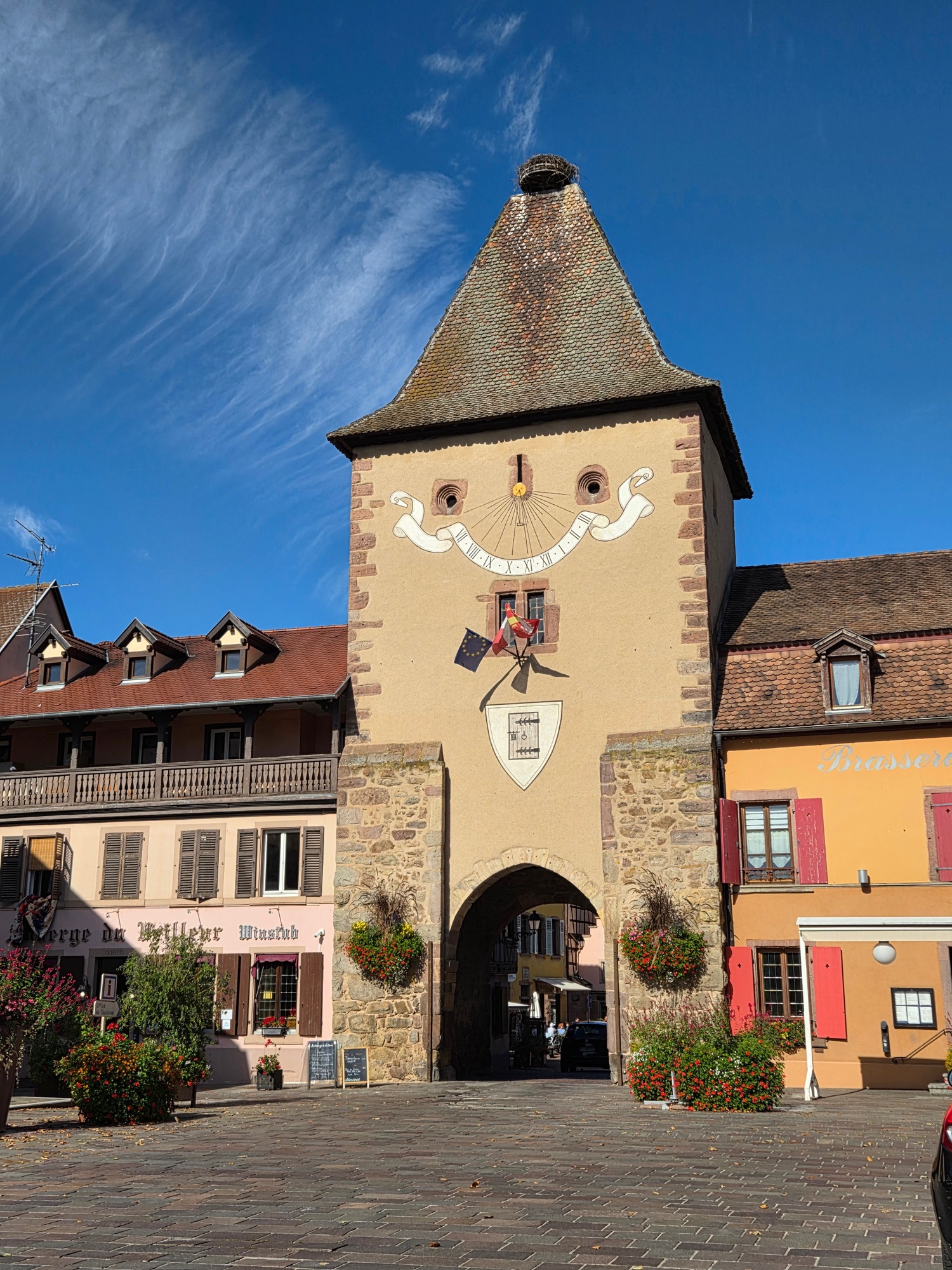
Cute little Turckheim top row: Gate, once imposing now welcoming; Main square with church; my Alsatian Pizza, aka Tarte Flambé. Bottom row: Vineyards surround Turckheim. We saw almost no one on our walk, just farmers in their fields. Last photo, the Collegiate Church at Neuchǎtel.
We are not museum people, as a rule. These days they are places to go when there is bad weather or there is a particular show or collection to view. (Although, I would go the the Orsay any day, if only for the Van Goghs.) The Tinguely Museum, with creations from the mind of an innovative mid-20th century artist, Jeannot Tinguely, was well worth our time. That said, there are abundant museums of interest and one could fill two or three days. But we had good weather so ventured out.
Tinguely Fountain, Basel
We missed several places I had hoped to go in the Alsace due to travel times. 2.5 hours each way to Ribeauville was not happening. Ditto the long ride to Strasbourg. The best parts of the Black Forest were just awkward and lengthy to get to from here without a car.
Should we have rented a car? It would have cut travel times but added expense. The train fares, even with a Swiss Half Fare Card, added up quickly. Nothing is cheap in Switzerland, although it was a pleasure to pay in Euros when we ate in France and Germany.
Would we come back? Not for such a long stay, but should an itinerary require a night or two in Basel, gladly.
A two-week stay gives you the chance to get to know a place in a way you cannot in short stay. Not every sight is a Rick Steves Triple Diamond must see, but then we are not fighting the hordes in Europes hot spots. There’s a lot of pleasure in that.
Now we are in Ferrara, Italy, another town that is not on the itinerary of most travelers. So happy to be back in Italy! More to come…
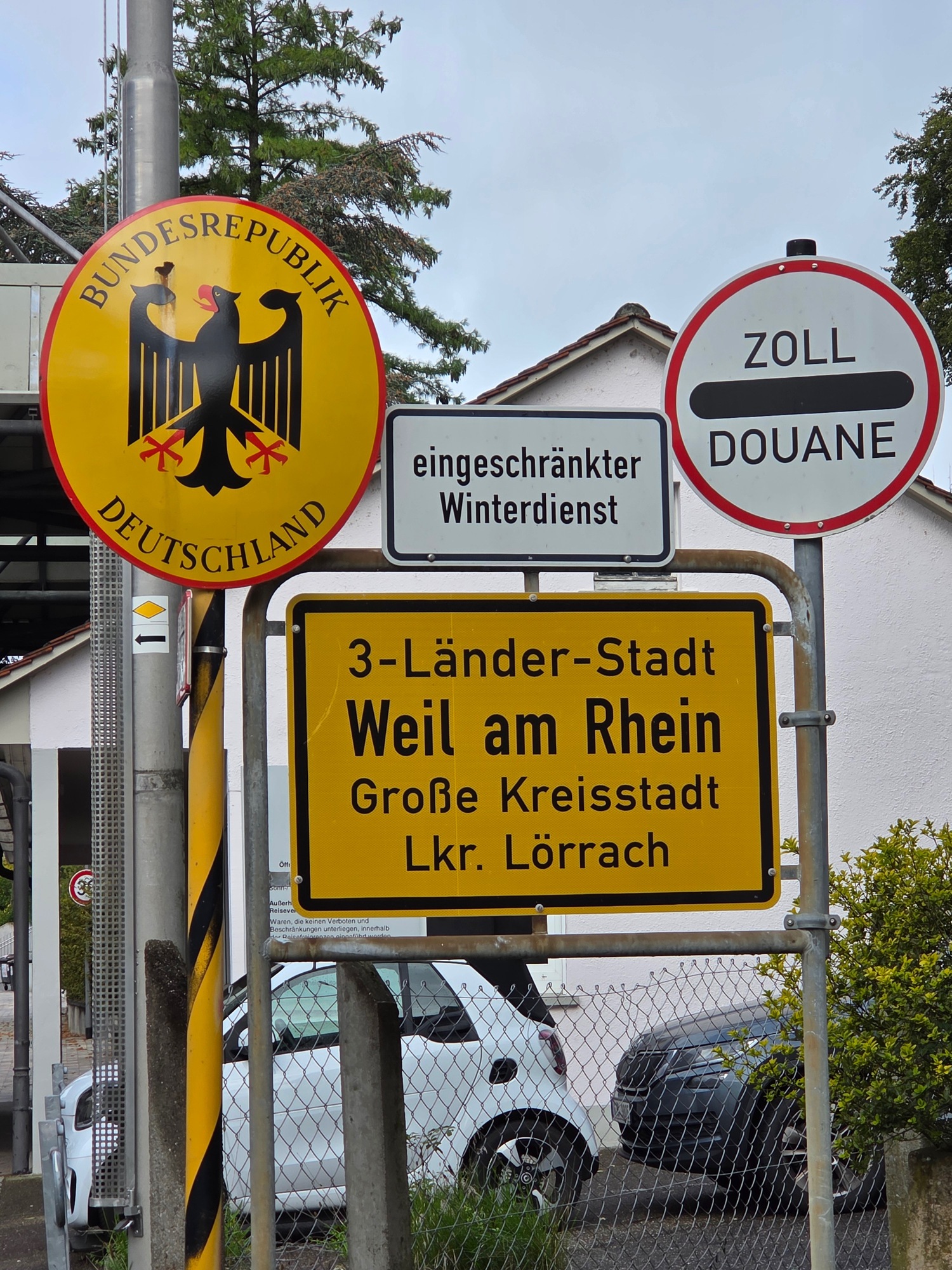
Monday we walked from Switzerland to Germany, passing closed border-control booths. Not in a high-mountain pass. A suburban street was our path, once again, to lunch.
Staying in Basel is part of our experiment this trip: two weeks in each of three new-to-us-places, exploring, finding places less-visited by our ilk, and “living local.” Basel is in a unique international position, a notch of Switzerland that juts into France and Germany and shares the Rhine River with both. This is a strategic shipping hub for Switzerland and the Dreiländereck, where the countries officially meet, is a mere half-hour’s walk from our apartment. Of course, since it is Switzerland, walking there is quite simple.
Our border crossing experience was not as straightforward. Ignoring spits of rain, we traveled by tram (so convenient!) to suburban Riehen to take the Rehberger-Weg, an artistically inspired walk between the Fondation Beyeler Museum and the Vitra Campus (a furniture company and design museum). Finding the start of the path was our first adventure as a construction project forced a detour. The track seemed obvious from there, but as we searched for the first piece of art we found we were off piste. Huh. Luckily, as paths cross-cross this country like plaid in a tartan, we were able to re-route ourselves with only a half mile walk for our trouble.
Top left and center, our inadvertent detour was at least well-trod and scenic; Top right, a vineyard;Bottom a distant view of Basel.
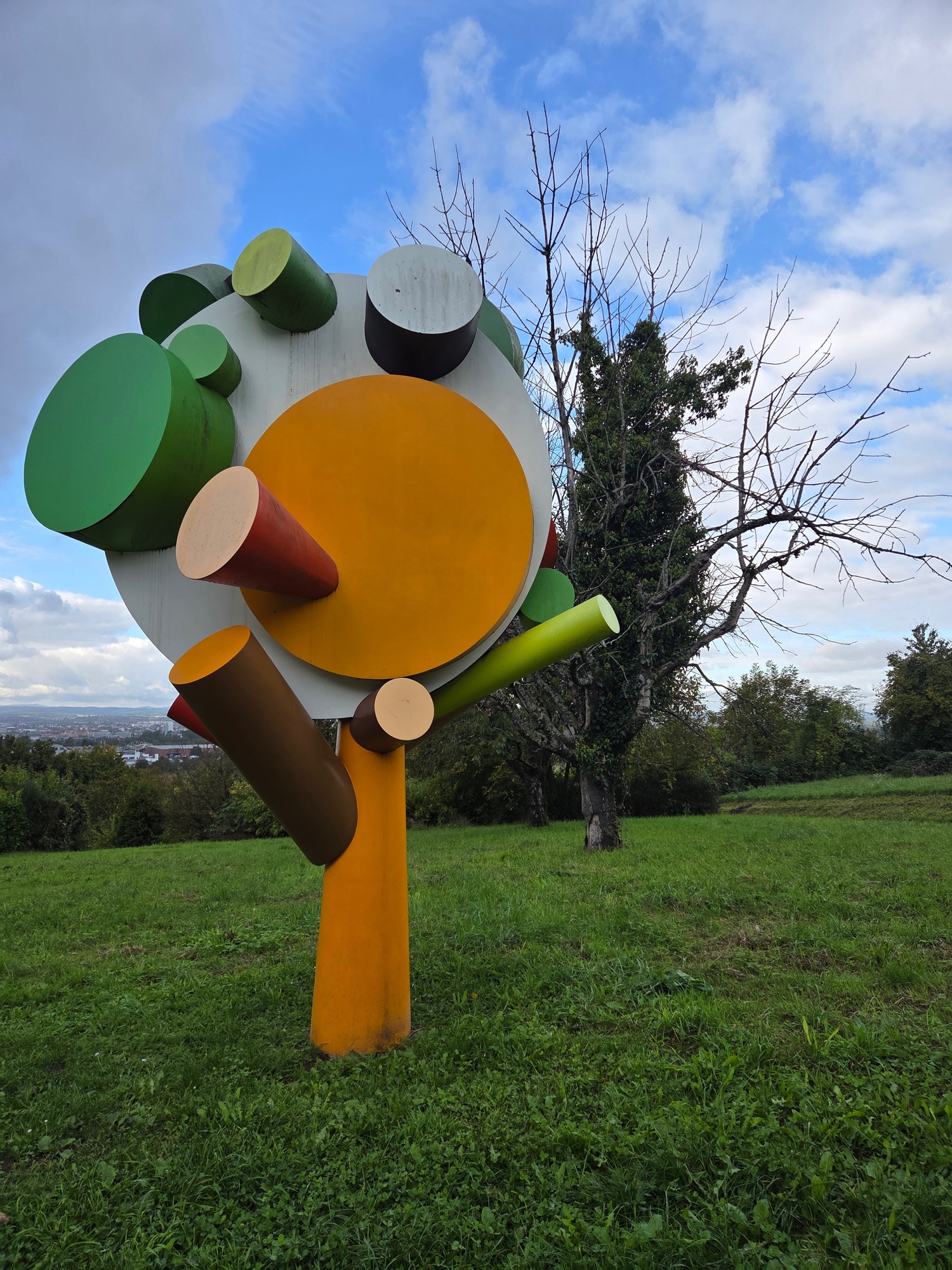
In my defense, I was guiding us with a very stylized map created by the artist. You can see it for yourself using the link above and clicking on Walking Map. Once I decoded what actually constituted art and which landmarks on the map corresponded, the going was simple enough and the views to Basel remarkable. We passed through small vineyards and past garden allotments, encountered little traffic and even fewer people. The art is, to me, obscure. They are (mostly) three-dimensional, brightly colored objects that allude to real things: a birdhouse, a streetlamp, a tree. We had fun making fun of them.
Top Row: Lookout, big enough for a human to climb into; Streetlamp; Signs. Bottom Row: Drinking Fountain (yes, it works!); Tree
The possibility of rain evaporated and we arrived at the Vitra Campus just in time for our Noon lunch reservation. Lunch in Germany, priced in Euros, was a treat both gastronomically and economically. A bus directly to our neighborhood left from Vitra every half-hour made our return uncomplicated.
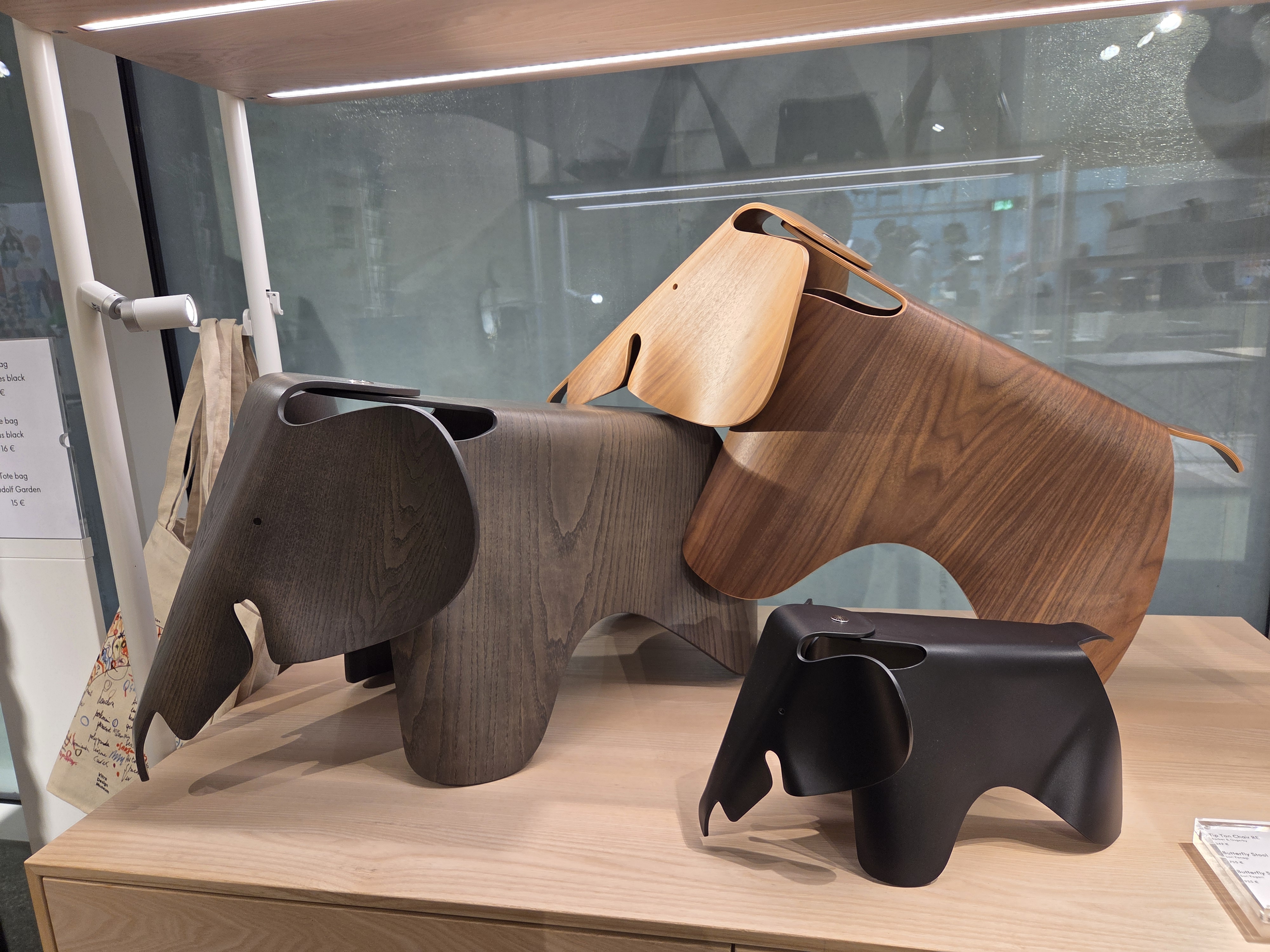
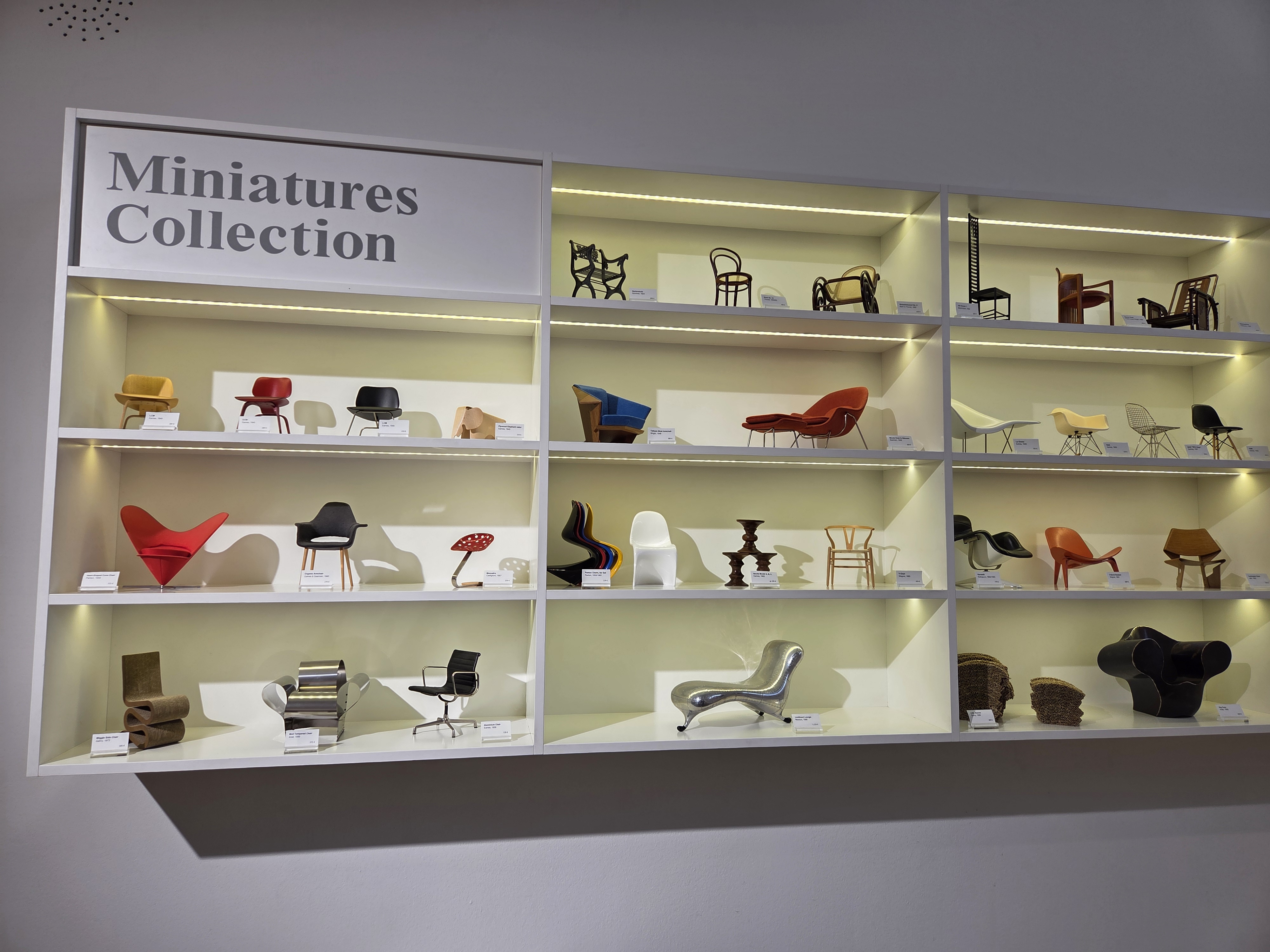
Top Row: Vegan quiche and organic salad at VitraHaus Cafe; A Vitra-designed chair for €429 which doesn’t seem bad until you realize it is a miniature like those in the case in the bottom row; A bit of elephant whimsy. They are for sale.
The path was envisioned as a 10-year project in 2015, and it officially ends this month. Presumably, the art along the route will go away…at least in time. We were lucky to have it as a guide.