Finding peace and quiet in Bettmeralp

2 Oct

2 October 2019.

Imagine a place without traffic noise. No cars, no trains, no buses: just a breeze in the trees, a distant cowbell, the gentle whirr of a gondola. Occasionally, an electric taxi or service vehicle makes its way through the village.

This is Bettmeralp, a tiny village where altitude (2006 meters/6581 feet) is mentioned before its population of 462.
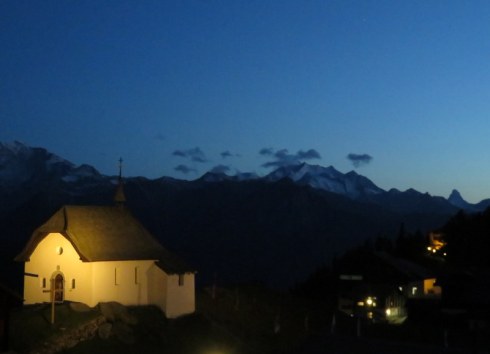
chapel on a hill at night

The little “Kapelle Maria zum Schnee” (Chapel of Maria of tne Snow) as night descends. On the far right, you can see the triangle peak of the Matterhorn.
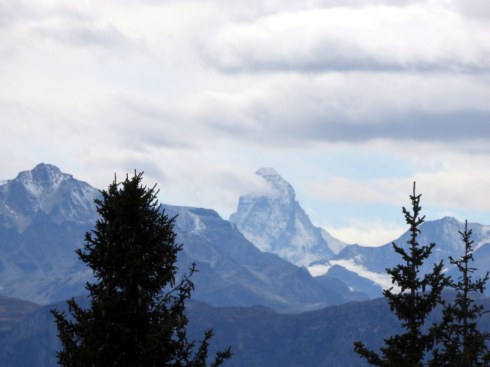
Matterhorn

You can see the Matterhorn from Bettmeralp when conditions are right.

The village has been on my list of must-explore places in Switzerland for about three years. While many tourists flock to Zermatt, our beloved Lauterbrunnen Valley, Luzern, and the Engadine, Bettmeralp in September is almost devoid of tourists. The first night in our hotel, the Waldhaus, only three rooms of this medium-sized family hotel were occupied. The next night, the shoulder season brought a group of 17 to stay for an entire week of alpine exploration.

It was quiet even with so many guests.

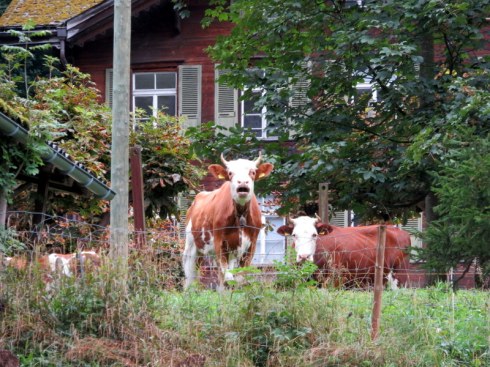
Cows on a road

The loudest noise we heard in 3 nights at the Hotel Waldhaus was this “cow parade” right below our window.

This is hiking country, with several trails offering views of the famous Aletsch Glacier, worth seeing before climate change takes even more of a toll. The Aletsch Arena is quite different from our usual haunts in the Berner Oberland. Bettmeralp sits at and above the tree line surrounded by massive snowy peaks too numerous to name. The light is constantly changing and the village is, like most Swiss villages, bedecked with flowers. It is picturesque, to say the least.

Sunlight on snowy mountain

The view from our room at the Hotel Waldhaus at sunrise.
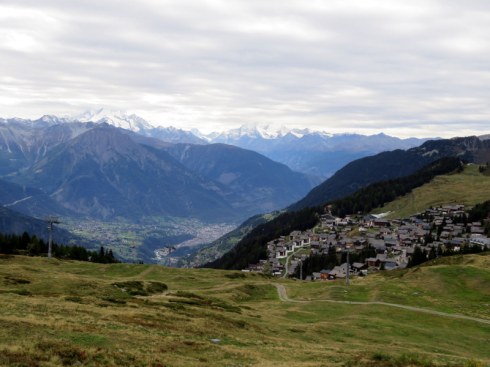
Swiss villag in mountains

Bettmeralp, nestled high above the valley.
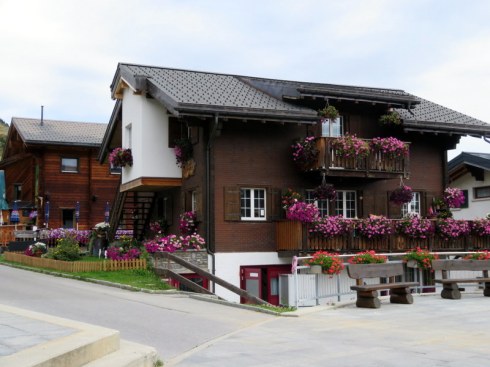
Swiss building

Flower-bedecked, the buildings look lovely even on cloudy days.

We only had two days to hike and one could certainly spend several days exploring more corners of the Aletsch Arena by train, lift, and on foot. We choose to start a rainy day by heading on the paved path to neighboring Riederalp. We were looking for one of the lifts in that small village and could not find it in the fog. We were astonished when after seeking refuge in a cafe for a warming cup of espresso we emerged to find the clouds had broken and the landscape revealed to us again.

Signpost

The signage is good: you won’t get lost but you might be confused at the options.

The second day we traveled by train and gondola to Fiescheralp, almost deserted now in the shoulder season but clearly a major ski-holiday destination. The exposed path we took back to Bettmeralp bore few fellow travelers this late in the fall but the vistas were, once again, magnificent and this hike, in particular, gave us a more complete picture of the area.

Mountain and road

On the road from Fiescheralp, a beautiful view.
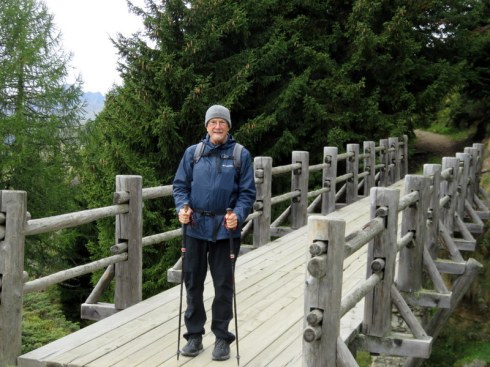
Man on bridge with hiking sticks

Ric crosses a bridge on our hike from Fiescheralp to Bettmeralp. Yes, it was cold enough for a tuque.

To top off the magnificent scenery, we found excellent pizza as well. Paolo, the pizzaiolo at Pizzeria PiccoBello told me that there are many Italians in the area, working on the lifts. (Italians were also employed in the creation of some of Switzerland’s amazing tunnel systems.)
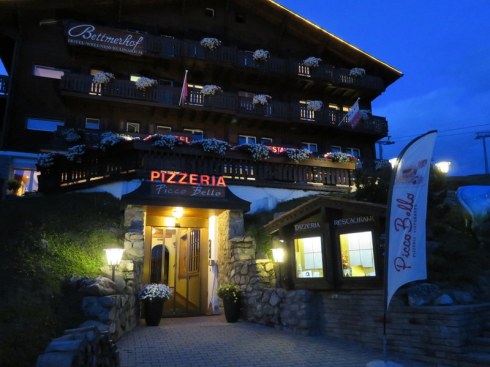
Building with pizzeria

A lovely Italian experience, high in the Swiss alps.

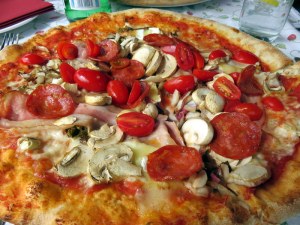
Pizza

One of our pies at PiccoBello. Truly Italian but with a Swiss-style sausage. The crust was top notch!

Pizza oven and man

Paolo the pizzaiolo plies his trade. A delicate crust that stands up to the sauce and toppings. An art form aided by a wood-fired oven.

The Waldhaus fed us well the other two nights as we partook of their excellent half-board. Mamma mia what a feast: 5 courses! Luckily portion-size was rational. Their selection of Swiss wines gave us a chance to enjoy products seldom found outside of the country.

Hotel bedroom

We had a moonwood room at the Waldhaus. Above the bed, a window leads from the shower room. Shower with a view!
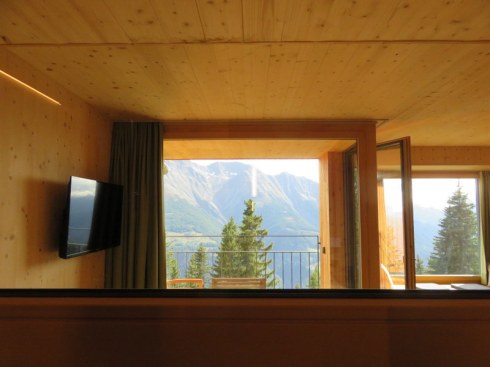
Vew in hotel room

This is the view from our shower room at the Waldhaus.
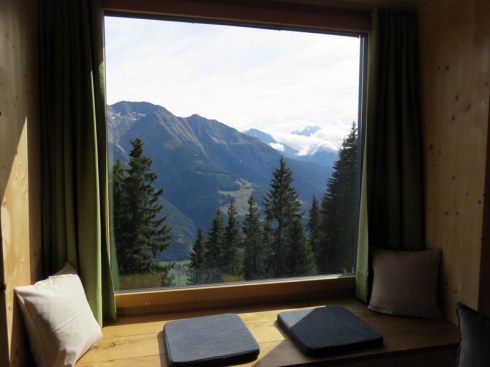
Mountain view out a window

A little nook in the room at the Waldhaus with a gorgeous view, ever-changing light.

We parted somewhat reluctantly after three nights. An additional night-or-two would have allowed us to visit the pristine alpine lakes or ride lifts to see the glacier from a couple of additional viewpoints.

There’s always “next time!”
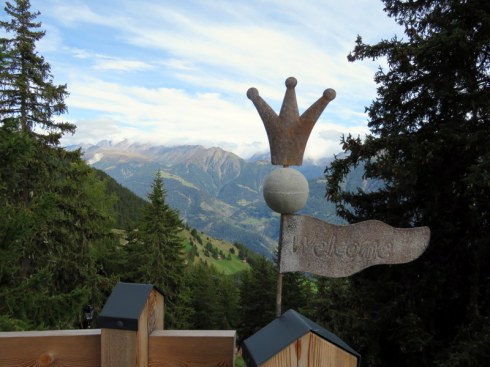
Welcome sign

Outside the Hotel Waldhaus where were were made to feel very welcome indeed.
Alpine Transhumance

26 Sep

26 September 2019.

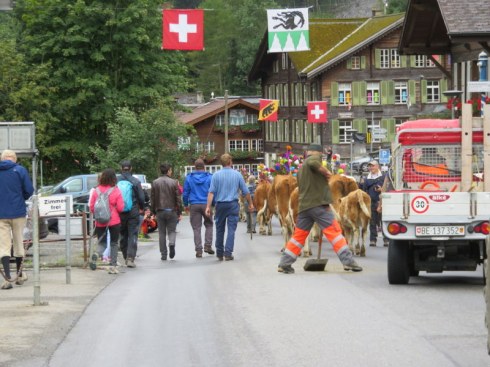
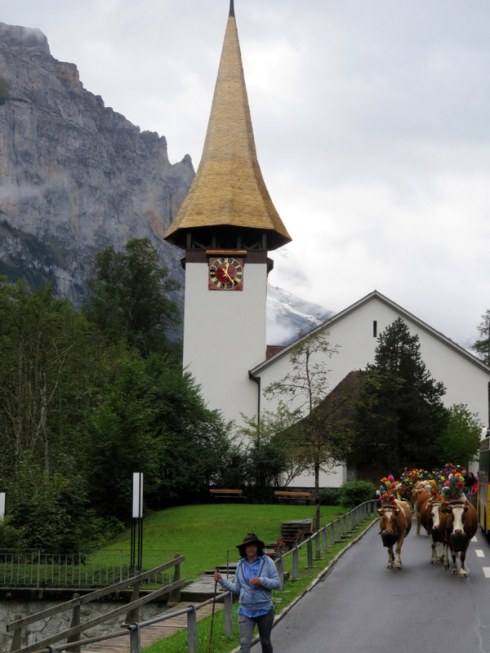
It seems I’ve been waiting until the cows come home to see the transhumance here in Lauterbrunnen, or at least the ceremonial descent from summer pasture to the valley.  Now and then we’d see a farmer going down the street with two or three cows — you can hear them coming for a kilometer or so thanks to the bells — but we’ve either been out on the mountain trails or arrived too late in the year to see what we saw today.

We were advised to be near the Hotel Silberhorn at noon to witness the parade. The cows were arriving from pasture at 1500 meters/4900 feet at Winteregg, a path of about 4 miles.


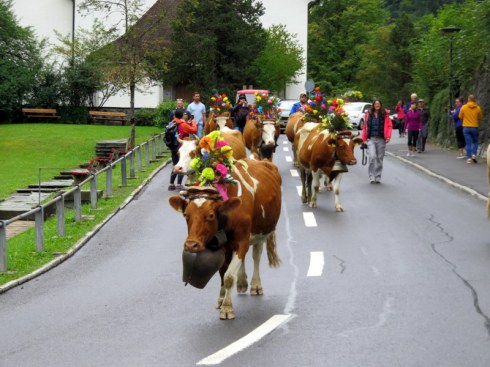
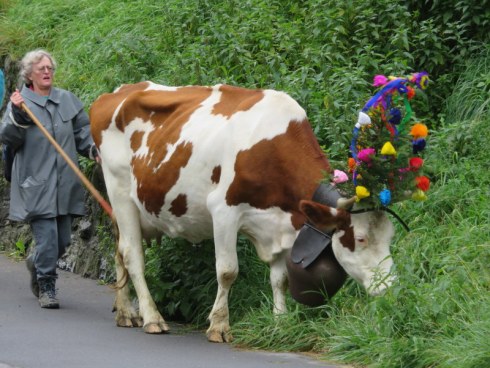
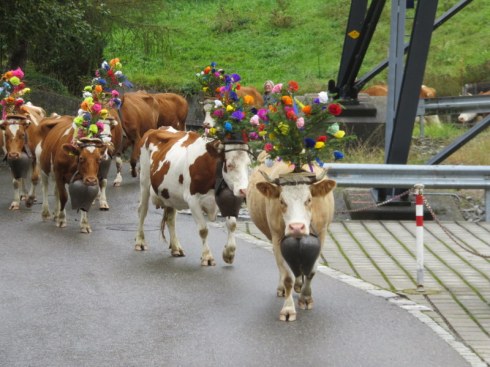
The ceremonial transhumance involves gigantic cowbells and decorative headwear…for the cows. I hope they weren’t forced to wear this gear the entire 4 miles, although that might explain why a couple of them looked so grumpy.

Cow parade

The cows round the curve coming into town by the Hotel Silberhorn, under the Grutschalp gondola. Look at the size of that bell!

End of cow parade

Trailing to cows through town, clean up vehicle and crew following.

Cow Parade

Coming around by the church, traffic is stopped on the main thoroughfare.

Cow Parade

Passing the church, the cows are coming into our neighborhood. We took a shortcut so we could meet them down by the river. This is just 150 meters from our temporary home.

Cow with head dress

One cow gets out of the parade when she spots something tasty after walking through the town.

Cow mooing

As the ceremonial cows pass on the street below, a small herd overlooks the scene and one cow seems to say “What about us?”

Hotel Silberhorn staff greeted the herders and onlookers bearing trays with small cups of wine. A nice touch!

Walking off the pizza

19 Sep

19 September 2019.

It is so wonderful to have fine Italian pizza again! Nothing in the U.S. compares, for us. Here, we each eat an entire pizza and while full, we never feel bloated or grotesque. And my jeans still zip the next morning.

Pizza

The culprit: Pizza Golosa, which means ‘delicious’ or ‘gluttonous.’ Fresh mushrooms and cherry tomatoes with spicy salami and gorgonzola. Ric had a Siciliana with anchovies, capers, and olives.

Italian pizza crust is made from a type of flour that is more digestible. (Ask any Italian about digestibility and you’ll be entertained for hours.) The toppings are fresh and pure and distributed with a light hand. Each ingredient shines on its own and together, well,  Mamma mia what a product!

Pizzeria & Steakhouse La Tambra in Santa Cristina is our favorite in the Val Gardena. Usually, we make the trek to La Tambra in the evening catching the infrequent and elusive night bus back to Ortisei. The other day, while tromping around on Monte Pana and Mont de Sëura, we realized that it was almost lunchtime and Santa Cristina was only a chairlift away. Does La Tambra serve pizza at lunch? Turns out they do, and as it was a sunny day, we could dine on the terrace. But what to do after lunch? It was only 14:30 and we certainly could use some steps to retard the growth of fat cells after eating THE WHOLE THING.

Ric’s idea? Walk back to Ortisei on the Sentiero del Trenino. This mostly level path takes one between the towns of Santa Cristina and Ortisei where the WWI supply train ran from 1916-1918. Eventually, it became a tourist train which operated until 1960. This area was part of Austria when the railway was built and was annexed by the Kingdom of Italy after WWI. Some 6000 Russian and Serbian POWs were conscripted to build the line, which they accomplished in only 5 months of brutal day-and-night labor.

WWI picture

Photo from one of the informative panels along the route. 6000 Russian prisoners and 3500 locals were employed in building the WWI rail line to resupply the front. This was Austria at the time.

We started our walk a bit before the official start of the path, launching our pizza-stuffed selves off the terrace of La Tambra and making our way up to the picturesque church in Santa Cristina. The cemetery is stunning and beautifully maintained by the families. Seasonal flowers are planted on each gravesite.

More-or-less beneath the church, a tunnel used by the narrow-gauge train was reopened in 2017 with informative displays about the line. It is well worth a 15-minute detour to walk the 203-meter tunnel and study the displays. The tiny renovated station house (from tourist train days) has short films of the trains in action.

Click any photo for more detail and a slide show.

Continuing on after the church, one heads steeply downhill. We encountered cyclists going both directions but felt exceedingly sorry for one guy who was pushing a pram uphill while his wife struggled along behind. We’ve done this hill in both directions and would vote to go down every time. Ugh!

S. Cristina pat

This path is steeper than it looks. After this descent the rest of the path is mostly level.

Then the path levels out and it is a delightful stroll to Ortisei, past farms, playgrounds, and beautiful hotels. Sunny vistas are interspersed with forested sections. The 3 miles passed quickly, taking about 90 minutes including the train tunnel detour.

At least we made a dent in those pizza calories since we are back on the weekly pizza plan during out trip!

Click any photo for more detail and a slide show.


Retreat on the Alpe di Siusi

15 Sep

15 September 2019.

Sometimes you just need to escape even while you are away. Rick Steves calls this a “vacation from your vacation.” While we aren’t really in need of further relaxation, we do like the atmosphere of the Alpe di Siusi and it has become a tradition for us to pass a couple of nights there and be able to hike in the mornings without worrying about an early bus from Ortisei or racing to beat the last gondola down at 17:30. It’s a looonnggg walk if you miss the last ride.

Cabinovia

The gondola up to — and down from — the Alpe di Siusi. It only runs until 17:30 so don’t miss the last ride!

We are based for 2 1/2 weeks at the incredible Residence Astoria, our home in the Val Gardena the past four years. (See Training cats from 2016.) Taking only our backpacks with a change of clothing, we headed to Hotel Saltria for two nights, partaking of their half-pension plan and enjoying the convenience of being right there in the Alpe di Siusi for an early morning hike as recommended in our book, Walking in Italy’s Val Gardena. It’s good to travel light as this journey takes 3 buses and a gondola over the course of 90 minutes. Not fun with heavy luggage.

Hotel Saltria

The Hotel Saltria is a larger property, yet retains an intimacy

Arriving at the hotel, we had time for an hour’s walk in the afternoon sun through mountain meadows, then a shower before dinner. No extended Italian eating hours here! Dinner is from 19:00-20:30 and almost all of the guests arrived in the first 15 minutes. (We did see one couple, clearly new to the concept and not Italian nor German, waltz in at 20:28 and they were seated and served. I think they got the dregs of what was left, though.)

Rifugio

A rifugio on the Panorama hike. The pond is used for fire-fighting (rare) and snow-making in ski season.

The next morning we were on the trail before 10:00 and took what may be our new favorite hike in the Alpe di Siusi, Panorama to Zallinger. (I’ll be writing that in detail for another post.) This was a long-ish one. Leaving the hotel a few minutes before 9:00, we did not return until 15:30 what with transportation, a coffee stop, a lunch break, and a 10 km walk. If we had tried to do this from Ortisei, we would have been gone from 8:00-18:00.

It was so nice to be catered to for breakfast and dinner. No shopping (which we do daily when we are in a self-catered situation), no cooking or food prep of any type. We just showed up and let the hotel staff take care of everything.

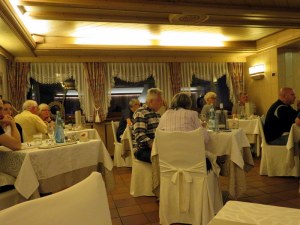
Dining room Saltria

The dining room at Saltria. There were people of all ages: young couples with new babies, young couples alone, multi-generational groups, and people like us.

Breakfast was spread across a room bigger than our home living, dining, and kitchen areas combined! Set in a huge “E” shape, were baskets of various rolls and pastries, 8 types of preserves, 4 kinds of honey including one that was still in the comb, fruits, fruit salad, yoghurt, soft boiled eggs, a vegetable juicer, salad ingredients, 4 kinds of sliced meats, and at least 4 types of cheese. Beverages were on a separate buffet and the waitress made cappuccino, espresso, or “German” coffee to order.

This part of Italy is so Austrian that the first words out of anyone’s mouth are generally in German. In fact, this past week one of the German-language newspapers of the Südtirol expressed sadness on the 100th anniversary of the annexation by the Kingdom of Italy in 1919. Memories are long. So we were offered “German” coffee whereas in most of Italy we would have been asked if we wanted “American” coffee.

German is more prevalent in the Alpe di Siusi than it is even in the valley. A couple of our servers had trouble with Italian. One stumbled over the number 6 (sei in Italian) until I used the German word sechs. Some transactions became amusing mixtures: I told them I wanted my coffee senza milch. That high-school German comes back on occasion.

Vegetables

A sampling of the many vegetables available every night.

At the hotel, none of the food on the menus was described in English. Our evening meals — five courses if you wanted to eat that much — were described in Italian and German and the cuisine was decidedly fusion. Pasta or prosciutto and melon for a first course followed by roasted veal and a beetroot/potato puree. Or a cheese strudel as a starter with mountain lake fish on a bed of leeks with lardo. (Lardo is what it sounds like, though quite refined, a Tuscan specialty.) Like I said, fusion, or as our Italian friend would say, contaminated (contaminazione in Italian is a little pejorative, but serves as a false cognate in this case).

After our long day hike, we could have refreshed in the indoor-outdoor pool or worked on our skin cancer, but we retreated to a pre-dinner shower and coffee on the terrace overlooking the magnificent peaks. Just as the sun was setting, we headed to dinner, now greeted by a huge salad and vegetable buffet spread over the enormous “E” that once held breakfast. Perfectly sauteed artichokes, two types of asparagus, grilled peppers and eggplant, marinated mushrooms, more salad ingredients than the farmers’ market, and a cheeseboard.

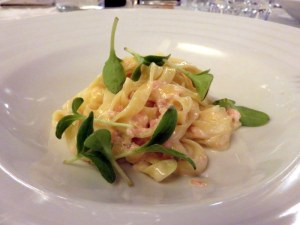
Pasta

My primo one night, pasta with smoked salmon. Sensibly small portion as there was more to come.

That was the first course. After that, there were soup, a primo, a secondo, and dessert, plus (more) cheese and fruit. We confined ourselves to three courses (no soup nor dessert) but indulged in a fine and reasonably-priced wine list.

My middle-of-the-night trip to the bagno was blessed with the lovely sight of the great mountain peaks bathed in moonlight. That alone was worth getting up for at midnight.

Travelers often complain about “touristy” areas and that so many places are over-crowded, or that they encounter too many Americans carrying Rick Steves’ guidebooks. If one wants to have an experience unlike any you are likely to have in North America, this is a fine place to add to an itinerary.

Laurel and the Sciliar

Just starting out on the Panorama hike. Perfect day!

Here we go again!

31 Aug

31 August 2019

We weren’t a week into our spring trip to France and the U.K. when Ric opined that he would miss our fall trip to Italy and hated to think of waiting 18 months before we saw il bell paese again. We were one glass into a bottle of fine pinot noir from the Alsace at this point in the conversation. By the time the bottle was gone, we were researching tickets for September. Tomorrow we fly to Milano.

Much like last autumn, we will visit Italy (the Val Gardena) and Switzerland’s Lauterbrunnen Valley, This year we will spend two weeks in Lauterbrunnen and 2.5 in Ortisei with a brief stop in new-to-us Bettmeralp. Needless to say, we have packed our trekking sticks.

The housesitter has arrived and we will no doubt have little sleep tonight. Maybe that will allow us to sleep on the plane. 

I’ll be writing blog posts that I call postcards from our trip, as I have in the past. Enjoy your holiday weekend!


Girovaga

Formerly GoodDayRome

Skip to content ↓