Tag Archives: Graubünden

Landwasser Welt – A train nerd’s paradise.

7 Sep

6 September 2026.

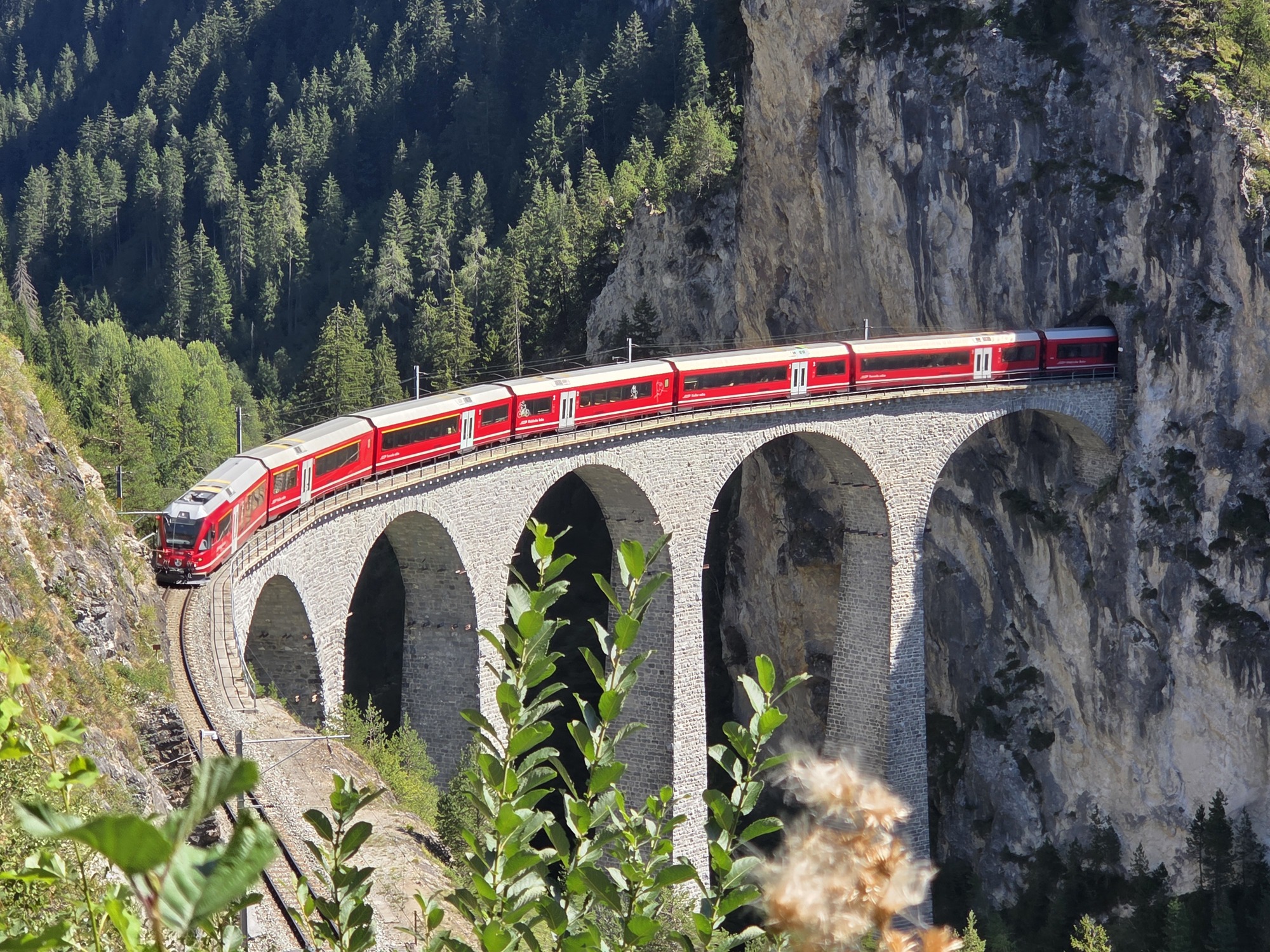
The Landwasser Viaduct from the Hennings Platform

We have traversed the Landwasser Viaduct on the famous Albula Railway at least a dozen times over the years, but I wanted to see the architectural wonder with the train on it: not from the train. Figuring out exactly how to get there and see it was not a small task but for inclusion in our upcoming book, Walking in Switzerland’s Engadine it was worth doing the research. My train aficionado husband’s love of trains has rubbed off on me in our 42 years together.

The day started out cold – low 40s Fahrenheit –  but by the time we got to our first stop in Filisur, Switzerland, we had our jackets off and stuffed into our day packs.

But back up. This adventure starts with one of the prettiest short train rides in Switzerland along the Albula railway line which boasts UNESCO World Heritage status. From the MySwitzerland tourism site:

“The Rhaetian Railway…is a marvel of railway engineering that winds its way through the Graubünden mountains thanks to man-made structures, viaducts and helical tunnels. Railway enthusiasts assert that the Albula route between Chur and St. Moritz is the most picturesque mountain route in the world and rave about the boldly curved Landwasser viaduct.”

I’ll spare you too much boring engineering talk but some keys stats:

  • Built between 1898 and 1904
  • 55 bridges
  • 39 tunnels
  • 38 miles
  • Linking Thusis at 2,287 Feet with St. Moritz at 5,820 feet

The Bernina Express and Glacier Express both travel this line as part of their scenic journeys. We enjoyed our little slice from Samedan to Filisur even though we have traveled it many times before in winter, summer, and fall. This amazing line uses a series of spiral loop (helical) tunnels to gain elevation over a short distance with viaducts and bridges for longer segments. Instead of moving straight up the valley, the train enters the mountain side and follows a continuous, rising loop inside the rock. As a result, you travel through the valley crossing over from side-to-side and an ever-changing view.
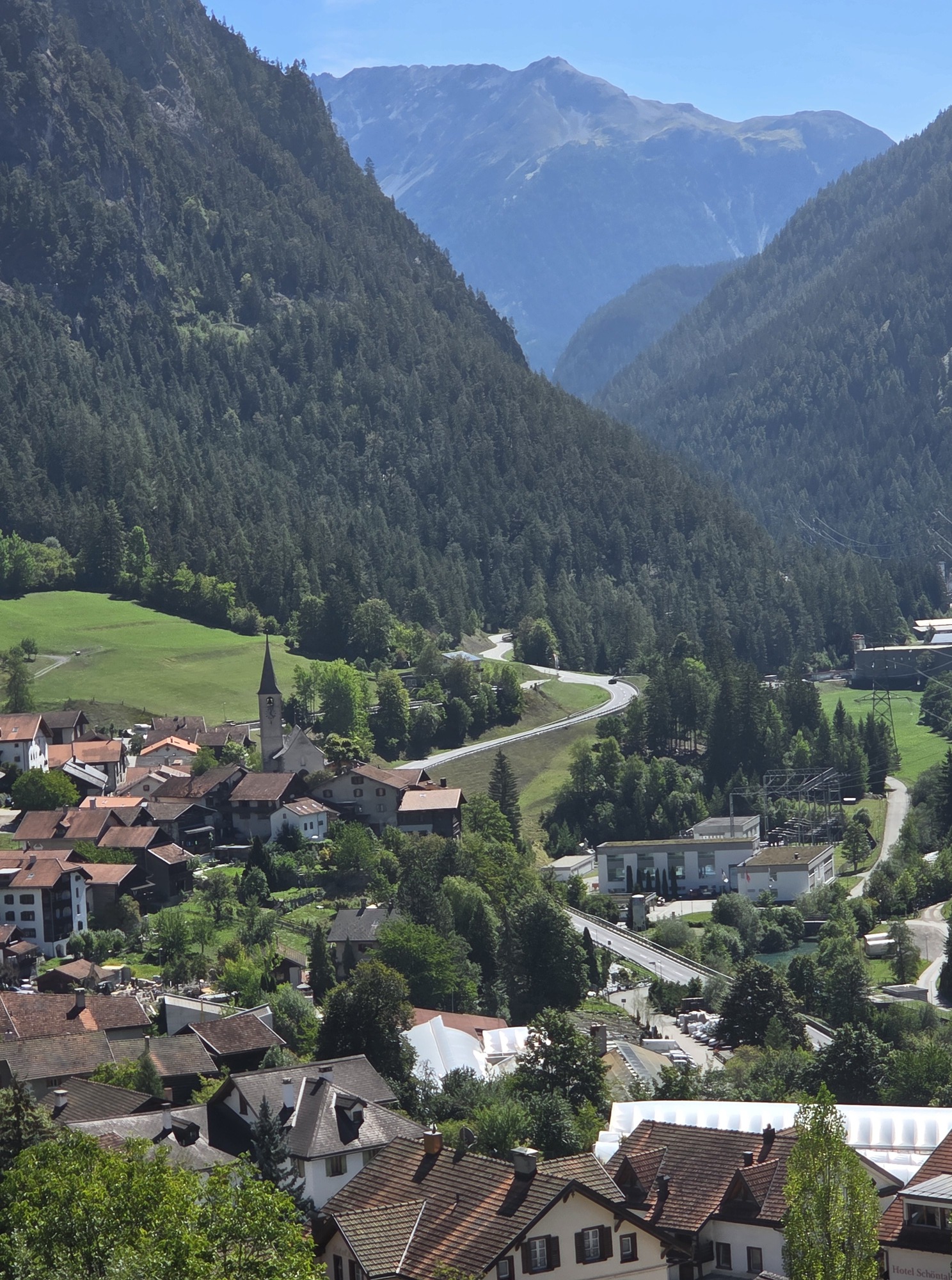
Filisur and the Valley from the train station.

At Filisur, it was a little confusing finding the exact start of the walk; the very reason we do the research ourselves instead of just reading the online so-called directions. (We do not let AI write our books.) There was actually too much signage and the maps displayed had so many lines illustrating hikes and train routes that it was hard to sort. The guy at the Info Mobil booth was very helpful in making sure we were pointed the right way so we can carefully guide our readers.
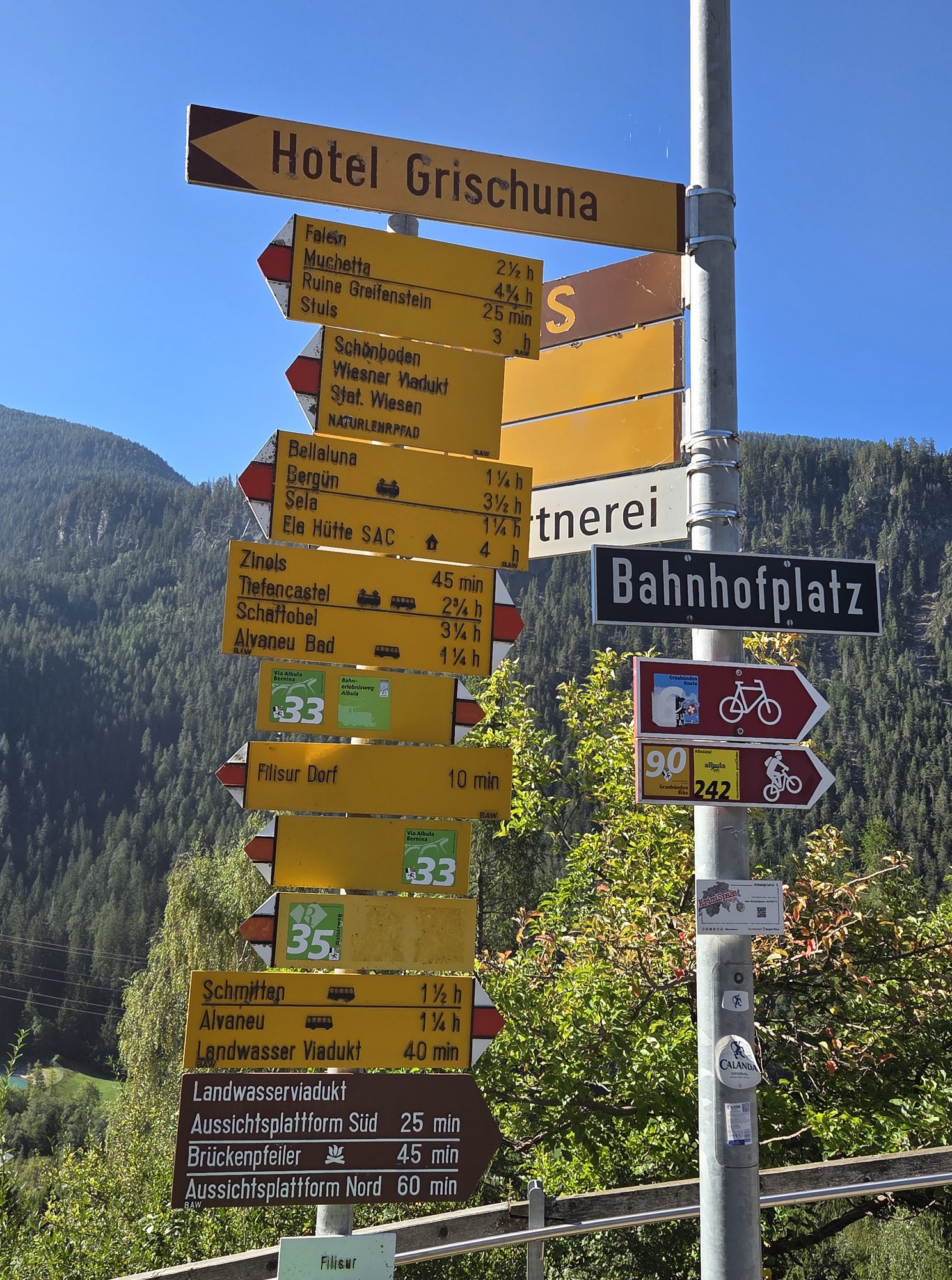
Too many signs!

This was a nice walk. Although not pram-worthy, it is a solid “2” in our book: easy-enough, not strenuous, some rocks and tree roots to navigate. We should have had our trekking sticks for the return due to loose gravel on the downhill bits, but we held hands to prevent falling. We’ll recommend sticks in the book. It is only a 50-minute walk, roundtrip.
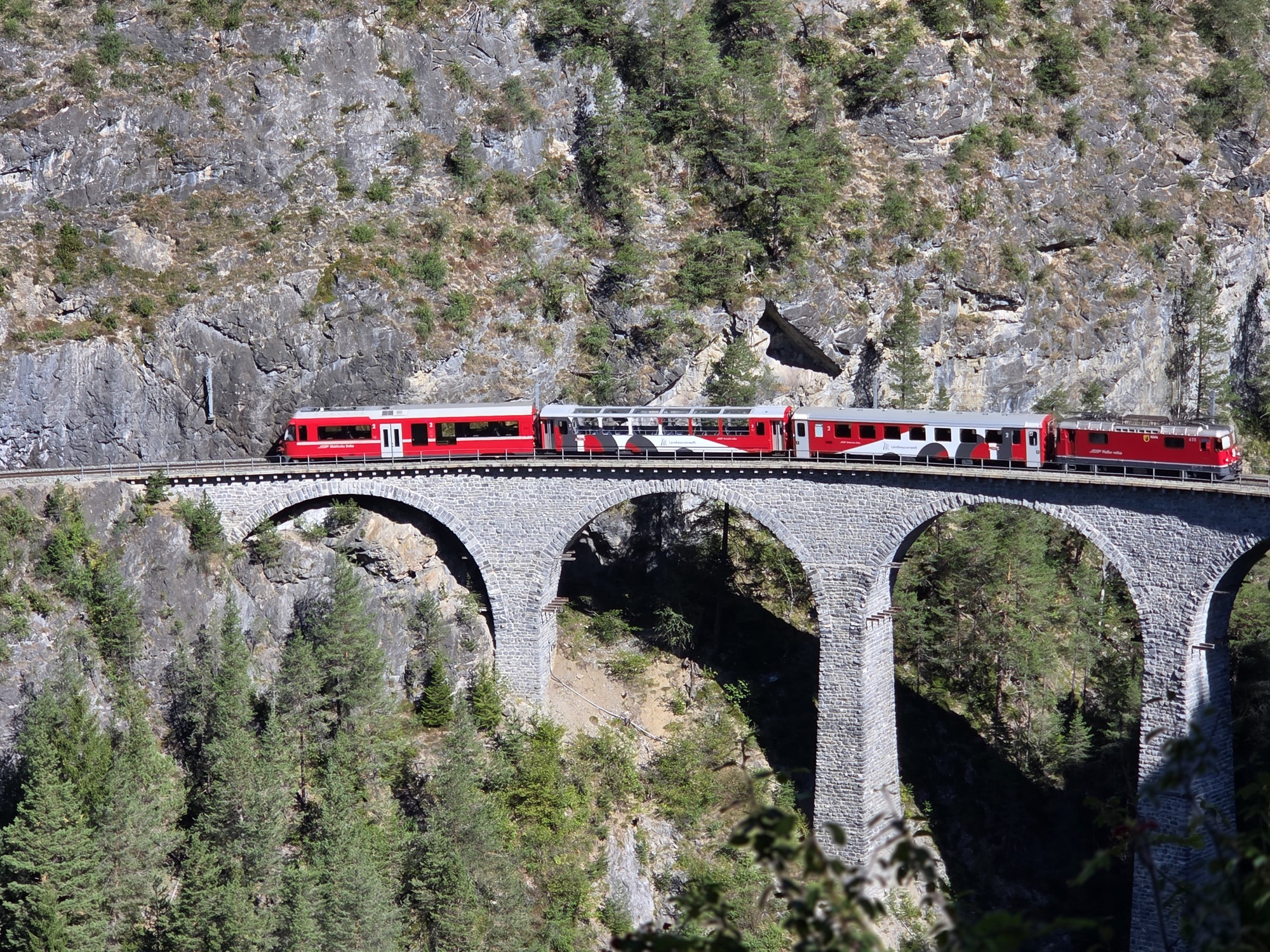
The Viaduct Shuttle on the Landwasser Viaduct as viewed from the Acatos Platform.

The Acatos platform offers an amazing view over the Landwasser Viaduct. We were delighted by four trains passing in about 20 minutes: One to Zermatt, others to Alvaneu, to Chur, to Filisur. Long, Panoramic Express Trains as well as short shuttles like we would take later. And only four other people visited while we were there on a glorious sunny morning in early September. By the way, there is a QR code on the platform that leads to a list of trains passing in the following hour-or-so https://kisqr.rhb.ch/stationDisplay/CulturalSights/RCS-Landwasserviadukt.
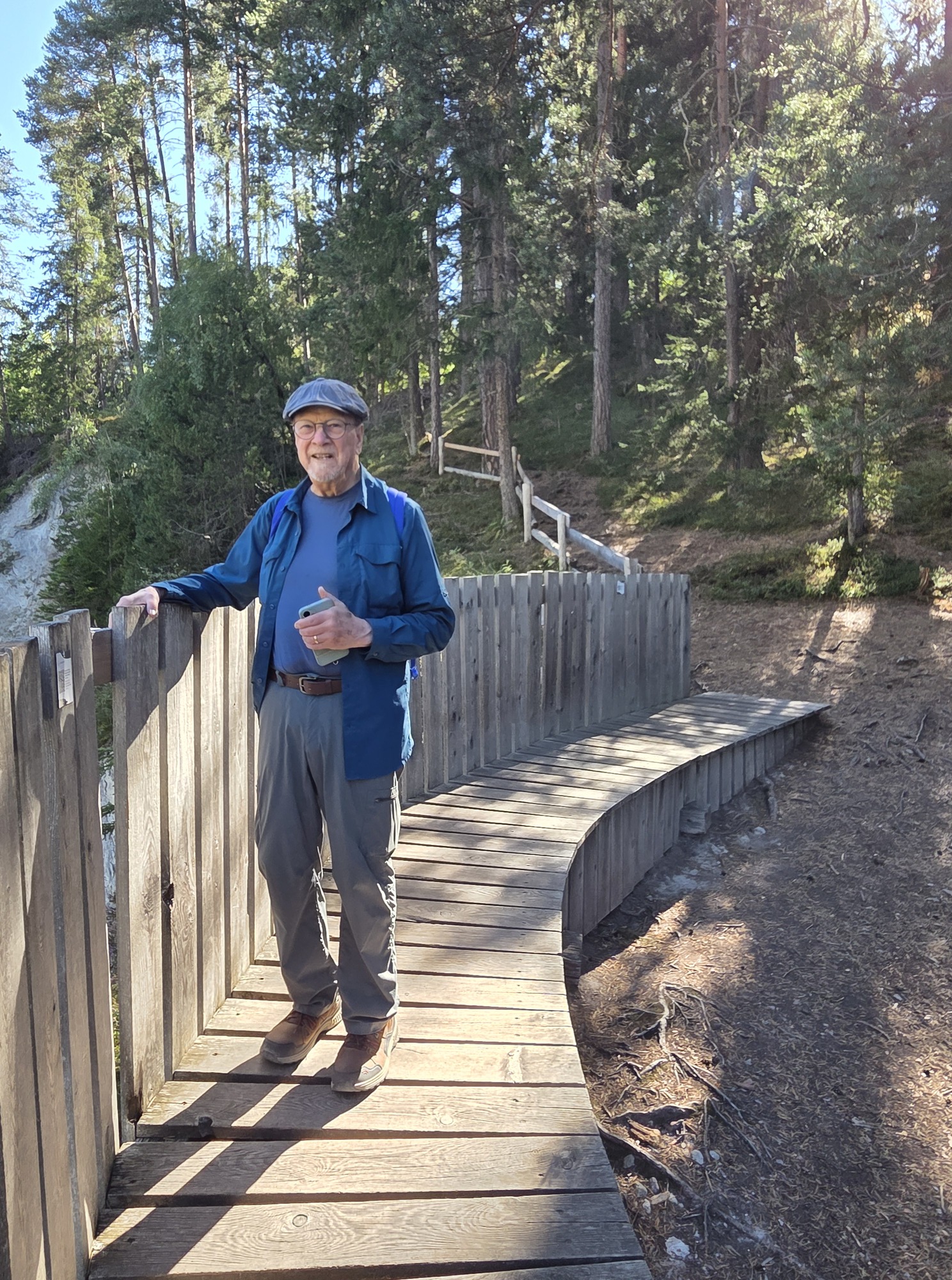
Ric at the Acatos Platform

Back at the station, we decided to grab a simple sandwich and iced coffee. The two men running the café were from Mexico and thought I was Italian when I spoke to them. Always makes my day!

The day had warmed considerably, now over 70 degrees Fahrenheit at 3500 feet above sea level. We waited for the 12:46 shuttle to the Hennings Platform happy to find shade at the station. It’s only a 3-minute trip to the Schmitten station, then a short but steep walk with loose rock and unguarded steps up to the two-levels of the viewing platform. Walking up, we were leery about walking down on the loose gravel and with no handholds on the stairs. Problems of aging knees and hips.
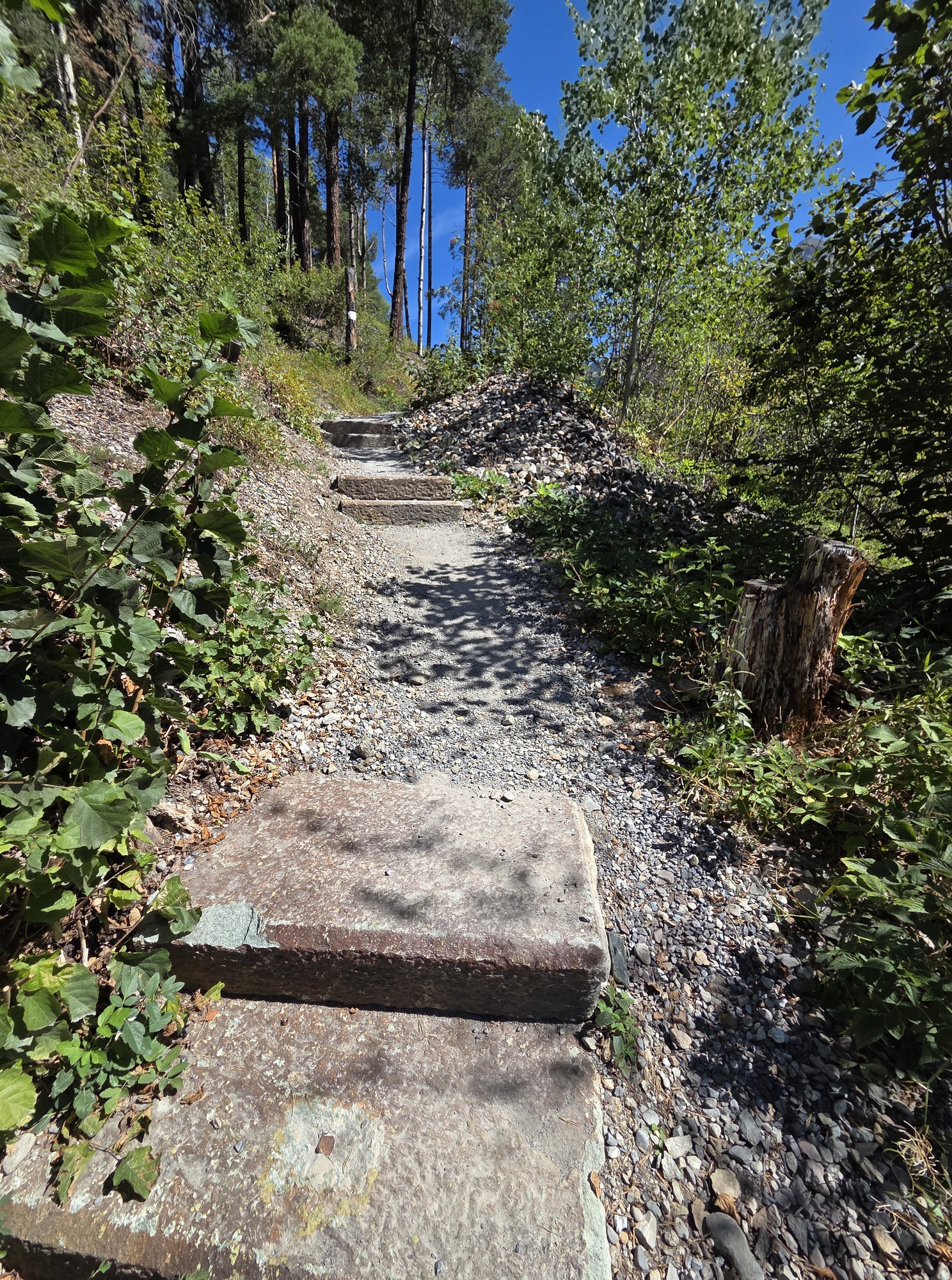
The rough path and steps without handrails: Watch your step!

The lower of the two platforms proved to be excellent for taking pictures of the trains. We weren’t certain they were any better than the morning shots we took from Acatos but viewing the pictures from Henning’s on a larger screen proved us wrong: The Henning’s Platform is superior for photography. We hauled ourselves up to the upper platform which was very nice nice for hanging out between trains and also had a great angle for photos. Light shade and a bit of a breeze made the wait tolerable since we had a long one.

Time of day matters: we had to wait a long time for a return shuttle due to a midday pause, and we only caught one major train during that time, so we were there in a period of light traffic. We weren’t sure how long it would take to pick our way down. Ric had his hiking sticks along so armed with one hiking stick each, we headed down early, catching sight of one more long train headed north. Luckily the sticks helped a LOT with stability and we were on the train platform with plenty of time, waiting for the shuttle in the heat.

That gave us an excuse back at the station to indulge in ice cream while waiting for the 15:00 train back to Pontresina.

This outing will definitely be in the book: trains and light hiking with a suggestion for time of day for the most efficient visit. There is also a terrific museum at Bergün, which we visited last year, that is a must for train enthusiasts. A very full day out for train nerds could include our tour today as well as a stop in Bergün for the Albula Railway Museum.
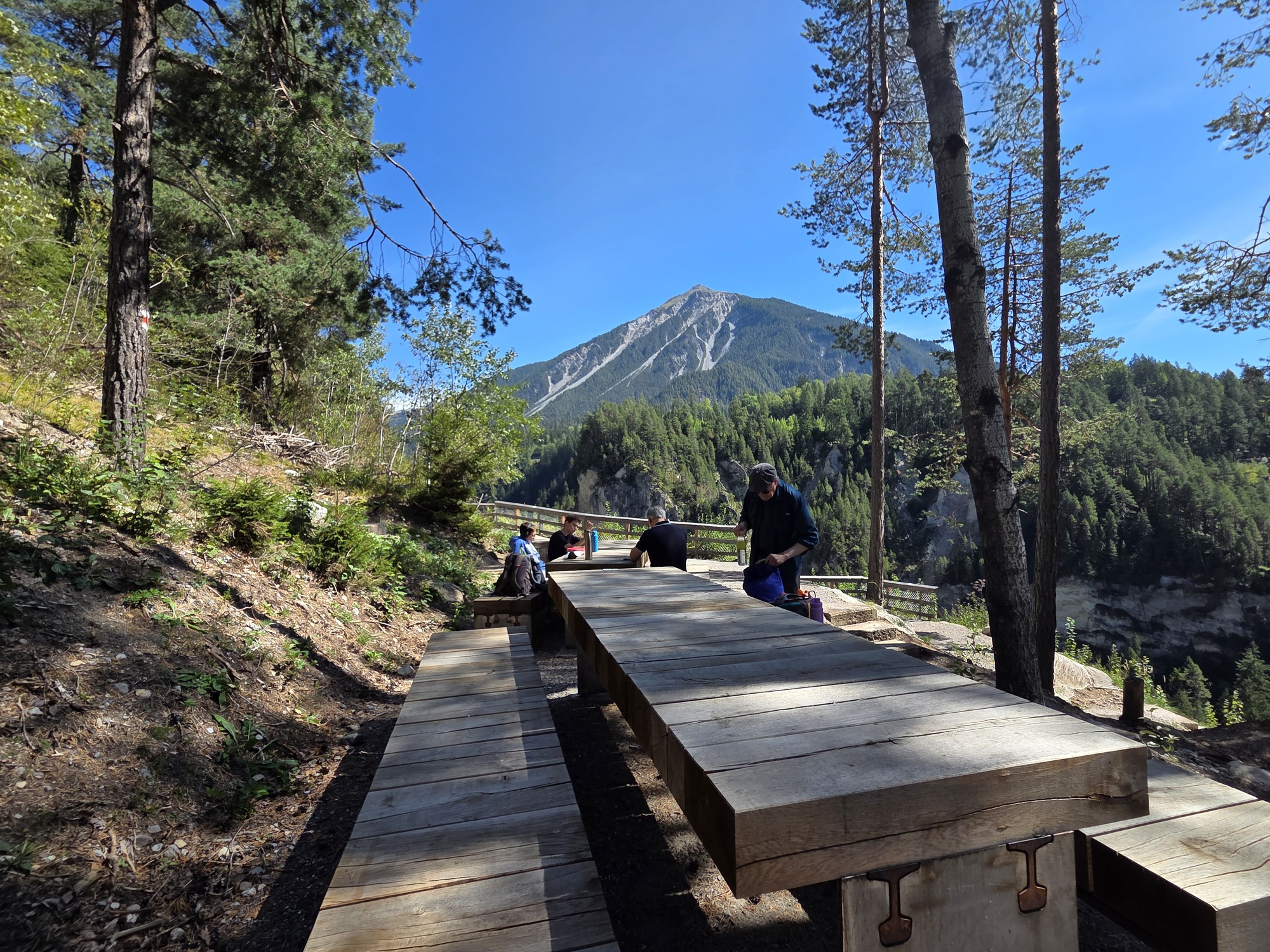
Hennings upper platform where train lovers can hang out, picnic and wait for trains to pass.

Our visit also opened our eyes to how much else is on offer in Landwasserwelt. Countless hiking paths beckoned, the village of Filisur yet to be explored, and a chairlift to a mountain restaurant we did not have time for, all contained in the gigantic Parc Ela, a regional nature park within Graubünden.

Beyond having a nerdy train day, we are exploring other parts of the region, revisiting some places from past trips to finalize details for the book, and exploring some that are new-to-us.

The weather is beautiful! The Swiss could use the rain, but these travelers are enjoying clear skies and few people. Apparently, there is a shoulder season here, still.
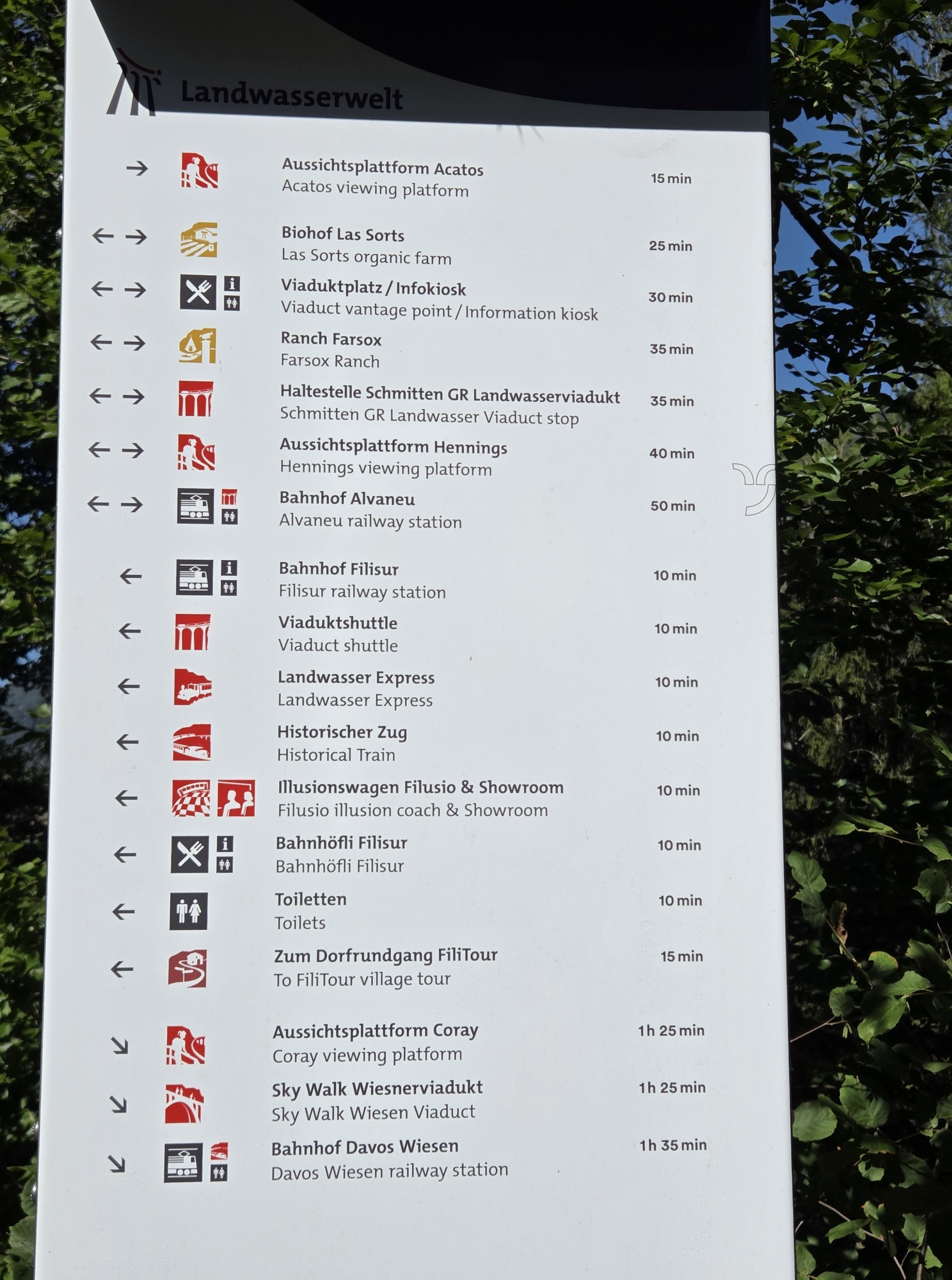
So many things to do in Landwasserwelt!

Graubunden Wrap-up

30 Sep

30 September 2025.

From the heights of Graubünden to the lowlands of the Rhine River Valley, tonight we are sleeping 5000 feet lower than we have for two weeks. We are now in Basel with explorations in three countries planned for the next two weeks.

But first, a wrap-up on our time in Samedan.

Architecture

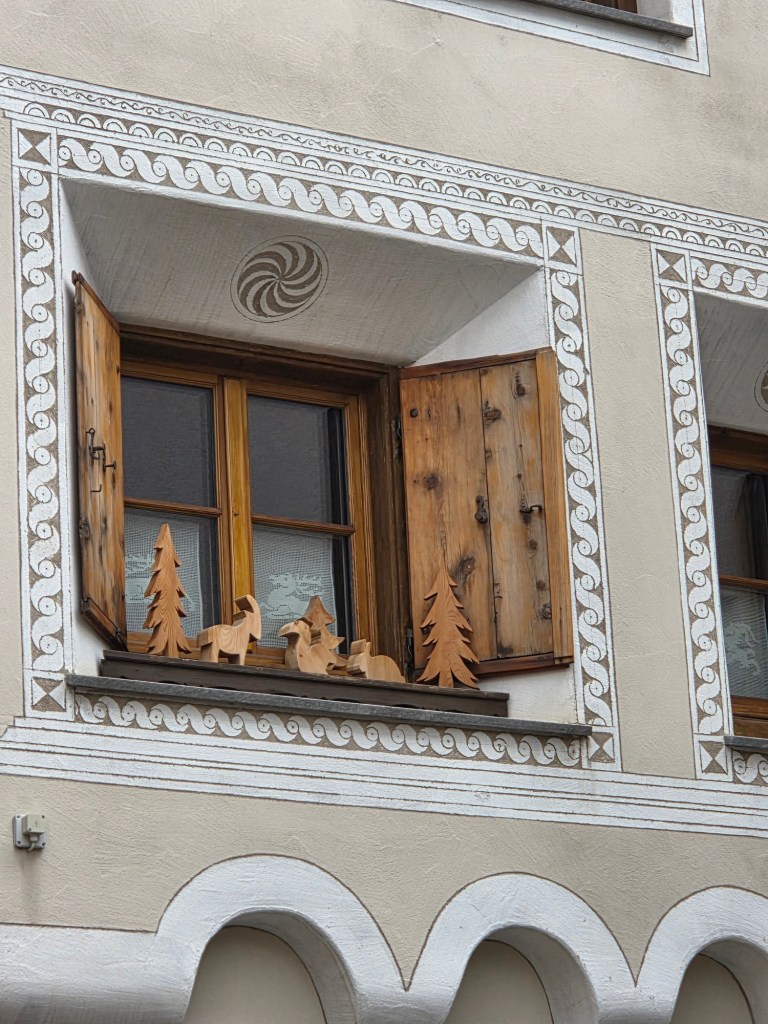
Graubünden sports distinctive architecture. The walls are very thick — up to two feet — in the traditional buildings to conserve heat in the winter, so the windows are often set in deep recesses. The houses are decorated, sometimes in the form of words, often geometric designs called sgraffito, and occasionally paintings. It seems like every building has a name: Chesa dals Tres Frers (House of Three Brothers) or Chesa Manzoni (Manzoni’s House). Chesa is pronounced CHESS-ah in Romansh, by the way. The town was first mentioned in writing in 1130 and some houses we saw date back to the 15th Century. Not only do the old buildings sport a date built, but the dates of renovation are on display. Click on any photo for a better look.

Top Row: Village church and house with sgraffitti; One of the older buildings; My favorite window in Samedan.

Bottom Row: Close up of dates of original construction and renovation; Heavily sgraffitted building; Very Deep-set window.

Language

Romansh is still used in this canton, more than elsewhere in Switzerland, but the canton’s official languages are Romansh, Italian, and German. I like to trot out my limited skills if only to be polite. Starting with German, I’ll say “Ich spreche nur ein bischen Deutsch. Sprechen Sie Englisch oder Italianisch?” About 50% of the time, Italian works but it is clear most people speak some, if not fluent, English especially in restaurants and ticket offices.

Samedan is not “touristy” in the sense that nearby St. Moritz and Pontresina are. It is far less touristed than our beloved Lauterbrunnen Valley and the Greater Jungfrau Region. But then it is more time consuming to get here. Winter is another story when the ski hoards descend on the area. A person in St. Moritz said it’s crazy with famous and wealthy people all winter long.

Pizza Venerdi Returns

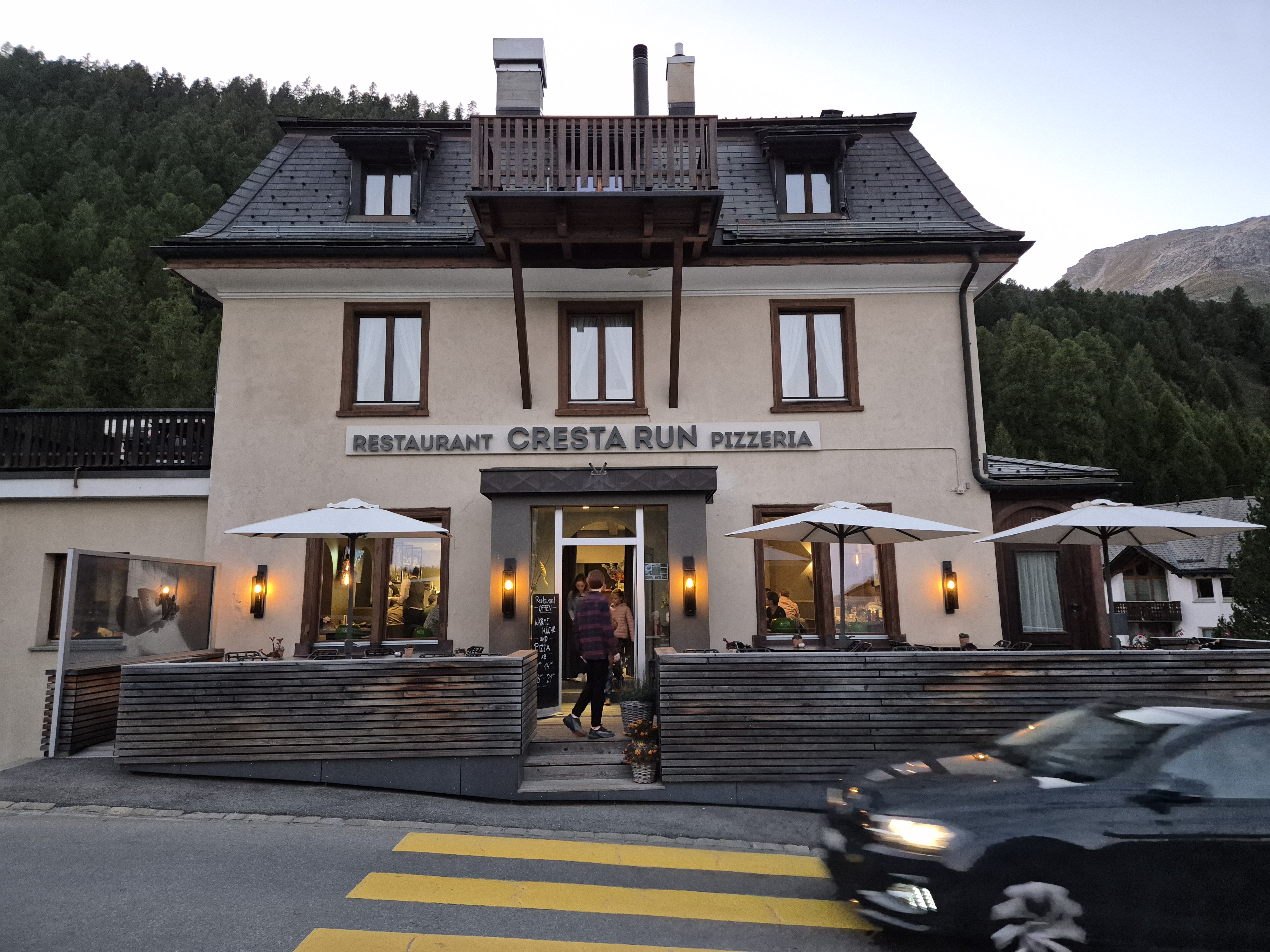
As is our habit when traveling, pizza every Friday (Venerdi in Italian). We have had marvelous pies in this Italy-adjacent canton. We journeyed from Samedan to neighboring Celerina for one Friday feast at Pizzeria Cresta Run and to Pontresina at Riccardo’s for the second.

One of my favorite things is taking a train to dinner and that was possible to both villages. The proximity of Italy and the Italian-ness of the Val Poschiavo in South Graubünden contribute to authenticity in the food.

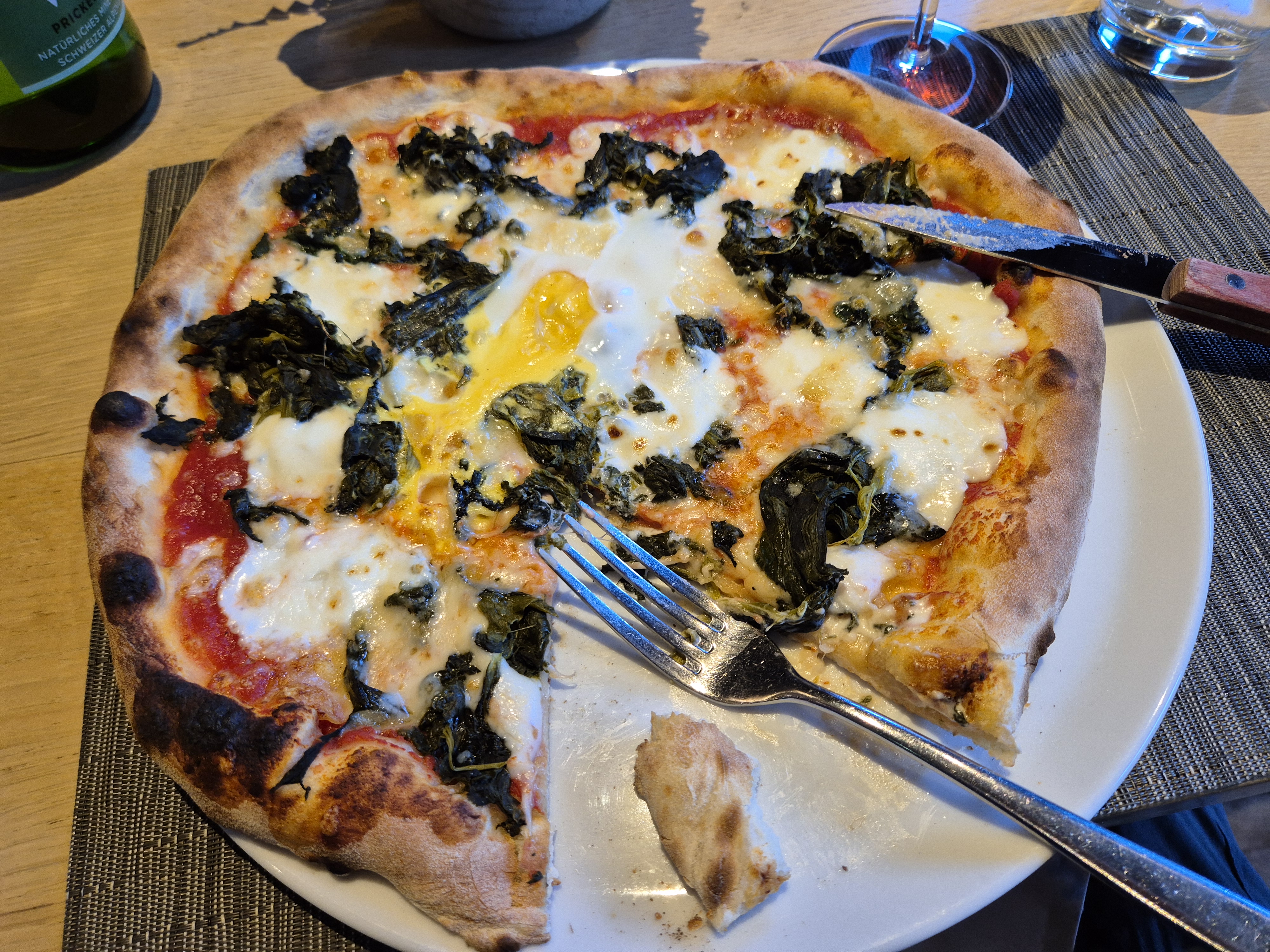
From Top Left: Pizzeria Cresta Run at dusk; Ric’s Pizza Popeye with spinach, egg, and mascarpone at Cresta Run; At Riccardo’s, my pizza with prosciutto crude, cherry tomatoes, and basil; Ric’s with eggplant (it tasted like eggplant Parmesan; The pizzaiola at work.

Easy-Hiking and Sunday Lunch

Paths to Lunch and easy hiking have been the theme of our stay. We just don’t do the elevations that we used to do, and no tricky footing, please. (Downhill is evil according to my knees and hips.) Switzerland delivers and is, indeed, attuned to those of us who cannot climb the mountains or do not want to clamber up steep elevations. The Swiss Mobility website even features Obstacle-free routes in addition to routes as long and as challenging as you care to tackle. It took a few days for us to become accustomed to even small hills and the steep streets in Samedan, but we did manage some terrific view hikes

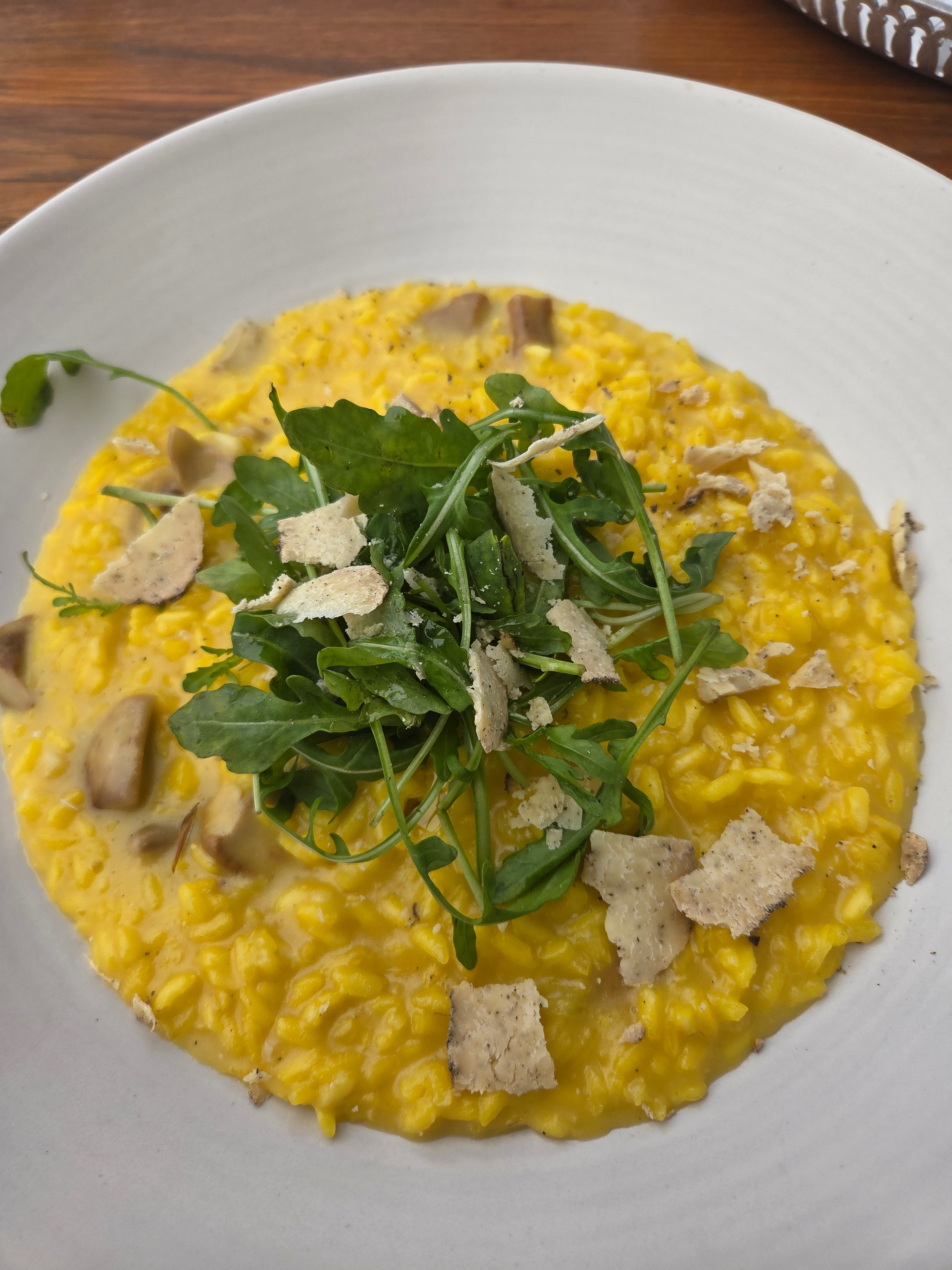
In addition to the outing a couple of weeks again (See A Path to Cappuccino and Lunch), we had a delightful Sunday lunch at Laj de Staz, where there is no vehicle access. Barely a 30-minute walk from upscale St. Moritz one finds rustic but gourmet cuisine in a charming rural environment between forest and lake. Our porcini (now in season!) risotto was outstanding. It almost made up for the fierce wind we had to endure while walking. Luckily, the restaurant was mostly sheltered.

Porcini Risotto; The view toward St. Moritz from the path; Restaurant Laj de Staz

Another delightful lunch outing sent us on a 2.5-mile undulating one-way trek past grazing cattle and sheep, through a forest above a quirky golf course with views to passing trains, nearby towns, and snow-dusted mountains. Lunch was at the golf course, Restorant Sur En, followed by a 2.5-mile return walk, this time flat and along the river. See the details here Golf Course Hike (the name is mine, for simplicity).

That was on Saturday, but Sunday demands a proper lunch outing when we are traveling and last Sunday we found the delightful Gravatscha-Innauen Route with Restaurant Piste 21 half-way through, to be a perfect combo. This was the first truly sunny day in a week, and we wanted to take advantage of it. Although it was only about 50 degrees Fahrenheit, it was a fabulous, sunny, wind free day. Lots of cyclists and a few walkers were taking advantage of a vast network of trails. The restaurant is a gem, blending into the landscape, rustic but elegant, serving beautiful, fresh food. To be repeated.

Lake Gravatscha; Interior of Piste 21; My capuns, a local specialty. I needed a statin after eating it.

Two weeks flew by for us. It was not go-go-go every day. We no longer travel that way. We like to settle in, get to know a place, do some exploring, and exercise enough to ward off weight gain.

We had a perfect apartment in Samedan, found through a local tourism site. Constructed in 1975 and recently modernized with a sleek kitchen, 1+1/2 baths, excellent WiFi, an elevator (we hate hauling luggage up stairs) and a shared washer in the basement. Very nicely curated with artwork, a cozy throw on the couch, beautiful duvets, chairs in the bedroom (I wish more places thought of that), and plenty of horizontal surfaces and electrical outlets, which we appreciate. There is a Nespresso for coffee, high on the list of accouterments I look for in self-catering accommodations. I highly recommend Anna’s cute place Crasta. The host picked us up at the train station, too, a kindness we seldom encounter.

Now we are in Basel in another cute apartment, where we will spend two weeks enjoying the tri-country area. Looking forward to day trips to the Black Forest, the Alsace, the Cité du Train in Mulhouse, and finally getting to Strasbourg after missing it the last time we were nearby. If any readers have favorite things to do in the wider Basel area — especially if they are doable by train or bus — please let me know. Might rent a car for a few days. We will see how brave I am feeling.

Tschüss! Ciao! A revair!