Summer in Oregon begins on the 5th of July is a trope oft-quoted in the Western part of the state. Following a “June-u-ary,” (not uncommon) even American Independence Day can be chilly. But soon the Willamette Valley (referred to locally as simply The Valley) gets its heat on.
Here on the Oregon Coast, our idea of summer is anything over 60 degrees Fahrenheit and when it on rare occasion reaches 72 we think we are going to die. It’s the number one reason Ric and I chose to live here; it does not get hot in the summer. We hesitate to journey into The Valley in July and August.
Last Friday we were looking for a day trip so we could vacate the house while our housekeeper came. The irony of needing to leave home for four hours so someone else can clean it is not lost on us; however, we choose locations where we can be physically distant from others. A hike is always a good plan and if we can follow a hike with a meal anywhere but at home, so much the better. It was cool in The Valley on July 24th so we dared to venture to the Trappist Abbey and explore the peaceful forest.
The Abbey advertises the Guadalupe Loop at 3.5 miles. Our Fitbits clocked in at almost 5 miles, accounting for a couple of spurs we took and the distance to-and-from parking. A good workout of 2 hours. While not a difficult hike, it isn’t “easy” in the Easy-Hiker sense. My knees wished I had taken my trekking sticks for the downhill portion and there were also some rugged sections on the backside of the hike where I was happy to be wearing hiking shoes.
This day was overcast and pleasant. We only encountered 15 people in two hours. Not sure I would venture here on a weekend or when it is hot or wet.
I’ll let our pictures do the talking but a few points of advice from our trek:
Take the loop in a clockwise fashion as we did.
In the rainy season, go back the way you came from the viewpoint. The section from the shrine and along the southern part of the trail would be very muddy when it has rained.
Trail junctions are marked counter-intuitively. Keep left except for the viewpoint, unless you want to take one of the “passes.”
The viewpoint is not well-marked. After making the left turn at an obvious point, make the first right you come to.
Take your hiking sticks if you have bad knees.
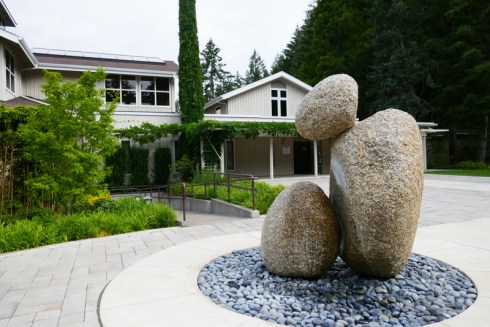
Our Lady of Guadalupe Trappist Abbey’s peaceful courtyard.
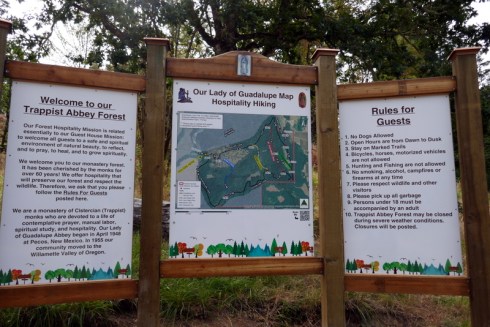
Signage and map with history and rules. Put your cellphone on airplane mode.
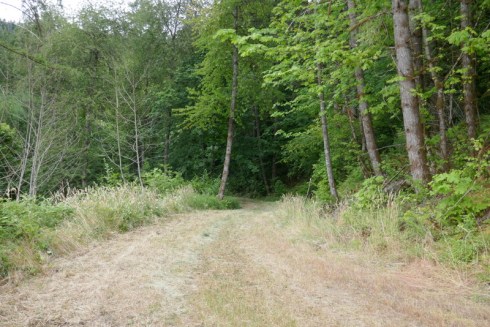
The trail varies from wide “highways” to narrow, rocky, packed clay.
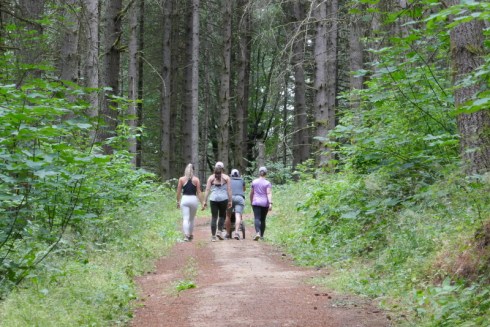
A family group was among the few people we saw. They pushed a stroller up 800 feet!
“The woods are lovely dark and deep…”
The view from the top is of Oregon vineyards.
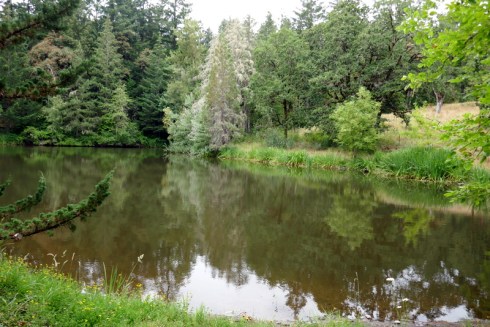
Reflection in the pond.
Still smiling after an 800-foot climb.
Some of you sharp-eyed readers will notice a new link in the navigation bar, Masks to Benefit Food Pantry. I am making lovely, effective masks and selling them as a fund-raiser. I like to sew and after outfitting family and friends and still having a vast supply of nice fabrics, I thought perhaps I could do some good by supporting our local food pantry while keeping myself occupied. LMK if you see anything you like and I’ll figure out shipping.
Like everything else in the Time of COVID-19, our spring and early summer travel plans were completely upended. The original plan was Bandon in May to see the Shore Acres gardens in gaudy display, then an early July hiking and wine tasting adventure with Rick & Jane. Poof! Blown to pieces!
What could we do knowing Europe was building walls to keep out COVID-laden Americans while visiting friends and relatives domestically is unwise? Airports seem a little scary right now so flying is out.
Escaping to a different part of the Oregon Coast seemed a reasonable choice: just the two of us, with plans to minimize the risks by managing our approach to the situations we might encounter. From Lincoln City, we traveled to Coos Bay and Bandon-by-the-Sea. Outdoor activities, keeping to ourselves, and eating something we did not have to cook ourselves were on the agenda.
A reminder that masks are required!
The Southern Oregon Coast has not been hit hard by the virus. While that is really good news, we worried that the Governor’s orders and CDC guidelines might be poo-pooed. Happily, we found most businesses and travelers following guidelines. Several businesses tried to put some fun into the restrictions through creative displays. Some accosted customers at the door with a stern admonition to wear a mask. That made us feel good about how committed they were to protecting their employees as well as guests
High praise is due to Bandon Coffee Company and Edgewaters Restaurant in Bandon, The Pancake Mill in Coos Bay, Bridgewaters and the Coffee Roastery in Florence, and the Red Fish in Port Orford for showing they cared about both staff and customers by enforcing the guidelines. We made reservations where feasible and given limited seating we were happy we did! We ate a number of outdoor lunches and most places had doors or windows open so fresh air could break up those COVID-carrying droplets.
I don’t think I ever heard anyone cough or sneeze in our vicinity. (Except for me and my allergy-caused sneezes could raise the dead! I sneezed only when we were alone in our room or on a trail.)
I could watch sandpipers on the beach for hours.
A few places made us uncomfortable and we had to “walk” a couple of times. In a mom-owned diner with a high rating for breakfast, I was told by the owner/waitress that she could not wear a mask for medical reasons. That is outside of our comfort zone, so we moved on to our number two choice. At a busy brewpub/pizzeria there was strong signage for customers to mask up but three employees (cashier, pizza cook, and a kitchen worker) were maskless. Again, not to our standards so we moved on and this night we had a little trouble finding a place to eat as the town is small with limited options. Lesson learned: do not go out to dine without a second choice.
One restaurant added, “sorry for the inconvenience” to the sign on the door requiring masks, to me an indication they were not in compliance willingly. However, at the same place, which is in Brookings, Oregon, the hostess admonished people entering without masks that they were not able to enter unless they donned said protection. Some were aghast they had to wear a mask to cross the dining room. Good for her for being insistent!
Some servers we saw had mask-slippage problems leaving their noses hanging out. I wish I had traveled with a few of my homemade, secure-fitting masks to give out. I think I’ll pack some along on future outings.
Lodging services are, of course, minimal. I normally enjoy a few nights reprieve from bed-making but not so this trip. We made our own bed every morning and exchanged trash and towels at the door a couple of times.
Ric and friend on the riverfront in Florence.
There is beautiful scenery on the Southern Oregon Coast. South of Florence, we found far less traffic and far fewer tourists than we get on the Central Coast. There were longer hikes and shorter walks but we encountered almost no one. When we did encounter others, everyone was polite, stepped off the trail, and tried to be as far away as possible in passing. One little boy of about six had been well-schooled by his parents. As their party of four and the two of us each squeezed right on a boardwalk to give what distance we could, he loudly exclaimed “I don’t have to wear a mask because I’m a kid.” (For the record, we did not wear masks when hiking!)
All-in-all it was terrific to be somewhere different. After months of relative seclusion and hiding from our fellow human beings, different was good! We still avoided people, enjoyed the outdoors in very good weather, indulged in many good meals, and remembered why we don’t like long driving trips. Give me a train any day!
Here are a few photo highlights of the area. There is amazing food to be had, too: fresh as can be seasonal seafood from Oregon waters. Click on any image for a slideshow.
From the “washed Ashore” project, made entirely of trash found in the ocean.
Does this plant make me look small?
A Florence shop takes a whimsical approach to remind us to mask up.
Shore Acres State Park: the garden still beautiful although past the peak of spring blooms.
Boardwalk through the South Slough, Coos Bay. The rest of the hike was a bit more rugged.
Sea lions on an island near Cape Arago.
Another “Washed Ashore” project.
Bandon Islands State Park preserves the offshore rocks as sanctuary for birds.
This picture has a lot going on. The famous Face Rock upper left, Cat and Kittens Rocks on the right, and a “Circles in the Sand” seasonal maze in the foreground. We passed on walking the maze as it was a bit too crowded. The maze washes away with the tide but another is drawn in the morning.
Seaside meadow near Brookings. We don’t see a lot of grasslands along our rocky shores.
EDITORS NOTE: Both books were updated in 2025. Here is the link to the current edition, US site: Walking in Italy’s Val Gardena. If you are purchasing from another market (UK, DE, etc.) please go to your country’s page and be sure to look for the 2023 edition.
It has been a very busy month. Having just released our book Walking in Switzerland’s Berner Oberland on January 26, we’ve updated our book of easy hikes in Italy’s Dolomites. Walking in Italy’s Val Gardena is now available in its third — and best — edition. Just released on Amazon overnight last night, the big improvement in this edition is that it includes maps for every one of the 23 easy hikes described in the book.
We first published “Walking,” or as I like to call it “WIVG,” in early 2017. Each year we’ve made it stronger, but I am really delighted that we found a tool to help us create maps. Each hike has a printed map and a link to an online map with an elevation profile. The viewer can customize their experience by selecting the type of map (Street, Satellite, Cycling and more), zoom in to see more details, and also personalize a timer based on individual walking speed. Maps can be downloaded in eight different formats.
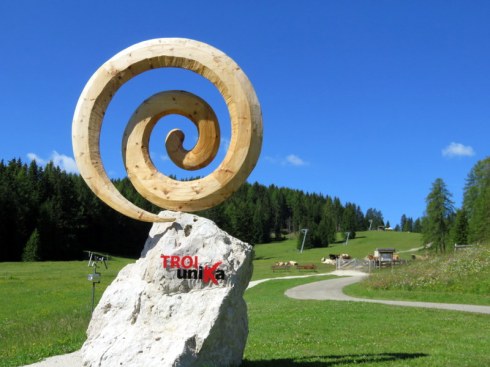
For fun, here’s one route, a very easy but delightful art walk on a small mountain called Monte Pana where views over the valley from almost 7200 feet are accompanied by an art installation. Take a look and discover the Troi Unika. (NOTE: As of 2025, we no longer recommend this walk as the trail was poorly maintained when we walked it.)
The emblem a the start of the Troi Unika, a very easy walk.
WIVG is available in paperback as well as Kindle, and if you are a Kindle Unlimited subscriber, you can read it for free. Our books are also available in Amazon Marketplaces worldwide such as Italy, the UK, Japan, and India.
EDITORS NOTE: This book was updated in 2023. Here is the link to the current edition, US site: Walking in Switzerland’s Berner Oberland. If you are purchasing from another market (UK, DE, etc.) please go to your country’s page and be sure to look for the 2023 edition.
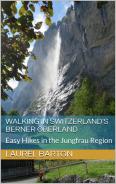
We are delighted to announce our new e-book is live on Amazon! Walking in Switzerland’s Berner Oberland: Easy HIkes in the Jungfrau Region is designed for anyone who likes to walk, likes to be in nature, but may not have the stamina for longer, more strenuous hikes. Like our book on Italy’s Val Gardena, we’ve included hikes for children, seniors, or anyone who wants to enjoy the mountains but not climb them.
There are 13 walks, perhaps best described as light hiking. They range from 1.4 to 4.4 miles and all are under 2 hours. Some can be linked together for those desiring more activity. We also advise on transportation, which the Swiss make amazingly easy. A car is an unnecessary expense and hassle especially in this region of Switzerland.
While the Swiss offer a mind-numbing assortment of transportation passes, we explain the differences and how to determine which passes you may need.
For a taste of the book, you might enjoy our blog post from Project Easy Hiker, the Lauterbrunnen to Mürren hike from 2017. It is our #1 recommended hike for those who only have a couple of days to spend here.
We welcome your input. If you use the book and have comments, please send them to us using ProjectEasyHIker@gmail.com. If you have favorite hikes in that area that we should explore, please leave a comment here or send a note to the email address.
If you have not been to the area, think about this view and ask yourself why you haven’t gone there yet?
NOTE: In January 2025, “Walking in Italy’s Val Gardena” was published in its 6th edition and the link to Amazon was updated.
As the clouds, rain, fog, and cold temperatures descend on the Oregon Coast, I am thinking about a wonderful hike we took in September and looking forward to a repeat next September.
We pushed ourselves a bit in taking this hike as it is more ambitious than our usual fare. We reveled in our satisfaction at completing it and celebrated with a Radler over lunch. Rick Steves’ Italy guidebook sucked drew us to this hike but his directions and time estimates were terrible. (His 1H30M section was our 2H25M. We would have taken the hike anyway however an hour’s difference in the estimated time is disappointing.) I think it has been many years since anyone in the Steves’ organization took this route and updated directions.
So we did it.
Click here to buy on Amazon.com. Also available on all Amazon sites worldwide in Kindle or paperback versions.
I would include this in the next edition of our book (coming in early 2020!), but it is a little beyond the “easy hiker” scale so I offer it here, for anyone who might enjoy the option. We spent the nights before and after on the Alpe di Siusi, enjoying the luxury of half-pension at the Hotel Saltria. This hike can be done as a day trip from Ortisei, but it is a long day, at least 10 hours with transportation. We recommend a couple of nights on the Alpe di Siusi as part of a holiday in the area. Two or three nights on the Alpe di Siusi plus four or more nights in Ortisei is perfect.
Herewith, this magnificent hike as we would write it for the book. Start dreaming of an Italian hiking trip! If you are not into hiking or cannot imagine doing this, at least look at the pictures?
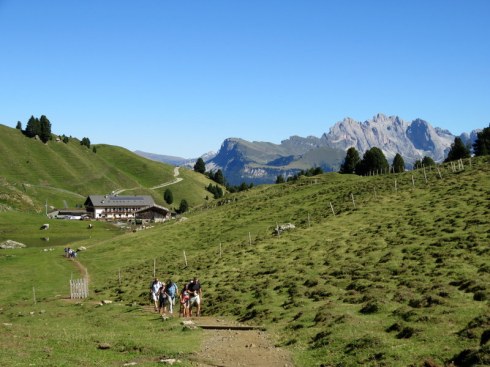
Panorama to Williamshütte: A grand view on the Alpe di Siusi
The route map with profile can be examined in detail and downloaded at Plotaroute. (We will be including maps for most walks in our next edition.)
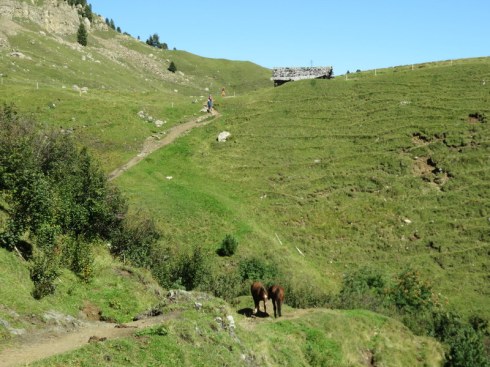
Featuring: Vast meadows, peak views near-and-far, cows, ponies, wildflowers, two dramatic chairlifts, and lovely rifugi where you can rest and refuel. The best time to take this hike is from mid-June to mid-October but be aware there can be snow in high elevations at any time which may compromise your ability to do this hike.
This hike is more strenuous than most of those in our book, Walking in Italy’s Val Gardena. In fact, we rated it a “4” on the Easy Hiker Scale* due to the varying terrain of the final two-thirds. While it starts and ends at about the same altitude, the ups-and-downs are considerable, and you will ascend 1253 feet/382 meters and descend 978 feet/298 meters.
How to arrive: Six times each day the bus #4 from Piazza Sant’Antonio goes directly to the base station of the Cabinovia Alpe di Siusi/Seiser Alm Bahn. This is your most efficient choice at 8:45, 10:00, 11:15, 14:50. 16:00, and 17:15. Note the cabinovia may not be running if you arrive on the last bus. Later in the day, use a combination of bus #172 to the bus plaza in Castelrotto and the #170 to Bivio Cabinovia (drops you a short way below the lift station and you walk up) or the combination of bus #172 and #2/3 which takes you right to the base station. Ask locally if you are confused. The bus drivers are fantastic and the route is included with the Val Gardena Mobile Card provided by your lodging host.
(NB: Bus numbers, routes, and schedules tend to be adjusted seasonally so verify times before setting out on your adventure!)
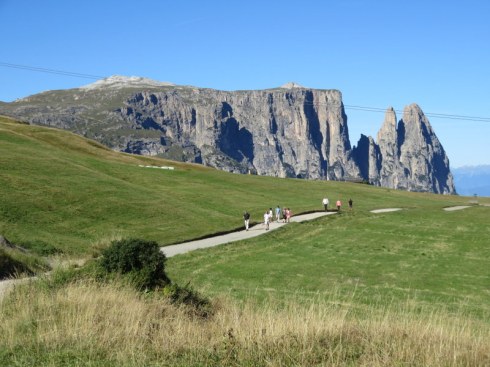
The path is wide and level as it leaves Panorama with the Sciliar and Punto Santner in view.
FYI, driving to the Alpe di Siusi is possible only before 9:00 and after 17:00 unless you have a hotel reservation and a permit for your vehicle. If you have a permit from your hotel, you can drive in at any time on your arrival day and out on your departure day, but during your stay you may only use your car before 10:00 and after 17:00. The buses are excellent, though, and parking is limited so go with the flow and take the #11 shuttle! Once at the base station (where there is lots of parking if needed), take the blue gondolas up to Compatsch where the hike begins with another lift, to Panorama. The Cabinovia Alpe di Siusi starts running at 8:00 from late May to early November. Note there are seasonal closures before-and-after ski season commences. Last ride down is 19:00! (Check locally to make sure that has not changed.)
Make your way to the base station for the Panorama lift (opens at 8:30), about a 5 minute walk down from Compatsch. At the top of the lift, pass the Alpenhotel Panorama and look for Trail #2, the start of this journey.
Mountains on the other side of the Val Gardena are visible from the trail near Edelweiss Hütte.
The route
Trail #2 joins Trail #7 in short order. Turn right and follow Trail #7 with magnificent views of the Sciliar and Punto Santner to the west. Trail #7 is a road, more up than down, but it is not steep and undulates pleasantly on your way to Rifugio Molignon, aka Mahlknecht Hütte. There’s plenty of room to walk abreast and footing is easy. We rate the section from Panorama to Molignon a “2” on the Easy Hiker Scale.*
Coming into Molignon, a perfect stop for strudel.
Moligon is a delightful place to stop although you may choose instead Edelweiss Hütte or Almrosenhütte as you pass them. Molignon is about 1H20M (depending on how often you stop to take pictures) from the Alpenhotel Panorama at the top of the lift. We usually arrive about 10:30 and use Molignon as a coffee/strudel/bathroom stop. Marvel that real ceramic dishes, stainless tableware, and actual glasses are used to serve housemade food, hot, fresh, tasty. Have a late morning beer like many of the locals do. Cyclists also stop here also and will head off on 8A as they are prohibited on the next section of Trail #7, but you’ll see many of them again at Dialer and some go all the way to Zallinger so you will share the path on occasion.
Leaving Molignon, which is a working farm as well as rifugio.
After Molignon the path becomes a true trail.
From Molignon, pass through the gate and walk past the pond, horse corral, and pasture with a herd of cows. Now the trail becomes more of a hike. You will pass over a couple of small streams, one with a bridge and one with stepping stones. Expect some dampness and mud if it has rained recently. Climbing fairly steadily, you will briefly rejoin the road (with cyclists) and reach Dialer, the highest point on the route. The chapel of Dialer Kirchl sits picturesquely against the backdrop of the Sciliar-Catinaccio.
The little church at Dialer.
Take a moment to savor the setting and maybe visit the chapel, then continue on Trail #7, following signs to Zallinger. The trail goes in and out of forests and the pavement varies. There are full-on views of the Sassopiatto’s flat face and occasionally a glimpse of Saltria far below. There is another tiny stream to cross. At one point, it appears you might need to hike up a steep gravel road but look for the sign on your left indicating #7 to Zallinger and follow it slightly down, then undulating, and at one point falling to a creek (with bridge). Finally, pass a farm and hike steadily up to the beckoning rifugio.
One of the bridges crossing a creek.
]
Zallinger comes into view!
And what a refuge it is after this long hike! It is only 10-15 minutes to Williamshütte and the Florian chairlift down to Saltria but Zallinger offers some of the best views possible from their terrace and the food is praise-worthy, ranging from gourmet salads (try the fitness salad with turkey) to Weiner-Schnitzel or the local canaderli. Of course, there’s beer and where there is beer, a Radler is possible as well.
The Sassopiatto looks a lot different from this angle.
Refueled and rested, make your way up up up to Williamshütte (15 minutes) and the dramatic chairlift down to Saltria. From Saltria, the #11 shuttle runs roughly every half-hour to Compatsch. The last bus is at 18:55 from mid-June until mid-September, then for the next month the last bus is at 17:35. Check locally to make certain you know when the last bus departs as well as being informed about the last gondola down from Compatsch!
* Easy Hiker Scale
Promenade – Paved or partly paved and mostly level; well-signed and generally suitable for baby carriages
Easy hike – Unpaved, crossing hills or mountain terrain, some ups and downs, or may have minimal signage
Extra Energy – More exertion required due to length or extended uphill segments; may have loose gravel or moderately tricky footing
Moderately Strenuous – Longer, more challenging terrain requiring sturdy footwear and endurance. Not suitable for very young children.
Logistics
Start:
Mountain station of the Panorama chairlift at Alpenhotel Panorama, Alpe di SIusi
End:
Williamshütte, mountain station for the Florian chairlift to Saltria
Duration:
3H 45M
Difficulty:
4*
Distance:
10.1KM, 6.3 miles
Type of Hike:
One-way with return by bus
Trail #s:
2, 7
Transportation:
Bus #4 or combination of #172 and #170 from Ortisei to Cabinovia Alpe di Siusi, then 3 lifts: the Cabinovia AdS, Panorama, and Florian. Return to Compatsch by #11 Saltria Shuttle. See links to schedules below.
Refreshments:
Compatsch restaurants, Hotel Panorama, Edelweiss Hütte or Almrosenhütte, Rifugio Molignon, Zallinger, Williamshütte
WCs:
Compatsch restaurants, Hotel Panorama, Edelweiss Hütte or Almrosenhütte, Rifugio Molignon, Zallinger, Williamshütte